HPLinks #72.
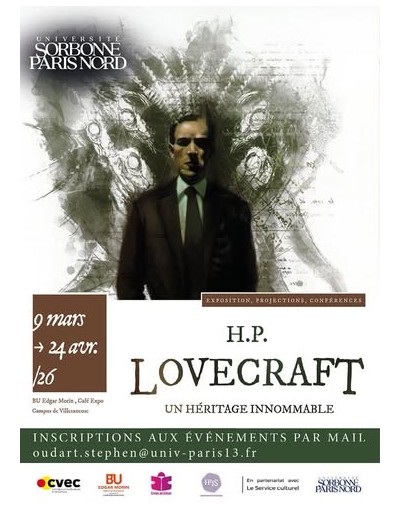
* H.P. Lovecraft is to be celebrated at the Sorbonne university in France, in March and April 2026. A large programme with a conference, interviews with translators, film screenings, and an exhibition at the Edgar Morin University Library. Also a related… “day in Boulogne with Lovecraft board games and role-playing”.
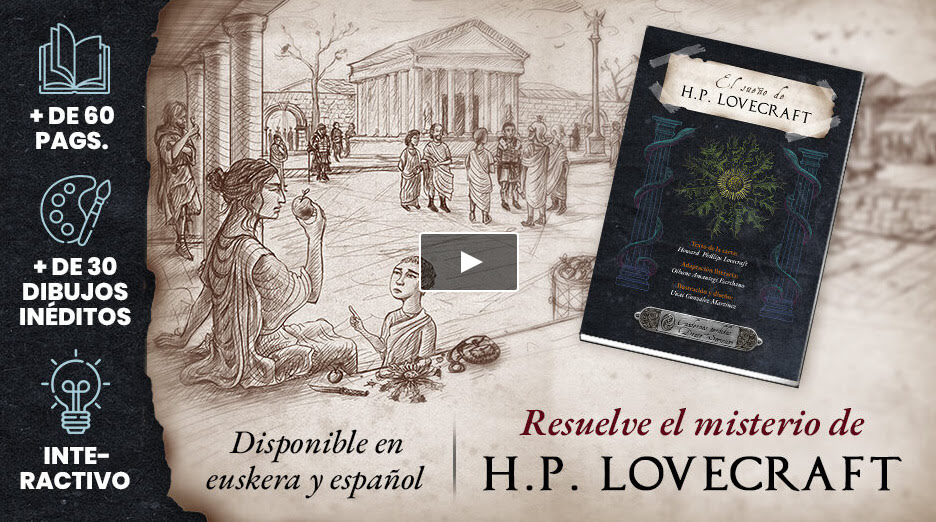
* The open-access journal Brumal (2025, Vol. 13) has the Spanish article ‘Cosmic horror and the fantastic narratives of H.P. Lovecraft in videogame mechanics’ (my translation). Also in Spanish, a book review of Across the Abyss: H.P. Lovecraft and Ontological Horror (my translation).
* Deep Cuts considers the memoir Memories of Lovecraft (1969) by Sonia H. Davis & Helen V. Sully.
* S.T. Joshi’s latest blog post brings news of the new monograph Transmigrations: Lovecraft, Barlow, Burroughs (2026). Available now as a budget-priced Kindle ebook or paperback. This…
slender but substantial monograph is one of the most penetrating studies of R.H. Barlow ever written, examining not only his weird fiction but also his anthropological work in Mexico to paint a much fuller portrait of Barlow than has been available elsewhere. Along the way, Deleage examines Barlow’s relations with both his mentor, H.P. Lovecraft, as well as William S. Burroughs, who briefly studied with him in Mexico.
* Death At The Flea Circus is writing a series of Fungi From Yuggoth -inspired sonnets… “S.T. Joshi has accepted my sonnet “Immortal Bird” for number 24 of Spectral Realms magazine.” Spectral Realms No. 24 appears to be shipping now.
* A new Robert E. Howard Foundation Newsletter, for members. Including the typescript of the letter “To H.P. Lovecraft, ca. August 1930”.
* SpraguedeCampFan has posted “Fred Blosser on Robert E. Howard: Additional Books”. This is part three of the post series, and we reach the the more interesting books (from a Lovecraftian perspective). A Guide to REH’s Lovecraftian fiction, which includes the appendix “Horrors from the Deep: Howard’s Stories of Haunted Seaports”. Plus the Annotated Guide to Robert E. Howard’s Weird Fantasy.
* ICV2 report that a mammoth R.E. Howard Art Chronology book-set is planned for 2026…
Troll Lord Games revealed a four volume Robert E. Howard Art Chronology set […] 1,600 pages and 7,000 images chronicling Robert E. Howard’s publication history in the U.S. The book tells the narratives of the artists who adapted Howard’s characters …
* Talking of artwork, I hear that major comics publisher Titan has a new magazine, titled The Savage Sword of Conan: Reforged. It take the best tales from Marvel’s original Savage Sword of Conan b&w magazine and adds careful hand-painted colour. It’s appears that it’s not to be compared to the sort of hideous day-glo colouring we’ve seen in the past, on comics such as Moebius b&w classics. Two issues so far, and another due in February.
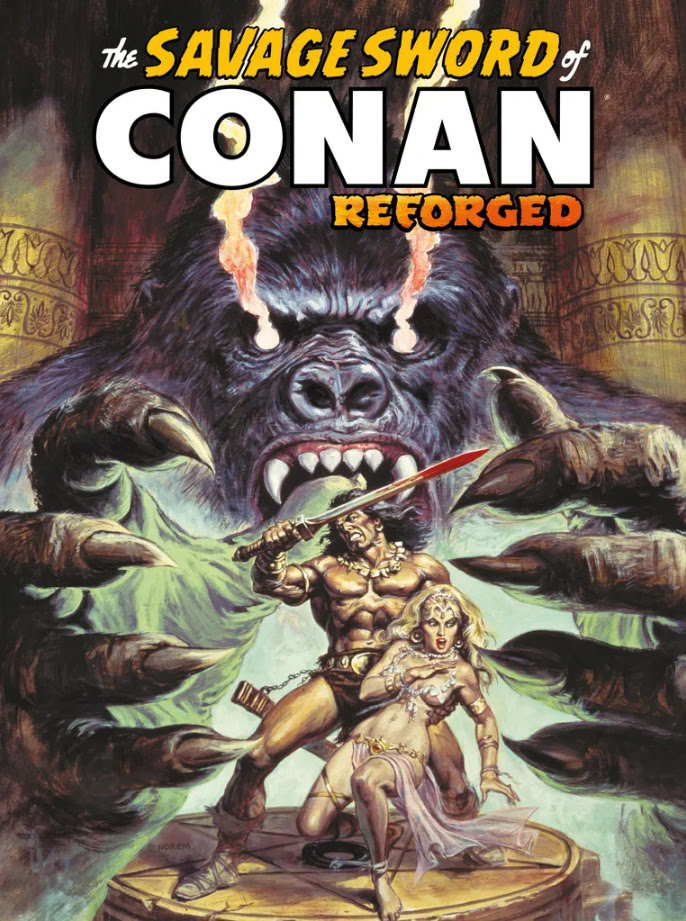
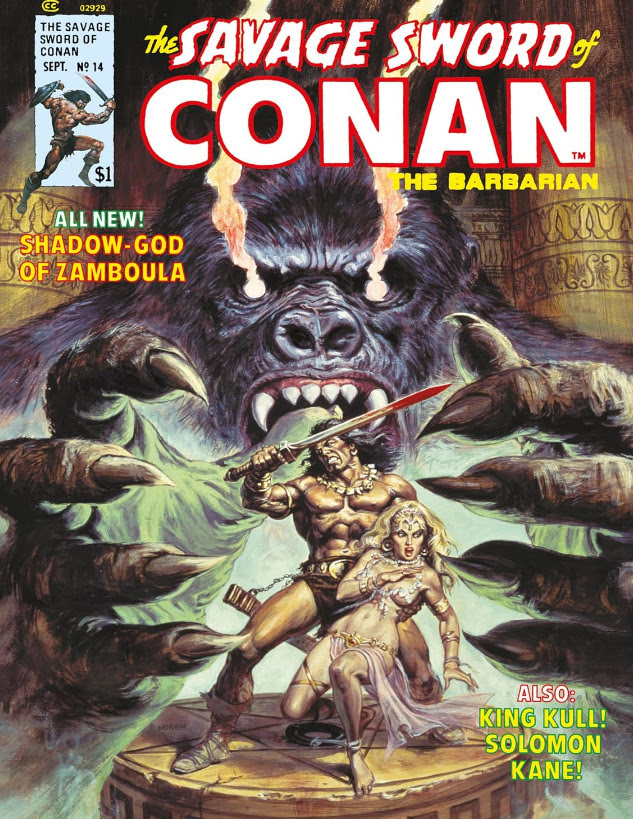
I also see that Titan are re-issuing the original The Savage Sword of Conan magazines as budget-priced Kindle editions. They seem to be on a release schedule of about one a week. #14 arrives next week. The lead tale has art by Neal Adams. ‘Nuff said. …
Titan also have a new reprint and ebook of the Shadows Over Innsmouth (1994) Lovecraftian anthology. Good to see that Neil Gaiman hasn’t been excluded from the contents-list. The reprint is set for March 2026.
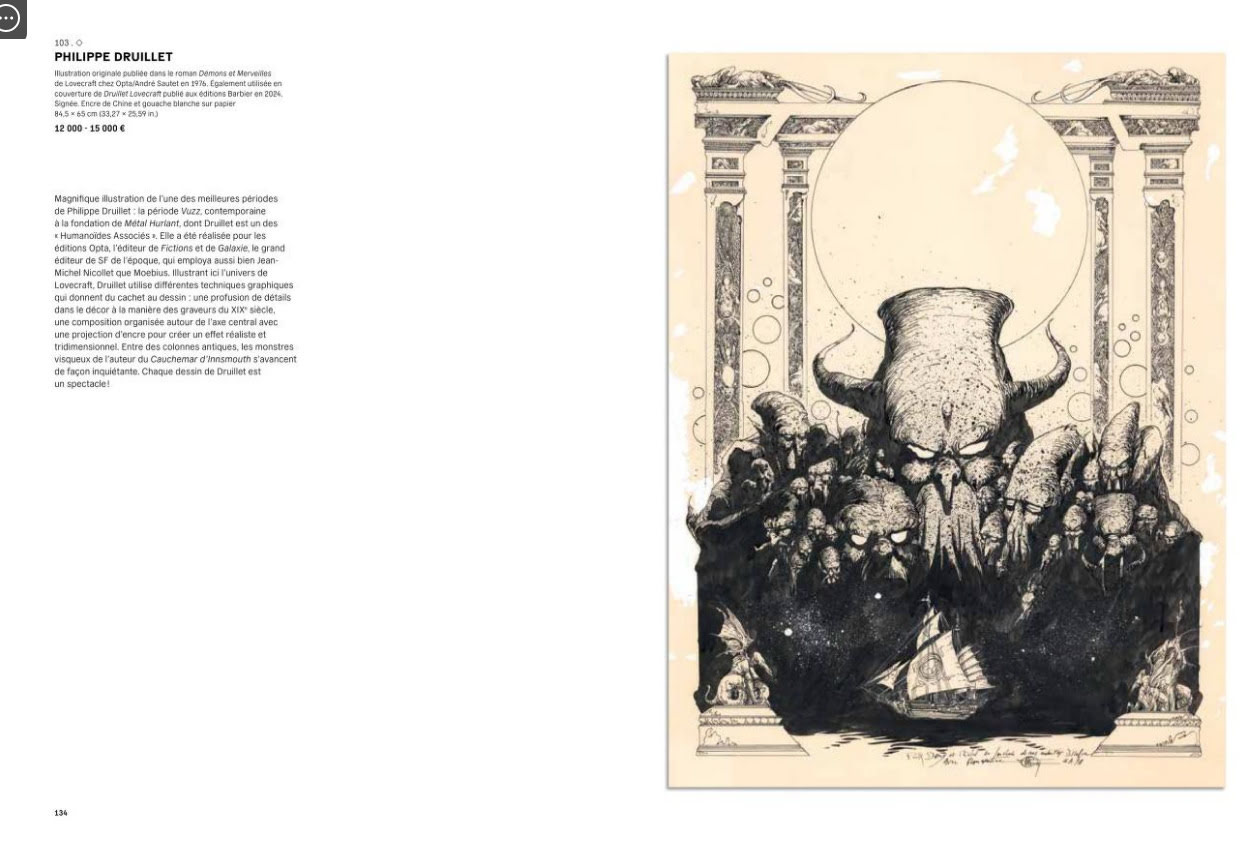
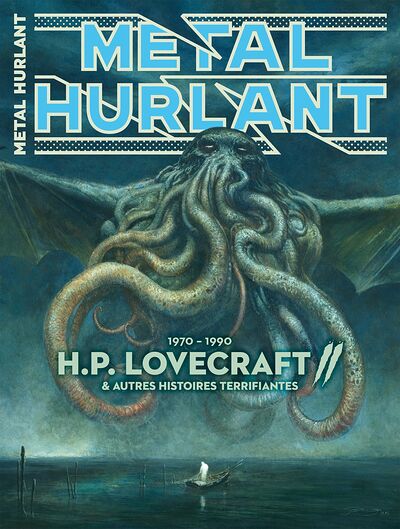
* Metal Hurlant (Heavy Metal) No. 18 (new series), April 2026, will be another Lovecraft special.
In this issue, echoing the Lovecraft Special of 1978, you will find the nectar of Lovecraftian comics from the 1970s to the 1990s. Whether among the Americans or the Franco-Belgians, H.P. Lovecraft had a deep and sprawling impact on the creativity of fantasy authors, and Metal has selected for you the best. So dive with us into the universe of the Master of Providence alongside the legendary Moebius, Bilal, Caza, Claveloux, Chaland and all the others!
* From the world of Lovecraft theatre, the board-treaders of the Miskatonic Theatre write from Hamburg, Germany…
After the ‘world’s only horror theater’ was set on fire by unknown perpetrators in March 2025 and burned to the ground, the Miskatonic Theatre endured a turbulent season in exile at Sprechwerk and Haus73 on the north side of the Elbe. [But] it will now reopen its doors in Hamburg in autumn 2026, which with your support will be bigger and better.
* In Spanish, Hijos de Cthulhu blog usefully discovers a ‘Lovecraft as character’ tale tucked away in the English-language anthology War of The Worlds: Global Dispatches (1996, 2021). The book has stories of the Martian invasion encountered elsewhere in the world, as told by historical “celebrity eyewitnesses”. Don Webb’s “To Mars and Providence” tale was set in Providence, and he had the young telescope-peering Lovecraft encountering Martians. Wikipedia still keeps a copy of an old page for the story which summarised the plot, and which the WikiPolice later deleted from the main Wikipedia.
* Talking of anthologies, Dark Worlds Quarterly this week surveys Horror Anthologies of the 1920s…
We tend to take Horror anthologies for granted. […] Back in 1920, not so much. There were ghost story collections [and] 1913’s Ghosts & Goblins from the UK is a Pulp before Pulp collections. Pearson’s, the British publisher, did Uncanny Stories in 1916. […] The stage was set but what was missing was the Pulps.
* And finally, the Ghosts and Goblins (see the mention above) caused me a bit of trouble in its tracking down, but Heritage Auctions saved the day. Published by The World’s Work in London (not ‘The Lord’s Work’, as HA amusingly has it), and the book appears to have been a shilling-shocker issued and promoted by the sensationalist tabloid newspaper The News of the World. Not online.
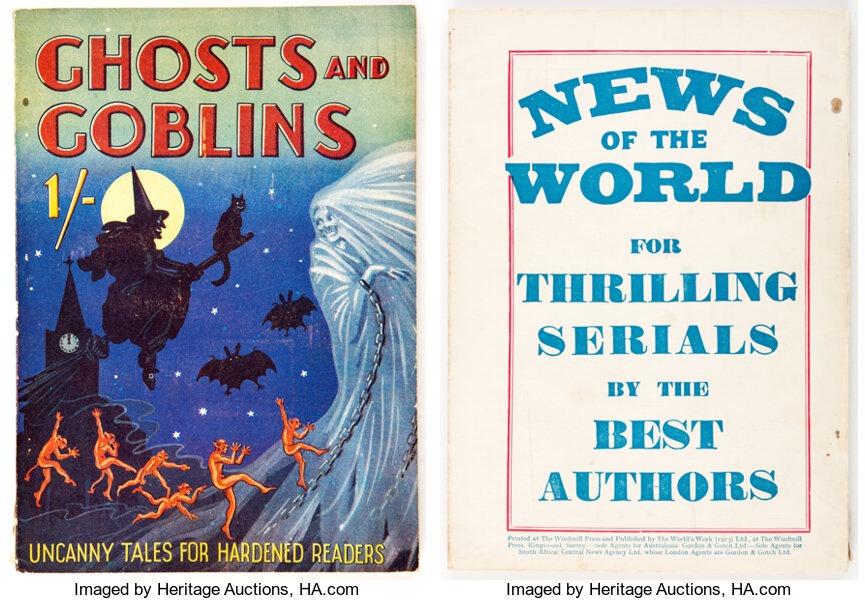
Update: Not published in 1913. HA have the date wrong.
— End-quotes —
“Miss Fidlar’s remark that war horrors have exhausted the capacity of the world for receiving new horrors may be answered [by saying that] The physical horrors of war, no matter how extreme and unprecedented, hardly have a bearing on the entirely different realm of supernatural terror. Ghosts are still ghosts — the mind can get more thrills from unrealities than from realities.” — H.P. Lovecraft, “In Defence of Dagon”, 1921.
“To my mind, the sense of the unknown is an authentic & virtually permanent — even though seldom dominant — part of human personality; an element too basic to be destroyed by the modern world’s knowledge that the supernatural does not exist. It is true that we no longer credit the existence of discarnate intelligence & super-physical forces around us, & that consequently the traditional ‘gothick tale’ of spectres and vampires has lost a large part of its power to move our emotions. But in spite of this disillusion there remain two factors largely unaffected — & in one case actually increased — by the change: first, a sense of impatient rebellion against the rigid & ineluctable tyranny of time, space, & natural law — a sense which drives our imaginations to devise all sorts of plausible hypothetical defeats of that tyranny — & second, a burning curiosity concerning the vast reaches of unplumbed and unplumbable cosmic space which press down tantalizingly on all sides of our pitifully tiny sphere of the known.” — Lovecraft to Harold S. Farnese, April 1932.
“the literature of mere physical fear and the mundanely gruesome […] has its place, as has the conventional or even whimsical or humorous ghost story where formalism or the author’s knowing wink removes the true sense of the morbidly unnatural; but these things are not the literature of cosmic fear in its purest sense. The true weird tale has something more than secret murder, bloody bones, or a sheeted form clanking chains according to rule. A certain atmosphere of breathless and unexplainable dread of outer, unknown forces must be present; and there must be a hint, expressed with a seriousness and portentousness becoming its subject, of that most terrible conception of the human brain — a malign and particular suspension or defeat of those fixed laws of Nature which are our only safeguard against the assaults of chaos and the daemons of unplumbed space.” — Lovecraft, “Supernatural Horror in Literature”.