Protected: Big Panthers
24 Tuesday Aug 2021
Posted in Kittee Tuesday, Lovecraftian arts
≈ Enter your password to view comments.

24 Tuesday Aug 2021
Posted in Kittee Tuesday, Lovecraftian arts
≈ Enter your password to view comments.
17 Tuesday Aug 2021
Posted in Kittee Tuesday, Podcasts etc.
You know you’re in the mid-August silly season for news… when you find a new podcast dedicated to H.P. Lovecraft’s kitten drawings.

If you understand the spoken Italian in this podcast then the rest of the Librinpillole YouTube channel appears to be worth a look, and seems to be a relatively Kitten Free Zone. Lovecraft, Bloch, Poe, Smith and others.
15 Tuesday Jun 2021
Posted in Kittee Tuesday, Lovecraftian arts
Another few picks from the new or recent Lovecraft art.
The Music of Erich Zann by Rabbitstein.

Howard Lovecraft-Process by Red-Rus. And the final finished version.

H.P. Lovecraft, Prophet of the Great Old Ones by Airen90. Adapted from one of the several ‘stage magician’ movies, I’m guessing.

Lovecraft by YlarchC. Imagining Cage playing Lovecraft himself, in a TV movie.

Cthulhu Rises by Silberius. (Lovecraft and Sonia in New York City, 1925 at the genesis of “Cthulhu”).
The Cats of Ulthar (BW) by UnworthyReturn.
Alhazred Encounter 10: The Temple of Ong by Tillinghast23. There’s a large series of these, depicting the many quests of Alhazred. Also a similar Fungi from Yuggoth set from a few years ago, and an Ashton Smith set.

Egypt 04 by Blik1976.

Abdul Alhazred by Mgenccinar.

Also noticed was Solomon Kane in the Ruins by ArtofReza.
18 Tuesday May 2021
Posted in Kittee Tuesday, Scholarly works
S. T. Joshi’s Blog has updated. Lovecraft’s letters to Long are finally safely in the scanning-vaults at Brown University, and Joshi tentatively places a 2024 date on the paperback.
He also notes several foreign language publications, including Lovecraft, l’Arabe, l’horreur, a French book of 90 pages. In this a historian considers “The Orient and Islam and the Gentleman of Providence”. According to the blurb this finds that Lovecraft… “is neither hostile to Islam nor contemptuous of Arab-Muslim culture.”
Also a slimmer booklet of just 58-pages from the same publisher, Lovecraft: sous le signe du chat. On looking into this I learn that the author apparently muses on the notion that… “cats are at the centre of Lovecraft’s life, philosophy and literary work”. And indeed that Lovecraft himself could be understood as becoming ever more cat-like during his life. H.P. Lovecat, indeed.
Both together might make for a viable double-bill English translation in one volume?
04 Tuesday May 2021
Posted in Kittee Tuesday, Lovecraftian arts
A few more DeviantArt picks of recent Lovecraft creativity…
Call of Cthulhu by moe7seven. In the Mignola style.


when the stars were ready by breath-art and the evils arise by breath-art on DeviantArt.


117340644 1698901060278971 411004522147484521 N by TecComics, or “The Boy Lovecraft”.

HPL by GoMiyazaki on DeviantArt or, as it might be re-titled, “Waiting for the Kitties”.
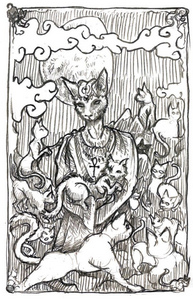
The Cats of Ulthar by ghostexist, with a sort of Bert Akeley feel about it, such that it might not have looked out of place on the wall of a Vermont farmhouse in 1928.

Ancient Egypt IV by AranniHK with cat just visible. Part of a series.


And a bit of book-cover art from France in 2017, which I had not seen before. Appears to have been a 500-page slab collecting the key stories in French translation?

13 Tuesday Apr 2021
Posted in Historical context, Kittee Tuesday, New discoveries
In Letters to Family Lovecraft gives an actual address for an Italian cafe he frequented with Kirk during the Clinton St. period. The cafe offered not only delicious spaghetti and cheese and a very friendly Italian owner, but also long-time lap-service by two delightful ‘tiger’ kittens.
Greenwich Village, where at #17 (not #10!) Downing St we found the little returned tiger-kitty, who sat in Grandpa’s lap just as serenely as one of those Tilden and Thurber kitties during the entire meal of native Italian spaghetti — for which Kirk insisted on paying” (May 1925)
These kittens were an attraction mentioned on several visits, and it appears to have been a regular haunt. “Tilden and Thurber” is the Providence based Tilden-Thurber Co, Inc., at that time having “miniature kitties” as part of their range of kitsch giftware. Lovecraft’s aunt enquired if Kirk might like one.

Kirk & I take a perennial delight in two small tiger kittens in an Italian restaurant in Greenwich Village. They know us, & we each have one which we habitually hold. Kirk calls his Lucrezia Borgia [the infamous poisoner], & I call mine Giambattista Tintoretto [old name for the famous Baroque painter].
Loveman and Kleiner sometimes joined them there. Occasionally Lovecraft and Loveman dined there without Kirk, at a later point when there was a Loveman-Kirk feud. He states that “the Downing Street joint is weak” on the coffee, which was a drawback.
In September Kirk adopted one of the cafe’s kitties, to be delivered October, and we thus learn more of the place from Lovecraft…
… he is an orphaned waif, who strayed into Kirk’s favourite Downing Street restaurant just at the time when the old lady cat was nursing her own tiger brood. Madam Tabitha, in generous mood, added the forlorn mite to her household without the least hesitation … these Downing St. Italians cherish their felidae with an almost Egyptian tenderness which warms the heart! No kitten has ever been killed in that restaurant, but with each new brood a canvas of patrons is made with a view to providing homes. … the homes [have] been always forthcoming …
Kirk’s Diary shows he could not wait and Lovecraft’s letters reveal that he instead tried to adopt a purloined alley cat… “the darlingest kitten vot I’ve adopted … white mostly with a black tail” (Kirk), and he jokes about starting a cattery. This new alley-adoption quickly ran away. Kirk seems to have been ill-fated with cats. A year later, the cat he finally settled on was run over and killed by a car.
Kirk’s Diary does not, so far as I can tell from a quick re-read, take an interest in describing or naming the cheaper New York eatieries or their cuisine, and all we get is an occasional “lunched with so-and-so”.
Lovecraft calls the place an “Italian-ordinary”, presumably meaning it was a cheaper and more everyday Italian restaurant than several others he would visit with Sonia such as the Taormina. His regular everyday cafe near his room in Brooklyn he calls “The Tiffany” or “Tiffany Cafeteria” and it was evidently a place that young hoodlums and hardened gangsters would also frequent. He also frequents “John’s” near Willoughby St. for Sunday meals, on which more tomorrow. And he often calls at the nearby Scotch Bakery on the corner of Court St and Schermerhorn. With the “gang” there are sometimes art-world coffee places to hang out in, such as the ‘Double R’.
17 Downing Street clearly means the Greenwich Village street rather than the street of the same name in Brooklyn (near Fulton St.), since this is a Kirk eatery. A little later in his letters Lovecraft talks about exploring the slums section between “the 4th Avenue and Downing Street”, which would make sense for a night-time tour of Greenwich Village. At this time Kirk had a new shop at No. 97 Fourth Avenue (page 288) and “the 4th Avenue and Downing Street” area thus becomes a prime target of more explorations into Greenwich’s ancient alleyways and hoary courtyards with “the gang”.
As one can see here, Downing Street was not as salubrious as today…

No. 17 is the dark shopfront three doors along. The gigantic Locatelli ‘Italian cheese’ sign seen here would likely have existed in the mid 1920s and would have naturally attracted the attention of wanderers in the small hours. Especially Lovecraft, who adored his cheese.
[I] Like Italian cooking very much — especially spaghetti with meat and tomato sauce, utterly engulfed in a snowbank of grated Parmesan cheese.
Here we move a little closer. There appears to be a two-part junk shop adjoining No. 17, part storage garage / old clothes-rack and part a smaller and more secure junk shop with a show-window.


Here 17 is more central…

But there’s a problem… another photo from 1940s.nyc lets us read the shopfront lettering. No. 17 is labelled as “Cabinet Maker” in the front window, and of course that’s a natural adjunct to a junk shop. We can even see what appears to be new-made chairs stacked near the window.

My feeling is then the next door section is actually the cafe in the picture, which makes the cafe No. 19-21. It looks like one, though there is no sign visible.

What of his exclamation “(not #10!)”? Evidently he intends his aunt to visit without him, and is giving her the address and recommendation without actually needing to state he is doing so. She is quite familiar with Greenwich Village and capable of visiting it herself. One possible explanation might be that the cafe was indeed once small and cheap and located at #17, but some 15 years later (seen above) had found success and moved next door to larger premises.
But it is far more likely that there was a simple transcription error in the Lovecraft letter. “17” was actually written as “19”, in which case his comment “(not #10!)” suddenly makes a lot more sense. His “9” might look like “0”, and there was and is no “10” in the street. This actually seems the most likely explanation to me, at least without a palaeographic scrutiny of the original letter.
A 1925 Italian trade directory of New York has… “Prota, A. & Co., 19 Downing St., New York”, and another directory adds “importer of foodstuffs” as the trade and elsewhere distinguishes Brooklyn addresses with “Brooklyn”. Hence this is not the Brooklyn Downing St. Also in 1925, a “Fratelli Prota” is granted a patent for peeled canned tomatoes, on behalf of “Prota, Angelina & Co., doing business as Fratelli Prota”. Thus the Downing Street eatery is likely to have been “Fratelli’s” and owned by the Prota family.
Today the street is very gentrified, and as we see here No. 17 has a stylish new brick frontage (presumably unappealing to graffiti vandals and inimical to drug-dealer stickers). But No. 19 was, until recently, a discreet wine-bar… and it may still be so. It’s the red door. Nice to think that you might still eat in New York City where Lovecraft and his circle once ate.

30 Tuesday Mar 2021
Posted in Kittee Tuesday, New books
A new blog post from S.T. Joshi. Among other items of note, two volumes of Clark Ashton Smith are now available in Brazil in translation.
Talking of South America, new on Archive.org under Creative Commons is Les Historietas: Un Survol De La BD Argentine, being a sumptuously illustrated fannish history of Argentine comics and their creators. There are several pages on Breccia and Lovecraft.

Trans: “The tale you have told is terrifying, Malinche…”
16 Tuesday Feb 2021
Posted in Astronomy, Historical context, Kittee Tuesday
In his boyhood article “Can the Moon Be Reached by Man” (October 1906) H.P. Lovecraft opens with the observation that…
In 1649 a Frenchman named Jean Baudoin published a book entitled: A Trip from the Earth to the Moon.
The footnotes in Collected Essays reveals that this was actually a translation of a book by the Englishman Francis Godwin (1562-1633). Though it does not seem likely the boy Lovecraft had yet read either Godwin or Baudoin, since I have found that he was likely borrowing his opening fact from Jules Verne’s From the Earth to the Moon. In Chapter II of this novel Verne has a French speaker addresses the Gun Club in Baltimore, reminding them of various great French ‘firsts’ in the field…
Permit me,” he continued, “to recount to you briefly how certain ardent spirits, starting on imaginary journeys, have penetrated the secrets of our satellite. In the seventeenth century a certain David Fabricius boasted of having seen with his own eyes the inhabitants of the moon. In 1649 a Frenchman, one Jean Baudoin, published a “Journey performed from the Earth to the Moon. At the same period Cyrano de Bergerac published that celebrated ‘Journeys in the Moon’ which met with such success in France.”.
We know that Verne’s From the Earth to the Moon was in Lovecraft’s library in book form. But the young Lovecraft was presumably unaware, in 1906, that Verne had conveniently omitted to inform readers that the work was a translation from the Englishman Francis Godwin (1562-1633, possibly the great uncle of the writer Jonathan Swift). Nor is the reader told that Bergerac, also lauded by Verne’s orator, had actually been parodying the English Godwin. Had Lovecraft known of the English author or the Swift connection in 1906, then he would surely have been mentioned these facts. In his Anglophile fervour he might even have upbraided Verne for his cheek. Not that it would have mattered much to most readers of the Pawtuxet Valley Gleaner, of course.
Godwin had been the Bishop of Hereford at the time he wrote the book circa the 1620s, the tale of a fantastical voyage to the Moon titled The Man in the Moone: or A Discourse of a Voyage Thither. Godwin’s tale was published posthumously in 1638, and tells off a voyage accomplished by the man being carried to the Moon by a flock of powerful one-footed swans (not geese, as one modern encyclopaedia wrongly has it). One might think that his sounds somewhat similar to the dream-leap to the Moon that Carter experiences in Lovecraft’s “Dream Quest”, …
Verily, it is to the moon’s dark side that they go to leap and gambol on the hills and converse with ancient shadows […] upon a signal, the cats all leaped gracefully with their friend packed securely in their midst
This method of flight is also broadly similar to Godwin, in its distributive aspect. Godwin has his hero invent a mechanical device that evenly distributes his weight among the especially powerful swans.
Thus it seems worth asking if Lovecraft happened upon Francis Godwin during his intensive New York research for Supernatural Literature? Or perhaps in his conversations with the members of his New York circle who we know where collecting and reading early science-fiction? If so, the discovery would be conveniently timed, re: the writing of “Dream Quest”. But the publication dates do not fit. The first modern edition of Godwin’s Moone was in 1937, just before Lovecraft’s death. He may have known of it, as it was not only known among cloistered academics but also covered by popular articles such as the one in Flying Magazine (dated February 1937, and likely appearing on the newstands earlier). There had also been a long review-article in 1931 (“Bishop Godwin’s Man in the Moone“, Review of English Studies), which may well have become known to his circle — but again this was far too late to have influenced “Dream Quest” and its visit to the Moon.
However, my feeling is that he would have been encountered references earlier via his study of his favourite poet Samuel Butler. For instance, the author of the Poetical Works of Samuel Butler footnotes an allusion in Hudibras as relating to… “Bishop Godwin … getting to the Moon upon ganzas or wild swans”. Lovecraft knew Samuel Butler well and had “ploughed through” even the toughest of his poems, and his Hudibras was a special favourite. Lovecraft owned the extensively footnoted 1864 edition of this large and allusive work. The 1864 edition’s annotator does not actually name “swans” in this case, but he refers to the Bishop and his ganzas (a fictional super-powerful breed of swan) on page 286…

There is also the more general theory, lightly held my many learned men until the 17th century, that many types of birds migrated to the Moon in winter. Again, this was the sort of early proto-scientific theory that Lovecraft would have been aware of. As for finding cats on the Moon, as in Dream-quest, the 12 year old Lovecraft already delighted in the idea of other nearby worlds populated by his beloved cats, and so this seems to have been his original idea, part whimsy and part science — the idea of creatures on Venus or Mars was then still a topic on which reputable scientists could speculate in the press.
26 Tuesday Jan 2021
Posted in Kittee Tuesday, Lovecraftian arts
Italian newspaper Il Giornale has a review of the new Lovecraft comics anthology, noticed here before Christmas.
The stories selected by Congedo and Montano all predate the Cthulhu Cycle. There are no cosmic gods screaming from the centre of the universe, no scary, sprawling creatures emerge from the bottom of bubbling abysses. “The Terrible Old Man”, “The Cats of Ulthar”, “The Outsider” and “The Hound” are by comparison (almost) stories of everyday life. And it is precisely this frightening simplicity that help keeps the reader gripped until the last panel. The comic’s colors are acid, the strokes are pulp. … “The Outsider” becomes a sort of literary confession that drops the reader into a labyrinthine abyss and makes him touch the ultimate meaning of feelings such as loneliness and isolation of the truly ‘different’ person. And it is here that Lovecraft literally comes face-to-face with one of the themes dearest to him: the devastating density of the feeling that one is completely ‘out of this world’.
A fine new front-cover is now available, which wasn’t to be had before.
08 Tuesday Dec 2020
Posted in Kittee Tuesday, Lovecraftian arts
A new collection of Lovecraft comics adaptations, in Italian. H.P. Lovecraft: I gatti di Ulthar e altri racconti (2020).


24 Tuesday Nov 2020
Posted in Historical context, Kittee Tuesday, New books, Scholarly works
I’m currently reading the recent Tolkien biography by Raymond Edwards, newly in Kindle ebook in 2020. At least one Amazon reviewer has spluttered at the book’s occasional informed speculation, such as the suggestion that Tolkien read Ker’s classic scholarly synthesis The Dark Ages. Yes, it was a key book of the time and a highly readable and yet erudite synthesis. Edwards doesn’t put a date on it, but I’d say Tolkien probably read it and circa summer 1912 is the most likely date. The Amazon reviewer is anyway tripped up by not consulting a footnote on the matter — which reveals that Tolkien did read it and by the early 1930s, when he “quoted extensively from it”.
But for me Edwards is very usefully conversant with the ins-and-outs and ways of Oxford University life and its nomenclature, and has a keen insight into the mindset of intelligent lads of that era. Some further observations and phrasing suggest he’s writing from a traditionalist Catholic perspective, but this is offered very lightly and not laid on with a trowel. Despite its readability and seemingly reliability this is not the biography to read first, and it needs to be filled-in with the use of the Chronology (lucky Tolkien scholars have a vast day-by-day / week-by-week Chronology of his life, assiduously compiled by Hammond and Scull). But the new biography generally presents a readable and insightful narrative.
Lovecraft occasionally makes an appearance, being Tolkien’s contemporary. Here is Edwards on cat-demons and Lovecraft, about a quarter of the way through his book and at the point when Tolkien has been invalided home to Birmingham (early November 1916) after a fierce and victorious battle in France, and then stays at Great Haywood in mid Staffordshire (early Dec – late Feb 1917)…
The style of the Tales [very early First World War works, collected in Lost Tales] is a deliberate mixture of archaizing prose in the best William Morris manner, with a faintly precious Edwardian ‘fairy’ or ‘elfin’ quality, all flittermice and flower-lanterns and diminutives (partly down to [the whimsical side of the Catholic poet, Tolkien’s favourite] Francis Thompson, partly we may guess to [Tolkien’s young wife] Edith’s fondness for such things), with a dash of whimsy (cat-demons, talking hounds) that may owe something to Lord Dunsany. At moments, the effect is most like not Morris or Dunsany but, oddly, the later Randolph Carter stories of H.P. Lovecraft, which are explicit dream-narratives. The [key work in Lovecraft’s Dreamlands cycle was] not written until [1926–27]*, and [Dream-Quest] not published until after Lovecraft’s death, so there can be no question of influence either way, but there is a certain occasional likeness of tone. Lovecraft was two years older than Tolkien, and their backgrounds were not really alike; but there was perhaps something in the air. Both men, as well, had clearly read their Dunsany.
* I’ve corrected his dating.
There is another comparison to make, and at more or less the same time. Compared to Lovecraft, Tolkien at the end of 1919 saw the…
widening of modern knowledge of the universe & consequent opening up of new fields of ideas, should more than compensate for any blunting of our capacity for imaginative appreciation of certain aspects of nature, as compared with the ancients.
By which he means the nature-appreciation not only of the Egyptians, Greeks, Babylonians etc, but also the Northern tribes and peoples. And their ability to ‘spring’ imaginative stories from a local nature on which they relied for their very being. Here he also implicitly harks back to a long British Christian tradition that saw the natural sciences as a positive thing in terms of helping to reveal the works and workings of God.
Lovecraft worried about how such things might play out negatively on a longer time-scale, and in a mutually-reinforcing manner. In the mid 1920s he famously stated that…
the piecing together of dissociated knowledge will open up such terrifying vistas of reality, and of our frightful position therein, that we shall either go mad from the revelation or flee from the deadly light into the peace and safety of a new dark age.
However, the Tolkien of 1919 was not the Tolkien of the mid 1930s. Later, as 1934 dawned and the darkness of the mid 1930s settled in, Tolkien too felt much as Lovecraft did about the changing times. Like…
A lost survivor in an alien world after the real world had passed away.
20 Tuesday Oct 2020
Posted in Kittee Tuesday
Do rats, mind-controlled by weird invisible brain-parasites, launch themselves to their doom in the jaws of hungry cats? This faintly Lovecraftian claim has been made, sometimes with seeming authority, and then hugely amplified by the media and by the follow-on percolation of the notion into folk-belief. With the implication that kitty, having unaccountably turned up her nose at her Chicken Chunks ConCarne and instead chewed on a smelly rat, might then pass on the brain-controlling parasite to her humans.

Turns out, it’s something of a media myth, according to the new Royal Society paper “When fiction becomes fact: exaggerating host manipulation by parasites”…
… there is no sound evidence that the behavioural changes in infected rodents increase the transmission of T. gondii to felids [i.e. cats …] The evidence surrounding the ‘fatal feline attraction’ is inconsistent and contradictory at best (as it is for all the impacts of T. gondii on human and non-human behaviours).
Which doesn’t mean that this is impossible, just so far un-tested in a firm manner. If such a causal transmission and chain-of-effect were eventually to be found, the paper points out, it may be far more subtle and complex than we think. Of course, everyone who has a cat knows they can do thought-control of humans (“feed me… feeed me… feeeed meee…”), and cause them to head rapidly toward the kitchen. But the lurid ‘rat parasite’ claim is of a different order. It’s no doubt been a very handy excuse for cat-haters, over the last 20 years or so, along the lines of: “Oh no, we don’t let little Timmy anywhere near cats, they could give him a mind-warping brain-parasite…”
This also rather throws cold water on the possibility that H.P. Lovecraft, through his frequent heavy-petting encounters with just about every stray cat in the unsavoury parts of Providence, Boston, and New York City, “must” have had his mind turned toward weirdness by brain-parasites.