• About
  • Directory
  • Free stuff
  • Lovecraft for beginners
  • My Books
  • Open Lovecraft
  • Reviews
  • Travel Posters
  • SALTES

Tentaclii

~ News & scholarship on H.P. Lovecraft

Tentaclii

Category Archives: Historical context

Berkeley Square restored

16 Tuesday Aug 2011

Posted by asdjfdlkf in Historical context

≈ 1 Comment

The 2011 H.P. Lovecraft Film Festival will be showing a restored print of Lovecraft’s favourite movie, the time travel feature Berkeley Square (1933).

“This movie was considered by many to be lost […] This will be the first time this print has been screened, and probably the first time the movie has shown anywhere in decades.”

The Fantasy Fan collected

14 Sunday Aug 2011

Posted by asdjfdlkf in Historical context, New books

≈ Leave a comment

All 18 issues of The Fantasy Fan, as an apparently restored facsimile and bound as a book. Only 100 copies.

Lovecraft and the dragons

13 Saturday Aug 2011

Posted by asdjfdlkf in Historical context

≈ Leave a comment

In 1926 the Bronx Zoo exhibited some captured “dragons” (250-pound carnivorous Komodo dragons), which Lovecraft and his circle went along to see…


From Wonders of Animal Life, circa 1930s.

Interestingly, the dragon exhibition also directly inspired King Kong…


From: King Kong: the history of a movie icon from Fay Wray to Peter Jackson, by Ray Morton.

They don’t seem to have directly inspired Lovecraft, unless perhaps you count the description of Cthulhu…

“a scaly, rubbery-looking body, prodigious claws on hind and fore feet” — “The Call of Cthulhu”.

Lovecraft may also have seen evocative photos of their habitat in the magazines…

“Ugly roots and malignant hanging nooses of Spanish moss beset them, and now and then a pile of dank stones or fragment of a rotting wall intensified by its hint of morbid habitation a depression which every malformed tree and every fungous islet combined to create.” — “The Call of Cthulhu”.

Lovecraft’s Brooklyn cafes

12 Friday Aug 2011

Posted by asdjfdlkf in Historical context, New discoveries

≈ Leave a comment

I’ve already written a note on Lovecraft and the Double-R Coffee House. Here are some more notes on the other coffee houses and cafes Lovecraft is known to have frequented…


* Cairo Gardens, Brooklyn.

Owned, probably in the late 1930s and 40s, by Joseph Oppedisano….

“He was a former teacher at Albany High School and Ravena-Coeymans High School. He later owned his own restaurant, Cairo Gardens, in Cairo, N.Y. and was also an area [local] musician in his own band called The Manhattans.” — from his obituary in the Albany Times Union from 8th-10th October 2004.


* Tiffany’s, Brooklyn.

Lovecraft calls this “my regular” in the 1925 letters. Apparently (perhaps later) it was the occasional hangout of young roughs, since a Lovecraft letter of 1927 states that the police had arrested some youngsters for possessing guns at the cafe. Although, one wonders if perhaps they were just attempting to extort ‘protection’ money from the owner?

Tiffany’s obviously also sold food, since Lovecraft states in a letter that he “dined” there with friends. Elsewhere in his letters he calls it the “Tiffany Cafeteria”.

Some might think that the movies Breakfast At Tiffany’s has something to do with the place, but the Tiffany’s in the movie is a jewellery store not a cafe.


* Tontini’s, Brooklyn.

Nothing known. Seems to occur only in Kirk’s letters. Could this actually be Kirk’s mis-spelling of the name of the ‘legendary’ Totonno’s on Coney Island, which was originally… “on Neptune Ave off Coney Island Ave in Brooklyn”?…

“Since 1924, Totonno’s pizzeria has been a beacon on the block, remarkable for its longevity and for the deliciousness of its food.” — New York Times, March 2009.


* Unknown. Spanish restaurant on Fulton Street, sometimes visited on Sundays for lunch.


Lovecraft and the gang would also frequent the ice-cream parlors. These were apparently very sparkly, and a woman in the 1920s was once described as… “glittering like an ice-cream parlor”.

Daniel Fuchs’s Brooklyn story “Low Company” (1937) gives us a vivid portrait of two burglars in a closed ice-cream parlor, a decade after Lovecraft was in New York…

Lovecraft and the gang also paid at least one visit to Coney Island, which had plenty of ice-cream parlors.

Amazingly, the famous anarchist Emma Goldman once opened an ice cream parlor in Brownsville, Brooklyn. It went bust within three months.

Lovecraft’s Double-R Coffee House – photo

12 Friday Aug 2011

Posted by asdjfdlkf in Historical context, New discoveries

≈ 5 Comments

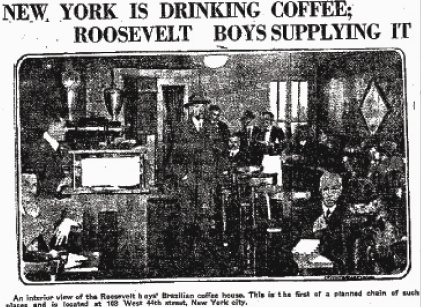
The Double-R Coffee House was a fairly regular hangout of Lovecraft and the Kalem Club in New York City. This is what the interior looked like when it opened…

This is a little potted history of it…

“Members of the family of the late Colonel Roosevelt began to promote a Brazil coffee-house enterprise in New York in 1919. It was first called Cafe Paulista, but it is now known as the Double R coffee house, or Club of South America, with a Brazil branch in the 40’s [this is Lovecraft’s 112 West Fortyfourth Street haunt] and an Argentine branch on Lexington Avenue. Coffee is made and served in Brazilian style; that is, full city roast, pulverized grind, filtration made; service, black or with hot milk. Sandwiches, cakes, and crullers are also to be had.” — William Harrison Ukers, All About Coffee (1922).

“Upon entering the long narrow shop, a patron saw portraits’ of Voltaire and Shakespeare on opposite sides of the room. The walls were decorated with green and gold wallpaper containing a Brazilian bamboo plant design. The room contained 30 small oak tables and matching chairs with a large oak counter in the center where freshly ground coffee was made.” — The Rough Writer, Volume 9, Issue 3

It seems to have lasted about ten years under the first owners, and seems to have been set up to take advantage of Prohibition. It sold coffee, postum (a sort of decaf coffee substitute before decaf), pastries and cakes, sandwiches, and offered “a daily Brazilian dish”. It seems the manager was Brazilian.

There were “Expansion plans of Double-R Coffee House” (New York Times, 1923) which presumably meant the new Lexington Av. branch, but the venue was sold in 1928 (Tea and Coffee Trade Journal, 1928) to a Mr. and Mrs. Zivko Magdich — at which time the New York Times described it as a…

“gathering place for aspiring playwrights, actors, artists and musicians.”

The letters of George Kirk are a little more explicit on its artistic nature. It seems that, at least part of the week, the Double-R Coffee House served as a discreet queer meeting place…

“If you had been longer in NYC you’d know that there are many boys and many girls both male and female. My dear Double-R is claimed to be a hangout for these half and halfers.” — George Kirk, Letter of 17th Feb 1925.

Lovecraft wrote a poem to the place…

 Here may free souls forget the grind
   Of busy hour and bustling crowd
And sparkling brightly mind to mind
   Display their inmost dreams aloud

   — extract from “On the Double-R Coffee House” (1st February 1925)

It was also rather smoky, since Lovecraft writes in the same poem…

   Mids’t them I sit with smoke-try’d eyes

   — “On the Double-R Coffee House” (1st February 1925)

He also talks in one of his letters of the… “nicotined atmosphere”.

The full poem is to be found in The Ancient Track: The Complete Poetical Works of H.P. Lovecraft. It somewhat contradicts his very sour view of the artists of Greenwich Village in the short story “He”, although the fact that the coffee shop was a queer meeting place may throw new light on the line in Lovecraft’s New York story “He” (1925)…

“… uncommunicative artists whose practices do not invite publicity or the light of day.”

The Greenwich Village quill of 1921 very briefly mentions the Double R, so it seems that it was ‘on the map’ of the Greenwich Village crowd at that time.

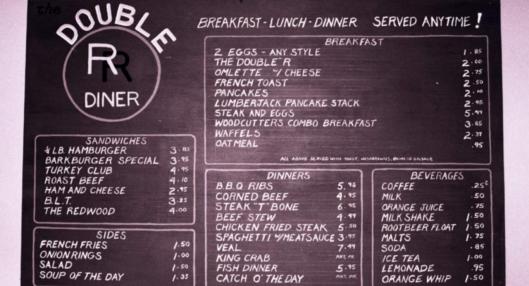
The Double R apparently had a post-closure ‘media ghost’, since it seems to have been recreated as a setting in the TV series Twin Peaks. I’ve never seen the series, so I don’t know how faithful it might have been to the original. Presumably it was a covert Lovecraft reference by the makers.

On the Cthulhu figurine

11 Thursday Aug 2011

Posted by asdjfdlkf in Historical context, New discoveries

≈ 1 Comment

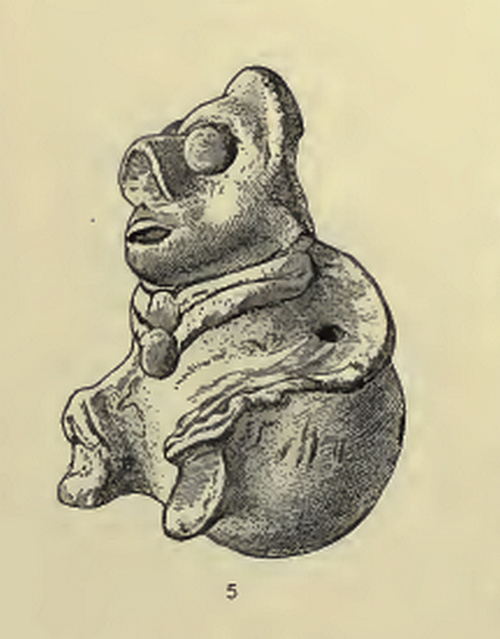
A hat-tip to Christophe Thill, who has pointed out the existence of an interesting octopoid bas-relief from Equador, South America. It seems that this has been written about before as a possible source for the figurine in “The Call of Cthulhu”. Nothing shows up on Google Books or Amazon Look Inside, so possibly there is an essay on this in Lovecraft Studies, Crypt of Cthulhu etc. But those are very expensive now, and I don’t have access to them. So here’s my quick re-tracking down of some of the key facts and images…


Both from The Antiquities of Manabi, Equador (1907) (Incidentally, an excellent example of why scanned books should not be discarded after mass scanning — the picture quality is rubbish).


The same picture given again in G. Eliot Smith’s book Evolution of the Dragon (1919). It has eight “arms” like an octopus, even though the arms are very straight rather than curvy.


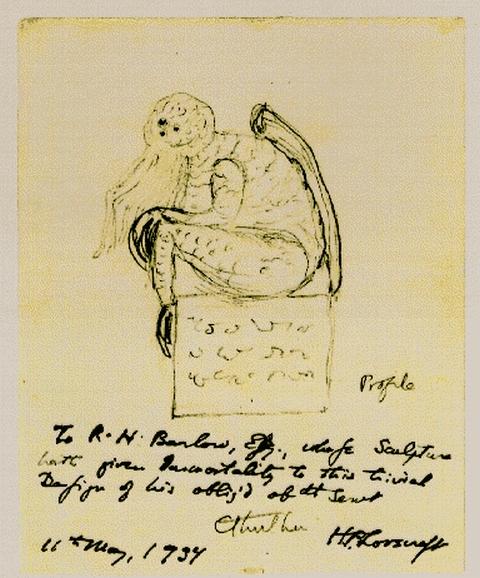
Lovecraft’s own pen-sketch of the Cthulhu figurine in the story.

Frank Belknap Long’s major mythos story “The Horror from the Hills” was written 1929, and first appeared as a two-parter in Weird Tales, Jan & Feb 1931. It is set in a New York museum, and Long mentions ‘The Manabi monoliths’. Although Lovecraft apparently gave written permission for one of his dreams [given in, among others, a letter to B.A. Dwyer of Nov. 1927] to be used in the story, as far as I can tell the story was not one of Lovecraft’s revision works. The late date and the seemingly tangential Lovecraft involvement thus suggests that there’s no actual proof that the Lovecraft circle may have known about the South American Manabi sculptures before 1927/9. Possibly some of Manabi works were on show in museums Long visited to research the story.

Yet… the Evolution of the Dragon was called a “highly acute and sensitive” (The Nation, 1919) work in the reviews of the time, and was even reviewed in Nature (1919), so it would seem strange if Lovecraft had not badgered the Providence library to obtain a copy. Or later tried to obtain a copy when he haunted the used bookshops and libraries of New York. Christophe Thill says that… “A picture of it [the Manabi octopoid] was published in Nature in 1924″, so it was obviously commented on. It is certainly very suggestive in the respect of the 1919 date that the famous entry in the Commonplace Book (entry No. 25, circa 1919, from a dream) describes not a squatting figure but a bas-relief like the one shown in Evolution of the Dragon…

“25. Man visits museum of antiquities — asks that it accept a bas-relief he has just made—old and learned curator laughs and says he cannot accept anything so modern. Man says that ‘dreams are older than brooding Egypt or the contemplative Sphinx or garden-girdled Babylonia’ and that he had fashioned the sculpture in his dreams. Curator bids him shew his product, and when he does so curator shews horror. Asks who the man may be. He tells modern name. “No — before that” says curator. Man does not remember except in dreams. Then curator offers high price, but man fears he means to destroy sculpture. Asks fabulous price — curator will consult directors. Add good development and describe nature of bas-relief.”

He is unlikely to have seen the squatting Manabi figure in the 1907 monograph, and it was not given in the book Evolution of the Dragon. So where might he have had it from? There are of course a great many similarly squatting and pedestal-seated Ancient Egyptian figures, and this seems an obvious source for an Egyptomaniac like Lovecraft. For instance, there are some human figures in that pose, many squatting baboon sculptures from Ancient Egypt from all periods, and the Egyptian sculptures of Bes mostly have the typical pose of squat with hands resting on knees. Lovecraft would have seen these illustrated in books on Egypt, and then by the time of writing “Cthulhu” would have seen plenty of actual examples in the New York museums…


Note the beard of Bes, which almost suggests octopus-like tentacles.

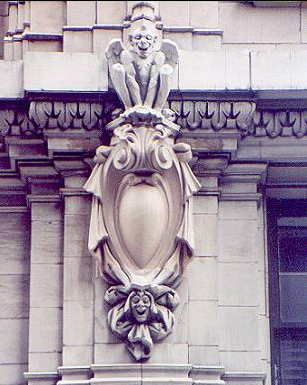
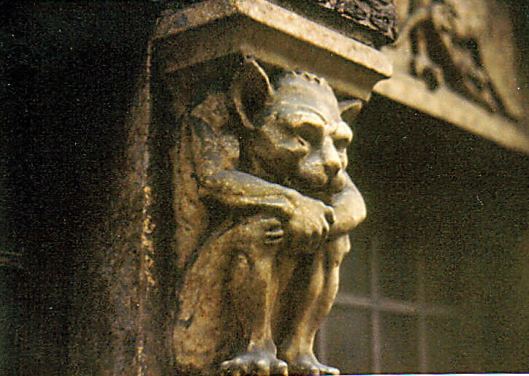
One might also point to the gargoyles of New York as another possible inspiration for the squatting figure of the Cthulhu statuette, especially the wings…

I know almost nothing of the roots of Masonic beliefs, but it may be that some scholar has reliably traced gargoyles back to guilds of masons whose traditions recalled those of Egyptian sculpture at the time of Rome? Whatever the truth of that, Lovecraft would certainly have made the Egyptian connection in his mind when he saw them on the buildings.

“The huge variety of nymphs, grotesques, demons, gargoyles, and other mysterious creatures carved into the facades of New York buildings is pretty astounding.” Ephemeral New York blog, 12th January 2011.

Lovecraft and Moe – photo

10 Wednesday Aug 2011

Posted by asdjfdlkf in Historical context

≈ 2 Comments

Snagged from an eBay listing of a rare chapbook printing of a poem to Moe. I’ve never seen this photo before, featuring Maurice Moe and Lovecraft in the warm months of 1936…

Moe looks rather short, but I think it’s just an optical illusion? Lovecraft was quite tall, especially for a time when people tended to be shorter than they are now. So, by comparison, Moe looks short?

The ‘mob mind’, riots, and Lovecraft

10 Wednesday Aug 2011

Posted by asdjfdlkf in Historical context, Unnamable

≈ Leave a comment

I thought it’d be timely to write a little about public attitudes to “the mob” in Lovecraft’s time, given that we’ve had a taste of it here in the UK over the last few nights.


The ‘mob mind’, riots, and Lovecraft:

The “mob mind” was a popular concept and talking point around 1919-1920, and built on very real public concerns about the dangers of increasingly crowded and ill-educated modern cities that were emerging in the 1910s and 1920s.

In the early 1900s there had been mass panic on the New York subway…

‘Indescribable scenes of crowding and confusion, never paralleled in this city. […] a deadly, suffocating, rib-smashing subway rush which began at 7 o’clock tonight. Men fought, kicked and pummeled one another […] grey haired men pleaded for mercy, boys were knocked down and only escaped by a miracle from being trampled underfoot. The presence of the police alone averted what would undoubtedly have been panic after panic, with wholesale loss of life.’ — New York Tribune, 28th October 1904.

On 1st August 1918, when a then-new subway shuttle system had opened in New York, there had apparently been another riot and stampede to get out of the station. This was before the installation of glowing guide-lines that led people out of the dark.

E.A. Ross’s best-selling book Social Control (1901) had suggested that people were increasingly subject to a primitive “suggestibility” in crowded modern cities. Partly this had to do with the rise of and change in the nature of advertising, partly with the rise of a violent leftist politics, but in America it was able to built on existing French thinking about the nature of the new modern urban crowd and its patterns of behavior. This writing had initially arisen in France after the terror of the French revolution — but it was later heavily developed as intellectuals tried to divine what sort of new politics might come out of the new crowds from the 1900s onwards.

In 1919 Ross’s student Robert Gault had published the book The Psychology of Suggestion, drawing heavily on Ross’s ideas and the concept of the mob mind, and this was no doubt reviewed in the sort of publications Lovecraft would have read. I expect that the race riots and the serious political unrest in 1919 gave Gault’s book a wide readership. On the links between ‘the mob crowd’ and race in 1919 and the years following, see Jan Voogd’s book Race Riots and Resistance: the Red Summer of 1919 (2008) which examines the Chicago race riots of 1919. Even the most violent of the pulps paled beside the vicious horrors described in false rumours that fanned the riots.

On 9th September 1919 the whole of the Boston police force deserted their posts, leaving the city virtually defenceless against the mob, leading to further strong cultural anxieties about Bolshevism (widely believed to have inspired the police strike). This time it was much closer to Lovecraft’s own Providence, and it no doubt conflated politicized unions and crime in the public mind.

These anxieties were, of course, set against the background of the terror of the 1917 Russian Revolution and its organised exporting of the Bolshevist [socialist] creed. And, closer to home and a little later, there was the major terrorist bomb attack on New York on 16th September 1920 using 100lbs of dynamite with metal curtain-weights packed around it. This had followed the discovery of two series of horrific parcel bombs in the mail. This must have further heightened tensions in New York and the cities of New England.

On the specific ‘hypnotic’ nature of crowds, which seems relevant to the columns of semi-hypnotised people in the Lovecraft story “Nyarlathotep” (1920), one might also point to Gustave le Bon’s earlier book The Crowd (published in America in 1896) which had argued that an individual who is too long in a crowd…

finds himself in a special state, which much resembles the state of fascination in which the hypnotized individual finds himself in the hands of the hypnotizer.

By the time Lovecraft arrived in New York in the mid 1920s these wider anxieties appear had quieted down somewhat. Nevertheless they undoubtedly left their mark on the psyches of ordinary people, including Lovecraft.

Further reading:

John Carey. The Intellectuals and the Masses: Pride and Prejudice Among the Literary Intelligentsia 1880-1939. Faber and Faber, 1992.

J.S. McClelland. The Crowd and the Mob: From Plato to Canetti. Taylor & Francis, 2010.

Paul S. Boyer. Urban Masses and Moral Order in America, 1820-1920. Harvard University Press, 1992.

On Lovecraft’s Pen

08 Monday Aug 2011

Posted by asdjfdlkf in Historical context, Odd scratchings

≈ Leave a comment

Some quotes on Lovecraft’s Waterman fountain pen, rescued from the clutter of an old discussion thread on the Fountain Pen Network forum (several kindly supplied to the Network by Chris Perridas). Illustrated here with photos of a 1920 No.56 Ideal Waterman, without gold decoration, currently on sale to collectors in Taiwan, plus a few others of the same time-period. They apparently sell for upwards of $800 in really good condition.


“But avaunt [Go away], dull care! Let me drown my worries in watered ink, or the clatter of Remington [typewriter] keys.” — Lovecraft letter, in Lord of a Visible World: an autobiography in letters.


“You’ll recall that I obtained a pen a piece for SH (Sonia) & myself last October at a price of $1.28 … we found the sale still on [&] the salesman still willing to make exchanges. …to obtain real satisfaction one must invest in a real Waterman … I did not escape from the emporium till a $6.25 Waterman reposed in my pocket — a modern self-filler corresponding to the ancient $6.00 type which I bought in 1906 & lost seventeen years later amidst the sands of Marblehead Neck in the summer of 1923 … the feed is certainly a relief after sundry makeshifts — tho’ I think I’ll change this especial model tomorrow for one with a slightly coarser point — one less likely to scratch on rough paper. It is certainly good to be back among the Watermans again …” — Lovecraft to Lillian Clark on 30th January 1926.

[The “sundry makeshifts” apparently included a self-filling Conklin, loaned from Moe after Lovecraft’s pen was lost “amid the sands of Marblehead”].


From: Howard Phillips Lovecraft: Dreamer on the Nightside, by Frank Belknap Long…

Howard was fascinated by small articles of stationery — writing pads, rubber bands of assorted sizes, phials of India ink, unusual letterheads, erasers, mechanical pencils, and particularly fountain pens.

He used one pen, chosen with the most painstaking care, until it wore out, and several important factors entered into his purchase of a writing instrument. It had to have just the right kind of ink flow, molding itself to his hand in such a way that he was never conscious of the slightest strain as he filled page after page with his often minute calligraphy. It also had to be a black Waterman; a pen of another color or make would have been unthinkable.

When a pen he had used for several years wore out, the purchase of a new one became an event — lamentable in some respects, but presenting a challenge which I am sure he secretly enjoyed. We were walking northward from Battery Park [New York City], where I had met him at noon, stopping occasionally to admire one of the very old houses which still could be found scattered throughout the financial district in the 1920s, when he told me that he intended to purchase a new pen at the first stationery store that had a well-stocked reliable appearance. He removed the old one from his vest pocket and showed me how worn the point had become. I found myself wondering just how many letters and postcards he had written with it, for it did have a ground-down aspect.

We walked on for three or four blocks, found the kind of store he had in mind, and I accompanied him inside. The clerk who waited on him was amiable and greeted him with a smile when he asked to try out a number of pens.

“The point has to be just right,” Howard said. “If it won’t put you to too much inconvenience, I’d like to test out at least twenty pens.”

The clerk’s smile did not vanish when Howard turned to me and said, “I’m afraid this will take some time.”

It was just a guess, but I felt somehow that he had made the kind of understatment that would strain the clerk’s patience almost beyond endurance.

“We just passed a pipe store,” I said. “I’d like to go back and look at the window again. I may just possibly decide to buy a new pipe. I can be back in fifteen or twenty minutes.”

“No need to hurry,” he said. “I’ll probably be here much longer than that.”

I was gone for forty-five minutes. It was inexcusable, I suppose, but it was a clear, bright day, a wind with a the tang of the sea was blowing in from one of the East River wharves where several four-masted sailing ships were tied, and I decided to go for quite a long walk instead of returning to the pipe shop.

When I got back to the stationery store, there were at least fifty pens lying about on the counter and Howard was still having difficulty in finding one with just the right balance and smoothness of ink flow. The clerk looked a little haggard-eyed but he was still smiling, wanly.

The careful choice of a fountain pen may seem a minor matter and hardly one that merits dwelling on at considerable length. But to me it has always seemed a vitally important key to the basic personality of HPL in more than one respect. He liked small objects of great beauty, symmetrical in design and superbly crafted, and by the same token larger objects that exhibited a similar kind of artistic perfection. And the raven-black Waterman he finally selected was both somber and non-ornate, with not even a small gold band encircling it. That appealed to him in another way and was entirely in harmony with his choice of attire.


“I certainly share your despair in regard to ever finding a serviceable fountain-pen — it’s the main reason why I have taken to typing most of my letters. I, too, often employ pencils in making the first draft of a story — though such drafts, with me, are likely to get themselves done any old way. Sometimes I start ’em on the machine — and then finish up or alternate with all the available mediums of scripture. I don’t dare leave the resultant mass lying around too long before making the final typed version — or even I would be powerless to unscramble it!” — letter to Clark Ashton Smith in March 1932.

Lovecraft and sympathy for the Devil

07 Sunday Aug 2011

Posted by asdjfdlkf in Historical context, New discoveries

≈ Leave a comment

In 1924 Lovecraft wrote…

‘Take a werewolf story, for instance — who ever wrote a story from the point of view of the wolf, and sympathising strongly with the devil to whom he has sold himself?’ — H.P. Lovecraft in the letters columns of Weird Tales, March 1924. Quoted in Darrell Schweitzer, Discovering Classic Fantasy Fiction, p.126.

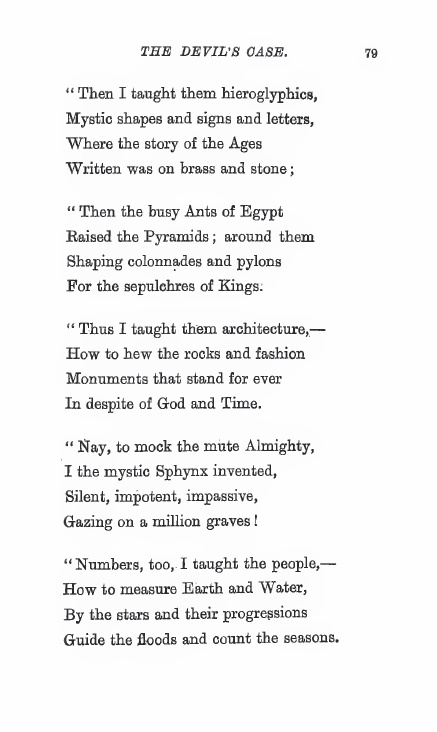
In this respect it’s interesting that a decadent writer called Robert Buchanan published a long decadent poem as a book, The Devil’s Case (1896). In it Buchanan sympathises with the Devil, portraying him both as a magician and a scientist/skeptic. Regrettably for the modern reader it comes with an offputtingly teduous late-Victorian preamble and it has much ‘poeticky’ language, but there are many very effective and vivid passages. Arkham House reprinted one of his long poems, but sadly not this one.

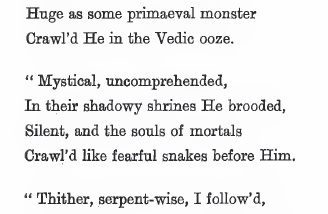
Here is Buchanan’s Devil in The Devil’s Case, recalling his time as a scientist/architect in Ancient Egypt. This would seem to have obvious relevance to “Nyarlathotep” (1920)…

Given Lovecraft’s dislike of 19th century literature it’s perhaps understandable that Lovecraft does not appear to have even known about some of the Victorian fantasy novelists such as William Morris (or possibly he assumed from summaries that they were more like children’s fairy tales, or just felt them not to be weird or horrific enough for mention in Supernatural Literature). But Lovecraft was apparently fairly informed on the Decadents and poetry. Indeed he went through a Decadent “phase” up until about 1922/23. So it seems strange he appears never to have mentioned Robert Buchanan. Archibald Stodart-Walker’s book Robert Buchanan, the poet of modern revolt: an introduction to his poetry had appeared in 1901. Also Harriet Jay’s Robert Buchanan: some account of his life, his life’s work, and his literary friendships had appeared from Unwin in 1903, and Henry Murray’s Robert Buchanan: a critical appreciation, and other essays in 1901 — so it wasn’t as if the author had been forgotten in the 1910s. Much of Buchanan’s early work was conventional, but his The Book of Orm (1870) and especially its section of poems titled “The Devil’s Mystics” might have been on Lovecraft’s list had he read about it. Certainly Orm was described in Chapter 12 of Lafcadio Hearn’s Appreciations of Poetry (1916)…

Buchanan’s Orm is represented to be an ancient Celt, who has visions and dreams about the mystery of the universe, and who puts these visions and dreams, which are Buchanan’s, into old-fashioned verse.

a very remarkable beauty, a Celtic beauty of weirdness [of “The Ballad of Judas Iscariot”]

But Lafcadio Hearn’s essay appears to resolutely steer matters toward the ponderous ‘Christian meanings’, and he very oddly neglects to even mention that Buchanan ever published The Devil’s Case. If this book chapter was all that Lovecraft ever read about or by Buchanan (Hearn gives a large chunk of Judas Iscariot), then it may well have been enough to strike the name off Lovecraft’s list of works to investigate. Still, there does appear to be at least one very striking point of correspondence between the “The Devil’s Case” and “Nyarlathotep” (see above), and also some rather Lovecraftian language in places such as…

Edison in Providence, 1896

06 Saturday Aug 2011

Posted by asdjfdlkf in Historical context

≈ Leave a comment

Edison was commonly referred to as “The Wizard of Menlo Park”, and his Vitascope presentation had come to Providence when Lovecraft was six years old. It played to virtually the entire town for a month, twelve hours a day. See Charles Musser, The Emergence of Cinema: the American screen to 1907. University of California Press, 1994. p.125.

I would imagine the shows were fronted with a film of Edison himself. One thus wonders if the childhood memory of the huge Edison on the screen might have been a spur to the dream that inspired “Nyarlathotep”?

Lovecraft and Maxfield’s

05 Friday Aug 2011

Posted by asdjfdlkf in Historical context, New discoveries

≈ 3 Comments

A quick tracking-down of the site of Lovecraft’s famous ice-cream eating contests, which I had pictured as being in urban New York. But seemingly not…

“21, Federal Street [Warren, Rhode Island]. “Bosworth Mansion” or “Maxfields” c.1840: 2 story gable roof Greek Revival house possibly designed by architect Russell Warren for Judge Alfred Bosworth; known for years as “Maxfields” a popular local ice-cream parlor.”

“After digesting Warren’s quiet lanes and doorways we went across the tracks to Aunt Julia’s, where we tanked up on twelve different kinds of ice cream — all they’re serving at this time of year.” — Selected Letters: 1932-1934.

This was owned by Julia A. Maxfield’s whose father was apparently Louis Warren Taft, and was of an old Rhode Island family. It seems from the mention of “Aunt Julia” that she was related to a member of the Lovecraft Circle. It seems, though, that the “Bosworth Mansion” was not the actual site of the parlour. The parlour was apparently in a nearby building, presumably in the grounds and maybe looking more like a wooden Summer House?…

From: Ruth Marris Macaulay, John Chaney. Warren. Arcadia, 1997.

Or possibly it was a veranda-like extension at the back of the house, which Wandrei’s (then nearly 20 years-old) memories seem to imply. Although I think I would rather trust the memories of the local historians and local people that the parlour was actually some distance from the main house.

Possibly Julia A. Maxfield didn’t actually work there either, but employed her relatives to do so, since there is mention of a Charles Redfern Maxfield Snr. being the manager of an ice-cream parlour in Warren in the 1920s.


Thanks to Chris Perridas for snagging this from an auction-house blurb on the parlour…

From the 1944 Arkham House book Marginalia by H.P. Lovecraft, there is a section titled “The Dweller in Darkness” by Donald Wandrei. In that piece he explains the history and story behind the first 1927 trip to Maxfields:—

We took a bus for Warren, Rhode Island, where they promised a great treat. At Warren we walked to an establishment called Maxfield’s in a rambling old Colonial house. Its specialty was ice-cream, and it developed that our pilgrimage was solely for the purpose of consuming ice-cream.

There were thirty-two varieties on the menu. “Are they all available?” asked Lovecraft.

“No,” said the waiter, “only twenty-eight today, Sir.”

“Ah, the decay of modern commercial institutions,” said Lovecraft dolefully. “Thirty-two varieties are advertised but only twenty-eight are prepared for the famished pilgrims.”

We each ordered a double portion of a different flavor, and by dividing each other’s choice, we enjoyed three flavors with each serving. The trams came on and on — chocolate, vanilla, peach, black raspberry, pistachio, black walnut, coffee, huckleberry, strawberry, orange, plum, mint, burnt almond, and exotic types whose names I do not recall. The ice-cream was superior; there was no doubt of its being of the finest quality. But on the twenty-first variety I was beyond capacity. I watched with awe while the remaining flavors arrived in the same huge portions, and Lovecraft and Morton ate on with undiminshed zest, interspersing the astonishing meal with a wealth of literary allusions on the origins of ice-cream, its preparation in Italy, its appeal to famous men, the distinctions between meringues, ice-creams, and ices. I managed to sip each flavor for the record of twenty-eight, but I was a weak runner-up to the champions. I would estimate that Lovecraft and Morton consumed between two and three quarts of ice-cream apiece on that gastronomic triumph.

The occasion was so memorable that we wrote a short note of appreciation of the twenty-eight varieties and our enjoyment, signed it, and left it at the table. A year later when we visited Warren, we were surprised to find our tribute decorating a wall. Lovecraft was both amused and delighted but all he said was, “What a disapointment that the other four varieties were not available.”

← Older posts
Newer posts →


Please become my patron at www.patreon.com/davehaden to help this blog survive and thrive.

Or donate via PayPal — any amount is welcome! Donations total at Easter 2025, since 2015: $390.

Archives

  • March 2026
  • February 2026
  • January 2026
  • December 2025
  • November 2025
  • October 2025
  • September 2025
  • August 2025
  • July 2025
  • June 2025
  • May 2025
  • April 2025
  • March 2025
  • February 2025
  • January 2025
  • December 2024
  • November 2024
  • October 2024
  • September 2024
  • August 2024
  • July 2024
  • June 2024
  • May 2024
  • April 2024
  • March 2024
  • February 2024
  • January 2024
  • December 2023
  • November 2023
  • October 2023
  • September 2023
  • August 2023
  • July 2023
  • June 2023
  • May 2023
  • April 2023
  • March 2023
  • February 2023
  • January 2023
  • December 2022
  • November 2022
  • October 2022
  • September 2022
  • August 2022
  • July 2022
  • June 2022
  • May 2022
  • April 2022
  • March 2022
  • February 2022
  • January 2022
  • December 2021
  • November 2021
  • October 2021
  • September 2021
  • August 2021
  • July 2021
  • June 2021
  • May 2021
  • April 2021
  • March 2021
  • February 2021
  • January 2021
  • December 2020
  • November 2020
  • October 2020
  • September 2020
  • August 2020
  • July 2020
  • June 2020
  • May 2020
  • April 2020
  • March 2020
  • February 2020
  • January 2020
  • December 2019
  • November 2019
  • October 2019
  • September 2019
  • August 2019
  • July 2019
  • June 2019
  • May 2019
  • April 2019
  • March 2019
  • February 2019
  • January 2019
  • December 2018
  • November 2018
  • October 2018
  • September 2018
  • August 2018
  • August 2015
  • July 2015
  • April 2015
  • March 2015
  • February 2015
  • January 2015
  • December 2014
  • November 2014
  • October 2014
  • September 2014
  • August 2014
  • July 2014
  • June 2014
  • May 2014
  • March 2014
  • February 2014
  • January 2014
  • December 2013
  • November 2013
  • October 2013
  • September 2013
  • August 2013
  • July 2013
  • June 2013
  • May 2013
  • April 2013
  • March 2013
  • February 2013
  • January 2013
  • December 2012
  • November 2012
  • October 2012
  • September 2012
  • August 2012
  • July 2012
  • June 2012
  • May 2012
  • April 2012
  • March 2012
  • February 2012
  • January 2012
  • December 2011
  • November 2011
  • October 2011
  • September 2011
  • August 2011
  • July 2011
  • June 2011
  • May 2011
  • April 2011
  • March 2011
  • February 2011
  • January 2011
  • December 2010
  • November 2010
  • October 2010
  • September 2010
  • August 2010
  • July 2010

Categories

  • 3D (14)
  • AI (70)
  • Astronomy (70)
  • Censorship (14)
  • de Camp (7)
  • Doyle (7)
  • Films & trailers (101)
  • Fonts (9)
  • Guest posts (2)
  • Historical context (1,096)
  • Housekeeping (91)
  • HPLinks (77)
  • Kipling (11)
  • Kittee Tuesday (92)
  • Lovecraft as character (58)
  • Lovecraftian arts (1,628)
  • Lovecraftian places (19)
  • Maps (70)
  • NecronomiCon 2013 (40)
  • NecronomiCon 2015 (22)
  • New books (966)
  • New discoveries (165)
  • Night in Providence (17)
  • Odd scratchings (984)
  • Picture postals (276)
  • Podcasts etc. (431)
  • REH (184)
  • Scholarly works (1,470)
  • Summer School (31)
  • Unnamable (87)

Get this blog in your newsreader:
 
RSS Feed — Posts
RSS Feed — Comments

H.P. Lovecraft's Poster Collection - 17 retro travel posters for $18. Print ready, and available to buy — the proceeds help to support the work of Tentaclii.

Proudly powered by WordPress Theme: Chateau by Ignacio Ricci.