A new interview with Lovecraft, transcribed from a single postcard!
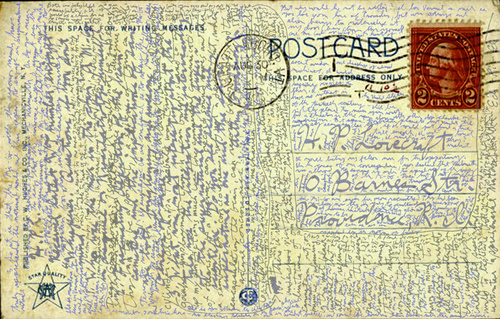
Part of the new Lovecraft edition of The Revelator.
So now we know, H.P. Lovecraft invented Mail Art as well as everything else 😉

10 Thursday Jan 2013
A new interview with Lovecraft, transcribed from a single postcard!
Part of the new Lovecraft edition of The Revelator.
So now we know, H.P. Lovecraft invented Mail Art as well as everything else 😉
02 Wednesday Jan 2013
Posted in Historical context, New discoveries
While browsing the Economist‘s Xmas issue I came across an unlikely-but-excellent article on Hell. Thanks to this article I also found a nugget that sounds very similar to the ending of At The Mountains of Madness…
“The Trojan hero Aeneas in Virgil’s Aeneid toured Hades [Hell], with difficulty enough, and [while there] he merely glanced towards Tartarus [the prison of the defeated gods], glimpsing a high cliff with a castle below it surrounded by a torrent of flame. That single sighting fixed him to the spot in terror.”
Very similar to Danforth’s final backward glance (in which he presumably glimpses Kadath), I thought. As far as I can tell, no-one’s spotted this possible source before. It suggests there may be further links between the Aeneid and Mountains.
19 Wednesday Dec 2012
Posted in Historical context, New books, Scholarly works
PS Publishing’s website has is taking orders for S.T. Joshi’s monumental new work Unutterable Horror – a History of Supernatural Fiction, Volume 1: From Gilgamesh to the End of the Nineteenth Century, and Unutterable Horror – a History of Supernatural Fiction, Volume 2: The Twentieth and Twenty-first Centuries. £35 each, in hardcover.
[ Hat-tip: S.T. Joshi’s blog ]
18 Sunday Nov 2012
Posted in Historical context, Scholarly works
The University of Michigan has announced a free online academic course in Fantasy and Science Fiction: The Human Mind, Our Modern World. No sign-up yet or precise dates yet, but it looks like it might be a 10-week summer school in summer 2013. One to watch.
16 Friday Nov 2012
Posted in Historical context, New books, Scholarly works
A new book by Michael Moon, Darger’s Resources (Duke University Press, 2012), historically contextualises the American outsider artist Henry Darger, through an examination of his actual and likely sources. One chapter that may interest Lovecraftian scholars is called “Wierd Flesh, World’s Flesh: Darger and the pulps”. Google Books is only letting me have a selection of pages but there appears to be no actual suggestion of direct influence, from Darger having read Lovecraft. But Moon notes that Darger’s work on The Realms was contemporaneous (1908/11-1938) with Lovecraft’s working years and ‘the pulp years’, and Moon draws parallels between the two men’s approaches to evoking horrors.
31 Wednesday Oct 2012
Posted in Historical context, Odd scratchings
The Dark Side of the Poles: Dreams and Nightmares in Polar Exploration runs until 3rd November 2012 in the UK, as part of the University of Cambridge Festival of Ideas…
“Throughout the Festival, explore our trail of polar dreams and nightmares. Find untold secrets hidden in drawers and strange objects that have crept into the cases.”
The BBC has a companion essay on the topic, from Fred Lewsey of the University of Cambridge.
06 Saturday Oct 2012
Posted in Historical context, New discoveries
[ Expanded version of this post, in footnoted essay form, can now be found in my new book Lovecraft in Historical Context: fourth collection. ]
25 Tuesday Sep 2012
Posted in Historical context, New books, Scholarly works
The Smithsonian magazine has a long article on “The Great New England Vampire Panic”. The story is based on the work of a consulting folklorist at the Rhode Island Historical Preservation & Heritage Commission, who has documented…
“80 exhumations […] concentrated in backwoods New England, in the 1800s” […] “The public hysteria almost invariably occurred in the midst of savage tuberculosis outbreaks”
23 Sunday Sep 2012
Posted in Historical context
“27th [October 1918] — Government officials, Watch and Ward Society men and United States troops from Camp Devens raid two houses on Cumberland Hill, [about four miles north of Providence] arresting 40 people. Proprietor of one house uses shotgun and troops are ordered to shoot to kill. One of Watch and Ward men is shot in the leg by man who really had attempted to put bullet into injured man’s abdomen. Both vice places are broken up by direction of Government authorities, because soldiers and sailors were frequenting them. Many robberies had been complained of. Most every man arrested in the raid was armed with gun and brass knuckles [knuckle-dusters].” — from news summary of the month’s events, Providence Magazine, Nov 1918, p.605.
Who were the Watch and Ward Society? Here’s the description from a 2011 book by Neil Miller, Banned in Boston: The Watch and Ward Society’s Crusade against Books, Burlesque, and the Social Evil
“An influential watchdog organization, bankrolled by society’s upper crust, it actively suppressed vices like gambling and prostitution, and oversaw the mass censorship of books and plays.”
Evidently they were also active in areas close to Providence. They were originally the New England Society for the Suppression of Vice. More details here. Lovecraft mentions them in Selected Letters III, musing idly on the prospect of being sent a copy of Venus in Furs for Christmas…
“I certainly wouldn’t get het up and call in the repressed perverts of the Watch and Ward Society of Boston.”
In what might be an interesting little sidelight on Lovecraft’s literary flowering circa summer 1926…
“In 1926 [5th April], the [Watch and Ward] society challenged a Herbert Asbury story called “Hatrack”, published in H.L. Mencken’s American Mercury. In Boston, with police, press, and a large crowd in attendance, Mencken sold a copy of the magazine to society president John Chase. Mencken was arrested. In the ensuing trial [6th April], the magazine was found not to be obscene, and Mencken was acquitted. Mencken proceeded to successfully sue the Watch and Ward Society for illegal restraint of trade.”
Presumably many pulp authors and editors felt some relief that the Watch and Ward Society had taken such a decisive legal pummeling.
20 Thursday Sep 2012
Posted in Historical context, Scholarly works
The Lovecraft Archive website has a useful new comprehensive summary list of Lovecraft’s friends and acquaintances.
07 Friday Sep 2012
Posted in Historical context, Odd scratchings
From today’s press reports: A British team is exploring the Antarctic in a search for life unseen for half a million years.
Incidentally, here’s a news report from 1922 on the massive melting of ice across the Arctic. Arctic seas became so warm that ice seals left the region…
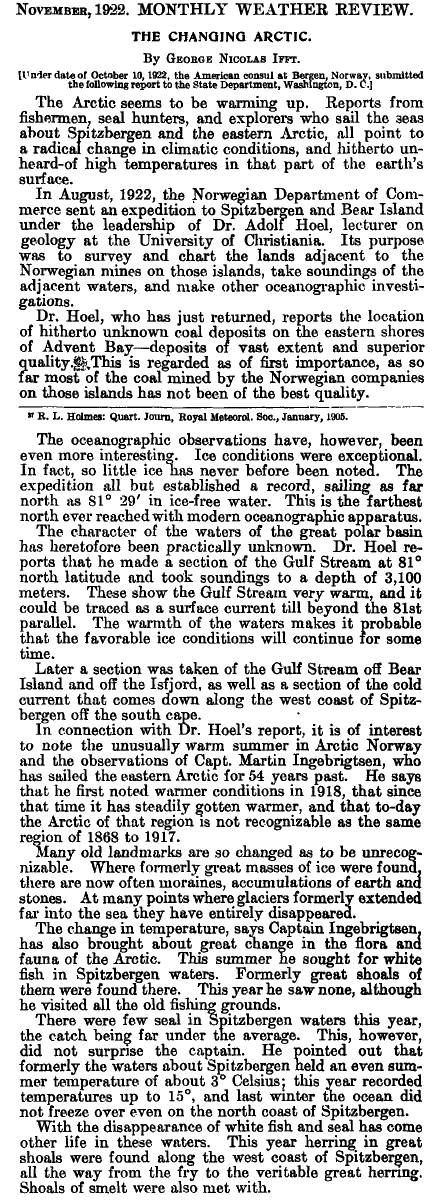
Possibly an interesting sidelight on Harry Houdini’s movie The Man from Beyond (1922), featuring a man defrosted from the Arctic ice.
03 Monday Sep 2012
Posted in Historical context, Podcasts etc.
A fascinating BBC Radio 4 history programme, The Discovery of the English Land (listen online) has much to interest those looking into the antiquarian/topographical tradition of the curiously perambulating English literary gentleman, a tradition in which Lovecraft was steeped.