• About
  • Directory
  • Free stuff
  • Lovecraft for beginners
  • My Books
  • Open Lovecraft
  • Reviews
  • Travel Posters
  • SALTES

Tentaclii

~ News & scholarship on H.P. Lovecraft

Tentaclii

Category Archives: Historical context

Adams’ Synchronological Chart

09 Sunday Jun 2013

Posted by asdjfdlkf in Historical context

≈ Leave a comment

A full composite of Adams’ Synchronological Chart of Universal History (1881), which Lovecraft used as a child and which he kept in later life.

adams

Lovecraft called it, in a letter about how he learned as a child, … “a marvellously graphic historic device called “Adams’ Synchronological Chart” — which I still have” (Lord of a Visible World, p.20). Elsewhere it is termed…

A huge and impressive twenty-three foot long chart showing 5,885 years of history, from 4004 B.C. to 1881 A.D. First issued in 1871, Adams put out several editions in many formats.

66 College Street

07 Friday Jun 2013

Posted by asdjfdlkf in Historical context, Maps

≈ 2 Comments

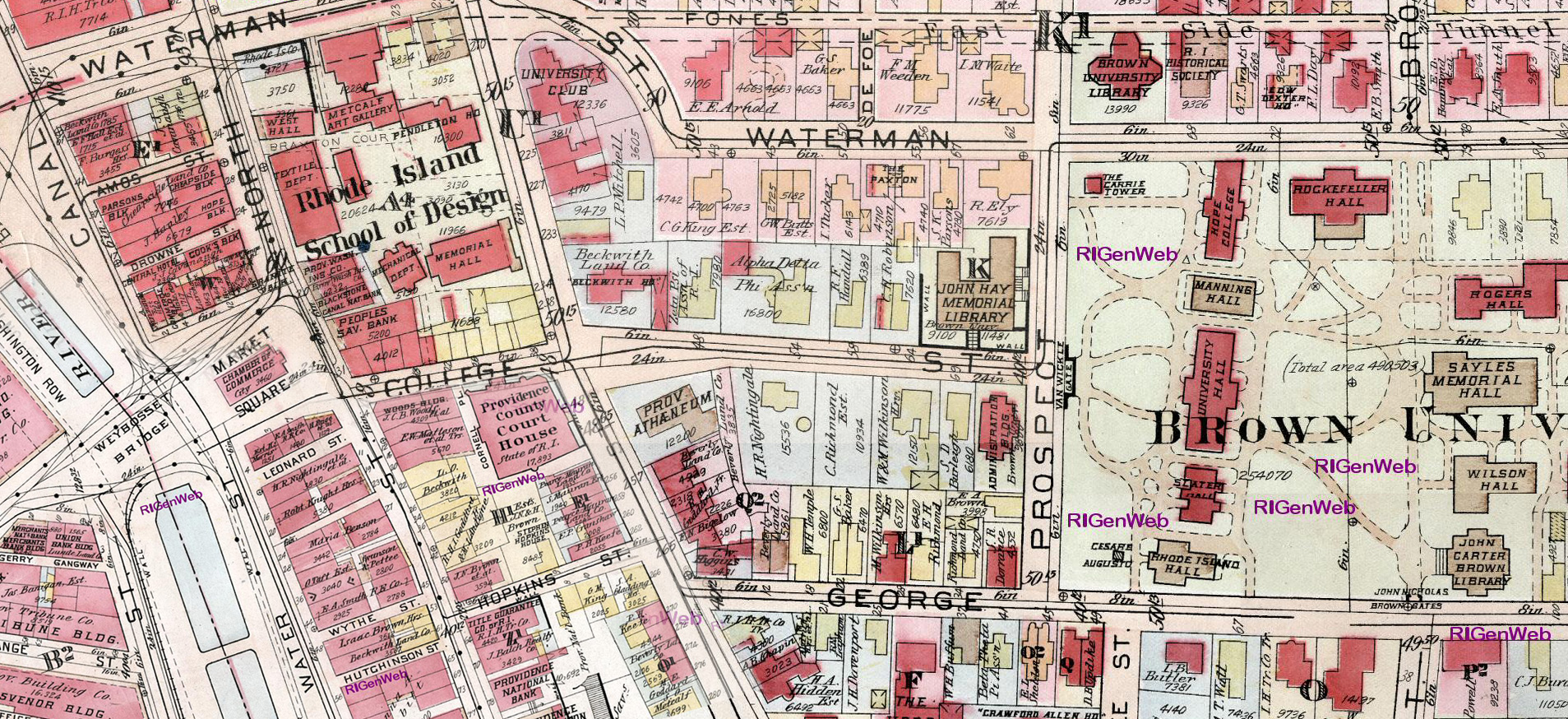
Here’s a hi-res composited version of the map sheets from Plat Book of the City of Providence Rhode Island, 1918, which I’ve centered on 66 College Street, Lovecraft’s last address. 66 is set back from College St., and actually sits halfway between College St and Waterman St. S.T. Joshi says in I Am Providence that the tiny alley leading back to 66 from College St. was once called Ely’s Lane. The “Paxton” just north on Waterman was the boarding house where Lovecraft sometimes had his meals.

Update: The Paxton was the ‘Arsdale’ by Lovecraft’s time. Later the “old Arsdale” at 53-55 Waterman Street became the “Hopkins House” dormitory for boys in 1946, when there was a sudden and pressing need to accommodate vast numbers of students returning from the Second World War. My thanks to Schultz and Faig for the additional information.


Above: (No.66 detail from Plat Book of the City of Providence Rhode Island, 1918)

Lovecraft’s desk window looked west from the upper floor, and in the other corner he had a seat looking through two paired windows (one facing west and another south). So his desk would have been looking at the back parts of the Alpha Delta Phi (Brunonian chapter) fraternity house at Brown. This appears in “The Haunter of the Dark” as: “Students in the Psi Delta house, whose upper rear windows looked into Blake’s study, noticed the blurred white face…”

Missing picture
Above: Alpha Delta Phi fraternity house. You can see how the curved frontage section corresponds with the map. Lovecraft’s home out of sight directly behind the fraternity house. In the left of his view from his two west windows he would have seen the NE upper windows of the short wing at the back of the fraternity house.

The house has now been moved. Thanks to Andrew Kuchling for the photo (below) of the site of 66 College Street, as it is now. The western view from about 15 ft. above the roof of that little extension of the List Art Building (seen here) would give an approximate indication of the main view from Lovecraft’s study desk. One would need to point the camera so that the Psi Delta house windows are on the far left of the picture being taken and the roof of their little low square building is in the left quarter of the picture.

50446673_e4744f9b3c_z

You can see the location in relation to the road in this picture by Will Hart…

3809991158_e940b9705f_z

Sadly it now appears there are trees in the way of Lovecraft’s old view, as you can see in this picture by Will Hart …

3822932791_1371b5bb1d_z

Remote-controlled hover-drone with HD camera needed, I’d say, to hover just to the left of the top of the central bright green tree in the above photo Alternatively one of the building windows might do it. Keep in mind you’re facing west, so avoid late afternoons and sunsets or you might have difficulties with photographing straight into the sun. A clear bright winter morning might be best, when the leaves are off the trees.

Lovecraft’s streets

07 Friday Jun 2013

Posted by asdjfdlkf in Historical context, Maps

≈ Leave a comment

Very large scale public-domain boundary maps of Providence, scanned from the Plat Book of the City of Providence Rhode Island, 1918. There’s an Overview of sections…

2013-06-07_124544

…and hi-res scans of the plates of each section. 160ft to the inch, giving incredible amounts of detail (and also the names of the owner of each house plot) of the streets of Providence.

Presumably surveyed during the First World War, Lovecraft then about age 26 or 27. Compare with the 1891 Survey map to see how the area north of Lovecraft’s home was built up from the 1890s to 1918.

Cat Swamp in Providence: a site of Lovecraft’s childhood?

07 Friday Jun 2013

Posted by asdjfdlkf in Historical context

≈ Leave a comment

Update: this essay has been hugely expanded and footnoted, and is now available in my new book Lovecraft in Historical Context: fourth collection.

Deacon Edward Taylor house

05 Wednesday Jun 2013

Posted by asdjfdlkf in Historical context, New discoveries

≈ 1 Comment

The building next to the Fleur de Lys Studios in Providence? Lovecraft’s uncle Franklin C. Clark appears to have owned it between 1873-1884. It’s the Deacon Edward Taylor house at 9 Thomas Street.

deaconprovidence

More Franklin Chase Clark articles

05 Wednesday Jun 2013

Posted by asdjfdlkf in Historical context

≈ Leave a comment

Franklin Chase Clark, “A Contribution to the Study of Medicine“, Detroit Medical Journal, October 1877, Vol. 2. No.10. A long learned article from Lovecraft’s uncle (the nice one), on the emergence of medicine from the well of superstition…

“In an old medical work, published in London as long ago as 1711, and used as a vade mecum by students and practitioners generally, is the following prescription for the cure of stone. I give in its original spelling and crudeness :

“Take Blood of a Goat, four or five Pound ; the urine of a healthy young Lad and of a Goat, of each five or six Pints ; Wood-Lice, bruised, three pints ; Seeds of Parsley, Commin, Juniper Berries and black Radish Roots, of each four ounces ; Winter Cherries, number sixty or seventy; Herb arsemart. Parsley, Leaves of Birch, Rue and Burdock, of each two Handfulls ; Juice of Birch, Arsemart, Fenil and Wild Tansey, of each one Pint ; digest these together in a warm Place for four or five days. Then distil and draw off a Gallon or five Quarts, which keep close topped for use. Of this Liquor give two ounces with the like Quantity of good White Wine, every Morning, Noon and Night.”

This remarkable prescription without doubt, produced some, if not the desired, effect.”

He also touches for a page on alchemy, in an article on the history of antiseptics in early medicine.

In The Narragansett Historical Register (1888) he had an article “The Dubertus Caught” that went to quite some lengths to track down the mysterious Dubertus, a giant fish mentioned in whaling records.

In the Biliotheca Sacra journal (1908), he has a historical article “The Rise of the Toleration Movement”, tracing the rise of religious toleration.

Uncle Edwin feels the chill

05 Wednesday Jun 2013

Posted by asdjfdlkf in Historical context, New discoveries

≈ 2 Comments

Here’s the ad of a refrigerator company agent in Providence in 1910. Note that the name is that of Lovecraft’s uncle Edwin Everett Phillips (1864-1918). This is from just before he lost a load of money for Lovecraft and his mother in 1911…

lovecraftuncle1910

In 1911, is this him being the Secretary and a Director in the new Providence Rotary Club?

rotary

rotary2

1911officers

The Boston Rotary Club (in 1912 apparently on rocky foundations, according to an open letter from the Chairman in 1912), sponsored the first Providence Rotary Club in 1911. The Providence club was set up alongside the established Rhode Island Rotary Club. One wonders if the new Providence Rotary got off to a shaky start, and/or if the Boston Rotary Club had to call in its sponsorship? A history of the Providence Rotary Club and its later merger with the incumbent club is given in The Rotarian, Oct 1917.

One wonders if Providence Rotary Club, being a commercial venture, was the same commercial venture which lost Lovecraft and his mother a lot of money? In 1932 Lovecraft remembered in a letter that…

“an uncle lost a lot of dough for my mother and me in 1911” (Selected Letters III, p.267)

Uncle Edwin (if indeed it was he) appears to have vanished as both Secretary and Director of the Providence Rotary Club by 1912/13, as evidenced by this picture and list of the officers. One wonders of his disappearance might suggest some financial calamity, one which necessitated his resignation?

provrotary1912

More on the Men’s Club in Providence

05 Wednesday Jun 2013

Posted by asdjfdlkf in Historical context, New discoveries

≈ 1 Comment

I found some further illuminating details which touch on the youthful Lovecraft’s involvement with the Universalist Men’s Club in Providence. Here is an article from 1922 (Cambridge Chronicle newspaper, 4th March 1922) in the fourth paragraph of which a visitor from the Providence men’s club visits the Cambridge equivalent, and reminds the laymen members there of their founding aims (the press report not actually going into detail on these, sadly)…

comrades

Following up the group’s name, it seems “The Order of Universalist Comrades” would be the title of such Clubs, at least by the early 1920s. I have found another reference to a branch of the “Universalist Comrades” in The Lewiston Daily Sun (17th Feb 1922). Yet The Universalist Register (available online to 1918) contains no mention of any Comrades. It seems likely that the name was changed after Lovecraft’s likely years with the organisation (his involvement perhaps sometime between 1906-1914), with the name change perhaps around 1921 or 1922? It strikes me that, in the radical political times after 1919, renaming the Men’s Club as “The Order of Universalist Comrades” might have been meant to appeal to naive youth looking for clubs of either the right or the far-left. But the Comrades seem to have vanished as an organisation during the years of the Great Depression…

“[Fred Colwell Carr, 1873-1936] was a native of Rhode Island and most of his life was passed in Providence” “He was national secretary of the now defunct organization, the Universalist Comrades.” “For the past eighteen years he has been secretary of the Universalist Convention of Rhode Island.” (The Christian Leader aka The Universalist Leader, Volume 39, Issue 4, 1936, p. 125) My emphasis.

This Carr name is interesting, and he must be the same Carr who spoke at the Cambridge meeting in 1922 (see the press cutting above). Carr may thus give us the name of someone connected to the Providence Men’s Club in Lovecraft’s time, when Carr would have been in his 40s and a possible leader of the Men’s Club. His name leads to me a list of its officers in Providence in 1922…

“The Universalist Comrades: President, Mr. E. S. Burlingham, 11 Progress Ave., Providence; Vice-President, Mr. Anson Wheelock, Woonsocket; Treasurer; Mr. Daniel E. Peckham, 30 Gurney St., East Providence; Secretary, Mr. Fred C. Carr, …” (Universalist Biennial Reports and Directory, 1922)

But there the trail goes dead. Sadly his 1936 obituaries are inaccessible online, due to copyright. They might have told us if he led the Men’s Club in Providence before the First World War, and something of the nature of the youth work then done in Providence. He also shows up in the record as Frederick Colwell “Freddie” Carr (1873-1936).

Teen Lovecraft at the Young Men’s Club

04 Tuesday Jun 2013

Posted by asdjfdlkf in Historical context

≈ Leave a comment

Lovecraft’s teenage years are mostly a mystery. But we know, from the title of a poem, that he probably attended or was a formal member of the Men’s Club of the First Universalist Church, at 250 Washington Street in Providence. This is a gothic revival church building of 1872 by Edwin L. Howland. Doubtless he was allowed into a number of church towers on his antiquarian walks. But one wonders if the youthful experience of a visit to the gothic belfry here, with other lads from the Men’s Club, may have much later played into the descriptions in “The Haunter of the Dark”?

“In openings still further above — where, by chamfering, the dimensions of the tower are reduced — are paired Gothic louvered belfry openings with a roundel. Above these windows a band of stone bosses runs around the base of a steep, slate-covered “extinguisher” spire pierced by four narrow, hooded dormers [windows]…” (description from National Register of Historic Places).

1stunivch-providenceThe First Universalist Church in the 1970s.

Perhaps not, though, as it seems unlikely the group actually met at the church. The plan of the church interior shows no large meeting rooms. More likely was that Lovecraft’s group met in a nearby hall. The new Young Women’s Christian Association (YWCA) building seems a prime candidate for this, being an enormous modern building opened on the same street late in 1906 (opening date from National Register of Historic Places). The book Providence: a citywide survey of historic resources notes it replaced…

…smaller, crowded facilities [which meant that] the YWCA Building was begun early in 1905″

In this 1908 postcard you can see how close these two buildings were…

First Universalist Church  YWCA Building Providence, RI

295_001

The YWCA with its new facilities and huge amounts of space, plus perhaps the enticement of meeting the girls who used the building, might explain why a Young Men’s Club could have been started there circa 1906. This does not mean Lovecraft joined in that opening year, though. I’m guessing that perhaps there was an age barrier which meant one could only join at age 18 or 21 (circa 1908 and 1911 respectively, for Lovecraft)? My other guess would be that this Club might have been for young men of a more intellectual bent, those who would not frequent the YMCA, the sort of lads who could be trusted to behave as gentleman around a lot of young women?

The Universalist Register (volumes for 1907-1912) names all its few Men’s Clubs as “Young Men’s Club”, so I suspect that this is the proper name for what Lovecraft was a member of — and which he named in the poem he titled: “The Members of the Men’s Club of the First Universalist Church of Providence, R.I., to Its President, About to Leave for Florida on Account of His Health”.

Sadly neither the club nor the Providence YWCA seems to have left much trace in the online record. If anyone cares to investigate, the Providence YWCA archives 1867 — 1980 are held at the Rhode Island Historical Society Manuscripts Division. They also have the First Universalist Church of Providence Records 1905 — 1992.

A 93-page book called The centennial book of the First Universalist Society in Providence, R.I. April 10, 1921 may have a few details of the Men’s Club in its opening “Outline of History” section, but the book is not yet available online.

In 1919 Judge Fred B. Perkins was President of the First Universalist Church of Providence. He was a Brown University graduate and Perkins Hall at Brown is now named after him. I have not been able to discover who was President in the possible Lovecraft years of 1906 — circa 1914.

Mural in the Fleur-de-Lys

04 Tuesday Jun 2013

Posted by asdjfdlkf in Historical context

≈ 7 Comments

Below is a picture from the historical buildings preservation document for the Fleur-de-Lys Studios (which features in “The Call of Cthulhu”). Note the semi-tentacular nature of the tails in the mural design placed above the fire-place in the Fleur-de-Lys Studios interior…

fleur-providence

dragonserpent

One wonders if Lovecraft could have seen it on a tour of the interior?

It might be interesting to know the mythological derivation and symbolism in use here? It appears to be blending of a gryphon or Welsh red dragon (also to be seen on the exterior) with a sea-serpent? And with a human eye shape made by the combination of both tails.

Angell’s Lane

04 Tuesday Jun 2013

Posted by asdjfdlkf in Historical context

≈ 2 Comments

A free book from 1948 in digital facsimile, Angell’s Lane: the history of a little street in Providence, a complete history of Angell’s Lane. Angell’s Lane is now called Thomas Street, home of the Fleur-de-Lys Studios in Providence. Note the book has a handy annotated and referenced “list of Rhode Island Artists” and sculptors, from the 17th, 18th and 19th centuries. This might be useful for some Lovecraftian scholar in the future.

The nearby Seril Dodge house in Thomas Street also has a free and very detailed history article online.

On the endpapers of the Angell’s Lane book is “Thomas Street 1932” by Helen M. Grose, although badly scanned…

thmas-st-providence-1932-helen-m-grose

Grose leads to some interesting racial fears of the time. Helen Mason Grose (1880-1960) was a member of the Providence Art Club and a local book illustrator who worked for national publishers. She was married to Howard B. Grose (b. 1851), who wrote ‘slum missionaries’ books on immigration such as Aliens or Americans? (1906) and The Incoming Millions (1906 Second Edition). Meant as primers for junior missionaries into the immigrant areas, taken together these two books appear to form virtually a complete high-school primer and study course on Lovecraft’s race fears. Complete with study questions at the end of each chapter, in Aliens or Americans?. One wonders if this was the sort of Christian race literature the teenage Lovecraft encountered during his mysterious teen years with the Men’s Club of the First Universalist Church of Providence? Aliens or Americans? is introduced with this poem from Thomas Bailey Aldrich — an example of how Lovecraft was certainly not alone in his fear of the Eastern hordes and what gods they might bring to America…

UNGUARDED GATES

   Wide open and unguarded stand our gates,
   And through them presses a wild, motley throng–
   Men from the Volga and the Tartar steppes,
   Featureless figures of the Hoang-Ho,
   Malayan, Scythian, Teuton, Celt, and Slav,
   Flying the old world’s poverty and scorn;
   These bringing with them unknown gods and rites,
   Those, tiger passions, here to stretch their claws.
   In street and alley what strange tongues are these,
   Accents of menace alien to our air,
   Voices that once the Tower of Babel knew!
   
   …

Actually, Lovecraft and his class could today be presented with the historical argument that well-assimilated and mixed mass-immigration prevented hard-line socialism in America. Because most socialist immigrants of the 1920s-40s dropped the ideology as soon after they arrived and understood the operations of a free market; mass immigration from many different places prevented massed formations of trades-unions, which would have provided socialists with an organising base serving as a precursor to revolution; and ‘mass immigration + wartime and 1950s jobs’ meant there was consequently little demand for an all-embracing post-war ‘welfare state’ run by the government. Immigrants and their assimilated descendants also came to be prominent among the post-war defenders of economic liberty and American freedoms, in many strands of intellectual and business life.


The picture below is also by Helen M. Grose, possibly in Providence. The children and mother perhaps evoke something of Lovecraft’s infant perambulations with his mother, and perhaps someone might recognise the building as one known to Lovecraft? The auctioneer suggests Brown University.

grose-providence

Fleur-de-Lys Studios interior

03 Monday Jun 2013

Posted by asdjfdlkf in Historical context

≈ Leave a comment

A rare quality photograph of the interior of an art studio at the Fleur-de-Lys Studios (1885) in Providence, which features in Lovecraft’s “The Call of Cthulhu”. Big sharp version here, and some more pictures here.

lys-builing-providence-1950

Wilfred Israel Duphiney painting Commodore John Barry. You just know someone’s going to Photoshop Lovecraft’s face on the portrait in this picture… 🙂

fdl-prov

The place housed artists’ studios for masters — many of whom were associated with the Rhode Island School of Design. It or adjacent buildings seem to have also served as a rooming house for students of a creative bent. The complex seems to have been what would now be termed a ‘live-work creative hub’?

It is sometimes also called Fleur-de-Lis is the art history literature. Designed by Charles Walter Stetson and Sydney Richmond Burleigh in collaboration with architects Stone, Carpenter, and Willson (who also built the Providence Public Library).

Incidentally, there’s a 2009 book “Infinite Radius”: Founding Rhode Island School of Design…

* rare archival photographs
* previously unpublished manuscripts
* Elsie Bronson’s unpublished chronicle of RISD’s first 50 years
* transcriptions of archival letters
* facsimiles of course & museum catalogues from 1877–1900

← Older posts
Newer posts →


Please become my patron at www.patreon.com/davehaden to help this blog survive and thrive.

Or donate via PayPal — any amount is welcome! Donations total at Easter 2025, since 2015: $390.

Archives

  • March 2026
  • February 2026
  • January 2026
  • December 2025
  • November 2025
  • October 2025
  • September 2025
  • August 2025
  • July 2025
  • June 2025
  • May 2025
  • April 2025
  • March 2025
  • February 2025
  • January 2025
  • December 2024
  • November 2024
  • October 2024
  • September 2024
  • August 2024
  • July 2024
  • June 2024
  • May 2024
  • April 2024
  • March 2024
  • February 2024
  • January 2024
  • December 2023
  • November 2023
  • October 2023
  • September 2023
  • August 2023
  • July 2023
  • June 2023
  • May 2023
  • April 2023
  • March 2023
  • February 2023
  • January 2023
  • December 2022
  • November 2022
  • October 2022
  • September 2022
  • August 2022
  • July 2022
  • June 2022
  • May 2022
  • April 2022
  • March 2022
  • February 2022
  • January 2022
  • December 2021
  • November 2021
  • October 2021
  • September 2021
  • August 2021
  • July 2021
  • June 2021
  • May 2021
  • April 2021
  • March 2021
  • February 2021
  • January 2021
  • December 2020
  • November 2020
  • October 2020
  • September 2020
  • August 2020
  • July 2020
  • June 2020
  • May 2020
  • April 2020
  • March 2020
  • February 2020
  • January 2020
  • December 2019
  • November 2019
  • October 2019
  • September 2019
  • August 2019
  • July 2019
  • June 2019
  • May 2019
  • April 2019
  • March 2019
  • February 2019
  • January 2019
  • December 2018
  • November 2018
  • October 2018
  • September 2018
  • August 2018
  • August 2015
  • July 2015
  • April 2015
  • March 2015
  • February 2015
  • January 2015
  • December 2014
  • November 2014
  • October 2014
  • September 2014
  • August 2014
  • July 2014
  • June 2014
  • May 2014
  • March 2014
  • February 2014
  • January 2014
  • December 2013
  • November 2013
  • October 2013
  • September 2013
  • August 2013
  • July 2013
  • June 2013
  • May 2013
  • April 2013
  • March 2013
  • February 2013
  • January 2013
  • December 2012
  • November 2012
  • October 2012
  • September 2012
  • August 2012
  • July 2012
  • June 2012
  • May 2012
  • April 2012
  • March 2012
  • February 2012
  • January 2012
  • December 2011
  • November 2011
  • October 2011
  • September 2011
  • August 2011
  • July 2011
  • June 2011
  • May 2011
  • April 2011
  • March 2011
  • February 2011
  • January 2011
  • December 2010
  • November 2010
  • October 2010
  • September 2010
  • August 2010
  • July 2010

Categories

  • 3D (14)
  • AI (70)
  • Astronomy (70)
  • Censorship (14)
  • de Camp (7)
  • Doyle (7)
  • Films & trailers (101)
  • Fonts (9)
  • Guest posts (2)
  • Historical context (1,096)
  • Housekeeping (91)
  • HPLinks (77)
  • Kipling (11)
  • Kittee Tuesday (92)
  • Lovecraft as character (58)
  • Lovecraftian arts (1,628)
  • Lovecraftian places (19)
  • Maps (70)
  • NecronomiCon 2013 (40)
  • NecronomiCon 2015 (22)
  • New books (966)
  • New discoveries (165)
  • Night in Providence (17)
  • Odd scratchings (984)
  • Picture postals (276)
  • Podcasts etc. (431)
  • REH (184)
  • Scholarly works (1,470)
  • Summer School (31)
  • Unnamable (87)

Get this blog in your newsreader:
 
RSS Feed — Posts
RSS Feed — Comments

H.P. Lovecraft's Poster Collection - 17 retro travel posters for $18. Print ready, and available to buy — the proceeds help to support the work of Tentaclii.

Proudly powered by WordPress Theme: Chateau by Ignacio Ricci.