• About
  • Directory
  • Free stuff
  • Lovecraft for beginners
  • My Books
  • Open Lovecraft
  • Reviews
  • Travel Posters
  • SALTES

Tentaclii

~ News & scholarship on H.P. Lovecraft

Tentaclii

Category Archives: Historical context

Winifred Virginia Jackson

15 Sunday Sep 2013

Posted by asdjfdlkf in Historical context

≈ 3 Comments

I found an interesting snippet about the post-Lovecraft activity of Winifred Virginia Jackson (1876-1959), a Lovecraft collaborator and amateur journalism colleague from 1918-21. In 1924 Jackson was…

[William Stanley] Braithwaite’s partner and treasurer in the [publishing] house of Brimmer” (George Hutchinson, The Harlem Renaissance in Black and White, Harvard University Press, p.359).

Braithwaite was… “a self educated black man” (Hutchinson, page 360) and editor-in-chief and founder of his publishing imprint of B. J. Brimmer (c. 1922-1927). One early Brimmer book that Lovecraft may have especially noted was Arthur H. Hayward’s Colonial Lighting (spring 1923), since Lovecraft was fascinated by the history of the lamps of the Colonial era. However, Lovecraft may not have had his attention drawn to the book by Jackson herself, as An H.P. Lovecraft Encyclopedia states… “there is no evidence HPL met or corresponded with her after July 1921”.

The Brimmer book-list appears to have been rather uncommercial. Braithwaite was apparently persuaded or obliged to include books by Virginia herself, her sister-in-law Elizabeth Rhodes Jackson (who had “married a Boston architect”, presumably Winifred’s brother), and other now long-forgotten Boston authors and poets. After about 1925 Brimmer appears to have struggled to keep going. Hutchinson’s claim that the Brimmer imprint lasted until “1927” may be stretching it a bit, since the book The William Stanley Braithwaite Reader states the firm folded by spring 1925. The formal filing for bankruptcy may have been in 1927, but the company was effectively defunct long before that.

If Lovecraft had been romantically involved with the older and glamorous Winifred Virginia Jackson (as some rather fancifully surmise) and had followed through, it’s amusing to think that he could have ended up having his first book published by a black man. Who was, so the surmises claim, also Winifred’s lover.

However, it’s been pointed out that Braithwaite had “white” on his birth certificate, and a newspaper photograph has him looking indistinguishable from white, but the matter is apparently still debatable in certain circles. Evidently Lovecraft at first understood him to be black, on his reading in the newspaper of an award Braithwaite had been given as a “negro poet”. Most likely Braithwaite technically was so, if judged according to the very strict colour-lines of the era. But today he would obviously not be considered so, and presumably the two young men had never met in person at that time. A 1921 letter from Lovecraft states clearly that he had no further contact from Winifred’s partner Braithwaite “after 1919”, and presumably thus he never met him. Some modern academics also claim Jackson herself was black, because she had a few poems published in a black journal of the 1920s, but photos and other records well known to Lovecraftians show she was very obviously white. Nor did Lovecraft see the publications of either Jackson or Braithwaite after circa 1920 — so all-in-all there can be no question that ‘he should have known’ about the Harlem Renaissance that way.

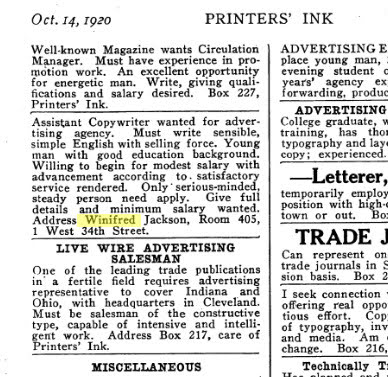
I also found some possible evidence of Jackson’s activity during the time she knew Lovecraft. An advert in Printer’s Ink for 14th Oct 1920 suggests that Jackson may, if the same Winifred Jackson, have been involved in a New York copywriting agency some years before Lovecraft arrived in the city. If so then evidently her radical sympathies did not mean that she could not work for a New York ad agency…
Lovecraft and Braithwaite came into a brief literary contact in February 1930. Braithwaite then produced an annual Anthology Of Magazine Verse. A letter shows that Braithwaite had evidently expressed an anthologist’s interest in an F.B. Long poem that had appeared in Weird Tales. Long had been sent a letter via Weird Tales asking if there were others of that quality to be found in the back-issues. Long had passed the enquiry to his friend Lovecraft who had a complete set of the magazine and an expert’s knowledge of the poetry in it. Lovecraft politely declined to put his own name and poetry forward and could only suggest Clark Ashton Smith — but he recalled that Braithwaite had already recently anthologised Smith. Lovecraft also added a kicker by slyly recommending Moe’s Doorways to Poetry (a cherished Moe-Lovecraft project), and he remarked… “There is no doubt but that you will receive a copy upon its issuance”. Was there then a review or note on this in the Anthology? Probably not, since CORE states of the Anthology… “Publication suspended 1930”, suggesting that Long’s poem may never have made it to the Anthology and that any review or notice of Doorways to Poetry would never have appeared there.

Index to Newspapers published in Rochester

14 Saturday Sep 2013

Posted by asdjfdlkf in Historical context, Scholarly works

≈ Leave a comment

“Index to Newspapers published in Rochester, New York”: online for 1818-1850 and for 1851-1897 (of which the Lovecraft entries are here). Rochester was where Lovecraft’s family had settled on coming to America.

RK – Rheinhart Kleiner: A Memoir, scanned PDF

12 Thursday Sep 2013

Posted by asdjfdlkf in Historical context, New books, Scholarly works

≈ 2 Comments

Here’s a new PDF edition of RK – Rheinhart Kleiner: A Memoir. A new annotated version of a mimographed pamphlet first issued by James Guinane in 1951. My special thanks to Dennis Weiler for generously acquiring a copy of this scarce booklet, and for emailing me the scans needed to make this new annotated version.

Download PDF.

I’ll get this on Archive.org soon too, although yesterday they were down all day for maintenance.

Albert August Sandusky (1896 – c.1934?) of Cambridge, Mass.

11 Wednesday Sep 2013

Posted by asdjfdlkf in Historical context

≈ 7 Comments

I had another look at Albert A. Sandusky, a rather mysterious friend of Lovecraft. We don’t have a birth date, and only have a c.1934? death date for him. He lived in Cambridge, Mass., and this cutting from the Cambridge Chronicle, 7th May 1910, has him performing in a ninth-grade school play…

CambridgeChronicle7 May1910

It seems that, in America, “ninth grade” in May is likely to mean most of the class will have recently hit 15 years of age? If so then that would put his birth date at c.1895. Update: thanks to Miss Allen in the States for pointing out that it’s more like 14. So c.1896.

The same newspaper has him in the city’s school graduation lists in June 1915, where he is named as Albert August Sandusky (which I think is the first time that Lovecraftians have known his middle name?). Sadly this new middle name doesn’t lead anywhere in the online archives, but it might prove useful to those who have access to commercial geneaological databases.

So when the amateur journal The Torpedo (Sept 1913) called him the “youthful editor and publisher” of his Boys’ World magazine, he would have been aged around 17.

There was a Bertha Sandusky who made her way through the Cambridge school system some years ahead of Albert. She is recorded, on her marriage in June 1913, as “of Elm Street” and the daughter of August Sandusky of Cambridge. I’d suspect — given the name, and the fact that Elm Street was also where the school play (see above) was being performed — that August Sandusky may also have been the father of Albert August Sandusky. If so, then the father has left no other trace online.

Kenneth W. Faig Jr., in the Books at Brown Lovecraft special issue, mentions (p.56) that Sandusky became a policeman.

Lovecraft on a rollercoaster

10 Tuesday Sep 2013

Posted by asdjfdlkf in Historical context

≈ 4 Comments

Imagine H.P. Lovecraft trying all the fairground rides at the beach, and then as a finale hurtling down the biggest roller-coaster. It happened, perhaps several times. In November 1921 his fellow amateur Mrs. Miniter wrote up a report of the Boston Convention of amateur journalists of July 1921. This had taken the amateurs to Boston’s Revere Beach amusements park, Boston’s equivalent of Coney Island…

… he [Lovecraft] tried all the soporific stunts at Revere” … “…to Revere Beach, where Mr. Lovecraft dropped eighty-five feet and was all over.” (Lovecraft Remembered, p.83).

wp1

George Houtain expanded on a Revere Beach visit, in a memoir of Lovecraft…

… we all journeyed to Revere Beach. Here Howard Lovecraft and Albert Sandusky did the eighty-five-foot-drop switchback three times in succession and complained bitterly of the tameness of it all. The greatest fun was with [the ride] “Over The Falls” [possibly this was earlier “Neptune’s Frolic”? — see picture below]. After passing through various chambers of trick floors, we were escorted singly and in pairs to a little elevator, where sitting down we expectantly waited either for the elevator to drop or a curtain to go up and the show to commence. Before we could adjust our thoughts, the whole front suddenly gave way, the seat propelled us forward , and in a second we were bounding down the most billowy waves one could imagine. Picture, if you will, the philosophical form of one Henry Padget-Lowe, Edward Softly, Theobald Jr., H.P.L., popping out and coming bouncing toward us. It was a screaming scream.” (Lovecraft Remembered, p.88-89).

His rollercoaster companion Albert Sandusky was the editor of Boys’ World, about six or seven years younger than Lovecraft and so much given to slang that Lovecraft called him “Wisecrack Sandusky” on paper. “Lovecraft met him frequently during trips to the Boston area”, apparently, although little else seems to be known about him other than his early involvement as a boy printer for Lovecraft 1915-1916, and his editing of the Quill magazine for the Hub Journalist Club c. 1923.

Lightning_Revere_Beach_postcard_cropped

rb15

chutes

Here are some of the other attractions Lovecraft could have enjoyed, including a palmist, Hell Gate, Neptune’s Frolic, Dragons Gorge, Japanese Ping-Pong, a “Fatal Wedding” theatre show (a grand guignol?), an animal show with monkeys, the Virginia Reel, The Whirlpool, and more.

rb5-1

$(KGrHqJ,!oIFIFnKuCRJBSGp(V5nNQ~~60_57

$(KGrHqVHJBsFHeFsfLqvBR4KJ!SYnw~~60_57

dragonsg

rb2-1

rb3-1

Wonderlandboston1917

wp20

wp3

It’s also known that Lovecraft visited Coney Island, the world-famous set of amusements, at least twice while living in New York. We also know he enjoyed several attractions there, including the $100,000 Fun House called “The Pit” which had opened in 1923.

Driftwind and Walter J. Coates

09 Monday Sep 2013

Posted by asdjfdlkf in Historical context, Scholarly works

≈ 1 Comment

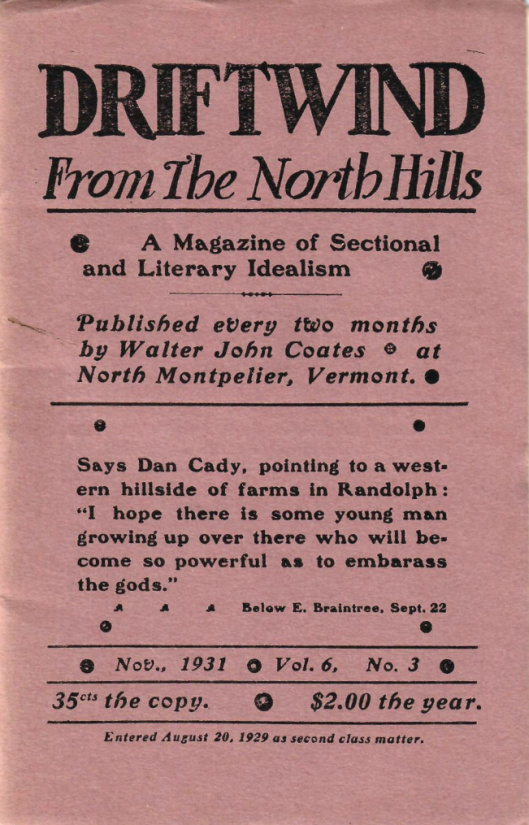
Lovecraft scholars will occasionally come across mention of the amateur journal Driftwind and the Driftwind Press. This is what the issues looked like (from a new eBay listing)…

driftwind

Chris Perridas also has other different covers on show, grabbed from eBay over the years.

The East Montpelier Historical Society has online a detailed historical essay on the magazine and its editor, including several photographs.

Find a Grave has other photographs of Walter J. Coates, from the family…

walter-j-coates

His 250-copy limited edition of his own poetry, Mood Songs (1921), is now scanned and online. The Walter John Coates Papers are now held in the University of Vermont Libraries Special Collections.

The location of “Juan Romero”: Area 52

03 Tuesday Sep 2013

Posted by asdjfdlkf in Historical context, Maps

≈ 4 Comments

Lovecraft’s early failure “The Transition of Juan Romero” (Sept 1919) is located in “the Cactus Mountains”…

“In the summer and autumn of 1894 I dwelt in the drear expanses of the Cactus Mountains, employed as a common labourer at the celebrated Norton Mine, whose discovery by an aged prospector some years before had turned the surrounding region from a nearly unpeopled waste to a seething cauldron of sordid life.”

There really were and are “Cactus Mountains”, which lie south-east of Tonopah. Gold was first discovered there 1900, the gold rush there was 1903, and by 1915 the area south of Tonopah was the U.S.A.’s second biggest gold producing locality. The “Cactus Mountains” can be traced in documents from the 1840s, through to the following article in the Mining and Scientific Press magazine (1912). This article gives some of the history and details of a new 1911 gold discovery at the southern tip of the Cactus Mountains, Lovecraft’s exact setting…

mining1912

There had also been new mines sunk at that spot by a British miner (recalling the nationality of the narrator of “Juan Romero”?), ostensibly for other minerals, back in 1908. The British miner’s name was Samuel G. Knott, and he was president of the Cactus Range Gold Mining company of Goldfield. His Mine Supervisor there was Elmer F. King. So far as my researches can tell, Knott was not known to have previously been in British India (as the British narrator of “Juan Romero” had been).

Mention of these mountains also occurs in a U.S. Navy report of 1977… “The 8 to 10 miles of blasting required along each antenna line occurs in the Cactus Mountains on the Tonopah Test Range…” The mountains are now better known as the Cactus Range (Lovecraft also uses this name in the story) and they form part of a vast highly-restricted military testing ground. The location in particular is now “Area 52, Tonopah Test Range“, sited 30 miles SE of Tonopah …

“lies mostly within the Cactus Flat valley, consisting of horst and graben geology. It is flanked by the Cactus Range hills to the west”

Yes, conspiracy fans, Lovecraft got there first as usual — this Area 52 is the neighbour of the fabled Area 51. 🙂 Which, for some, may bring a new frisson to the story’s descriptions — since they appear to somewhat prefigure the tropes of UFO folklore…

“[the mysterious sound from the newly-discovered bottomless cave] was like the pulsing of the engines far down in a great liner, as sensed from the deck, yet it was not so mechanical; not so devoid of the element of life and consciousness.”

“At first I beheld nothing [in the bottomless pit] but a seething blur of luminosity; but then shapes, all infinitely distant, began to detach themselves from the confusion, and I saw — was it Juan Romero? — but God! I dare not tell you what I saw!”

Another curious co-incidence is that the story “Juan Romero” was not published until 1944. I’m no expert on the history of UFOs, but that appears to be the same year as the UFO craze first started.

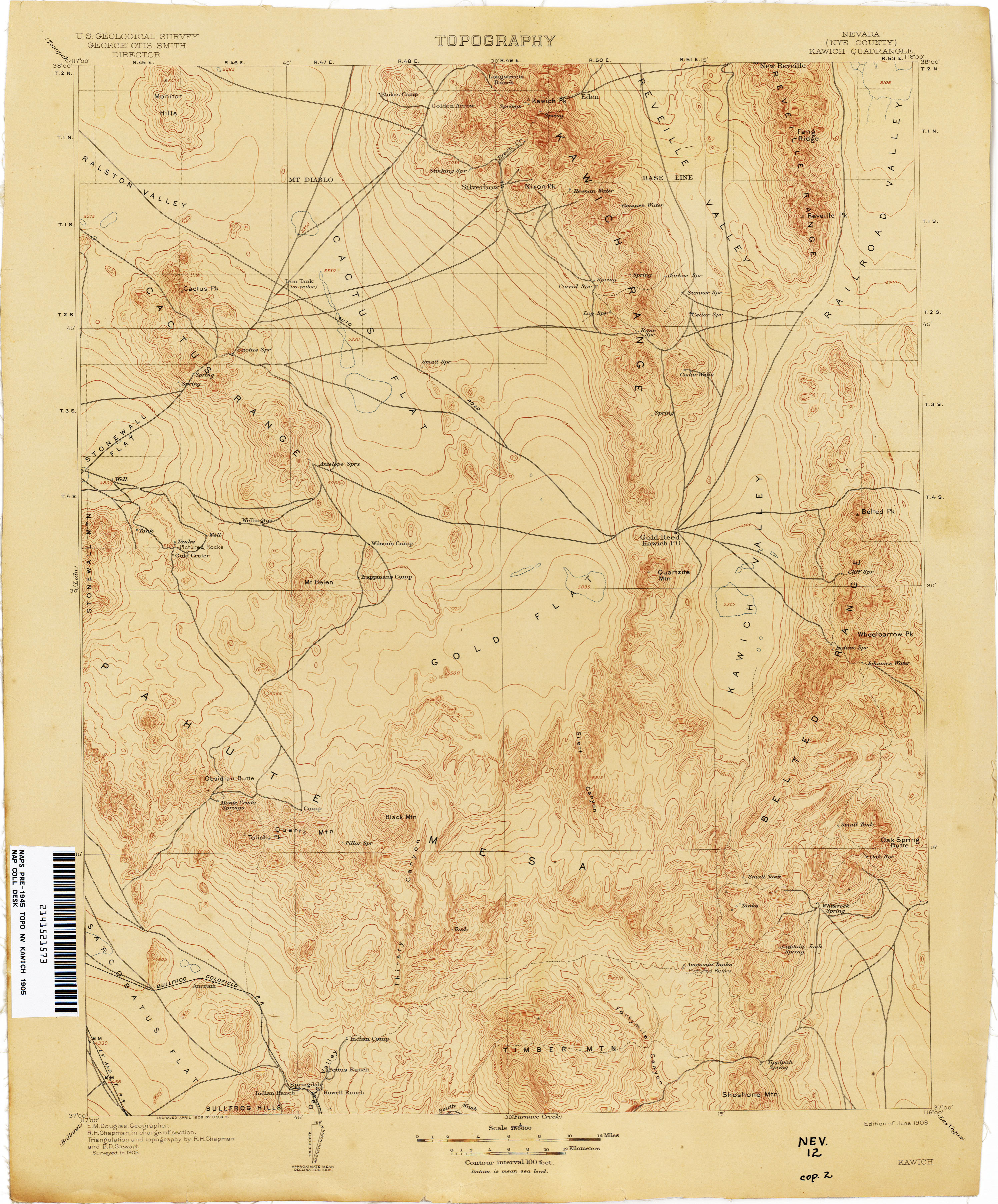
Lovecraft also sites the action in “Juan Romero” directly beneath a “Jewel Lake”. Sadly this name, like the name “Norton Mine”, doesn’t lead anywhere. The area is a volcanic plateau at 6,000 feet, and is very dry on the surface although there are springs and water not far down under the earth. According to the following 1905 topographic map there was no actual named lake at the exact spot, and the history book Preserving the Glory Days: Ghost Towns and Mining Camps of Nye County, Nevada has no mention of a Jewel Lake (or a Norton Mine, for that matter). Although the blue dotted areas on the 1905 topo map perhaps indicate there were temporary flashes of valley-bottom water in winter?

cactus_mountains_1905

There is a huge “Mud Lake” nearby, though. So I wonder if Lovecraft may have flipped the meaning of the name, from Mud to Jewel?

How did Lovecraft come to know of the area? He appears to have been inspired in his choice of a desert setting by reading an amateur journalism author he named in a letter as ‘Phil Mac’ (Prof. Philip B. McDonald), who had apparently used a similar desert / mining setting, but for a “commonplace adventure yarn” (Lord of a Visible World, p.69). It seems Lovecraft had copied out a “dull” and “commonplace adventure yarn” sent to him by McDonald, intending to send the copy to his correspondence circle with a detailed critique of his own. But then he decided to just spend a day writing his own story based on the same or similar setting, and he then sent out both… “Youze gazinks have seen both Mac’s and my yarns.”

Philip B. McDonald graduated M.E. (Master of Engineering) from Michigan College of Mines. In Lovecraft’s The Conservative, McDonald was stated to be “Assistant Professor of Engineering English, University of Colorado” in July 1918, though he later moved to New York to become assistant professor of English, New York University. It appears he was the husband of the noted amateur journalist Edna Hyde McDonald (“Vondy”). McDonald’s desert story was not used in Lovecraft’s The Conservative and seems not to exist today, nor any of his fiction. So we don’t know how closely Lovecraft used, or not, what he called “the richly significant setting” of McDonald’s “dull yarn”.

Dark Swamp trails

02 Monday Sep 2013

Posted by asdjfdlkf in Historical context, Maps

≈ 7 Comments

Stone Wings blog has walked and traced the route of the Lovecraft/Eddy Sunday 4th November 1923 expedition to find the notorious Dark Swamp in western Rhode Island, and reports with fine photographs. Dark Swamp was never actually reached by Lovecraft that day, although he and his “newly adoped son” C.M. Eddy hoped for another trip in summer 1924 that seemingly never happened…

“We now know how to reach the swamp most expeditiously, and will not again lose time in devious inquiries. It will be a pleasing day’s trip, and even tho’ we discover no unsuspected horror, we shall surely behold enough of the darkly picturesque to furnish out a dozen tales apiece.” (Selected Letters I, pp.264-67).

Their not reaching the swamp was probably just as well. Since it reputedly had many snakes, sump pools, and morasses, and was probably filled to brimming by the heavy October rains of that year.

Back in 2001 The Cthulhu Prayer Society (Newsletter, 11th Nov 2001) also followed the route of the walk to Dark Swamp. Jarett Kobek actually made it into part of the Dark Swamp and has online photos of White’s Pond and also part of the swamp.

The swamp had been penetrated by several naturalists early in the 20th century…

“Howard W. Preston, whose Botanical Notebook for the years 1877-1919 awaits and deserves publication, recorded his search for rhododendron in Dark Swamp, Glocester, Rhode Island by the Willie Woodhead Road.” (The Bulletin of the Massachusetts Audubon Society, 1966).

“As early as 1911, Fred Barnes served as a guide into the Dark Swamp in West Glocester for a research group from Brown University” (Glocester, the way up country: a history, guide and directory, 1976).

The swamp was/is not far from Chepachet, the north part of the road from Chepachet to Pascoag being of course the setting for the opening of Lovecraft’s “The Horror at Red Hook”. That was where Malone recoils in horror at reaching the junction and unexpectedly seeing buildings not unlike New York tenements in style. Such buildings can still be seen at that Pascoag junction, using Google StreetView, although they are on the right rather than the left turn. Lovecraft had been for another ramble in this area with Morton, a little earlier in 1923, in search of Durfee Hill (one miles east of the swamp, and Rhode Island’s second highest point), and so it’s possible he may have walked the same stretch of road that appears in “The Horror at Red Hook”.

According to S.T. Joshi’s I Am Providence, the visit to Dark Swamp was also recorded by Lovecraft in a letter to Edwin Baird. But I’m not sure where that’s been published, if it has been.

L. Sprague de Camp wrote in Lovecraft: A Biography that part of the Dark Swamp was submerged by the Ponaganset Reservoir a few years after the Lovecraft/Eddy trip — but judging by the modern satellite photography, trail maps, and the fact that Ponaganset Reservoir was completed in 1865, this cannot be correct.

darkswampri

Similarly shaky on certain points of fact may be Eddy’s recollections of his walks with Lovecraft. They can be found in The Dark Brotherhood and Other Pieces (Arkham House 1966) and reprinted in Lovecraft Remembered. The date of 1966 implies that Eddy was recalling events in the mid 1920s from the viewpoint of the mid 1960s? As I understand it some of these distant recollections of Lovecraft by Eddy, and especially by Eddy’s wife, should not be taken at face value.

Edward Harold Cole (1892-1966)

01 Sunday Sep 2013

Posted by asdjfdlkf in Historical context

≈ 3 Comments

Additional information, including addresses, for Edward Harold Cole (1892-1966), a long-time amateur journalism friend of Lovecraft, who… “frequently visited Cole in the Boston area in the 1920s and 1930s” (An H.P. Lovecraft Encyclopedia). Cole and Lovecraft corresponded from 1914 onwards, and the letters survive but don’t appear to have been yet collected in a single volume book form.

Cole was born in Boston. Harvard notes he lived at 36 Tower St., Somerville, a suburb of Boston in the early/mid 1910s. He was a Harvard freshman in the class of 1915, where he won a scholarship. An H.P. Lovecraft Encyclopedia has details of his brief marriage — his wife died in 1919, the year after she gave birth to their son E. Sherman Cole. Cole became administrative assistant at Chauncy Hall School, Boston, and was later Head of Department of English there, with some sources also having him as head of History. He published his Lovecraft edition of The Olympian (Autumn 1940) from Wollaston, Massachusetts. The book Harvard Class of 1915 (1935) lists him as living at 53 Freeman St., Wollaston, Massachusetts — confirming the same address in Lovecraft’s 1937 address list.

New earthquake-raised island in the Pacific in 1925

01 Sunday Sep 2013

Posted by asdjfdlkf in Historical context, New discoveries

≈ 6 Comments

The earthquake in “The Call of Cthulhu” was purportedly what brought R’lyeh to the surface, as if a new island. But it was also an earthquake which really happened, striking the north-east of North America on 28th February 1925, followed by 55 aftershocks…

image061

It’s an interesting example of ‘real-world intertextuality’ for the reader, in that in February 1928 his young readers would have remembered reports of the real quake three years earlier.

The more studious among his readers may also have remembered the earthquake-raised island that had been found in the Pacific by the famous explorer-biologist William Beebe [1877-1962] in early summer 1925…

“Beebe Discovers a New Island in the Pacific.

ABOARD THE S.S. ARCTURUS, May 2. — Mount Williams and Mount Whiton, the two volcanoes on Albemarle Island, Galapagos group, which broke out in violent eruption on April 10 while this deep-sea expedition of the New York Zoological Society was near by…” (New York Times, 3rd May 1925).

“William Beebe, a scientific investigator, is now on the Pacific Ocean in his good ship Arcturus. He reports the discovery of a new island in the Pacific. It was probably thrown out of the waves by the recent earthquake which shook Japan.” (wire report in Jefferson County Journal, 20th May 1925).

“He had discovered a new island and named it after Prof. Henry Fairfield Osborn, President of the American Museum of Natural History. He had caught, among other curious denizens of the deep, a fish with long, jointed, lighted rods issuing from its head.” (Time magazine, 11th May 1925).

The expedition was seeking things with tentacles, too. Which was probably why Ernest B. Schoedsack, co-director of the movie King Kong, was aboard for the duration with movie-camera in hand. The Arcturus was… “a properly fitted-out scientific research vessel that possessed the ability to dredge [deep-sea] animals from beneath the ocean”. It was meant to explore the depths beneath the Sargasso Sea — and Beebe told a newspaperman that he was especially keen that…

“We will go out to get a specimen of the giant squid,” he explained. “Nothing is known about these fearsome beasts except that whales have been seen fighting with them, engaging in terrific struggles that churned the water and dyed it red. A few remains of these octopi’ have been found in the stomaches of captured whales. In one case there is a record of finding an arm, or sucking tentacle, of one of these creatures 27 feet in length. This would indicate that the monster, whose limb it was, measured at least 58 feet across.” (Daily Princetonian, 16th February 1925).

But the expedition just couldn’t find the vast Sargasso (a 700 x 2,000-mile mass of surface-floating weed that moves around), and so while waiting for its return they appear to have repeated a previous Beebe expedition of 1923 which had been recorded in the book Galapagos: World’s End (1924), a book which became a long-standing best-seller. Due to copyright the book is sadly not scanned and online for free, but The Spectator review highlighted its incident of… “the terrible walking over the lava [on a volcanic island]— a mass of sliding, jagged fragments” — which seems rather similar to the treacherous geometry of R’lyeh. The Spectator review also noted that in the book was…

“[a] photograph which I have no hesitation in saying is one of the two or three most amazing I have ever seen in the field of Natural History — of acres of lava covered with thousands upon thousands of these great reptiles. In the foreground is a fissure, up which crawls a huge crab: it is a picture of a new circle in hell.”

Beebe’s later Arcturus expedition was chronicled in the book The Arcturus Adventure (1926), but that book was published too late to have influenced the conception of “The Call of Cthulhu” (which was plotted in the summer of 1925).

Brown’s “Dexter Ward” manuscript online

30 Friday Aug 2013

Posted by asdjfdlkf in Historical context, Scholarly works

≈ 6 Comments

Brown University Digital Repository: the “The Case of Charles Dexter Ward” manuscript in digital facsimile…

wardman

Archives of the Blue Pencil Club of Brooklyn

29 Thursday Aug 2013

Posted by asdjfdlkf in Historical context, Scholarly works

≈ 2 Comments

I came across a list of the archives of the Blue Pencil Club of Brooklyn, which are held as part of the Katharine Brownell Collier Papers at the Archives and Special Collections Library, Vassar College Libraries, in Poughkeepsie, New York. The 1924-1927 (Lovecraft in New York period) issues of The Brooklynite, are marked as having been annotated.

So far as I can remember, there is no proof that Lovecraft was ever an actual paid-up member of the Blue Pencil Club of Brooklyn. But it’s known that he sometimes went as a guest, usually a guest of his wife. (Update: he joined in 1924). Lovecraft wrote his essay “Cats and Dogs” for them in 1926, though was unable to read it in person at the meeting. The Club included Lovecraft’s friends, such as James Ferdinand Morton (and his later wife, Pearl K. Merritt, also the sister of Dench’s wife), Rheinhart Kleiner (sometime editor of The Brooklynite), and his associate Ernest A. Dench (and presumably also his wife). I think Kirk also went occasionally to Blue Pencil meetings or perhaps to offshoot walking rambles organised by Dench, but he found the members fairly humdrum. There appears to have been a later cross-pollination of members with the Paterson Rambling Club, and probably also with the non-Club amateur gatherings held at Dench’s small home. Possibly Dench’s Writers’ Club, for professionals, was an informal (since it seems to have left almost no trace) offshoot of the Blue Pencil Club — but that’s just my guess.

Note that the Club was established c. Feb 1915, and the Vassar College archive appears to be missing its early publications such as the Blue Pencil Amateur, c.1916.


Blue Pencil Club:

Folder 5.6 Correspondence: among club members re: club organization, meetings, and various written works, 1925-1944, n.d. (12 items)

Folder 5.7 Programs: banquet programs, 1929-1932 (2 items)

Folder 5.8 Publications: memorial booklets for Hazel Pratt Adams and Alice Lovett Lewis, VC 1904, 1922, 1027 (TS, 48 p.)

Folder 5.9 Publications: The Brooklynite, official organ of the BPC, 1917-1918 (TS, 12 p.)

Folder 5.10 Publications: The Brooklynite, 1921 (TS, 6 p.)

Folder 5.11 Publications: The Brooklynite, 1923 (TS, 16 p.)

Folder 5.12 Publications: The Brooklynite, includes annotated issue, 1924 (TS, 16 p.)

Folder 5.13 Publications: The Brooklynite, includes annotated issue and 17th anniversary issue 1925 (TS, 20 p.)

Folder 5.14 Publications: The Brooklynite, includes annotated issue, 1926 (TS, 16 p.)

Folder 5.15 Publications: The Brooklynite, includes annotated issue, 1927 (TS, 20 p.)

Folder 5.16 Publications: The Brooklynite, 1928 (TS, 12 p.)

Folder 5.17 Publications: The Brooklynite, includes 21st anniversary issue, 1929 (TS, 20 p.)

Folder 5.18 Publications: The Brooklynite, 1930 (TS, 8 p.)

Folder 5.19 Publications: The Brooklynite, includes annotated issue, 1931-1932 (TS, 12 p.)

Folder 5.20 Publications: The Brooklynite, includes 25th anniversary issue, 1933 (TS, 34 p.)

Folder 5.21 Publications: The Brooklynite, 1935-1936 (TS, 16 p.)

Folder 5.22 Publications: The Brooklynite,includes annotated issue, 1937-1939 (TS, 16 p.)

Folder 5.23 Publications: The Brooklynite, includes annotated issue, 1940-1944 (TS, 12 p.)

Folder 5.24 Publications: The Brooklynite, n.d. (TS, 2 p., fragments)

Folder 6.51 Blue Pencil Club

← Older posts
Newer posts →


Please become my patron at www.patreon.com/davehaden to help this blog survive and thrive.

Or donate via PayPal — any amount is welcome! Donations total at Easter 2025, since 2015: $390.

Archives

  • March 2026
  • February 2026
  • January 2026
  • December 2025
  • November 2025
  • October 2025
  • September 2025
  • August 2025
  • July 2025
  • June 2025
  • May 2025
  • April 2025
  • March 2025
  • February 2025
  • January 2025
  • December 2024
  • November 2024
  • October 2024
  • September 2024
  • August 2024
  • July 2024
  • June 2024
  • May 2024
  • April 2024
  • March 2024
  • February 2024
  • January 2024
  • December 2023
  • November 2023
  • October 2023
  • September 2023
  • August 2023
  • July 2023
  • June 2023
  • May 2023
  • April 2023
  • March 2023
  • February 2023
  • January 2023
  • December 2022
  • November 2022
  • October 2022
  • September 2022
  • August 2022
  • July 2022
  • June 2022
  • May 2022
  • April 2022
  • March 2022
  • February 2022
  • January 2022
  • December 2021
  • November 2021
  • October 2021
  • September 2021
  • August 2021
  • July 2021
  • June 2021
  • May 2021
  • April 2021
  • March 2021
  • February 2021
  • January 2021
  • December 2020
  • November 2020
  • October 2020
  • September 2020
  • August 2020
  • July 2020
  • June 2020
  • May 2020
  • April 2020
  • March 2020
  • February 2020
  • January 2020
  • December 2019
  • November 2019
  • October 2019
  • September 2019
  • August 2019
  • July 2019
  • June 2019
  • May 2019
  • April 2019
  • March 2019
  • February 2019
  • January 2019
  • December 2018
  • November 2018
  • October 2018
  • September 2018
  • August 2018
  • August 2015
  • July 2015
  • April 2015
  • March 2015
  • February 2015
  • January 2015
  • December 2014
  • November 2014
  • October 2014
  • September 2014
  • August 2014
  • July 2014
  • June 2014
  • May 2014
  • March 2014
  • February 2014
  • January 2014
  • December 2013
  • November 2013
  • October 2013
  • September 2013
  • August 2013
  • July 2013
  • June 2013
  • May 2013
  • April 2013
  • March 2013
  • February 2013
  • January 2013
  • December 2012
  • November 2012
  • October 2012
  • September 2012
  • August 2012
  • July 2012
  • June 2012
  • May 2012
  • April 2012
  • March 2012
  • February 2012
  • January 2012
  • December 2011
  • November 2011
  • October 2011
  • September 2011
  • August 2011
  • July 2011
  • June 2011
  • May 2011
  • April 2011
  • March 2011
  • February 2011
  • January 2011
  • December 2010
  • November 2010
  • October 2010
  • September 2010
  • August 2010
  • July 2010

Categories

  • 3D (14)
  • AI (70)
  • Astronomy (70)
  • Censorship (14)
  • de Camp (7)
  • Doyle (7)
  • Films & trailers (101)
  • Fonts (9)
  • Guest posts (2)
  • Historical context (1,096)
  • Housekeeping (91)
  • HPLinks (77)
  • Kipling (11)
  • Kittee Tuesday (92)
  • Lovecraft as character (58)
  • Lovecraftian arts (1,628)
  • Lovecraftian places (19)
  • Maps (70)
  • NecronomiCon 2013 (40)
  • NecronomiCon 2015 (22)
  • New books (966)
  • New discoveries (165)
  • Night in Providence (17)
  • Odd scratchings (984)
  • Picture postals (276)
  • Podcasts etc. (431)
  • REH (184)
  • Scholarly works (1,470)
  • Summer School (31)
  • Unnamable (87)

Get this blog in your newsreader:
 
RSS Feed — Posts
RSS Feed — Comments

H.P. Lovecraft's Poster Collection - 17 retro travel posters for $18. Print ready, and available to buy — the proceeds help to support the work of Tentaclii.

Proudly powered by WordPress Theme: Chateau by Ignacio Ricci.