• About
  • Directory
  • Free stuff
  • Lovecraft for beginners
  • My Books
  • Open Lovecraft
  • Reviews
  • Travel Posters
  • SALTES

Tentaclii

~ News & scholarship on H.P. Lovecraft

Tentaclii

Category Archives: Historical context

Lovecraft postcard, Aug 1933

02 Saturday Nov 2013

Posted by asdjfdlkf in Historical context

≈ 1 Comment

Lovecraft postcard on offer on the Spanish eBay.

Hornig

cod

Mailed Providence, 10.30pm, 11th Aug 1933. To Charles D. Hornig, on the subject of reprinting a long (“would make a small book”) article formerly published by Paul W. Cook, presumably Supernatural Horror in Literature. Lovecraft is suggesting he might revise it for its second publication in a new fanzine. The postcard ends with congraulations on Hornig’s new “congenial” job as a staffer with Gernsback.

hpl-postcard-aug-1933

Essential Solitude: The Letters of H. P. Lovecraft and August Derleth (p.599) mentions the same address…

“The new weird magazine — Fantasy Fan, 137 W. Grand St., Elizabeth, N.J. — offers an 18 months’ subscription for a dollar. Klarkash-Ton & I are contributing old stuff — no pay, but good way to get…”

So this must be the then seventeen year old Charles D[erwin] Hornig (1916-1999). He was a hard-left socialist who edited the Fantasy Fan magazine (it had an 18 month run, to sixty subscribers, Sept 1933-Feb 1935). His magazine contained a column called “The Boiling Point”, which published heated disputes between Lovecraft and others. Fantasy Fan also published a revised version of Supernatural Horror in Literature, Oct 1933-Feb 1935, although the zine closed before the serialisation was complete. FF also provided an outlet for four of the Fungi from Yuggoth poems.

Hornig was also on the Gernsback staff as editor of Wonder Stories from circa summer 1933 until circa May 1936. Later Silberkliet’s Science Fiction magazine was “edited rather stodgily by Charles D. Hornig” (Damon Knight, The Futurians, p.10). Hornig was known for being heavy-handed with his rejection letters… “Apparently Hornig got a real charge out of rejecting stories” (Heavy Planet and Other Science Fiction Stories, Milton A. Rothman and ‎Darrell Schweitzer, p.305).

New England Vampire Panic

22 Tuesday Oct 2013

Posted by asdjfdlkf in Historical context, Podcasts etc.

≈ Leave a comment

“New England Vampire Panic” history podcast. Starts at 2:46. The first instance sounds similar to “The Shunned House”, in terms of the run of deaths in a family. The second instance in Exeter also recalls the town of Innsmouth, in terms of the depopulation and the accusations of inbreeding.

Providence and Rhode Island c.1943

22 Tuesday Oct 2013

Posted by asdjfdlkf in Films & trailers, Historical context

≈ 1 Comment

Providence in circa 1943…

[youtube=http://www.youtube.com/watch?v=VsFNKsCCwfY&w=420&h=315]

The Shepard Cafeteria

12 Saturday Oct 2013

Posted by asdjfdlkf in Historical context, Lovecraftian arts, NecronomiCon 2013

≈ 1 Comment

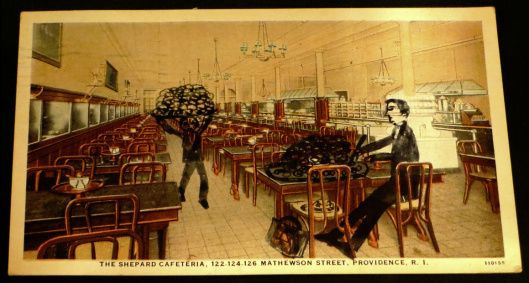
On display as part of the NecronomiCon 2013 exhibitions, a postcard that H.P. Lovecraft sent to Donald Wandrei in 1934, with his own ink drawing overlay and self-portrait. Part of the Brown University collection…

shepardcaf

It presumably shows his black writing materials case, seen resting at the foot of the chair. This was commented on by several people in Lovecraft Remembered, but was never photographed only photographed once.

The Shepard Cafeteria postcard as a clean scan…

The Shepard Cafeteria, 122-124-126 Mathewson Street Providence, RI

“[the Mathewson St cafe] was owned by John Shepard [III], “a radio mogul, [who also] owned department stores in Boston and on Westminster Street in Providence.” (Providence, Arcadia Publising, p.93)

Lovecraft among the Jews

25 Wednesday Sep 2013

Posted by asdjfdlkf in Historical context

≈ 3 Comments

As a follow-up to my recent “Lovecraft on a rollercoaster” post, I’ve come across an even more incongruous event, drawn from the man’s seemingly-bottomless life-story. Lovecraft once spent the evening at the Providence Jewish Community Center, in the company of his latest ‘grandson’ who appears to have been a boy-genius. Presumably he was surrounded by Jewish people. He was there to listen avidly to a lecture from a left-leaning Jewish psychiatrist. Amazing, when you consider Lovecraft’s rhetorical anti-Semitism, but true.

“I remember going with him one evening to some Jewish cultural center, to hear a talk by the Austrian psychiatrist Alfred Adler … Lovecraft was intensely interested in hearing Adler…” (Kenneth Sterling in Lovecraft Remembered, p.379)

Kenneth Sterling was the boy-genius and he lived in Providence for about a year from early 1935, so their trip to see Adler is likely to have been sometime between about late March 1935 and early 1936. Here is Lovecraft describing meeting the fourteen year-old Sterling at Lovecraft’s home in early March 1935…

“the important visitor appeared … a little Jew boy about as high as my waist, with unchanged childish treble [i.e.: voice] & swarthy cheeks innocent of the Gillete’s [razor’s] harsh strokes. He did have long trousers — which somehow looked grotesque upon so tender an infant” (Lovecraft in S.T. Joshi, I Am Providence, p.947)

The speaker that Sterling and Lovecraft went to hear was Alfred Adler. Adler was a leading psychiatrist of the early 1930s, at a time when the new Freudian psychiatry was struggling for acceptance in America. In the simplest terms: Adler tried to tone down the grotesqueries of Freud and the mysticism of Jung, and he was vilified for it by the Freudian faithful. Was Adler in Providence? Yes, very much so, and not simply as part of a whistle-stop national lecture tour…

“Adler assumed his duties in 1932 as visiting professor of medical psychology [at Long Island College of Medicine]”. [He] “gave lectures elsewhere in America from time to time” [… and his Marxist wife was found an appointment at Boston in 1934]. (Phyllis Bottome, Alfred Adler; a biography, pp.229-230).

“Dr. Dey and Miss Dey, the Principal of the Mary C. Wheeler School [on the East Side of] Providence, were among Adler’s special friends” […] “young and stimulating friends, and of great assistance to Adler, since they gave fortnightly meetings at their house to whomever they felt Adler would like to meet.” […and their school they] “gave him the opportunity he valued most of regular work among children” […] “he spoke of this school often to friends in Europe” (Phyllis Bottome, Alfred Adler; a portrait from life, p.203 and p.214).

It therefore seems quite likely that Adler would have accepted an invitation to speak at the city’s local Jewish cultural center. This Center was located just one mile from the Wheeler School in the East Side, where Alder did his work with children. It seems that he gave many talks in the city, from time to time…

“In Providence, Adler spoke at Brown University and the Providence Medical Association. He also addressed the parents and teachers of the Mary C. Wheeler School” (from introduction to Adler, Superiority and Social Interest: A Collection of Later Writings, 1965)

The Jewish Cultural Centre (JCC) had been located at 65 Benefit Street since 1914. It was named the Hebrew Education Institute from 1914-1925, then became known as the Jewish Community Center in 1925. This re-naming in 1925 marked a radical new mission — to appeal to any and all Jews in the city, secular or religious….

“It counted within its membership persons from all walks of life and every part of the city. […] it had over 100 organized activities catering to many human needs and desires. [One of its declarations was…] ‘NOT a partisan in discussion — BUT the home of discussion’.” (Horvitz, “The Jewish Community Center of R.I.”, Rhode Island Jewish Historical Notes, Nov 1972, pp.157-158).

It’s also interesting to note that Lovecraft would perhaps have seen the Adler lecture introduced by one Jacob I. Cohen. J.I. Cohen was the Jewish Community Center’s Director from 1926 to 1948. Not only was Cohen a Jew, but — judging by Cohen’s photograph — Lovecraft’s horrified eyes may well have detected a partial black ancestry. One wonders quite how tightly Lovecraft was gripping his chair-arms at that point…

jacobcohenprov

Dr. William F. Channing (1820-1901)

25 Wednesday Sep 2013

Posted by asdjfdlkf in Historical context

≈ 3 Comments

An interesting addendum to my recent dive into Orville Livingstone Leach. Parallel to Leach, and probably giving tacit credence to Leach’s quackery, there was another and more high-class purveyor of medical electricity in Providence. This was Dr. William F. Channing (1820-1901), a Providence doctor who was also a free-thinking scientist and inventor. He was the author of the book Notes on the Medical Application of Electricity (1849) which went through six editions. In the back of this book there is a fearsome list of electrical ‘medical’ apparatus for purchase…

Channing_1849

Dr. Channing was also Sarah Helen Whitman’s literary executor, Whitman being of course well known to Lovecraft as a romantic interest of Poe.

What immediately struck me is the name Dr. William F. Channing. It is very similar to that of William Channing Webb, the anthropologist found in “The Call of Cthulhu”. Note that I don’t say that Lovecraft’s Webb was based on Dr. Channing. I’ve already established in Walking with Cthulhu what I think is a good case that William Channing Webb was based on the career and activities of the anthropologist Franz Boas.

There seem to have been several William Channings around at that time, seemingly from branches of the same family. Dr. William F.’s relation William Ellery Channing (1817–1901), for instance… “was a Transcendentalist poet and member of the Transcendental Club” and was a bosom friend of Henry David Thoreau. There was also a William Henry Channing (1810-1884) in the family, who was a Fourier socialist and emancipationist. But it is the scientific aspects of Dr. William F. Channing, and his role in Providence life, which mark him as the most likely member of the clan to have had his name borrowed by Lovecraft.

Dr. William F. Channing also had a Charlotte Perkins Gilman connection…

“Charlotte [of “The Yellow Wallpaper” fame] was a frequent visitor at the Providence home of the family of Dr. William F. Channing… [and became a lifelong closer-than-sisters friend of one of the daughters of the house]” (Ann J. Lane, To Herland and Beyond: The Life and Work of Charlotte Perkins Gilman, p.137).

Presumably her husband Charles Walter Stetson accompanied her on the Channing visits. Stetson was Providence’s pagan visionary artist, and co-designer with Burleigh of the Fleur de Lys building. I have previously suggested Stetson as the model for Wilcox in “The Call of Cthulhu”, the Providence pagan artist who Lovecraft describes as a… “thin, dark young man of neurotic and excited aspect”.

Like the quack doctor Leach, Dr. William F. Channing also tinkered with inventions as well as medical electricity. Like Leach, he also happened to strike it rich with one of these inventions. He was fascinated by the telegraph, and patented a telegraphic fire alarm which was taken up by a manufacturer and sold widely. At the time some called him the inventor of the fire alarm, although today there are half-a-dozen contenders for that title in the United States alone.

In the 1870s he corresponded with Alexander Graham Bell (1847-1922), who lived in Boston and who was the inventor of the telephone system. Popular Science Monthly (1877) wrote of…

“Dr. William F. Channing, of Providence, who, with other gentlemen of that city, have taken an active interest in the telephone from the outset, and contributed valuable aid to Prof. Bell in perfecting his invention.”

Channing later seems to have fallen out with Bell. Since he wrote a popular article in 1883 claiming another man had invented the telephone.

Given Lovecraft’s interest in electricity (“From Beyond”), and the telephone (“Randolph Carter”) in some of his stories, and his interest in the history of science and free-thinking in Providence, Dr. Channing seems to be of possible interest to Lovecraftians. There is also the previously mentioned residence in Providence, and connection with Poe.

Finally, I note that in 1869 Dr. Channing was Secretary and Treasurer of Rhode Island Society for the Encouragement of Domestic Industry, and was the Secretary of their Fine Arts committee. Possibly he was also involved with Providence societies for the arts in later decades. One wonders if, in this and similar offices, he was known to some of Lovecraft’s older relatives?

Orville Livingston Leach (1859-1921)

23 Monday Sep 2013

Posted by asdjfdlkf in Historical context, Scholarly works

≈ 1 Comment

I note that there’s an interesting piece included in the new Lovecraft Annual, although I have yet to receive a copy. This is… “Letters between H.P. Lovecraft and Orville L. Leach”, edited by Donovan K. Loucks.

Here’s what I can dig up online about Orville Livingston Leach (1859-1921), inventor, successful patent medicine purveyor, Rhode Island pleasure park owner, and a truly cosmic loon who believed the earth was hollow and the Millennium was near. In his dotage he had a cranky book to prepare, and he sounds like a prime candidate to have been a Lovecraft revision client c.1919-1921.

He was the youngest son of Elihu Leach and Sarah Lovisa Leach, and was born at Raynham, Mass. In 1886 he married Theresa Walsh but had no children. In the 1896 Providence Directory he was a seller of patent medicines via a remedy company. He was living at Prairie Avenue, Providence — about a mile south of College Hill. He seems to have moved around a lot around the turn of the century, but he is in one genealogy book with a note that he kept… “the Emory House in Providence”.

This house either took or gave the name to the Order of Emorians, which he founded. This order was originally the Evergreens, a “Life & Longevity League”, and was probably founded in the early or mid 1890s to promote his patent remedies and health regimens? He later became the… “Secretary of the Order of Emorians, Providence Lodge”. There was also an English branch of the Emorians, possibly a franchise for his patent medicines.

He was also President of the Emorian Marching Band aka Bartlett’s Emorian Concert Band. This band presumably paraded in Emery Park, of which he was the owner from c.1896-1921. Emery Park was a popular recreation ground some four miles SW of Providence, near the New London Turnpike. This Park is mentioned many times as the location for field days and annual outings of local trades federations, employee groups, and the like, in the early decades of the 20th century. Presumably it was landscaped and equipped as a sort of picnic gardens with a parade field, and perhaps with ‘medicinal’ springs and baths etc, serving as a free introduction to his patent cures?

He was also an inventor, patenting a new type of tyre, an “electrocardiographic electrode device”, and a “medicinal electrode” in 1901…

“This invention relates to improvements in electrodes for applying electric treatment to increase the vitality in animal bodies to cure diseases, and by supplying force which is adapted for the use of organized bodies to give strength and eradicate microbes and germs by subjecting them to the force which while beneficial to the higher types of organisms will overpower and destroy the disease germs. It is known to scientists that the filaments of nerves are tubular and that the nerve impressions travel with a spiral motion…”

In 1907 he patented a “Hair growth method and apparatus”, and then a storage battery in 1918. His tyre may have actually had some genuine commercial success, and was at least notable in the industry…

“THE Boston Herald devotes a page to stating the theory of Orville Livingston Leach, of Auburn, Rhode Island, that the earth is inhabitable in the interior. The name of Mr. Leach, by the way, doubtless is familiar to many of our readers as the inventor of a bicycle tire and of a solid rubber automobile tire, but it would appear that he is no less interested in making his cosmic theory known than in developing his tires.” (India Rubber World, Dec 1907).

Here’s a similar report from The New Enterprise (Florida) June 04, 1908…

leachhollow

Although some of the tire profits may have been taken in legal costs…

“The Emery Tire Co. (Providence, Rhode Island) have filed a suit for $20,000 damages against Orville L. Leach, the inventor of the cushion vehicle tire which they are exploiting, on the ground that, contrary to his agreement with the company, he has not admitted them to an interest in a patent for an improvement of the tire…” (India Rubber World, 1902)

In his final years he aspired to publish his fringe beliefs. Here is the cover of his loon-tastic 84-page “handbook of the Millennium” The White Spark (1920)…

7158060-L

A “Books Received” notice in Reedy’s Mirror suggests The White Spark was circulated to newspapers with additional pamphlets…

“The White Spark and Two Pamphlets by Orville Livingston Leach. Providence, Rhode Island : Rhode Island Scientific Research Association . A new philosophy which claims to give a key to the universe.”

It’s a hilariously loony book, and if Lovecraft did revise it he may have been chuckling to himself the whole time.

The Rhode Island Scientific Research Association seems to have been incorporated c.1912, presumably by Leach, and has left almost no trace. I’d suspect it was just a pamphlet imprint for his patent medicine promotional materials and cranky pamphlets?

“a corporation, under the name of Rhode Island Scientific Research Association, for the purpose of the investigation, discovery, elucidation, and dissemination of science…” etc.

Leach died in late 1921, and his Emery Park died with him…

“…on December 31, 1921 the local papers announced the death of Orville L. Leach, owner and operator of Emery Park for over a quarter of a century, and Emery Park seems not to have been able to survive him.” (Gladys W. Brayton, Other ways and other days, p.103).

Parker’s Composition

19 Thursday Sep 2013

Posted by asdjfdlkf in Historical context, Odd scratchings

≈ Leave a comment

More of Lovecraft’s favorite books, Richard Green Parker’s Aids to English Composition and Progressive exercises in English composition. The latter he sent to at least one promising revision client (Zealia Bishop).

Composition

The Whately Burials

18 Wednesday Sep 2013

Posted by asdjfdlkf in Historical context, Odd scratchings

≈ 1 Comment

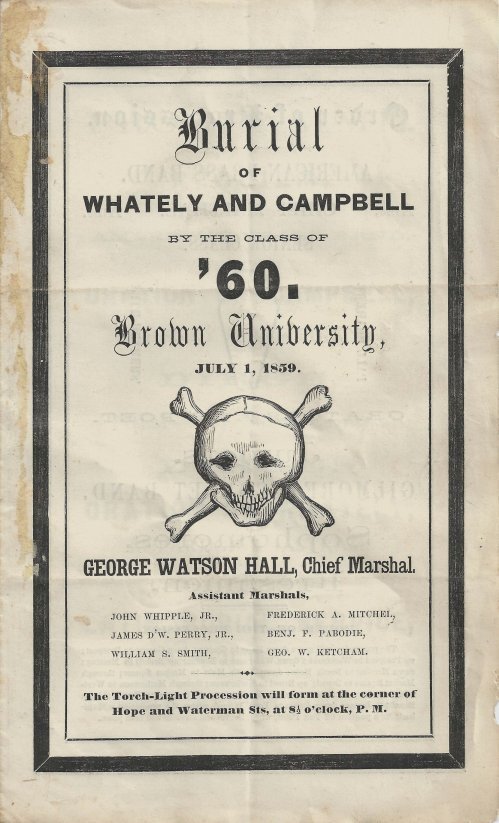
It’s interesting to learn that there was once a weird end-of-term tradition among junior Brown University students in Providence. In early July each year they would parade in a boisterous throng from the University to the Seekonk River by flaming torchlight, in order to “bury Whately”. This appears to have been done from 1833-8, then again from 1853-9 — when the tradition ended due to the advent of the Civil War.

Whately is of course rather a similar name to Whateley, the famous name from Lovecraft’s story “The Dunwich Horror”. Wilbur Whateley ends up horribly dead in the “reading-room” of a university library, you’ll remember. He evaporates, and so cannot be buried.

what-brown

“…[the] earliest known program [for the “Junior Burials”] being for the year 1853. On these occasions there was a procession through the city streets with a brass band, banners and burning torches, as the rhetoric textbooks of Richard Whately, George Campbell, and William Spalding were conveyed in a coffin to Ferry Wharf [Fox Point, Providence, at the confluence of the Seekonk and Providence Rivers]. There the students embarked in boats to an offshore spot where the funeral ceremonies were conducted, complete with orations on the textbook authors, a poem and an ode, and the books were thrown overboard [sealed in a coffin].” (Encyclopedia Brunoniana)

According to Encyclopedia Brunoniana the tradition was taken up again in the 1870s, without the books of Whately but with more ghoulish costumes — and this time a burning of the books rather than a burial-at-sea…

“They were later revived as a “cremation,” and the textbook authors singled out [as] Elias Loomis on analytical geometry and Thomas B. Shaw’s Manual of English. The later processions did not head for the boats, but paraded across Red Bridge (and, once across, opened the draw bridge with the approval of the appropriate authorities) and burned the offending books. The cremation held in 1875 was described in rhyme in a local newspaper under the heading, “Brown Boys ‘On the Rampage’”:

“Thursday, by early candle light,
appeared a strange and grotesque sight,
upon the College Campus green,
a sight as queer as e’er was seen.
It was the Brown boys, out in force,
to celebrate in usual course,
their Class Day eve, with mock display,
and mimic funeral pageantry.
The Juniors, in outlandish guise,
bedecked themselves to strike surprise
to all who saw them thus arrayed,
on their accustomed street parade.
Some wrapped in winding sheets were ‘most
too noisy for a sober ghost,
and some wore horns, in travesty
of his Satanic majesty,
The latter seemed, upon the whole,
familiar with the title role,
and many, as the train went by,
inclined to Darwin’s theory.
From street to street the cavalcade,
with blatant hand, its progress made;
red robes, a skull and cross-bones bare,
looked hideous in the torches’ glare.
Beyond the [River] Seekonk’s further shore,
the strange procession marched, and bore
an English text-book, with Greek fire,
burned on a mock funeral pyre.
This frolic o’er, each Junior sped
at midnight to his little bed,
ending in peace this revel queer,
which comes, thank God, but once a year.”

The tradition had its last year in Providence in 1884, when the books documenting the university marking-system were buried (the Brown lecturers had started to complain that the students were becoming embarrassingly likely to burn textbooks written by Brown staff).

What of Whately? Richard Whately (1787-1863) was not actually a Professor at Brown University, but was rather the British free-market intellectual and nominal churchman who was the author of the hugely influential Elements of Rhetoric (1828) and Elements of Logic (1826), and also the editor of Bacon’s Essays with annotations (1857). Lovecraft’s use of the name Wilbur for Wilbur Whateley is a red herring if one looks for it in the real Richard Whately — since it is an obvious nod to Wilbraham, the topographical inspiration for “The Dunwich Horror”.

Could Lovecraft, so ardent a student of his city’s history and of ghoulish burials, have known of the Whately burial tradition? Possibly, although there is no evidence in the surviving letters that I know of. Nor is it in the city histories. A city prefers to forget many things about itself.

The Other Mr. Lovecraft

17 Tuesday Sep 2013

Posted by asdjfdlkf in Historical context, New books, New discoveries

≈ 3 Comments

New on the Kindle store at Amazon, David Acord’s The Other Mr. Lovecraft: A True Story of Tragedy and the Supernatural From H.P. Lovecraft’s Family Tree

“In this original [10,000 word] non-fiction monograph, author David Acord (When Mars Attacked: Orson Welles, The War of the Worlds and The Radio Broadcast That Changed America Forever) shines a light on a forgotten aspect of Lovecraft’s family tree: the troubled life of his [father’s] cousin Frederick [1850-1893], a once-prosperous businessman in 1890s New York City. When Frederick committed suicide in [6th Oct] 1893, it caused a sensation, with wall-to-wall coverage in all of the major papers, including The New York Times. His death triggered a pitched battle over his estate and revealed a secret romance with one of the most beautiful actresses in America [May Brooklyn], who took her life several months later. After her death, a tragic story of grief, spiritualism and obsession with the supernatural was revealed.”

I haven’t yet seen this new work, but the blurb seems factually correct. Although I suspect any spiritualist aspect of the case may be a new discovery(?). How much H.P. Lovecraft knew of the truth of the case is not known, or even if he knew of it at all. Those were the pre-microfilm and pre-Web days when even yesterday’s newspapers were hard to get hold of, still less the newspapers from twenty years before. But there may well have been family stories around the event.

Frederick Lovecraft was a treasurer of Palmer’s theater in New York, and May Brooklyn was its leading lady. Shortly before his death he had lost around $100,000 in…

“numerous schemes which loaded him down with worthless stocks” … “Day by day he grew worse and was finally seized with nervous prostration. Mr. Lovecraft’s delusion was that all his money was gone and that he was a poor man. Col. Kearney went over his friend’s fund account and found $60,000 of his fortune remained, but it was impossible to get Lovecraft to believe this.” (Evening Star, October 27 1893).

Possibly this $100k was the bulk of money he had in the jewellery trade, as he was also… “a partner in the firm of Williamson & Co., 26 Union Square, and a director in the Essex Watch Co.” (Jewelers’ Circular and Horological Review, 1893). The New York Times stated that “he owned outright” Williamson & Co. which was a “jewelry manufacturing concern”. Perhaps he also felt he had let down, or even ruined, other men involved in one or more of these jewellery businesses? Was his cousin, Winfield — Lovecraft’s father — perhaps even one of those men, since there was a vague memory that he had once worked in jewellery? Winfield had gone mad in April 1893, six months before Frederick Lovecraft’s suicide.

His 1894 probate hearing concurred with the diagnosis of acute depression…

“He seemed to be in a very depressed condition,” said Dr. Robertson. “He took no interest apparently in anything that was transpiring, when spoken to, he answered in monosyllables, He was exceedingly pale, and complained of insomnia and nervousness. He said he was hardly able to attend to his business.” Dr Robertson said that Lovecraft was “suffering from melancholia, following delusions.

“What was the condition of his eyes?” asked a lawyer. “Were they vacant or full of life as in ordinary men?”

“I couldn’t tell. I could hardly induce him to look up. He kept his head bowed down. Everything indicated acute melancholia.”

I wonder if the author of this new monograph has discovered that Frederick Lovecraft’s “warm personal friend” in the theatre, Mr. W.B. Palmer, also committed suicide by the same method as Frederick, two years later in early September 1895?

wbpalmer

Howard V. Brown

17 Tuesday Sep 2013

Posted by asdjfdlkf in Historical context, Lovecraftian arts

≈ Leave a comment

The Golden Age blog has a new gallery of the pulp art of Howard V. Brown, the artist who gave Lovecraft his Astounding cover and interior illustrations for “The Shadow Out Of Time”…

shadow-artist

Ernest La Touche Hancock (1857-1926)

16 Monday Sep 2013

Posted by asdjfdlkf in Historical context

≈ 2 Comments

In Lovecraft Remembered Kleiner mentions a New York friend of Lovecraft, Ernest La Touche Hancock (b. Shanghai, 1857 — d. NYC 1926). Lovecraft knew Hancock in New York, and liked him enough to lend him his own books. But then Hancock died suddenly in 1926. The address at which the precious books were kept was not known to the Lovecraft circle, so Kleiner surmises that they were probably never returned to Lovecraft.

Hancock was an accomplished and long-standing commercial light comic versifier, at a time when one could actually make a living in that manner through syndication in newspapers. He once even managed to land a comic poem in the Hog Fancier’s Gazette. He was also sometimes a humorous lyric writer for musical theatre, and an occasional light music critic.

Lovecraft may not have initially known Hancock’s verse from various popular magazines such as Judge’s Library: a monthly magazine of fun, Harper’s, Lippincott’s, and Puck etc. — since Lovecraft didn’t confess to reading such magazines in his youth. But on meeting Hancock he may have recalled the name and poetry from his old copies of Railroad Man’s Magazine (1906-), a Munsey magazine of which he had once been an avid cover-to-cover reader and subscriber. Hancock had also published in Munsey magazines such as The Cavalier, and Argosy All-Story Weekly.

Hancock would have greatly interested Lovecraft because he was uncompromisingly British and Imperialist. He was a member of the St. George Society around 1921. A flavour of their Anglo-American fervour was once given by the New York Times…

ST. GEORGE SOCIETY ANNUAL BANQUET; Three Hundred Guests Gather at Anglo-American Love Feast. Patriotic Songs of Both Nations Sung and Cheers Given for King Edward and President McKinley. (New York Times c.1900)

One wonders if Hancock may have invited Lovecraft along as a guest, circa 1924-5?

Hancock had been born in British Shanghai, China, the son of Herbert Matthews who was an attache to the British Embassy there. Hancock schooled at a public school in England, and was later to be found in British India as the editor of The Rangoon Times 1879-c.1880. Hancock had traveled extensively in Egypt, perhaps shortly after leaving The Rangoon Times, and one wonders if this experience meant that he might have been consulted by Lovecraft on the accuracy of the local colour used in “Under the Pyramids”?

Around that time he wrote a book for boys, A Mesmeric Ordeal (c.1880), now incredibly obscure but seemingly published under the name “E.L.H.” Mermerism means hypnotism, so one wonders if he had once had an interest in the subject?

He then returned to England and lived in Marylebone, central London, during the mid-late Victorian period. There he was editor of The Windsor Gazette 1882—?. So he would have been able to vividly describe to Lovecraft the great London fogs of the 1880s, and probably many details of London high-society and the literary/artistic life of that time.

In 1877 he married a Jersey City socialite’s daughter, Charlotte Youlin, against his family’s wishes. They settled in New York City in 1890 or 1891, thus missing the decadent “Yellow ’90s” period in English literary life. Hancock settled down in NYC as a journalist and newspaper editor, living at West 133th Street, Manhattan. He would have been able to tell Lovecraft many tales of the poets of New York in the 1890s.

Hancock was also something of an early historian of the comic arts around that time, publishing in 1902 a multi-part history “American Caricature and Comic Art”. Those were the days of The Yellow Kid, and Krazy Kat, and the pungent satirical editorial cartoon. Hancock could have no doubt given Lovecraft a decent ten-minute history lesson on the American proto-comics, if he had so wished.

Hancock had moved to the “Bronx Assembly District 34” by 1910, having been divorced with public bitterness in January 1903 (unfaithfulness with unspecified others was given by newspapers as the cause). In the 1909 Who’s Who in New York Hancock was recorded at 134 West, 37th St., New York City, about a mile south of Central Park. He appears to have known Brooklyn well, and perhaps before 1910. He was a key member, from the early years of the twentieth century, of the Brooklyn Press Club and the Blue Pencil Club of New York (not to be confused with the later amateur journalism club of the same name, of Brooklyn). The latter was a well equipped private gentleman’s club just along the street from the Brooklyn Citizen offices. His catch phrase at the Brooklyn Press Club was a roaring call to the Club’s head assistant, George: “More typewriter paper, George!” He later had an office above 5 Willoughby Street, the Brooklyn Press Club premises.

By 1916 he was recorded at 170 Nassau St, NYC, a half-mile NW of the Brooklyn Bridge — although that was also the address of New York Sun, so it was probably simply a convenient mailing address. At around this time his two sons were in the silent movie newsreel business in New York City, being key founders of Fox News (1919–1930).

Hancock was certainly living in the Kings/Flatbush section of Brooklyn when Lovecraft knew him, c.1925-6. At that time he was in his 60s, and was probably semi-retired. But the exact address still remains unknown.

Back in the spring of 1911 he had been made the Editor of the new society weekly The Sandpiper, which covered the summer season on “the Rockaway peninsula” (Rockaway, Queens, a ten mile strip of resort coast more popularly known as The Rockaways). The Sandpiper was published from there, at Arverne. One might suspect that he was chosen as Editor because that was where he chose to holiday in the summer. One of his poems runs…

You will find that it will pay
To invest down Arverne way

A Brooklyn almanac of 1912 confirms an Arverne address for Hancock, though does not specify the street and number. Possibly Lovecraft’s lost books were left in one of the summer cottages there, some time in 1926?

This appears to be the only online image of him…

images

It appears that only the Harvard University scan of Desultory Verse has this front picture (there are two other scans online, from other libraries), but it is currently locked down by Google Books and is unavailable except as a thumbnail.

← Older posts
Newer posts →


Please become my patron at www.patreon.com/davehaden to help this blog survive and thrive.

Or donate via PayPal — any amount is welcome! Donations total at Easter 2025, since 2015: $390.

Archives

  • March 2026
  • February 2026
  • January 2026
  • December 2025
  • November 2025
  • October 2025
  • September 2025
  • August 2025
  • July 2025
  • June 2025
  • May 2025
  • April 2025
  • March 2025
  • February 2025
  • January 2025
  • December 2024
  • November 2024
  • October 2024
  • September 2024
  • August 2024
  • July 2024
  • June 2024
  • May 2024
  • April 2024
  • March 2024
  • February 2024
  • January 2024
  • December 2023
  • November 2023
  • October 2023
  • September 2023
  • August 2023
  • July 2023
  • June 2023
  • May 2023
  • April 2023
  • March 2023
  • February 2023
  • January 2023
  • December 2022
  • November 2022
  • October 2022
  • September 2022
  • August 2022
  • July 2022
  • June 2022
  • May 2022
  • April 2022
  • March 2022
  • February 2022
  • January 2022
  • December 2021
  • November 2021
  • October 2021
  • September 2021
  • August 2021
  • July 2021
  • June 2021
  • May 2021
  • April 2021
  • March 2021
  • February 2021
  • January 2021
  • December 2020
  • November 2020
  • October 2020
  • September 2020
  • August 2020
  • July 2020
  • June 2020
  • May 2020
  • April 2020
  • March 2020
  • February 2020
  • January 2020
  • December 2019
  • November 2019
  • October 2019
  • September 2019
  • August 2019
  • July 2019
  • June 2019
  • May 2019
  • April 2019
  • March 2019
  • February 2019
  • January 2019
  • December 2018
  • November 2018
  • October 2018
  • September 2018
  • August 2018
  • August 2015
  • July 2015
  • April 2015
  • March 2015
  • February 2015
  • January 2015
  • December 2014
  • November 2014
  • October 2014
  • September 2014
  • August 2014
  • July 2014
  • June 2014
  • May 2014
  • March 2014
  • February 2014
  • January 2014
  • December 2013
  • November 2013
  • October 2013
  • September 2013
  • August 2013
  • July 2013
  • June 2013
  • May 2013
  • April 2013
  • March 2013
  • February 2013
  • January 2013
  • December 2012
  • November 2012
  • October 2012
  • September 2012
  • August 2012
  • July 2012
  • June 2012
  • May 2012
  • April 2012
  • March 2012
  • February 2012
  • January 2012
  • December 2011
  • November 2011
  • October 2011
  • September 2011
  • August 2011
  • July 2011
  • June 2011
  • May 2011
  • April 2011
  • March 2011
  • February 2011
  • January 2011
  • December 2010
  • November 2010
  • October 2010
  • September 2010
  • August 2010
  • July 2010

Categories

  • 3D (14)
  • AI (70)
  • Astronomy (70)
  • Censorship (14)
  • de Camp (7)
  • Doyle (7)
  • Films & trailers (101)
  • Fonts (9)
  • Guest posts (2)
  • Historical context (1,096)
  • Housekeeping (91)
  • HPLinks (77)
  • Kipling (11)
  • Kittee Tuesday (92)
  • Lovecraft as character (58)
  • Lovecraftian arts (1,628)
  • Lovecraftian places (19)
  • Maps (70)
  • NecronomiCon 2013 (40)
  • NecronomiCon 2015 (22)
  • New books (966)
  • New discoveries (165)
  • Night in Providence (17)
  • Odd scratchings (984)
  • Picture postals (276)
  • Podcasts etc. (431)
  • REH (184)
  • Scholarly works (1,470)
  • Summer School (31)
  • Unnamable (87)

Get this blog in your newsreader:
 
RSS Feed — Posts
RSS Feed — Comments

H.P. Lovecraft's Poster Collection - 17 retro travel posters for $18. Print ready, and available to buy — the proceeds help to support the work of Tentaclii.

Proudly powered by WordPress Theme: Chateau by Ignacio Ricci.