• About
  • Directory
  • Free stuff
  • Lovecraft for beginners
  • My Books
  • Open Lovecraft
  • Reviews
  • Travel Posters
  • SALTES

Tentaclii

~ News & scholarship on H.P. Lovecraft

Tentaclii

Category Archives: Historical context

Howard Days: recording of a panel on the Lovecraft – Howard letters

25 Tuesday Sep 2018

Posted by asdjfdlkf in Historical context, New books, Podcasts etc., REH, Scholarly works

≈ Leave a comment

From 2015, a one-hour panel discussion by scholars of the two-volume A Means to Freedom: The Letters of H. P. Lovecraft and Robert E. Howard.

Part of Ben Freiberg’s fine and seemingly comprehensive collection of recordings of the ‘Howard Days’ panels and speeches. ‘Howard Days’ look excellent and, as as I’m never likely to get to Texas, a big thanks to Ben for placing clear recordings online.

The Music of Harold Farnese

24 Monday Sep 2018

Posted by asdjfdlkf in Historical context, Lovecraftian arts

≈ 1 Comment

Harold S. Farnese didn’t write any stories, poems, or articles for Weird Tales, nor was he a cover artist or illustrator. His eight letters published in “The Eyrie,” the letters column of Weird Tales, failed to land him in the top twenty contributors in that category. [Yet he] may have been the first person to adapt a work by H.P. Lovecraft to a form other than verse or prose.

Harold S. Farnese, Part One.

Harold S. Farnese, Part Two.

Harold S. Farnese, Part Three.

Harold S. Farnese, Part Four.

Harold S. Farnese, Part Five.

Harold S. Farnese, Part Six (final part).

From Tellers of Weird Tales. See also his post on “The Lovecraft-Farnese Correspondence” with a new timeline.

“Robert E. Howard, Bran Mak Morn and The Picts”

24 Monday Sep 2018

Posted by asdjfdlkf in Historical context, Podcasts etc., REH, Scholarly works

≈ Leave a comment

A curious thing, but welcome. A 54-minute reading of a scholarly essay, in an audiobook style more suited to reading Conan. The essay is by Rusty Burke and Patrice Louinet, “Robert E. Howard, Bran Mak Morn and The Picts”, and it appears to have been recorded because it was part of the Howard collection Bran Mac Morn: The Last King, Del Rey, 2005. Now on YouTube. Backup: Mirror.

Genuine Pictish or Irish brooch, circa 800 A.D. Note the ‘winged ones’ perched around the edge of the design which circles the amber stones…

A headstone for ‘Tryout’ Smith

22 Saturday Sep 2018

Posted by asdjfdlkf in Historical context

≈ Leave a comment

In the Eagle Tribune, Mass., newspaper today. I won’t link to the full story, as they block all Web traffic from the UK and Europe.

‘Tryout’ Smith finally gets a headstone

22nd Sept 2018.

HAVERHILL — A Haverhill man who operated a small printing press in his shed on Groveland Street more than 100 years ago and helped launch the career of horror-fiction author H.P. Lovecraft and others now has his own headstone at the Hilldale Cemetery.

Charles W. “Tryout” Smith, who lived from 1852 to 1948, was an early pioneer of the amateur journalism movement. He will be honored on Saturday with a ceremony capped by the placement of a headstone at his gravesite, where previously only a stone for his father, a Civil War veteran, existed.

“Tryout Smith was a very well known figure in a very specific market, the amateur journalism movement at the start of the 20th century,” said historian and author David Goudsward, a Haverhill native.

Securing a grant from The Aeroflex Foundation, Goudsward, 57, contracted with Atwood Memorial to craft a headstone at Hilldale. A dedication ceremony is Saturday [22nd] at 6:30 p.m. as part of Essex Heritage’s Trails & Sails.

Also on Saturday is a display of Smith’s work, the release of a commemorative booklet and self-guided tours with H.P Lovecraft significance taking place between 1 and 4 p.m., at the Buttonwoods Museum, 240 Water St.

Goudsward, who grew up in the Ayers Village section of Haverhill, lives in Palm Beach County, Florida with his wife, Heather Bernard, also a Haverhill native.

[… and then the article goes on to give a potted account of Smith’s biography and connections with Lovecraft, which readers of this blog will already know about or be able to find on their shelves.]

The local radio station also has a nice crisp crop of ‘Tryout‘ Smith at his compositing table, which I’ve colorised and added a late 1880s map to. He’s in the process of picking out the metal type (individual letters) which will enable him to set up a page of his little magazine for hand-printing.

The Fossil for July 2012 is a “Memories of ‘Tryout‘ Smith” special issue, with several contributions by Lovecraft.

Was there a Lovecraft?

19 Wednesday Sep 2018

Posted by asdjfdlkf in Historical context, Lovecraftian arts

≈ Leave a comment

A curious reader enquires of Amazing Stories, “Was there a Lovecraft?”

His letter was published in the October 1951 issue.

On transcribing the letter for publication, “H. P.” becomes “F. P.”, so we have to assume that the office-boy who typed up the hand-written letter was also unfamiliar with the “H. P. Lovecraft” name. Despite working at a leading science-fiction magazine. And that his error was not caught by the Editor before printing.

Lovecraft’s library and ‘Atlantic culture’

19 Wednesday Sep 2018

Posted by asdjfdlkf in Historical context, Scholarly works

≈ Leave a comment

There’s a new “Knowledge in Books” special issue of the Italian journal Nuova informazione bibliografica, and it has an interesting-looking article by a bibliophile on Lovecraft’s personal library in the context of the ‘Atlantic culture’ of the time, presumably meaning the 1890s-1930s cultural interplay between the east coast of America and Britain / Spain and Portugal. However it appears to be in a paywalled journal, and all they have is the front page. So I can’t grab it and do a quick summary translation. Still, it may be of interest to some readers…

Some Notes on a Non-entity: The Life of H. P. Lovecraft

11 Tuesday Sep 2018

Posted by asdjfdlkf in Historical context, Lovecraftian arts, New books, Scholarly works

≈ 1 Comment

I’m pleased to see that Jason Eckhardt’s graphic novel of Lovecraft’s life was published last summer (2017), with what is said to be a well-researched script by Sam Gafford. Some Notes on a Nonentity: The Life of H. P. Lovecraft eventually weighed in at 118 pages of art. It covers the entirety of Lovecraft’s life, using the clever framework of a stage-play directed by HPL himself.

Amazingly, according to the writer…

“Much to my surprise, the project has been passed on by every publisher and agent I’ve contacted. I’m truly gobsmacked at this as I thought it would be an easy sell especially considering the quality of Jason’s artwork.”

The book is still only in hardcover, at present, and at an eye-watering price of £40 here in the UK via Amazon. The UK-based publisher PS Publishing currently has it listed at a more reasonable £25 plus shipping. It looks great and I’d imagine it would do rather well selling as a $6 Kindle ebook for 10″ digital tablets, once the print-run is eventually sold out at PS.

It doesn’t appear that PS has sent out review-copies yet, as there are no real reviews online at present, other than few comments from buyers at Amazon and a brief promo-blurb at Publishers’ Weekly.

The Corner in Lovecraft and Ballard

09 Sunday Sep 2018

Posted by asdjfdlkf in Historical context, Scholarly works

≈ Leave a comment

W. Wiles, “The Corner of Lovecraft and Ballard”, Places, June 2017.

“H.P. Lovecraft and J.G. Ballard both put architecture at the heart of their fiction, and both made the humble corner into a place of nightmares.”

A good long article, in a landscape and urbanism journal. Though the author doesn’t know about a possible ‘root’ for this in Lovecraft’s life, to be found in his mother’s apparent belief in and fear of… “creatures that rushed out from behind buildings and from corners at dark” as her madness deepened. The quote was from Clara Hess, a neighbour of his mother…

“I remember Mrs. Lovecraft spoke to me about weird and fantastic creatures that rushed out from behind buildings and from corners at dark, and that she shivered and looked about apprehensively…” — Memories of Clara L. Hess, given in De Camp, Lovecraft: A Biography.

This sources to: Clara L. Hess, letter to The Providence Journal newspaper, 19th September 1948, later reprinted by Derleth (with some additions gleaned from an interview with her, including the “corners” item) in the book Something about Cats and other Pieces, Arkham House, 1949, under the title “Addenda to H.P.L.”

If you’re interested in this topic, you may also be interested in two hours of the Lovecraft philosopher Graham Harman, speaking at the Secret Life of Buildings Symposium: 21st October 2016.

An early Lovecraft appearance in fiction: “The Black Druid”

09 Sunday Sep 2018

Posted by asdjfdlkf in Historical context, Lovecraft as character, Lovecraftian arts, New discoveries, Scholarly works

≈ Leave a comment

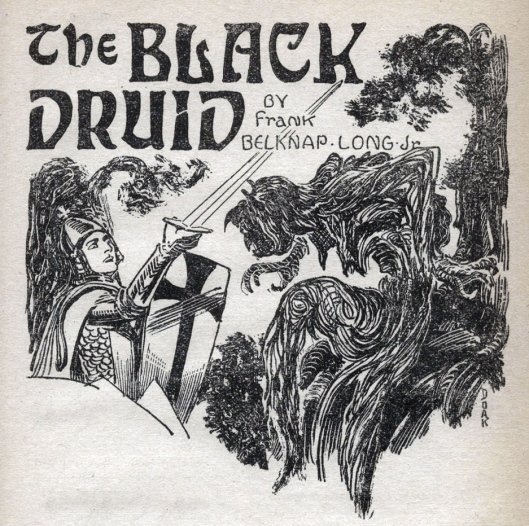
An early appearance of H.P. Lovecraft in fiction is to be found in “The Black Druid” by Frank Belknap Long, published in Weird Tales for July 1930. The Editor, Farnsworth Wright, knowingly bills the story on the contents page as: “A short tale that compresses a world of cosmic horror in its few pages”, trusting the regular reader to make the connection between “cosmic horror” and Lovecraft.

The picture illustrates the Lovecraft character in his ‘dream form’.

The story is interesting to scholars of Lovecraft’s life for being a knowing bit of fun-poking fictional commentary on Lovecraft, by someone who knew him on a near-everyday basis during the New York years. Lovecraft is only lightly veiled as “Stephen Benefield” and the character has similar concerns, physical attributes and locales. The story also fictionalises Lovecraft’s wife Sonia. Possibly the Bene in the name Benefield was even a comment on Lovecraft’s frugal diet, hinting at beans.

Archive.org’s OCR of the text is middling, but I’ve made the story readable as a PDF and have given it some annotations and a little introduction — along the way solving a very minor scholarly mystery about an entry in Lovecraft’s Commonplace Book.

Download PDF.

The meat-waggon to Innsmouth

03 Monday Sep 2018

Posted by asdjfdlkf in Historical context, Lovecraftian arts, Picture postals

≈ Leave a comment

Whatever the academic textbooks and Wikipedia tell you, creative and satiric photomontage began before Dada. It was a grassroots and folksy and anonymous thing, and its postcards went far and wide. Here’s such a doctored postcard sent 1915, and it was probably pasted up sometime in the early 1910s.

It pokes fun at the reputation the decaying Newburyport in New England. Which would later be H.P. Lovecraft’s inspiration for Innsmouth. The card’s fun-poking implies that, in Lovecraft’s time, the town already had a certain reputation which the postcard-maker expected would be recognised throughout the region.

Rhode Island School of Design – new online collection

02 Sunday Sep 2018

Posted by asdjfdlkf in Historical context, Odd scratchings

≈ Leave a comment

Rhode Island School of Design (RSID) have announced that…

“starting in September [2018], our website will provide open access to our entire collection [in online digital form] at risdmuseum.org/collection“

It might be worth a rummage, to see what locally-relevant historical material they have and how far back it goes. Although as yet the URL is still non-functional.

Weird Editing at ‘The Unique Magazine’

31 Friday Aug 2018

Posted by asdjfdlkf in Historical context, New discoveries, Podcasts etc.

≈ Leave a comment

PulpFest 2017 recordings don’t appear to have made it onto YouTube, but there’s a 50-minute panel discussion of Weird Editing at “The Unique Magazine” recorded at PulpFest 2015, on the editorial policies and practices at Weird Tales. The sound quality is listenable, given that it’s a convention panel recording and that those are usually notoriously bad (despite all the microphones present on the tables). But ideally you’ll still want good headphones and the volume turned up.

About ten minutes in there’s a rather curious five-minute monologue by someone who manages not to say very much about anything, but don’t be put off — after that the rest of the discussion is precise and very well informed.

Where exactly was this ‘weird editing’ going on? Chicago. I thought I’d do a brief survey of the actual addresses there, and along the way I discovered a highly likely reason why the editor Farnsworth Wright so inexplicably rejected Lovecraft’s “Cool Air”.

854 North Clark Street:

This address was noted by The Editor magazine in 1923 and O’Brien’s Best Short Stories in 1924. The address was also that of the Newberry Theater in Chicago. The new book Secret Origins of Weird Tales book gives the magazine’s 1923-24 years a detailed business history, if you want the full story of their time here.

450 East Ohio Street:

The later address of the Weird Tales editorial office in Chicago was then the Dunham Building, 450 East Ohio Street, seemingly from some point in 1926.

Interestingly this was the building of the Dunham company, “Manufacturers of Sub-Atmospheric Steam Heating Systems” and Air Conditioning. So this move to new offices may play into Lovecraft’s story “Cool Air” (written March 1926). Though perhaps only partly, in terms of the addition to the story of the technology involved, as there was an obvious precursor story in Arthur Leeds’s tale “The Man Who Shunned The Light” (1915). I suspect this story was used at one New York coffee-and-buns meeting, as a starting point for discussion on how the impoverished Leeds might improve it into a newly saleable story (see my book Lovecraft in Historical Context #4 for all the details and the story itself).

So far as I can tell, I’m the first scholar to notice the trade of the main occupants of the Dunham Building, and to connect that with “Cool Air” and the magazine’s move to a new office in 1926.

This then seems to neatly explain the decision of Farnsworth Wright to reject “Cool Air”…

Farnsworth Wright incredibly and inexplicably rejected “Cool Air”, even though it is just the sort of safe, macabre tale he would have liked” — S.T. Joshi, I Am Providence.

He may have rejected it not only because it was too close to Leeds’s 1915 story (published in Black Cat a decade earlier), but also for fear that his building’s owners would get to hear of it. And that they would then think that Wright had asked for the story from Lovecraft, in order to poke some macabre fun at them and their trade. In which case, they might even have given Weird Tales notice to quit. One can understand how Wright might have wanted to play it safe and reject the story.

840 North Michigan Avenue:

After a few years the editorial office moved to the new ‘Michigan-Chestnut’ building at 840 North Michigan Avenue, Chicago. The building was formally opened in 1929, according to the city’s architecture books.

This was a 20,000 sq.ft. corner lot, with shops at street level and elegant offices and studios above. The upper floors were said to be designed with two floors of light and high-ceiling studios that were intended to accommodate the area’s burgeoning artists’ scene. Though there doesn’t appear to be much exterior evidence of such studios on this later picture.

Judging by this plan, the studios were at the back, away from the clangour of the street noise…

Built 1927-28, by the time the building formally opened in 1929 the artists had been priced out of the booming district. As is often the case with such art studio complexes, the studios were instead occupied as offices by more professional creative services such as architects and magazine production. (Stamper, Chicago’s North Michigan Avenue: Planning and Development, 1900-1930). The ‘Michigan-Chestnut’ building was the home of the editorial offices of Weird Tales magazine until 1938.

Finally, a 1930s or 40s postcard of North Michigan Av. at night, looking like a very suitable home for Weird Tales…

Today, 840 North Michigan takes the form of an early-1990s historical folly-store, and is a far cry from Weird Tales darkness… unless you count a Hitler-saluting teddy-bear as sinister…


Further reading:

* Robert Weinberg’s The Weird Tales Story (1977) was a short 144-page fannish survey of the magazine’s history to 1974. It was stitching together fragments and hazy memories about the early days in the 1920s, and apparently it got a lot wrong on the early history.

* Weird Tales: The Magazine That Never Dies (1988) was a story anthology, but also had an introduction that surveys the entire history of the magazine to 1988, with notes on where further information might be found.

* Scott Connor’s “Weird Tales and the Great Depression” in The Robert E. Howard Reader (2010).

* The Thing’s Incredible: The Secret Origins of Weird Tales (2018) is a proper in-depth business history of the magazine, but only of the turbulent 1923-24 period.

Don’t bother with the litcrit The Unique Legacy of Weird Tales (2015) if you’re looking for business history.
← Older posts
Newer posts →


Please become my patron at www.patreon.com/davehaden to help this blog survive and thrive.

Or donate via PayPal — any amount is welcome! Donations total at Easter 2025, since 2015: $390.

Archives

  • March 2026
  • February 2026
  • January 2026
  • December 2025
  • November 2025
  • October 2025
  • September 2025
  • August 2025
  • July 2025
  • June 2025
  • May 2025
  • April 2025
  • March 2025
  • February 2025
  • January 2025
  • December 2024
  • November 2024
  • October 2024
  • September 2024
  • August 2024
  • July 2024
  • June 2024
  • May 2024
  • April 2024
  • March 2024
  • February 2024
  • January 2024
  • December 2023
  • November 2023
  • October 2023
  • September 2023
  • August 2023
  • July 2023
  • June 2023
  • May 2023
  • April 2023
  • March 2023
  • February 2023
  • January 2023
  • December 2022
  • November 2022
  • October 2022
  • September 2022
  • August 2022
  • July 2022
  • June 2022
  • May 2022
  • April 2022
  • March 2022
  • February 2022
  • January 2022
  • December 2021
  • November 2021
  • October 2021
  • September 2021
  • August 2021
  • July 2021
  • June 2021
  • May 2021
  • April 2021
  • March 2021
  • February 2021
  • January 2021
  • December 2020
  • November 2020
  • October 2020
  • September 2020
  • August 2020
  • July 2020
  • June 2020
  • May 2020
  • April 2020
  • March 2020
  • February 2020
  • January 2020
  • December 2019
  • November 2019
  • October 2019
  • September 2019
  • August 2019
  • July 2019
  • June 2019
  • May 2019
  • April 2019
  • March 2019
  • February 2019
  • January 2019
  • December 2018
  • November 2018
  • October 2018
  • September 2018
  • August 2018
  • August 2015
  • July 2015
  • April 2015
  • March 2015
  • February 2015
  • January 2015
  • December 2014
  • November 2014
  • October 2014
  • September 2014
  • August 2014
  • July 2014
  • June 2014
  • May 2014
  • March 2014
  • February 2014
  • January 2014
  • December 2013
  • November 2013
  • October 2013
  • September 2013
  • August 2013
  • July 2013
  • June 2013
  • May 2013
  • April 2013
  • March 2013
  • February 2013
  • January 2013
  • December 2012
  • November 2012
  • October 2012
  • September 2012
  • August 2012
  • July 2012
  • June 2012
  • May 2012
  • April 2012
  • March 2012
  • February 2012
  • January 2012
  • December 2011
  • November 2011
  • October 2011
  • September 2011
  • August 2011
  • July 2011
  • June 2011
  • May 2011
  • April 2011
  • March 2011
  • February 2011
  • January 2011
  • December 2010
  • November 2010
  • October 2010
  • September 2010
  • August 2010
  • July 2010

Categories

  • 3D (14)
  • AI (70)
  • Astronomy (70)
  • Censorship (14)
  • de Camp (7)
  • Doyle (7)
  • Films & trailers (101)
  • Fonts (9)
  • Guest posts (2)
  • Historical context (1,096)
  • Housekeeping (91)
  • HPLinks (77)
  • Kipling (11)
  • Kittee Tuesday (92)
  • Lovecraft as character (58)
  • Lovecraftian arts (1,628)
  • Lovecraftian places (19)
  • Maps (70)
  • NecronomiCon 2013 (40)
  • NecronomiCon 2015 (22)
  • New books (966)
  • New discoveries (165)
  • Night in Providence (17)
  • Odd scratchings (984)
  • Picture postals (276)
  • Podcasts etc. (431)
  • REH (184)
  • Scholarly works (1,470)
  • Summer School (31)
  • Unnamable (87)

Get this blog in your newsreader:
 
RSS Feed — Posts
RSS Feed — Comments

H.P. Lovecraft's Poster Collection - 17 retro travel posters for $18. Print ready, and available to buy — the proceeds help to support the work of Tentaclii.

Proudly powered by WordPress Theme: Chateau by Ignacio Ricci.