• About
  • Directory
  • Free stuff
  • Lovecraft for beginners
  • My Books
  • Open Lovecraft
  • Reviews
  • Travel Posters
  • SALTES

Tentaclii

~ News & scholarship on H.P. Lovecraft

Tentaclii

Category Archives: Historical context

Some 2019 anniversaries

09 Friday Nov 2018

Posted by asdjfdlkf in Historical context

≈ Leave a comment

50 Years (1969):

* Foundation of Panther in the UK and Ballantine in the USA, both publishers who did sterling work to bring H.P. Lovecraft, R.E. Howard, and the writers of the Lovecraft Circle, to the masses.

* Arkham publishes its two-volume Tales of the Cthulhu Mythos, the first multi-author Mythos anthology book.

* French literary journal Le Cahier de l’Herne famously devotes its entire issue to Lovecraft.

80 Years (1939):

* Arkham House founded in 1939, and the first title published — The Outsider and Others.

100 years (1919):

* Lovecraft publishes the story “Dagon”.


(My thanks for Martin A. for correcting my ‘slip of the memory’ on “Dagon”. When first published the above post said the story was written in 1919. The story was, of course, published in 1919).

More on McNeil

08 Thursday Nov 2018

Posted by asdjfdlkf in Historical context

≈ Leave a comment

Found, a new biographical peice from Everett McNeil of the Lovecraft Circle. It was published in The Trestle Board, 1887. We might imagine that this anecdote of childhood tobacco poisoning was one that the Lovecraft Circle heard at least once, during their long coffee and tobacco-fuelled meetings in McNeil’s rooms in the mid 1920s. From it we can glean just a few more biographical details. We already knew his father was an accomplished prize-winning farmer, but here McNeil confirms that his father David McNeil grew significant amounts of tobacco, and that there was a hired farm-hand ‘living in’ with the family.

And another new article by McNeil is found in Moving Picture News in 1912. At this point he is still part of the movie industry (then still largely in New York City) where he works as a highly experienced scenarist (in modern terms, a screenwriter). 1912 was a couple of years before his move to the Edison studio to work under Arthur Leeds. Here he complains about cinemas that run the film ‘fast’, in order to put on extra showings, and hints at industry prosecutions of the exhibitors.

Again, one imagines that in the mid 1920s the Lovecraft Circle heard McNeil’s memories of encountering his own movies being shown at high-speed, back during his movie-making years. Possibly (with the bitterness erased by the years in between) such memories were recounted by him in a rather more comic manner than previously, focussing on the laughably speeded-up antics?

The above are in addition to my book on McNeil and his career, Good Old Mac.

Lovecraft and The Raven

07 Wednesday Nov 2018

Posted by asdjfdlkf in Films & trailers, Historical context, New discoveries

≈ Leave a comment

In a late September 1919 letter H.P. Lovecraft singled out “Henry B. Walthall” as a silent cinema star he held to be “above the rest”, the only other being the young Japanese star Sessue Hayakawa.

Walthall possess tragic potentialities all too seldom utilised on the screen. His part in the “Birth of a Nation”, though a leading one, failed to do him justice. He could create a sensation if some of Poe’s tales were dramatised — I can imagine him as Roderick Usher or the central character in “Berenice”. No one else in filmland can duplicate his delineation of stark, hideous terror or fiendish malignancy. — Lovecraft.

What movies would Lovecraft likely have seen Walthall in? The annotations in the volume of Galpin letters suggests only… “Judith of Betthulia [1914, Biblical melodrama], Avenging Conscience [1914, horror-drama, Poe], and Birth of a Nation [1915, family drama, war-epic].”

Avenging Conscience was based on Edgar Allan Poe stories, and featured Walthall playing Poe himself.

But a quick look at Walthall’s filmography suggests that Lovecraft might also have been thinking of “The Raven” (1915, Essanay), a remake of a lost 1912 D.W. Griffith short. The expanded 1915 version was a major ‘melodramatic bio-pic’ movie of Edgar Allan Poe, and Walthall again played Poe.

Lovecraft may have been impressed by what were reported (in the 1915 movie press) to be uncanny double-exposure FX scenes such as Poe fighting a duel with himself, dream-levitating, and by the general visual inventiveness of the sets. Also with the fact that it been filmed in an exact life-sized reproduction of the interior of Poe’s home in Fordham, built on a stage-set after Essanay sent an architect to take the exact measurements. Lovecraft would likely have been less impressed by what is said to be a curt re-write of Poe’s life history, including giving him a thirty-five year old Virginia.

Apparently the movie was immensely popular, and Lovecraft would almost certainly have seen it despite its biographical shortcomings. Perhaps it was too popular, as movie buffs note that there was no screen representation of Poe for many decades afterwards. Originally running as much as 80 minutes (six reels, lost), there’s an approx. 40 minute survival which appears to have been crudely butchered for length and which is now on a 2007 DVD. It’s not currently on Archive.org or YouTube.

Rediscovering Clifford D. Simak

04 Sunday Nov 2018

Posted by asdjfdlkf in Historical context, New books, Odd scratchings

≈ 4 Comments

In the 178-page photobook The Faces of Science Fiction (St. Martin’s Press, 1984), now on Archive.org, I was pleased to see Clifford D. Simak. This Patti Perret portrait is exactly how I would have expected Simak to look, sans blue denim overalls and Casey Jones railroader cap, and is so much better than than the usual grimacing Wikipedia image…

When photographed he was likely working on his late dark fantasy novel Where Evil Dwells (1982), in which the Roman Empire “never quite fell” but humanity got side-swiped instead by the arrival of Lovecraft’s Elder Gods. The Elder Gods being only slightly disguised, to avoid The Wrath of Derleth. One suspects he’d got the general idea for that while reading the 1976 paperback of Lovecraft: A Biography. At this point Simak had about 125 sci-fi stories and 26 sci-fi and fantasy novels, not to mention a whole sack-full of awards (and that was back when an award still meant something).

I’m pleased to see that Simak’s short stories have become available since 2015 as a series of Kindle ebooks, the Complete Short Fiction of Clifford D. Simak series, from Open Road. Amazon UK lists 12 volumes, with the most recent three released in summer 2017.

False Ducks runs a completist website which documents the stories and where they’ve been published, and I note that many stories are still not listed there as collected by the Open Road series, even though the site is up-to-date. This makes me think that the original announcement by Open Road of 14 books for the series may have been correct, and that we may yet have two (or more) to come sometime in 2018/19. Note that False Ducks complains that Open Road’s Complete Short Fiction series is “wildly jumbled up” as regards publication date and themes. Their #12 includes his first published story from 1931 and a couple of the 1940s westerns, which appears to bear out such comments. Still, it’s nice they’re now so easily and cheaply available.

As a result of the “jumble” the purchaser of the Open Road 12-volume set may think they want to try reading through in publication date order. But doing that would mean that one would first have to plod through the very mediocre 1930s sci-fi, then some western and war stories in the 1940s, then early sci-fi potboilers such as Cosmic Engineers (1939, 1950 in book form). That doesn’t seem like a good way to start on Simak.

A better initial introduction to Simak’s stories is probably the audiobook for Over the River & Through the Woods: The Best Short Fiction of Clifford D. Simak, and then the audiobook of the fix-up stories-novel City. Then ‘fill in’ by dipping into the 12 volumes of ebooks of the stories, guided firstly by the contents-lists of his other four or five ‘best stories of…’ collections such as Skirmish. Then finally go looking for remaining rarities among the pulp scans and anthologies, with the help of the lists on False Ducks. One good thing about Simak is that he’s so unfashionable that you can currently pick up many of his print volumes for pennies, so filling in the gaps should be fairly painless — so long as you’ve willing and able to read from cramped 1970s paperback type (there wuz a world paper shortage, don’cha-know…) or buy an automated sheet-feed scanner and slice the spines off the books.

Most of Simak’s novels were published in ebook, between about 2011 and 2014, under the ‘Gollancz yellow-covers’ of the Gateway ebook imprint. I count about 20 such budget-priced ebooks on Amazon UK, of his output of around 27 novels, including the famous Way Station. (Note that the Gateway ebooks I’ve tried — not by Simak, admittedly, as I already have him in other forms — usually have their share of uncorrected OCR errors, having seemingly been scanned from the print books and not proofread). Three of the novels are currently available as unabridged recently-recorded audiobooks on Audible, including the fix-up City, but older crackly cassette-tape versions of many novels can also be had on YouTube. It’s probably important for new readers of Simak to know that after about 1967 (The Goblin Reservation) he started to veer strongly toward writing more whacky / humourous science-fiction novels and, while these obviously appealed to and entertained the surrealism-inclined hippies of the late 1960s and early 1970s, they are not well regarded today.

Due to his immense popularity, from about 1960s until the mid 1980s, there are also vast numbers of foreign translations of his work, and non-English readers should find translations fairly easily.

So far as I can tell there was never a Starmont Reader’s Guide for Simak, with chapters briskly and comprehensively surveying his various themes, settings and ideas. But we do have something very similar and more up-to-date, the book-length survey and bibliography When the Fires Burn High and The Wind is From the North: The Pastoral Science Fiction of Clifford D. Simak (2006, Borgo Press). Talking of plot summaries, beware the writers of Simak’s introductions, back-cover blurbs and short reviews — all of which appear to delight in giving the reader plot-spoilers. One needs to be very very careful in deciding which Simak to read, as it’s made incredibly easy to get a plot-spoiler.

See also the discussion of his crude stereotyping as a rustic-conservative and his consequent neglect by sniffy academics in recent decades, in: “The Pastoral Complexities of Clifford Simak: The Land Ethic and Pulp Lyricism in Time and Again“, in the journal Extrapolation in 2014. A similar point about his deliberately misrepresented reputation was made by Robert Silverberg’s short appreciation of City in “Rereading Simak”, Asimov’s magazine, August 2013. Thomas Clareson’s 1976 essay collection Voices for the Future also had a sensitive essay on City, specifically on what changed from the stories to the fix-up novel. A year earlier in 1975 there was an interview. [BEWARE: there are huge plot spoilers in all these!]

His best work could be a natural follow-on for readers of this blog who enjoy the summer travel sections of H. P. Lovecraft’s Letters. And who sometimes wonder what rustic science-fiction could have been home-grown from those hard-working back-road towns — “if only…”. Perhaps if a well-fed HPL had settled down with Mrs. Miniter, who might have then inherited from Mrs. Beebe and so started a rural writers’ colony with HPL, including the loving couple formed of the regionalist Derleth and the ethnographic Barlow. Then, in the 1950s, they might have succeeded in nurturing a regionalist science-fiction from the rural grassroots. A whimsical idea, of course, but the results might have looked something like Simak’s work and also the small-town work of Bradbury. In Simak’s concerns about land, ecological balance and science-fiction set in the context of organic communities, I would hazard a guess that he may — in future decades — come to appeal to both ends of the political spectrum from neo-hippie solarpunkers to conservative localists.


Further reading:

Plot-spoilers abound in these! In date order.

* Sam Moskowitz, “The Saintly Heresy of Clifford D. Simak”, Amazing Stories, June 1962. An excellent long biographical profile by the leading SF historian of the time. This also discusses his work to 1952 — Simak had only started writing really impressive SF stories from circa 1942/43. Reprinted in Moskowitz’s Seekers of Tomorrow: Masters of Modern Science Fiction (1967).

* “An Interview with Clifford D. Simak”, Tangent No. 2, May 1975.

* Thomas Clareson’s 1976 essay collection Voices for the Future had a sensitive essay on the famous City, specifically on what changed from the original stories to the fix-up novel.

* Speaking of Science Fiction (1978). Contains 31 interviews of the 1970s published in Luna Monthly. The Simak interview is reprinted from a 1972 issue.

* Muriel Becker, Clifford D. Simak, a primary and secondary bibliography (Masters of science fiction and fantasy series), 1980. 149 pages. Well regarded, though now mostly superseded as a reader’s guide by later efforts. The 1980 review in Extrapolation states that it was only annotated in terms of the reviews and similar works it listed. It has an interview with Simak and a short life chronology, and listed his adaptations for radio. The more substantial and thoughtful reviews of his books are listed to circa 1979. (Update: now at Archive.org)

* Darrell Schweitzer, “An Interview with Clifford D. Simak”, Amazing Stories Vol. 27, No. 6, February 1980.

* Thomas P. Linkfield, “Aliens invade the Midwest”, Society for the Study of Midwestern Literature Newsletter, 1981. Surveys some of the then-recent fiction by the likes of Bradbury, Simak and Tom Reamy. Reamy was obviously going to be a match for both Simak and Bradbury in the field of ‘small town SF’, in time — but he died before his great promise could be fulfilled, leaving only a novel and a short-story collection. The article talks about back-road midwest towns in a rather negative and stereotyping manner.

* The expensive essay anthology Space and Beyond: The Frontier Theme in Science Fiction (2000) had a 10-page essay by Michael Cassutt. His “Way Station – the Motion Picture: a possibly premature progress report”… “laments studio reluctance to do an authentic film of Clifford Simak’s Way Station (1963).”

* M.J. DeMarr, “Clifford D. Simak’s Use of the Midwest in Science Fiction”, MidAmerica, 1995. Substantial but appears to have been unknown to Ewald (2006).

* Robert J. Ewald, When the Fires Burn High and The Wind is From the North: The Pastoral Science Fiction of Clifford D. Simak, 2006, Borgo Press. Excellent book-length survey which lists many more secondary sources than I can here.

* Hardy Kettlitz, Clifford D. Simak: pastorale Harmonien, Shayol Verlag, 2012. A German bibliography in 148 pages, part of the SF Personality series.

* Robert Silverberg, “Rereading Simak”, Asimov’s magazine, August 2013.

* “The Pastoral Complexities of Clifford Simak: The Land Ethic and Pulp Lyricism in Time and Again“, Extrapolation, 2014.

* Meine and Keeley, The Driftless Reader, University of Wisconsin Press, 2018. A wide-ranging anthology of the region in which Simak set many of his tales, a bio-region “spanning parts of southwestern Wisconsin, southeastern Minnesota, northeastern Iowa and northwestern Illinois.” Includes some Simak excerpts.

*~*

There has been some recent interest in Simak re: the post-human, mostly from Europe following initial forays from Americans.

* J. Gordon, “Talking (for, with) Dogs: Science Fiction Breaks a Species Barrier”, Science Fiction Studies, 2010.

* G. Canavan, “After Humanity: Science Fiction after Extinction in Kurt Vonnegut and Clifford D. Simak”, Paradoxa, 2016.

* Juliette Feyel, “Present retrospectif et detour post-humain chez Clifford Simak et Michel Houellebecq”, Res.Futurae, No. 7, 2016. (Trans: ‘The post-human detour in Simak and Houellebecq’. Finds Simak more interesting than Houellebecq, re: ideas on the post-human).

* Francesco Nieddu, L’apertura all’alieno e la difficile palingenesi umana in Way Station di Clifford D. Simak, Medea, Vol. 4, No. 1, Summer 2018. (Under Creative Commons Attribution, if anyone wants to translate it. Title roughly translates as “Openess to the alien and the difficulties of the post-human in Clifford D. Simak’s Way station“).


Possible links with Lovecraft:

My first pass at noting down some strands that may be worth exploring, without as yet a full re-reading of Simak…

Simak has at least one direct Lovecraft pastiche story, some macabre horror stories, and the late novel Where Evil Dwells which has strong Lovecraft elements.

Concern with the quiet American pastoral landscapes and vistas which Lovecraft so loved and often visited re: his visits to the homes of various Amateurs, and his summer travels.

Simak’s work preserves the emotional and life-world textures of the rural back-roads America that Lovecraft and the Amateurs knew in the mid 1920s, and does so in an imaginative form palatable to those who enjoy reading Lovecraft’s Letters.

Is concerned with the psychic resonance of regionalist landscapes, their invasion by the alien other, and the post-human on cosmic time-scales.

Concerned with civilisation-scale loss and preservation. Like Lovecraft, similarly despised and slighted by leftists for his conservatism.

Friday “picture postals” from Lovecraft: Providence Opera House

02 Friday Nov 2018

Posted by asdjfdlkf in Historical context, Picture postals

≈ Leave a comment

Providence Opera House (green board and canopy, on the left of the picture). It was a 1,500 seater.

“… we were acquainted with Mr. Morrow [Robert Morrow], the lessee & manager of Providence’s chief theatre — The Providence Opera House — (he lived directly across the street) so that it was not thought too shocking to let my aunt take me to see something [on the stage, when a young boy in 1896]” — H. P. Lovecraft, letter to Kleiner dated 16th November 1916.

An impression of the pre-show hustle and bustle the boy Lovecraft might have encountered on arriving, before the age of the motor-car…

Some may doubt that the boy Lovecraft was in one of those carriages. Yet, at this time his family still had a horse & carriage and a live-in coachman to drive it.

Halloween Postcard Special: along the Innsmouth shoreline

31 Wednesday Oct 2018

Posted by asdjfdlkf in Historical context, Maps, Picture postals

≈ 6 Comments

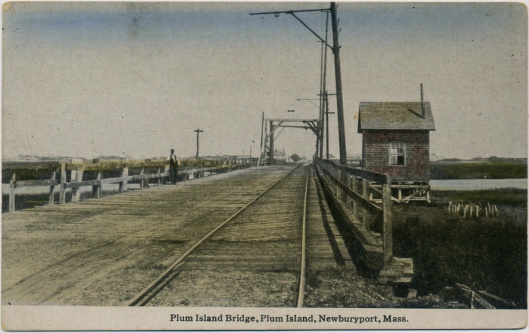
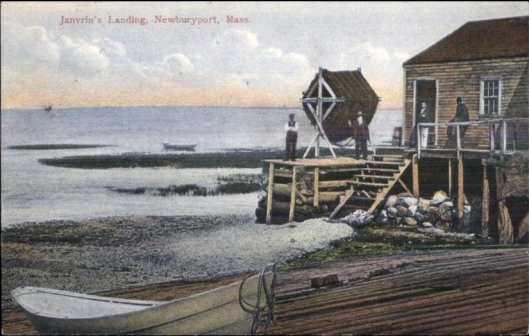
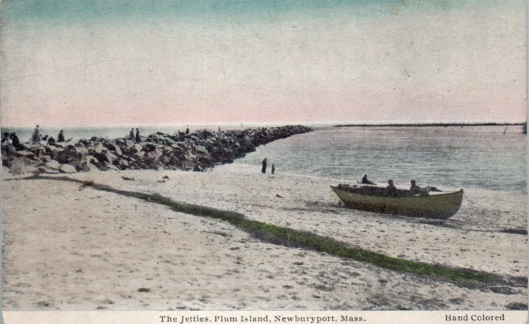
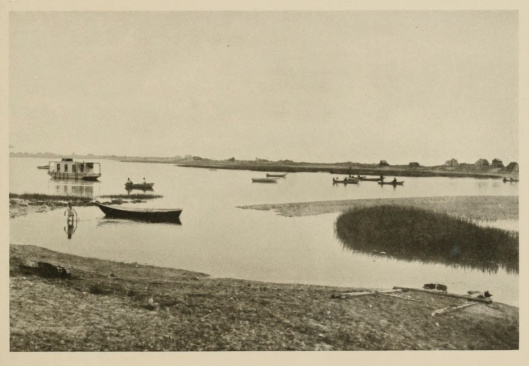
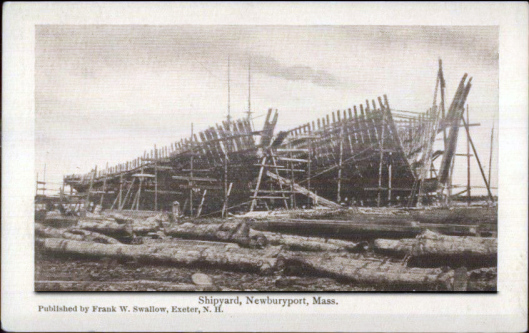
Below are a selection of Lovecraft-era postcards from the shoreline at Newburyport, Lovecraft’s base model for the town of Innsmouth in “The Shadow over Innsmouth”.

Mostly toward Joppa and Plum Island, the stretch of shortline that runs about a half-mile to a mile south-east of the main town, along the Merrimack River waterfront.

“Newburyport is one of the most hauntingly quaint towns in America [… it has a] spectral hush & semidesertion […] In Haverhill, 8 miles up the Merrimac [River], they call it ‘The City of the Living Dead’ [Among its other features, he noted] the unpaved sidewalks on pre-Revolutionary streets with rotting, half-deserted houses south of the Square. When I first saw Newburyport I mistook the central square for a mere neighbourhood shopping centre, & kept on the car (it was a trolley-car then) in the expectation of reaching some real ‘downtown’. Only when the line ended — at the ‘Joppa’ fishing hamlet — did I realise that the half-deserted square I had passed through was actually ‘downtown’!” — H.P. Lovecraft, Selected Letters IV, pages 259-260.

Lovecraft apparently got off at the end of the line, presumably toward the islands end of the Joppa stretch, and walked back to town. If he had followed the line further he would have found the route hooking around east and over to the islands resort area, such as it was, which was more to the east of the town as the crow flies. He probably didn’t step out to the Plum Island section except on postcards, or perhaps on another trip or from the train or bus. Though he did accidentally go to “the end of the line” on the tram on his first visit, that being out on the edge of Plum Island. He then walked back into town.

Also, the old railway track…

“Then I thought of the abandoned railway to Rowley, whose solid line of ballasted, weed-grown earth still stretched off to the northwest from the crumbling station on the edge of the river-gorge.” — “The Shadow over Innsmouth”.

For further details on Newburyport and Lovecraft, see Chapter 3 of David Goudsward’s book H. P. Lovecraft in the Merrimack Valley (2013). Also the book Legends and Lore of the North Shore.

Want more postcards and a map? See my earlier Old Newburyport post of 2014, which also has couple more pictures of Joppa.

‘The Decline of the West’ on Kindle

28 Sunday Oct 2018

Posted by asdjfdlkf in Historical context, New books, Scholarly works

≈ Leave a comment

I see that S. T. Joshi’s H. P. Lovecraft: The Decline of the West was made available as a Kindle ebook since the end of summer 2018, and now sports a very reasonable pocket-money price.

It’s the fullest account of ‘Lovecraft the philosopher’ and his wide range of influences in that field. Also the influence on him of what might be called ‘the phantasm of decline’ — that strangely popular but nebulous apparition that haunts gloomy intellectuals, and which leads them to believe that civilisational collapse is forever just around the corner. (As a corrective, see heavyweight books such as: Ridley’s The Rational Optimist; Paul Johnson’s Intellectuals; Herman’s The Idea of Decline in Western History, and my ongoing 2020 blog). Perhaps also Staring Into Chaos: Explorations in the Decline of Western Civilization; and The Perennial Apocalypse: How the End of the World Shapes History.

Joshi writes clearly and precisely as usual, and the book is usefully untainted by airy academic genuflections toward the latest idols of literary-political theory. The Decline of the West was previously available as an oversize paperback, which has a two-column layout — which some may prefer for the task of ploughing through dense philosophical triangulations. On the other hand, the ebook is keyword-searchable, which means that Lovecraft scholars may want to own both editions — though you may chuckle at such a heavyweight ebook having a toy-like ‘stop-motion Cthulhu’ on the front cover. Such are the demands of trigger-finger ebook marketing today, I suppose — ‘no monster, no sales’.

Purchasers will also want to have on their Kindle the texts available from my 2014 blog post Lovecraft as Philosopher, these being a sniffy review of Decline of the West and Joshi’s magisterial demolition of the review.

Falling Felines

28 Sunday Oct 2018

Posted by asdjfdlkf in Historical context, New books, Scholarly works

≈ Leave a comment

Falling Felines Research: the history book, successfully crowd-funding now.

If you can’t wait for the book, the author has a long blog post on the topic of lab research on falling cats.

It turns out that that aerodynamics, molecular physics, mathematics, mechanical control systems, and other branches of science and engineering were all strongly informed by the study of tumbling kitties which (of course) always landed on their feet. Perhaps Lovecraft was right (again), when he said that inherent in the very form of the cat lay cosmic secrets, a potent symbolisation of the universe, and that this was “just as true kinetically as statically”.

A quick search of Google Scholar and JURN shows that such research is still ongoing, and that the same science may yet inform the design of human-interacting robots, autonomous drones, space-elevator nano-ribbons, and many other sqwerky uses as yet undreamed. Robo-tentacles, perhaps.

The Abbey frescoes of Boston

25 Thursday Oct 2018

Posted by asdjfdlkf in Historical context, Picture postals

≈ Leave a comment

“As for Abbey — you ought to see his Holy Grail frescoes in the Boston Public Library!” — H.P. Lovecraft to August Derleth.

One imagines that Lovecraft or his aunts might have once owned a set of these postcards. Today good pictures can be seen online here.

The Library definitely seems to have been a place Lovecraft would have enjoyed for its creepy atmosphere…

Brooklyn Bridge

25 Thursday Oct 2018

Posted by asdjfdlkf in Historical context

≈ Leave a comment

Brooklyn Bridge (1935) by Harry Sternberg. The picture is unlikely to have been an inspiration, but it’s interesting to note that in the same year Lovecraft wrote “The Haunter of the Dark” (November 1935).

“… my face, which is something else again”

25 Thursday Oct 2018

Posted by asdjfdlkf in Historical context, Scholarly works

≈ Leave a comment

On the facial identification elements needed to identify Lovecraft in old photos. Useful as a guide for artists. The long article also looks at the shape-detail of Lovecraft’s eyes.

A new Lovecraft poem?

20 Saturday Oct 2018

Posted by asdjfdlkf in Historical context, Lovecraftian arts, New discoveries, Picture postals

≈ 1 Comment

I think I may have found another new poem by Lovecraft. Not a macabre one this time, but rather a bit of early juvenilia. It’s the “Fore-worde” to his Hope Street High School yearbook for summer 1907, The Blue & White.

This “Fore-worde” is a poem of suspiciously archaic language, and also has a characteristic Lovecraft touch in the coining of the neo-archaism “strange-froughte”. Who else but Lovecraft would write such a poem in the style of an ancient wit, or insert such a phrase?

Neither the title or first line of the poem is in the latest edition of The Ancient Track. Nor is it in the Ancient Track‘s “Chronology”.

If the poem is a very early one by Lovecraft then it’s also interesting for implying that the author was on “ye humbell Boarde of Editours” in early summer 1907, which then leads one to wonder if he influenced the design on the cover. In which the tentacular flame seems to evoke (if you look at it right) a rather Lovecraftian version of a jinn to accompany the surrounding Aladdin’s lamps. If one knows that Lovecraft wore glasses at this time, the central ‘face’ could almost be a self-portrait.

Obtaining a full copy of the Yearbook would show if Lovecraft was on the “Boarde of Editours” for 1907. If he wasn’t, then the poem would be less likely to have been written by him.

He also appears as “H.P.L.” in the text of a humorous playlet in the Yearbook, titled a “Merry Drama of Hope”. At the plangent end of which he might be trying, in vain, to interest a passing fresher in the concept of meteoritic flight-paths…


Act IV, Scene 1.

The Corridor after school (snatches of conversation heard.)

[…]

“H. P. L. (Sophomorite:) “Well, the only definite theory advanced as to the cause of the meteoric path being hyperbolic or elliptic, is —”

Giddy Freshite (giggling hysterically:) “— And then he said —”

    (Corridor gradually becomes vacant)


Lovecraft was a freshman (fresher) at Hope Street High in 1904-05, but left in November 1905 and did not return until September 1906. He formally left on 10th June 1908, without a High School diploma — as he had only taken a few full classes in his final year.

According to a comment by Chris Perridas there may be a photo of Lovecraft in the next yearbook, 1908. But Chris had not been able to see either 1907 or 1908, and they’re still not scanned and online. Possibly it’s a photo that’s already well-known, though there’s nothing from 1908 here.

The small page-scans above are from a long-lost eBay listing, the data for which was snagged and kept online (just about) by a Web traffic-funnelling autobot.


← Older posts
Newer posts →


Please become my patron at www.patreon.com/davehaden to help this blog survive and thrive.

Or donate via PayPal — any amount is welcome! Donations total at Easter 2025, since 2015: $390.

Archives

  • March 2026
  • February 2026
  • January 2026
  • December 2025
  • November 2025
  • October 2025
  • September 2025
  • August 2025
  • July 2025
  • June 2025
  • May 2025
  • April 2025
  • March 2025
  • February 2025
  • January 2025
  • December 2024
  • November 2024
  • October 2024
  • September 2024
  • August 2024
  • July 2024
  • June 2024
  • May 2024
  • April 2024
  • March 2024
  • February 2024
  • January 2024
  • December 2023
  • November 2023
  • October 2023
  • September 2023
  • August 2023
  • July 2023
  • June 2023
  • May 2023
  • April 2023
  • March 2023
  • February 2023
  • January 2023
  • December 2022
  • November 2022
  • October 2022
  • September 2022
  • August 2022
  • July 2022
  • June 2022
  • May 2022
  • April 2022
  • March 2022
  • February 2022
  • January 2022
  • December 2021
  • November 2021
  • October 2021
  • September 2021
  • August 2021
  • July 2021
  • June 2021
  • May 2021
  • April 2021
  • March 2021
  • February 2021
  • January 2021
  • December 2020
  • November 2020
  • October 2020
  • September 2020
  • August 2020
  • July 2020
  • June 2020
  • May 2020
  • April 2020
  • March 2020
  • February 2020
  • January 2020
  • December 2019
  • November 2019
  • October 2019
  • September 2019
  • August 2019
  • July 2019
  • June 2019
  • May 2019
  • April 2019
  • March 2019
  • February 2019
  • January 2019
  • December 2018
  • November 2018
  • October 2018
  • September 2018
  • August 2018
  • August 2015
  • July 2015
  • April 2015
  • March 2015
  • February 2015
  • January 2015
  • December 2014
  • November 2014
  • October 2014
  • September 2014
  • August 2014
  • July 2014
  • June 2014
  • May 2014
  • March 2014
  • February 2014
  • January 2014
  • December 2013
  • November 2013
  • October 2013
  • September 2013
  • August 2013
  • July 2013
  • June 2013
  • May 2013
  • April 2013
  • March 2013
  • February 2013
  • January 2013
  • December 2012
  • November 2012
  • October 2012
  • September 2012
  • August 2012
  • July 2012
  • June 2012
  • May 2012
  • April 2012
  • March 2012
  • February 2012
  • January 2012
  • December 2011
  • November 2011
  • October 2011
  • September 2011
  • August 2011
  • July 2011
  • June 2011
  • May 2011
  • April 2011
  • March 2011
  • February 2011
  • January 2011
  • December 2010
  • November 2010
  • October 2010
  • September 2010
  • August 2010
  • July 2010

Categories

  • 3D (14)
  • AI (70)
  • Astronomy (70)
  • Censorship (14)
  • de Camp (7)
  • Doyle (7)
  • Films & trailers (101)
  • Fonts (9)
  • Guest posts (2)
  • Historical context (1,096)
  • Housekeeping (91)
  • HPLinks (77)
  • Kipling (11)
  • Kittee Tuesday (92)
  • Lovecraft as character (58)
  • Lovecraftian arts (1,628)
  • Lovecraftian places (19)
  • Maps (70)
  • NecronomiCon 2013 (40)
  • NecronomiCon 2015 (22)
  • New books (966)
  • New discoveries (165)
  • Night in Providence (17)
  • Odd scratchings (984)
  • Picture postals (276)
  • Podcasts etc. (431)
  • REH (184)
  • Scholarly works (1,470)
  • Summer School (31)
  • Unnamable (87)

Get this blog in your newsreader:
 
RSS Feed — Posts
RSS Feed — Comments

H.P. Lovecraft's Poster Collection - 17 retro travel posters for $18. Print ready, and available to buy — the proceeds help to support the work of Tentaclii.

Proudly powered by WordPress Theme: Chateau by Ignacio Ricci.