• About
  • Directory
  • Free stuff
  • Lovecraft for beginners
  • My Books
  • Open Lovecraft
  • Reviews
  • Travel Posters
  • SALTES

Tentaclii

~ News & scholarship on H.P. Lovecraft

Tentaclii

Category Archives: Historical context

Inside the Ladd Observatory, in colour

25 Tuesday Dec 2018

Posted by asdjfdlkf in Astronomy, Historical context, Lovecraftian places, Picture postals

≈ Leave a comment

“The late Prof. Upton of Brown, a friend of the family, gave me the freedom of the college observatory, (Ladd Observatory) & I came & went there at will on my bicycle. Ladd Observatory tops a considerable eminence about a mile from the house. I used to walk up Doyle Avenue hill with my wheel, but when returning would have a glorious coast down it. So constant were my observations, that my neck became affected by the strain of peering at a difficult angle. It gave me much pain, & resulted in a permanent curvature perceptible today to a close observer. My body has ever been unequal to the demands of an active career. […] I no more visit the Ladd Observatory or various other attractions of Brown University. Once I expected to utilise them as a regularly entered student, & some day perhaps control some of them as a faculty member.” — Letter to Kleiner, 16th November 1916.

[During my time at Ladd] “I had a chance to see all the standard modern equipment of an observatory (including a 12” telescope) in action, and read endlessly in the observatory library. The professors and their humbler assistant — an affable little Cockney from England named John Edwards — often helped me pick up equipment, and Edwards made me some magnificent photographic lantern-slides (from illustrations in books) which I used in giving illustrated astronomical lectures before clubs.” — Letter to Duane Rimel, 29th March 1934. (My emphasis)

I’ve newly colourised two interior pictures, one showing the Observatory library in which the young Lovecraft spent so much time:

“As a boy I used to haunt the Ladd Observatory of Brown University — looking through the 12″ refractor now & then, reading the books in the library, & probably making an unmitigated nuisance of myself through my incessant questioning of everybody present. Curiously enough, the assistant there was one of your grandfather’s humbler compatriots — a Cornishman named John Edwards, whose capacity for mis-placing h’s was limitless. Scarcely less limitless was his mechanical skill, & in his infinite kindness he fixed me up all sorts of devices (a long-focus celestial camera, a set of photographic lantern slides, a diagonal eyepiece for my telescope, etc. etc.) at no more than cost price. I still have the slides somewhere — as well as lunar & other photographs I took with the camera. He is dead now — as is Prof. Upton, the director in those days [Winslow Upton], our acquaintance with whom gave me my passport to that dark-domed enchanted castle. My third victim there — Associate Prof. Slocum — is now head of the observatory at Wesleyan U. in Middletown, Conn. I would have carried astronomy further but for the mathematics — but I hadn’t quite the right stuff in me.” — Letter to Jonquil Leiber, 29th November 1936.

He continued to bicycle until the summer of 1913 (age 22) long after most other boys of Providence would have had given it up (to cycle after about age 18 was deemed ‘not the done thing’). So presumably from 1913 to 1918 he walked to the Observatory or took a trolley car.

There was a biography of Lovecraft’s Ladd mentor Winslow Upton, An Earth-bound Astronomer: Winslow Upton, A Memoir (1971), and his “A Visit to Kilauea” (1883) is online. Kilauea is the active volcano on Hawaii, and the model reed-boat seen in the picture above is likely both a souvenir of the trip (ultimately to observe an eclipse, some 1000 miles to the south) and a conversation-starter with shy students. Or possibly it was from a sabbatical in Peru. As well as being an astronomer Upton had also been interested enough in storms in the 1880s to publish two papers, “An investigation of cyclonic phenomena in New England” (1887) and “The storm of March 11-14, 1888” (1888), which might perhaps interest those looking for a ‘hook’ for a Mythos story.

Lovecraft’s recall of John Edwards as a Cockney (working-class Londoner) is perhaps more to be trusted than the late recollection that Edwards was a Cornishman. However, a highly intelligent lad from remote and rural Cornwall might soon find himself in London, circa 1865 or thereabouts, and picking up the Cockney speech from the local lads. Which could mean that both were true.

In the mid 1930s some in fantasy and science fiction fandom heard rumours that Lovecraft had once been the director of the Providence Observatory. He had to write to The Phantagraph (Nov-Dec 1935) fanzine to correct the misapprehension…

“Your statement that I was once director of the Providence Observatory flabbergasted me a bit, insomuch as there has never been any ‘Providence Observatory’! Then after a moment, it dawned on me that you must have seen one of my kid publications of 30 or more years ago — when I used to call my own small telescope and other astronomical apparatus ‘THE PROVIDENCE OBSERVATORY’ and publish (by hectograph or typewriter) important looking ‘bulletins’ and ‘annuals’. Thus do the exaggerations of youth bear misleading fruit in old age.”

He refers to his boyhood ‘astronomy newspapers’, mostly made when a preteen, containing his own observations from the rooftop of his house…

“The roof of 598 Engelstrasse [Angel St.] is approximately flat, and in the days of my youth I had a set of meteorological instruments there. Hither I would sometimes hoist my telescope, and observe the sky from that point of relative proximity to it. The horizon is fair, but not ideal. One can see the glint of the Seekonk through the foliage of Blackstone Park, and the opposite bank is quite clearly defined. With a terrestrial eyepiece of fifty diameters on my telescope, I can see some of the farms in the heart of East Providence, and even Seekonk, Mass., across the river. One in particular delights me — a typical bit of ancient agrestick New England with eighteenth century farmhouse, old-fashion’d garden, and even archaic well and well-sweep—all this bit of primitive antiquity visible from a roof in the prosaic modern town!! […] A good telescope, or even a binocular glass, is a great pleasure when one has a wide vista. I am fortunate in having an almost ideal battery of optical aids, including a Warner and Swasey — hell, no, I mean Bausch and Lomb—prism binocular which cost me $55.00 about twelve years ago. Ah, them golden days when I didn’t have to worry about what I spent! I’d like to see meself buying a $55.00 plaything today!!!” — Letter to the Gallomo, 30th September 1919.

Toward the end of this life in the summer of 1936, ill and in a generally weak condition, Lovecraft returned to the Ladd telescope…

“Had an interesting view of Peltier’s Comet on July 22 at the Ladd Observatory — through the 12″ refractor. The object shewed a small disc with a hazy, fan-like tail.”

Another hand-drawn map of Providence, 1907

19 Wednesday Dec 2018

Posted by asdjfdlkf in Historical context, Maps

≈ Leave a comment

I previously posted a hand-drawn map made for a 1907 series of ‘Open Days’ in Providence, from The Official Program of the Old Home Week.

Now I’ve found a scan of the pocket walking booklet for the same event, A Little Guide to Providence, 1907. The neat little Guide focusses largely on the artistic and cultural life of Providence, as Lovecraft would have become aware of it circa age 16-17.

I’m pleased to see that the booklet has a version of the same map without the gutter problem of the earlier scan. At the back it has another map made in the same charming hand-made style as the first. I’ve rectified the slight lens distortion, perspective skew and colour-cast, as well as dropping them to 3,800 pixels so they’re manageable.

Looking at the map, it strikes me that if one were to combine Kingston and Plymouth placenames via a “Kin–mouth” amalgamation then one would come very close to the name Innsmouth, and with the “kin” perhaps pointing to that story’s underlying plot element of ‘kinship’.

The “lightning-scarred” Lovecraft

18 Tuesday Dec 2018

Posted by asdjfdlkf in Historical context

≈ Leave a comment

I don’t bother with the likes of Twitter, but I occasionally use Social Searcher to take a fleeting keyword-based glance across the cesspool. Very rarely does anything newsworthy turn up among the parroting and blather. But today I noticed that a Twitter-diot is complaining about Lovecraft making up items such as “lightning-scarred” in “The Lurking Fear”. Yet a simple search of Google Books, Google Scholar and Hathi swiftly reveals many such uses…

* The U.S. Congress…

These lightning-scarred trees are readily found in any large body of timber. During the dry season of 1910 there were many electrical storms, and innumerable small fires were found immediately afterwards.” (1910)

* The U.S Bureau of Mines…

Lightning, however, sometimes strikes an airship without destroying it. The Friedrichshafen Museum has lightning-scarred parts of airships that have withstood thunderstorms successfully (1933)

* It appears to have been ‘house standard’ usage in American Forestry journal, and elsewhere in forestry publications and articles. One can find it, for instance in the pre-war publications of the ranger stations at Yosemite and the Grand Canyon.

Thus, while one can find it getting past the picky copy-editors of The New England Magazine in 1909 (“the lightning-scarred beech tree by the mill in the hollow”) and The Saturday Evening Post in 1919 (“He had seen living trees struck and had examined the lightning-scarred tops of fallen dead ones”), and it does occurs in the poetry of Aubrey De Vere and the 1910 translation of The Aeneid of Virgil (“[his] body lightning-scarred, Lies prisoned under all, so runs the tale”), Lovecraft does not seem to have been reflecting very much of a literary usage. For instance, there’s nothing in the obvious suspects such as Poe or Melville’s “The Lightning-Rod Man”.

It seems more probable that Lovecraft had noticed the then-current forestry usage, and I assume that was because he had perused a few journals for research before he wrote “The Lurking Fear” and made a working list of the correct terminology. He would also have been looking for books on mountain lightning and thunder-storms. See my annotated “Lurking Fear” for details on the extent of Lovecraft’s accurate knowledge of the Catskill Mountains.

Added to Open Lovecraft

10 Monday Dec 2018

Posted by asdjfdlkf in Historical context, Lovecraftian arts, New books, REH, Scholarly works

≈ Leave a comment

Added to Open Lovecraft…

* Philip Emery, “Revivifying the Ur-text: a reconstruction of sword-&-sorcery as a literary form”, PhD thesis at Loughborough University, UK, 2018. (The author is a North Staffordshire writer, of several horror novels. Here he asks if, given this literary genre’s relative neglect in recent decades, it is possible to identify the genre’s core characteristics and then use these “to create a work that realizes the form’s potential to exist as literature”. Explores the structural development of the Ur-genre as it emerged in the stories of R.E. Howard (influenced by Lovecraft in terms of the horror elements), then surveys de Camp’s later contributions and distortions, and generally seeks to identify the “pristine elements” at the core of the genre’s once-flourishing form which are still available to creative writers).

“… the volume I stumbled upon was one of the unexpurgated German copies, with heavy black leather covers and rusty iron hasps”.

09 Sunday Dec 2018

Posted by asdjfdlkf in Historical context, REH, Scholarly works

≈ Leave a comment

Bobby Derie has a new and comprehensive survey of “Robert E. Howard in the Biographies of H. P. Lovecraft”. The first half usefully steps us through how Howard gradually crept into the Lovecraft biographies, as decades of scholarship put the peices together. In the second half Derie surveys what uses various recent writers on Howard and Lovecraft appear to have made of the best biographies, and Derie finds most recent efforts wanting in some way. He usefully includes the two recent biographical Lovecraft graphic novels in this assessment, though gives the nod to one and finds only some slight dramatic licence in the other.

I’ve taken the liberty of using his final paragraphs as a source for a handy guide list:

* Don’t take De Camp at face value. Though pioneering, and with direct access to those who (hazily) remembered the 1930s, he didn’t have all the facts. Remember also that he was embedded in a particular cultural and publishing milieu, and that you need to know enough about that to spot where and how it’s influencing the text.

* Find out what the best recent Howard biographies are, read them and use them.

* Make sure you’re using the accurate Howard texts for the fiction.

* Read the volumes of Howard letters and Howard-Lovecraft letters.

* Don’t go in for heavy over-reliance on I Am Providence. A very great source, yes. But not if: i) you’re just rehashing it so as to crank out another tick-box article for your academic C.V.; and ii) you are assuming it’s exhaustive and that it’s ‘all that it is possible to say’; and iii) you’re assuming that certain key events (such as the rejection of “Cool Air”) haven’t been recoloured by new facts found since publication.

Poe’s politics

03 Monday Dec 2018

Posted by asdjfdlkf in Historical context, Scholarly works

≈ Leave a comment

A newly-republished essay on “The Political Thought of Edgar Allan Poe” which has until now been locked up in an obscure paper journal published in the 1990s. It seems like a useful addition for those reading Joshi’s Decline of the West, the key book on Lovecraft’s politics and philosophy, and who might be left wanting an overview of what Lovecraft could have taken from his idol Poe — beyond the obvious inheritance of the fictional style/settings and the aesthetic repertoire.

Poe’s room at the University of Virginia. A Creative Commons Attribution image which is set to be removed in the Flickr-purge in January 2019.

My Opinion on the Lunar Canals (1903)

26 Monday Nov 2018

Posted by asdjfdlkf in Astronomy, Historical context, Lovecraftian arts

≈ Leave a comment

“My Opinion on the Lunar Canals” (1903) by H.P. Lovecraft writing when a boy. The ‘canals’ were then a current topic for debate, rather than crackpot-ery.

And his 1904 sketch observation of “The Gibbous Moon” seen through his rooftop telescope, showing the “streaks radiating from the principal craters”.

Also notable among his boy astronomer papers is a drawing of Saturn from above, looking like a staring eye and: “It can never be seen this way on the earth”.

From the Brown University Library H.P. Lovecraft Collection, with 131 items now online.

Edward Lloyd Sechrist (1873-1953)

21 Wednesday Nov 2018

Posted by asdjfdlkf in Historical context

≈ 3 Comments

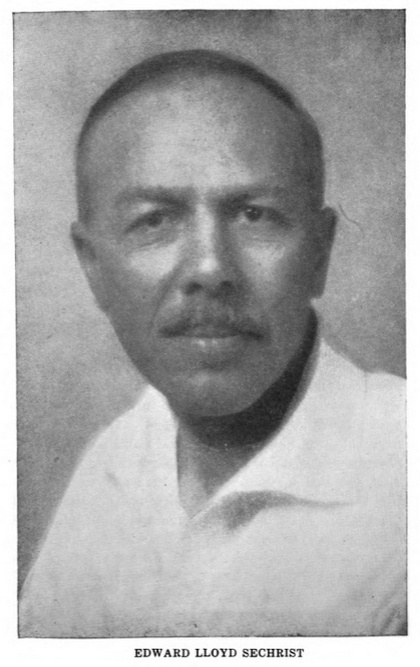
Edward Lloyd Sechrist (1873-1953) was born in 15th August 1873 in Wayne County, Ohio. He was notable for being one of the world’s leading scientific bee-keepers and an important writer on bees, from about 1922 onward, and he contributed much to the developing art and science of modern beekeeping. He corresponded with H.P. Lovecraft in the 1920s and became his good friend.

Early Life:

Sechrist was born and raised on SpringCrest Farm, the Sechrist family farm located near Pleasant Home in Wayne County, Ohio. There is A History of the Sechrist Family (1919), written by Julia Ann Shoemaker Sechrist (1846-1935) of that branch of the family, and although this is not online it presumably has full details of their background.

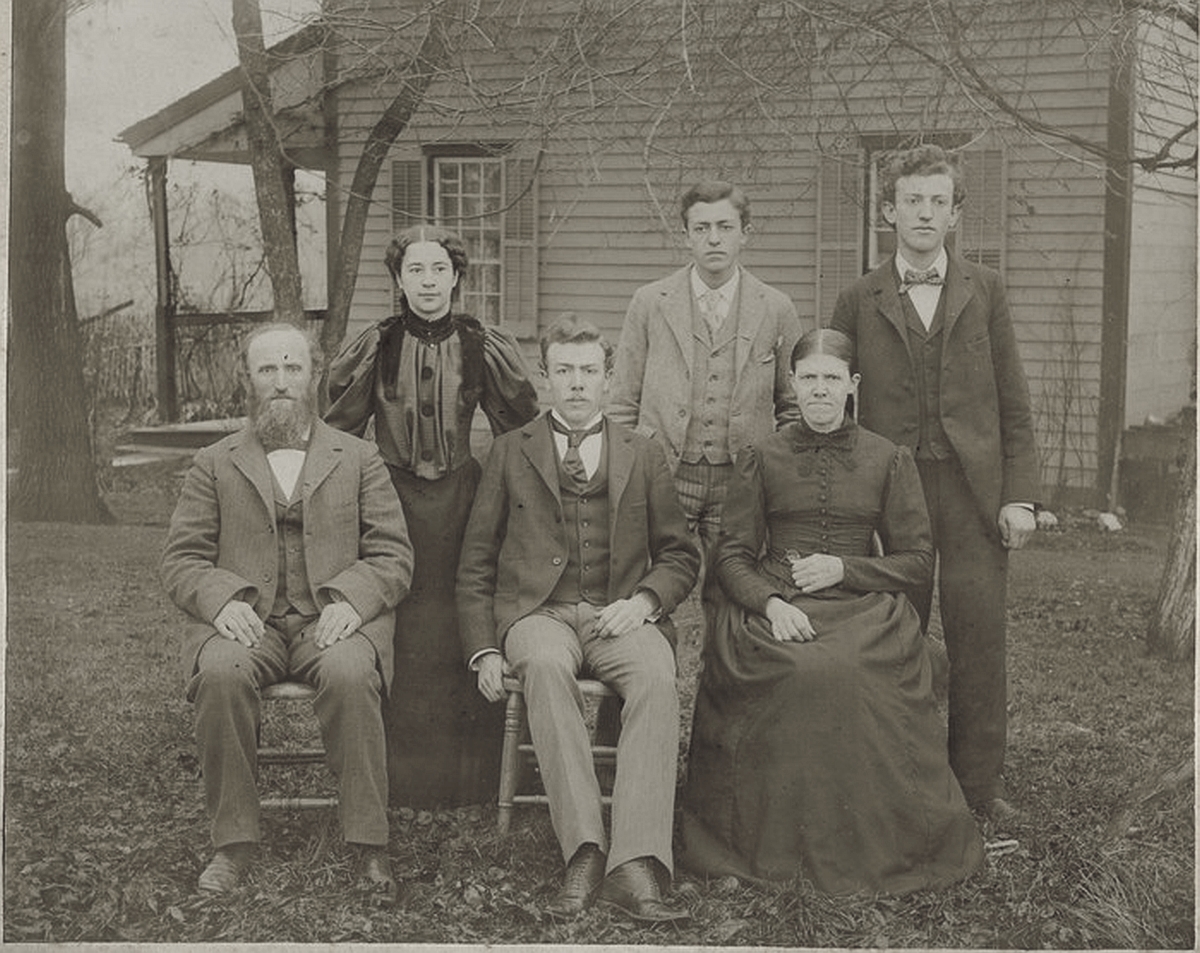
His parents.

Sechrist sitting (middle) with his parents.

He would have come of age in the early 1890s. He presumably underwent religious training and initial trial congregation work, because he became the Rev. Edward Lloyd Sechrist. This was possibly in Cleveland. He married in Cleveland and he and his wife had two young children by 1905.

In Mashonaland:

As the Rev. Edward Lloyd Sechrist he had served as a teacher and evangelising missionary in Mashonaland, Rhodesia (East Central Africa). He “went in the field in 1905” according to one journal. Then he and his young family arrived at the Methodist Episcopal Mission at Old Umtali in October 1906 to serve there as “the agricultural man”, training locals in fresh vegetable production on the Mission farm. He also tested the ground with new useful crops, to see what might thrive there. Local species of fruit trees and bushes were planted by the thousands each year.

This Mission was “a large industrial training mission”, established in 1899 in the most trying and difficult circumstances, and in practice it seems that a teacher there had to be an ‘all rounder’ and a bit of a medical man as well. Bringing a doctor out for a visit cost fifty dollars. A history of Christian missions in Rhodesia notes that… “Mr Sechrist took charge of the Mechanical Department while Mrs Sechrist supervised the work in the primary school.” One of the first things they did was to grade the school classes much more efficiently by intelligence and aptitude. He found the boys capable of most types of basic craftsmanship and productive manual work, and hoped to marginally improve their future earning and homemaking capacity without forcing western ideals and standards on them. Mrs Sechrist also soon introduced musical instruction. The Rev. Sechrist, as well as supervising much building and fencing work, taught drawing and “has started the bee industry” at the Mission. These were, however…

“native wild bees which are extremely cross [fierce] and have many undesirable traits. We are getting some imported bees and hope to give a better report in a few years. The boys work with the bees very well and if it can be made a profitable industry it should be a good thing, as honey will sell at a good price.” (1907 report)

A daughter, Helen Alice Sechrist Osman, was born to the Sechrists at Old Umtali in January 1908. By summer 1908 the Mission was making strong local progress and the natives had turned from sullen to friendly. The Mission’s attention was thus turned to opening up ‘the interior’ districts, still hostile. For three months in the summer of 1908 the Rev. Sechrist tried, solo and living out of a rat-infested hut, to open up new missionary territory in the ‘interior’ districts of Mrewa and Mtoko. Sechrist found the natives suspicious and hostile to white men, and the tribal chiefs still adamantly refusing to allow the possibility of any local missionary station. The few white people living in these remote districts appear to have been just as unresponsive.

Return to America:

At the end of the summer of 1909 he returned to America, with his wife and three children. The Epworth Herald [Chicago] reported… “Mr. Edward L. Sechrist and Mrs. Sechrist of the Old Umtali Industrial Mission, East Central Africa, arrived in New York with their three children Monday, October 25.”

The family may have returned via London, which would be the natural stop on the route — Sechrist’s poem “Success”, found near the front of his 1947 edition of his intructional book Honey getting, remembered that forty years before… “I saw a wall in a palace-garden in England”. This he always remembered as ‘the perfect’ mossy vine-trailed sun-brushed wall. One thus imagines that the Anglophile Lovecraft would have once heard from Sechrist some memories of the autumnal palace gardens and streets of London at the height of Empire.

To Tahiti:

There is no trace of Sechrist in the online-accessible historical record from about 1910 to 1918. But it is possible to infer that he was in Polynesia as a missionary for at least part of this time. Lovecraft noted Polynesia in January 1922, after Sechrist had joined the United and thus become involved in Amateur Journalism in late 1921…

“One of our most distinguished new accessions is Mrs. Renshaw’s recruit, Edward Lloyd Sechrist, of Washington, D. C., whose powerful essay on Columbus will introduce him to United readers. Mr. Sechrist is studying advanced literature at Research University, and promises to be heard from in the future. He is a traveller and philosopher, with strong predilections for the more genuine side of Nature; and has spent much time in such remote places as South Africa and Polynesia.” (Lovecraft in News Notes, January 1922).

A profile in the journal Bees, unavailable except as a snippet, has…

“His seven years in Tahiti Sechrist later described as “the most delightful episode of my life”.”

We know he was in Tahiti in the 1930s so there may have been two such stays, the first being with his young family sometime during 1910-1918. Since Asia: Journal of the American Asiatic Association wrote in 1921 that…

“Sechrist lived in Tahiti with members of the Teva clan of poets — hereditary keepers of old stories and dance-songs.”

One result of this was Sechrist’s “The Shadow Folk” (Asia, April 1921). Possibly there are other such articles to be found.

[image broken by site move]

Published writings on bees:

Rather than continue to develop his ethnographic work, Sechrist developed a more serious practical interest in bees and how to make bee-farming more efficient. It is probable that this was spurred by the needs of the First World War, as his first substantial bee publication Transferring bees to modern hives (Farmers Bulletin 961, U.S. Dept. of Agriculture) was in 1918. This date might suggest that he was in Tahiti 1910-1917 and then returned to America.

So far as I can tell he issued no publication of his own in the world of Amateur Journalism, nor any sort of amateur bee newsletter.

Meeting Lovecraft in 1924:

Sechrist entered Amateurdom in 1921 and met Lovecraft in person on a visit to Providence in February 1924. They evidently also corresponded, as The Dream-Quest of Unknown Kadath is written on the back of Sechrist’s letters to Lovecraft.

He met Lovecraft in New York in November 1924…

“Early last November Mr. Edward Lloyd Sechrist of Washington spent some time in New York, absorbing many of its museums and antiquities under the guidance of the Official Editor [i.e. Lovecraft].” (Lovecraft, News Notes, July 1925).

A November 1924 letter in Letters from New York (page 85) confirms that the dating of this is indeed secure and News Notes is 1925 not 1926. Lovecraft records Sechrist arriving for “a week’s sightseeing among friends” and Lovecraft “prepared the Boys for Sechrist’s presence at the next meeting”. Thus it appears that Sechrist was, however briefly, sitting among the Kalems with Lovecraft.

Joshi, with access to all the Lovecraft letters, adds that…

“the two of them went to the Anderson Galleries on Park Avenue and 59th Street to meet a friend of Sechrist’s, John M. Price; Lovecraft had some dim hope that Price might be able to help him get a job at the gallery, but obviously nothing came of this.”

Price was a cataloguer with the gallery.

Around Washington in Spring 1925:

In April 1925 Lovecraft and Kirk visited Sechrist’s home ground for a whirlwind tour by speeding Ford car, Mrs Renshaw at the wheel…

“In April, accompanied by George W. Kirk, he [Lovecraft] paid a hurried visit to Washington and its Virginia environs; where the benevolent and expert guidance of Mrs. Renshaw and Mr. Sechrist enabled him to see much [in one day]” (Lovecraft, News Notes, July 1925).

“Lovecraft, Kirk, and Sechrist first made a walking tour of the important landmarks in the city centre, noting the Library of Congress (which failed to impress Lovecraft), the Capitol (which he thought inferior to Rhode Island’s great marble-domed State Capitol), the White House, the Washington Monument, the Lincoln Memorial, and all the rest. Renshaw then drove them to Georgetown, the colonial town founded in 1751, years before Washington was ever planned or built. Lovecraft found it very rich in colonial houses of all sorts. They then crossed the Key Memorial Bridge into Virginia, going through Arlington to Alexandria, entering the Christ Church, an exquisite late Georgian (1772–73) structure where Washington worshipped, and other old buildings in the city. After this, they proceeded south to Washington’s home, Mount Vernon, although they could not enter because it was Sunday. They drove back to Arlington, where, near the national cemetery, was the residence called Arlington, the manor of the Custis family. They also explored the cemetery, in particular the enormous Memorial Amphitheatre completed in 1920, which Lovecraft considered “one of the most prodigious and spectacular architectural triumphs of the Western World.” Naturally, Lovecraft was transported by this structure because it reminded him of classical antiquity — it was based upon the Dionysiac Theatre in Athens — and because of its enormous size (it covers 34,000 square feet). They then came back to Washington, seeing as much as possible before catching the 4.35 train back to New York, including the Brick Capitol (1815) and the Supreme Court Building. They caught the train just in time.” (S.T. Joshi, I Am Providence).

With Lovecraft in New York in late 1925:

Lovecraft’s Letters state that Sechrist was again coming to New York in June 1925 and “bringing two of his children”, when Lovecraft was anticipating meeting him again. (Selected Letters II, page 10). Possibly the trip was delayed, as Lovecraft’s day-by-day skeleton diary for 1925 makes no mention of him during June 1925.

The two men certainly met again in New York in late 1925, according to Lovecraft’s New York skeleton diary and confirmed by Letters from New York. Lovecraft talked on the telephone with Sechrist in advance of a visit. Lovecraft appears to have talked with him on the phone until after midnight, on the 12th-13th December. Lovecraft’s diary then has him meeting Sechrist on the 14th, 16th and 17th December, the last date being when two museum visits and a gallery occurred…

“AM. Mus., Met. Mus. bus to library — gallery & reading room — els lv.”.

‘ELS lv.’ = ‘Edward Lloyd Sechrist leaves’.

During this time Sechrist was again sitting among the Kalems with Lovecraft one evening (Letters from New York, page 253). Evidently the visit led Lovecraft to spruce up his dingy low-life apartment beforehand, even going to far as to wash the windows and curtains.

As was his wont, Lovecraft included Sechrist in his 1925 round of Christmas odes to friends, “May Polynesian skies thy Yuletide bless”.

Honey production and classification:

Sechrist continued his rapidly ascending career in the world of bee culture. There is evidently a mis-transcription in Selected Letters II when Lovecraft talks of…

“my old friend Edward L. Sechrist of the government bookeeping dept., a delightful aesthete & poet with a predilection for primitive life, who has spent much time in Africa & the South Sea Islands.”

“Bookeeping” should obviously read “beekeeping”.

Sechrist’s booklet The Color Grading of Honey appeared in 1925, in which some may see an interesting parallel to Lovecraft’s similar concern with colour gradations in “The Colour Out of Space” (1927).

In 1927 he wrote the technical report United States Standards for Honey for the United States Department of Agriculture, setting out in tight detail the nation’s recommended standards for all forms of the substance. When Americans buy or eat honey they can thus thank Sechrist for helping to ensure that it meets a set standard.

In 1928 he wrote a report on honey production in the Intermountain States of the U.S. This reveals that he was by then an Associate Apiculturalist at the Bureau of Entomology, Dept. of Agriculture. The field research undertaken for this report was likely why he was not at home when Lovecraft was in the area…

“He tried to look up Edward Lloyd Sechrist, but found that he was away on business in Wyoming.” (S.T. Joshi, I Am Providence)

Stymied, Lovecraft instead took a $2.50 four-hour bus-ride out to the Endless Caverns of Virginia, whence he descended. Thus giving us Lovecraft’s marvellous account of “A Descent to Avernus”, written Summer 1928.

Washington and Great Zimababwe:

In Lovecraft’s Travels in the Provinces of America (1929) he states that he had again taken trips with Sechrist, when in Washington in 1929…

“In many of my trips I was ably guided by my friend Edward Lloyd Sechrist, Esq., whose courtesy contributed so much to my Washington trip of 1925.”

This was when Lovecraft heard Sechrist’s most substantial account of visiting the ruins of the fortress at Great Zimababwe. The account, and more specifically the authentic artefacts that Sechrist had by then acquired, inspired Lovecraft’s long and languorously weird African poem “The Outpost” (1929)…

“he shewed me many rare curiosities such as rare woods, rhinoceras-hide, &c. &c. — & especially a prehistoric bird-idol of strangely crude design found near the cryptical & mysterious ruins of Zimbabwe (remnants of a vanished & unknown race & civilisation) in the jungle, & resembling the colossal bird-idols [eagles] found on the walls of that baffling & fancy-provoking town. I made a sketch of this, for it at once suggested a multiplicity of ideas for weird fictional development.”

Sechrist’s first-hand account and newly revealed artefacts would seem to have arisen from a more recent visit to Africa in the later 1920s, rather than from his missionary work back in the 1900s. One then suspects that Sechrist may have re-visited Old Umtali to set up modern commercial bee hives at the Mission there, and to train the Mission in the art of advanced bee-keeping. There is as yet no confirmation of a 1920s visit, though, that I can find.

However, evidently Sechrist had already discussed Zimbabwe with Lovecraft back in 1925, since Lovecraft mentions the fortress in his 1925 poem to Sechrist, “May Polynesian skies thy Yuletide bless” etc. This has the line “Zimbabwe’s wonders hint mysterious themes”. There is also an account of Lovecraft being intensely interested in a discussion of Zimbabwe with Sechrist, had in December 1925. (Letters from New York, page 256). For more on the extended influence Zimbabwe had on Lovecraft see my essay “H.P. Lovecraft and Great Zimbabwe”.

A leading bee specialist:

In 1930 Sechrist developed a lantern slide (slide-show) presentation on bee-handling, for presentation to farmers in remote rural districts during the early part of the Great Depression. He also undertook radio talks on beekeeping. His books show he was a competent photographer, and used photographs in his work and books, something begun as far back as the 1900s when he did “considerable photographic work” at his African Mission. Sadly he doesn’t appear to have left us any pictures of Lovecraft.

Sechrist at work in 1930.

In April 1932 Lovecraft writes that…

Sechrist — the bee expert — is now stationed in Davis, California.

This was the Pacific Coast Bee Culture Field Station at Davis, California. In 1931 this was less grand than it sounds, with Frontier Bees and Honey magazine stating that…

“we understand almost the only equipment now on hand is the staff of workers, now occupying a large bare room in the Animal Science building”

One source on Sechrist mentions his “first marriage”, so presumably there was a second marriage, and the early 1930s move across the nation might (at a guess) have been connected with that? Apparently his second wife was a nutritionist. But more probably the move out west was due to pressure on the government from the booming Californian bee-farmers, who wished to have their share of the top national consultants. Such matters could be easily clarified, if only outdated copyright laws did not hinder access to much defunct 20th century material. The same can be said of Sechrist’s books, all but two of which are on copyright lockdown.

The 1944 introduction to the 1947 second edition of his standard introduction to commercial bee farming, Honey Getting (Bee Master Series), states that he worked at the U.S. Bee Culture Laboratories at Washington D.C. and in California. He published several other major books such as Amateur Beekeeping and Scientific Beekeeping, as well as articles in the likes of the American Bee Journal.

In Polynesia (again):

On Lovecraft’s death, the instruction was to send certain manuscripts to Sechrist in Tahiti…

Mss. of Polynesian folklore with pictures [to] E. L. Sechrist, Box 191, Papeeti, Tahiti.

We have to then assume that Sechrist was living in Tahiti in the mid 1930s, and that he was almost certainly assisting bee farms there. Barlow duly sent the required parcel away to Tahiti, on Lovecraft’s death.

Update: Some information on the post-retirement life of Lovecraft’s friend Sechrist, from the USDA Employee Newsletter, 12th June 1944…
Possibly this folklore collecting, presumably done by Sechrist himself in Tahiti, was why de Camp stated in his biography of Lovecraft… “Edward Lloyd Sechrist, an anthropologist of the Smithsonian Institution.” Lovecraft states in Selected Letters IV that…

“My friend Sechrist (the ex-Washingtonian bee expert) lived in Tahiti for years — close to the natives — & studied their folklore in detail.”

We know this was true of the 1910s, and that he did gift a full-size traditional outrigger Hawaiian fishing canoe to the Smithsonian (catalogued in 1923, but perhaps acquired earlier than that date). Possibly he also deposited his Tahitian folklore notes and manuscripts. However I can find no record of these, nor any mention of Smithsonian links during the 1930s or later.

As a poet:

Lovecraft evidently considered Sechrist a poet in the 1920s. One Sechrist poem appears in his Honey Getting (1945/47), and possibly more may be found. There appears to have been no poetry collection.

Obituaries:

Sechrist died at his home at Escondido, California, aged 81, following a stroke. I regret there are no obituaries freely available online, nor can the several profile articles on Sechrist in bee publications be had. The Canadian Bee Journal does provides a substantial snippet which offers context for his career…

“Edward Lloyd Sechrist, during his lifetime of 81 years, spanned the years from the early attempts to bring modern beekeeping into practice then the rush to large scale commercial beekeeping and lately, to methods to improve bee brooding.”

His best publicly-available tribute is to be found in Honey Getting…

Sechrist as Lovecraft would have known him. The three blurry dots are probably large bees.

There appears to be no archive of his papers, photographs and correspondence.

“H.P. Lovecraft and Great Zimbabwe”

17 Saturday Nov 2018

Posted by asdjfdlkf in Historical context, Scholarly works

≈ Leave a comment

A new free sample essay from my book Lovecraft In Historical Context: the fifth collection (2014). “H.P. Lovecraft and Great Zimbabwe”.

Update: due to popular demand I’ve re-uploaded it in colour rather than black and white.

Rootwork

16 Friday Nov 2018

Posted by asdjfdlkf in Historical context, Scholarly works

≈ Leave a comment

Now free on Archive.org, a huge encyclopaedic compendium of folk-beliefs about the ‘active supernatural’, that could still be found being expressed by folks in America during the 1930s. The beliefs are exhaustively categorised by type, in the manner of the theme-sorting ethnographic folklorists and fairy-tale sifters of the period (sadly, sci-fi has never had a similarly completist look-up volume containing an index of all of its themes and concepts).

Many of the book’s ‘folklore collecting points’ overlap with areas encompassed by Lovecraft’s annual summer travels.

My red dots, for clarity. South Carolina is a probable dot as well, but I can’t be sure.

This defunct historical lore is possibly most useful, these days, as a set of Oblique Strategies-like ideas which writers can use to inspire new works. Open at random three times, pick an idea randomly from each of the three pages, then think of a setting that might contain and combine them all in some way. Add characters, and devise the skeleton plot framework.

George Julian Houtain in the movies

12 Monday Nov 2018

Posted by asdjfdlkf in Historical context, New discoveries

≈ Leave a comment

I’ve found another interesting little nugget about the connections of the Lovecraft Circle with the movie business in New York City. Arthur Leeds had been in the movies there, and Everett McNeil (who Leeds employed at one time) had been an experienced screenwriter. Now I find that George Houtain was also once in the movie business. He was an amateur journalism colleague who later published Lovecraft ‘shocker’ stories in Home Brew. But only a few years earlier he was head of Gray Seal Productions, before the industry moved west. This appears to be a new discovery.

Not only that, but Houtain employed another Lovecraft colleague in 1919…

“Dench Joins Gray Seal, Inc. President George Julian Houtain announces the appointment of Ernest A. Dench” “Mr. Dench will handle the special publicity of the Gray Seal stars, who include Myrtle Stedman, Wheeler Dryden, Grace Harte and Richard Turner.” — Moving Picture World (March 1919).

Wheeler Dryden, you’ll recall, attended a number of meetings of the Kalems with Lovecraft. Motion Picture News (April 1919) reported that Dench resigned this “special publicity” role after a few weeks, due to taking an extended trip back to England…

Dench must have either primed the files with some stories before he went, or returned soon, as an article by him in favour of Gray Seal appeared in Photo-Play Journal (July 1919). It reveals the address of Gray Seal…

Gray Seal Productions made a number of movies with the comedy star Wheeler Dryden, Chaplin’s half-brother. Dryden reportedly made 26 comedy shorts for Gray Seal in 1919. Myrtle Stedman was an “old time” star, having “been associated with the industry since its earliest days”, and presumably played older women. Grace Harte was a young society girl who was a “find” of Houtain’s. Richard Turner was the leading man and also a production supervisor.

It appears the company may have been named for a memorable gangster/crime movie character, “The Gray Seal” (1916). The brand doesn’t appear to have survived the industry’s move to the west of America. Houtain, along with Leeds, Dench and McNeil stayed in New York City. As mentioned above, Wheeler was Charlie Chaplin’s brother and is known to have attended many meetings of Lovecraft’s circle, the Kalem Club in the mid 1920s. So it appears that he also stayed and was in New York at least in 1925/26, but Chaplin historians may know more about his movements at that time.


The above adds to my “How did H.P. Lovecraft come to know McNeil?” section in my book Good Old Mac, on the life and work of Everett McNeil.

HPL in colour: the rural gardener

10 Saturday Nov 2018

Posted by asdjfdlkf in Historical context

≈ Leave a comment

My first try at colourising the scan of the Vrest Orton ‘milkmaid’ picture. It is September 1928, and HPL is again visiting Vrest Orton in the woods of Vermont, and is wearing a wooden yoke of the type traditionally used to carry milk-pails.

   “The change of plan began when a friend of mine — now resident in New York but spending the summer in his ancestral Vermont — fairly kidnapped me into a two weeks’ visit at a lonely farm he had hired in the exquisite countryside near Brattleboro. In this half-fabulous paradise of endless green hills and wild, brook-haunted glens, it is needless to say that my nerves recovered very substantially from the strain of New York. […] I now drank in to its fullest extent the miraculously preserved early-American life of the region.” — letter of 28th July 1928.

   “No more likeable, breezy, & magnetic person ever existed than he [Vrest Orton]. In person of smallish size; dark, slender, handsome, & dashing, he is clean-shaven of face & jauntily fastidious of dress … He confessed to 30 years, but does not look more than 22 or 23. His voice is mellow & pleasant … & his manner of delivery sprightly & masculine — the careless heartiness of a well-bred young man of the world. … A thorough Yankee to the bone, he hails from central Vermont, adores his native state and means to return thither in a year, & detests N.Y. as heartily as I do. His ancestry is uniformly aristocratic — old New England on his father’s side, & on his mother’s side New England, Knickerbocker Dutch, & French Huguenot.” — letter quoted in I Am Providence.

One can see, if one looks closely, that the “smallish” Vrest is standing on a slightly raised lawn, about four inches higher than HPL, in the picture. Thus they appear to be about the same height. Some tactful visual height compensation has obviously been neatly arranged by the photographer. He also likely has boot-heels that add another inch, whereas HPL appears to have flatter old walking shoes.

This picture was made at a time when he was helping Orton to dam a hillside stream and divert it to make a new pool, so it also reflects that labour.


Postcard sent by Lovecraft during his 1928 stay with Vrest…

← Older posts
Newer posts →


Please become my patron at www.patreon.com/davehaden to help this blog survive and thrive.

Or donate via PayPal — any amount is welcome! Donations total at Easter 2025, since 2015: $390.

Archives

  • March 2026
  • February 2026
  • January 2026
  • December 2025
  • November 2025
  • October 2025
  • September 2025
  • August 2025
  • July 2025
  • June 2025
  • May 2025
  • April 2025
  • March 2025
  • February 2025
  • January 2025
  • December 2024
  • November 2024
  • October 2024
  • September 2024
  • August 2024
  • July 2024
  • June 2024
  • May 2024
  • April 2024
  • March 2024
  • February 2024
  • January 2024
  • December 2023
  • November 2023
  • October 2023
  • September 2023
  • August 2023
  • July 2023
  • June 2023
  • May 2023
  • April 2023
  • March 2023
  • February 2023
  • January 2023
  • December 2022
  • November 2022
  • October 2022
  • September 2022
  • August 2022
  • July 2022
  • June 2022
  • May 2022
  • April 2022
  • March 2022
  • February 2022
  • January 2022
  • December 2021
  • November 2021
  • October 2021
  • September 2021
  • August 2021
  • July 2021
  • June 2021
  • May 2021
  • April 2021
  • March 2021
  • February 2021
  • January 2021
  • December 2020
  • November 2020
  • October 2020
  • September 2020
  • August 2020
  • July 2020
  • June 2020
  • May 2020
  • April 2020
  • March 2020
  • February 2020
  • January 2020
  • December 2019
  • November 2019
  • October 2019
  • September 2019
  • August 2019
  • July 2019
  • June 2019
  • May 2019
  • April 2019
  • March 2019
  • February 2019
  • January 2019
  • December 2018
  • November 2018
  • October 2018
  • September 2018
  • August 2018
  • August 2015
  • July 2015
  • April 2015
  • March 2015
  • February 2015
  • January 2015
  • December 2014
  • November 2014
  • October 2014
  • September 2014
  • August 2014
  • July 2014
  • June 2014
  • May 2014
  • March 2014
  • February 2014
  • January 2014
  • December 2013
  • November 2013
  • October 2013
  • September 2013
  • August 2013
  • July 2013
  • June 2013
  • May 2013
  • April 2013
  • March 2013
  • February 2013
  • January 2013
  • December 2012
  • November 2012
  • October 2012
  • September 2012
  • August 2012
  • July 2012
  • June 2012
  • May 2012
  • April 2012
  • March 2012
  • February 2012
  • January 2012
  • December 2011
  • November 2011
  • October 2011
  • September 2011
  • August 2011
  • July 2011
  • June 2011
  • May 2011
  • April 2011
  • March 2011
  • February 2011
  • January 2011
  • December 2010
  • November 2010
  • October 2010
  • September 2010
  • August 2010
  • July 2010

Categories

  • 3D (14)
  • AI (70)
  • Astronomy (70)
  • Censorship (14)
  • de Camp (7)
  • Doyle (7)
  • Films & trailers (101)
  • Fonts (9)
  • Guest posts (2)
  • Historical context (1,096)
  • Housekeeping (91)
  • HPLinks (77)
  • Kipling (11)
  • Kittee Tuesday (92)
  • Lovecraft as character (58)
  • Lovecraftian arts (1,628)
  • Lovecraftian places (19)
  • Maps (70)
  • NecronomiCon 2013 (40)
  • NecronomiCon 2015 (22)
  • New books (966)
  • New discoveries (165)
  • Night in Providence (17)
  • Odd scratchings (984)
  • Picture postals (276)
  • Podcasts etc. (431)
  • REH (184)
  • Scholarly works (1,470)
  • Summer School (31)
  • Unnamable (87)

Get this blog in your newsreader:
 
RSS Feed — Posts
RSS Feed — Comments

H.P. Lovecraft's Poster Collection - 17 retro travel posters for $18. Print ready, and available to buy — the proceeds help to support the work of Tentaclii.

Proudly powered by WordPress Theme: Chateau by Ignacio Ricci.