• About
  • Directory
  • Free stuff
  • Lovecraft for beginners
  • My Books
  • Open Lovecraft
  • Reviews
  • Travel Posters
  • SALTES

Tentaclii

~ News & scholarship on H.P. Lovecraft

Tentaclii

Category Archives: Historical context

Lovecraft was related to Barlow

19 Tuesday Mar 2019

Posted by asdjfdlkf in Historical context, Scholarly works

≈ Leave a comment

A new article on “H.P. Lovecraft and Block Island”. By Edward Guimont, a PhD candidate at the University of Connecticut, who looks deeply and diligently for connections to the place but comes up rather empty handed. He does however end on the fascinating point that Lovecaft was very distantly related to Barlow….

R. H. Barlow, a young collaborator [was, as] Lovecraft discussed in an August 27, 1936 letter to their mutual friend Elizabeth Toldridge […] descended from Rathbone1. In a visit to Lovecraft in the summer of 1936, Barlow and Lovecraft discovered that Barlow’s family tree split with the original Rathbone’s son, making the two authors sixth cousins.

Lovecraft also had had some distant family-tree members living on Block Island, but I’ve never yet found any mention of him going there to check the graveyards etc.


1. John Rathbone = “one of the original 16 purchasers of Block Island from 1661 now immortalized (under the spelling John Rathbun) on the Settlers’ Rock plaque near the North Light.”

Invisible Monsters in Magnolia

17 Sunday Mar 2019

Posted by asdjfdlkf in Historical context, Scholarly works

≈ Leave a comment

Bobby Derie, at the Deep Cuts blog today, has a new appreciation of “The Horror at Martin’s Beach” (1923) by Sonia H. Greene & H. P. Lovecraft.

I see there’s also a new PDF scan of its appearance in Weird Tales as “The Invisible Monster”, because it’s now in the public domain. It can also be seen in its original Weird Tales context.

Magnolia, Gloucester was evidently the inspiration for the moonlight/ropes elements of the story. Though one was to wonder if Lovecraft’s earlier story “The Moon-Bog” (written 1921) didn’t play its part in Lovecraft’s ‘instant inspiration’ on the beach at Magnolia, with its similar moonlight-ladders and bewitched chain of people being drawn to their watery doom. Only published in June 1926, it’s possible that Sonia had not yet seen or heard a reading of “The Moon-Bog” in the early 1920s.

I’d suggest that for the first part of “The Horror at Martin’s Beach” (the capture and display of the sea-monster) Lovecraft was also splicing the Magnolia atmosphere with the fabled sea-monster of Sheepshead Bay. That was where the amateurs often met, at Dench’s house on the waterfront, and to hint that the setting was similar would add a slick veneer of Jaws-like local interest. Possibly that part had significant input from Sonia? The twist ending in the final line is also a bit ‘off’ in the believability of its twist, I think, and I’m not sure that’s from Lovecraft either.

New book: The Culture and Art of Death in 19th Century America

17 Sunday Mar 2019

Posted by asdjfdlkf in Historical context, New books

≈ Leave a comment

A new book from McFarland, The Culture and Art of Death in 19th Century America…

“Nineteenth-century Victorian-era mourning rituals — long and elaborate public funerals, the wearing of lavishly somber mourning clothes, and families posing for portraits with deceased loved ones — are often depicted [today] as bizarre or scary. But behind many such customs were rational or spiritual meanings. This book offers an in-depth explanation at how death affected American society and the creative ways in which people responded to it. The author discusses such topics as mediums as performance artists and postmortem painters and photographers, and draws a connection between death and the emergence of three-dimensional media.”

Currently on available on Amazon USA, and quite expensive at $55.

Friday picture postals from Lovecraft: un-tarred Brattleboro back-road to the mountain

15 Friday Mar 2019

Posted by asdjfdlkf in Historical context, Picture postals

≈ Leave a comment

“The kinship and hospitality of the Main Street [of Brattleboro] spread over us, and encourage us to climb higher into the charmed sea of westerly greenness to which these atavistic bricks form pylon and peristyle. The wild hills are before us […] Narrow, half-hidden roads bore their way through solid, luxuriant masses of forest, among whose primal trees whole armies of elemental spirits lurk.” — H.P. Lovecraft, “Vermont: A First Impression” (September 1927).

Lovecraft’s friend and fellow amateur pressman Arthur H. Goodenough lived near Brattleboro, hence Lovecraft came to know the place quite well on several visits. He also visited with Vrest Orton, also near Brattleboro.

The local history Brattleboro Words project also has…

“I’ve never seen no country niftier than the wild hills west of Brattleboro,” Lovecraft wrote to a friend. “The nearness and intimacy of the little domed hills become almost breathtaking. Their steepness and abruptness hold nothing in common with the hum-drum standardized world we know, and we cannot help feeling that our outlines have some strange and almost forgotten meaning.”

The full quote, uncensored by political correctness, is as follows. Lovecraft starts off in contemporary slang…

“I never seen no country niftier than the wild hills west of Brattleboro, where this guy hangs out. Brat itself is the diploduccus’ gold molar, with its works of pristine Yankee survival, but once you climb the slopes toward the setting sun you’re in another and an elder world. All allegiance to modern and decadent things is cast off — all memory of such degenerate excrescences as steel and steam, tar and concrete roads, and the vulgar civilization that bred them —”

The nearness and intimacy of the little domed hills become almost breath-taking — their steepness and abruptness hold nothing in common with the humdrum, standardized world we know, and we cannot help feeling that their outlines have some strange and almost-forgotten meaning, like vast hieroglyphs left by a rumoured titan race whose glories live on in rare, deep dreams.”

Some notes on Hugh B. Cave’s “Magazines I Remember”

15 Friday Mar 2019

Posted by asdjfdlkf in Historical context

≈ Leave a comment

Some notes made on reading Hugh B. Cave’s book Magazines I Remember: Some Pulps, Their Editors, And What it Was Like to Write For Them, newly on Archive.org and which I linked to yesterday in the post The Cave of Pulps.

* Cave lived in Pawtucket (a long trolley/tram ride from Providence), and sometimes took an apartment in Boston. While he briefly corresponded professionally with Lovecraft in the early 1930s, and Cave had at least two fulsome replies from the master, they never met or even telephoned.

* Newspapers then reprinted pulp stories. Also, Farnsworth Wright nearly interested radio in ‘putting Weird Tales on the air’, to the extent of casting the male lead for a radio adaptation of a Cave story — yet he obviously never succeeded.

* There was an informal blacklist among pulp editors of young authors known to have plagiarised the stories of others and who tried to sell the result.

* Farnsworth Wright marked unpublished manuscripts with red ink dots in the margin, in the process of assessing them, thus making them difficult to send to other editors who knew Farnsworth’s ‘ways’ and could thus spot a ‘Weird Tales reject’. This fact suggests that if a Lovecraft manuscript was rejected by Weird Tales, then he would likely have to retype it — which he hated doing.

* The “summer is a dead time in the pulps”, said of story acceptances in the early 1930s.

* Even when a pulp writer was obviously ‘working at it’ like dog, the early 1930s were a real roller-coaster for the finances of a pulp author. It seems that one could sell quite regularly, sell overseas rights, newspaper rights, and even movie options (to RKO in this instance), as well as selling to the ‘slicks’, and still find oneself living in dire poverty for long periods as magazine failed to pay or went bankrupt. I’d already known something of this re: Lovecraft and R.E. Howard, but it was interesting to see another pulp writer’s detailed perspective on the pulp market in the period.

* The ‘spicy’ pulps could be found on open sale on news-stands in Pawtucket, Rhode Island, in 1934. They were a new development in the market at that time and were rumoured among writers to be ‘under the counter’ yet Cave found it otherwise even in Pawtucket. In Cave’s professional opinion they were no more than regular pulps stories with some hackneyed sex inserted here and there.

* It seems that, to save money, writers often did not buy pulps regularly. With perhaps the exception of Weird Tales. They would only purchase if they were being published in an issue, and then they might buy a number of copies. The British reprint and anthology market would accept magazine pages instead of a typed manuscript.

* In the early 30s Cave held J. D. Newsom in very high regard for his slick funny adventure stories of the French Foreign Legion. A quick look for the name finds there’s a blog review and Pulpdom #46 (June 2006) had the article “The Men Who Made the Argosy: J. D. Newsom”.

* In the 1970s Jacobi thought that much of August Derleth’s ‘juvenile’ work (i.e. what would today be called ‘young adult’) was his strong point as a writer and that many were ‘masterpieces’. Judging by a quick search, the $7 essay collection Return to Derleth (Vol 1) has what might be the best survey of these, with one review stating that an essay by… “Marion Fuller Archer tackles the juvenile novels with rare understanding of their impact on Derleth’s own life.” Jacobi also expresses his puzzlement at the growing ‘Lovecraft cult’ of the 1970s.

The Cave of Pulps

14 Thursday Mar 2019

Posted by asdjfdlkf in Historical context, Scholarly works

≈ Leave a comment

New and free on Archive.org…

Hugh B. Cave, Magazines I Remember: Some Pulps, Their Editors, And What it Was Like to Write For Them, 1994. A 185 page book, with story-header illustrations from the pulps. Amazon and used book sellers will happily ding! your wallet for between £15 – £172 for this, in paper.

Hugh Barnett Cave (1910-2004) was a prolific pulp writer and a lifelong correspondent of Carl Jacobi. The book looks like an excellent mine of information, and the first five chapters appear to be extracts from the on-the-spot letters from one immersed in the pulp market — rather than a hazy attempt to recall matters from a distance of more than 50 years.

Definitely a book to cue up for proper reading on my Amazon Fire tablet! Sadly, I see that the PDF version has mangled the pictures, though.

Actually, this problem has usefully made me aware that Archive.org is now also offering a “COMIC BOOK ZIP” format for some types of content, which I had never noticed or tried before. This turns out to actually be the .CBZ format which can be read in any comic-book reading software. Superb quality, if 95Mb. So please forget my advice from a few days ago, about doing a manual conversion of the Archive.org .JP2s to .CBZ format. Archive.org now does it for you, if only on some types of content.

This means that you can drag-and-drop a link on a private Trello board for the relevant Archive.org page, to send a live clickable Web link from desktop to tablet. Then you can download the .CBZ directly from the tablet, rather than wrestle with a wi-fi or cable file-transfer. A simple Trello board saves having to use a mega-corp cloud service that wants to slurp up your entire bookmarks and every site URL you visit, just to send the occasional clickable URL from your desktop Web browser over to your Kindle or iPad tablet. Also works fine with YouTube videos. It’s a home-brew solution to the surprisingly difficult problem of sending a live clickable Web link from desktop to tablet, but it’s quick and it works.

On the Kindle, ComittoNxN (Comic Viewer) (paid) and Comic Time Reader (wholly free, ad-free, but needs to be sideloaded on a Kindle) are the best reader apps for free comics, in my experience, untethered from the locked-down offerings at Comixology and Marvel and similar services.

1933 profile of Farnsworth Wright

14 Thursday Mar 2019

Posted by asdjfdlkf in Historical context

≈ 1 Comment

From Science Fiction Digest, March 1933, a profile of Weird Tales editor Farnsworth Wright. Including some details of his working methods.

Spaceways for December 1940 also had Julius Schwartz’s “A Biography of Farnsworth Wright”, but this issue of the fanzine is incredibly rare and not online.

New book: Collected Essays on H.P. Lovecraft and Others

14 Thursday Mar 2019

Posted by asdjfdlkf in Historical context, New books, Scholarly works

≈ Leave a comment

Douglas A. Anderson’s A Shiver in the Archives post made me aware of George “Wetzel’s Collected Essays on H.P. Lovecraft and Others, e-book 2015″. I missed this when it became available in October 2015. It’s a 116-page ebook with eight essays. A bit expensive for me, at present, at £3.68. But it’s definitely gone onto my ever-lengthening ‘to get’ Wish List of Lovecraft Scholarship…


CONTENTS:

“Biographic Notes on Lovecraft” (from HPL, 1971)

“The Mechanistic Supernatural of Lovecraft” (from Fresco, 1958)

“The Cthulhu Mythos: A Study” (from HPL: Memoirs, Critiques and Bibliographies, 1971)

“A Lovecraft Profile” (from Nyctalops #8, April 1973)

“The Pseudonymous Lovecraft” (from The Lovecraft Scholar, 1983)

“Lovecraft’s Literary Executor” (from The Lovecraft Scholar, 1983)

“Copyright Problems of the Lovecraft Literary Estate (from The Lovecraft Scholar, 1983)

“A Memoir of Jack Grill” (from Huitloxopetl, 1972)

“Letters of George Wetzel” (from Fan-Fare, 1951-1953)

The Grill collection and the location of the Binkin bookshop

12 Tuesday Mar 2019

Posted by asdjfdlkf in Historical context, New discoveries

≈ Leave a comment

Douglas A. Anderson’s A Shiver in the Archives has a good new article on The H.P. Lovecraft Collection of Jack Grill and (later) Irving Binkin.

According to Wetzel, Grill “collected HPL photos, letters written to and by HPL; he interviewed HPL acquaintances, visited many of the Middle Atlantic and New England towns to which HPL had made antiquarian tours, and accumulated many other odds and ends of Lovecraftiana.” An odd, shy man, Grill wished he was “a writing fellow,” but his only writings were letters — in an execrable hand-writing, without paragraphs and mostly without dates.

The collections was purchased by Binkin in New York…

Having seen the photographs [of Lovecraft in the collection], Binkin realized that Lovecraft had been a regular customer at his bookstore, just off Red Hook in Brooklyn, over forty years earlier.

Wetzel, in his memoir of Grill, quotes a letter from Grill (circa June 1957) stating he’d acquired unpublished stories by Hazel Heald, “The Basement Room” (5 pages) and “Lair of the Fungus Death” (25 pages), from Heald herself.

Given the clunky titles, I’d expect that the Heald stories were not ones revised by Lovecraft.

But the Binkin bookshop is an interesting new point of street-level data about Lovecraft’s time in New York City in the 1920s. One wonders if an address can be pinned on it and a photo found?

54 Willoughby Street (1961 —)

A Directory of the early 1980s lists “Binkin’s Book Center, 54 Willoughby Street, Brooklyn”. The address is off Fulton St. and certainly fits the description of “just off Red Hook in Brooklyn”. A Bargain Hunter Guide of 1990 noted that “Binkin’s is the oldest bookstore [in the city]”. There is however a problem in assuming that this was always his location. For the Antiquarian Bookman for 1961 has…

“IRVING BINKIN. NEW LOCATION — ENTIRE BUILDING – FIVE FLOORS OF BOOKS. BINKIN’S. BOOK. CENTER. 54 Willoughby St., Brooklyn”

Thus it appears he only moved there circa 1961. Where Wally Dobelis remembered him in the 1960s…

Irving Binkin, in the back of Brooklyn Heights and the courthouse, on Willoughby Street, had a four-story building, the ground floor of which was devoted to making a living. Irving’s heart was really in ballroom dancing, of which he was a champion. He liked to go to Hispanic dances, and had a small Spanish book stock for his dance partners. Upstairs, he held residues of good Brooklyn estates, unpriced and unevaluated, books, paintings and ephemera. After much negotiating, Irving had decided that we were trustworthy and would not stuff our pockets, and could be permitted to make selections and bring them down for pricing. Irving was not knowledgeable, but prided himself on being able to divine, from our body language, things about the value of our selections. It did work out, since he asked for our scholarship, and we were not out to steal high value items for pennies. It was fun. I found some Elihu Vedder lithographs…

Hunting this erroneous location, however, did lead me to two evocative photos from the fringes of Red Hook…
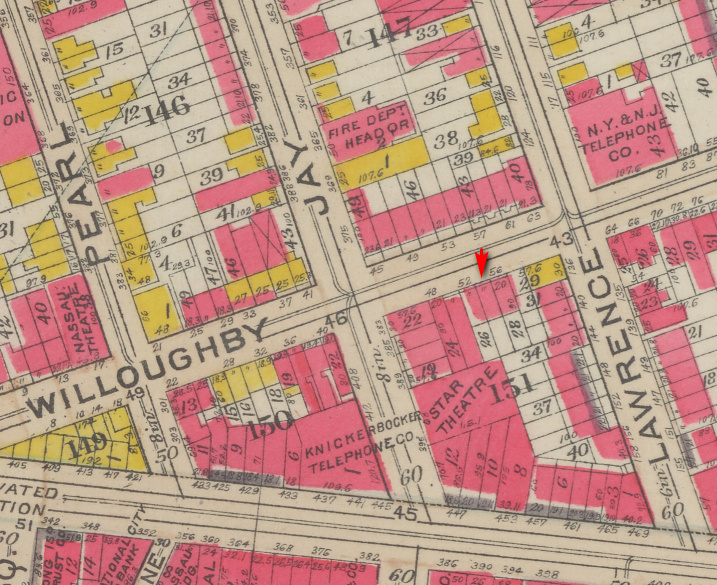
This eBay picture is from 1927, looking east along Willoughby with No. 54 ahead in the near middle-distance on the right of the street…

The sign on the far right states “Baked Beans”, a Lovecraft staple. He refers in his letters to “Red Hook’s modestly priced bean-bureaus”. A 1928 photo of Jay and Willoughby shows the same distinctive building on the corner, and the cafe and its distinctive corner-sign on the other corner…

We know that Lovecraft frequented a cafe on this street…

John’s — the Italian joint around the corner in Willoughby St.

We can also see that this picture is looking down Jay St toward the Star Theatre as seen on the map, and the theatre is advertising Burlesque girlie shows with its signage. This picture and its identification as ‘Jay’ clearly confirms the location of the other 1927 photo and that it just-about shows No. 54 in the middle distance on the right.


162 Pierrepont Street (later 1950s-1961)

However, we must step back further in time to Binkin’s earlier book store. This was on Pierrepont Street, the address given by Book Dealers in North America, 1956. Photographs of this store dated 1958 are on the Brooklyn Historical Society website. Obviously he was getting ready for his move to Willoughby Street, appearing to be a ’25-cents a book’ guy and thus generating a big low-cost stock that he could sell for higher prices at Willoughby Street in a few years’ time…

But again it’s hazardous to assume that this was the same as the store he had since the early 1930s.

We do however know that Lovecraft’s best friend Samuel Loveman knew Binkin. Also in the book trade, Loveman evidently once had a copy of Clark Ashton Smith’s poems Ebony and Crystal (1922). This is currently for sale by L.W. Currey and “a presentation inscription by Samuel Loveman, the book’s dedicatee, to bookseller Irving Binkin is present on the title page.” However, what date this book might have been gifted has to be uncertain. Perhaps the 1930s, when Binkin first set up in the book trade? Or perhaps a friendly gift in the 1970s, on rescuing the Grill collection? We shall probably never know.


252 Fulton Street.

A kind credit in Richard Morris’s scholarly book Reading Finnegans Wake (1959), and a book trade directory entry, shows that he was at 252 Fulton Street before Pierrepont Street…

The Bookshop of Isei Binkin
252 Fulton Street.

Fulton Street is of course a name well known to those who have read up on Lovecraft in New York in the 1920s, and especially his epic pursuit of a new suit at a cheap price. The dedication usefully give us Binkin’s Jewish name, which may help someone to track down where exactly he was selling books in Brooklyn, and thus where he might have been patronised by Lovecraft.

One ad Binkin placed stated that his business was “Established 1932”. So even if the 252 Fulton Street address in Brooklyn is his first such store, that would mean that Lovecraft would not have been a frequent customer there in the 1920s when he was living in New York.

And even here we can’t quite even be sure that this was where Binkin was trading from 1932 to perhaps the mid 1950s when Morris knew him. Until circa 1913 the address appears to have been a cheap and rather notorious flop-house hotel for sailors. Then after the War it appears to have been renovated into apartments and boutique shops. For instance, the American Florist for 1922 has… “S. Mastir, 256 Fulton Street, Brooklyn. We found in addition to his fine stock of cut flowers, an excellent collection of palms and other foliage plants.”

Thus a book store there from 1932 onward seems not unlikely. We know from Frank Belknap Long that the antiquarian shops along Fulton Street were not unknown to Lovecraft… “[Roman coins and] baked-clay Roman lamps, and he [Lovecraft] once helped me pick out magnificent examples of both ‘coinage and lampage’ at an old-coin shop on Fulton Street.” (Dreamer on the Nightside) Although it might be that this was the other Fulton St., to be found across the Brooklyn Bridge.


Of course, it is just possible that Binkin was ’embroidering history’ after he purchased the Grill collection, and was only claiming that he remembered having Lovecraft browsing in his shop back in the 1920s or 30s. Possibly he mis-remembered circa 1970 and another customer conveniently ‘morphed into Lovecraft’ in his memory, when hazily recalled over the distance of more than 40 years. But then there is also the possibility that Belkin had started in the book trade in the mid 1920s as a youthful assistant in someone else’s book store, and it was from that period that he genuinely remembered Lovecraft’s distinctive face.

New Derleth letters found, to be published

12 Tuesday Mar 2019

Posted by asdjfdlkf in Historical context, New books, Scholarly works

≈ Leave a comment

S. T. Joshi has a new blog post. Yet another truck-full of Joshi books is announced. Among which…

* “Eccentric, Impractical Devils [is] the whimsical title we have affixed to the collected letters of Clark Ashton Smith and August Derleth. Recently a previously unknown batch of Derleth’s letters to Smith came to light, causing us to refashion the book almost in its totality”.

* Joshi’s own “collected mystery and horror fiction” is now in one volume as The Recurring Doom: Tales of Mystery and Horror. These include his detective stories, but not the ‘Lovecraft as character’ novel The Assaults of Chaos (2013) which seems to be languishing in a limited-edition hardback.

* Also… “a complete edition of the fiction of Arthur Machen. This will appear in a three-volume trade paperback edition from Hippocampus Press very shortly”. One completely new very short story, never before published, and the excised final chapters of The Secret Glory.

Dream Quest in audio

11 Monday Mar 2019

Posted by asdjfdlkf in Historical context, Podcasts etc.

≈ Leave a comment

Lovecraft’s The Dream Quest of Unknown Kadath, in an unabridged 2014 reading made by Martin Reyto and kindly made available as a free Public Domain recording.

It’s the best free reading I could find, though slightly sibilant when heard with good headphones. That can be cured in AIMP thus…

You may also want to boost the Bass, and I ramped it up quite a bit. The MP3 doesn’t take kindly to real-time pitch shifting, though.

There’s another fairly good one I’ve heard, which is to be found in the Eldritch Tales: A Miscellany audiobook, although this is paid and appears to only be available in the USA. There’s also a reading of Kadath in the $20 USB stick from the H.P. Lovecraft Historical Society, from the Joshi corrected text and apparently with some music. Unlike Amazon, the Society seem willing to ship Kadath around the world.

It would be great to crowd-fund to pay someone like Phil Dragash to tackle this as a semi-dramatised unabridged reading with his voices, full sound effects, environmental ambience and music.


The zebra seen on the book cover above only appears for a short while, but is ridden by Carter. Later he takes to a yak. I wonder if this was a reflection of Lovecraft’s boyish desire to ride on some of the animals seen at Roger Williams Park in Providence, during his boyhood?

But perhaps it more likely reflects the boy Lovecraft’s ardent desire to get the zebra at the Roger Williams Park merry-go-round, rather than one of the more mundane horses…

Major Lovecraft auction – catalog coming in mid-March

09 Saturday Mar 2019

Posted by asdjfdlkf in Historical context

≈ Leave a comment

Windy City Pulp and Paper Convention is holding a Lovecraft collection auction…

the first part of the Robert Weinberg Estate Auction being held at the 2019 Windy City Pulp and Paper Convention … the auction will be held on the evening of Friday, April 12, 2019. […] The catalog and all images will be available on our website (www.windycitypulpandpaper.com) in mid-March, and we’ll also have instructions there for how you can place absentee bids if you can’t make it to the show.

One of the forthcoming auction items is shown, a Lovecraft postcard to Galpin from October 1922. Galpin has obviously written something negative about Loveman to another of the circle, and Lovecraft chides him for it, and suggests Galpin’s indiscretions could damage his whole circle.

← Older posts
Newer posts →


Please become my patron at www.patreon.com/davehaden to help this blog survive and thrive.

Or donate via PayPal — any amount is welcome! Donations total at Easter 2025, since 2015: $390.

Archives

  • March 2026
  • February 2026
  • January 2026
  • December 2025
  • November 2025
  • October 2025
  • September 2025
  • August 2025
  • July 2025
  • June 2025
  • May 2025
  • April 2025
  • March 2025
  • February 2025
  • January 2025
  • December 2024
  • November 2024
  • October 2024
  • September 2024
  • August 2024
  • July 2024
  • June 2024
  • May 2024
  • April 2024
  • March 2024
  • February 2024
  • January 2024
  • December 2023
  • November 2023
  • October 2023
  • September 2023
  • August 2023
  • July 2023
  • June 2023
  • May 2023
  • April 2023
  • March 2023
  • February 2023
  • January 2023
  • December 2022
  • November 2022
  • October 2022
  • September 2022
  • August 2022
  • July 2022
  • June 2022
  • May 2022
  • April 2022
  • March 2022
  • February 2022
  • January 2022
  • December 2021
  • November 2021
  • October 2021
  • September 2021
  • August 2021
  • July 2021
  • June 2021
  • May 2021
  • April 2021
  • March 2021
  • February 2021
  • January 2021
  • December 2020
  • November 2020
  • October 2020
  • September 2020
  • August 2020
  • July 2020
  • June 2020
  • May 2020
  • April 2020
  • March 2020
  • February 2020
  • January 2020
  • December 2019
  • November 2019
  • October 2019
  • September 2019
  • August 2019
  • July 2019
  • June 2019
  • May 2019
  • April 2019
  • March 2019
  • February 2019
  • January 2019
  • December 2018
  • November 2018
  • October 2018
  • September 2018
  • August 2018
  • August 2015
  • July 2015
  • April 2015
  • March 2015
  • February 2015
  • January 2015
  • December 2014
  • November 2014
  • October 2014
  • September 2014
  • August 2014
  • July 2014
  • June 2014
  • May 2014
  • March 2014
  • February 2014
  • January 2014
  • December 2013
  • November 2013
  • October 2013
  • September 2013
  • August 2013
  • July 2013
  • June 2013
  • May 2013
  • April 2013
  • March 2013
  • February 2013
  • January 2013
  • December 2012
  • November 2012
  • October 2012
  • September 2012
  • August 2012
  • July 2012
  • June 2012
  • May 2012
  • April 2012
  • March 2012
  • February 2012
  • January 2012
  • December 2011
  • November 2011
  • October 2011
  • September 2011
  • August 2011
  • July 2011
  • June 2011
  • May 2011
  • April 2011
  • March 2011
  • February 2011
  • January 2011
  • December 2010
  • November 2010
  • October 2010
  • September 2010
  • August 2010
  • July 2010

Categories

  • 3D (14)
  • AI (70)
  • Astronomy (70)
  • Censorship (14)
  • de Camp (7)
  • Doyle (7)
  • Films & trailers (101)
  • Fonts (9)
  • Guest posts (2)
  • Historical context (1,096)
  • Housekeeping (91)
  • HPLinks (77)
  • Kipling (11)
  • Kittee Tuesday (92)
  • Lovecraft as character (58)
  • Lovecraftian arts (1,628)
  • Lovecraftian places (19)
  • Maps (70)
  • NecronomiCon 2013 (40)
  • NecronomiCon 2015 (22)
  • New books (966)
  • New discoveries (165)
  • Night in Providence (17)
  • Odd scratchings (984)
  • Picture postals (276)
  • Podcasts etc. (431)
  • REH (184)
  • Scholarly works (1,470)
  • Summer School (31)
  • Unnamable (87)

Get this blog in your newsreader:
 
RSS Feed — Posts
RSS Feed — Comments

H.P. Lovecraft's Poster Collection - 17 retro travel posters for $18. Print ready, and available to buy — the proceeds help to support the work of Tentaclii.

Proudly powered by WordPress Theme: Chateau by Ignacio Ricci.