• About
  • Directory
  • Free stuff
  • Lovecraft for beginners
  • My Books
  • Open Lovecraft
  • Reviews
  • Travel Posters
  • SALTES

Tentaclii

~ News & scholarship on H.P. Lovecraft

Tentaclii

Category Archives: Historical context

Lovecraft’s Music

28 Tuesday May 2019

Posted by asdjfdlkf in Historical context, Lovecraftian arts

≈ Leave a comment

* As a young child H.P. Lovecraft… “sat rapt with childish adoration at the strains of Beethoven”.

* In his early boyhood he greatly enjoyed… “in youth listening to the [bandstand] concerts of Reeves’ American Band at Roger Williams Park with my grandfather.” and “I was forever whistling & humming in defiance of convention & good breeding.” He also enjoyed hearing Beethoven.

* After two years of lessons in classical violin playing… “I played a solo from Mozart before an audience of considerable size” in 1899, age 9. S. T. Joshi (also a music expert, compared to most ordinary folks) has carefully evaluated the possibilities for the pieced played. Joshi concludes… “it may be that Lovecraft played one movement (probably the slow movement or the minuet, since even the allegros of the early sonatas are demanding to a very inexperienced player) of the sonata in C, K. 6, in D, K. 7, or in B-flat, K. 8. Lovecraft’s description of a “solo from Mozart” implies only part of a work rather than a complete work.” But Lovecraft was pushed too fast and too far, and thus reacted strongly against the possibility of further lessons. All classical music seems to have been thrown overboard, along with his violin.

* By middle-childhood he was instead excelling at a more boyish instrument. He… “was also a star zobo soloist … the “zobo” — a brass horn with a membrane at one end, which would transform humming to a delightfully brassy impressiveness!”

* The popular tunes of his boyhood stayed with him, and… “even now I relish the old-time inanities when they are revived on the radio” (1934). He refers here to ‘tin-pan alley’ songs, old barber-shop tunes, and jaunty marching ditties. S.T. Joshi notes that in 1933 letter Lovecraft could still rattle off the names of “the hit songs of 1906″… ““When the Whip-Poor-Will Sings, Marguerite,” “When the Mocking-Bird Is Singing in the Wildwood,” “I’ll Be Waiting in the Gloaming, Genevieve,” “In the Golden Autumn Time, My Sweet Elaine””. These being the songs he had belted out as a boy of about age 12, in the company of his ‘Blackstone Military Band’ — made up of young friends playing their buzzing zobos and the like.

* He had a phonograph and discs as a boy of about 16-18… “memories of the days of a decade ago [c. 1907], when my phonograph was in constant use. I remember one record — a song called “Starlight”, which was truly Western in its cadences: “Good Nity, my Starrrrlight, hearrrt of my hearrt” … etc. etc.” Presumably he means Western as in ‘the wild west’.

* He appears to have also attained and retained some small facility with a musical keyboard, probably first acquired in childhood. For instance, at the main Baptist Church in Providence… “Lovecraft ascended to the organ loft and attempted to play ‘Yes, We Have No Bananas'”, a jaunty and highly popular tune. Which implies he could handle a keyboard. He would also sing tunes when called upon, in circumstances requiring parlour piano singing, with one letter vividly recording such a time in the Little household. There were probably also various social calls with his aunts where a song was a requirement.

* He was a tenor singer… “I once owned an Edison machine of the primitive type, with recorder and blanks; and I made many vocal records in imitation of the renowned vocalists of the wax cylinder. My colleagues would smile to hear some of the plaintive tenor solos which I perpetrated in the days of my youth!!”

* As for recorded and stage music, he wrote… “I am a frank barbarian, with Victor Herbert as about the upper limit of my real appreciation.” Victor Herbert (1859-1924) was the USA’s first accomplished composer for musical theatre. Mostly known now for a few enduring songs such as “Ah! Sweet Mystery of Life” (1910). Some of his operetta work is interesting re: Lovecraft, such as his… “wonderful and terrifying children’s operatic dreamscape”, Babes in Toyland (1903, music only). Though regrettably Babes has never been filmed in any form resembling the 1903 stage original (“Alan and Jane are abandoned in the Forest of No Return. In the Spider’s Den, they are protected by the Moth Queen. [In Toyland] the Master Toymaker is an evil genius who creates toys that kill and maim.”). After the First World War, Herbert swung behind the nation’s changing tastes and wrote straight musical comedies with simpler songs and tunes. I imagine Lovecraft liked both phases of Herbert’s work, but his use of the phrase “upper limit” might appear to indicate that he had enjoyed Herbert’s rather more complex operettas of the pre-war period. Yet he mentions Babes in Toyland as a youthful memory, in a letter to Morton of 1932.

* Lovecraft valued patriotic British songs, and for him… “”Tipperary” or “Rule Britannia” has infinitely more emotional appeal than [classical music]”. He refers here to the famous “It’s a Long Way to Tipperary / Pack Up Your Troubles…” song.

* He heard and enjoyed singing in the context of a seasonal townscape, for instance attending Christmas carol-singing… “at the old Truman Beckwith mansion” on College Hill in Providence.

* He apparently approved of Chopin, or at least he expressed murmurs of approval when the enthusiastic music student Gaplin played him some on a gramophone. He also saw light opera on the stage (or, as ‘light’ as opera gets) in the form of Katinka (1915). I imagine that was probably attended in the company of his aunts. There were doubtless many other such visits, to other local popular shows.

* Although he had at first disliked it passing, during his early boyhood, when older Lovecraft was genuinely stirred by the sweeping music of Wagner. He had an excellent opportunity to hear Wagner in New York City when he saw Fritz Lang’s Siegfried in 1925. Though this was seen in a cinema specially-equipped for the lush Wagnerian sound, Lovecraft felt he wasn’t able to appreciate the music fully due to his lack of training in understanding its subtleties and meanings. “The conventional grand opera goes over okay with Grandpa [i.e. Lovecraft], & Dick Wagner (whose Ride of the Valkyries I was privileg’d to hear) is just about my idea of emotion as derivable from sound.”

* He would, of course, have heard a great deal of incidental stage and feature film music over the years. The most memorable of which was likely pointing up some aspect of the macabre, mysterious or fantastical as it flickered across the silver screen.

* He would hum and whistle on walks, which was once a very common and accepted practice. He wrote… “It is impossible for me to whistle out of tune, or to miss notes by sharping or battening them. Whatever I do hum, I hum with the mathematical precision of a well-tuned piano. Rhythm, also.” And, writing to Kleiner… “today I hum & whistle the stuff you despise so much as played on your relative’s phonograph”. The once-common practice of outright singing while walking appears to have totally passed away in the Anglosphere by the 1920s, at least for lone walkers. Even humming and whistling is not ‘done’ today, and strikes us as eccentric and a sign of likely madness. But humming and whistling would have been acceptable in the 1920s, and probably even welcomed on the sleepy back-roads of New England. It would have rather politely served to alert people of his imminent arrival, while coming toward them along a track or lane.

* He also valued simple music that was integral to landscapes, such as… “sleepy churches whose chimes weave music and magic on Sunday mornings”, and faint music heard from ineffably far-off in an intriguingly indistinct and un-placeable form.

As S.T. Joshi has pointed out, Lovecraft never seems to have become familiar with the music of his beloved 18th century.


Thus, an imaginary “Lovecraft’s Music” 12-track album might look something like:

1. Strange “Zobo” noises, the sliding and zip of bicycle tyres on asphalt, merging into a New England parkland ambiance with the oompah playing of a distant bandstand, then a merry-go-round whirrs up to manic intensity, before a tumble of scraping violins chases away all the outdoor sounds.

2. Fade to indoors ambience. Faint scratchings. A single violin starts, initially halting and hesitant, and sometimes “rats clawing in the walls”-like. Yet it becomes ever more proficient and leads up into the fine if not very professional Mozart solo. This is played in a manner that expresses something of the boy Lovecraft’s loneliness. There is no applause from an audience.

3. Climbing old wooden stairs, a creaking door opens. Something from Babes in Toyland is heard, perhaps the “Toymaker’s Workshop” with its medley of weird workshop noises, suggesting Lovecraft’s time spent in the attic and the whirring of his mind as it comes alive.

4. The uncertainty of the previous track becomes the certainty of a jaunty boyish marching song, this then turning into a wartime “It’s a Long Way to Tipperary”, which in turn merges into a stirring “Rule Britannia”.

5. Fade into distant carol-singing, the noises of College Hill, the mew of cats, but increasingly echo-y as if in dark tunnels. The echo of the Boston subway, the ding and rumble of trolley-cars. The rumbling becomes more and more ominous and is mixed with anxious “Nyarlathotep”-like crowd-shouts from the disturbed Boston of 1919, then…

6. Siegfried music, and on into the “Ride of the Valkyries”.

7-10. A blended selection from the film music Lovecraft would have heard in the 1920s and 30s.

11. A modern electro-ambient / low-key plaintive interpretation of Victor Herbert’s “Ah! Sweet Mystery of Life” (1910), evoking his fallow years. Delightfully mewing kitties pad softly into and around the music.

12. … fading to a Virginia Astley (From Gardens Where We Feel Secure) -like soundscape of New England summer lanes, the sound of a man humming precisely a lively marching tune as he crunches down a path, against the call of distant bells and ever more indistinct far-off sounds as the man walks into the distance. Sounds of night coming on, a cosmic whisper of stars, distant whip-poor-wills call, and then the distant meowrrr-ing of a grimalkin Ulthar-cat is heard.

Protected: Neutaconkanut photos – site of Lovecraft’s last summer walk

27 Monday May 2019

Posted by asdjfdlkf in Historical context

≈ Enter your password to view comments.

This content is password-protected. To view it, please enter the password below.

New R.E. Howard letter

27 Monday May 2019

Posted by asdjfdlkf in Historical context, Odd scratchings, REH

≈ Leave a comment

Found, a new Robert E. Howard letter. After painstaking initial sorting through seven new boxes of archival material…

we now have a new, verified Howard letter for the correspondence collection.

Including a delightful potted biography from Howard himself. Click the link to see the letter in full.

Protected: Two pictures of places poignant to Lovecraft

26 Sunday May 2019

Posted by asdjfdlkf in Historical context

≈ Enter your password to view comments.

This content is password-protected. To view it, please enter the password below.

The sacking of Farnsworth Wright, editor of Weird Tales

25 Saturday May 2019

Posted by asdjfdlkf in Historical context, Scholarly works

≈ 1 Comment

Was Farnsworth Wright actually fired from Weird Tales? Don Herron is on the case and digs up what seems to be a clincher of a quote. In which case, he muses…

A few tweaks to the timeline and Farny [Farnsworth Wright] could have had HPL [Lovecraft] spearheading a legion of young apprentices in the [Weird Tales] pulp — which he was doing already by the mid-30s. Robert Bloch. Kuttner. Fritz Leiber was about to jump in, too. I wonder what that crew might have done if Lovecraft had lived, given what they did do? Perhaps [in that case] Wright wouldn’t have been unceremoniously kicked to the kerb.

A couple of days later Don posted More on the Firing of Farnsworth Wright, which picks up the notoriously inaccurate Wikipedia on what is apparently yet another inaccuracy, namely that… “Wright’s failing health forced him to resign as editor during 1940”.

I don’t know enough about this end of the Weird Tales years to be able to sift all the ramifying data points, but on the face of it there does seem to have been a sacking rather than a resignation. But I think that what we really need here is a good full archive-researched book-length biography of Wright.

Friday Picture Postals from Lovecraft: The Italian quarter in Providence

24 Friday May 2019

Posted by asdjfdlkf in Historical context, New discoveries

≈ 1 Comment

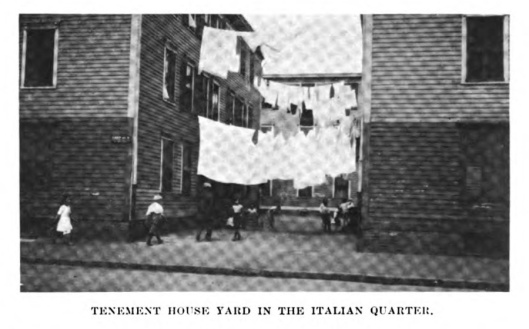
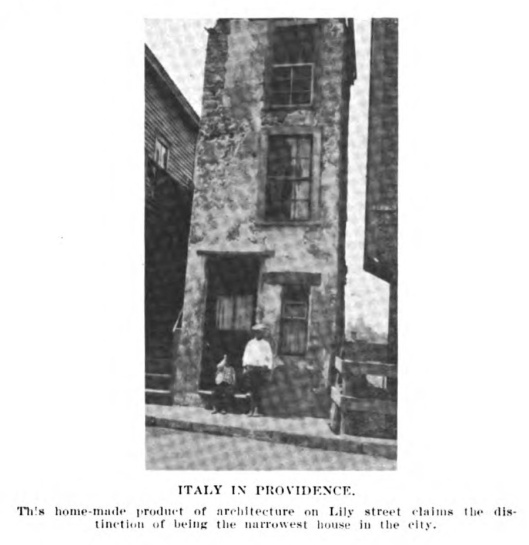
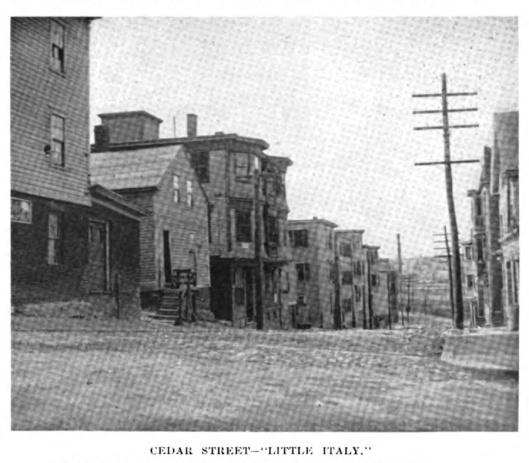
Pictures of Providence’s Italian quarter in the 1910s-30s are rather scarce, at least online. There is one above, and below I show three more from prior to 1921. These are badly scanner-moired, but are here newly-exposed to search-engines.

This district of Providence was also known locally as ‘Little Italy’, ‘the Italian Quarter’, and the Federal Hill district. It was settled by a large wave of Italian immigrants after 1890. Italian shops, Italian cafes, Italian banks, and other facilities were quickly established there, and the Italians gradually displaced an existing Irish population which was moving on and up in the world.

Lovecraft could see this district from his windows, in his later years…

The [new] study also has 2 west windows, at one of which I am now sitting, gazing across the roofs of the ancient hill to a strip of far horizon & a distant steeple on Federal Hill 2 miles away.

“Federal Hill (the Italian quarter) as seen 2 miles away from my window is really quite a mysterious & picturesque sight — with the dark bulk & spire of St. John’s rising against the remote horizon…”

Lovecraft set his substantial late story “The Haunter of the Dark” (1935) on Federal Hill…

From his few local acquaintances he learned that the far-off slope was a vast Italian quarter […] he came finally upon the ascending avenue of century-worn steps, sagging Doric porches, and blear-paned cupolas which he felt must lead up to the long-known, unreachable world beyond the mists. There were dingy blue-and-white street signs which meant nothing to him, and presently he noted the strange, dark faces of the drifting crowds, and the foreign signs over curious shops in brown, decade-weathered buildings. Nowhere could he find any of the objects he had seen from afar; so that once more he half fancied that the Federal Hill of that distant view was a dream-world never to be trod by living human feet. Now and then a battered church facade or crumbling spire came in sight, but never the blackened pile that he sought. When he asked a shopkeeper about a great stone church the man smiled and shook his head, though he spoke English freely. As Blake climbed higher, the region seemed stranger and stranger, with bewildering mazes of brooding brown alleys leading eternally off to the south. He crossed two or three broad avenues, and once thought he glimpsed a familiar tower. Again he asked a merchant about the massive church of stone, and this time he could have sworn that the plea of ignorance was feigned. The dark man’s face had a look of fear which he tried to hide, and Blake saw him make a curious sign with his right hand.

The pictures are of obvious relevance to the setting of “The Haunter of the Dark”, but look also at that weirdly thin house. Is there a possible inspiration for “Erich Zann”, in this home-made structure? Probably not, as “Zann” was written 1921, at which time Lovecraft may not have yet had his first boots-on-the-ground encounter with the district.

He toured the place in the expert company of his local friend Eddy, as Selected Letters Vol. 1 has…

I decided to have Eddy guide me thro’ the vast and celebrated Italian quarter — Federal Hill — which I had heard him so often describe and as quainter even than the Boston Italian quarter …

Sadly I can’t get more than this snippet from this now very expensive book, and thus can’t determine the date for this letter. But Selected Letters Vol. 1 goes up to 1924. [Update: yes, he got to know Eddy after the writing of “Zann”]

At dusk on a day in April 1926, at the end of one of his rambling exploratory walks in the city…

[the walk] introduced me to a tangle of horrible and infinitely alluring alleys of blackness in the Federal Hill Italian quarter

This must indicates just his discovery of the tangle of alleys, rather than the entire district, since he had already seen it with Eddy a few years earlier. Presumably he thus realised that he had not seen everything there in his tour with Eddy. He returned there in June 1926, and made an initial full exploratory walk of Federal Hill, during which he appears to have encountered the large churches for the first time…

Last Saturday “did” Mount Pleasant, Davis Park, and Federal Hill — and was astonished by the great Italian Churches.

But the remarkable thin house (seen above) was featured in the local press circa 1919. So he might have encountered pictures of it, prior to writing “Zann”…

The houses were tall, peaked-roofed, incredibly old, and crazily leaning backward, forward, and sidewise. […] at last I came upon that tottering house in the Rue d’Auseil, kept by the paralytic Blandot. It was the third house from the top of the street, and by far the tallest of them all. (“Erich Zann”)

That said, he could have been equally inspired by any number of prints (Samuel Prout and his ilk) and postcards of ancient streets in old European cities, or descriptions thereof in literature.

While he may have encountered some of the Hill’s residents on his walks, he had also known them elsewhere. For instance a member of the Providence Amateur Press Club, a group of aspiring young writers who Lovecraft had attempted to tutor and encourage, had lived on Federal Hill. The lad in question seems to have been a holdover of its former Irish population, who would by then have been well into the process of moving on and up as they assimilated into American life. (There was also a fruit pedlar who used to come to Lovecraft’s house on Angell St., Manuel Arruda, but the name suggests he was Spanish or Portuguese rather than Italian).

During the U.S. prohibition of alcohol, Lovecraft indulged in a bit of whimsy about the district in one letter. He joked with a friend that he might acquire there a local case of bootleg whisky, not for himself but to ship to Weird Tales editor Farnsworth Wright (to help steady his physical jitters induced by Parkinson’s disease)…

I feel tempted to unearth a local bootlegger [and] Providence’s Italian quarter is a miniature Chicago of hootch, gang wars, and rackets!

This was indeed the state of affairs there under the Morelli mafia gang, which had been allowed to become established from 1917. But apparently today Federal Hill, Providence, is said to have some of the most “funky” hipster-ish sort of places in the city, and yet to have also successfully retained an Italian character. That may be a bit of quiet online booster-ism, but I haven’t encountered anything to contradict such statements.


Lovecraft’s taste-buds may also may have led him to patronise the cheaper end of the Italian restaurant trade in Providence. He wrote…

[I] Like Italian cooking very much — especially spaghetti with meat and tomato sauce, utterly engulfed in a snowbank of grated Parmesan cheese.

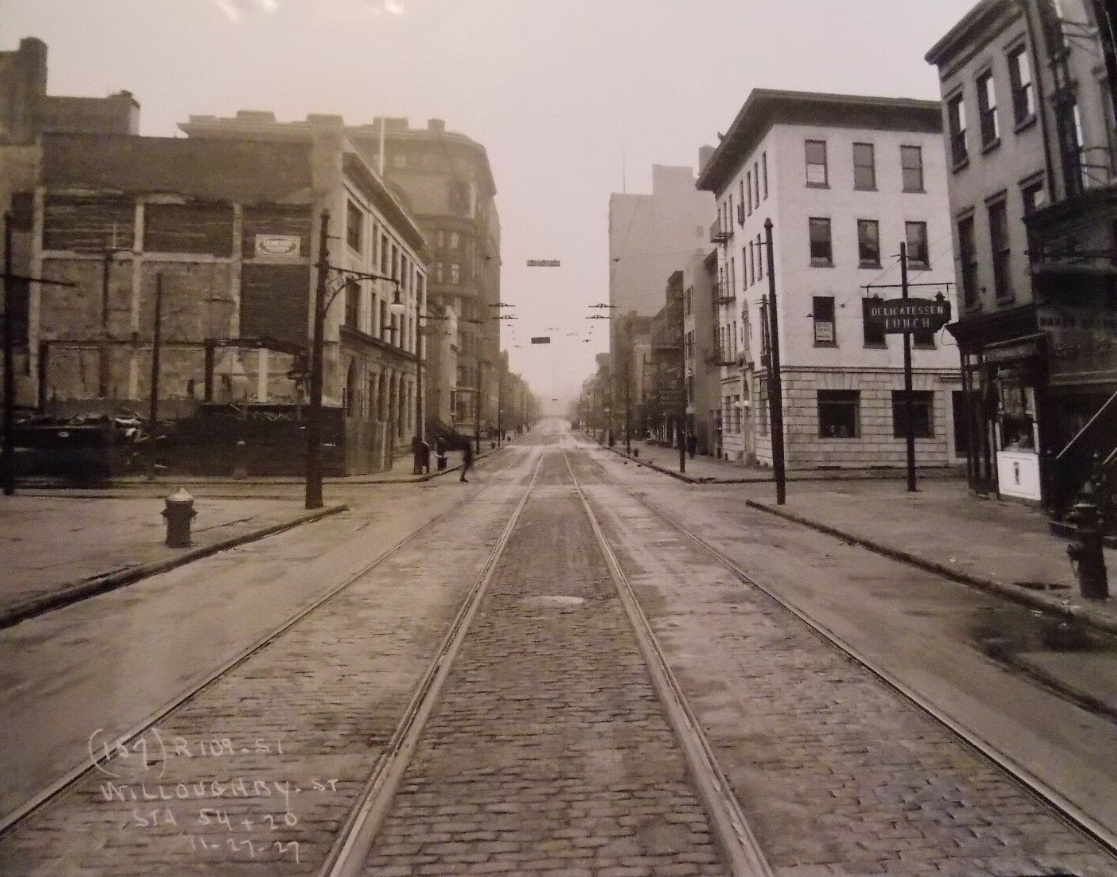
Living in the notorious Red Hook in New York City in the mid 1920s, and forced by poverty to rub shoulders with jail-hardened gangsters and petty hoodlums in the cafes there, he often took his meals at…

John’s — the Italian joint around the corner in Willoughby St.

The above show two views of the same Jay and Willoughby interaction on Willoughby St., Red Hook, with one and possibly two corner cafes visible. The dates of the pictures are 1927 and 1928, and while the cafe(s) may not actually be John’s, the environment seen is closely indicative. Note that the theatre offers a “Burlesk” (burlesque) girlie show.

Once returned to his beloved Providence, we might assume that Lovecraft was even more open to trying out any new “Italian joint” “feed station” that looked suitable and cheap and yet able to attain a ‘New York quality’.

Protected: Lincoln Woods explored

23 Thursday May 2019

Posted by asdjfdlkf in Historical context, Maps, New discoveries

≈ Enter your password to view comments.

This content is password-protected. To view it, please enter the password below.

Protected: Providence Art Club Interior

22 Wednesday May 2019

Posted by asdjfdlkf in Historical context, New discoveries

≈ Enter your password to view comments.

This content is password-protected. To view it, please enter the password below.

New book: A Place of Darkness

22 Wednesday May 2019

Posted by asdjfdlkf in Historical context, Lovecraftian arts, New books, Podcasts etc., Scholarly works

≈ Leave a comment

An interesting sounding new book of cultural history from Kendall R. Phillips, A Place of Darkness: The Rhetoric of Horror in Early American Cinema (Spring 2018). It steps beyond the movie industry’s early history and surveys the wider currents which each distinct cultural milieu both drew on and drew around itself…

“He shows how early cinema [1890s onward] linked monsters, ghosts, witches, and magicians with Old World superstitions and beliefs, in contrast to an American way of thinking that was pragmatic, reasonable, scientific, and progressive. Throughout the teens and twenties [1910s and 20s], Phillips finds, supernatural elements were almost always explained away as some hysterical mistake, humorous prank, or nefarious plot. The Great Depression of the 1930s, however, constituted a substantial upheaval in the system of American certainty and opened a space for the reemergence of Old World gothic within American popular discourse in the form of the horror genre [the famous Universal monster movies, 1931 onwards], which has terrified and thrilled fans ever since.”

It’s being well reviewed. Sublime Horror has a sturdy review, and also a free one-hour podcast interview with the author.

Book And Magazine Collector on Lovecraft

21 Tuesday May 2019

Posted by asdjfdlkf in Historical context, Lovecraftian arts, Odd scratchings

≈ Leave a comment

New on Archive.org, Book And Magazine Collector #193 (2004) with a good short potted introduction to Lovecraft’s genuine rarities and his basic publication history. Also the (then) not-so-rare. Oh, to have had Selected Letters Vol. 1 for just £15!

Lovecraft’s Public Library

19 Sunday May 2019

Posted by asdjfdlkf in Historical context, New discoveries

≈ Leave a comment

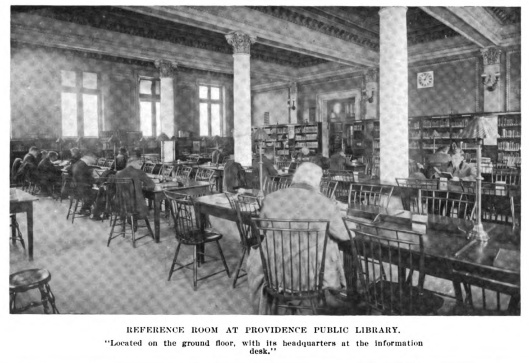
My new-found picture of the reference section of the Providence Public Library, in use by patrons. Published April 1916, so perhaps made 1915. It’s from one of the early Google Books scans and has bad un-correctable moire. I can’t get it larger or less fuzzy.

One could almost imagine that the lad seen on the far right of the picture is a 25 year-old H.P. Lovecraft. The hair-parting and the look of the ear are both correct. Lovecraft’s obvious lantern jaw might be there, but it might not. Lovecraft wore eyeglasses at this time, but it’s difficult to tell if this lad is wearing glasses or not. The feature that suggests this may not be the young Lovecraft is the dark shade and cut of the collar on his camel coat or jacket, which thus becomes two-tone — this being rather too jaunty and not sober enough for his known tastes in menswear. Although we do know that in 1915 Lovecraft became enamoured of ‘the dandy’, a figure he later associated with Edwardian frock-coats and their velvet collars, so who knows now if that phase of his interests temporarily affected his taste in clothing?

Still, even as a ‘stand in’ this young man is a close match, and thus very indicative of Lovecraft’s undoubted youthful presence in the room at other times.


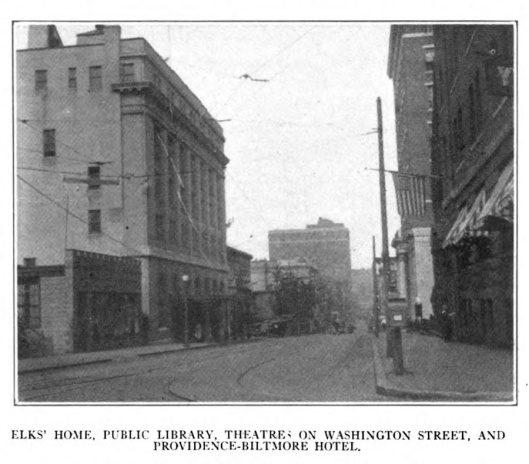
I also found a later picture of the Public Library exterior in its urban context. The library is in the middle-distance on the left, with the Biltmore Hotel in the far distance, and what looks like a small theatre in the foreground on the left. One can just about see that there were young trees around the library, by circa the early 1920s.

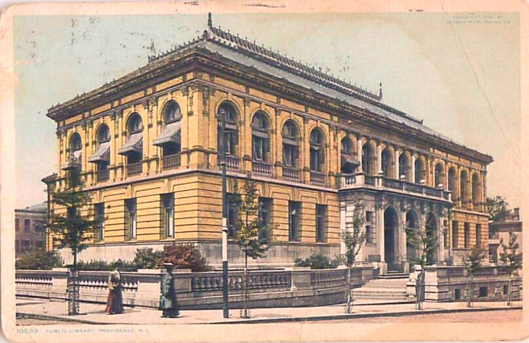
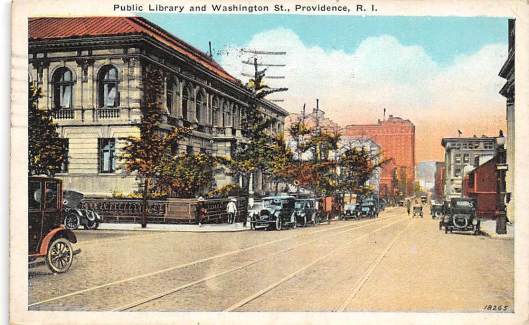
The trees can be better seen here in cards. They look fine at the start when small, but look rather spindly and struggling circa 1927…

The Seekonk: Lovecraft afloat on the Seekonk

17 Friday May 2019

Posted by asdjfdlkf in Historical context, Maps

≈ 5 Comments

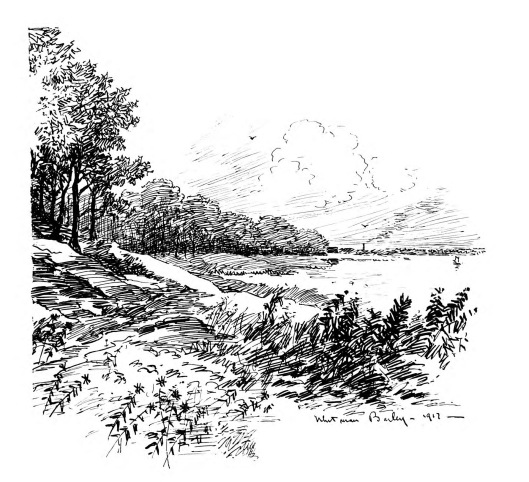
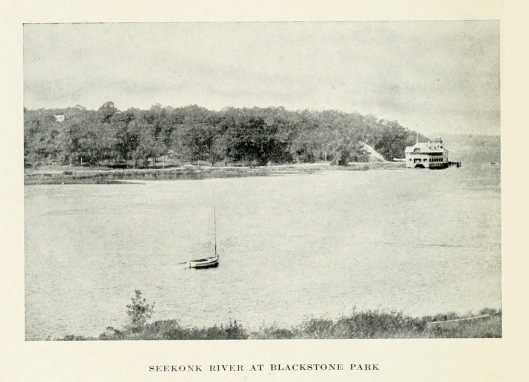
H. P. Lovecraft was once something of a waterman on the Seekonk River, seen above in a Whitman Bailey drawing made on the Poe-haunted west shore at Blackstone Park…

“I used to row considerably on the Seekonk … Often I would land on one or both of the Twin Islands — for islands (associated with remote secrets, pirate treasure, and all that) always fascinated me.” — Lovecraft letter to Rimel, April 1934.

The islands are locally known as Cupcake Island and Pancake Island, indicating their respective shapes. Though these may be modern post-1945 names. There appears to be no vintage photograph, sketch or postcard of them, available online. But one can see them on this map…

They can also be seen on some of the earliest maps of Providence, c. 1650…

From where and how would the young Lovecraft row? One imagines that, once old and strong enough to row alone on a large river, he might have been allowed to take out a row-boat from the Boat Club boathouse (opened c. 1884). The name of his grandfather probably still had some sway with Club, and he might have avoided the sort of hire-fee he could have had to pay at Red Bridge. The boathouse can be seen here…

The residential house seen through the trees is one in Angell St., so that indicates Lovecraft’s proximity to the boathouse. The boathouse had an interesting gothic look from a certain angle…

Lovecraft must have been no puny stripling at this time, for the Seekonk could be a dangerous river and the city Report noted that a rescue crew patrolled the river on Sundays and holidays circa 1912. Today the Brown University men’s rowing team notes that…

The Seekonk is known for its difficult rowing conditions, particularly heavy wind and waves, as well as a strong current.

Thus perhaps we can assume a Lovecraft who was aged 14 or 15, circa 1904 or 1905? Lovecraft might not have encountered the Brown rowing team’s twice-daily training (they apparently had another boat-house nearby). As evidenced by the statement… “The Brown Alumni Monthly has been for years in favor of the resumption of rowing at Brown” (1915), implying that the team might have been moribund for a number of years prior to 1915.

In his row-boat experience, and the island encounters amid the shifting sediments, do we glimpse the personal roots of his famous story “Dagon” (July 1917)? His nightmare of the Seekonk River draining away to reveal primal ooze was recounted in a letter of May 1920 (“the river-bed was fully exposed — only the deep channel filled with water like a serpentine stream of death flowing through a pestilential plain in Tartarus”), but Lovecraft called this a “typical dream” — thus there may have been similar pre-“Dagon” dreams. Indeed we know there were, as he later wrote of “Dagon” that… “I dreamed that whole hideous crawl, and can yet feel the ooze sucking me down!” If this latter dream was of the drained Seekonk or not, must now remain unknown. But the likelihood is that it was.

The flow of the river was probably faster then, because its main flow was in a far narrower and shallower navigation channel of 12 feet, this being “the deep channel” referred to by Lovecraft. Only in 1927 did a U.S military dredging project dredge a longer and deeper… “3.4-mile-long channel, 16 feet deep” all the way from East Providence to Pawtucket. “The channel is 150 feet wide from the Red Bridge to an area opposite Goose Point where it widens further to 230 feet.” (U.S. Army, Seekonk River Navigation Project).

His ‘considerable’ rowing experience on the Seekonk may also help explain his extreme delight in the header illustration he had in Weird Tales, for “Dagon”, since he would then see in it not only an illustration of the story, but also a reflection of his own experience of rowing on the Seekonk…

Presumably such things were cast off along with his bicycle, which he ceased using altogether in the summer of 1913, long past the point when he was expected by local convention to shed such boyish activities. As his family descended into poverty, he may anyway have lacked the hire-fee for such a boat.


See also: the mysterious river island in “Dreams in the Witch House”…

She had told Judge Hathorne of lines and curves that could be made to point out directions leading through the walls of space to other spaces beyond, and had implied that such lines and curves were frequently used at certain midnight meetings in the dark valley of the white stone beyond Meadow Hill and on the unpeopled island in the river. […] He [later] rowed out twice to the ill-regarded island in the river, and made a sketch of the singular angles described by the moss-grown rows of grey standing stones whose origin was so obscure and immemorial.

← Older posts
Newer posts →


Please become my patron at www.patreon.com/davehaden to help this blog survive and thrive.

Or donate via PayPal — any amount is welcome! Donations total at Easter 2025, since 2015: $390.

Archives

  • March 2026
  • February 2026
  • January 2026
  • December 2025
  • November 2025
  • October 2025
  • September 2025
  • August 2025
  • July 2025
  • June 2025
  • May 2025
  • April 2025
  • March 2025
  • February 2025
  • January 2025
  • December 2024
  • November 2024
  • October 2024
  • September 2024
  • August 2024
  • July 2024
  • June 2024
  • May 2024
  • April 2024
  • March 2024
  • February 2024
  • January 2024
  • December 2023
  • November 2023
  • October 2023
  • September 2023
  • August 2023
  • July 2023
  • June 2023
  • May 2023
  • April 2023
  • March 2023
  • February 2023
  • January 2023
  • December 2022
  • November 2022
  • October 2022
  • September 2022
  • August 2022
  • July 2022
  • June 2022
  • May 2022
  • April 2022
  • March 2022
  • February 2022
  • January 2022
  • December 2021
  • November 2021
  • October 2021
  • September 2021
  • August 2021
  • July 2021
  • June 2021
  • May 2021
  • April 2021
  • March 2021
  • February 2021
  • January 2021
  • December 2020
  • November 2020
  • October 2020
  • September 2020
  • August 2020
  • July 2020
  • June 2020
  • May 2020
  • April 2020
  • March 2020
  • February 2020
  • January 2020
  • December 2019
  • November 2019
  • October 2019
  • September 2019
  • August 2019
  • July 2019
  • June 2019
  • May 2019
  • April 2019
  • March 2019
  • February 2019
  • January 2019
  • December 2018
  • November 2018
  • October 2018
  • September 2018
  • August 2018
  • August 2015
  • July 2015
  • April 2015
  • March 2015
  • February 2015
  • January 2015
  • December 2014
  • November 2014
  • October 2014
  • September 2014
  • August 2014
  • July 2014
  • June 2014
  • May 2014
  • March 2014
  • February 2014
  • January 2014
  • December 2013
  • November 2013
  • October 2013
  • September 2013
  • August 2013
  • July 2013
  • June 2013
  • May 2013
  • April 2013
  • March 2013
  • February 2013
  • January 2013
  • December 2012
  • November 2012
  • October 2012
  • September 2012
  • August 2012
  • July 2012
  • June 2012
  • May 2012
  • April 2012
  • March 2012
  • February 2012
  • January 2012
  • December 2011
  • November 2011
  • October 2011
  • September 2011
  • August 2011
  • July 2011
  • June 2011
  • May 2011
  • April 2011
  • March 2011
  • February 2011
  • January 2011
  • December 2010
  • November 2010
  • October 2010
  • September 2010
  • August 2010
  • July 2010

Categories

  • 3D (14)
  • AI (70)
  • Astronomy (70)
  • Censorship (14)
  • de Camp (7)
  • Doyle (7)
  • Films & trailers (101)
  • Fonts (9)
  • Guest posts (2)
  • Historical context (1,096)
  • Housekeeping (91)
  • HPLinks (77)
  • Kipling (11)
  • Kittee Tuesday (92)
  • Lovecraft as character (58)
  • Lovecraftian arts (1,628)
  • Lovecraftian places (19)
  • Maps (70)
  • NecronomiCon 2013 (40)
  • NecronomiCon 2015 (22)
  • New books (966)
  • New discoveries (165)
  • Night in Providence (17)
  • Odd scratchings (984)
  • Picture postals (276)
  • Podcasts etc. (431)
  • REH (184)
  • Scholarly works (1,470)
  • Summer School (31)
  • Unnamable (87)

Get this blog in your newsreader:
 
RSS Feed — Posts
RSS Feed — Comments

H.P. Lovecraft's Poster Collection - 17 retro travel posters for $18. Print ready, and available to buy — the proceeds help to support the work of Tentaclii.

Proudly powered by WordPress Theme: Chateau by Ignacio Ricci.