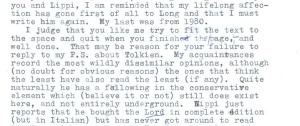
• About
  • Directory
  • Free stuff
  • Lovecraft for beginners
  • My Books
  • Open Lovecraft
  • Reviews
  • Travel Posters
  • SALTES

Tentaclii

~ News & scholarship on H.P. Lovecraft

Tentaclii

Category Archives: Historical context

On Irem

21 Wednesday Aug 2019

Posted by asdjfdlkf in Historical context, Scholarly works

≈ Leave a comment

Some readers of Tentaclii may be interested in a detailed scholarly paper on Iram of the Pillars, from the journal Arabica, 60, 2013. Free on Archive.org. Iram or Irem is, of course, the mysterious and lost desert city evoked a number of times in stories by Lovecraft.

Lovecraft’s Birthday: “The Cats of Ulthar” annotated

20 Tuesday Aug 2019

Posted by asdjfdlkf in Historical context, Kittee Tuesday, Lovecraftian arts, New discoveries, Scholarly works

≈ 1 Comment

As mentioned here a few weeks ago, here is H.P. Lovecraft’s story “The Cats of Ulthar” (1920) with my full annotations. This is being issued for the first time today, to celebrate Lovecraft’s birthday.

“The Cats of Ulthar” annotated as a 20-page PDF.

The Adobe Caslon Pro and Garamond fonts have been embedded in the PDF, so you should have no problems with font substitution. For those who like print, simply use any imposition-capable printer driver to print this as a 5-sheet fold-ready booklet. Fold up, then slip it between card covers… and ideally have your resident kitty make a paw-print on the card cover in the blood of a Zoog.

“Air” by Myrta Alice Little

19 Monday Aug 2019

Posted by asdjfdlkf in Historical context

≈ 2 Comments

I’ve discovered a curious ‘country fair’ story, “Air” by Myrta Alice Little. Her story was published a few months after she had two long visits from H.P. Lovecraft in summer 1921, when there was a faint prospect of marriage in the air. “Air” has an interesting if slight resemblance to Lovecraft’s later “Cool Air” (March 1926).

At this late date it’s somewhat difficult for a modern reader to parse the story while reading it, but here’s a plain plot summary which may help make more sense of it the first time around…

A wife visiting a summer State Fair as a competitor requires a room with four windows. She feels she’d die without ’em, due to the lack of cool air in the night. (This was before the era of air conditioning units). The head of the Fair has a Committee to allocate rooms efficiently to visitors, and the head of this committee reluctantly finds the wife and her husband such a rare thing. Especially rare in the hot and crowded summer season. On then finally going to bed the wife demands the husband open all the windows, but he finds them all sealed tightly shut by some mysterious force. In desperation to please his wife he smashes the glass bookcases in the dark of the night. As a result the wife is convinced that cool air must be circulating, and she dozes off blissfully ‘like a contented cat’. Only the next day does she discover that the windows had all remained sealed. The Room Committee chairman had let them have his sealed house which had four windows, his family having departed for the summer and thus tightly shut up the house (presumably nailing the windows, which one could do in those days of sturdy wood frames). The wife is suitably chastened by the experience, and the husband is glad to pay for the damages.

Friday ‘picture postals’ from Lovecraft: the Eddy bookstore on Weybosset St.

16 Friday Aug 2019

Posted by asdjfdlkf in Historical context, New discoveries, Night in Providence, Picture postals

≈ 3 Comments

The cutting:

This week I open the Friday ‘Picture Postals’ post with a magazine cutting. There are postcards in this post, but they come later. The cutting is: Muriel Eddy, “H. P. Lovecraft, gentleman”, a letter and memoir of Lovecraft. Published in Thrilling Wonder Stories, June 1948. The magazine’s editor leads straight into the letter without division, which was presumably his house-style…

I don’t see this item under “Eddy, Muriel” in either The Lovecraft Encyclopedia or the Comprehensive Bibliography. A Google Books search for “H. P. Lovecraft, gentleman” comes up empty, as does a general Google search. de Camp doesn’t have it in the bibliography of his 1975 biography, nor does he discuss its claims.

I don’t see either biographer examining Muriel Eddy’s claim that, during his “embryo” years, the young Lovecraft dropped in on Arthur Eddy’s second-hand bookstore on Weybosset St. Nor even mentioning that Lovecraft had easy access to a large local used bookstore, with a friendly proprietor, which I find rather surprising. The same is true for The Lovecraft Encyclopedia, there being no mention in it of either uncle Eddy or his store.


Initial confirmation:

The RIAMCO Collection of Lovecraft has the following catalogue entry, which offered me some initial quick confirmation:

Lovecraft, Howard P. [letter to ] to Wandrei, Donald.

Undated, with envelope postmarked Jul. 31, 1931. Headed: “Nether Crypts – Lammas-Eve” only. Enclosed is a clipping from The Providence News-Tribune [22 Jul 31] about Arthur A. Eddy, proprietor of Eddy’s Bookstore on Weybosset Street in downtown Providence.

I note that the initial ‘A’ is erroneous, as trade directories have ‘E’. I further note that the July 1931 run of this newspaper appears to have otherwise been allowed to perish from the historical record.

This first hit showed me that the uncle and the store did indeed exist and were known to Lovecraft. The mid 1931 date of the clipping might suggest a retirement-date or death-date for the uncle, and if it still exists to be read this clipping may have more information on the old bookseller? Perhaps even a picture of the interior? I don’t have access to the Wandrei letters (in the expensive Mysteries of Time and Spirit, and soon the forthcoming H. P. Lovecraft: Letters with Donald and Howard Wandrei), so I don’t know if there’s mention of the Eddy store in that particular letter. Presumably the clipping was sent because Lovecraft was fond of the old fellow, though it doesn’t necessarily follow that he knew the store as far back as the “embryo” ‘mystery years’ of 1908-1916.

Lovecraft did visit the store:

My thanks to Chris Perridas, though, who once looked at the Munn visit to Providence, and thus quoted two letters which reveal the store was still going in 1928 and Lovecraft was frequenting it…

[31st July 1928 to Wandrei]
I trust Munn has by this time looked you up. He was here yesterday, & we had a very pleasant session – went down to Eddy’s Bookstore & nosed around until he found an old story by Camille Flammarion in some 1893 Cosmopolitans.

[4th August 1928 to Derleth]
… when Munn and I were in Eddy’s bookshop Monday, (this Eddy is uncle of the C. M. Eddy, Jr who writes for W.T.). We met the venerable Joseph Lewis French, editor of the anthology “Ghosts, Grim and Gentle”. He is a quaint, peppery-voiced old codger of 70.


Getting the address and store history:

A directory of 1919 puts uncle Eddy’s address at 260 Weybosset St…

With an address I was then able to get the outline of the store history. A 1914 automobile trade journal recorded that “The local branch of the B. F. Goodrich Co. has been removed from its former location at 260 Weybosset”, though another journal announced that this was a partnership with a local rubber tyre company, and thus the 1914 item may simply indicate the removal of the national franchise. Goodrich Co. was a national chain that sold vehicle tyres. Polk’s Providence directory later listed Avery Piano in the ground-floor frontage at 260, selling pianos, sheet music, music teaching aids, and musical replaceables such as strings. If the premises had once been a Goodrich car-tyre sales/fitting/showroom place, then it presumably had the sturdy showroom floor and street-frontage roll-out ramp needed to later hold heavy pianos, plus a large dry cellar for tyre storage and parts — suitable for later use as a nice dry bookstore. That would be my guess. More certain is that such a bookstore would have benefited from the passing musical clientele, and would be a natural fit with a piano store. One then imagines that Lovecraft might have often heard the hasty scraping of a violin or random tinkling of a piano, coming faintly through the ceilings as he browsed the ancient books. “The Music of Erich Zann” springs to mind…

I heard strange music from the peaked garret overhead … I was haunted by the weirdness of his music. Knowing little of the art myself, I was yet certain that none of his harmonies had any relation to music I had heard before…

Publishers Weekly may indicate the date of change from a tyre store to pianos / used-books. Its edition of 21st April 1917 also usefully confirms Muriel Eddy’s claim of the book store’s large size, by stating “20,000 volumes in stock”. It further suggests that there had been an earlier Eddy store in Providence…

Given this hint I then found the American Library Annual of 1912 and 1913-14, which gave the store’s earlier address as 852 Broad Street.

Broad Street is very long and runs up from the south and at its most northerly end becomes Weybosset. Most probably the new piano store invited uncle Eddy to move further up along the same street, much closer to the commercial heartland at 260 Weybosset, in order to bring suitable additional passing-trade to their own store. 852 Broad Street is probably way too far down into South Providence for the young Lovecraft to have known of it, although if it had a prominent street frontage then he could have noticed it on tram journeys down to Pawtuxet.

The International Directory of Second-hand Booksellers and Bibliophile’s Manual for 1894 gave me an even earlier address at 100 Gallup St.

100 Gallup Street is a small residential house in Lower South Providence, and may have been uncle Eddy’s home address. No date of establishment is given by this 1894 Directory, as it is for the other two, so it seems likely he first started the book-selling from a residential property in the early 1890s.

100 Gallup Street is not near the Eddys, who lived on Second Street over on the other side of the river.


Testing Muriel Eddy’s other claim of night-opening hours:

Given all the above, it seems that Muriel Eddy’s coy hint of “embryo” years for Lovecraft’s night visits to 260 Weybosset does not mean the mystery years of 1908-1916, but must mean springtime of 1917 onward. There is a slim chance he once visited Eddy’s store way down at 852 Broad Street, but he must surely have heard the spring 1917 news of the opening of the new used bookstore at 260 Weybosset. A store with 20,000 volumes no less, and located two streets over from the Public Library. In fact, one can envision him as being the first to jangle the doorbell on the opening day morning. By 1929 he wrote of the “1500 or so books I possess” in his personal library at home and, despite the wonders of the New York stores, one wonders how many of these had come via uncle Eddy. By the time he moved house in 1933, he had 2,000 books.

What of Muriel Eddy’s claim of night opening? Well, directories place the musician’s union office and several newspaper offices on Weybosset St. and around the corner. Daily newspapermen and dance-hall musicians were then semi-nocturnal, often working well past midnight (see the first half of Some Like it Hot for a portrait of the life of jobbing musicians), which may have made it viable for a bookstore that also carried newspapers and magazines to open at night on certain evenings of the week. If the piano store above were open late on ‘dance nights’, to supply emergency strings and minor repairs to the many dance-hall and theatre musicians, then the bookshop below might also have opened very late. By the 1930s Avery also sold advance tickets for big Boston concert performances, another reason to be open in the early evenings at times when show-going crowds were strolling past to the nearby theatres.

Nor is it impossible that, once Lovecraft was bringing amateur and bookish friends to Providence, some special night openings might have been arranged for him by an obliging proprietor in the 1920s. Indeed, there is clear evidence that Lovecraft could introduce some really ‘high rollers’ to uncle Eddy in the late 1920s…

[Lovecraft expects] “as guest the amiable James Ferdinand Morton, who in the next four days will probably do to our local mineral quarries what Cook did to Eddy’s bookshop” [i.e. will ‘mine them out’] (Lovecraft to Talman)

Cook was a major book-collector at that time, termed by some in Lovecraft’s circle as “The Colossus of the North”. I then found further details on Cook and Eddy in Selected Letters II…

Cook has been down twice this autumn — once on the 15th and 16th of October, and again last Sunday. On each occasion we have made trips to Eddy’s (Arthur E. Eddy, uncle of the celebrated theatrical man and weird author whom you had the inestimable honour of meeting) Book Store — Cook nearly buying the old fellow out, and I purchasing a good deal more heavily than my purse and recent custom would ordinarily justify. I am now trying to complete my family file of the Old Farmer’s Almanack… Eddy evades the Sabbath closing [Sunday closing] law by keeping his shop door locked and admitting cus­tomers individually as they knock.”

So, there were special arrangements for liked customers, and at odd times too. Such clandestine opening was probably facilitated by the cellar location, and also usefully indicates that access was not dependent on the piano store above being open. Sunday opening also indicates that uncle Eddy was not a religious man in the later 1920s.


Is there a deeper Eddy connection here?:

One even wonders if it was this uncle who introduced Lovecraft to the Eddys in summer 1923? On this S.T. Joshi writes in I Am Providence…

But how did Lovecraft come into contact with the Eddys at all? There is some doubt on the matter.

Joshi then rightly finds the fanciful 1960s claims of Muriel Eddy on the matter to be very questionable (she claimed then, and only then, that they had known Lovecraft and his mother from circa 1918, and that the Eddys had been amateurs published in The Tryout etc). But Joshi remains puzzled as to how it actually happened. I can now suggest that the bookseller offers a simple and plausible mechanism for this:

i) Lovecraft, newly interested in pulps and seen to be browsing old examples of such in Eddy’s store, explains to the bookseller that he’s just had five stories accepted by Weird Tales circa June 1923. He naturally bemoans ‘the torture of typing’ that he must now endure, in order to see these stories actually published.

ii) The bookseller mentions that his nephew writes stories like that, indeed just last year he had landed a ghost story in Action Stories. This nephew lives in the city, and quite near to Mr. Lovecraft. Then the old bookseller figures Eddy and his wife could use any paid typing work Lovecraft might care to send their way. He swiftly writes out the address and hands it to Lovecraft.

iii) Lovecraft then feels obliged to contact the Eddys, but is perhaps cautious of social entanglements quite so close to home. Especially with those living in what he regards as a somewhat down-at-heel neighbourhood located just across the river. Also, he does not want to damage his relationship with a good local bookseller by ‘getting off on the wrong foot’ with his nephew. Thus he seeks only to sign up the Eddys for the amateur journalism movement. But after a few such letters, and a few phone calls, he decides to stroll over the bridge and meet them in person.

That would be my theory.


Other evidence for Lovecraft and Weybosset Street:

A 1918 letter to Kleiner suggests another reason Lovecraft might have regularly visited Weybosset late at night or in the very early morning after all-night walking. Drugs (for his aunts as well as himself) and a vital tram-stop…

the corner of Dorrance & Weybosset Streets, which is adorned & distinguished by a pharmaceutical emporium — that is, commonly speaking, a drug-store. This is the southeast corner — where you wait for the local stage-coach, or street-car, as such things are called nowadays. [this being the vital tram-stop for Lovecraft, to and from his home]

Here, in two cards, is a day-night comparison of the same stretch of Weybosset…

There are a few other mentions of Weybosset in the materials I have access to. Lovecraft mentioned to Galpin that the stationary store… “Neilan in Weybosset Street always charges me fiendish rates for my [typewriter] paper”. That was the Neilan Typewriter Exchange, 43 Weybosset (Prop. Francis H. Neilan), which adds just a little more data to the story of Lovecraft’s typewriter. Sonia also stayed at a hotel on Weybosset when she first came to Providence. Much later in life Lovecraft also regularly had cheap food from the Weybosset Pure Food Market.


Was this bookstore also mentioned in her 1945 memoir?

What of the 1948 date on the above letter? Sadly I’ve never seen Muriel Eddy’s 1945 memoir, despite S.T. Joshi having written that… “The first memoir [1945] seems on the whole quite reliable”. Until 2019 this item (titled “Howard Phillips Lovecraft”) was available in the booklet Rhode Island on Lovecraft (1945) and the booklet The Gentleman from Angell Street (2001), both duplicated in Lovecraft Remembered other than this memoir. But the 1945 memoir is now also in the new Ave atque Vale: Reminiscences of H. P. Lovecraft (2019) — which I have yet to obtain. Thus, her 1945 memoir has escaped my perusal until now. I’d be obliged if someone with access to it might tell me if the 1948 letter above adds anything to it or not. Ditto for the Wandrei letter of “Jul. 31, 1931”, the other item I don’t have access to.

Update: I’ve now seen Muriel Eddy’s 1945 memoir in A Weird Writer, and it makes no mention of the bookshop or the uncle. I still need the “Jul. 31, 1931” Wandrei letter and cutting.

The above 1948 letter appears to have been overlooked by Lovecraftians and thus has some interest today. And has more interest than if it was from the 1960s.

Note also that the Eddys published a similarly titled “H.P. Lovecraft Esquire: Gentleman”, but that was a 6-page duplicated item of the 1960s.


Did the bookstore’s surroundings also have some interest for Lovecraft?:

Uncle Eddy’s shop was not far from the Public Library, about two streets over. But more interestingly in terms of atmospherics, nephew Eddy evidently knew the ancient back-alleys behind his uncle’s bookshop. These went threading down from the back of Weybosset toward the docks. He introduced these to Lovecraft in the heavy fog of 22nd November 1923…

There are [in the city of Providence] whole sections in which I had never set foot; & some of these we [Lovecraft and Eddy] have begun to investigate. One southwesterly section I discovered from the 1777 powder-horn map … Not a stone’s throw from that 1809 Round-Top church that I shew’d you [at 300 Weybosset St., just down from the bookstore on the same side], lies the beginning of a squalid colonial labyrinth in which I moved as an utter stranger, each moment wondering whether I were indeed in my native town or in some leprous, distorted witch-Salem … there was a fog, & out of it & into it again mov’d dark monstrous diseas’d shapes … narrow exotick streets and alleys … grotesque lines of gambrel roofs with drunken eaves and idiotick tottering chimneys … streets, lines, rows; bent and broken, twisted and mysterious, wan and wither’d … claws of gargoyles obscurely beckoning to witch-sabbaths of cannibal horror in shadow’d alleys that are black at noon … and toward the southeast, a stark silhouette of hoary, unhallowed black chimneys and bleak ridgepoles against a mist that is white and blank and saline — the venerable, the immemorial sea”. (Heavily abridged from a letter to Morton, 5th December 1923)

It would be natural for Eddy to have used his uncle’s bookshop as a base from which to depart and return, on explorations in this “squalid colonial labyrinth” section of the city.


What of today?

When last heard of 260 Weybosset had become the “Gallery Flux”, and a few former local art students note it on their online resumes. Though it seems to have vanished as a gallery in recent years. If someone still has the keys (RISD?) they may be interested to learn that one H.P. Lovecraft once regularly haunted their art-space cellar, musing there on old and hoary books. Avery Pianos is actually still there at ground level at 254-258, although in what seems to be a rebuilt ‘1990s olde-style’ frontage. But one can still see the two blocks of four tyre-shaped street hatches, which presumably let down to the cellars below, the blocks being today embedded in the sidewalk and sealed with concrete. Perhaps sets of four Goodrich tyres were once jacked up out of these openings to street level, before 1917, hence their unusual shape and configuration? I’d guess these may later have held sturdy iron grids of glass blocks, to let a little light down into uncle Eddy’s cellar bookstore? One can’t help thinking of the cellar in “The Shunned House”…

the dank, humid cellar … with only a thin door and window-pierced brick wall to separate it from the busy sidewalk.

Here is a postcard showing the same location, seen over on the extreme right of the card. For orientation, note the same distinctively domed building on the street-corner.
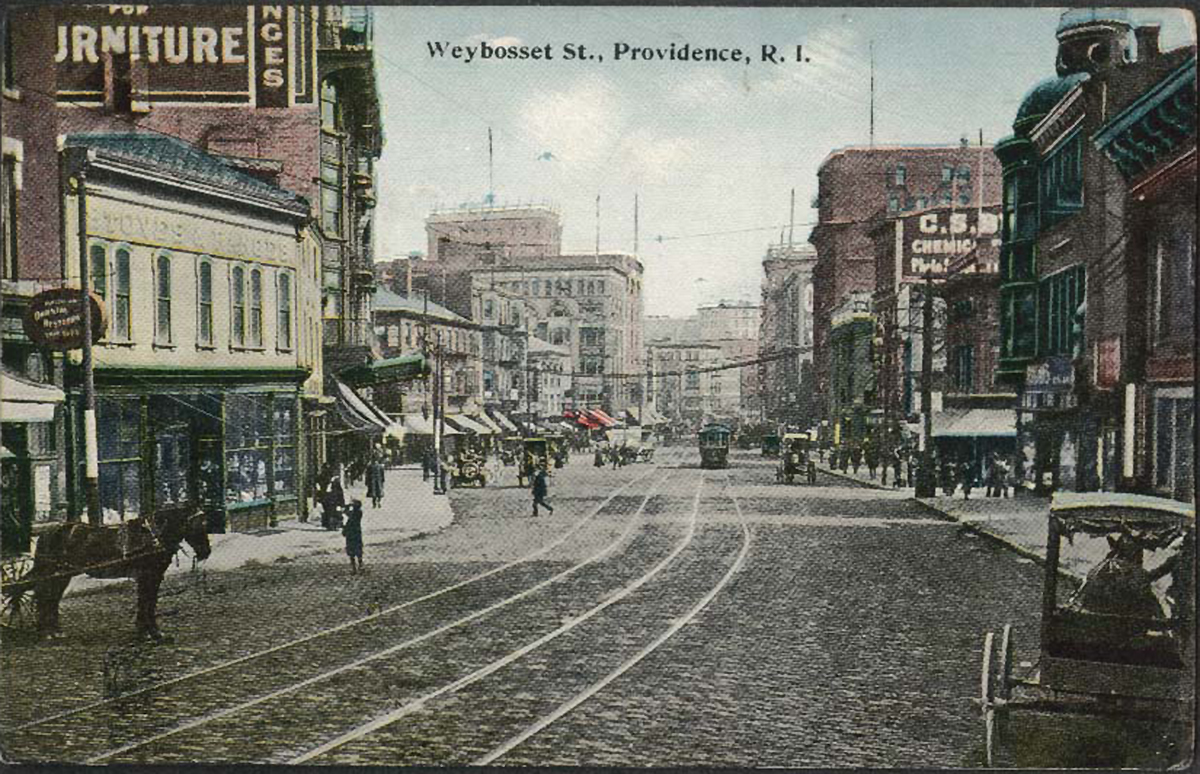
This shows that the current ‘1990s olde-style’ frontage is fairly close to the old look of c. 1905, just a bit shorter and with an inverted roof overhang.


Update: I’ve now seen the detailed biographical introduction on the Eddy family in the Eddy collection The Loved Dead And Other Tales (2008). No mention is made there of uncle Eddy. I’ve now also seen Muriel Eddy’s 1945 memoir in A Weird Writer, and it makes no mention of the bookshop or the uncle. In the latter book, Joshi’s introduction has the Eddy family living in “North Providence” at the time they allegedly first met Lovecraft in person — obviously we need a year-by-year address list for the Eddys, to use to test the veracity of the various memoirs and Muriel’s often-embroidered versions of the truth.

Friday ‘picture postals’ from Lovecraft: HPL in an aquarium

09 Friday Aug 2019

Posted by asdjfdlkf in Historical context, Picture postals

≈ 1 Comment

Continuing my summer visits to the seaside and shoreline, in the Friday ‘picture postals’ post. This week, a stroll down to the New York shoreline and the New York Aquarium in the company of H.P. Lovecraft.

He visited the New York Aquarium in 1922, and then again in April 1929. On the latter visit he and his friend Frank Belknap Long had some long-distance horse-play with Lovecraft’s aunt, in which Lovecraft claimed to have purchased a giant seahorse with the intention of bringing it home to Providence.

“I have purchased one of these and am bringing it home!” Below is the same card, but in a later more vivid over-painted version, with Lovecraft and Long’s messages on it front and back…

My thanks to the Brown University repository for making these available.

Here’s my transcription…

Greetings again! I continue my diary from a bench on the Battery [Battery Park, alongside the aquarium], facing the winds and foam of the immemorial sea! We visited honest old Mac [Everett McNeil, elderly writer of boys adventure stories] this afternoon as per schedule & were pleased to find him bright & much improved – though he is still of course quite weak, & probably won’t be out of the hospital for a week or so yet. Someone else was there to see him – an old lady who was at school with his sister. We took him some oranges which Belknap [Long]’s mother sent him. (|| After our call we went down to the Battery [Park] & inspected the Aquarium – which I hadn’t seen since 1922. Now we are seated on a bench, absorbing the spirit of the sea & having our shoes shined by a sweet boy. Afterward we shall stroll about the ancient parts of Manhattan, toward Paul’s, Fraunce’s Tavern, etc – & finally return to 230 [Long’s parents] …. stopping en route at the Hotel Pennsylvania for guide leaflets & time tables to direct me in my coming antiquarian wanderings. [He was headed to Washington] [“More tales” or “More follows”]. Yr aft. Nephew & obt. servant HPL.

Long has then written: “Howard has purchased an enormous, living sea horse (eighteen inches!) I sincerely hope that it lives to imbibe Providential Atmosphere! – FBL Jr.”

The front of the card excitedly records his finding of a “marvellously cheap” Washington Excursion, perhaps discovered among the Hotel Pennsylvania brochures.

His next postcard shows a mundane view of the Aquarium frontage, with a hand-written note that Lovecraft has bagged the front-right seat behind the driver on the coach to Washington, which he deems the best seat to have in a long-distance coach. Otherwise the card does not concern the Aquarium.


Here are some other scenes from the Aquarium at that time…

The setting:

What Lovecraft would have seen there in 1922, concisely described in Guide to the nature treasures of New York city (1917)…


Some of the denizens, from the same card-set:

“It is no coincidence that the monsters of his later stories resemble combinations of various denizens of an aquarium” — de Camp, Lovecraft: A Biography, 1975.

Visitors appear to have been given a set of tokens on entrance, these presumably giving entrance to halls and pools holding ‘the main attractions’ and thus preventing crowding. Note especially the stylish Octopus token…

It’s possible that this was an inspiration for the metallic octopus-disk in Long’s late story “Dark Awakenings”…

The small object which rested on his palm did not seem to have been compressed or injured in any way by the tight constriction to which it had been subjected. I thought at first it was of metal, so brightly did it gleam in the sunlight. But when I picked it up and looked at it closely I saw that it was of some rubbery substance with merely the sheen of metal.

I had never before looked at any inanimate object quite so horrible. Superficially it resembled a tiny many-tentacled octopus, but there was something about it which would have made the ugliest of sea monsters seem merely fishlike in a slightly repulsive way. It had a countenance, of a sort, a shriveled, sunken old man’s face that was no more than suggestively human. Not a human face at all, really, but the suggestion was there, a hint, at least, of anthropoid intelligence of a wholly malignant nature. But the longer I stared at it the less human it seemed, until I began to feel that I had read into it something that wasn’t there. Intelligence, yes — awareness of some kind, but so much the opposite of anthropoid that my mind reeled at trying to imagine what intelligence would be like if it was as cold as the dark night of space and could exercise a wholly merciless authority over every animate entity in the universe of stars.


Lovecraft later encountered Long’s private home aquarium, on a visit for Christmas 1934…

“I took the midnight coach [from Providence] & arrived in Manhattan the next morning … all the [Long] household were united in absorption in Belknap’s new hobby – tropical fish. These sprightly finny citizens – whose ideas anent [about] temperature are much like my own – form quite a heavy responsibility; since their diet, aeration, & heat have to be regulated with the strictest care. Their infinite variety, however. makes them much more interesting than [the then-common domestic] goldfish; so that I fancy the present fashion for them will prove reasonably permanent.” (Selected Letters IV).

The New York Aquarium encouraged such home ventures…


Lovecraft also visited the the New Bedford Whaling Museum (Jonathan Bourne Whaling Museum) in August 1929, when he also visited the aquarium at the famous Wood’s Hole.

He also also known to have taken a trip in a glass-bottomed boat, to observe a ‘living aquarium’ on the sea-floor…

“… sailed out [from Miami] over a neighbouring coral reef in a glass-bottomed boat which allowed one to see the picturesque tropical marine fauna & flora of the ocean floor.” (Selected Letters III, page 380).

But in terms of inspiration, the 1922 visit to the New York Aquarium seems a key possibility. Or an unrecorded Boston visit circa 1919 or thereafter, to the Museum of Natural History in Boston. There he would have seen, beautifully lit and incredibly life-like…

131 glass models of sea slugs, hydroid jellyfish or craspedotes [made] for the Museum of Natural History Society in Boston in 1880.

According to the de Camp biography of Lovecraft, he saw their collection of such models (flowers and presumably also the sea creatures) at Harvard, and quite early. de Camp, presumably drawing on Sonia’s memory of her courtship of Lovecraft circa Autumn (Fall) 1921, states in the biography that…

Once he [Lovecraft] showed her [Sonia] the display of glass flowers in the Museum of Comparative Zoology at Harvard

These were made by the Blatschkas, who specialised in sea-creatures and fungi. They sold by catalogue a great many (700?)… “Blaschka glass models of marine invertebrates” of which Harvard made a collection of 430 species. These are now documented in the photobook Sea Creatures in Glass: The Blaschka Marine Animals at Harvard (2016). Cornell also has a collection of 570 such items, though it was heavily used for teaching and became much degraded through use. The Cornell collection is being painstakingly restored where possible, and the best restorations featured in a 2017 exhibition.

The Sydney Bulletin

07 Wednesday Aug 2019

Posted by asdjfdlkf in Historical context

≈ Leave a comment

S.T. Joshi’s blog today reports that he saw some actual copies of the old Sydney Bulletin, while on his recent Australian tour…

Danny and I also went to the library of MacQuarrie University to look up the Sydney Bulletin, well known to readers of “The Call of Cthulhu.” What was my amazement when I discovered that this was not a newspaper, but a magazine of political, social, and literary commentary, with an abundance of fiction, poetry, and artwork (not a little by Norman Lindsay). In short, this paper could not possibly have printed the news article that Lovecraft quotes in the story.

So we’ve assumed the title to be a newspaper, but it’s not. That Lovecraft states that it “escaped the cutting bureau” suggests its non-newspaper nature. His use of “an old number of an Australian journal” also suggests a journal, rather than a newspaper. Since one would call a newspaper an issue or edition, while a “number” is usually reserved for referring to a magazine or journal. The Sydney Bulletin was a weekly title, one of the biggest in Australia.

In the story it’s a title had by the “the curator of a local museum and a mineralogist of note” [aka James F. Morton], who though local and provincial “has wide affiliations in all conceivable foreign parts”. A page from it is used as shelf-paper for some “reserve specimens roughly set on the storage shelves”, again suggesting that the paper quality here is a little better than the fragile moisture-absorbing old newsprint of a colonial daily newspaper. The page also contains “a half-tone cut” being “the picture of the hellish image”, again suggesting a paper able to take pictures rather than pulpy daily newsprint.

Evidently then this is a publication with some small interest in curious rocks and carvings, presumably these being notable in a fresh new colonial Australia which had little other history to hand, and this is why the museum mineralogist was sent the issue (or perhaps just the tear-sheet).

Hyde Park, Sydney, in 1932.

The “crouching image” the paragraphs report had gone into the keeping of the “Museum at Hyde Park” in Sydney (there is a real Australian Museum, on the south-west edge of the Park). This may suggest the conduit by which issues of the Sydney Bulletin item might have reached “a learned friend in Paterson, New Jersey” who was an expert on mineralogy.

Technically the real Bulletin appears to be classed as a newspaper, much as the Spectator in London was classed as a newspaper despite being a magazine in format. There were postage-rate advantages to being regarded by the Post Office as a newspaper, if the title has many far-flung postal subscribers. In the Sydney Bulletin‘s case it was apparently held by the “Bulletin Newspaper Company”.

It also published horror stories, at least in its early “coarse” years. For instance a book collection of Ernest Favenc’s stories (such as the macabre “Haunt of the Jinkarras”, ‘black cloud of madness / racial regression’, etc) gives an indication of scale of the Bulletin in its early years when it was publishing Favenc…

Stead’s Review of 1901 summed up the title as it was in the 1890s as…

The only distinctive Australian journal which has made any mark outside Australia is the “Sydney Bulletin”. It is a curious product, clever, wicked, lawless, sarcastic, cynical, scoffing, but it is nevertheless a distinct creation.

An academic article on magazine circulation in Australia in the 1920s suggests it was still one of the top national titles in that decade, and had maintained its biting edge — though by then it had added poetry and theatre reviews and the like. The turn toward literature came in 1915-16, and developed from then on, but this was underpinned by a new reputation for financial news and coverage of mining and suchlike. Thus, presumably, it had a new interest to mineralogists by the early 1920s. That section may have been spun out by 1924, as Wild Cat Monthly, though.

From a scan and OCR from 1924 I found a report in the West Coast Sentinel… “In recent issues of the Sydney Bulletin there have appeared several paragraphs relating to…” a horrible outback massacre in history. This report gives the Bulletin item in question. The format suggests that in 1924 the Bulletin did indeed have an interest in macabre history and strange doings of the type cited by Lovecraft, and that it published these as short two-paragraph items.

Another source has the writer Jack McLaren sending in what sound like similar “paragraphs” circa 1918-19, as a Bulletin correspondent…

From Cape York he sent a stream of paragraphs to the Sydney Bulletin under the pseudonym of McNorth, while also writing Red Mountain (1919), the first of about twenty adventure novels” (By the Book: A Literary History of Queensland)

Yet in Lovecraft’s paragraphs in “The Call of Cthulhu” he does appear to have the Bulletin act more as a reporting newspaper, in terms of having them send a telegraph cable-gram to “Our Auckland correspondent” in order to add a final paragraph to their report.

Were “paragraphs” often present in the Bulletin? It’s difficult to say more about the nature of it without seeing a full run of the Bulletin from the first half of the 1920s. After all it was a weekly, and perhaps such paragraphs only featured once a month. But it does not appear to be scanned and online, though evidently it exists in the archives to be seen by S.T. Joshi.

How did Lovecraft come to know of this weekly (and the museum, placed in its accurate location), a title that appears by the 1920s to have been a sort of somewhat coarsely patriotic Australian equivalent of The Spectator? Lovecraft can’t have been sent clippings from the Bulletin by his correspondent Geo. Fitzpatrick of Sydney, since the two men don’t appear to have come into contact until 1929. But it occurs to me that Lovecraft may have seen issues of the Sydney Bulletin in the New York libraries, and been more interested in it than otherwise because it was a potential outlet for paid story publication. He did after all seem to keep his overseas rights, so far as I recall, and these were not grabbed by Farnsworth Wright.

Incidentally, the Bulletin‘s pungent and cutting politics were of just the type to cause the anarchist Morton to have quickly disposed of it, by using it for “shelf-paper” in his museum, had he been sent a full copy of that 1924 “number”.

Letters to Nelson Rogers, 1912

07 Wednesday Aug 2019

Posted by asdjfdlkf in Historical context

≈ 1 Comment

The Arthur Langley Searles Collection of H. P. Lovecraft Research Files at Temple University has…

photo-reproductions of Lovecraft letters of 1912 to Nelson Rogers in Mt. Vernon, N.Y.

Who was Nelson Rogers, and why was Lovecraft writing to him in 1912?

Possibly this was “John Nelson Rogers” b. 30th Sep 1893, and who lived at Mount Vernon in 1920. He was a railroad repairman in 1920, which may suggest the connection. The young Lovecraft had been greatly enamoured of railroads and, via his avid reading of magazines such as Railroad man’s Magazine, he may have come into contact by letter with someone his own age who worked on them.

Update: While the above candidate may have been a younger member of the correct Rogers family, I now see that the correct candidate is revealed by Ken Faig in Lovecraft Annual No.9, 2015 (page 176). This being one Nelson William Rogers (1878-1951), who had been a friend of Lovecraft’s mother in her youth. Also, I would add that Lovecraft’s father had lived for a time at Mt. Vernon.

On that elbow

06 Tuesday Aug 2019

Posted by asdjfdlkf in Historical context

≈ 2 Comments

After many decades, I think I may have finally figured out that “titan elbow” in the 1924 story “The Shunned House”. It’s always bugged me… “an elbow, why an elbow”? Even Joshi is seemingly very slightly puzzled and uses the work “merely” in his summary of the story… “the shape was merely the “titan elbow”…”. Burleson rather more bluntly notes than an elbow seems… “at this crucial moment, a bit jarring, even a little comic”.

The damnable Indiana censorship of 1924 is why it’s an “elbow”, I’d suggest. The quick reader was meant to infer the correct body part from the description, spurred by the hint of a double-meaning in “doubled in two”.

The surface I uncovered was fishy and glassy—a kind of semi-putrid congealed jelly with suggestions of translucency. I scraped further, and saw that it had form. There was a rift where a part of the substance was folded over. The exposed area was huge and roughly cylindrical; like a mammoth soft blue-white stovepipe doubled in two, its largest part some two feet in diameter. Still more I scraped, and then abruptly I leaped out of the hole and away from the filthy thing; frantically unstopping and tilting the heavy carboys, and precipitating their corrosive contents one after another down that charnel gulf and upon the unthinkable abnormality whose titan elbow I had seen.

Note also that the tale was written at the exact moment in time when Lovecraft’s short marriage was falling apart.

Blaschka Invertebrate Models at Cornell: online catalogue

03 Saturday Aug 2019

Posted by asdjfdlkf in Historical context, Lovecraftian arts

≈ Leave a comment

Cornell Collection of Blaschka Invertebrate Models, made in glass.

Boston had…

131 glass models of sea slugs, hydroid jellyfish or craspedotes [made] for the Museum of Natural History Society in Boston in 1880.

… which it’s possible Lovecraft could have seen there, either as a boy or in 1919.

According to the de Camp biography of Lovecraft, he saw their collection of such models at Harvard, and quite early. de Camp, presumably drawing on Sonia’s memory of her courtship of Lovecraft circa Autumn (Fall) 1921, states in the biography that…

Once he [Lovecraft] showed her [Sonia] the display of glass flowers in the Museum of Comparative Zoology at Harvard

Lovecraft on a bicycle

03 Saturday Aug 2019

Posted by asdjfdlkf in Historical context

≈ 1 Comment

H.P. Lovecraft frequently bicycled, and did so from 1900 to 1908. In 1908 he was severely ill, and thereafter he probably only cycled sporadically until 1913 when he gave it up entirely.

Below is a basic preliminary timeline for his bicycling. We shall probably learn more of such things when the huge volume of ‘the aunts’ letters is released.

I haven’t been able to find out what brand(s) of bicycle he had. He noted such things for his typewriter and telescopes and suchlike gear, but not his bicycles.

1900: “Good old 1900 — will I ever forget it? My mother gave me my first bicycle on Aug. 20 of that memorable year — my tenth birthday.” One assumes it was a smaller junior model, with a frame suited to middle childhood.

1900-1902: At first hesitant with it, and unable to dismount without assistance and horse-block, he soon began what he termed… “a persistent though perforce short-distanced cycling which made me familiar with all the picturesque and fancy-exciting phases of the New England village and rural landscape.” With a junior model of bicycle his daily range was probably more limited than otherwise.

1902: “… before I was 12 years old … my foot and bicycle rambles in quest of ancient houses and archaic streets and centuried villages” He was a “veritable bicycle centaur”, a remark which probably most evokes the late summer of 1900 near home and then the summers of 1901-1904 further afield.

Perrins Railroad crossing and halt, over on the east shore of the Seekonk in Providence, which was near to home and was likely the sort of road along which the young Lovecraft ventured on initial bicycle forays.

1902: His cycling was not all freewheeling along well-paved level roads, then fairly free of motor traffic and thus part of the ‘golden age’ of cycling. On a much later car journey he found the car… “jogging over the indescribable washouts & hummocks that used to force us to dismount in the old cycling days.”

1903: But there were also many urban jaunts, though necessarily only in clement weather. Of the incredibly mild Halcyon weather of Christmas 1903 he remembered… “1903, when I wore a summer weight coat (and short trousers!) as I rode my bicycle from home over to see my aunt” in another part of Providence.

1904: “the warm, shallow, reed-grown Barrington River down the east shore of the bay. I used to go there on my bicycle & look speculatively at it. That summer [1904] I was always on my bicycle – wishing to be away from home as much as possible, since my [new] abode reminded me of the home I had lost.” He briefly contemplated throwing himself into the river, and ‘ending it all’, but he was saved by his intellectual curiosity about the world. He also takes solo rowing-boat trips on the Seekonk around this time, when he might otherwise have been cycling.

1904: “The late Prof. Upton of Brown, a friend of the family, gave me the freedom of the college observatory, (Ladd Observatory) & I came & went there at will on my bicycle.” The “Ladd Observatory tops a considerable eminence about a mile from the house.” He wheeled the bicycle up, and rode it down on the short trip home. He had begun to use Ladd from Autumn/Fall 1904, and likely first used it heavily in the good observing conditions of winter 1904/05. Possibly the birthday bicycle of 1900 was now too small for him, and thus would have been an embarrassment to ride to school — but such a bike could still have served a nimble lad for a short and brisk freewheeling home down the hill.

1905: One gets the feeling that by 15 he was starting to move on to other activities than simple solo leisure cycling for exploration of the district. He had anyway probably visited all the suitable antiquarian places within easy reach, during his last three summers. He may perhaps have cycled to high school for his intermittent attendance there, but I know of no evidence for that. We might assume that he got a larger bicycle around this point, more suited to his adolescent years and perhaps school, but given the family’s finances it was probably a rather mundane model. He much later refers to the bicycle of this point in time as one made by Corp Bros., and states it was kept in the cellar of his home at 598.

Outside any possible school journeys, during the summers from 1905-07 there is much evidence that he was out and about with his friends. Almost certainly on their bicycles, as this culminated in long trips with the Munroe brothers to help rebuild an old clubhouse structure out near Rehoboth. The distance from the East Side to Rehoboth is about eight miles there and the same back, implying a robust and adult-sized bicycle. Sonia’s late 1940s memoir has it that her husband told her he had broken his nose while cycling with friends, about age 15 or 16 (1905 or thereabouts).

1906: Due to bad handlebars he has “a bad accident” on Irving Hill in September, and ruins a new suit of clothes.

1908: Although we know from Lovecraft himself that 1913 is the terminal date for his cycling, the activity probably became very sporadic following his breakdown of 1908. While he recalled in a letter that… “My greatest exercise was bicycle-riding, which I pursued from 1900 to 1913”, it was likely only sporadic after 1908 due to his poor health during what he called… “the semi-invalidism of my 1908-1920 period”.

1908 on: He often appears to have been essentially nocturnal during the early years of this “semi-invalidism” period, partly due to his observing of the night-sky via his own telescope and his work on the Ladd Observatory telescope. There were acetylene lamps for bicycles, and we know he had added an oil lamp on his first bicycle by circa 1906 if not 1905. For Morton, in one letter he recalled an “acetylene bicycle lamps” in a litany of memories from his childhood. He did the same with Moe. In his parody poem “Waste Paper” he has… “I used to ride my bicycle in the night / With a dandy acetylene lantern that cost $3.00”. But cycling at night probably wasn’t much fun in the period before abundant bright street-lighting and good tarmac/asphalt, even with the quality acetylene lamp, and it appears his eyesight was such that he now had to wear glasses. One then suspects that the acetylene lamp was mainly of use for the short bicycle journeys on known journeys — such as back from the Ladd Observatory in the winter, and that in the cold clear months which offered the best observing conditions for the night sky.

1909: Rhode Island begins the mass laying good tarmac roads, making for excellent bicycle riding.

1910: A near-killer bout of the measles in late 1909 / early 1910 (the exact dates seem to be uncertain) left him very weak, and the long convalescence probably precluded cycling that summer.

1911: Judging by one letter about a long trolley trip in the summer of 1911 (a ‘birthday treat’ to himself, in which he rode the trolleys all day and alone), he evidently felt himself too ill to cycle even in high summer.

1913: According to an un-referenced assertion in de Camp’s biography, Lovecraft had another bad prang on the bicycle in summer 1913. He came off the machine and damaged his nose, and thereafter he gave up cycling completely. Sonia places this incident in 1905-06, some seven years earlier, probably confusing it with the 1906 prang. Elsewhere Lovecraft confirms the 1913 terminal date for his cycling in a letter, but not the prang or nose problem. We’re not told by de Camp if this was a secondary prang due to his bringing out and ‘dusting down’ a long-unused machine with failing brakes, or if it occurred in the ongoing course of regular cycling. I can’t find Joshi noting this apparent event in I Am Providence, which otherwise has many things to say about Lovecraft’s “hideous” face and his opinion of it. Was the incident some local hearsay that de Camp had picked up? I do seem to remember Lovecraft talking somewhere in a letter about some damage to his nose, and how it thereafter veered a little — but despite much searching I can’t re-find that item.

After: He seems to have given up the Ladd Observatory work circa September 1918, due to deteriorating eyesight and his lack of advanced mathematics. He presumably walked there and back in 1913-18, after he had given up his bicycle. I expect that the Christmas holidays, when the students and some staff were away, probably offered him the year’s prime opportunity to get time on the big telescope under a good clear sky. After summer 1913 his primary mode of conveyance was walking, the public trolley cars (trams), trains, buses, and occasional lifts in cars driven by others. He also appears to have hitch-hiked (‘thumbed a lift’) on his more remote rural backroads expeditions.

“The Picture in the House” (December 1920): The narrator is bicycling in the Miskatonic Valley, and this must evoke Lovecraft’s own bicycling. The text hints that family history was the reason for such fledgling antiquarian travels…

I had been travelling for some time amongst the people of the Miskatonic Valley in quest of certain genealogical data; and from the remote, devious, and problematical nature of my course, had deemed it convenient to employ a bicycle despite the lateness of the season.


For an adult to cycle in Providence wasn’t the “done thing” back then. This was very different to the situation in Great Britain during the Edwardian period, where there was a sustained cycling mania among all ages and classes once good brakes on modern ‘safety’ bicycles were available. Nor did Lovecraft avail himself of bicycles to get himself along long sea-front promenades on his travels. The trolleys (trams) were undoubtedly a more convenient, if rather more noisy and odoriferous, way of getting about. Lovecraft did however very briefly return to cycling during a late summer visit to the resort of Nantucket in the mid 1930s. As S.T. Joshi explains in I Am Providence…

“for the first time since boyhood he mounted a bicycle to cover the districts outside the actual town of Nantucket. “It was highly exhilarating after all these years — the whole thing brought back my youth so vividly that I felt as if I ought to hurry home for the opening of Hope St. High School!” Lovecraft ruefully regretted the social convention that frowned upon adults riding bicycles in respectable cities like Providence.


A strange man dons ‘The Flower-Planter of Shame’ at the entrance to the John Hay Library, Providence…

Friday ‘picture postals’ from Lovecraft: the Long ‘strip’

02 Friday Aug 2019

Posted by asdjfdlkf in Historical context, New discoveries, Picture postals

≈ 2 Comments

This week, a set of hand-drawn postcards sent to Lovecraft. My thanks to the Brown University repository.

From 16th November 1926 Frank Belknap Long began to send a ‘comic-strip by postcards’ to his good friend H.P. Lovecraft. Having recently escaped the ‘pest zone’ of New York City, and recovered his wits, the master thus found one ‘episode’ per day being slipped through his letter-box in Providence from New York. While Long’s art is crude, the biographical and professional insights are of some interest. The final card is not addressed or stamped, so may have been delivered in person or enclosed inside a letter.

1. Randolph Carter and the Priests of Baal-Naplong. While attempting to escape Baal-Naplong (New York?), HPL is caught up on the city’s wall and hangs there ‘invert’ and upside down. He utters vital sentences which are cut in the sword battle between Frank Belknap Long (wielding the Scimitar of Sophistication) in battle against Weird Tales / Farnsworth Wright (wielding, curiously, the Sword of Modernism. Perhaps the irony was intended?).

2. Randolph Carter defies the daemons of Baal-Naplong. Having escaped the city of Baal-Naplong, HPL is perused by daemons from that city. He wields the sword of Puritan Ethics against various monsters, which represent literary, critical and artistic tendencies. He appears to wear a Puritan-style hat.

3. Randolph Carter pursued by an Octopus — that is more shoggoth than octopus. HPL had become rather plump during his early stay in New York, but later took to a ‘reducing’ diet and often this veered near to starvation.

4. Randolph Carter goes in for Genealogy. This may suggest family history as an activity that HPL found solace in when he first returned home from New York City, as he had in the mystery years after 1908. It may also hint that Long was aware that HPL’s family tree was not as blue-blooded as he might have wished for.

5. Randolph Carter indulges in a slight altercation. In Providence Cemetery he battles a “Dr. Calef” for possession of a manifesting spirit. The reference is to Robert Calef, author of More Wonders of the Invisible World (1700).

6. Top: The spirit of Ivan Lampisz, deemed a long-dead medieval poet by the gravestone inscription seen in the previous card, seems to engage in some sort of personality transference with Randolph Carter, which thus enables Lampisz to be released from the spirit world. Lampisz ascends and is welcomed by the higher poetic spirits of Baudelaire, Shelley and Swinburne.

Bottom: Randolph Carter defends the 18th Century. Revivified and rid of the spirit, Carter arises and defends himself and his ugly Georgian Cyclops (i.e. Georgian poetry) against another risen spirit of the graveyard, the Spirit of Eternal Loveliness.

7. Finally, Randolph Carter is seized by three ghouls (Flaming Youth / Victorianism / the 20th Century) and taken by them to the top of a church tower to be dismembered. Lesser horrors (ghost, winged hound or ‘The Hound’ or perhaps a gargoyle, large snake) appear to be circling the church.

A quote from Poe, “The Bells” concludes: “They that dwell up in the steeple, all alone … They are neither man nor woman”. This seems a rather curious choice of emphasis, from the original…

And the people -ah, the people –
They that dwell up in the steeple,
All alone,
And who tolling, tolling, tolling,
In that muffled monotone,
Feel a glory in so rolling
On the human heart a stone –
They are neither man nor woman –
They are neither brute nor human –
They are Ghouls

In Long’s choice is there a subtle inference that HPL risks becoming such a ‘third sex’ or ‘intersex’ type, “neither man nor woman”? Which was how homosexuality was vaguely understood and framed, in 1926, following the reception of the new Hirschfeldian sexology from Berlin. A few months earlier Lovecraft had referred to his close friend Samuel Loveman, a gay man, “if Samuelus isn’t a flaming youth still, for all his barren pole and uncertain equator”. The “pole” and “equator” here are presumably allusions to Loveman’s balding head and slightly expanding paunch. This was said in a June 1926 letter to Long. Had Long looked up the discreet allusion apparently being proffered (in a discussion on poetry) then he could only have found it in Shakespeare…

To flaming youth let virtue be as wax
And melt in her own fire. Proclaim no shame
When the compulsive ardour gives the charge

Perhaps then the apparent not-so-subtle warning offered by Long’s last card was the whole point of the comic strip? Did Long somehow fear that if Lovecraft remained “all alone” and yet also under the sway of the “flaming youth” (Loveman) by correspondence and poetry, then there was a risk that certain latent platonic tendencies might somehow be encouraged to flower in the master? And with “no shame”, too? That the final card had to be delivered in person or inside a letter, rather than risk one of the aunts seeing it in the morning mail, does seem to enhance the likelihood of “neither man nor woman” being intended to have a personal as well as poetic meaning.

Note that Lovecraft did refer to Long as a “flaming youth” a couple of times. But that was four years later, in 1930, and the context shifted the meaning much more toward ‘flaming young fool’. Lovecraft was at that point chiding Long for not having written a ‘dinosaur egg hatches’ story, back when Lovecraft had suggested it to him and no-one else had yet written one.

Tunnels of Boston’s North End

29 Monday Jul 2019

Posted by asdjfdlkf in Historical context, Podcasts etc.

≈ Leave a comment

The Secret Tunnels of Boston’s North End is a new 30-minute podcast episode. The show is done weekly by “two Boston history buffs”. In this episode they debunk some of the confabulated guff being told to clueless tourists, and try to get to the heart of the history.

← Older posts
Newer posts →


Please become my patron at www.patreon.com/davehaden to help this blog survive and thrive.

Or donate via PayPal — any amount is welcome! Donations total at Easter 2025, since 2015: $390.

Archives

  • March 2026
  • February 2026
  • January 2026
  • December 2025
  • November 2025
  • October 2025
  • September 2025
  • August 2025
  • July 2025
  • June 2025
  • May 2025
  • April 2025
  • March 2025
  • February 2025
  • January 2025
  • December 2024
  • November 2024
  • October 2024
  • September 2024
  • August 2024
  • July 2024
  • June 2024
  • May 2024
  • April 2024
  • March 2024
  • February 2024
  • January 2024
  • December 2023
  • November 2023
  • October 2023
  • September 2023
  • August 2023
  • July 2023
  • June 2023
  • May 2023
  • April 2023
  • March 2023
  • February 2023
  • January 2023
  • December 2022
  • November 2022
  • October 2022
  • September 2022
  • August 2022
  • July 2022
  • June 2022
  • May 2022
  • April 2022
  • March 2022
  • February 2022
  • January 2022
  • December 2021
  • November 2021
  • October 2021
  • September 2021
  • August 2021
  • July 2021
  • June 2021
  • May 2021
  • April 2021
  • March 2021
  • February 2021
  • January 2021
  • December 2020
  • November 2020
  • October 2020
  • September 2020
  • August 2020
  • July 2020
  • June 2020
  • May 2020
  • April 2020
  • March 2020
  • February 2020
  • January 2020
  • December 2019
  • November 2019
  • October 2019
  • September 2019
  • August 2019
  • July 2019
  • June 2019
  • May 2019
  • April 2019
  • March 2019
  • February 2019
  • January 2019
  • December 2018
  • November 2018
  • October 2018
  • September 2018
  • August 2018
  • August 2015
  • July 2015
  • April 2015
  • March 2015
  • February 2015
  • January 2015
  • December 2014
  • November 2014
  • October 2014
  • September 2014
  • August 2014
  • July 2014
  • June 2014
  • May 2014
  • March 2014
  • February 2014
  • January 2014
  • December 2013
  • November 2013
  • October 2013
  • September 2013
  • August 2013
  • July 2013
  • June 2013
  • May 2013
  • April 2013
  • March 2013
  • February 2013
  • January 2013
  • December 2012
  • November 2012
  • October 2012
  • September 2012
  • August 2012
  • July 2012
  • June 2012
  • May 2012
  • April 2012
  • March 2012
  • February 2012
  • January 2012
  • December 2011
  • November 2011
  • October 2011
  • September 2011
  • August 2011
  • July 2011
  • June 2011
  • May 2011
  • April 2011
  • March 2011
  • February 2011
  • January 2011
  • December 2010
  • November 2010
  • October 2010
  • September 2010
  • August 2010
  • July 2010

Categories

  • 3D (14)
  • AI (70)
  • Astronomy (70)
  • Censorship (14)
  • de Camp (7)
  • Doyle (7)
  • Films & trailers (101)
  • Fonts (9)
  • Guest posts (2)
  • Historical context (1,096)
  • Housekeeping (91)
  • HPLinks (77)
  • Kipling (11)
  • Kittee Tuesday (92)
  • Lovecraft as character (58)
  • Lovecraftian arts (1,628)
  • Lovecraftian places (19)
  • Maps (70)
  • NecronomiCon 2013 (40)
  • NecronomiCon 2015 (22)
  • New books (966)
  • New discoveries (165)
  • Night in Providence (17)
  • Odd scratchings (984)
  • Picture postals (276)
  • Podcasts etc. (431)
  • REH (184)
  • Scholarly works (1,470)
  • Summer School (31)
  • Unnamable (87)

Get this blog in your newsreader:
 
RSS Feed — Posts
RSS Feed — Comments

H.P. Lovecraft's Poster Collection - 17 retro travel posters for $18. Print ready, and available to buy — the proceeds help to support the work of Tentaclii.

Proudly powered by WordPress Theme: Chateau by Ignacio Ricci.