• About
  • Directory
  • Free stuff
  • Lovecraft for beginners
  • My Books
  • Open Lovecraft
  • Reviews
  • Travel Posters
  • SALTES

Tentaclii

~ News & scholarship on H.P. Lovecraft

Tentaclii

Category Archives: Historical context

“All life might well be a trifling pimple or disease”

13 Monday Jul 2020

Posted by asdjfdlkf in Historical context, Scholarly works

≈ Leave a comment

The Voluminous podcast dips into Lovecraft’s letters to his aunts, to find one on “Laundry and Influenza”…

Written during his time in New York, this letter to HPL’s Aunt Lillian discusses … the Spanish Flu pandemic of 1918.

I haven’t yet listened to the podcast yet, and perhaps the presenters verbally state where the letter is from. But I have the Letters from New York volume, and there’s no entry for ‘Influenza’ in the index. A Google Books search hints (without a snippet) it might be in Selected Letters 1, but Joshi’s index booklet (2nd ed.) for the Selected Letters has no entry at all for ‘Influenza’, and my quick flick-through of Vol. 1 in paper fails to identify a letter that appears to mention the topic.

Presumably all will be revealed when we get the indexed and annotated ‘aunts letters’, due later this summer in two volumes from Hippocampus. Update: I’ve now listened to the show, and yes, it’s from this forthcoming book.

In the meanwhile, I see that Hippocampus is now newly listing No. 27 of Dead Reckonings: A Review of Horror and the Weird in the Arts.

The Scientific Romance in Britain

12 Sunday Jul 2020

Posted by asdjfdlkf in Historical context, New books, Scholarly works

≈ Leave a comment

MarzAat reviews Brian Stableford’s scholarly history The Scientific Romance in Britain, 1890-1950 (1985). His review also reveals a book unknown to me and not previously noted on Tentaclii…

I would recommend this book to others interested in the history of science fiction, but, I suspect, it’s been superseded by Stableford’s four volume New Atlantis. Published in 2017, it pushes his survey back in time to some works of proto-scientific romance starting with Francis Bacon.

New Atlantis: A Narrative History of Scientific Romance appears to be from Wildside Press though some booksellers have it as Borgo Press, and the cost of extracting a set of paperbacks from Wildside is currently $64 plus shipping. In the UK they can also be had via eBay, with free shipping. There appears to be no ebook version yet.

Vol. I: The Origins of Scientific Romance sounds rather interesting in its own right. A weary reviewer castigated the book for its compendious nature…

Its aim seems to be to enumerate in the most exhaustive fashion how virtually every form of storytelling and every instance of scientific or pseudoscientific speculation, from the ancient world to the end of the nineteenth century, contributed to the gestation of the six-decade life of the scientific romance.

… but that sounds fine to me. One may not want to actually read through 300 pages in that form. But it sounds like a good ‘dip in at random’ book, for idle moments with tea and toast. I’d be interested to see if Stableford noticed my local lad Erasmus Darwin as being a precursor of science-fiction.

A Letter Book

11 Saturday Jul 2020

Posted by asdjfdlkf in Historical context, Scholarly works

≈ Leave a comment

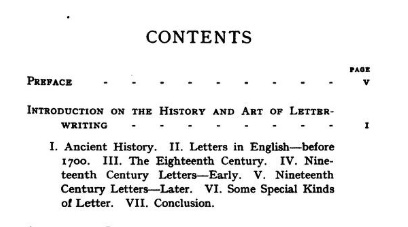
In 1922, George Saintsbury published A Letter Book, Selected with an Introduction on the History and Art of Letter-Writing, with the Introduction running to a fulsome 100 pages. The rest of his 300-page book draws on classic letters, almost all English, to provide examples of points made in the Introduction.

Did the most formidable letter writer of the 20th century read this? I can find no evidence that Lovecraft read this particular book, but we do know that he knew of George Saintsbury’s large and judicious anthology Tales of Mystery (1891). In I Am Providence, S.T. Joshi informs us that…

Lovecraft had obtained [this book] in one of his New York trips of 1922. He drew very heavily upon this latter compilation [for Supernatural Literature]

Tales of Mystery was a gift from Long, presumably picked up from one of the bookstores and used book-stalls he knew so well. Thus Lovecraft was strongly aware of the author in 1922/23, and would have been alert to his name in the various book reviews of that year. It is then probable that he, and his growing circle, were at least aware of the existence of a worthy new introductory book on the history of letters. It does seem the sort of book that Lovecraft might have corresponded with Loveman on, though we can’t know unless the perhaps-lost letters to Loveman re-surface. The book also seems one that a good public library might have wanted on their shelves. However, is is not a book listed in the edition of Joshi’s Lovecraft’s Library I have access to.

Nevertheless Saintsbury’s Introduction offers an interesting and accessible introduction to the epistolary traditions of which Lovecraft was aware of in other ways, and which he sought to perpetuate into the new Machine Age with his ever-dashing pen.

On Lovecraft and Hemingway

09 Thursday Jul 2020

Posted by asdjfdlkf in Historical context

≈ 1 Comment

I have my first question on Lovecraft, from a $6 Patreon patron…


John Miller writes…

Thanks for great content at Tentaclii. I have a two-part question about HPL, if you’re willing to tackle it.

1) Did he read Ernest Hemingway, and do we know what he thought of Hemingway?

2) I love the idea of HPL and Hemingway possibly meeting. What an awkward conversation that would have been, though perhaps they would have bonded over cats! At any rate, were they ever in the same place at the same time? I’m wondering especially about HPL’s visit to Key West. I think Hemingway was out of town those days, but I’m not 100-percent certain.

Thank you!


Ernest Hemingway published his first novel in 1926, just as Lovecraft was writing “The Call of Cthulhu”. Over time Lovecraft’s star dimmed away almost to nothing, while Hemingway struck the world like a meteorite. So much so, that Robert Bloch once remarked that it was difficult to conceive that Lovecraft had actually been living and working in the same era as Hemingway. Another protege, J. Vernon Shea, also observed that… “Part of the reason for Lovecraft’s unpopularity with the literary critics of his day lay in the fact that mainstream literature, following Sherwood Anderson’s and Hemingway’s leads, was turning more and more toward simple sentences and action–packed narration”. One suspects this was not the whole story, and that political axe-grinding was also involved. Perhaps unwittingly abetted by ammunition provide to the critics by the heavy genre-policing of the horror / science-fiction divide in the 1950s.

But Lovecraft lived a life surrounded by long-ago books, some which had been printed and bound when Shakespeare was a boy. As such he took the long-view on matter of taste, feeling relatively un-phased by fleeting trends. Here he writes to Moe in June 1930, alluding to shifting literary tastes and what would become the bitter culture wars of the 1930s…

The only rational attitude of a civilised man [i.e. writers such as Dreiser, Hemingway etc] is to let all the evidence about life go on the record impartially … Nor need we fear that the free circulation of all the evidence is going to have any especial effect on the direction of the civilisation, one way or the other. Trends come from deeper sources that what is written on the surface of literature, and the average domestic adjustments of 1980 or 2030 will not depend on the question of whether Ernest Hemingway is encouraged or not in 1930. … all this business is only a drop in the bucket as scaled against other vital trends in civilisation.

He thought of the early Hemingway as one of the “honest portrayers and intelligent interpreters” of his times, but smiled wryly in March 1931 at the often plebeian nature of the protagonists depicted…

It does not take a microscope to perceive that Ernest Hemingway and John V.A. Weaver have much greater intellectual command of their material than would the kind of people they depict.

Also in 1930 Lovecraft compared Hemingway unfavourably with the truth-telling wits of his beloved 18th century…

Dean Swift [Jonathan Swift, has] a typical piece of sentimental deflation that even an Hemingway cou’d scarcely lead to!

Yet, as with his friend R.E. Howard, Lovecraft recognised that Hemingway was writing ‘what was in him’. Stuff that ‘had to come out’ in a way fitted to the author…

they are right in stripping down to vulgate essentials when they wish to say what they have to say. … To suppose a man with the aesthetick and philosophick visions of Hemingway could say anything in the French pastry jargon of Thornton Wilder … is to miss the whole point and purpose and mode of functioning of language.

This letter was written before the Great Depression really started to bite, and Hemingway joined the herd of what Lovecraft called “political radicals” steadily drifting leftward. One wonders if Lovecraft read more of Hemingway in book and interview in 1931/32, and wearied a little of both the style and the politics. Possibly Hemingway would have been encountered in the form of stories printed in the Saturday supplements of the mainstream press. Does Lovecraft show this irritation in June 1932, writing to Moe on the topic of reading literature aloud? It…

Isn’t wholly a matter of words, and often a smooth ample passage is more direct … ample phonetic harmony means a lot in itself. Good prose needs rhythm … there’s no excuse for barking out an Hemingway machine-gun fire, when one could weave prose which can be read aloud without sore throat or hiccoughs.

By this time Hemingway was rapidly moving left, and in mid 1932 was giving press interviews in which he stated that if he expressed his true leftist beliefs… “I would be jailed for their publication”. Such interviews, and the inevitable press comment on them, were probably not calculated to endear the Hemingway of 1932 to Lovecraft. Lovecraft could pass off his friend Loveman’s pose as a red-dyed Debs-ist syndicalist as an intellectual affectation, similar that of Long’s penthouse communism and old Morton’s mildewed 1900s anarchism. None of these fellows were going to be throwing dynamite into the Providence Courthouse any time soon. But to hear it in public from ‘the coming man’ in literature in 1932, as the Great Depression deepened, may have been another matter. It might have peeved Lovecraft.

“Virtually all the reputable authors & critics in the United States are political radicals — Dreiser, Sherwood Anderson, Hemingway … It would be shorter & easier to compile a list of first-rate writers who are not leftists!” — mid 1930s Lovecraft letter to Catherine L. Moore.

Along with his evident genius, I would guess that Hemingway’s political sentiments probably helped ease his passage through the literary world of the 1930s. By the time of Lovecraft’s death he is said to have been an outright hard-line Stalinist, which may be why I can find no trace of Lovecraft mentioning him after 1932. He and his work became the centre of a long-standing critical consensus on, in S.T. Joshi’s words, what was later seen as… “an outmoded and superficial realism that vaunted the barebones style of a Hemingway or a Sherwood Anderson as the sole acceptable model for English prose.” (I Am Providence).

But Lovecraft was eventually proved right in taking a more long-term view of shifting tastes and sentiments. To ‘stick’ for decades, the consensus had to be made bitterly hard and exclusionary — and it consequently crumbled away.

But how much of Hemingway had Lovecraft actually read? S.T. Joshi, in considering Lovecraft’s arduous and health-breaking ghost-writing of Well-bred Speech (1936) remarks…

consultation of his letters shows that, while he had indeed read a good many of these [authors, inc. Hemingway], others he either was planning to read but apparently never did or knew merely by reputation.

It appears that we don’t actually know what Hemingway he had sampled, unless the details are salted away in some book of letters I’ve not yet seen. One imagines the Derleth and Howard letters have some mentions. When he was writing to Moe, Hemingway had published two collections of short stories (The Sun Also Rises, and Men Without Women), Death in the Afternoon (non-fiction, Spanish bullfighting), and A Farewell to Arms (the American war novel and love story of the First World War). In his 1936 Reading Guide in Well-bred Speech Lovecraft only cites “Ernest Hemingway (A Farewell to Arms)” among a long list of modern works “worth exploring”. In 1931 and 33 Lovecraft had admired the man’s “objectivity” in terms of subjects, and for offering a counterweight to the “effeminate pacifism” of high literary circles, but stated that he simply disliked his terse machine-gun style.

Lovecraft never lived to read To Have and Have Not (October 1937), For Whom the Bell Tolls (1940), Across the River and Into the Trees (1950), or The Old Man and the Sea (1951), nor to read the acceptance speech for Hemingway’s 1954 Nobel Prize.

What of Key West? Hemingway wintered at the sunny Florida resort in 1928/29, and for many winters thereafter. “We have a fine house here” he told the press in 1932, and told them also of his exotic travels to Cuba, Europe, and East Africa. He also bought a boat and sailed the Caribbean. He was deemed a virile hard-edged “man of action”, actually somewhat akin to the types that Lovecraft’s fans read about in the action pulps, but apparently one dreaming of Stalinist power-fantasies rather than riding a zebra across Dunsanian dreamlands.

Lovecraft meanwhile wintered in Barnes Street, Providence, often shivering like an old gent in heavy blankets over a flickering oil stove. He never had the cash to hop on a boat to Havana, still less to carouse, fish and hunt flamingos there. But he did once make it to Key West, a trip enabled by cheques from the March 1932 appearance of “The Trap” in Strange Tales, and from some revision work. A series of long ferry and bus trips then took him ever-southward along the Florida Keys to Key West. S.T. Joshi remarks “Lovecraft spent only a few days in Key West, but he canvassed the place thoroughly.” He found the place was rather Spanish, but not too much, the weather and heat and spicy food must have perked him up superbly…

The best coat of tan I ever had was during this recent trip, when Key West and Miami added to the acquisitions of St. Augustine and Dunedin.

Might the tanned and cheerful Lovecraft then have once dropped in on some waterfront cafe, to hear a manly “Hemingway machine-gun fire” voice reading from A Farewell to Arms? Could the two men have then met, even collaborated? It seems unlikely, but Joshi states that at Key West…

Lovecraft remarks having done “quite a bit on a new story yesterday”, but he ceased abruptly once he heard the news of the rejection [of At the Mountains of Madness]. This story fragment does not, apparently, survive.

This seems like a good factual opening for a fictional Hemingway—Lovecraft meeting and collaboration, if anyone cares to write such a thing. One imagines that Hemingway knew of Robert E. Howard and his bold style, perhaps via several notable summer 1931 tales in Oriental Stories. Did he read such manly tales of the Orient? Well, he used to write such tales, and only a few years prior to his breakthrough success in 1929.* Anyway, if Hemingway did occasional pick up a copy of Oriental Stories while waiting around in fishing shacks for the tide to be right, then an R.E. Howard connection might have provided Lovecraft with the entree to Hemingway’s circle. Also they were also both, in their own ways, uber-realists and yet uber-fantastists. One can then imagine them relaxing with each other, out in front of a beach-hut and working out some manly Robert E. Howard pastiche. Then deciding, amid much laughter, to actually write the thing at speed and mail it to Cross Plains — in part so as to blow away the cobwebs of Hemingway’s strange Einstein-ian experimental short-story of time, “Homage to Switzerland” (written March-June 1932).

The dates and locations are not entirely against such a thing. Hemingway was in Cuba in June 1932, spending several weeks fishing there — having successfully rounded up and transported a flock of flamingos to adorn his new Key West home. Lovecraft was strolling around Key West, exploring the place and probably offering the mundane tourists a rather noticeable figure despite his rich tan. 100 miles of sparkling water separated the two men, but it’s not impossible that Hemingway might have sailed over to Key West for a few days to check on his new flamingos, then headed back to Cuba. It would also be plausible for a fiction writer to imagine an alternative timeline in which Lovecraft had just heard that At the Mountains of Madness had been accepted by Weird Tales, and that editor Wright had then generously wired Lovecraft the dollars needed to spend a few weeks in Cuba.


* “… examining the subject matter of much of Hemingway’s early fiction through the all-fiction magazines offers a context for his development other than modernism. Hemingway’s fiction is in many ways closer to Adventure and All-Story than to the aesthetic sensibilities of Pound and T. S. Eliot. … Hemingway attempted to perfect the popular story formula. His topics and settings are undeniably the stuff of the early genre fiction magazines that composed the general fiction market. Boxing, gambling, mercenaries, trappers, hunters, and the underworld were grist for the pulp mill, as they were for Hemingway … Letters of Hemingway from 1919 recount his storming the walls of popular magazines with a barrage of stories. … he learned salability from popular magazines. … The foundational influences of the popular wood-pulp magazines never left him; they were integral to his concept of authorship. More than that, though, they were integral to his concept of audience.” (Ernest Hemingway in Context, Cambridge University Press, 2013)

‘Picture postals’ from Lovecraft: the Hope Street Reservoir

03 Friday Jul 2020

Posted by asdjfdlkf in Historical context, New discoveries, Picture postals

≈ 1 Comment

H.P. Lovecraft lived at 10 Barnes St., Providence, from 1926 to May 1933. Since the mid 1890s, Barnes Street had a large 75 million gallon reservoir looming up at the back of it. Even if Lovecraft had become habituated to the sight and vicinity of this reservoir, he cannot have been unaware of it when writing “The Colour out of Space” in March 1927. You’ll recall the story involves a planned reservoir, and potential contamination of the urban water-supply. The story was written about a year after he had moved to 10 Barnes St.

Hope St. reservoir and pumping station.

Was the reservoir still full at that time? Probably partly full, but possibly no longer being pumped with fresh water — and thus emitting a certain invisible miasma over the neighbouring streets by early spring 1927. Because according to a Providence magazine of early 1928 the reservoir was then being decommissioned and its slow drainage was well underway… it “is not yet dry, but it will soon be; the city may make use of the site of the big pool for school purposes”. It may have been used as a school sports area, but other reports indicate it remained undeveloped at Lovecraft’s death. The pumping station/house was decommissioned in July 1928.

Lovecraft lived a little off the left of this picture-map, which shows the reservoir and Barnes Street. Looking at another map, it appears that Lovecraft’s high school directly faced the reservoir. He must surely have been familiar with its existence, even if he never walked up there and peered down into its fishy depths.

It would take work at the local archives to discover more, and the exact dates at which the slow drainage started. I assume it takes a year or so to slowly drain something like that, as rapid drainage could cause landslips and catastrophic spillage etc. But from the dates we do have it appears we can be fairly sure that Lovecraft would have taken note of the city’s plans to drain the reservoir, and possibly the start of the drainage, at about the time of the writing of “The Colour out of Space”. If the two were connected or not is now lost in the mists of time.


Update:

Thanks to Tom Douglass, local historian, who writes…

“I believe you are right about the connection you draw between the two, and perhaps more directly than you stated. … When Scituate’s water treatment facility came online in 1926, the Hope pumping station was decommissioned.”

So it’s interesting that the two events – draining Hope and filling Scituate – should be so closely connected. Lovecraft later recalled in a letter that the filling of Scituate was the key inspiration.

Two books on old Marblehead

01 Wednesday Jul 2020

Posted by asdjfdlkf in Historical context, Odd scratchings

≈ Leave a comment

Old Marblehead was a well-loved haunt of H.P. Lovecraft. Two books are freely available online which show something of what he saw in the place.

Uploaded to Archive.org in 2019, An Artist’s Sketch Book of old Marblehead, with very fine pen and ink sketches of the town and its environs.

Also on Archive.org is Old Marblehead: A Camera Impression, although sadly it’s one of thousands of Public Library of India scans in which the pictures are ruined by incredibly harsh contrast.

Still, one can see what the completist Lovecraftian would be getting, if the book were to be picked up in paper for a private library.

Long Dark

29 Monday Jun 2020

Posted by asdjfdlkf in Historical context, Lovecraftian arts

≈ Leave a comment

Dark Worlds Quarterly appreciates Long’s ‘Lovecraft years’, with the new article “Frank Belknap Long – Part One: 1920-1939”. Including a nice ink-drawing of him I’d not seen before, and a fine collection of his story and poetry header-art.

Update: Frank Belknap Long – Part Two: The 1940s.

Also at Dark Worlds, a new “Giant Spiders in Weird Tales“ visual survey.

Arthur Leeds and the Canadian Army

28 Sunday Jun 2020

Posted by asdjfdlkf in Historical context

≈ Leave a comment

My reading of the volume of Lovecraft’s letters to Bloch, now completed, has helped fill in a gap in the life of Arthur Leeds. On page 274 Lovecraft gives Kenneth Sterling a potted biography of his friend Leeds, and notes that…

During the war he was a volunteer with the Canadian Army … he has travelled extensively, even been to Egypt.

This new (to me) data helps fill in the circa 1916-1919 gap for the Leeds biography, as found in my book Lovecraft in Historical Context #4. Leeds was Editor of Scripts at the Edison movie studio in New York City until December 1915, so any war service presumably started (after basic training) in late spring 1916.

Presumably he embarked for France. The Canadian Corps. of volunteers was “one of the most effective allied fighting forces on the Western Front”, and if he was serving with them in an armed capacity he would have seen some heavy fighting in trench warfare conditions.

As for Lovecraft’s mention of Egypt, one wonders if Leeds headed there for a few month in late 1918/early 1919 on being demobbed? It would make sense to go somewhere both warm and safe (Egypt was then British) if one had the meagre funds to get to southern France and then by ship across the Mediterranean. Rather than return home to face a possibly brutal New York winter with no prospect of employment — the old New York movie industry had upped stakes and ‘gone west’ to California. Edison formally wrapped up its Bronx movie division in 1918.

The Private Life revisited

24 Wednesday Jun 2020

Posted by asdjfdlkf in Historical context, Lovecraftian arts

≈ Leave a comment

Bobby Derie revisits The Private Life of H. P. Lovecraft (1985), a memoir by his wife Sonia H. Davis.

Cover by Jason Eckhardt.

The Weird angle

21 Sunday Jun 2020

Posted by asdjfdlkf in Historical context

≈ Leave a comment

An unusual angle on Weird Tales. When Lovecraft mentions, in his letters of the mid 1930s, that the latest edition of Weird Tales is on his desk or shelf ‘hot from the news-stand’ this is what he saw, ready to lift and peruse.

Peruse somewhat reluctantly, as he is often heard bemoaning the unevenness of the magazine in its mid 1930s form. I get the impression from the Barlow / Bloch / Sterling letters that Lovecraft didn’t obtain his copy by subscription via the mail at this time, but preferred to walk down into town and patronise a local news-stand or store. Presumably he used the opportunity to browse the racks and shelves, casting a professional eye over the competition and near-rivals, while forming a rough idea of the state of ‘the slicks’. Incidentally, in his mid-1930s letters he refers several times to the ‘book-stalls’ of Providence, at which bargains could evidently be had by determined browsers such as Barlow, Loveman, Kenneth Sterling and himself. One imagines that, as the Great Depression set in, the four main bookstores of Providence saw competition from used book-stalls popping up in indoor markets and at regular fundraisers.

Talking of unusual angles, Black Gate has a short but perceptive review of the new academic book Weird Tales of Modernity (2019). The book’s author was also interviewed at length recently, on episode #140 of The Sectarian Review podcast.

‘Picture Postals’ from Lovecraft: a cool ice-cream in a hot Red Hook

19 Friday Jun 2020

Posted by asdjfdlkf in Historical context, Picture postals

≈ Leave a comment

‘Picture Postals’ from H.P. Lovecraft, part of an ongoing series.

Sabrett’s horse-drawn ice-cream cart in Red Hook, Brooklyn, New York City. Also selling coffee, candy etc. On the corner of Bush and Clinton Street, about a mile south of Lovecraft’s room in the notorious Red Hook.

“On December 31, 1924, I established myself in a large room … at 169 Clinton St.”

“Sometimes I get a dime’s worth of ice-cream for breakfast” (said of 1934, but just as likely after his walks in Brooklyn).

“It takes no effort at all [to imagine] that I am still 12 years old, and that when I go home it will be through the quieter, more village-like streets of those days — with horses and wagons, and little varicoloured street cars with open platforms…”

More new instances of ‘Lovecraft as character’

15 Monday Jun 2020

Posted by asdjfdlkf in Historical context, Lovecraft as character

≈ 2 Comments

Toward the close of the Bloch section of the Letters to Robert Bloch book, a mention of two early ‘Lovecraft as character’ stories…

Not long ago Kuttner showed me a new story — “Hydra” — in which all three of us figure … & are disposed of” … Shea has also slain me in a recent tale.

I’d not known about these before now. I was initially not quite sure what the Shea item is. The endnote for the mention is “RB 66”, this refers not to page 66 of the Bloch letters, but to letter #66. At first I thought it might refer to Shea’s “The Snouted Thing”, to be found his In Search of Lovecraft (1991), which appears to be its first publication. But a little further digging revealed that Lovecraft must have been referring to Shea’s tale “The Necronomicon”.

Kuttner’s “Hydra” eventually appeared, perhaps revised since Lovecraft had seen it, in the April 1939 issue of Weird Tales, later collected in The Watcher at the Door: The Early Kuttner, Volume Two.

 
At 2,500 words in clean text, I was interested in using the Shea tale as an AI audio test-text, and went looking to see if there’s any ‘sounds like a real human’ AI-shaped text-to-speech services or desktop software. Nope, it seems not — it’s still ‘if you have to ask the price, you can’t afford it’ offers of chatbot-focused API services which claim to do deep learning. Who uses chatbots enough that people want to invest in them?

Anyway, it seems we might have ‘just about good enough’ story-reading AI voices in the European languages by 2025. But for now ordinary mortals are still stuck with the TTS robo-voices, albeit with a few of them being vastly improved since the 2000s and with a new range of local accents. But I guess I should just stop being cheap, lugubriate the voice-box and do it myself.

Update: easy2reading.com Free online Text To Speech TTS and freetts.com Text to Speech Converter were found to be the best in April 2021, with either using Google’s excellent male GB-Standard-D, though lacking in emotional colouring. The latter costs $6 per 1m characters, but has the advantage of using TTS markup for pauses and emphasis.


I’ve started a new Lovecraft as character tag on this blog, and gone back and retrospectively tagged. It’s limited to just the early appearances or recognisable versions of him. I’ve also found another new one, but that will appear here tomorrow in the Kittee Tuesday feature.

← Older posts
Newer posts →


Please become my patron at www.patreon.com/davehaden to help this blog survive and thrive.

Or donate via PayPal — any amount is welcome! Donations total at Easter 2025, since 2015: $390.

Archives

  • March 2026
  • February 2026
  • January 2026
  • December 2025
  • November 2025
  • October 2025
  • September 2025
  • August 2025
  • July 2025
  • June 2025
  • May 2025
  • April 2025
  • March 2025
  • February 2025
  • January 2025
  • December 2024
  • November 2024
  • October 2024
  • September 2024
  • August 2024
  • July 2024
  • June 2024
  • May 2024
  • April 2024
  • March 2024
  • February 2024
  • January 2024
  • December 2023
  • November 2023
  • October 2023
  • September 2023
  • August 2023
  • July 2023
  • June 2023
  • May 2023
  • April 2023
  • March 2023
  • February 2023
  • January 2023
  • December 2022
  • November 2022
  • October 2022
  • September 2022
  • August 2022
  • July 2022
  • June 2022
  • May 2022
  • April 2022
  • March 2022
  • February 2022
  • January 2022
  • December 2021
  • November 2021
  • October 2021
  • September 2021
  • August 2021
  • July 2021
  • June 2021
  • May 2021
  • April 2021
  • March 2021
  • February 2021
  • January 2021
  • December 2020
  • November 2020
  • October 2020
  • September 2020
  • August 2020
  • July 2020
  • June 2020
  • May 2020
  • April 2020
  • March 2020
  • February 2020
  • January 2020
  • December 2019
  • November 2019
  • October 2019
  • September 2019
  • August 2019
  • July 2019
  • June 2019
  • May 2019
  • April 2019
  • March 2019
  • February 2019
  • January 2019
  • December 2018
  • November 2018
  • October 2018
  • September 2018
  • August 2018
  • August 2015
  • July 2015
  • April 2015
  • March 2015
  • February 2015
  • January 2015
  • December 2014
  • November 2014
  • October 2014
  • September 2014
  • August 2014
  • July 2014
  • June 2014
  • May 2014
  • March 2014
  • February 2014
  • January 2014
  • December 2013
  • November 2013
  • October 2013
  • September 2013
  • August 2013
  • July 2013
  • June 2013
  • May 2013
  • April 2013
  • March 2013
  • February 2013
  • January 2013
  • December 2012
  • November 2012
  • October 2012
  • September 2012
  • August 2012
  • July 2012
  • June 2012
  • May 2012
  • April 2012
  • March 2012
  • February 2012
  • January 2012
  • December 2011
  • November 2011
  • October 2011
  • September 2011
  • August 2011
  • July 2011
  • June 2011
  • May 2011
  • April 2011
  • March 2011
  • February 2011
  • January 2011
  • December 2010
  • November 2010
  • October 2010
  • September 2010
  • August 2010
  • July 2010

Categories

  • 3D (14)
  • AI (70)
  • Astronomy (70)
  • Censorship (14)
  • de Camp (7)
  • Doyle (7)
  • Films & trailers (101)
  • Fonts (9)
  • Guest posts (2)
  • Historical context (1,096)
  • Housekeeping (91)
  • HPLinks (77)
  • Kipling (11)
  • Kittee Tuesday (92)
  • Lovecraft as character (58)
  • Lovecraftian arts (1,628)
  • Lovecraftian places (19)
  • Maps (70)
  • NecronomiCon 2013 (40)
  • NecronomiCon 2015 (22)
  • New books (966)
  • New discoveries (165)
  • Night in Providence (17)
  • Odd scratchings (984)
  • Picture postals (276)
  • Podcasts etc. (431)
  • REH (184)
  • Scholarly works (1,470)
  • Summer School (31)
  • Unnamable (87)

Get this blog in your newsreader:
 
RSS Feed — Posts
RSS Feed — Comments

H.P. Lovecraft's Poster Collection - 17 retro travel posters for $18. Print ready, and available to buy — the proceeds help to support the work of Tentaclii.

Proudly powered by WordPress Theme: Chateau by Ignacio Ricci.