• About
  • Directory
  • Free stuff
  • Lovecraft for beginners
  • My Books
  • Open Lovecraft
  • Reviews
  • Travel Posters
  • SALTES

Tentaclii

~ News & scholarship on H.P. Lovecraft

Tentaclii

Category Archives: Historical context

For Lovecraft’s birthday: Annotated “Hypnos”

20 Thursday Aug 2020

Posted by asdjfdlkf in Historical context, Scholarly works

≈ 2 Comments

Here’s my annotated “Hypnos”, for H.P. Lovecraft’s 130th birthday.

Download: annotated_hypnos_v1_2020.pdf

This is a version 1.0, and may well be polished up a bit and added to in a future version.

I’ll be hoping to gather together links to other people’s birthday offerings in due course, once the search-engines catch up with indexing today.

New S.T. Joshi podcast interview, and “How H.P. Lovecraft Chose His Pens”

19 Wednesday Aug 2020

Posted by asdjfdlkf in Historical context, Podcasts etc.

≈ Leave a comment

The new podcast Hard to Believe #015 has a long interview with… “biographer S.T. Joshi on the life and legacy of Lovecraft”.

Also, the latest Arkham Reporter appreciates “How H.P. Lovecraft Chose His Pens”, with the aid of Frank Belknap Long’s late memoir.

“The Horror at Clinton Street”

17 Monday Aug 2020

Posted by asdjfdlkf in Historical context

≈ Leave a comment

Colin Wilson specialist Gary Lachman notes on his blog that…

my article “The Horror at Clinton Street: H.P. Lovecraft in Brooklyn,” is in the September 2020 issue of Fortean Times, #396

The article is structured around biographical details of Lovecraft and Sonia in New York, interspersed with short paragraphs highlighting the very worst of the racist body-descriptions to be gleaned from the New York letters. Then there’s a standard short gloss on Lovecraft’s time alone at Clinton Street, with no additional research on Red Hook in the 1920s. For instance, how piquant it would have been just to point out that the large number of Syrians there were actually refugee Christians, fleeing persecution in their homeland. Or to note that Lovecraft later planned and outlined to Dwyer a long story which would feature the Clinton Street rooming house as the monster. Or to learn just in passing that Lovecraft’s closest friend in New York was a gay man, Samuel Loveman, and that another was a Harlem-based anarchist who lectured and published on racial equality. The article ends with a potted summary of the story “Red Hook” and “He”.

Friday ‘picture postals’ from Lovecraft: almost No. 66

14 Friday Aug 2020

Posted by asdjfdlkf in Historical context, Picture postals

≈ Leave a comment

I’ve found another view of Lovecraft’s lane and a bit of his home at No. 66. It’s tucked into the side of a 1906 bird’s eye view of the Brown Campus, possibly made from a balloon.

Tucked into the corner we just about get a glimpse of No. 66, set back from the road on its unpaved lane.

Here we see Lovecraft at the top of the steps leading up to his front door, these steps possibly appearing as a smudge on the postcard.

Judging by the eBay photo, the card was slightly clipped at both edges by the seller. So, since it was only a mere $5 with international postage… I bagged it. I’ll hope to have a bigger scanner-scan of that corner, in due course.

Protected: The juvenile gangs of Red Hook during Lovecraft’s time there

13 Thursday Aug 2020

Posted by asdjfdlkf in Historical context, New discoveries, Scholarly works

≈ Enter your password to view comments.

This content is password-protected. To view it, please enter the password below.

Lovecraft and Webster’s

13 Thursday Aug 2020

Posted by asdjfdlkf in Astronomy, Historical context

≈ Leave a comment

This post is a small follow up to my recent post on Lovecraft’s Dictionary. Lovecraft used Webster’s in the form of Webster’s International, 1890, and continued to do so to the end of his life. But he wrote to Dwyer in 1927 that he had — as a boy — used Webster’s unabridged illustrated edition of 1864. There…

I became utterly infatuated with the pages of illustrations with the pages of illustrations of “Philosophic and Scientific Instruments” in the back of Webster’s unabridged of 1864.

Webster’s unabridged appears to have gone through numerous ever-expanding printings after 1864, all seemingly generally nodded to as “the 1864”. At each printing the illustrations at the back were often varied, being incrementally improved. For instance the pages on the 1880/86 edition of “the 1864” lack the appeal of the same pages in the 1890s editions…

This suggests Lovecraft’s family had an 1890s edition of “the 1864”. I say “1890s” because one can find eBay and Archive.org examples of the International which have title page dates from 1888 through 1895, and it appears it would probably be the work of a small thesis to work out the tangled printing history. But S.T. Joshi has “1891” in Lovecraft’s Library. Thus it appears on the face of it that what Lovecraft calls “the 1864” in his letter to Dwyer is in fact the the 1890 edition of “the 1864”. And that what in the 1930s he called the “1890” actually saw its second and final volume appear in 1891. To confuse matters further, there was evidently also an 1895 edition, which is the one most people now consult from that period on Archive.org.

If all this is correct then Lovecraft was likely “utterly infatuated” with the illustrations collected at the end of the second volume which appeared in 1891, these being presumably the same as the following 1895 edition illustrations…

In part then, this central illustration of a telescope may be what started Lovecraft on his cosmic journey, as he revisited the illustrations after he had finished with his chemistry obsession…

Further on in this rear illustrated section of the 1895 printing one can find all manner of curious ocean life and fungi.

Incidentally, in the same 1927 letter to Dwyer he remarks on a possible sequel or continuation to his recent “The Call of Cthulhu”. In response to Dwyer’s tabulation of the approaches so-far used at the more cosmic end of fiction, Lovecraft muses briefly on a future cosmic story he might write and remarks…

I think I shall write about the place that Cthulhu came from.

One wonders if this might have been somehow entangled with the other story he tells Dwyer he wants to write, in which his Red Hook lodging-house was to be depicted as some sort of malign sentient entity.

Bulletin of the Cleveland Museum of Art

12 Wednesday Aug 2020

Posted by asdjfdlkf in Historical context

≈ Leave a comment

New on Archive.org, Bulletin of the Cleveland Museum of Art, The, 1914-1994. Judging by the 1922 issues they have been not yet been processed by the Archive.org bots to .PDF files though are available in other formats. The early part of the run is possibly of interest to some, re: the Cleveland scene circa 1922, which Lovecraft was involved in via Loveman and the literary circles orbiting Laukhuff’s Book Store. In terms of pinpointing possible local art exhibitions seen, Lovecraft was in Cleveland from 29th July to the 15th August 1922. I don’t know if there are pictures in it (I’ll wait for the PDFs) but in terms of possible group photos of those attending exhibition launch-events etc, 1921-23 would be the issues to flip through.

Lovecraft in Harlem

11 Tuesday Aug 2020

Posted by asdjfdlkf in Historical context

≈ 4 Comments

Another good question from one of my $6 Patreon patrons…

Did HPL [Lovecraft] ever engage with the Harlem Renaissance or any of its major figures? Did he ever comment on them or their works? I’m especially interested in Zora Neale Hurston, but of course there were others. Did he ever visit Harlem when he was living in NYC (or at any time)?

Lovecraft had fond memories of Harlem. In 1896 at age six he enjoyed his first stage play in Providence, an event and staging thereafter forever indelibly etched within a nook of his capacious memory. This play had included “Act IV — A political picnic in Harlem” and he later recalled “the oddly loud apparel of the ‘ladies’ & ‘gents'” in the park. This play offered an idealised stage echo from an 1890s world of straw-boater hats, bright political rosettes and sawdust lucky-dips. A Harlem into which his friend Frank Belknap Long had been born in 1901, and where Long had also grown up. Long’s extensive conversations with Lovecraft in the 1920s would have undoubtedly conveyed certain memories of that older time and place, thus allowing Lovecraft to piece together a firmer idea of the old Harlem and its ways. Long before, their idol Poe had also walked alongside the Harlem River.

Lovecraft probably had some vague awareness of the changing demographics of modern Harlem before he first visited New York in 1922, perhaps via titbits picked up from the newspapers. For instance, his comic poem “The Nymph’s Reply to the Modern Businessman” (1917, in Tryout) has the suspicious young nymph remark… “But others have said things like that | and led me to a Harlem flat!” This appears to generally allude to Harlem’s reputation for licentious behaviour, since at that time Lovecraft had not met Long.

Long had grown up in Harlem, but he and his family had since moved away. Yet in the early 1920s James Morton, another of Lovecraft’s close friends, was still living there. During ‘the New York years’ Lovecraft appears to have heard repeated and vigorous arguments from Morton in favour of Harlem’s population, and he probably also heard something about their emerging modernist culture. Morton had been an active anarchist back in the days of ‘Red Emma’, and was still of that bent intellectually and also ardently anti-racist and had published and lectured on the topic. Though ageing and increasingly ‘past it’, as a seasoned travelling-lecturer he could still put up a stiff argument for racial equality. For instance Kirk, in his Diary, compares Morton to a “King” in terms of his conversation and arguments in 1924/26. We know that in 1922 Morton still lived in Harlem because Lovecraft wrote…

At the elevated station at 6th Ave. and 42nd St. I lost my fellow Anglo-Saxon, whose home is far to the north in the semi-African jungles of Harlem.” (18th May 1922).

This was later confirmed by Long’s autobiography, which noted Morton lived in one of the old New York ‘brownstone’ buildings and worked as a lecturer. From the new Family letters we now know that Lovecraft actually briefly saw Morton’s “No. 211” apartment in September 1922, and noted it as being of good architectural quality in a tree-lined street. In contrast to Long’s memory of it as a “brownstone” Lovecraft has it as “an old brick single house … spacious & unkempt” in which Morton had apartment rooms on the top floor. It was owned by “Edwin C. Walker” (d. 1931) who ran the freethought / free-love / inter-racialist Sunrise Club, which also had spiritualist speakers at its dining meetings. Lovecraft’s mention of the owner’s name and “211” gets me the address: “Edwin C. Walker, 211 W. 138th St.” in Publisher’s Weekly, 1917, and the American Booktrade Directory for 1925. Edwin C. Walker also merits a listing at that address in Hartmann’s Who’s Who in Occult, Psychic and Spiritual Realms, 1925. For more on Walker see the book The Sex Radicals: Free Love in High Victorian America (1977).

The contrast between Lovecraft’s “single house” and Long’s “brownstone” is explained by a photograph. Lovecraft was likely using the architecturally-correct Georgian term for a long single-block of row-houses, built in the pseudo-Georgian style in the 1890s…

211-203 W. 138 St. With No. 211 glimpsed on the far left.

Thus it would be curious if Morton, prior to his move to New Jersey, was not verbally conveying to Lovecraft some sort of outline of Harlem’s emerging culture. Both he and his landlord appear to have been in the ‘cultural oratory’ business. Thus Morton might have re-shaped a rosy picture of Harlem very vaguely formed from hearing Long’s boyhood memories of the place. Conversation with Morton may have helped inform the over-the-top horror serial Herbert West (1922), penned by Lovecraft for the salacious Home Brew magazine. This serial “shocker” featured an episode in which a resurrection is attempted on a dead back-room boxer called ‘The Harlem Smoke’. The letters from Morton to Lovecraft, which we don’t now have, may have also given many details of the Harlem life in which Morton was involved.

There had been at least one meeting of the Kalem Club in Harlem, at Morton’s place in the searing heat of August 1924 (perhaps the place was larger and cooler than other venues, or the flat roof was accessible?) and this is attested by a Lovecraft letter and Kirk’s Diary. But it is quite possible he did not walk the streets at night to get there, and took a tram instead. On the way back, in the middle of the night, the streets would likely have been almost empty.

Morton moved away from Harlem in 1925, but for some reason Lovecraft actually visited Harlem in person at the start of 1925. His telegraphic 1925 Diary cryptically records…

[Jan 17] Morn. fix up GK room. Aft. shop — Harlem — return 106.

… thus we know that Lovecraft was strolling through Harlem on the afternoon of 17th January 1925. Why he was there is anyone’s guess. Possibly it was to make a last visit to Morton before the old fellow’s marriage and move to Paterson, New Jersey.

In a 1927 letter Lovecraft talks of the sights his young correspondent must see in New York, and one of these is Harlem…

sinister and fascinating – not a white face for blocks. Lenox Ave. subway to 125th St. – walk north.

This most likely indicates a route Lovecraft was familiar with, most probably the one he occasionally took to visit Morton.

Lovecraft was also aware of Harlem as a home of jazz, and once remarked in his New York letters on his awareness of the new cultural forms of theatre then being born in the clubs of Harlem. Like many in the USA, he did not subscribe to the correct ‘little journals’ such as the Dial, where he might have read sympathetic and informed accounts of the new modern forms of culture. But he would have picked up the gist of the place from the newspapers and from his circle. It would have been part of his ‘mental map’ of the city.

We also know of a tangential connection he briefly made with Harlem. Toward the end of March 1925 Lovecraft’s silhouette was crafted at a Broadway book shop by the silhouettist E.J. Perry, who in the summer worked a stand at Coney Island’s Luna Park and who lived in Harlem in the mid 1920s.

Lovecraft’s wife Sonia later had her silhouette cut twice by the same artist, this time at Coney Island.

Should Lovecraft have known, during his New York years, of what are now thought of as the major writers of the Harlem Renaissance — Hurston, Claude McKay, Jean Toomer and Langston Hughes? Let’s consider them one by one.

The mystic poet Jean Toomer published just one book, Cane (1923). This experimental modernist collection of poems and vignettes centered about the black experience in Georgia, in the deep south of America. The book took a nostalgic view of the black rural folk-culture, which Toomer saw as fading away in the face of the drift to the big cities. However, Cane was not widely read until republished and hailed as a classic in the late 1960s.

Zora Neale Hurston was an undergraduate student during Lovecraft’s New York years, graduating from her B.A. degree in 1928 and then taking a two-year Masters degree at Columbia. After that she spent five years travelling the South, Jamaica and Haiti collecting folklore and songs. Hurston does appear to have had two short pieces in a small Harlem modernist magazine of the mid 1920s, including the now-notable “Sweat” about an abused washerwoman, but during this period it was unlikely that even the Harlem-based Morton knew of her as a writer of fiction. Her first substantial print works were Jonah’s Gourd Vine (1934, debut novel, semi-autobiographical work about a philandering father), and Of Mules and Men (1935, a study of African-American folklore collected from North Florida logging camps, and some initial ventures into voodoo in New Orleans/Haiti). These appeared late in Lovecraft’s life and obviously went un-noticed by him, though it’s possible he encountered book reviews of Of Mules and Men in the press in the Fall of 1935. Her later books Their Eyes Were
Watching God
(1937, novel) and Tell My Horse: Voodoo and Life in Haiti and Jamaica (1938) appeared after his death.

Langston Hughes was at Columbia for a year as an undergraduate in 1921 and is said to have enjoyed the night-life of Harlem at around that time. It appears that Hughes was not then in New York again until 1929, when he graduated from a B.A. degree elsewhere and returned to live in New York City. So far as I can tell he does not seem to have been in New York when Lovecraft was living there. His debut poetry collection was published in 1927, after Lovecraft left New York and it was his “least successful in terms of both sales and critical reception” (Wikipedia, citing a study of the book’s reception). His debut novel was Not Without Laughter (1930, coming-of-age in rural Kansas before the First World War) and — despite being hailed as a powerful debut — its subject matter does not seem likely to have appealed to Lovecraft.

Claude McKay appears to have been substantially an IWW (syndicalist) and then a communist journalist, until his first novel Home to Harlem (1928). This followed the white Carl Van Vechten’s ground-breaking sensationalist novel about Harlem nightlife, which had been published in October 1926 — six months after Lovecraft had left the city (Carl Van Vechten: A Bibliography). McKay’s novel appeared even later, several years after Lovecraft had left New York City. According to Wikipedia McKay’s novel was controversial when published, as like Van Vechten he… “depicts a culture in Harlem that is full of drug use, prostitution, and a variety of sexual encounters”. McKay’s novel was acclaimed and well reviewed, and Lovecraft may well have seen reviews of it and recalled the earlier Van Vechten novel. Yet neither sound like the sort of book that would have made Lovecraft regret not venturing further into Harlem in the mid 1920s. Nor would either have modified his racist view, encountered in the letters, that New York City was a giant ‘pest zone’.

As we can see from the dates above, there is very little reason why either Lovecraft or his circle should have been strongly aware of these writers while living in New York City in the mid 1920s. Nor, in the books I have access to, did he ever comment later on their works. He was, however, aware in the mid 1920s of Harlem as a home to jazz and new cabaret theatre. Probably this knowledge came both from reading the New York press and from talking with those in his circle who were long-standing New Yorkers.

A decade later in 1934 he shows in a letter than he was still aware of the then-current racial geography of New York City, presumably from first hand experience, stating that the black district formed a “zone from about 150th St. down to 125th & beyond” and was pushing south into the then Puerto-Rican area of “upper 5th Ave”. He also noted that expansion… “is checked abruptly on the west by the rocky precipice of St. Nicholas Heights … & the streets [around] the old country seat of Alexander Hamilton”. He also comments in passing on the strong divisions of ‘social standing’ which black people operate among themselves (rich and poor, different island origins and skin shades etc.) and notes the tidiness of those small parts “of Harlem where the rich blacks dwell”. He also comments on the curiosities and voodoo-like items sold in shops on “Lenox & 7th Aves”. All of which indicate he had by then walked the streets involved, and thus might seem to contradict the old notion that Lovecraft ‘ran screaming and cowering’ on seeing a black face. By 1934 he was slowing down in his writing, but such things could have influenced his tales had he gone on living. He might well — as I have suggested elsewhere — have written tales of ancient Africa in the time of the Roman Empire, in the liminal setting of the border region between the Empire and Africa.

Telephones under the earth

10 Monday Aug 2020

Posted by asdjfdlkf in Historical context

≈ 1 Comment

I’ve encountered an interesting item which perhaps throws a small sidelight on the use of the telephone in Lovecraft’s “The Statement of Randolph Carter” (1919). You’ll recall that a telephone is taken on the descent…

I promise to keep you informed over the telephone of every move — you see I’ve enough wire here to reach to the center of the earth and back!”

The telephone might sound like an unlikely thing to take down below. But wired long-distance field telephones were a known ‘thing’ at that time, not least because of their use in the war. A modified long-distance field telephone was also used in the very deep explorations of the pioneering explorer of underground rivers and lakes, E.A. Martel (1859-1938), then world famous.

Though Martel had quit the more arduous forms of exploring by the time Lovecraft was writing “The Statement of Randolph Carter”, back in 1912 Martel visited America for a celebrity tour of the caves and… “spent three days exploring in Mammoth Cave, Kentucky”. Mammoth Cave, you’ll recall, being a favourite location of interest to H.P. Lovecraft.

Here is Martel, mistakenly called “Hartel” by the American editor, dramatically profiled in a popular magazine article of 1923. The article details the use of his special telephone in circumstances not unlike that of Lovecraft’s story…

The article’s artist also shows the chest-mounted speaking-horn for the underground telephone. Presumably the backpack held the the coiled cable, ready to be spooled out, and the batteries.

Incidentally I see that there’s now a 2013 DVD documentary on Martel in German and French, being a substantial 1995 documentary film rescued from the archives. Note that… “In addition, a limited edition of the English version is currently available” for 19 Euros. The film won a number of awards at film festivals, and may interest some readers of Tentaclii. Martel also sounds like a prime subject for an as-yet unmade documentary graphic novel. France is quietly but strongly investing in its ‘soft power’ in the form of comics, partly to help reach the young ‘coming billions’ in French-speaking Africa, and it may be relatively easy to find French interest in such a project.


Talking of unearthly voices, I see that Archive.org now has a new TTS “read aloud to me” button…

Friday ‘picture postals’ from Lovecraft: the dockside

07 Friday Aug 2020

Posted by asdjfdlkf in Historical context, Picture postals

≈ 2 Comments

Providence, as if seen from a night-gaunt hovering above 66 College St. Available as an 8000px .TIF at the LOC.

This 1895 supplement the Providence Sunday newspaper at first appears to be a standard and rather dull city engraving of the period, until one zooms right in and sees the quality of the ink and wash work. Here we see a detail of the Providence river and dockside, the side usually shunned by postcard-makers…

In letters of the 1930s Lovecraft recalled the rigged sailing-ships of Providence, seen and admired in his youth but now departed.

In the heavy fog of late November 1923, his Providence friend Eddy introduced him to the sinister courtyards and back-alley labyrinths which ran back from the dockside seen above…

a squalid colonial labyrinth in which I moved as an utter stranger, each moment wondering whether I were indeed in my native town or in some leprous, distorted witch-Salem … there was a fog, & out of it & into it again mov’d dark monstrous diseas’d shapes … narrow exotick streets and alleys … grotesque lines of gambrel roofs with drunken eaves and idiotick tottering chimneys … streets, lines, rows; bent and broken, twisted and mysterious, wan and wither’d … claws of gargoyles obscurely beckoning to witch-sabbaths of cannibal horror in shadow’d alleys that are black at noon … and toward the southeast, a stark silhouette of hoary, unhallowed black chimneys and bleak ridgepoles against a mist that is white and blank and saline — the venerable, the immemorial sea”. (Lovecraft, heavily abridged from a letter to Morton, 5th December 1923).

Zooming further in we see a lone rower on the river…

As a sturdy lad, Lovecraft was for a short time an avid rower in a small boat, a period from which memories probably linger in the story “Dagon”. Lovecraft was (so far as we know) only boating around the corner on the Seekonk, rather than pulling past the sailing-ships and coalers as seen here. Still, the sight of a little rower is evocative of a freer time…

“I used to row considerably on the Seekonk … Often I would land on one or both of the Twin Islands — for islands (associated with remote secrets, pirate treasure, and all that) always fascinated me.” — Lovecraft letter to Rimel, April 1934.

“Klei edits The Brooklynite now”

06 Thursday Aug 2020

Posted by asdjfdlkf in Historical context

≈ Leave a comment

Among the Lovecraft circle, Rheinhart Kleiner had once edited a monthly New York paper called The Brooklynite…

Klei edits The Brooklynite now, & if he can surmount the difficulties of his task — the thankless task of recording social gossip — he will produce a paper worth a more careful reading than most Brooklynites. — Lovcraft, letter to Galpin, 1918.

This paper was read by Lovecraft during 1918, as Kleiner appears to have sent a copy of each issue. The magazine’s approach might have strongly shaped Lovecraft’s perception and awareness of Brooklyn, in terms of his later settling there.

The modern Brooklyn Magazine ran a short profile of the magazine in 2013. This found the magazine still lively and fresh, and revealed that the Brooklyn Historical Society only has…

“issues span the years 1926 through 1930.”

Little changes in some areas of human experience, it seems. One article in the magazine, it was noted…

recounts the existential crisis that one writer endured while he was waiting to have a phone placed in his apartment. Titled “Number Please,” the author writes, “To pass through the seemingly simple procedure of having a telephone installed is usually enough to hurry a normal person through the throes of dementia.”

We have some idea of it via Lovecraft’s noting of its poetry in his critical columns…

The general frivolity of The Brooklynite is doubtless due to the fact that this publication is designed primarily as a relaxation for persons engaged in other and more serious activities.

Elsewhere, a rare copy for sale terms it the “Official Organ of the Blue Pencil Club”, and The Fossil for 2017 confirms…

Brooklyn’s Blue Pencil Club held regular meetings and sponsored The Brooklynite through many decades.

Lovecraft not only read it, but was published in it, though perhaps not under Kleiner — it appears the history of the editorship remains to be written. Lovecraft’s long poetic celebration of “Providence” saw print in The Brooklynite for November 1924, for instance. Later, a comic poem Lovecraft had written for a Blue Pencil Club meeting was published in The Brooklynite for January 1926. One wonders if the publication may have also served as some sort of inspiration for the later commercial and even spicier Home Brew thus, by a sideways shift, giving Lovecraft another publication in which to publish fiction?

Back in 2013 I noted here that the archives of Vassar College has a good run of this publication…

1917-1918, 1921, 1923-1944.

… but it appears that these have still not been digitised or inspected by Lovecraftians or the historians of Brooklyn. Possibly The Fossil might run an article surveying the history and phases of the publication, and thus encourage a public scanning and digitisation of the Vassar College run, perhaps combined with that of the Brooklyn Historical Society?

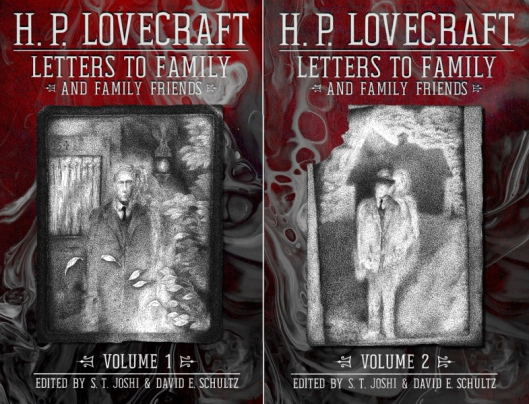
New book: H. P. Lovecraft: Letters to Family and Family Friends

03 Monday Aug 2020

Posted by asdjfdlkf in Historical context, Lovecraftian arts, New books, Scholarly works

≈ Leave a comment

H. P. Lovecraft: Letters to Family and Family Friends is now listed on the Hippocampus Press website. Nice and chunky at 1,110 pages, mostly because of the immense amount of letters to his aunts Lillian Clark and Annie Gamwell. These letters are here given “complete and unabridged” and also in a meticulously annotated and indexed form. There are also “previously unpublished letters written by Lovecraft’s grandfather, Whipple V. Phillips, to his grandson in the 1890s”.

Quite reasonably priced, at $60 for both in paperback. There’s an “Add to cart” button on the page, so I assume they’re shipping now. No sign of them yet on either Amazon USA or UK or eBay, but no doubt they’ll appear there in due course.

The books have a pleasing cover design by Daniel V. Sauer, around evocative art by David C. Verba.

← Older posts
Newer posts →


Please become my patron at www.patreon.com/davehaden to help this blog survive and thrive.

Or donate via PayPal — any amount is welcome! Donations total at Easter 2025, since 2015: $390.

Archives

  • March 2026
  • February 2026
  • January 2026
  • December 2025
  • November 2025
  • October 2025
  • September 2025
  • August 2025
  • July 2025
  • June 2025
  • May 2025
  • April 2025
  • March 2025
  • February 2025
  • January 2025
  • December 2024
  • November 2024
  • October 2024
  • September 2024
  • August 2024
  • July 2024
  • June 2024
  • May 2024
  • April 2024
  • March 2024
  • February 2024
  • January 2024
  • December 2023
  • November 2023
  • October 2023
  • September 2023
  • August 2023
  • July 2023
  • June 2023
  • May 2023
  • April 2023
  • March 2023
  • February 2023
  • January 2023
  • December 2022
  • November 2022
  • October 2022
  • September 2022
  • August 2022
  • July 2022
  • June 2022
  • May 2022
  • April 2022
  • March 2022
  • February 2022
  • January 2022
  • December 2021
  • November 2021
  • October 2021
  • September 2021
  • August 2021
  • July 2021
  • June 2021
  • May 2021
  • April 2021
  • March 2021
  • February 2021
  • January 2021
  • December 2020
  • November 2020
  • October 2020
  • September 2020
  • August 2020
  • July 2020
  • June 2020
  • May 2020
  • April 2020
  • March 2020
  • February 2020
  • January 2020
  • December 2019
  • November 2019
  • October 2019
  • September 2019
  • August 2019
  • July 2019
  • June 2019
  • May 2019
  • April 2019
  • March 2019
  • February 2019
  • January 2019
  • December 2018
  • November 2018
  • October 2018
  • September 2018
  • August 2018
  • August 2015
  • July 2015
  • April 2015
  • March 2015
  • February 2015
  • January 2015
  • December 2014
  • November 2014
  • October 2014
  • September 2014
  • August 2014
  • July 2014
  • June 2014
  • May 2014
  • March 2014
  • February 2014
  • January 2014
  • December 2013
  • November 2013
  • October 2013
  • September 2013
  • August 2013
  • July 2013
  • June 2013
  • May 2013
  • April 2013
  • March 2013
  • February 2013
  • January 2013
  • December 2012
  • November 2012
  • October 2012
  • September 2012
  • August 2012
  • July 2012
  • June 2012
  • May 2012
  • April 2012
  • March 2012
  • February 2012
  • January 2012
  • December 2011
  • November 2011
  • October 2011
  • September 2011
  • August 2011
  • July 2011
  • June 2011
  • May 2011
  • April 2011
  • March 2011
  • February 2011
  • January 2011
  • December 2010
  • November 2010
  • October 2010
  • September 2010
  • August 2010
  • July 2010

Categories

  • 3D (14)
  • AI (70)
  • Astronomy (70)
  • Censorship (14)
  • de Camp (7)
  • Doyle (7)
  • Films & trailers (101)
  • Fonts (9)
  • Guest posts (2)
  • Historical context (1,096)
  • Housekeeping (91)
  • HPLinks (77)
  • Kipling (11)
  • Kittee Tuesday (92)
  • Lovecraft as character (58)
  • Lovecraftian arts (1,628)
  • Lovecraftian places (19)
  • Maps (70)
  • NecronomiCon 2013 (40)
  • NecronomiCon 2015 (22)
  • New books (966)
  • New discoveries (165)
  • Night in Providence (17)
  • Odd scratchings (984)
  • Picture postals (276)
  • Podcasts etc. (431)
  • REH (184)
  • Scholarly works (1,470)
  • Summer School (31)
  • Unnamable (87)

Get this blog in your newsreader:
 
RSS Feed — Posts
RSS Feed — Comments

H.P. Lovecraft's Poster Collection - 17 retro travel posters for $18. Print ready, and available to buy — the proceeds help to support the work of Tentaclii.

Proudly powered by WordPress Theme: Chateau by Ignacio Ricci.