• About
  • Directory
  • Free stuff
  • Lovecraft for beginners
  • My Books
  • Open Lovecraft
  • Reviews
  • Travel Posters
  • SALTES

Tentaclii

~ News & scholarship on H.P. Lovecraft

Tentaclii

Category Archives: Historical context

Did Lovecraft ever mention Halloween?

27 Tuesday Oct 2020

Posted by asdjfdlkf in Historical context, Night in Providence

≈ 1 Comment

Did Lovecraft ever mention Halloween as a day of pranks? Well, he knew of its prankish traditions. In his Department of Public Criticism (January 1919) column he gives a few comments on the contents of The Brooklynite for November 1918…

Mr. A. M. Adams is more successful as an essayist, and manages to infuse some real, glowing, and practical patriotism in his colloquial discourse on “Halloween Pranks”. We are glad to see so virile a piece at this particular time…

But no, he doesn’t discuss it in any volume of letters I have access to, either historically or in terms of mentioning that neighbourhood kids had come knocking on the door offering ‘trick or treat’. Though there are headers in a couple of letters. On 31st October 1931 he dated a letter to Cole as simply… “All Hallows”, and two years later he did the same with a letter to Morton.

So far as I can tell the letters hint only twice at any sort of Halloween activity on his part. To Dwyer, on being sent a drawing of Pickman’s Model, he comments (3rd March 1927) that…

At Roodmas and All-Hallows’ shall I view it, and the Objects squatting on nearby coffins or peering monstrously over my shoulder shall shudder as they gaze upon its forbidden revelations.

Remarking to Donald Wandrei (3rd November 1927) on his recent reading of The Aeneid in the 1906 James Rhoades translation, he also comments on his “spectral thoughts” at Halloween…

This Virgilian diversion, together with the spectral thoughts incident to All Hallows’ Eve with its Witch-Sabbaths on the hills, produced in me last Monday night a Roman dream of such supernal clearness & vividness, & such titanic adumbrations of hidden horror, that I verily believe I shall some day employ it in fiction.

And that’s about it so far as I can tell, apart from the use in fiction. No comments in letters on the local tradition of “Halloween pranks”, if such things were even permitted in Providence. Though admittedly I don’t yet have the two volumes of his letters to his aunts, so may be missing some mentions in letters. But I’m sure S.T. Joshi’s I Am Providence would have noted any in-person trick-or-treating in company with his aunts (“I’m H.P. Lovecraft, I don’t need to wear a mask…”). Given the evidence above he might have marked the date merely with some “spectral thoughts” and perusal of a few especially shuddersome sketches. Possibly it also often marked more or less a terminal date for his summer walks, and the onset of his usual winter hermitage.

Though he did leave us this March 1926 National Amateur poem, later reprinted in the September 1952 issue of Weird Tales…

If written for Halloween 1925, as seems likely, this would make it a poem from the Red Hook period. A time in which Lovecraft trekked out (often in vain) on what he called “exploring trips” to find relatively unspoiled suburbs of New York City. There he might find a place to walk, often at night, and enjoy for a while a lingering old-time atmosphere and the occasional company of a wide-eyed cat or two. His 1925 Diary seems to confirm my supposition: 28th Oct “Paterson” [he visits Morton in Paterson]; 29th Oct “Start poem”; 30th Oct “Finish poem”.

This doesn’t mean that the ugly suburb of the poem is Paterson, but that the trip there may have sparked the idea of the poem.

A letter adds to the Diary, and suggests why he might have been in the mood to write. Just before starting the poem he had heard that afternoon that Weird Tales had accepted his story “The Horror at Red Hook”. Also, we learn that the landlady had finally put a fire in the furnace of his until-then unheated building.

For Halloween itself the Diary shows he met Kirk and Loveman, and the Kalem Klub meeting that developed broke up at 5am the following morning. Lovecraft wandered back through the darkened streets to his room in Red Hook. The evening appears to have been marked by no special festivities, though it is quite possible his new Halloween poem was read there. So we do have, perhaps, some hints that Lovecraft marked at least one Halloween by penning a new poem.

Perhaps anticipating the acceptance of “The Horror at Red Hook”, a few weeks earlier Lovecraft had been considering how to sprinkle his writing with more convincing occult mumbo-jumbo than that he had briefly used back in the summer in “Red Hook”. In a letter to Smith on 9th October 1925 he remarked…

I have frequently thought of getting some of the junk sold at an occultists book shop in 46th St. The trouble is, that it costs too damned much for me in my present state. [and he then asks Smith for] a more or less brief list of magical books — ancient & mediaeval preferred — in English or English translations.

… presumably to see if the various New York Libraries might have free copies he could make notes from. Or perhaps the list of titles might be passed to those in the book trade, such as Kirk or Loveman, who might know of a reprint.

What of the “46th St.” occult bookstore he mentions? It can’t be the famous Weiser store, as that did not open until 1926. Possibly Lovecraft had been taken to the Gotham Book Mart, and was mis-remembering 45th as 46th? Because the famous bookseller and anti-censorship champion Frances Steloff had opened this in 1920 (a 1921 Publishers Weekly has it at “128 W. 45th St”). According to her biography her shop only sold books she liked — her tastes being almost entirely in the then-emerging modernist literature and spiritual/occultist books. One can imagine which section of the shop Lovecraft headed toward. That the books were all too expensive for him, and perhaps also too ponderous, may have been part of the impetus toward inventing his own rather more lively mythos.

He did, however, later recall seedier New York sellers of such material…

“the mystic bookstalls with their hellish bearded guardians … monstrous books from nightmare lands for sale at a song if one might chance to pick the right one from mouldering, ceiling-high piles”

Merritt-ed

23 Friday Oct 2020

Posted by asdjfdlkf in Historical context, REH

≈ Leave a comment

DMR considers a plausible alternative ‘cosmic’ influence on Robert E. Howard, Abraham Merritt.

Another sketch of the College Street courtyard

21 Wednesday Oct 2020

Posted by asdjfdlkf in Historical context, Lovecraftian arts

≈ Leave a comment

Following my recent stroll down the old College Street, I found another drawing of the archway near the foot of College Street, this time by Providence artist Whitman Bailey and from 1914. Not in my Whitman Bailey ebook collection, which is available at the previous link.

Stuff To Blow Your Mind: a three-parter on the Minotaur

19 Monday Oct 2020

Posted by asdjfdlkf in Historical context, Podcasts etc.

≈ 2 Comments

The quality Stuff To Blow Your Mind podcast has a new three-parter on the famous Minotaur and its Cretan labyrinth.

Lovecraft would, like most children before the early 1980s, have early become familiar with Greek myth and with the Minotaur story. He found it early in his boyhood, and in vivid form, in Hawthorne’s Tanglewood Tales for Boys and Girls (1853). Despite the book’s misleadingly rustic title — from which one might expect only cosy mid-Victorian woodland cottages and merrily skipping milk-maids — Hawthorne actually recounts powerful Ancient Greek myth… “the stories of the Minotaur, the Pygmies, the Dragon’s Teeth, Circe’s Palace, the Pomegranate Seeds, and the Golden Fleece” (S.T. Joshi, I Am Providence). Sadly, libraries in the U.S. are now pulling Hawthorne from the shelves. Apparently he offends some perpetually-offended politically-correct sect or other. Laughably, Upton Sinclair, once the golden boy of the left and about whom Lovecraft was sniffy, is being swept away along with Hawthorne.

On Lovecraft and Fuseli

11 Sunday Oct 2020

Posted by asdjfdlkf in Historical context, Lovecraftian arts

≈ 1 Comment

An October question has arrived from one of my Patreon patrons.

What did HPL think of the artist Henry Fuseli?


There is not generally a lot to say about H.P. Lovecraft and art. A master he was, but not of practical visual art-making. He had aunts who were long-standing members of the local Art Club, and they could apparently produce a pleasing canvas of a seascape or similar Rhode Island scenes. But he could only produce fairly crude sketches, though these are not without some naive charm. Had he been trained from boyhood to draw, he might have produced passable pen-sketches of cherished scenes. He might even have later branched out into Mervyn Peake-like gothic ink drawings. But he both felt and knew that he had no talent for it, and at that point in time landscape and architectural photography was not a viable alternative picture-making option for him. He was an impoverished amateur, who made do with a box-camera and simple snaps developed at the local drug-store. This is not to say that he did not appreciate a silver-handed artistic talent in others, and indeed he encouraged it in his more hesitant young correspondents such as Dwyer and Barlow among others. Nor did his lack of ability mean that he was unable to appreciate fine art, though we can perhaps assume he lacked the very subtle eye of the practising visual artist.

What then of the painter Fuseli? He is referred to by name in Lovecraft’s “Pickman’s Model” (1926)…

I don’t have to tell you why a Fuseli really brings a shiver while a cheap ghost-story frontispiece merely makes us laugh.

This must refer to Fuseli’s masterwork “The Nightmare” (1781). The picture became so famous and well-reproduced, as both painting and its engraving by Thomas Burke (1783), that it was able to be very easily parodied and also alluded to in literature. There is a very vague claim that it may have inspired Shelley, and thus Shelley’s Frankenstein. This claim falls apart, as soon as one starts to dig into its footnotes. A much firmer example is found in two uses by Lovecraft’s idol Poe. There are a set of paintings in Poe’s “The Fall of the House of Usher” that are similarly compared to Fuseli…

If ever mortal painted an idea, that mortal was Roderick Usher. For me at least, in the circumstances then surrounding me, there arose out of the pure abstractions which the hypochondriac contrived to throw upon his canvas, an intensity of intolerable awe, no shadow of which felt I ever yet in the contemplation of the certainly glowing yet too concrete reveries of Fuseli.

Later in the tale there is a similar manifestation of a ‘dream terror’, as if from out of the paintings…

An irrepressible tremor gradually pervaded my frame; and, at length, there sat upon my very heart an incubus of utterly causeless alarm. Shaking this off with a gasp and a struggle, I uplifted myself upon the pillows, and, peering earnestly within the intense darkness of the chamber…

The allusion to the painting is subtle, but the setting is the same and would have promoted connoisseurs of the macabre to recall the famous “The Nightmare”. Lovecraft could also have recognised the more explicitly-named allusion to the painting in Poe’s “The Black Cat”…

I started, hourly, from dreams of unutterable fear, to find the hot breath of the thing upon my face, and its vast weight — an incarnate Night-Mare that I had no power to shake off — incumbent eternally upon my heart!”

These are likely the uses that Lovecraft sought to echo in his own “Pickman’s Model”, almost perhaps more in homage to Poe rather than for an avid fondness for the works of Fuseli. Since Lovecraft mentions Fuseli in no letters that I have access to, other than in a passing generic list given to Mrs Toldridge.

Yet, could Lovecraft have seen “The Nightmare” in its original? Let me quickly trace some of the history of the original picture. It seems that Fuseli, though of Swiss origin and name, had to all intents become an Englishman. This would have endeared him to Lovecraft even more, and it must then explain why the famous painting long remained in and around my own area, first at Ashbourne on the southern edge of the Derbyshire Peak, and later at the nearby county-town of Stafford. Local genius and future-visionary Erasmus Darwin saw it and wrote famous macabre poetry on the painting. This is a rather pleasing discovery for a localist like myself to make, and such data might one day find its way into a future story. But by 1950 the picture was gone. Post-war socialist death-duties and other punitive taxes were wracking and wrecking the stately homes, and it was sold and shipped to the USA. The original painting is apparently now in Detroit, USA, which seems a rather suitable resting place.

The above digital version is not ideal, but the quality of online reproductions is generally abysmal — and at least here one can see what’s going on in the picture. Including the dressing-table mirror and a trace of tell-tale blush on the cheek of the sleeping maiden. Note also the strong likeness to the squatting shape of Lovecraft’s Cthulhu idol.

There appears to have been no loan exhibition of any Fuseli to Boston or New York during Lovecraft’s lifetime. Thus it seems certain that Lovecraft knew the picture only as a good reproduction. However, there is a complicating factor. Fuseli also painted several other versions.

In a version destroyed in the infernos of the London Blitz during the Second World War, but whose likeness was captured in an engraving by William Raddon (1827), the demon-imp’s impact is lessened by having him look questioningly at the sheepish horse, and having the distinct shadow of a cat. The whole scene takes on a comedic self-parodic cast…

By 1810 Fuseli has his demon-imp escaping nightmare-woken women on the horse, by leaping out of the window astride the horse’s back. One suspects that Fuseli by this point had become rather fed-up of his famous painting, and was beyond even subtle self-parody. He was just playing it for laughs, to amuse friends. Possibly this picture also gives us a hint of the very large amount of items that his prudish widow heaped onto a bonfire shortly after his death.

One deep-diving art historian remarks that the famous demon-imp became a mere owl, in a version painted by Fuseli at age 80.


Thus my feeling is that what Lovecraft alludes to in “Pickman’s Model”, and what he assumes Poe also knew, was the version he would have seen in fine form in engravings — such as the one in Erasmus Darwin’s famous The Botanic Garden. We know that Lovecraft had an 1805 ‘sampler’ of the best of this long work, called Beauties of the Botanic Garden, and also an 1880 biography of Erasmus Darwin. In which case he would have been interested enough to peruse the complete poetic works, had he encountered the volumes in somewhere like Boston or perhaps even Providence. Had this been the 1799 edition, then on page 126 of Part Two (“The Loves of the Plants”) he would have seen a fine engraving of perhaps the best version of the famous work…

This plate faces and also illustrates the climax of a macabre section of the poem set at Wetton in the Manifold Valley in North Staffordshire, which was also (though Erasmus knew it not) the setting for the climax of the famous supernatural tale Sir Gawain and the Green Knight. Here is this version of the picture in paint, albeit in black and white…

Lovecraft may not have seen the connections with old European folklore, re: chest-squatting imps as folk explanations for sleep paralysis, or the water-horse (on which, to get past all the pagan parroting and modern mumbo-jumbo, see Stromback’s excellent “Some Notes on the Nix in the Older Nordic Tradition”, 1970, which is also comparative).

The paintings bear comparison with some other of Fuseli’s works. For instance in a study for “Prospero, Miranda, Caliban and Ariel”, the demon-imp and the dreaming girl are akin to Shakespeare’s Caliban and a swooning Miranda (Miranda here being just pencilled-in)…

In “Milton Dictating to His Daughter”, the blind Milton has a face akin to the original horse complete with blind eyes, and the long flowing drapery and Blake-like limbs of the girl is also similar…

There is another reference to Fuseli in Lovecraft’s fiction, in “The Colour out of Space”…

All the farm was shining with the hideous unknown blend of colour; trees, buildings, and even such grass and herbage as had not been wholly changed to lethal grey brittleness. The boughs were all straining skyward, tipped with tongues of foul flame, and lambent tricklings of the same monstrous fire were creeping about the ridgepoles of the house, barn and sheds. It was a scene from a vision of Fuseli…

This implies that by March 1927 Lovecraft had seen more of Fuseli than engravings or b&w reproductions of “The Nightmare”. Such works were most likely encountered in the public and personal libraries of New York City during his stay there, either as good reproductions or perhaps even as originals in the museums. What might the pictures have been? Well, it’s very difficult to see the full range of Fuseli’s work in the macabre and supernatural, and very easy to come away from any one old book unimpressed. But put them together and you start to glimpse how impressive he would be in this area if such works were collected together. I’d suggest what’s needed is a blockbuster 21st century exhibition of such works, in due course, hint hint…

So it’s currently difficult to say what Lovecraft saw in New York City. But perhaps this engraved faery picture might give a hint at the sort of ‘swirling’ painted work that Lovecraft had in mind in “The Colour out of Space”.

Or perhaps the background of Fuseli’s witch-sabbat “The Night Hag” also gives us a glimpse…

The other hints of influence are to be found in two entries in Lovecraft’s Commonplace Book of story-ideas…

Very late in 1923

#106. A thing that sat on a sleeper’s chest. Gone in morning, but something left behind.

Early 1924

#119. Art note — fantastick daemons of Salvator Rosa or Fuseli (trunk-proboscis).

From this, I suspect, eventually came Lovecraft’s Brown Jenkin in “Dreams in the Witch House” (1932)…


Further reading:

* Nicolas Powell, Fuseli: The Nightmare, Viking Press, 1973.

* Sleep Paralysis: Night-Mares, Nocebos, and the Mind-Body Connection, Studies in Medical Anthropology, 2011.

Pulpdom complete in PDF for $30

10 Saturday Oct 2020

Posted by asdjfdlkf in Historical context, Odd scratchings

≈ Leave a comment

A nice offer on back-issue sets, from the Pulpdom fanzine.

#1-75 in PDF with an index, for $25. Or all 98 issues in PDF for $30 (presumably also with the index for #1-75?)

On the Rhode

08 Thursday Oct 2020

Posted by asdjfdlkf in Historical context, Podcasts etc.

≈ Leave a comment

The Voluminous podcast starts in on a long Robert E. Howard letter, with “The Letters of H.P. Lovecraft: REH Part 1 – Rhode Island”…

In the first part of a long letter to Robert E. Howard, Lovecraft shares many thoughts including the fascinating and sometimes horrifying history of Rhode Island.

More on Lovecraft in Harlem

04 Sunday Oct 2020

Posted by asdjfdlkf in Historical context, Lovecraft as character

≈ Leave a comment

Dipping at random into my newly arrived book of Letters to Donald and Howard Wandrei has yielded up a new addition to my recent Harlem post at Tentaclii. In a 1927 letter Lovecraft talks of the sights the lad must see in New York, and one of these was Harlem…

sinister and fascinating — not a white face for blocks. Lenox Ave. subway to 125th St. — walk north.

This most likely indicates a route Lovecraft was familiar with. Possibly the one he took to visit Morton, who lived in a Harlem brownstone, or one that Morton took to give Lovecraft a taste of Harlem. We know from Lovecraft’s day-by-day 1925 Diary that he made a trip into Harlem at least once.

Update: There was at least one meeting of the Kalem Club in Harlem, at Morton’s place in the heat of August 1924, and this is attested by a Lovecraft letter in Letters to Family and a mention in Kirk’s Diary.

Also found was a new addition to the ‘Lovecraft as character’ list, albeit not extant. In a 1931 letter Lovecraft revealed that Frank Belknap Long was busy writing a novel with Lovecraft and his circle as lightly-veiled characters. This work has evidently not survived. Although Long’s “The Black Druid” (1930) has, in which Lovecraft is the lightly-veiled “Stephen Benefield”. Possibly the novel was an expansion of “The Black Druid”?

H.P. Lovecraft’s Magazine of Fun

03 Saturday Oct 2020

Posted by asdjfdlkf in Historical context

≈ Leave a comment

Lovecraft was once recruited by Henneberger as the new editor of The Magazine of Fun, of all things. It appears to be about the closest he came to employment in the period, unless one counts a short stint of envelope-addressing, some small bits of copywriting, and a day as a New York City debt-collector.

“In the fall of 1924 Henneberger provisionally hired HPL to edit a new humor magazine that he was planning (possibly titled the Magazine of Fun) at $40 per week; HPL spent the next several weeks preparing jokes for the magazine, but it never got off the ground. [As pay] Henneberger gave HPL a credit of $60 at the Scribner Book Shop” (Lovecraft Encyclopedia).

“He has — or says he has — hired me for his new magazine at a salary beginning at $40.00 per wk” (letter from Lovecraft)

This was the Magazine of Fun at the end of 1921 / start of 1922, published out of Chicago which was where Henneberger was located. There was much verse in it, probably best described as being “ribald” in a saucy seaside-postcard sort of way, some jokes that are still good, and with occasional touches of dry social satire and pokes at censorship.

One can thus see how Lovecraft ‘the metrical mechanic’ might have used his talents in churning out such light verse, something he could do at the drop of a hat. He also had quite a comic side and a line in ‘snappy-patter’ newly picked up from Sandusky, as one can see in his letters.

In the May 1922 issue Lovecraft’s friend Ernest La Touche Hancock can be found contributing some light verse…

Hancock was a fellow professional light versifier and fellow British Empire loyalist, then getting toward the end of his life. Hancock was working at a time when one could still make a living from such an activity, and had he been younger (he died in 1926) he might have been the one offered the editorship. His verse is also found in other issues of the magazine. His presence suggests that this is the correct Magazine of Fun, and this hunch is confirmed by my finding a 1922 ownership statement that has Henneberger as owner…

The final issue known to collectors appears to have been April 1923, so my guess is that — with Weird Tales successfully launched — the title was given a final big ‘send-off’ issue and then shelved and pencilled in to be re-started under a new editor some 18 months later. There may of course have been plans for a wholly new title in that line, but it seems unlikely — why waste a snappy title that the news-stand buyers recognised?

Its final issue had offered a “French art section with 100 illustrations”. “French art” then being a euphemism for naughty pictures, these presumably helping to justify the cover’s double-price price-tag of 50 cents. One wonders how far its sales helped under-write the bills arising from the first issue of Weird Tales, which was on the news-stands February-March-April 1923. I guess the new book The Thing’s Incredible! The Secret Origins of Weird Tales may well have more details, but its price is staying high and thus I have not yet seen this.

One imagines that, as the new editor, Lovecraft might have tried to take title back toward its 1921/22 approach as seen above. Certainly it’s difficult to imagine Lovecraft helming a magazine of “under-the-counter” girlie drawings, “French art” and explicit limericks. But Lovecraft could probably have managed a ‘snappy verse’ quarterly in the 1921/22 style, perhaps with the likes of ‘wisecrack’ Sandusky and experienced light-versifier Kleiner as contributors. It’s perhaps relevant that he went to see Sandusky in Boston at this time. He could supply the magazine’s anti-liquor comedy-travelogues himself…

It’s delightful to think that a brown folder, somewhere in the world, might yet be found to contain the six weeks of work done by Lovecraft in the Fall/Autumn of 1924, its faded covers opening to reveal an unknown wad of lusty limericks, jaunty jokes, cunning pokes at the censors, and snappy cracks all signed ‘H.P. Lovecraft’.

Lovecraft in Esquire, 1947

02 Friday Oct 2020

Posted by asdjfdlkf in Historical context, New discoveries, Picture postals

≈ 3 Comments

The post-war chill of January 1946 was made a little colder for readers of Esquire magazine by an article on the 1938 New England floods, illustrated with with a very gloomy picture specially commissioned for the article.

Not quite a “Friday ‘picture postal'”, but a flooded Providence is as as-good-as. This image unwittingly visually trailed a short profile and supposed memoir of one H.P. Lovecraft, then a figure of quite some mystery. This item was to be found later on in the issue, and was penned by John Wilstach.

S.T. Joshi bluntly calls this memoir “fictitious” in his monumental Lovecraft Bibliography. It’s easy to agree, and for this reason I won’t muddy the waters by republishing it here. The editor of Esquire magazine even appears to implicitly warn his readers of being too credulous, in his trailer-blurb for the article…

In the article itself Wilstach claims to recall that he was drinking with the poet Hart Crane one day in New York in the twenties, and Hart happened to have the crumpled manuscript of Lovecraft’s “He” in his pocket. Crane thought highly of the tale and asked Wilstach to accompany him then and there on a visit to Lovecraft’s decrepit room in Red Hook, as he allegedly felt tender and protective toward the ‘old gent’. Given what we now know of Crane’s antipathy toward Lovecraft, and his apparent ignorance of the tale (only published September 1926, after Lovecraft had left New York), this seems highly unlikely.

But possibly the Esquire article needed jazzing up for acceptance. As such it’s not impossible that Wilstach substituted the famous Crane for a lesser writer he had actually known and who had known Lovecraft. His biographical blurb puts him in about the right place for that…

John Hudnall Wilstach (b. 1891) was a short-story writer and novelist specializing in circus and carnival life, crime, and science fiction.

Given his apparent circus specialism, one wonders if a possible candidate for the ‘real’ Crane might then have been Arthur Leeds. Leeds had a circus background, and might once have asked Wilstach to look over Lovecraft’s new ‘New York’ tales with a view to finding a market in ‘the slicks’ in which Wilstach sometimes published. That would be one hypothesis which could fit, but more would have to be known about Wilstach in 1920s New York to say more.

It can however be more firmly suggested that Wilstach had most of his personal material for the Esquire article from Paul Cook. Comments on the Esquire article, on the front page of the NAPA amateur journal the Literary Newsette for 2nd February 1946, seem to confirm this…

Wilstach obviously “… obtained most of the facts from W. Paul Cook, for whom he seems to have a strong admiration.

Wilstach’s article also claims he once made a post-New York winter visit to Lovecraft’s home in Providence, though he gives no address or date and not a single telling detail. There are however a couple of interesting points in his article, arising from his likely Cook connection. In the second half of the article there is an un-credited quote, which the editor has surprisingly let slip through un-credited. Presumably this quote is from Cook, given Cook’s known concern over people making the Poe comparison…

A friend once suggested that he stimulate dreams by means of drugs. Lovecraft exclaimed that if drugs would give him any worse dreams than he experienced without them, he would go mad. His dreams were his own. It is unfair to call him equal to Poe, greater than Poe, or lacking in certain Poe qualities. Better, consider him as standing alone.

That sounds like Cook, although if the quote was hooked from print I can’t discover. Evidently Wilstach had talked with Cook, since he relates the ‘Lovecraft wouldn’t disturb a sleeping cat in his lap’ anecdote, and states it was “told me by Cook”. A later June 1946 Esquire letter by Wilstach, defending his claims of a mid-1940s “Lovecraft cult” against a questioning March 1946 letter by Weird Tales founder Henneberger, shows that Wilstach had access to Cook’s mid-1940s little magazine Ghost. In this same letter he also talks of “my friend Cook”.

Given this reasonably firm Cook connection, one point in Wilstach’s article does ring true…

The [Lovecraft] family had been prominent in Providence. It was Lovecraft’s ambition to buy back the old home and restore the family’s position. He was almost in tears when he found a number of his grandfather’s books in a bookshop. He bought all he could.

Given that we know Lovecraft went on long book-hunting trips in Providence with Cook, both at the store of ‘Uncle Eddy’ and at other book-sellers, this last seems quite likely to be a fragment of memoir had via Cook. One then wonders if finding “his grandfather’s books in a bookshop” can be confirmed by a mention somewhere in Lovecraft’s letters? It does seem the sort of thing he would have told at least one correspondent about, though I don’t recall encountering it.

The Esquire article succeeded in bringing Weird Tales founder Henneberger to print, on the letters page of the June 1946 issue. This item is not in the Lovecraft Bibliography. He makes a pithy rebuttal without specifics, but more interestingly flashes a light on the very moment of Lovecraft’s initial reception in the Weird Tales office.

This itself is somewhat questionable in light of what we now know. Henneberger recalls that it was he who discovered Lovecraft, via Home Brew and the story “Randolph Carter”. But we know it was Cook’s The Vagrant that had published “Randolph Carter” in May 1920, not Home Brew. While Henneberger was doubtless keeping a close and wary eye on Home Brew (a possible competitor), it’s less certain he had also been tracking The Vagrant since summer 1920. However, its quite likely that in late 1922 he had made enquiries among the amateur journalists about suitable writers for his new Weird Tales, and been sent a bundle of The Vagrant.

He has it that he “contacted Lovecraft through this magazine” via editor Houtain, and personally invited a submission from Lovecraft. He was sent “The Rats in the Walls” and after reading it he showed it to his editor who was incredulous. We know it was published in Weird Tales, but not until March 1924, and we also know that this was not the “first” story to see print. That was “Dagon”, in the Halloween 1923 issue.

We also know that “Rats” could not have been among the initial handwritten manuscripts Lovecraft sent to Weird Tales in May 1923, since the tale was only written in late summer 1923. “Rats” was eventually submitted to Weird Tales, but it only arrived in the office circa 10th November 1923 (Selected Letters I, page 259). “Rats” had been typed by Eddy for Lovecraft, presumably with a couple of carbons, and submitted in good form to Argosy, which was one of the well-paying ‘slicks’. Evidently a carbon had also been mailed to Arthur Leeds, since Lovecraft states Leeds had written back to say he felt the tale was just too horrible for Argosy to accept… and so it proved. The rejected “Rats” was then quickly sent on to Weird Tales, to join the pile of other Lovecraft tales awaiting consideration.

One way of explaining Henneberger’s memories is then to say that he had indeed been tracking Home Brew and that, via Houtain its editor, he had indeed acquired Lovecraft’s address and passed it on to his editor at Weird Tales. This is not incompatible with the known fact that Lovecraft’s friends were drawing the new Weird Tales to his attention and urging him to submit some stories. We know that Lovecraft had eventually after much persuasion sent in stories in passable hand-written manuscript form in May 1923 (“Dagon”, “Carter”, “Ulthar”, “Arthur Jermyn”, The Hound”). But Henneberger’s 1947 letter implies that Lovecraft only really came to his attention when the Weird Tales editor queried how startlingly good the Eddy-typed “The Rats in The Walls” was, when it was read in mid November 1923. Clearly this Lovecraft was a cut above his Home Brew “Herbert West” and “Lurking Fear” serial-shockers, and his sent-in tales “Carter” and “The Hound” obviously gave only a hint of what he could really do. This seminal moment in time would then be what Henneberger was recalling in his 1947 letter. He did indeed ‘discover’ Lovecraft via Home Brew, at least in terms of getting an address out of Houtain. But he perhaps wasn’t quite aware of what a great writer he had got hold of, until his startled editor landed “Rats” on his desk for a second opinion. What he then pulled off his shelves to comfort his editor would not have been the serial-shockers of Home Brew, but was more likely something like some back-issues of Cook’s amateur publication. Containing as it did items such as the 1920 printing of “Randolph Carter”, and more importantly Cook’s 1919 essay “Howard P. Lovecraft’s Fiction” which had introduced “Dagon” to the world. In this respect it’s perhaps notable that “Dagon” was the first Lovecraft story printed in Weird Tales (October 1923). Evidently there was a copy of this in good form, somewhere in the Weird Tales offices. The presence of this last item in print would be ‘a given’, had Lovecraft in May 1923 sent his “Dagon” to Weird Tales not in the handwriting which obscured the other tales in his bundle, but rather in Cook’s 1919 printed form.

Such was the past, as Henneberger recalled it after some 25 years. What of the future? He has certainly been proven correct in his prescient forecast that Lovecraft…

will be read as enthusiastically in 2023 as he was in 1923

A useful reminder that Halloween 2023 will be the 100th anniversary of Lovecraft’s fiction first appearing in Weird Tales.

The pursuit of Perkins

26 Saturday Sep 2020

Posted by asdjfdlkf in Historical context

≈ Leave a comment

In the spring and summer of 1934 Lovecraft appears to have been tracing his maternal Perkins ancestry into the English Midlands and the Welsh Marches. He wrote to Morton as from “Perkins Manor” in early March of that year. A letter dated 1st August 1934 to Edward H. Cole is catalogued in the archives as providing merely… “genealogical information on the Perkins family”. Presumably this is now in the volume of Cole letters, but I don’t currently have access to that book. Elsewhere in the letters we learn from Lovecraft that… “Perkins … didn’t reach R.I. [Rhode Island] till the 18th century” and it’s implied that he settled in “the Bay”. A letter to Barlow (O Fortunate Floridian, page 94) sees Lovecraft reveal more, with dates… “John Perkins (1590-1654) of Newent, Gloucestershire, who settled in Ipswich, Mass., in 1633. … son John Jr. (1614-1700)” also a forebear for Lovecraft, via John Jr.’s son Sam.

There was some local interest in this branch of the family, as Lovecraft tells Morton of the local Providence… “soulful poetess friend of my aunt’s — Miss Ada Perkins [who] was over [visiting in person] last week and calling up ancestral data”. Sadly it appears that Miss Perkins has left no trace in the online record, save that she may have had two sisters. It also appears from the same passage in the Morton letter that John Perkins (1590-1654) had arrived on the ship Lyon, and that a book then newly-added to the Providence public library had yielded up to Lovecraft the name of the wife of John Perkins, one “Judith Gater”. By this time Lovecraft’s “Perkins notes” had become a “stapled-together” bundle.

His pursuit of Perkins then merged into kitten-naming in his shared courtyard garden, which helped enshrine the sequence of the Perkins family-tree in print…

[I] called the little fellows “Newman Perkins” and “Ebenezer Perkins” after ancestors of my own — for I have a Perkins line. When the black kitten appeared, I went back along my Perkins ancestry and called him Samuel, after a forebear who fought in King Philip’s War in 1676. If there are any more kittens later on, I shall probably keep going back along my Perkins line (which is traceable to 1380 in Shropshire and Warwickshire) for names — John being the next in order.

A kitten name, ‘Sam Perkins’, then made it into one of the fantastical stories of his correspondent Duane Rimel. Lovecraft writes… [I] “was pleased to see his name in your new story!”  Poetry on the same kittie was also penned by Lovecraft himself, to be found in the new Cat Book.

The Perkins name also inspired a pen-name, with Lovecraft naming himself “Inspector Theobald-Perkins” during the assiduous hunt for a stamp-stealing clerk in a rural Post Office (a correspondent had sent a scarce and desirable stamp as postage, but it had been peeled off and replaced). By the Autumn and start of 1935 Lovecraft was styling himself “Theobaldus Perkins, Gent.” when writing to Morton as from “The Georgian Citadel”. By 1936 he was styling himself “Theobaldus Perkins-Field”, presumably reflecting another branch in the family-tree, perhaps newly discovered or documented.

Today such meanderings in Lovecraft’s life might seem fruitless. Certainly there is no use of a Perkins in his own fiction, unless one counts two spurious and passing uses (a hardware store in “Ermingarde” and a tiny bit-part in a Heald ghost-written tale). Still, spending a few minutes following such a burning and sustained interest on Lovecraft’s part can sometimes lead to new discoveries. Historians well know that the ‘irrelevant’ can become ‘relevant’ in the blink of an eye. Although here my only discovery was that the local Providence poetess “Miss Ada Perkins” was a visitor and friend of the family in the early 1930s, and had the Perkins family line in common with Lovecraft. Unfortunately she appears to have left no poetry or portrait.

Friday ‘Picture Postals’ from Lovecraft: College St. demolition, 1935

25 Friday Sep 2020

Posted by asdjfdlkf in Historical context, Picture postals

≈ 2 Comments

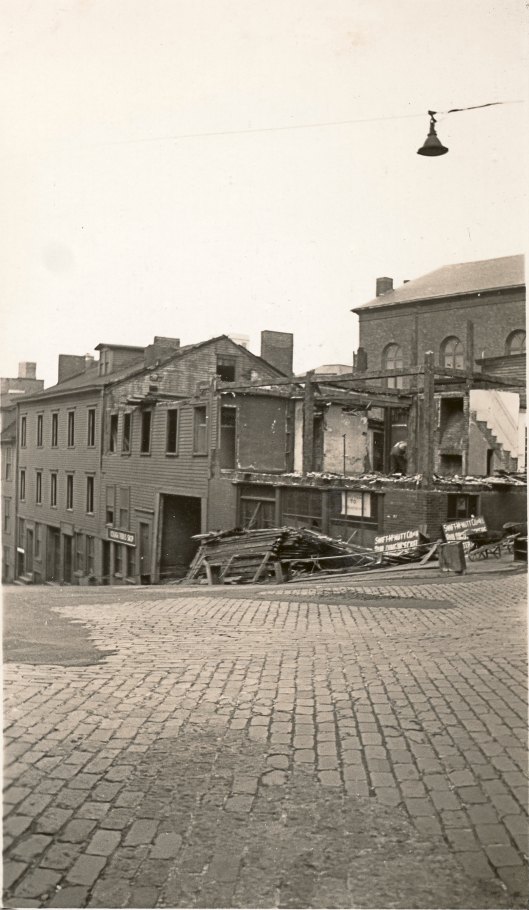
This Friday ‘Picture Postal’ follows last week’s, which had the same location but looked toward the city. In 1935 old buildings on lower College Street, Providence R.I, were demolished. Here we see 32-34 College Street in the process of demolition.

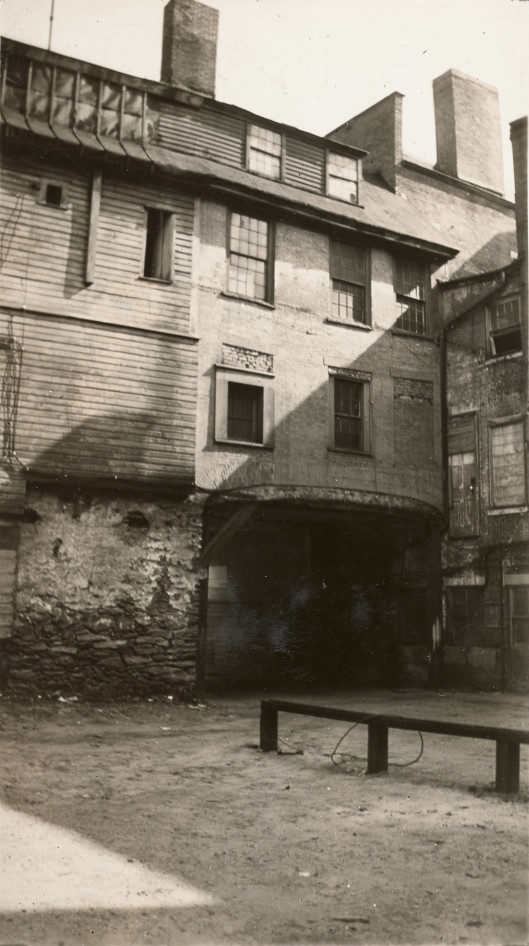
The wheels of modernity were spinning up and the motor car was the future. Horse-yards, and the antiquarians and artists who might haunt them, were increasingly surplus to requirements. We can imagine that Lovecraft, who lived further up the street at No. 66, objected to the demolitions. As he had at the demolition of the Old Brick Row, and other regretful changes to the city’s fabric. Though I can find no evidence that he did so for the bottom of College Street. Given the state of some of the backs (24-28 seen above), and the need for grand schemes in the Great Depression, it might have been difficult to publicly call for their preservation. Such is the way of it. Someone in authority makes a quiet decision somewhere and a street or area starts to be neglected. 15 or 20 years later the place is in such a state that it ‘has’ to be demolished, and it’s by then difficult to argue in favour of preservation.

Here we see local artist Stacey Tolman’s drawing of one of the yard entrances in the former ‘Rosemary Lane’, or one very much like it, and another from the other side showing the last days of usage for horses.

Here we see the back courtyard of No. 32 (top) and No. 33 (bottom), with the motor car replacing the horse in the yard at No. 33.

Tolman had earlier painted this yard at No. 33 in happier days, with its calm bright scene poised between industriousness and a faint threat.

Today, cynical modern eyes might instantly see men gambling and idle slum-boys playing hoop, or might raise a lip at the ‘chocolate-box’ sheen common to the Rhode Island art of the period. But the men are looking over plans for a worthy new horse-carriage for the somewhat Lovecraft-like man standing by them. Sturdy working apprentices stand ready to fit an iron rim to a hand-crafted wheel. An industrious wife has hung out lines of washing and one can just see her fresh green herb-pots on the same platform. This is a picture of a living place at work, but threatened by time. A point Tolman has emphasised by having the fateful clock tower of the Courthouse peering over the rooftops, steadily striking out the hours.

Did Lovecraft know the courtyard? He comments on the matter in a letter of April 1925. His aunts had both sent him a sketch of the courtyard, presumably printed in the local paper. He was astounded that he had never actually seen this inner court… “in all the thousands of times I have passed up & down College Hill.” However, being thus aware of it, we can be fairly sure that he visited it at least once on his return to Providence.

The demolitions appear to have inspired Lovecraft’s ever-fertile imagination. Late in his life, in a bitter winter, he ventured out from No. 66 to visit with a local girl admirer. Her memoir later recalled…

“Did we know, he asked, his sombre eyes intent on our faces, that recently, when early buildings on Benefit Street and College Street were razed to make way for new ones, deep tunnel-like pits, seemingly bottomless and of undetermined usefulness, were discovered in the ancient cellars?” — memoir of a visit by Lovecraft in 1934, by Dorothy C. Walter.

It was, of course, a test to see how imaginative she really was. As Lovecraft wrote a few years later…

The bulk of the human race lives very little in the imaginative realm; hence can seldom grasp the goals, motives, & aspirations of anyone with whom subtle perspectives, symbolic associations, & obscure mental correlations form important emotional factors.


The end result of the demolitions, looking up the lower part of College Hill…

← Older posts
Newer posts →


Please become my patron at www.patreon.com/davehaden to help this blog survive and thrive.

Or donate via PayPal — any amount is welcome! Donations total at Easter 2025, since 2015: $390.

Archives

  • March 2026
  • February 2026
  • January 2026
  • December 2025
  • November 2025
  • October 2025
  • September 2025
  • August 2025
  • July 2025
  • June 2025
  • May 2025
  • April 2025
  • March 2025
  • February 2025
  • January 2025
  • December 2024
  • November 2024
  • October 2024
  • September 2024
  • August 2024
  • July 2024
  • June 2024
  • May 2024
  • April 2024
  • March 2024
  • February 2024
  • January 2024
  • December 2023
  • November 2023
  • October 2023
  • September 2023
  • August 2023
  • July 2023
  • June 2023
  • May 2023
  • April 2023
  • March 2023
  • February 2023
  • January 2023
  • December 2022
  • November 2022
  • October 2022
  • September 2022
  • August 2022
  • July 2022
  • June 2022
  • May 2022
  • April 2022
  • March 2022
  • February 2022
  • January 2022
  • December 2021
  • November 2021
  • October 2021
  • September 2021
  • August 2021
  • July 2021
  • June 2021
  • May 2021
  • April 2021
  • March 2021
  • February 2021
  • January 2021
  • December 2020
  • November 2020
  • October 2020
  • September 2020
  • August 2020
  • July 2020
  • June 2020
  • May 2020
  • April 2020
  • March 2020
  • February 2020
  • January 2020
  • December 2019
  • November 2019
  • October 2019
  • September 2019
  • August 2019
  • July 2019
  • June 2019
  • May 2019
  • April 2019
  • March 2019
  • February 2019
  • January 2019
  • December 2018
  • November 2018
  • October 2018
  • September 2018
  • August 2018
  • August 2015
  • July 2015
  • April 2015
  • March 2015
  • February 2015
  • January 2015
  • December 2014
  • November 2014
  • October 2014
  • September 2014
  • August 2014
  • July 2014
  • June 2014
  • May 2014
  • March 2014
  • February 2014
  • January 2014
  • December 2013
  • November 2013
  • October 2013
  • September 2013
  • August 2013
  • July 2013
  • June 2013
  • May 2013
  • April 2013
  • March 2013
  • February 2013
  • January 2013
  • December 2012
  • November 2012
  • October 2012
  • September 2012
  • August 2012
  • July 2012
  • June 2012
  • May 2012
  • April 2012
  • March 2012
  • February 2012
  • January 2012
  • December 2011
  • November 2011
  • October 2011
  • September 2011
  • August 2011
  • July 2011
  • June 2011
  • May 2011
  • April 2011
  • March 2011
  • February 2011
  • January 2011
  • December 2010
  • November 2010
  • October 2010
  • September 2010
  • August 2010
  • July 2010

Categories

  • 3D (14)
  • AI (70)
  • Astronomy (70)
  • Censorship (14)
  • de Camp (7)
  • Doyle (7)
  • Films & trailers (101)
  • Fonts (9)
  • Guest posts (2)
  • Historical context (1,096)
  • Housekeeping (91)
  • HPLinks (77)
  • Kipling (11)
  • Kittee Tuesday (92)
  • Lovecraft as character (58)
  • Lovecraftian arts (1,628)
  • Lovecraftian places (19)
  • Maps (70)
  • NecronomiCon 2013 (40)
  • NecronomiCon 2015 (22)
  • New books (966)
  • New discoveries (165)
  • Night in Providence (17)
  • Odd scratchings (984)
  • Picture postals (276)
  • Podcasts etc. (431)
  • REH (184)
  • Scholarly works (1,470)
  • Summer School (31)
  • Unnamable (87)

Get this blog in your newsreader:
 
RSS Feed — Posts
RSS Feed — Comments

H.P. Lovecraft's Poster Collection - 17 retro travel posters for $18. Print ready, and available to buy — the proceeds help to support the work of Tentaclii.

Proudly powered by WordPress Theme: Chateau by Ignacio Ricci.