• About
  • Directory
  • Free stuff
  • Lovecraft for beginners
  • My Books
  • Open Lovecraft
  • Reviews
  • Travel Posters
  • SALTES

Tentaclii

~ News & scholarship on H.P. Lovecraft

Tentaclii

Category Archives: Historical context

Of cat-demons, Tolkien and Lovecraft

24 Tuesday Nov 2020

Posted by asdjfdlkf in Historical context, Kittee Tuesday, New books, Scholarly works

≈ Leave a comment

I’m currently reading the recent Tolkien biography by Raymond Edwards, newly in Kindle ebook in 2020. At least one Amazon reviewer has spluttered at the book’s occasional informed speculation, such as the suggestion that Tolkien read Ker’s classic scholarly synthesis The Dark Ages. Yes, it was a key book of the time and a highly readable and yet erudite synthesis. Edwards doesn’t put a date on it, but I’d say Tolkien probably read it and circa summer 1912 is the most likely date. The Amazon reviewer is anyway tripped up by not consulting a footnote on the matter — which reveals that Tolkien did read it and by the early 1930s, when he “quoted extensively from it”.

But for me Edwards is very usefully conversant with the ins-and-outs and ways of Oxford University life and its nomenclature, and has a keen insight into the mindset of intelligent lads of that era. Some further observations and phrasing suggest he’s writing from a traditionalist Catholic perspective, but this is offered very lightly and not laid on with a trowel. Despite its readability and seemingly reliability this is not the biography to read first, and it needs to be filled-in with the use of the Chronology (lucky Tolkien scholars have a vast day-by-day / week-by-week Chronology of his life, assiduously compiled by Hammond and Scull). But the new biography generally presents a readable and insightful narrative.

Lovecraft occasionally makes an appearance, being Tolkien’s contemporary. Here is Edwards on cat-demons and Lovecraft, about a quarter of the way through his book and at the point when Tolkien has been invalided home to Birmingham (early November 1916) after a fierce and victorious battle in France, and then stays at Great Haywood in mid Staffordshire (early Dec – late Feb 1917)…

The style of the Tales [very early First World War works, collected in Lost Tales] is a deliberate mixture of archaizing prose in the best William Morris manner, with a faintly precious Edwardian ‘fairy’ or ‘elfin’ quality, all flittermice and flower-lanterns and diminutives (partly down to [the whimsical side of the Catholic poet, Tolkien’s favourite] Francis Thompson, partly we may guess to [Tolkien’s young wife] Edith’s fondness for such things), with a dash of whimsy (cat-demons, talking hounds) that may owe something to Lord Dunsany. At moments, the effect is most like not Morris or Dunsany but, oddly, the later Randolph Carter stories of H.P. Lovecraft, which are explicit dream-narratives. The [key work in Lovecraft’s Dreamlands cycle was] not written until [1926–27]*, and [Dream-Quest] not published until after Lovecraft’s death, so there can be no question of influence either way, but there is a certain occasional likeness of tone. Lovecraft was two years older than Tolkien, and their backgrounds were not really alike; but there was perhaps something in the air. Both men, as well, had clearly read their Dunsany.

* I’ve corrected his dating.

There is another comparison to make, and at more or less the same time. Compared to Lovecraft, Tolkien at the end of 1919 saw the…

widening of modern knowledge of the universe & consequent opening up of new fields of ideas, should more than compensate for any blunting of our capacity for imaginative appreciation of certain aspects of nature, as compared with the ancients.

By which he means the nature-appreciation not only of the Egyptians, Greeks, Babylonians etc, but also the Northern tribes and peoples. And their ability to ‘spring’ imaginative stories from a local nature on which they relied for their very being. Here he also implicitly harks back to a long British Christian tradition that saw the natural sciences as a positive thing in terms of helping to reveal the works and workings of God.

Lovecraft worried about how such things might play out negatively on a longer time-scale, and in a mutually-reinforcing manner. In the mid 1920s he famously stated that…

the piecing together of dissociated knowledge will open up such terrifying vistas of reality, and of our frightful position therein, that we shall either go mad from the revelation or flee from the deadly light into the peace and safety of a new dark age.

However, the Tolkien of 1919 was not the Tolkien of the mid 1930s. Later, as 1934 dawned and the darkness of the mid 1930s settled in, Tolkien too felt much as Lovecraft did about the changing times. Like…

A lost survivor in an alien world after the real world had passed away.

Artificial life

23 Monday Nov 2020

Posted by asdjfdlkf in Historical context, Podcasts etc.

≈ Leave a comment

The Voluminous podcast, which reads Lovecraft’s letters, “is going monthly”. But this week, in place of a podcast, there is an item of historical context and curiosity, re: the previous letter and its mention of.. “extravagant claims about creating artificial life in a laboratory that got a fair amount of press coverage in the spring of 1926”. Lovecraft’s Aunt Lillian had saved and sent the press clippings.

The enclosures were perhaps unconsciously ironic, as Lovecraft was then seeking to escape a different kind of “artificial life”, as he found it in the…

cosmopolitan chaos [of] New York — which has no central identity or meaning, & no clean-cut relationship either to its own past or to anything else in particular — but of course I realise that different minds have different requirements, & that there are those who find in the intense surge of artificial life a certain stimulation which brings out what is already in them. But [a young writer considering coming to the city] ought to be warned in advance that all life in New York is purely artificial & affected…

H.P. Lovecraft at Christmas

14 Saturday Nov 2020

Posted by asdjfdlkf in Historical context

≈ 2 Comments

A Patreon patron has sent in a question for me: “What did Lovecraft write or say about Christmas? There’s the short story “The Festival,” of course. Anything else? Did he ever comment on a connection between Christmas and ghosts, beyond the observation that M.R. James read many of his tales to the boys at Eton at Christmastime?”


H.P. Lovecraft grew up with a traditional enjoyment of Christmas as a homely event. The trimming of the home with holly and evergreen boughs. Carol-singing in the parlour on Christmas Eve. The garlanded and lit star-topped Christmas tree, with a glittering drift of parcelled gifts and purling ribbons spread beneath it. The “old-time Christmas feast with plum pudding and all” and mince pies too. His ideal festive meal (here actually Thanksgiving, but very similar) being…

Enchanted soup — apotheosised roast turkey with dressing of chestnuts & all the rare spices & savoury herbs that camel-caravans with tinkling bells bring secretly from forgotten orients of eternal spring across the deserts beyond the Oxus — cauliflower with cryptical creaming — cranberry sauce with the soul of Rhode Island bogs in it — salads that emperors have dreamed into reality — sweet potatoes with visions of pillar’d Virginia plantation-houses — gravy for which Apicius strove & Lucullus sigh’d in vain — plum pudding such as Irving never tasted at Bracebridge Hall — & to crown the feast, a gorgeous mince pie fairly articulate with memories of New-England fireplaces & cold-cellars. All the glory of earth sublimated in one transcendent repast — one divides one’s life into periods of before & after having consumed — or even smelled or dream’d of — such a meal!

We can better judge his early regard for Christmas by his poetry rather than his fiction (of which only “The Festival” makes use of “the Yule-time”). For instance, the very long poem “Old Christmas” (written late 1917). S.T. Joshi sums it up as…

a re-creation of a typical Christmas night in the England of Queen Anne’s time [with] its resolutely wholesome and cheerful couplets. The sheer geniality of the poem eventually wins one over if one can endure the antiquated diction.

It reads better for a British reader, perhaps, and seems fine to me. Lovecraft himself called it “a rhymed essay — light verse, verging on the whimsical”. Lovecraft was pleased to find that his poem had successfully evoked an olde English winter coach-road topography… “I rejoice that Mr. Bullen, a native of the Mother Land, should find my pictures reasonably accurate.” The poem’s title likely points us to Washington Irving’s “Old Christmas” (1820) which has a very similar British setting and set of concerns, and which itself followed on from Scott’s Marmion (1808).

Lovecraft was also aware of the deeper Roman and pre-historical roots of Christmas, as evidenced in his local newspaper astronomy article “The December Sky” of 1914. There he talks of the winter solstice date and that the Christian festival was likely partly a 4th century absorption of “the ancient Roman Saturnalia, which was [itself] a development of the primitive [Italian] winter festival called Brumalia.” Of the Northern pagan customs, equally intertwined into the Christmas festivities, he notes in the same article that… “Many of our present Yuletide customs are derived from the winter festivals of the Druids and of our Saxon ancestors.” Here he was likely thinking of things like the Yule log and the red-berried evergreen holly.

For Lovecraft Christmas and New Year was usually a time for some sustained personal writing, beginning with some personal poems to ‘limber up’. Lovecraft penned and sent witty and personally-tailored “Yuletide” verses to his friends and sometimes also to their cats. For instance, in mid December 1925 his friend Sechrist received a verse that began… “May Polynesian skies thy Yuletide bless”. Sechrist had spent many years as a missionary on the islands. A great many more of these verses are to be found in the latest edition of The Ancient Track: The Complete Poetical Works of H. P. Lovecraft.

It should go without saying that Lovecraft, as an atheist, enjoyed Christmas as a festive tradition and not as a religious festival. Though he was not above wishing people like Derleth, Sechrist and the Rev. Whitehead a straight “Merry Christmas” in letters (rather than his usual use of “Yuletide”). He also sent plain Christmas cards, almost cursory in this instance, to his less favoured correspondents…

In his later years he could also stretch to hearing (but perhaps not singing) Christmas carols sung in the courtyard of the local Handicraft Club in College Street. He also found enjoyment in “decking the halls” and setting up a Christmas tree to surprise his surviving aunt, and in then accompanying her to the adjacent Paxton guest-house to enjoy a Christmas dinner with the old folks.

What of ghost stories? While admiring Victorian idealism and spread of manners Lovecraft disliked nearly all other aspects of mid-Victorian culture and architecture, and especially its sentimental “mind bred on Dickens”. He writes… “I have my pet detestations amongst the later English [authors, with the first of these being] “the sentimental hypocrite Charles Dickens” whose works made him “nauseatedly weary”. It then follows that this dislike may have extended to the maudlin and political Dickensian accretions on Christmas (Scrooge, Tiny Tim, etc), together with the British tradition of the ‘ghost story told at Christmas’. The latter first emerged in the late 1820s in the north of England, though we only have one unreliable source for that. Possibly the reception of Washington Irving’s “Old Christmas” (1820) helped spur such things, since at one point it notes an old antiquarian Parson “dealing forth strange accounts of popular superstitions and legends of the surrounding country” by the fireside. But the ‘Christmas ghost story’ as such first emerged in print in the 1830s, from the prolific pen of Dickens. By the 1860s a genteel ghost story was a commonplace in the Christmas annuals, but it is said to have mostly faded away by the start of the First World War in Europe. As an oral read-out-loud tradition it has now also largely faded away in the home — being now only a seasonal stock-in-trade reached for by weary magazine editors and TV programmers. The greatest British tradition may well be ‘the invention of tradition’, but such invention does not always stand the test of time.

What of America? So far as I know ghost stories were not told at Christmas in Rhode Island in Lovecraft’s youth. The Puritans had of course frowned on such things, to the extent that printed early Victorian accounts of a British Christmastime had to be peppered with footnotes to explain our curious doings and festive frolics to Americans. But it is not impossible that families of British origin continued the Dickensian tradition into the period of Lovecraft’s boyhood, the 1900s, via British magazines. If they did then it could not have been with ghost tales from M.R. James, who from circa 1904 onward was telling an annual self-penned ghost story to the boys at Eton, since Lovecraft did not even discover M.R. James until “mid-December 1925” (Joshi, I Am Providence). Nor, so far as I can tell, was there a wider American tradition of Christmas oral readings of ghost stories by other more local writers, though some pre-1914 Christmas annuals in America evidently followed the British tradition of printing a sentimental moralistic Christmas ghost story among the festive fare — and there is the possibly-isolated example of the famous “The Turn of the Screw” (1898) with its Christmas framing. Lovecraft’s grandfather also told him oral weird tales, but so far as I recall this was not done as a Christmas tradition.

However, Lovecraft’s long “Old Christmas” poem of 1917 does very briefly depict a “Granny Goodwife” telling small children a ghost tale on Christmas Eve in the pre-Victorian reign of Queen Anne, so evidently he knew of the British tradition and believed that it went back beyond Dickens and the 1830s. Possibly he had read Hervey’s Book of Christmas (1838), a book deeply unconvincing on the supposed antiquity of the ghost-story “tradition”, but which does have an evocative drawing of just such a “Granny Goodwife” and her little charges. Hervey would have us believe this is good evidence of ghost storytelling at Christmastime, and he leans on it heavily…

But note that there is nothing in the picture to suggest this depicts Christmas rather than Halloween, or the general telling of “winter tales” of the sort evoked by the British playwright Marlowe, who in a play of 1589 had a Maltese character recall these from childhood…

Now I remember those old women’s words,
Who in my wealth would tell me winter’s tales,
And speak of spirits and ghosts that glide by night
About the place where treasure hath been hid.

That there were undoubtedly supernatural fireside tales told during long winter nights does not, however, mean that some about ghosts were traditionally recounted on Christmas Eve. “Winter” here could equally imply Halloween or post-Christmas.

My feeling is that ‘the Christmas ghost tale’ as we know it was a confabulation that first arose organically in the 1820s, perhaps in local English responses to Scott’s best-selling Marmion (1808) and the visiting American Washington Irving (1820), and this trend in grassroots re-creation was then picked up and promoted commercially by Dickens and Hervey in the 1830s.

But ironically Lovecraft was right in his poem of “Old Christmas”… in a way. There was once some sort of Christmas tradition in Britain, but it had almost certainly long been broken by the 1820s. Sir Gawain and the Green Knight (c. 1377) is clear evidence that a supernatural ‘Christmas-set tale’ could have had a hearing at Christmas in the northern Midlands, but the poem was lost and was not recovered in good form until 1864. Another such ‘lost’ tale is the first horror novel Beware the Cat (1561), first published in accessible form by the Chetham Society in Remains, Historical & Literary (1860). The narrator tells his cycle of tales of talking cats to his bedfellows on a chilly Christmas night.

The Art Digest, 1926-1937

14 Saturday Nov 2020

Posted by asdjfdlkf in Historical context

≈ Leave a comment

New on Archive.org, a run of The Art Digest from ‘the H.P. Lovecraft years’ of 1926-1937. Albeit with the pictures in a very grungy black-and-white, seemingly from microfilm.

Friday ‘picture postals’ from Lovecraft: steamer across the Mississippi

13 Friday Nov 2020

Posted by asdjfdlkf in Historical context, Picture postals

≈ 1 Comment

This week I follow Lovecraft way out… across the Mississippi river. Dealing again with steamboats, this post is thus a follow-on to last week’s post on Lovecraft’s steamboat trips to Newport, RI. Yes, he actually once made it to the Mississippi, but he also encountered and was delighted by a rail journey along…

… the sinuous windings of the yellow Tennessee River. … After a couple of days in Chattanooga I rode across southern Tennessee to Memphis, where I saw the mighty Mississippi for the first time in my life. This ride involved some of the most magnificent sights of the whole trip — for most of it lay in or beside what is whimsically called the ‘Grand Canyon of the Tennessee River’ — the magnificent bluffs forming part of the Cumberland Mountain system [as they coil above] golden-tinted waters.

Once settled into the old quarter of New Orleans he crossed over “Old Father Mississippi” via the Algiers ferry…

for the first time treading soil west of the Mississippi….

Did he also see the big old river steamers? It’s quite possible, as it was summer 1932 and they were working on the river to be seen and photographed until at least 1936. As seen here in 1936…

He was also riding south on steam trains. In summer 1932 Lovecraft was still living in the last few years of the great age of steam power. At home in Providence, he would the next year move into a new home heated by steam.


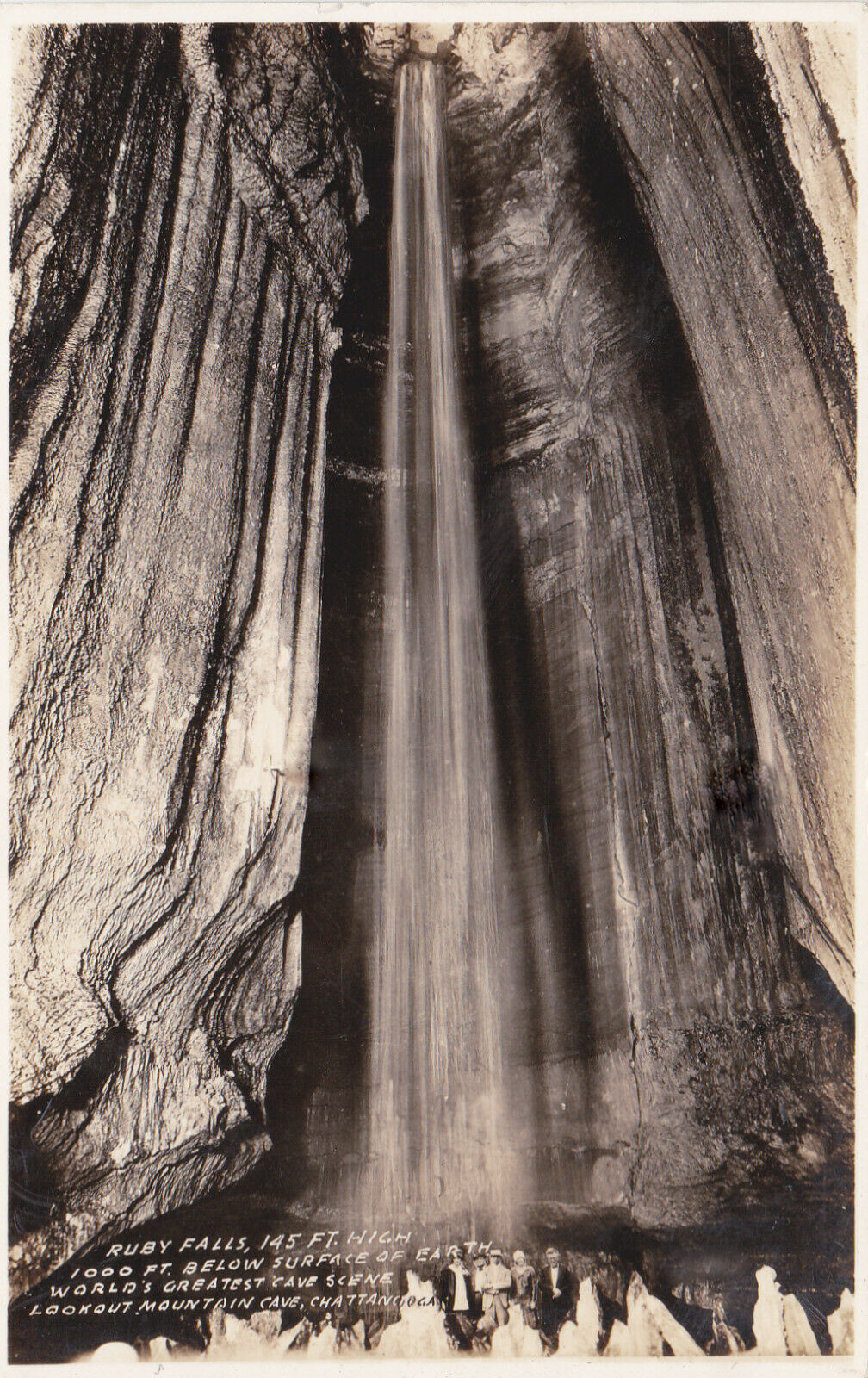
His visit to Lookout Mountain, also while in Tennessee, had however been via a nippy electrified mountain rail-car…

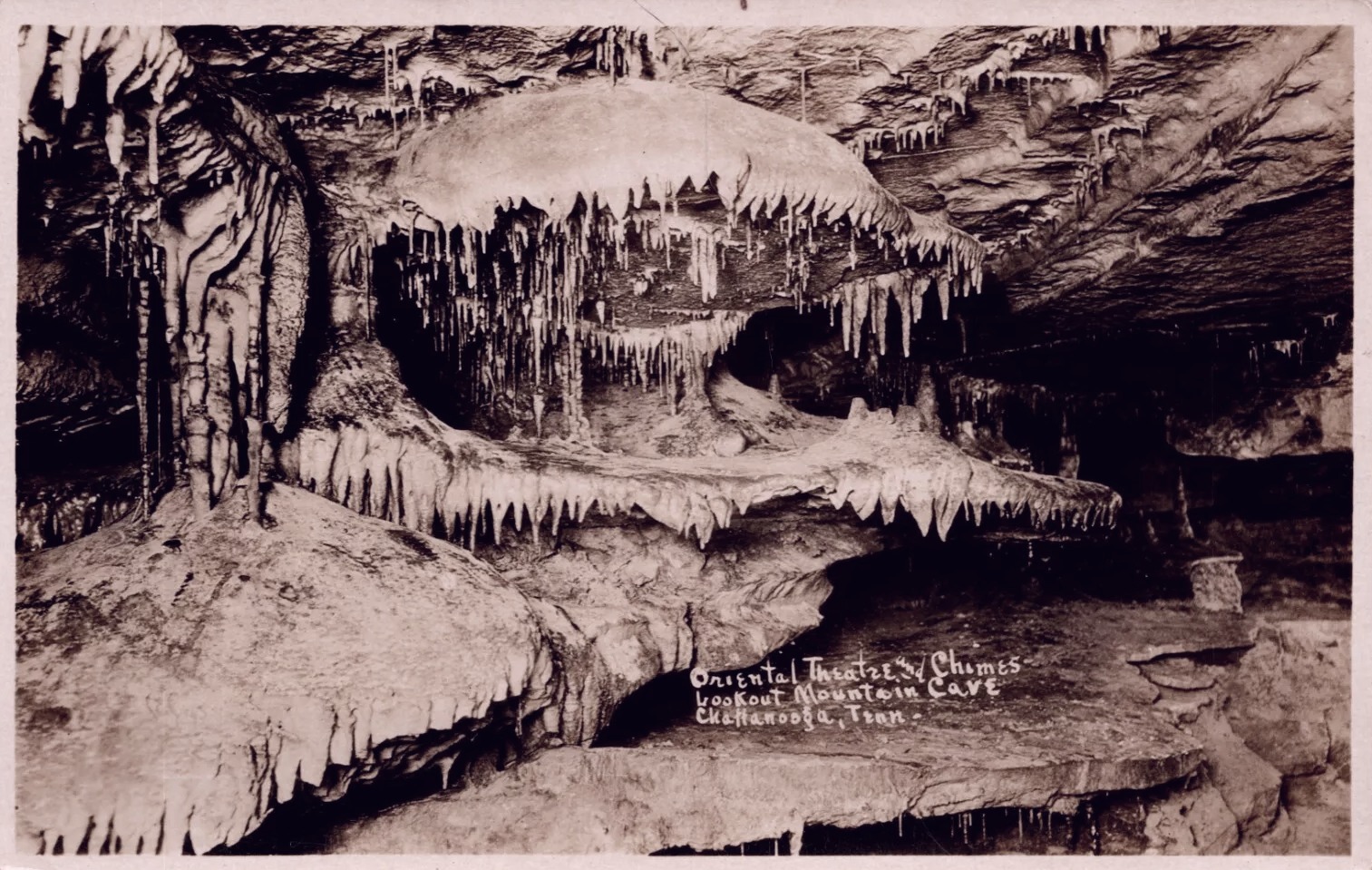
This precipitous car hauled him aloft Lookout Mountain and then he descended via a deep elevator shaft to explore another large and spectacular cave system. His first such descent having been in summer 1928 at the Endless Caverns.

I went up Lookout Mountain and revelled in the view and afterward descended into the spectral caverns inside the mountain — where in a vast vaulted chamber a 145-foot waterfall thunders endlessly in eternal night. This chamber and waterfall were discovered only ten years ago — at the end of sealed galleries whose geological formations prove them never to have been entered by mankind before.

I went all over Lookout Mountain [Tennessee], & explored the magnificent network of limestone caverns inside it — culminating in the vast & new-discovered [1923] chamber called “Solomon’s Temple” where a 145-foot waterfall bursts forth from the side — near the roof — & dashes down to a pool whose outlet no man knows.

Lovecraft postcard for sale

08 Sunday Nov 2020

Posted by asdjfdlkf in Historical context, Picture postals

≈ 1 Comment

For sale, a Lovecraft postcard, a pictorial addendum to a letter, in which he mentions his river journey down the river at Silver Springs. It sounds like it was sent to Clark Ashton Smith.

“Later – June 9 [1934]. Young Ar E’ch-Bei has held this epistle up several days, wishing to [solicit?] one enclosure. Meanwhile the envelope of your drawings has come, and he is in ecstasies over them. He keeps them always within reach and takes them out to gaze at every few minutes — and has made copies of many of them as best he can. I hope you can fix him up regarding the mythological matters. He wants all the available data on Tsathoggua — have you still the bits from ‘The Mound’ that I sent you when casting up that tale in 1930?

I went yesterday to Silver Springs, where the bottom of a lake is riddled with picturesque views seen from a glass-bottomed boat. Also sailed 10 miles down a tropical river which looked very much like the Amazon or Congo. The scenes for the cinema of ‘Tarzan’ were made here. I must send you a folder of the place — one of the most distinctive and fascinating spots I have ever seen. Evr Yrs for the Eternal Infra-red Flame.”


My June 2020 Picture Postals: On Silver River considered the same trip, with pictures.

Friday ‘picture postals’ from Lovecraft: the Newport boat

06 Friday Nov 2020

Posted by asdjfdlkf in Historical context, Picture postals

≈ 2 Comments

This week, another look at an aspect of the Providence dockside. H.P. Lovecraft wrote…

All my spare cash goes into trips to ancient towns like Newport” … In Rhode Island there is only one city really American, and that is Newport”.

How did he get there? He travelled by sea, and this was his departure point…

The “Newport boat” landing and departure point, Providence.

This picture shows a setting briefly evoked in one of the world’s most famous horror stories…

“Locally, interest was intensified by the obscurity of the cause of death. The professor had been stricken whilst returning from the Newport boat [while he was walking up] a short cut from the waterfront…” (“The Call of Cthulhu”)

Lovecraft himself often “took a boat trip to Newport” from Providence, at the very time he was writing “Cthulhu”. The voyage would have been a day-trip, and thus he would have been at the Providence dockside early. For instance he was writing a letter before dawn in August 1926, and in it he wrote…

Well — it’ll be dawn soon, so that I can tell whether or not I’m going to Newport.

As the Great Depression deepened, he was sometimes able to afford more Newport trips each summer. At one point, what was usually 50 cents in high season became just 15 cents. In August 1932 he remarked on the voyage itself and its duration…

For the past three days I have been taking advantage of the incredibly low steamboat rates (15 cents round trip), and making diurnal [daily] voyages to ancient Newport. It is an admirable relaxation — a two-hour sail past green shores…

Though he regretted that he could not write his letters on the steamship, because…

the vibration will play the devil with my penmanship.

The throbbing steamship that Lovecraft endured was the Sagamore, a “remodelled” Bristol liner that now sometimes served as a local freight and cattle-boat, rather than the more salubrious liner which also plied the same route.

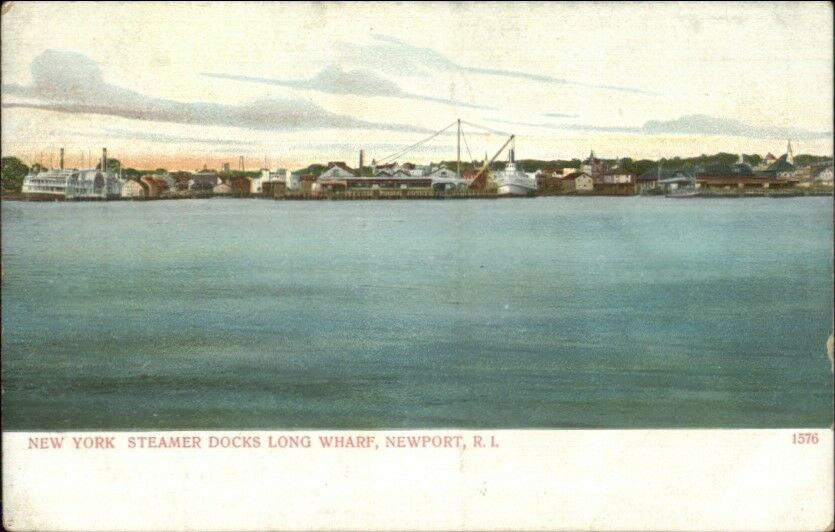
This would be the dawn sight of the Newport dockside, as Lovecraft approached from the sea…

And here is the same dockside seen in the distance, beyond some rather more picturesque fishing jetties…

After bringing in the Providence crowd, the steamship would then cast off for Block Island, returning later to pick up at Newport and return to Providence.

Once ashore in Newport, Lovecraft “wander’d through the living past” of the old town or “hiked into the Bishop Berkeley [British philosopher] country … some four miles beyond Newport beach on the road to Middletown”, through green fields of “sportive lambkins”. Often he sat writing for hours on “the great oceanward cliffs”, and once surveyed “the assembled U.S. Navy” in the bay — the place being also “quite a military town”.

Sometimes he ventured down into the holds of an ancient and venerable sailing ship that had been docked for the benefit of the Navy cadets.

Also, he haunted the oldest graveyards in his… “vain search in Newport for the grave of Michael, the elder James’s father [in his family-tree], who died in 1686”.

A lane in Newport, and Trinity church.

Lovecraft managed to see the town before the circa Fall/Winter 1927 “civic improvements” were made, which in a letter he called “detestable” because they would imperil…

the quaint narrowness of the main street, and the incomparable colour & atmosphere of the ancient wharves

He would also have known the Old Stone Tower, which appears to have had a small park around it where he might have sat and read.

Lovecraft and Havelock Ellis

05 Thursday Nov 2020

Posted by asdjfdlkf in Historical context, Podcasts etc., Scholarly works

≈ Leave a comment

New on Librivox is a free audiobook reading of the book A Study of British Genius (1904) by the pioneering sexologist Havelock Ellis. This led me to undertake a short survey of what’s known about Lovecraft and Ellis.

First, the book on British genius had originally been published in serial form in 1901 in Popular Science Monthly. It was the sort of serial item that (we might assume) would have caught the attention of the ardently pro-British 11 year-old Lovecraft, perhaps on the newsstands or in the periodicals room of the Providence Public Library. If he actually read it or not at that age is another matter. Though we know that Lovecraft’s uncle had published hypnosis articles in Popular Science Monthly, albeit back in 1876, so Lovecraft could have thought well of the title.

How did A Study of British Genius come to be written? Well, the comprehensive DNB had then recently been issued and thus provided the authoritative data for Ellis’s book…

UNTIL now it has not been possible to obtain any comprehensive view of the men and women who have chiefly built up English civilization. It has not, therefore, been possible to study their personal characteristics as a group. The sixty-three volumes of the ‘Dictionary of National Biography’ of which the last has been lately issued, have for the first time enabled us to construct an authoritative and well balanced scheme of the persons of illustrious genius …

Its appearance was thus a general part of the ‘tightening up’ of general knowledge, and also the affordable public dissemination of such. It forms part of the background of Lovecraft’s early intellectual development circa 1902-1922, in which thinkers sought to “correlate the contents” of the world.

But perhaps he overlooked the book. Such things were, after all, rather taken for granted and uncontroversial before 1914, as the British Empire bestrode the world. More difficult to imagine is that Lovecraft also overlooked Ellis’s substantial book on dreams and dream-worlds, The World of Dreams (1911, reprinted 1926). However, Lovecraft appears not to reference the title in any book I have access too, either pre-war or in the 1926/27 period when it was re-issued and (while writing Dream-quest) he might have been most receptive to it.

Ellis, like most of the early birth-control advocates and sundry leftists and social reformers of the period, was also a strong supporter of eugenic breeding for health. His introduction to the book on British genius positions it as a furtherance of the investigation of the topic undertaken by Sir Francis Galton, for instance. Though this aspect of his work also goes unmentioned by Lovecraft.

Therefore, so far as I know, by the 1920s Lovecraft evidently thought of Ellis only as a pioneering sexologist rather than an ethnographer of British genius and as a fellow explorer of the dreamlands. For instance, in a corrective to Woodburn Harris’s belief in a general female “coldness” on sexual matters, Lovecraft pointed the Harris toward Havelock Ellis and others…

read Havelock Ellis or Bertrand Russell or Lindsey or Fore! or Robie or somebody who knows something about the question! … For Pete’s sake get an intelligible slice of data by seeing what competent specialist physicians, sociologists, anthropologists, historians, psychologists, biologists, etc. have to say from their wide, deep, careful, & accurate observations! That tendency to go only by what you can smell & touch in your own farmyard will be the philosophic ruin of you if you don’t shake it off pretty soon — take off the blinders, boy, & see what the world is thinking & discovering — read, read. (Selected Letters III)

Joshi’s I Am Providence observes that, later in the same mammoth letter, Lovecraft referenced Havelock Ellis’s book “Little Essays in Love and Virtue” (1922, actual title Little Essays of Love and Virtue). Lovecraft could also have imbibed the gist of Ellis’s sexological findings in long conversations with Morton, who had been an ardent public polemicist for such causes — though rather surprisingly the name of Ellis is not to be found in the published Morton letters. Perhaps it was a settled question between them. Lovecraft would of course also have found book reviews and discussion of Ellis’s work in newspapers and magazines.

To Moe in January 1930 he talks of the wider impacts of “Havelock Ellis, Forel, Kraft-Ebing, Freud, etc.” in terms of having helped to brush away cobwebbed Victorian prudery, opening the doors to a less censorious portrayal of ‘modern’ life in literature. (Selected Letters III, also the Moe letters although there “Ellis” is un-indexed).

But that was the 1920s. By the mid 1930s he was rather more interested in debating political-economic matters. Lovecraft continued to mention Ellis as an authority on sex matters, but in May 1935 he told Barlow that he would “be the last to choose” a discussion of Ellis and sexology as a topic of conversation. By then he was more interested in keeping his young proteges away from hard communism, than in nudging them toward the soft cheeks of lovers.

Possibly he also knew from experience that, by the mid 1930s, he would encounter only a mish-mash of formulaic “parrot” talk on the subject. For instance, in 1933 Lovecraft wrote to R.E. Howard…

I always find your arguments full of meat and rich in starting-points for various trains of significant thought — a thing I could never say of the glib, ready-made harangues of those who merely echo Croce or Santayana or Briffault or Marx or Russell or Ellis or some other authority. … These fashion-followers forget that the authorities whom they parrot did not derive their original opinions in this easy [second or third-hand] way. An opinion which is serious with its first-hand creator ceases to be serious when it is mimicked without sufficient basis in experience.

Donald Wandrei by Clement B. Haupers

04 Wednesday Nov 2020

Posted by asdjfdlkf in Historical context, Lovecraftian arts

≈ Leave a comment

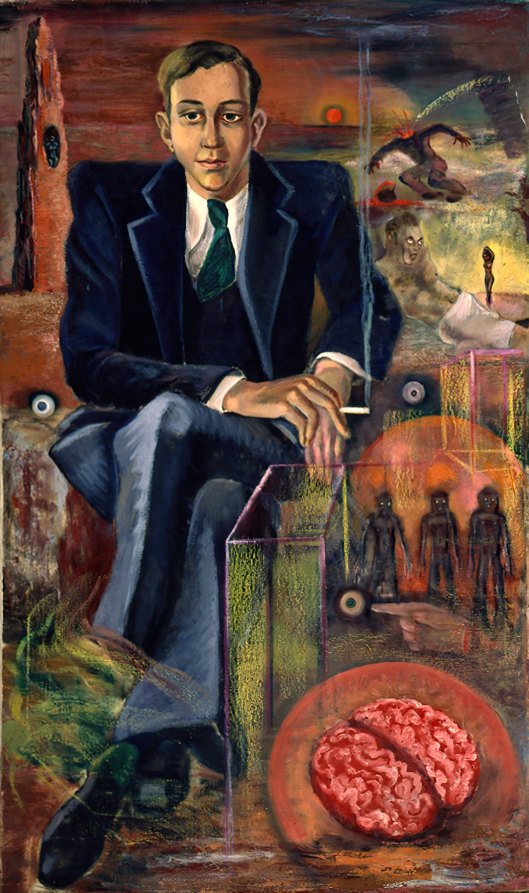
“Author with Dreams”, a circa 1936-46 painting of Donald Wandrei (and his personal dream-world) by Clement B. Haupers.

City of the Singing Flame

02 Monday Nov 2020

Posted by asdjfdlkf in Historical context, Podcasts etc.

≈ 1 Comment

Last week the Catholic traditionalist OnePeterFive considered Lovecraft’s worldview for Halloween, and Christian traditionalist blog The Orthosphere offered a long appreciation of Clark Ashton Smith’s “City of the Singing Flame” & Synchronicity. The latter post piqued my interest in an audiobook, as it soon becomes evident that the long essay has far many plot-spoilers and that it should be read after the work itself.

Is there a free audiobook version of quality? Yes. On Archive.org is “The City of the Singing Flame, read by the Late Great Harlan Ellison”, being a 90 minute audiobook via the venerable Cthulhuwho1. Recorded by him from the radio to mid-1980s tape, so you may want to use your audio-player’s graphic equaliser to fix sibilance and hiss and suchlike. I read elsewhere that Harlan Ellison consented to read it on air because it was a formative work for him as a youth. Ellison repeats a short section in the middle, with a better reading the second time around.

S.T. Joshi has called it “intoxicatingly exotic” in I Am Providence. This makes it sound quite interesting, to someone who’s so far found it impossible to get into what is supposed to be the best of Smith (vague memories of interminably dialogue-heavy wizards wandering around in a desert, given up on after XX pages, etc). What did Lovecraft think of it? I can only find a few instances of his mentioning “City of Singing Flame”. He was enthusiastic, but not gushing in his brief remark…

“The City of The Singing Flame” is certainly a memorable thing, & I was glad to learn that Wandrei shares my opinion. (Selected Letters III)

To Barlow he was equally terse in passing… “great story”, “worthy sequel”. To Bloch and Wandrei he mentions it not at all, judging by the indexes in the volumes of letters.

“City of Singing Flame” (the original title) and its sequel “Beyond the Singing Flame” (originally “The Secret of the Flame” on the typescript, now at Brown) ran in the pulp Wonder Stories in 1931. The stories were later reprinted in Famous Science Fiction, Winter 1966/67 and the follow-on Summer 1967 issue. Later both were collected in a single U.S. paperback, with generic ‘butterfly-dragon’ fantasy cover-art which was appears to have been hoping to appeal to the legions of female fans then avidly reading Anne McCaffrey’s best-selling Dragonrider series.

Turns out that Harlan Ellison also reads the sequel in his reading and both, shorn of the repeating middle section, run about 80 minutes in total. But if you want a variant reading there’s also a 2018 one-hour reading of the sequel on YouTube by Nemesis the warlock.

Update: I’ve now heard it. At times it’s very much like an audio-version of one of Moebius’s less convoluted graphic novels.

‘Picture postals’ from Lovecraft: the Handicraft Club

30 Friday Oct 2020

Posted by asdjfdlkf in Historical context, Picture postals

≈ 1 Comment

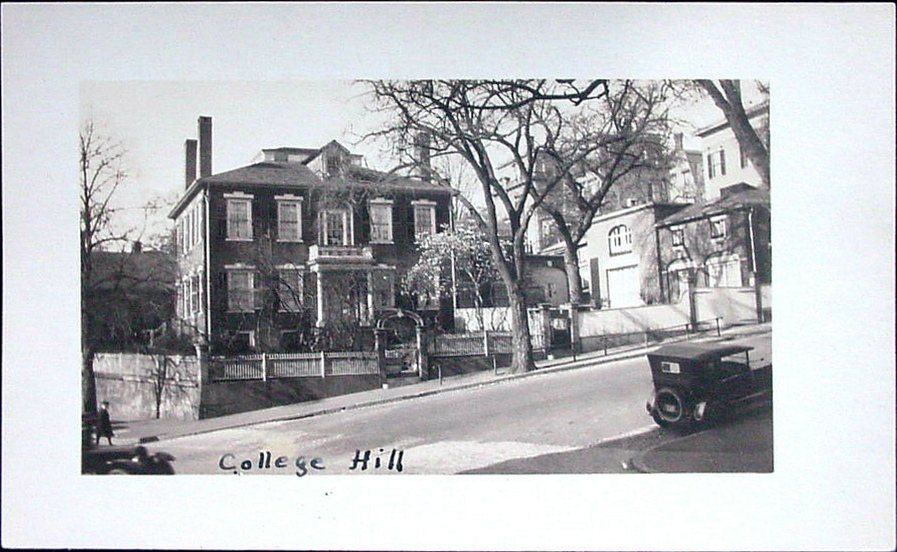
This week, yet another aspect of College Street as Lovecraft and his aunts would have known it. At the corner of Benefit and College Streets stood the headquarters of the Handicraft Club.

The artistically grown trees were apparently magnolias, and these later grew up substantially and when in leaf they obscure several later photographs of the frontage.

The Club was established there in 1905, and a rigorous approach soon attracted a healthy membership of skilled crafts workers. The place was extensive and there was a showroom and an annual exhibition of new crafts work.

It was here that one of Lovecraft’s aunts lived in 1927…

… half-way up [College Street] my aunt boarded in 1927 at the Handicraft Club in the old Truman Beckwith house. You doubtless recall that brick edifice and its old-fashion’d terraced garden.” (letter to Morton, Selected Letters IV)

S.T. Joshi writes of this period in I Am Providence…

We do not know much of what Lovecraft was doing during the first few months of his return to Providence [from New York City]. In April, May, and June [1927] he reported seeing several parts of the city he had never seen before, at least once in the company of Annie Gamwell, who at this time was residing at the Truman Beckwith house at College and Benefit Streets.

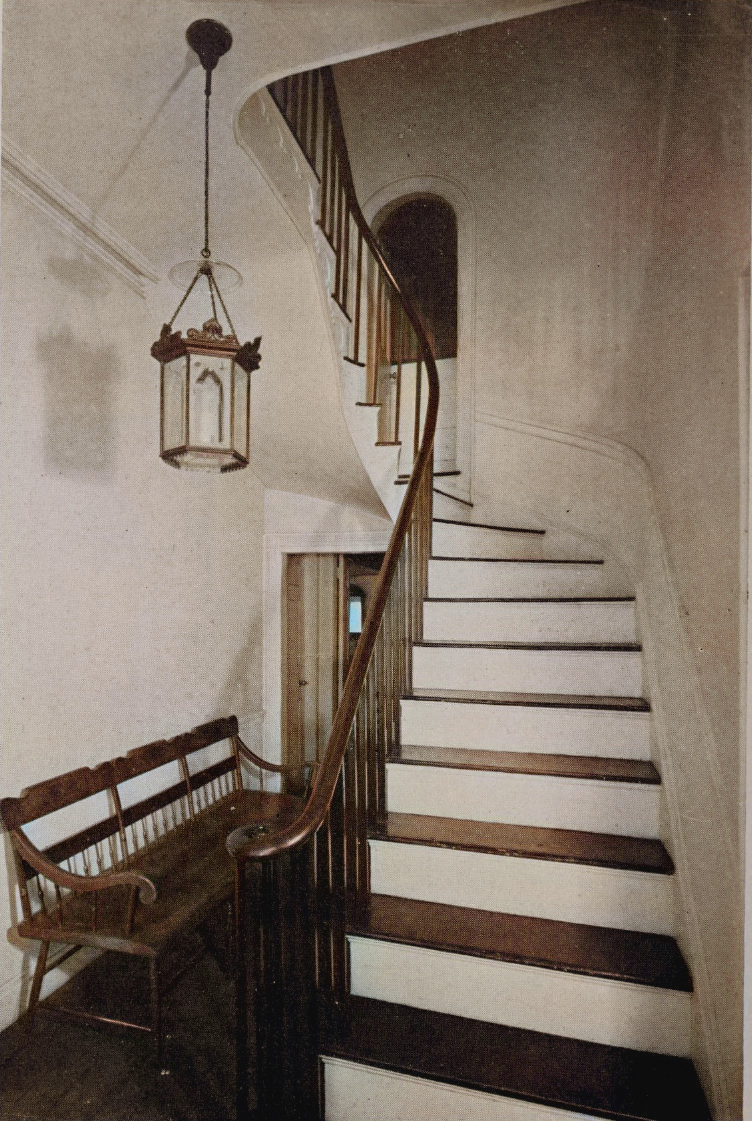
We do however know just a little of why his aunt might have been there. In 1925 the House had been purchased to serve as a “permanent home” (Handicrafts Of New England, page 321) as well as a clubhouse, and we can probably assume this was why Annie Gamwell could live there — if only for perhaps a single summer season of board and lodging. It seems plausible to assume that Lovecraft took the opportunity of his aunt’s residency to thoroughly appreciate the fine architecture. The Library of Congress has a detailed plan-book of the entire house, evoking all the details of the craftsmanship that Lovecraft would have thus admired. Though a photograph perhaps better evokes the interior that his aunt would have enjoyed at that time…


Atheist though he was, a few years later the mellowing Lovecraft was able to amiably enjoy an old traditional custom. Christmas 1933 found him listening to carols sung in the Handicraft Club courtyard…

Fixed up the sitting-room hearth with greens and surprised my aunt — and borrowed a cat for the occasion. Heard carol-singing in the early evening in the quaint cobblestoned courtyard of the Georgian Beckwith mansion (where my aunt was in 1927) halfway down the antient hill.” (letter to Morton, Selected Letters IV)

a turkey dinner at the boarding-house across the back garden & a stroll half-way down the hill to hear the carol-singing at the old Truman Beckwith mansion. I took the midnight coach & arrived in Manhattan the next morning —” (letter to Toldridge, Selected Letters IV)

Providence Art Club Costume Party themes, 1913-26

28 Wednesday Oct 2020

Posted by asdjfdlkf in Historical context

≈ Leave a comment

The themes of the annual Providence Art Club Costume Party, 1913-26. A curious thing, but his aunts were in that circle and it’s not impossible that Lovecraft might have occasionally provided a few lines of verse on the year’s chosen theme. However, the 1919 date of the science-fictional “A.D. 2000” party doesn’t match with Lovecraft’s very early poem of 1912, which had imagined “Providence in 2000 A.D.”

← Older posts
Newer posts →


Please become my patron at www.patreon.com/davehaden to help this blog survive and thrive.

Or donate via PayPal — any amount is welcome! Donations total at Easter 2025, since 2015: $390.

Archives

  • March 2026
  • February 2026
  • January 2026
  • December 2025
  • November 2025
  • October 2025
  • September 2025
  • August 2025
  • July 2025
  • June 2025
  • May 2025
  • April 2025
  • March 2025
  • February 2025
  • January 2025
  • December 2024
  • November 2024
  • October 2024
  • September 2024
  • August 2024
  • July 2024
  • June 2024
  • May 2024
  • April 2024
  • March 2024
  • February 2024
  • January 2024
  • December 2023
  • November 2023
  • October 2023
  • September 2023
  • August 2023
  • July 2023
  • June 2023
  • May 2023
  • April 2023
  • March 2023
  • February 2023
  • January 2023
  • December 2022
  • November 2022
  • October 2022
  • September 2022
  • August 2022
  • July 2022
  • June 2022
  • May 2022
  • April 2022
  • March 2022
  • February 2022
  • January 2022
  • December 2021
  • November 2021
  • October 2021
  • September 2021
  • August 2021
  • July 2021
  • June 2021
  • May 2021
  • April 2021
  • March 2021
  • February 2021
  • January 2021
  • December 2020
  • November 2020
  • October 2020
  • September 2020
  • August 2020
  • July 2020
  • June 2020
  • May 2020
  • April 2020
  • March 2020
  • February 2020
  • January 2020
  • December 2019
  • November 2019
  • October 2019
  • September 2019
  • August 2019
  • July 2019
  • June 2019
  • May 2019
  • April 2019
  • March 2019
  • February 2019
  • January 2019
  • December 2018
  • November 2018
  • October 2018
  • September 2018
  • August 2018
  • August 2015
  • July 2015
  • April 2015
  • March 2015
  • February 2015
  • January 2015
  • December 2014
  • November 2014
  • October 2014
  • September 2014
  • August 2014
  • July 2014
  • June 2014
  • May 2014
  • March 2014
  • February 2014
  • January 2014
  • December 2013
  • November 2013
  • October 2013
  • September 2013
  • August 2013
  • July 2013
  • June 2013
  • May 2013
  • April 2013
  • March 2013
  • February 2013
  • January 2013
  • December 2012
  • November 2012
  • October 2012
  • September 2012
  • August 2012
  • July 2012
  • June 2012
  • May 2012
  • April 2012
  • March 2012
  • February 2012
  • January 2012
  • December 2011
  • November 2011
  • October 2011
  • September 2011
  • August 2011
  • July 2011
  • June 2011
  • May 2011
  • April 2011
  • March 2011
  • February 2011
  • January 2011
  • December 2010
  • November 2010
  • October 2010
  • September 2010
  • August 2010
  • July 2010

Categories

  • 3D (14)
  • AI (70)
  • Astronomy (70)
  • Censorship (14)
  • de Camp (7)
  • Doyle (7)
  • Films & trailers (101)
  • Fonts (9)
  • Guest posts (2)
  • Historical context (1,096)
  • Housekeeping (91)
  • HPLinks (77)
  • Kipling (11)
  • Kittee Tuesday (92)
  • Lovecraft as character (58)
  • Lovecraftian arts (1,628)
  • Lovecraftian places (19)
  • Maps (70)
  • NecronomiCon 2013 (40)
  • NecronomiCon 2015 (22)
  • New books (966)
  • New discoveries (165)
  • Night in Providence (17)
  • Odd scratchings (984)
  • Picture postals (276)
  • Podcasts etc. (431)
  • REH (184)
  • Scholarly works (1,470)
  • Summer School (31)
  • Unnamable (87)

Get this blog in your newsreader:
 
RSS Feed — Posts
RSS Feed — Comments

H.P. Lovecraft's Poster Collection - 17 retro travel posters for $18. Print ready, and available to buy — the proceeds help to support the work of Tentaclii.

Proudly powered by WordPress Theme: Chateau by Ignacio Ricci.