• About
  • Directory
  • Free stuff
  • Lovecraft for beginners
  • My Books
  • Open Lovecraft
  • Reviews
  • Travel Posters
  • SALTES

Tentaclii

~ News & scholarship on H.P. Lovecraft

Tentaclii

Category Archives: Historical context

Inside the Weird Tales building, Chicago

15 Monday Mar 2021

Posted by asdjfdlkf in Historical context, New discoveries

≈ 1 Comment

A peek at the environment in which the Weird Tales offices existed, when at the Dunham Building, Chicago, during the prime ‘Lovecraft years’. Entrance in 1926, from Archive.org. Other pictures via Chicago History Museum Images, from which large b&w prints can be had.

It was probably not as brown as this rescued-from-microfilm and colorised picture. The entrance when new was described as having a quirky “colorful stone exterior” (1930 Architectural Annual, Chicago). Another journal suggests the building facade and entrance were elegantly lit at night. In daylight the exterior above the entrance was an ungainly hodge-podge of layers and decoration, but I guess it might have worked better when seen at night and from the ground.

Elevator entrances and corridor, and boards listing current office occupants for each floor.

One of the private offices.

The architects were Burnham Brothers and the building was that of a successful heating and refrigeration company. One thus assumes the heating and cooling was always perfect. The pictures suggest the interior would have felt like modernity de-luxe, efficient and clean but hand-crafted and with a nice touch of eccentricity hiding the advanced technologies. Lovecraft would likely have felt somewhat at ease there, had he accepted the editorship of Weird Tales and moved to Chicago. More so, too, due to the super-efficient heating during the tough Chicago winters. However, they were only there for about three years and then moved to a modernist building he might have found less congenial.

The building’s ownership may relate to editor Farnsworth Wright’s curious rejection of “Cool Air”. Wright may have been worried that the building’s owners might have thought the story was meant to be poking fun at them.

In the 1950s it appears to have been home to another popular magazine, Science and Mechanics. The building was later renamed “450 E. Ohio Street”, and demolished in 2007.

Old-time New England, 1910-25

14 Sunday Mar 2021

Posted by asdjfdlkf in Historical context, Scholarly works

≈ 1 Comment

Old-time New England, the journal of the Society for the Preservation of New England Antiquities. Hathi has scans of 1910-25 in public flipbook form with varying quality. Archive.org, has four from Lovecraft’s time, a couple being after 1925 and one of which has the article “Symbolic Cemetery Gates of New England”…

Surely Lovecraft must have eagerly perused each quarterly copy at the public library. Though, surprisingly, he was not a member of the Society and never contributed an article to their journal. Despite it being the natural outlet for local and regional antiquarian writing. I wonder why?

New addition, Tentacles over Brooklyn

12 Friday Mar 2021

Posted by asdjfdlkf in Historical context, New discoveries

≈ Leave a comment

A new addition to today’s ‘Picture Postals’. I’ve managed to catch a glimpse of the elusive giant squid, and also a picture of the first Invertebrate Hall as it existed until c. 1927. By 1928 it had been moved into another Hall.

The first Invertebrate Hall at the Brooklyn Museum, later moved wholesale to another hall c. 1927 and opened again by 1928.

This is as Lovecraft would have known it until c. 1927. Both the Giant Octopus and Giant Squid are seen, though it’s still not a good view of the squid.

‘Picture Postals’ from Lovecraft: Tentacles over Brooklyn

12 Friday Mar 2021

Posted by asdjfdlkf in Historical context, Lovecraftian arts, New discoveries, Picture postals

≈ 2 Comments

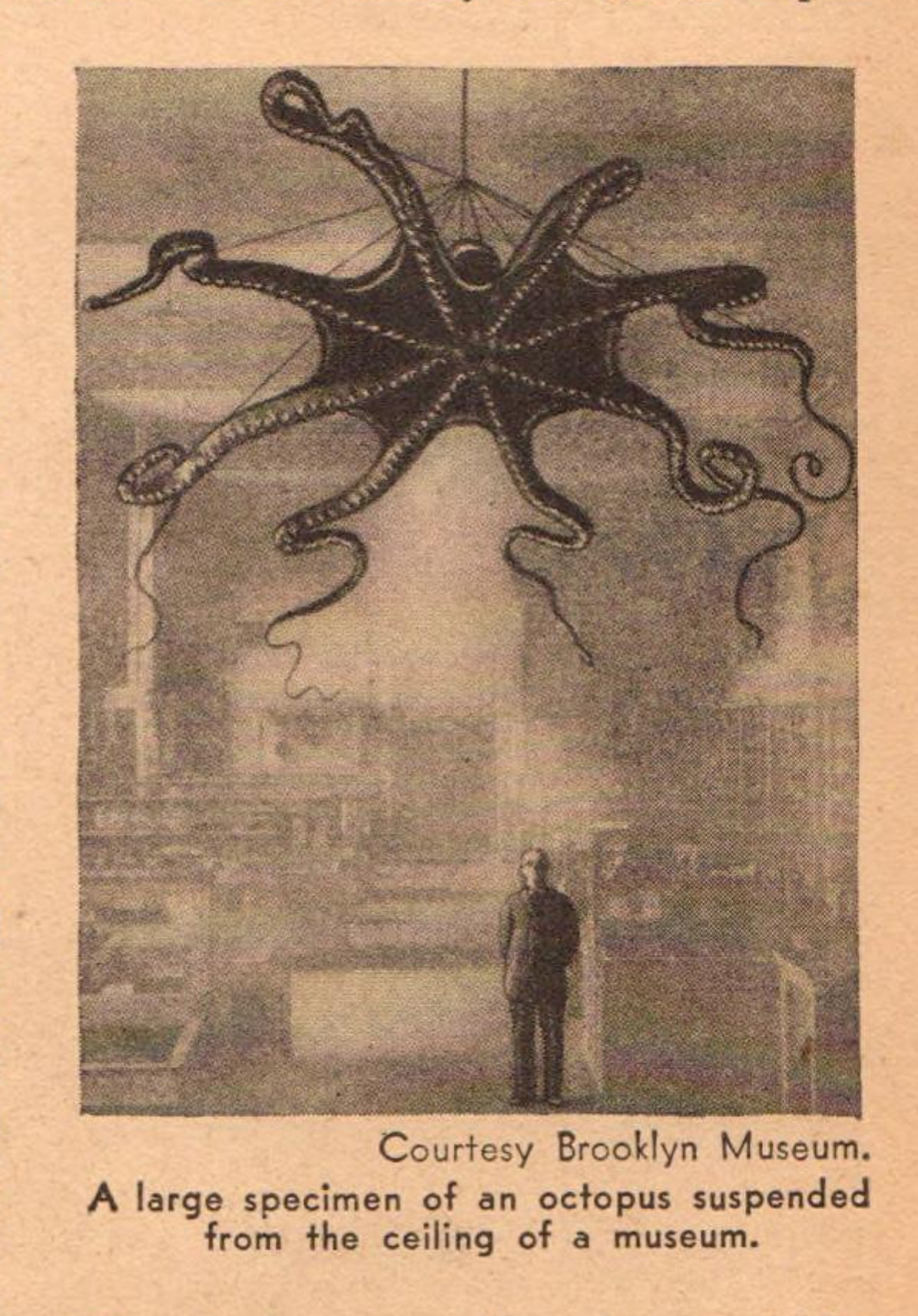
Tentacles in the Brooklyn Museum, 1931. Found while flipping through Science and Invention magazine for March 1931, newly on Archive.org. An initial search suggested there was also a giant squid, as the modern book Brooklyn Museum of Art: Building for the Future talks of their having once been natural history galleries and a specific section for… “Invertebrates housing not only display cases of specimens but also large models of a squid and an octopus suspended overhead”.

The first hall, moved wholesale to another hall and re-opened by 1928. This is as Lovecraft would have known it until c. 1927.

The first question was, did H.P. Lovecraft know the Museum from 1922 onward? Yes, of course he did. He saw it as a tourist first, and then ‘did it’ systematically and thoroughly later in 1922. Its galleries and the adjacent Japanese Gardens became a regular haunt when he was in New York. Another question was, was it always the “Brooklyn Museum” or did it have another or formal name? Indeed it did, being also known as the Brooklyn Institute. Pictures? Yes, here is a rare eye-level card showing it about a decade earlier. Most of the other cards are later, gaudily coloured and vigorously airbrushed.

Were there other attractions there? Well, a big attraction was the cost. Entry was free on most days, and the place was also open in the evening on Thursdays. By circa 1930 he probably knew the place well, but he was also well aware of the new items being accessioned. He did the Museum solo in May 1930, seeing the new ‘Colonial furniture and interiors’ wing which newly offered complete rooms arranged for Lovecraft’s lingering delight. In 1933 he “…did the Brooklyn Museum with Sonny” — Lovecraft letter to Morton, 12th January 1933, when they focussed on the “Dutch” section. I would suspect that this may also have been new.

But what of the tentacles, and the “Cthulhu” period? Regrettably there appears to be a lack of vintage postcards from the Museum, showing the interior, still less the Invertebrates section. Still there is one negative of a record-picture of the Hall of Invertebrates in 1928. Below I have newly enlarged and colorised it. The picture makes the room appear smaller than it was. The cabinets are man-high, not at child-level as they might be today.

1928, after removal from the second floor, east wing, to the first floor, west wing.

The hanging giant octopus was there before “Call of Cthulhu” was written, as confirmed by the book Guide to the Nature Treasures of New York City (1917). Also the giant squid…

Models of the octopus and squid occupy the last wall case at this end of the hall and should be compared with the giant octopus and squid suspended from the center ceiling and the marine painting above.

Thus it would be plausible to suggest that this (and the squid) could have played into Lovecraft’s conception of Cthulhu… “The cephalopod head was bent forward, so that the ends of the facial feelers brushed the backs…”.

1920 saw the addition of a ‘Pacific case’, a fine diorama with glass models. Possibly these were in the closed wooden cases seen at the back of the 1928 photo above. As such the picture below exemplifies the sort of detailed and accurate ‘undersea’ scene available in this Hall.

Here is the full description of what Lovecraft would have seen there circa 1922. This also notes the microscope views and many glass re-creations…

“… invertebrates and plants in the eastern galleries [on the “second floor” until 1927, the on the “first floor, west wing” after that]… the Hall of Invertebrates of the Brooklyn Museum (Room 7 on plan) is next entered, where the sponges and corals, worms, mollusks, crustaceans and other types of animals lacking a backbone (invertebrates) are exhibited.

Among this invertebrates are the sponges and corals, from all parts of the world, are systematically arranged in wall cases on the west, north and south sides of the hall, and in various floor cases special groupings have been made of sponges and corals of particular beauty or interest or of unusual size.

Other invertebrates are specimens of the Protozoa, or one-celled animals, the simplest forms of animal life, are shown in the first floor case on the left (north) side of the hall, by the aid of micro-scopes, and also by enlarged glass models. The sponges are the simplest forms of animals whose bodies consist of more than one cell, for the cells, although arranged in two layers, act each independently. Varieties of lime sponges, glass or silicious sponges and horny sponges are shown, as well as fresh-water, deep-sea and boring sponges, and sponge spicules under the microscope.

Models of coral, showing the anatomy of the polyps and their relation to one another, are seen in the second floor case on the left, which contains also models of the freshwater polyp hydra and other related forms. In the adjacent wall cases, specimens of mushroom, staghorn and brain coral and other forms are shown. A very large specimen of brain coral from the Bahamas and a specimen of staghorn coral, one of the largest pieces of branching coral ever collected, are exhibited in floor cases in the center of the hall.

Among the mural paintings in this hall of the Brooklyn Museum, representing some of the more striking invertebrates as they appear in life, is one depicting a coral reef in a tropical sea, and on the south wall in the center of the hall a large window group shows a coral reef close at hand and the animals that frequent it. Other mural paintings show an octopus at home, the formation of a mangrove swamp and other typical shore scenes of the Atlantic coast. Proceeding down the left side of the hall, the starfish and sea urchin families occupy the next case, and the development and anatomy of starfishes and sea urchins are illustrated by drawings, dissections, models and specimens of various ages. Abnormal specimens and specimens showing regeneration of rays in a starfish also are shown. The various types of sea urchins occupy the eastern side of the case. The worms in the next cases include the serpulid worm of the sea, the horsehair worm and a model enlarged and dissected; the branchiopods, related to both worms and mollusks, are shown here.

Crustaceans, in the next case of invertebrates, are represented by some one hundred species, including the crayfish with an enlarged model of dissection to show the anatomy, and a section of mud from a river bank showing a crayfish group at home, together with crabs, lobsters, shrimps, barnacles, horseshoe crabs and others. In the wall case at this point, the giant spider crab and the locust lobster of Japan, the largest species of living crustaceans, are shown.

The systematic series of shells, which includes characteristic examples of the principal divisions of mollusks and gives a general impression and synopsis of this group of animals at the Brooklyn Museum, is arranged in two floor cases on the right (southern) side of the hall at this (western) end. The largest specimens are in the upper part of the case, and the extensive study collections are arranged systematically in drawers below. Fine specimens of the nautilus and argonaut, representing the higher mollusks, may be seen, also the paper nautilus of Japan; a particularly interesting specimen is the naked mollusk from Naples, which appears to have no shell because the shell is internal.

An exhibit of land snails and of shells from Lake Tanganyika occupies a position in the systematic series of shells and shows specimens of the eggs of marine mollusks. The ship-boring bivalve teredo and its work in destroying ship bottoms are exhibited in the case next on the east; sections of wood show the damage done and method of work, and photographs show the anatomy of the animal. Other boring mollusks are exhibited here also, and in the upper part of the case are habitat groups of the edible snails of southern Europe. An exhibit of pearl shells from the pearl fisheries …

The marine animals of the coast of Long Island and New England, from high tide to a depth of 7,200 feet, form an interesting exhibit in the last floor case on this side. Among the specimens may be mentioned the oyster drill, showing the drilled shells, egg cocoons and stages of growth of the animal, and mounted specimens of the pipefish, sand flea and other shore creatures. Models of the octopus and squid occupy the last wall case at this end of the hall and should be compared with the giant octopus and squid suspended from the center ceiling and the marine painting above.

Passing into the Insect Hall (Room 8 on plan) …”

Ah, the Insect Hall. What monstrous wonders might he have seen through microscopes in there…?

The young Robert Bloch

11 Thursday Mar 2021

Posted by asdjfdlkf in Historical context, Lovecraftian arts

≈ Leave a comment

The young Robert Bloch at the typewriter keyboard, circa his Lovecraft correspondence period.

New book: The Emotional Life of the Great Depression

06 Saturday Mar 2021

Posted by asdjfdlkf in Historical context, Scholarly works

≈ Leave a comment

Possibly of interest to some, re: learning more about the historical context for Lovecraft and the Great Depression. A new book by John Marsh, The Emotional Life of the Great Depression, from Oxford University Press. Rejecting the usual approach of a ghoulish focus on ‘the despair of the 1930s’, the book…

explores the 1930s through other, equally essential emotions: righteousness, panic, fear, awe, love, and hope.

The author appears to delight in Walt Whitman, also being the author of In Walt We Trust: How a Queer Socialist Poet Can Save America from Itself.

Sadly I can’t find a single public review of The Emotional Life of the Great Depression, even on Amazon. I even looked on Good Reads, a site I usually disregard.

News of the book leads me to recall my elderly history teacher once impressing on his class, way back, that the 1930s in the UK were actually a time when many had a good time, got ahead, worked hard, were relieved from drudgery by labour-saving inventions, saw amazing cinema and read lively magazines, enjoyed better health and healthcare, revelled in public libraries, moved to beautiful new and affordable suburbs, were broadly optimistic about the future (they didn’t know a World War was coming) and generally unaffected by all the hand-wringing and maudlin machinations among the intellectuals. He had actually been there in 1930s Midlands Britain, albeit as a lad, and had later studied the period. He felt the need to enlighten his students because of the distorting effects of the stark and grimy black-and-white depiction of 1930s — pit-head and dust-bowl poverty, etc. — that had been relentlessly promoted in the media from about the 1960s until the 1990s.

The German Lovecraft

03 Wednesday Mar 2021

Posted by asdjfdlkf in Historical context, Lovecraftian arts

≈ Leave a comment

A glimpse of what H.P. Lovecraft ‘looked like’ to German readers, via the covers of the Insel books issued 1969-73.

Loveman’s “young” friend Gervaise Butler

02 Tuesday Mar 2021

Posted by asdjfdlkf in Historical context

≈ Leave a comment

Here I take a brief look at Samuel Loveman’s “young” friend Gervaise Butler. H.P. Lovecraft him met several times in short succession in Boston in early 1929, in the company of Loveman. Later that springtime Lovecraft remarked in April 1929 that he had been “seeing” young Gervaise, seemingly without Loveman, and a year later he recalled that this had been in New York City. Lovecraft also refers to him as being a “find” made by Loveman. “Find” being an amateur journalism term, used in terms of recruitment. Lovecraft calls Butler “young” several times, but the footnotes to the Letters to Family have him as born in 1888, making him two years older than Lovecraft. That didn’t seem quite right to me. Why would he repeatedly refer to someone older than himself as “young”, and do so across multiple letters? He did occasional use the term “good old”, mostly for old men, but that is not the sense he is using “young” here. Could there have been another Gervaise Butler? Indeed there was. Here are the two candidates, then…

1. There was a Gervaise Butler who left Bloomington High School, Illinois, in 1922. He was an boy actor with the local troupe, able to play “the comic bell boy” in 1923, and by 1927 he was film critic of the Bloomington Pantagraph. Bloomington is about 60 miles SW of Chicago. The dates would make him “young”, if he had left High School at 18 that would place his birth date at around 1904. Nearly 15 years younger than Lovecraft, and aged 25 if they had met in Boston in 1929. A short partially accessible biography in Trend reveals more and confirms the 1904 date and suggests a writer…

GERVAISE BUTLER. Born in 1904 at Bloomington, Illinois. Mr. Butler has, since that time, pretty well covered the United States and Europe. He studied journalism at the University of California at Berkeley; he reviewed books for the San …

My feeling is that the “studied journalism at the University of California at Berkeley” covers his 1924-26 period.

2. There was another Gervaise Butler, from Muscatine, Iowa. He was the manager of the Doubleday bookshop (Greybar Building, Manhattan, NYC) in 1932 (Publishers Weekly). One F. Minot Weld (poss. b. 1910) and Gervaise Notley Butler opened their own bookshop in 1933. The shop closed in 1955 when F. Minot Weld retired. (Publishers Weekly). A Publishers Weekly profile of Weld and Butler (only very partially available online) states he had been writing from childhood in Iowa, had seen publication in The Century magazine and others. In the 1930s he “became owner and editor of Decorative Furniture” magazine. Given the “N.” this seems likely to be the same Gervaise N. Butler who later wrote extensively as a dance critic for the Dance Observer (1934-) and who served on the board of the title. He it must be who has the 1888 birth date given in Letters to Family.

Either would be fitted to be Loveman’s friend. But Lovecraft’s repeated “young” does rather suggest that Loveman’s friend could be the other Gervaise Butler, born 1904 and picked up by Loveman as a 24 year-old amateur journalism protégé and “find” — most likely on his coming to New York City circa 1928.

Lovecraft’s tailor

01 Monday Mar 2021

Posted by asdjfdlkf in Historical context, New discoveries

≈ 1 Comment

The new Letters to Family reveals the 1920s Providence tailor… “Bernstein, late of the Golden Ball Inn”. It appears he was the go-to for substantial clothing repairs and alterations required by H.P. Lovecraft and his aunts. “Late” likely indicates the business had moved from Benefit Street.

A 1975 obituary for his son (above) reveals that Mr. Bernstein the tailor was also a Providence correspondent for the Jewish Daily Forward. This was a large-circulation Yiddish newspaper of record and culture, published nationally from New York City. The archives of the newspaper are online, but no article by a “Morris Bernstein” is to be found. Most likely the name does occur there, but in Yiddish. Or else his name was not given on his Providence reports. Unfortunately this prevents me determining the dates when he was the newspaper’s Providence correspondent.

The Jewish Daily Telegraph had a short report in English at Christmas 1926, from a “Chicago Correspondent, Morris Bernstein”. This is the only time his by-line appears there, and they have the whole run online and with an exemplary search-tool and results presentation. Could this actually be the Providence Bernstien, picking up news of an important ‘cosmic’ experiment near Chicago, from a chance conversation with Lovecraft, and stringing it along to the news service?

Prof. Michelson’s invention … measures the speed of a beam of light flashed from one mountain peak to another. He will use the interferometer when he once more conducts the world famous experiment which involves the measuring of the speed of the earth, and with it, the whole solar system through space.

His son (1910-1976) went on to become a leading man in Providence, a patron of the arts and a pioneer of persuasive advertising methods. Lovecraft was unlikely to have encountered the son, who started his ad agency in 1941 several years after Lovecraft’s death.

Still, this adds to the picture. Lovecraft’s jobbing tailor was likely also a working journalist, and his son had a very remarkable flair for words and a strong interest in the arts. These facts may hint at why Lovecraft favoured Mr. Bernstein above other Providence tailors who he might have patronised, beyond simply his presence in the historic Golden Ball Inn.

My thanks to Ken Faig for his new Moshassuck Monograph No. 33 on the “Golden Ball Inn”, which prompted me to see what I could find online about Lovecraft’s tailor.

The Golden Ball in the early 1910s. Possible side-entrance to tailoring workshops in the upper-back? (Picture not from the Moshassuck Monograph)

“I have an excellent microscope…”

28 Sunday Feb 2021

Posted by asdjfdlkf in Historical context

≈ Leave a comment

An article in the Frankfurter Allgemeine newspaper this week, on the other noxious creeping things that are nibbling away at our museum heritage during lockdown, reminds readers that Lovecraft’s imagination would have seemed curiously validated shortly after his death. Namely, by the first magazine pictures arising from the use of the new electron microscope on biological specimens…

He imagined beings from unimaginable depths and realms who, with their proboscis, tentacles, suction cups, mandibles and multiple legs, could appear to us like microbes brought to human size — had the scanning electron microscope been used a year earlier in 1937, the year Lovecraft died.

Admittedly such imagery was coming through to the public from normal microscopes in the 1920s and 30s, and had existed as small engravings in encyclopaedias, but it was not quite so startlingly big and monstrously clear as the photographs seen from 1938 onward. This would have added an interesting visual layer to the initial reception of Lovecraft in the 1950s and 60s, and of course the visuals eventually found their horror form in the late 1950s atomic-mutant movies (The Fly and others).

So far as I’m aware, Lovecraftians do not know what “excellent microscope” Lovecraft owned, nor its magnification.

‘Picture Postals’ from Lovecraft: Riverside Drive

26 Friday Feb 2021

Posted by asdjfdlkf in Historical context, Picture postals

≈ Leave a comment

The Riverside Drive scene on the card is almost certainly where we could have tragically lost Lovecraft in 1927, as he explains…

Just about a decade ago I began refusing to take dares beginning with the time a friend challenged me to walk along the foot-wide & not-quite level parapet of upper Riverside Drive in New York, with a 500-foot perpendicular drop to ragged rocks & railway tracks on one side.

“B.P.” usefully summarises the layout in the 1920s…

The first portion of Riverside Drive from 72nd to 85th Street was opened in 1879. Riverside Park terminated at 129th Street. The Riverside Viaduct completed in 1900, bridged the schism between 125th and 135th Streets. […] Above 168th Street Riverside Drive became somewhat rural [and] continued north to 181st Street.

Here we see the railway tracks…

What of Hulyer’s? The map places 60 West 125th Street about a mile south-east from the bridge shown. But it also reveals that this Huyler’s branch was just a half-mile south from Morton’s apartment (which was at 211, West 138 Street). We now know from the Letters to Family letters that there was at least one nightime Kalem Club meeting at Morton’s place. My guess that it was held there because it was high summer, and Morton likely had access to the flat roof of his terrace row (he had a very indulgent landlord). In and around Red Hook there was almost no access to the building roofs, as reported by an official slum report on the gangs of the district. Lovecraft’s 1925 diary also shows there he made at least one solo walk through Harlem to see Morton, and there were likely many other such walks. It’s thus not impossible, in the period when Sonia was helping out financially, that he and Morton could have dropped in on Morton’s best local soda, candy and ice-cream joint, even if it was further into central Harlem. The Huyler’s chain was very successful and appears to have been about the best one could get in terms of such drop-in stores.

Many Lovecraftians will also know the name Riverside Drive because it held a key Lovecraft “shrine” in New York City. This being the gallery of the visionary painter…

good old Nick Roerich, whose joint at Riverside Drive and 103rd Street is one of my shrines in the pest zone.

Maps put the gallery about a mile SW of the bridge seen in the above picture. Incidentally, nearby on the map is Morningside Heights, which explains Lovecraft’s 8th January 1925 telegraphic diary entry…

noon — meet LDC G.C.T. By. Exch. Ch. Art Gal. [Hatho?] Morningside & St Nick Hts. Ham. Gr. El. to G.C.T. Dinner St R. home. Tailor—Laundry Reading

Translated… he returns from the Leeds apartment after leaving there at 4am and walking across the Brooklyn Bridge and mailing some books and postcards on the way home. The next day he rises at noon, and meets “LDC” (Aunt Lillian) at the “G.C.T.” (Grand Central Terminus, aka Station) “By. Exch.” (Baggage Exchange?) some while later. They then visit the “Ch. Art Gal.” (City? Art Gallery). If “Hatho” indicates an unknown word, it could be a visit to Sonia’s “Hat House”, her hat store? The weather is presumably good and so they make for Riverside Drive bridge and walk a mile down the “Morningside” riverside section to see “St. Nick”, this being Nick Roerich and his gallery. The “Hts.” may be a mis-transcription for Mts, indicating Roerich’s mountain paintings. Then “Ham. Gr.” (Harlem to see Morton?, Greenwich Village?). Then they take the “El.” (elevated line) back to Grand Central Station and have a dinner there. They then take the “St. R.” (street railway, in contrast to the ‘elevated’) home. Lovecraft sorts his clothes in need of tailoring (his aunt had likely pointed out something in need of fixing) and for the laundry-service bag, and then he reads into the night.

Placing the three points on a map (bridge, Morton, the gallery) suggests that, once he was at Morton’s place, it would then be natural to walk with Morton a mile to the west through what is now marked as “West Harlem” to reach the Riverside Viaduct bridge. From the “Heights” there he and Morton could walk a mile south down the pleasant Riverside Drive (alongside the Hudson River) to reach Roerich’s gallery, and he knew that section of the route well enough to make it a prime walk with his aunt in January 1925. Possibly he and Morton occasionally walked on 2.5 miles down the same riverside, to reach McNeil’s Hell’s Kitchen district — possibly enabling a visit to McNeil. Though I’m not sure how salubrious the riverside walk would then have been, once it was south of 72nd Street, and how safe to then walk from the waterfront into Hell’s Kitchen. Public transport from the Roerich gallery might have been the safer option.


I’ve also found another card of a possible eatery. Safely back in Providence, Lovecraft no doubt dropped in at least once to sample the new “Franklin Spa”. This had been built while he was away in the big city (see the “1926” emblazoned on its frontage). It was about a quarter-mile south of the Public Library, in an area now swept away by a new concert hall.

A visit to 211

25 Thursday Feb 2021

Posted by asdjfdlkf in Historical context, New discoveries

≈ 2 Comments

Lovecraft’s friend and correspondent James Morton lived for many years at No. 211, West 138th Street, in a top floor apartment of a very dusty and unkempt building located a little north of the centre of Harlem, New York City. Lovecraft described it as a “single house”, Long in his memoirs as a “brownstone”. Both were partly right. Lovecraft was likely using the architecturally-correct Georgian term for a long single-block of row-houses, built in a pseudo-Georgian style in the 1890s, rather than meaning ‘a detached single house with a garden and yard’.

I’ve now found modern rental photos showing the inside of No. 215, the pictures being here suitable treated for a more retro look. The interior is not quite 211 but must surely evoke something very close to what a visit to Morton’s place might have been like. You have to imagine it prior to the strong gentrification, of course, and incredibly dusty as Lovecraft describes it in the new Letters to Family books…

No. 211 — the Morton mansion — is an old brick single house owned by an elderly eccentric named Edwin C. Walker; a spacious & unkempt edifice, thick with dust, & with half the rooms unused. Morton’s room is on the top floor, reached by dark & winding stairs, & is remarkably neat though atrociously dusty.

Anarchists, as a rule, tend to be disinclined to housework. The dust also suits their paranoia, usefully revealing the intrusion of the clandestine police investigators they imagine are around every corner. Lovecraft thought the street pleasant enough, though, with decent houses and trees and no policemen idling on the corner.

Entrance to 215, seen at an angle.

Entrance to 215

Lower exterior window of 215

The building’s owner was the fellow orator and publisher Edwin C. Walker (1849–1931) who then still ran the freethought / free-love / inter-racialist ‘Sunrise Club’ from there. This was a long-running bi-weekly dining meeting which had in its time seen a wide variety of invited after-dinner speakers, ranging from the distinguished racial universalist Du Bois (1919) to anarchist Emma Goldman on birth-control and censorship (1915), along with a wide range of fringe speakers on the burning topics of the era. Evidently ‘Red’ Emma was a regular guest, as she was impressed when she met and heard Du Bois there in 1919. These speakers are also known to have included spiritualist mediums. Glimpses of Walker’s Fair Play magazine of 1908, with a different mailing address, suggests the mix: pro-sex and birth-control stances; interest in the disciples of Walt Whitman; individualistic Stirnerite anarchism; anti-censorship; racial equality; and spiritualist ‘mediumship’. Lovecraft himself attended a meeting on pro and anti-censorship in 1922, finding the speakers and arguments facile except for the contribution on Morton.

It seems likely that the lower street windows of the building were those of Walker’s rooms, and thus in the latter years may have presented to the world a certain faded bohemian glamour in decor. Possibly there was sometimes a window-card to indicate the ‘Sunrise Club’, though in 1922 it was held in a nearby cafe for the meeting that Lovecraft attended. The “empty rooms” Lovecraft knew of were likely available as discreet meeting rooms on the first floor, above the prying eyes of police or journalists or Houdini-like debunkers. Walker is listed at that address in Hartmann’s Who’s Who in Occult, Psychic and Spiritual Realms, 1925. For more on Walker see The Sex Radicals: Free Love in High Victorian America (1977).

Lovecraft evidently met Walker briefly, when he first visited and probably also thereafter. Though Walker was in his early-mid 70s in the 1920s. Lovecraft had a lot of time for ‘good old fellows’ but he was unlikely to have seen eye-to-eye with Walker, had they chanced to settle into conversation. Though they might have been alright if they had stuck to the pros and cons of censorship and anti-liquor matters, things on which they both broadly agreed. I imagine he might have been a slight influence on the character of Robert Suydam in “The Horror at Red Hook”.

A photograph shows that Walker had been quite a looker, seen here his prime about the year 1889 when his ‘Sunrise Club’ was founded…

← Older posts
Newer posts →


Please become my patron at www.patreon.com/davehaden to help this blog survive and thrive.

Or donate via PayPal — any amount is welcome! Donations total at Easter 2025, since 2015: $390.

Archives

  • March 2026
  • February 2026
  • January 2026
  • December 2025
  • November 2025
  • October 2025
  • September 2025
  • August 2025
  • July 2025
  • June 2025
  • May 2025
  • April 2025
  • March 2025
  • February 2025
  • January 2025
  • December 2024
  • November 2024
  • October 2024
  • September 2024
  • August 2024
  • July 2024
  • June 2024
  • May 2024
  • April 2024
  • March 2024
  • February 2024
  • January 2024
  • December 2023
  • November 2023
  • October 2023
  • September 2023
  • August 2023
  • July 2023
  • June 2023
  • May 2023
  • April 2023
  • March 2023
  • February 2023
  • January 2023
  • December 2022
  • November 2022
  • October 2022
  • September 2022
  • August 2022
  • July 2022
  • June 2022
  • May 2022
  • April 2022
  • March 2022
  • February 2022
  • January 2022
  • December 2021
  • November 2021
  • October 2021
  • September 2021
  • August 2021
  • July 2021
  • June 2021
  • May 2021
  • April 2021
  • March 2021
  • February 2021
  • January 2021
  • December 2020
  • November 2020
  • October 2020
  • September 2020
  • August 2020
  • July 2020
  • June 2020
  • May 2020
  • April 2020
  • March 2020
  • February 2020
  • January 2020
  • December 2019
  • November 2019
  • October 2019
  • September 2019
  • August 2019
  • July 2019
  • June 2019
  • May 2019
  • April 2019
  • March 2019
  • February 2019
  • January 2019
  • December 2018
  • November 2018
  • October 2018
  • September 2018
  • August 2018
  • August 2015
  • July 2015
  • April 2015
  • March 2015
  • February 2015
  • January 2015
  • December 2014
  • November 2014
  • October 2014
  • September 2014
  • August 2014
  • July 2014
  • June 2014
  • May 2014
  • March 2014
  • February 2014
  • January 2014
  • December 2013
  • November 2013
  • October 2013
  • September 2013
  • August 2013
  • July 2013
  • June 2013
  • May 2013
  • April 2013
  • March 2013
  • February 2013
  • January 2013
  • December 2012
  • November 2012
  • October 2012
  • September 2012
  • August 2012
  • July 2012
  • June 2012
  • May 2012
  • April 2012
  • March 2012
  • February 2012
  • January 2012
  • December 2011
  • November 2011
  • October 2011
  • September 2011
  • August 2011
  • July 2011
  • June 2011
  • May 2011
  • April 2011
  • March 2011
  • February 2011
  • January 2011
  • December 2010
  • November 2010
  • October 2010
  • September 2010
  • August 2010
  • July 2010

Categories

  • 3D (14)
  • AI (70)
  • Astronomy (70)
  • Censorship (14)
  • de Camp (7)
  • Doyle (7)
  • Films & trailers (101)
  • Fonts (9)
  • Guest posts (2)
  • Historical context (1,096)
  • Housekeeping (91)
  • HPLinks (77)
  • Kipling (11)
  • Kittee Tuesday (92)
  • Lovecraft as character (58)
  • Lovecraftian arts (1,628)
  • Lovecraftian places (19)
  • Maps (70)
  • NecronomiCon 2013 (40)
  • NecronomiCon 2015 (22)
  • New books (966)
  • New discoveries (165)
  • Night in Providence (17)
  • Odd scratchings (984)
  • Picture postals (276)
  • Podcasts etc. (431)
  • REH (184)
  • Scholarly works (1,470)
  • Summer School (31)
  • Unnamable (87)

Get this blog in your newsreader:
 
RSS Feed — Posts
RSS Feed — Comments

H.P. Lovecraft's Poster Collection - 17 retro travel posters for $18. Print ready, and available to buy — the proceeds help to support the work of Tentaclii.

Proudly powered by WordPress Theme: Chateau by Ignacio Ricci.