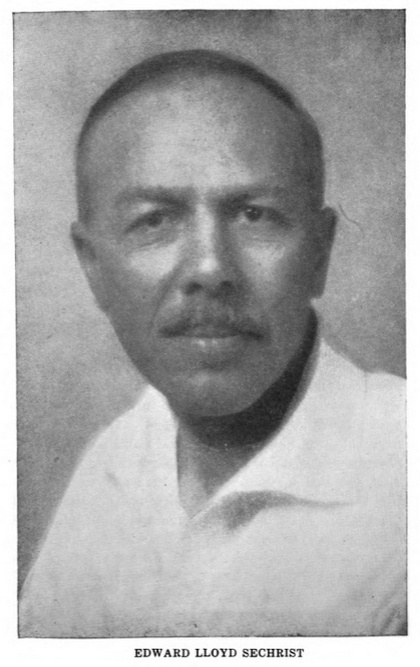
Edward Lloyd Sechrist (1873-1953) has been updated with some new information on the post-retirement life of Lovecraft’s friend Sechrist, from the USDA Employee Newsletter, 12th June 1944.
03 Saturday Apr 2021
Posted in Historical context
Edward Lloyd Sechrist (1873-1953) has been updated with some new information on the post-retirement life of Lovecraft’s friend Sechrist, from the USDA Employee Newsletter, 12th June 1944.
02 Friday Apr 2021
Posted in Historical context, Picture postals
This week, more on the transport theme. Letters to Family briefly reveals that, as a young boy, Lovecraft and his grandfather used to drive out in a horse and carriage/gig named “Tom”. Evidently they would enjoy getting purposely lost in the country east of Providence…
… we wandered interestingly in the young dusk, and became picturesquely lost — as when Grandpa and I used to get lost driving “Tom” in East Providence — on some unknown height…
The implication here is that, being lost, he and Grandpa would then need to find elevated viewing points to drive up to or halt by, presumably partly to-reorient themselves but also to enjoy unexpected views.
(The above quote is not indexed: in the Index to Letters to Family add “p. 145” to Phillips, Whipple and to Lovecraft, H.P. … and Whipple Phillips).

Not Lovecraft and his grandfather, but evocative of riding “Tom” into a field to enjoy a sunset vista.
These were the days before any substantial automobile ownership, and it would have been very safe and quiet on the roads and lanes. Most likely the field and track gates were only latched, not padlocked as they might be now. The only danger and noise was likely from the occasional fierce farm-dog, but dog training was far better in those days and they were also trained not to spook horses.
What was “Tom”? Possibly Lovecraft’s “Tom” was a large four-seater family ‘city carriage’ with the sides down or off for the better weather, but the type of East Providence backroads and lanes travelled probably meant this was not practical. The roads, especially back-roads on which one might become lost, would not have been as good as today. True, the turnpikes (toll-roads) had been abandoned in Rhode Island by the 1880s, and a decade or two later one could go where one liked. But the patchwork of local upkeep is said to have left much to be desired, being good in places, but poor and uneven a mile further on, then good again. Rhode Island’s famous scientific ‘road surfacing’ experiment was not until 1907. This saw the laying of 14 ‘experimental sections’ to discover which was the best-wearing and most dust-free option. They were, surprisingly, the first such state in the nation to actually do such rigorous tests and the results came in 1909. A simple mix of “tar with natural stone macadam” beat all the fancy expensive mixes that contractors recommended. But the state’s new roads were not laid until after 1909. Thus the pre-tarmac roads encountered by Lovecraft and his grandpa circa 1895-1900 would have been quite varied, especially if one was trying to take a semi-random route in outlying rural districts.
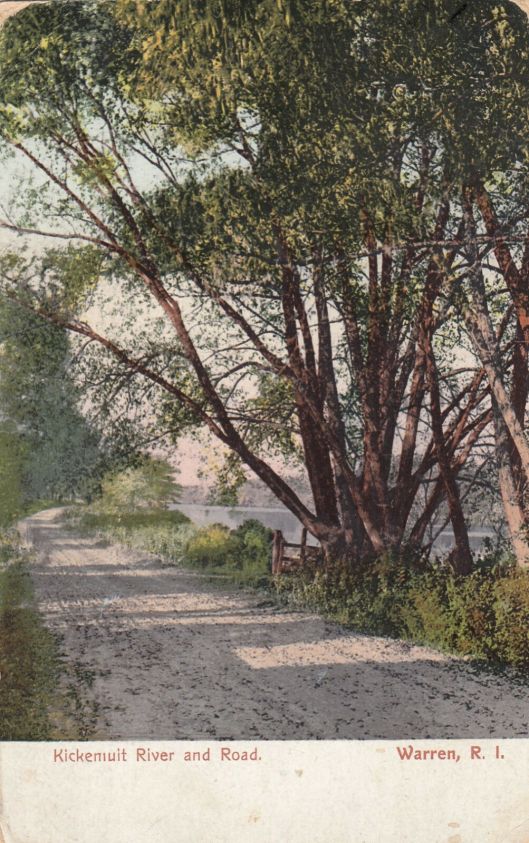
The unpaved road to Warren, in the far south of East Providence.
This means that a city-type carriage was probably not practical. Could there have been another lighter buggy-style carriage? Well we know the family kept several “carriages”, before financial problems meant…
the horses and carriages were sold too, so that I had a gorgeous, glorious, titanic, and unbelievable new playhouse — the whole great stable with its immense carriage room, its neat-looking ‘office’, and its vast upstairs, with the colossal (almost scareful) expanse of the grain loft…
Lovecraft somewhat hazily recalled this loss/gain as being “ca. 1895”, but S.T. Joshi dates the departure of the carriages and live-in coachman-groom a little later…
“when the coachmen left (probably around 1900)” (I Am Providence).
Whatever the dating we can thus be sure there were once several horse-drawn vehicles, hence the large size of the stable. The trips with his grandfather could then equally have been in a lighter runabout gig of the sort seen above. Possibly the formative vista-seeking trips were enjoyed when Lovecraft aged four or five, but if Joshi’s “1900” dating is a better informed guess they may have been a little later, perhaps at age seven or eight.
Anyway the dating of the stable probably does not matter for the dating of the trips. Since I assume that a sixty-something businessman like Grandpa Whipple would have still required hired horse transport to get around, even if he could no longer afford to have it located in the home stable. Experts on the Whipple finances may know more, but my guess is that he retained local access to at least a horse and buggy, even if it had to be hired in from nearby. He also likely retained the local ‘pull’ to borrow one from a friendly neighbour on a fine evening, even if finances were tight.
As quick-eyed photographers know, being on a bicycle (ideally tirelessly electric, or in this case a horse-buggy) enables one to discover exponentially more photographic possibilities than when plodding along on foot. If getting psychogeographically lost on purpose to find “picturesque” sights, Grandpa’s random turnings and likely exploration of spectrally embowered by-ways must have had much the same effect, offering many more ‘picture views’ than for the walker. I assume that the views were not simply for mundane re-orientation after becoming lost, and would have been enjoyed for their own sake.
But I also suspect the apparently random nature of the trips were about more than stacking up the probabilities of finding a really good near-sunset view. Recall, for instance, that his grandfather also gave the boy other forms of training at this time, such as finding his way through what Lovecraft called “a certain chains of dark rooms” to cure his fear of the dark. On a New York walk he recalled that he had also enjoyed becoming purposely lost in the local Cat Swamp as a boy…
Remembering that I had no map & knew nothing of the country, [I went] trusting with chance with a very agreeable sense of adventure into the unknown; just as I used to enjoy getting “lost” on walks around Cat Swamp, East Providence, or somewhere, with you [his aunt], Gramp, or my mother in the early and middle ‘nineties.” Letters to Family, page 421.
These things were also a form of navigation training. Thus getting lost with “Tom” could also have been another form of training, with purposeful random turnings aiming to teach the boy some skills of ‘natural navigation’ (the sort of things now found in best-selling books such as The Natural Navigator). But, if finding the way home at dusk, then also navigation by key stars and the moon. The adult Lovecraft often displayed an aristocrat’s hazy sense of time re: being less than prompt for meetings, but he seems to have had a countryman’s navigational skills. He was able to quickly find his way in situations when his clueless companions had their heads spinning. One suspects that this innate skill was honed early, firstly with his grandfather and later independently on his bicycle.
His grandfather had, once, been a rural man likely to value such skills. There was still at the back of the family horse-stable “the orchard”, which the boy Lovecraft would regularly raid for summer fruit. And there was also a field beside the house which pastured the family cow…
… the family cow — a beloved possession reminiscent of the prehistoric Greene days ere my grandfather became an urban dweller.” (Lovecraft, letter to Kleiner)
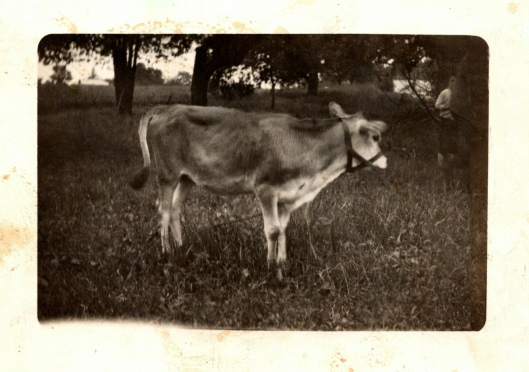
Again, not actually the boy Lovecraft and the family cow, but somewhat evocative of the likely scene.
It was, he later recalled…
an open field with a stone wall where great elms grew [and] a cow pastured under the gardener’s care. Here, when I was five, they built me a playhouse…
27 Saturday Mar 2021
Posted in Historical context
More brief notes on interesting items gleaned from Letters to Family…
* Lovecraft’s experience of New York City subway travel was likely not the same in 1922 as in 1924-26, due the carriage types. He appears to have been at the cusp of a changeover in the types, from old to modern. In 1922 he remarks on the very old hand-crafted and very large carriages. He preferred travelling on the largest and most palatial of these, and went out of his way to do so.
* Providence had good strong street-lighting at night by 1922, not always the case in comparable provincial cities. Relevant to the inclination to take Providence night-walks, with Eddy and alone.
* In spring 1924 Lovecraft researched and wrote three chapters of a book on “American superstitions”. This was prior to his work for Houdini, and his own Supernatural Literature. There is no footnote detailing the fate of this text, though possibly I’ll encounter more details on later pages. I’d suspect it was later rolled into the Houdini work.
26 Friday Mar 2021
Posted in Historical context
A few more insights gleaned from Letters to Family…
* It was Lovecraft who introduced Long to the second-hand bookshops of New York City, and not the other way around. Presumably Long had, until 1922, purchased purely from the ordinary bookshops and perhaps via the lists of mail-order dealers. Lovecraft notes that Long had never once entered the city’s many used bookstores. On learning that he could sell books fairly easily, Long lugged a suitcase full of unwanted books downtown and sold them for $4 credit.
* Sonia’s affluence and profligacy with money are a little better understood when one learns that she had private clients. For these she made exclusive hats, and was able to work from home to turn $20 of raw materials into a $60 designer hat. In today’s money that means she was making $600 profit per hat, and there was then a huge demand for fancy hats.
* In 1922 Lovecraft knew Poe’s High Bridge as “Highbridge”, and visited it and other Poe places in 1922.
26 Friday Mar 2021
Posted in Astronomy, Historical context, Picture postals
Newly coloured, a huge picture of The Museum of Natural History, Roger Williams Park, Providence. 1906, Lovecraft was then aged 16 and deeply investigating astronomy — so much so that the following year Prof. Upton of Brown personally introduced the young Lovecraft to Percival Lowell.

Only when record-pictures are this size and glass-plate clarity can one see certain details. The lizard-creature atop the building, for instance…

Or the wry humour in placing an “I Speak Your Weight” machine next to a short bench which looks about wide enough to accommodate one very fat person.

On the opposite side of the entrance-steps is what appears to be a huge lump of concrete, but I would guess was more likely a very fossil-rich accretion full of fossils… and thus designed to attract the sort of children interested in fossil-hunting. Another small but interesting detail is the British-English use of the wording “rubbish” on what today would be a ‘trash’ bin.

Lovecraft may have become overly familiar with the Museum’s exhibits by 1906, but it appears to have had local and visiting exhibitions and these could have been a continuing draw. He surely returned to it in the Autumn of 1916, when the famous astronomer Prof. Percival Lowell (he of the ‘Martian canals’ theory) exhibited there…
a remarkable collection of astronomical photographs … in the form of glass transparencies, exhibited in a darkened room, and illuminated from behind, so that they stand out with vivid clearness
There were 150 of these and they formed a “blockbuster” show, attracting over 1,300 visitors on the first day in Providence…
Currier of Brown University was at the museum all afternoon answering questions with regard to the 150 transparencies
I was uncertain of the 1916 date for this show, before, but Popular Astronomy for 1916 confirms it. The journal reprinted a newspaper report from Providence…

Lovecraft claimed lack of belief of Lowell’s ‘canal’ theories (“I never had, have not, & never will have the slightest belief in Lowell’s speculations” he wrote in 1916), though his surviving articles show more ambivalence. But he surely cannot have been sniffy enough about the theories to have missed this major local show of the Lowell Collection, in his favourite local park and running from circa 9th-23rd October 1916. Many of the pictures by Lowell and his highly skilled assistants were not again equalled in topographical detail until the 1960s. Also, Lovecraft would have been aware that by 1915 Lowell had theorized and had begun the search for “Planet X” (Pluto)…
in a manner not wholly dissimilar to that advised by Lovecraft himself in his letter to the Scientific American of July 1906. (S.T. Joshi, Primal Sources)
Rather amazingly the Lowell Collection of planetary photographs does not seem to have been digitized for modern public use. Perhaps there is a worry that they might still be mis-used re: the ‘Martian canals’? Nor are there even any pictures of what the Lowell exhibition looked like to the visitor of 1916.
Lowell died unexpectedly in November 1916, and Lovecraft penned a short poetic ‘elegy’ so turgid that it could even be intended to be read as some sort of sardonic snub in a coded 18th century manner. It ends by imagining Lowell ascending to the heavens and becoming a star, adding… “a new brilliance to the Southern Cross!” Could this be Lovecraft’s snippy allusion to the criss-cross of Lowell’s ‘canals’ theory, and also that Lowell had things ‘upside down’? Because the simple four-star Southern Cross is only visible ‘down under’ in places such as Australia. Apparently all Australians know that an observer can draw ‘imaginary lines’ out from the cross, to find the direction south at night.
25 Thursday Mar 2021
Posted in Historical context
I’ve started in on Lovecraft’s “Letters to Family” volumes, and am updating past blog posts as required by new evidence.
Friday ‘picture postals’ from Lovecraft: the Cloisters, NYC now has the first visit as being with Sonia…
Lovecraft’s first visit was with a day there with Sonia in 1922, but another was vividly recalled by Frank Belknap Long in his Lovecraft memoir, albeit a memoir written some fifty years later. Long has it that he, Morton and Lovecraft approached the Cloisters in the gloaming dusk…
Also the recent Fly me to the moon… post has a few additional final lines…
As for finding cats on the Moon, as in Dream-quest, the 12 year old Lovecraft already delighted in the idea of other nearby worlds populated by his beloved cats, and so this seems to have been his original idea, part whimsy and part science — the idea of creatures on Venus or Mars was then still a topic on which reputable scientists could speculate in the press.
24 Wednesday Mar 2021
Posted in Astronomy, Historical context

The Ladd Observatory, Providence, in a key architects’ drawing of summer 1890. The year of Lovecraft’s birth. It’s from a very poor Google Books scan, with fine details in the sky blown out and most of the small penmanship unreadable, so is not ideal. But it’s the best available. This is what was started with…

Lovecraft knew the Ladd from summer 1903, aged 13, and on Halloween of that year noted that the telescope was haunted by a ‘colour out of space’ where there should be no colour…
The telescope is a 12 inch equatorial, but does not perform in the manner that a glass of its size should. Chromatic aberration is the principal defect. Every lunar crater and every bright object is surrounded by a violet halo.
22 Monday Mar 2021
Posted in Historical context
Well, well, dipping at random into the new Letters to Family books of Lovecraft’s letters, as yet unread by me in a proper manner…
1) I find one H.P. Lovecraft, then editor of The Conservative, sitting down to a chicken dinner with the radical Sunrise Club in New York City in 1922. He had been invited along as a guest by Morton. The meeting was on ‘pro and anti-censorship’. Lovecraft found the speakers risible, shallow and presenting no real logical arguments, except for a crude fellow called “Rinn” (interrupting though not a speaker, seemingly)* and a far more rigorous and longer contribution from Morton. This suggests that — even in his older years — Morton may have had more influence, intellectually and via his public speaking, than might be assumed from a perusal of his earlier pamphlets. I’ve updated the post slightly.
2) Also in Letters to Family, the fact that Lovecraft extensively covered the Brooklyn Museum for a second time in 1922, doing it thoroughly than before. Thus he must have seen the giant octopus (seen recent posts) in the Invertebrates Hall at that time. Again, I’ve updated the post slightly.
* – Joseph Francis Rinn (1868-1952), American magician most active in the early decades of the 20th century, author of Sixty Years of Psychical Research.
20 Saturday Mar 2021
Posted in Historical context
Up for sale at Abe, Lovecraft’s poem “Despair” (c. February 1919) in his handwriting and signed.


The back is also interesting, with its address of “Appeal to Reason, Girard, Kans.” In the war years Theodore Roosevelt termed the socialist scandal-sheet Appeal to Reason a… “vituperative organ of propaganda, anarchy and bloodshed.”

But the Encyclopaedia of the Great Plains notes that the newspaper … “lost much of its zeal and readership and wilted under the anti-Red reaction of the early twenties”. Evidently a ‘Book of the Month’ club was then helping the newspaper stay afloat. But one wonders who was so naive as to send the editor of The Conservative (1915-1923) some ‘Book of the Month’ order-sheets for socialist tomes? Anyway, evidently Lovecraft merely considered these to be ‘free stationary’ and wrote on the backs.
The poem appeared in Pine Cones for June 1919, and relates to the severe mental illness of his mother.
19 Friday Mar 2021
Posted in Historical context, Picture postals
H.P. Lovecraft was a veteran traveller by motor-coach in the 1920s and 30s. Here we have a view as if from the back seat in a typical lower-cost local type of motor-coach of the mid 1930s, as photographed at that time (I’ve enlarged and colorised it).

By the mid 1930s there were, of course, expensive lines of streamlined coaches on the cross-country routes. Some even with reclining sleeper-seats and their own refreshments bar in a cubicle at the back with a white-uniformed server in the hatch. But Lovecraft was… “always seeking the cheapest possible route” on his many travels and so, unless an utter bargain of a long-distance ticket was on offer, he chose the lowest priced options. He would also have encountered many passenger transfer coaches, waiting at railway stations.
With clean glass, a good seat behind the driver (as was his wont) and the right weather, one might…
“traverse the long miles [through New England] by motor-coach, eagerly drinking in the green rolling hills, the fragrant, blossoming orchards, and the white steepled towns” (Dexter Ward).
He also appears to have been keen on the “fragrant” bit — a flow of rural air through the motor-coach — having come to detest the “prepayment suffocation chambers” that were the stuffy and smelly New York City equivalents. Possibly a draught was one of the advantages of being seated behind or beside the driver, who likely had a side-window open in summer. It would also have meant he was not forced to converse with a random fellow passenger, but might (if the driver was not the gruff and silent sort) obtain from the driver occasional names of the sights being passed. It would also enable him to easily signal the driver to stop and left him off, easy enough in those days of relatively little motor traffic. This happened at Salem, for instance…
The coach ride was delightful, giving frequent glimpses of ancient houses in a fashion to stimulate the antiquarian soul. Suddenly, at a graceful and shady village corner which the coach was about to turn, I beheld the tall chimneys and ivy’d walls of a splendid brick house of later Colonial design, and espy’d a sign which proclaim’d it open for publick inspection. Captivated by the sight, I signall’d the driver and alighted … I loudly sounded the knocker and awaited developments. Nothing develop’d. I then knock’d at the side door, but with equal futility. Then I noted a door half open in a miserable ‘ell’ at the back of the house; and believing the place tenanted, made a third trial there. My summons was answer’d simultaneously by two of the most pitiful and decrepit-looking persons imaginable — hideous old women more sinister than the witches of 1692, and certainly not under 80. For a moment I believ’d them to be Salem witches in truth; for the peculiarly sardonick face of one of them, with furtive eyes, sneering lips, and a conspicuously undershot lower law, intensify’d the impression produc’d by their incredible age and gauntness …” (1st May 1923).
Lovecraft may also have liked the hand-made and slightly rustic feel in some of lower-cost motor-coaches found in rural and coastal tourist districts, with (as can be seen here) stitched leather seat-top covers, woven wicker chair-frames and polished wooden arm-rests. This was a hand-crafted modernity, put together by artisanal craftsmen in small workshops.
Once in a new town or resort he also hopped aboard such coaches with his fellow tourists. Tourism was then a relatively ‘new thing’ for many towns, and even in the Great Depression there could be enough of this new breed of antiquarian sightseer to make such things viable. In this “rubbernecking” way he made his quick initial tour and assessment of a new place…
“[a] sort of preliminary touring, the standardised service of the various motor-coach sightseeing companies, and of the street-railway corporation, is strongly recommended as the cheapest and most comprehensive method [of first encountering a place].”
His sense of direction was excellent, even in the labyrinth of New York City, and he would also minutely study maps of a place before visiting. So, even while being spun around on a “rubberneck bus”, he could keep his bearings in a new place.
19 Friday Mar 2021
Posted in Historical context
A Patreon patron asks a question: “Did HPL visit sites associated with Poe and what did he think of them?”
Lovecraft revered Poe, and entire books could be written on the ramifying connections. Indeed, one such has been. The recent heavyweight The Lovecraftian Poe. Another book could likely be written by tracking down all the times Lovecraft visited a ‘Poe place’, and by gleaning all his sentiments and comments from the letters and poems. That would however be a large task, and must remain beyond the scope of this post.
Nevertheless, I can lay a bit of groundwork for others who may wish to tread further down this path. Firstly, Lovecraft has left us the usefully brisk essay “Homes and Shrines of Poe” (Collected Essays: Travel) which surveyed the homes and lodging houses as Lovecraft then knew them. I’m not in any way a Poe scholar and Poe scholarship may, of course, have finessed some of the dates or addresses or added new ones. But “Homes and Shrines” tells us what Lovecraft knew. His essay was published in The Californian for Winter 1934. Quotes below are from “Homes and Shrines” unless otherwise stated. Collected Essays footnotes “Homes and Shrines” with… “Poe’s residences in Philadelphia, Richmond, Charlottesville, Baltimore, New York, and Fordham, all of which HPL had personally visited.” The Encyclopaedia adds that he had visited “nearly all” the sites noted in the essay.
Here I limit the scope to the homes. There are, of course, a great many other places associated with Poe — including in Providence.
1. Poe was born in Boston at 62 Carver Street, but knew it not and grew up as a foster-son in Richmond. Lovecraft refers to this birthplace as… “the cheap boarding-house in Boston’s South End” and notes it “bears a bronze tablet” with some simple facts, and that the nearby district of his mother’s house was found by Lovecraft to be “very squalid”.
Lovecraft knew Boston well and especially explored the North End which features in “Pickman’s Model”. We have to assume he also took the time to visit the Poe birthplace, but I can find no evidence that he lingered. It appears to have been even more insalubrious and possibly dangerous than the decrepit North End.
2. Poe’s very young boyhood place was the “Allan home” on “Fourteenth Street between Franklin and Main in Richmond”, Virginia. Lovecraft calls this… “a three-story brick house at 14th Street and Tobacco Alley … still standing, though long ago converted into a shop and now deserted and unmarked.”
S.T. Joshi remarks in I Am Providence that Lovecraft include Virginia in his travels of Spring 1929, descending on the region like a whirlwind…
“… for only four days but [he] took in an astonishing number of sites — Richmond, Williamsburg, Jamestown, Yorktown, Fredericksburg, and Falmouth. All were delightful. Richmond [included the] Valentine Museum, which contained the then recently discovered letters by Poe to his guardian, John Allan … He also saw the farmhouse … that formed the Poe Shrine (now the Edgar Allan Poe Museum), which had also opened only recently. Aside from actual furniture owned by Poe, this place had a delightful model of the entire city of Richmond as it was around 1820; this made it much easier for Lovecraft to orient himself and to locate the surviving antiquities. “I never set eyes on the place till yesterday — yet today I know it like an old resident.”
Lovecraft sent Wandrei a May 1929 postcard of “The Edgar Allan Poe Shrine [Oldest House in Richmond]”. He noted however… “The oldest house — preserv’d as a Poe shrine though Poe never inhabited it — dates behind any of the others (estimates vary from 1685 to 1737!); it being a stone farmhouse preceding the urban settlement of the town.”
“In Richmond the chief object of interest for me is the Poe Shrine an old stone house with two adjoining houses connected as wings & used as a storehouse of Poe reliques. Here I have spent much time examining the objects associated with my supreme literary favourite.”
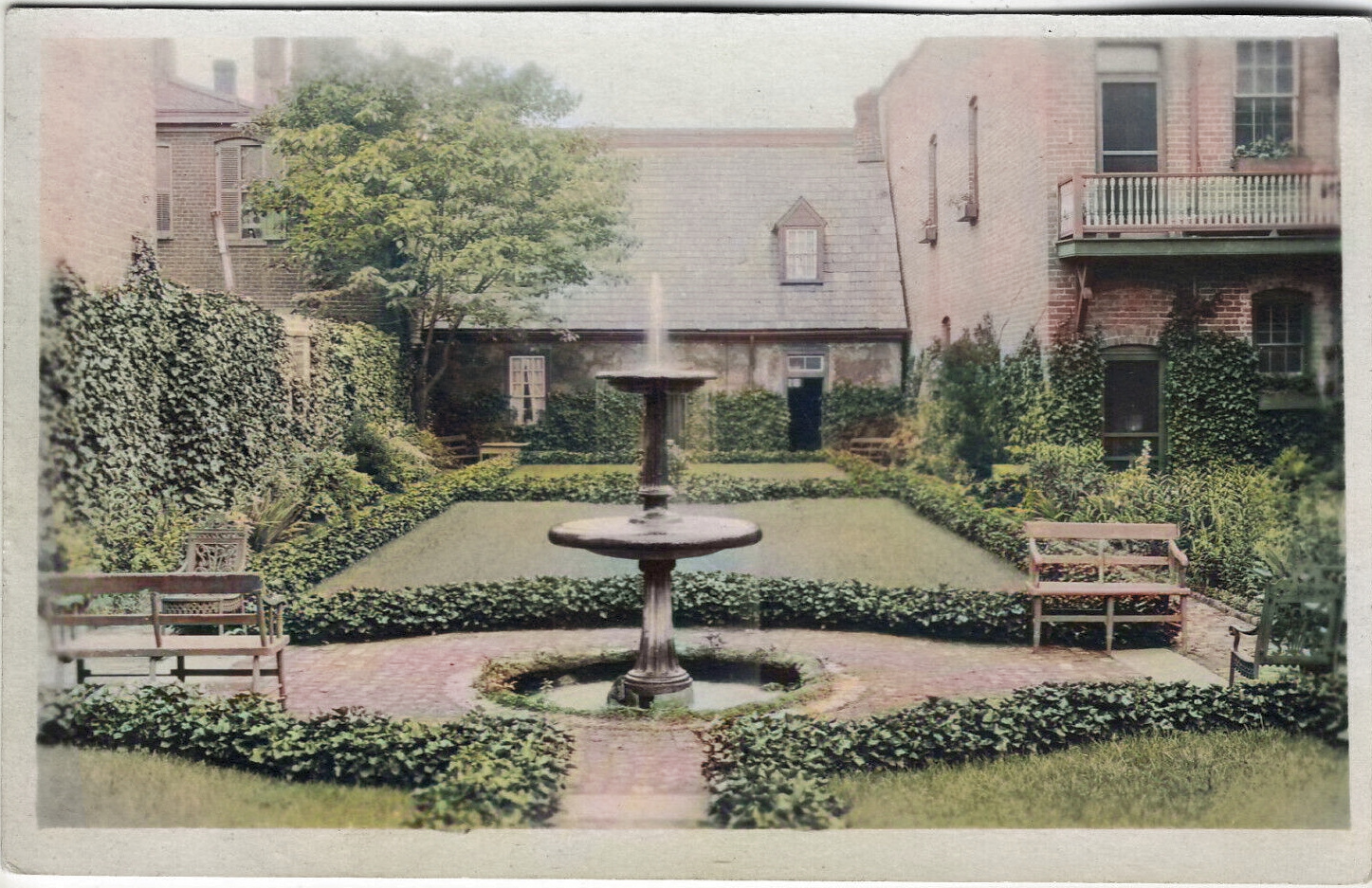
“… though Poe never inhabited it”
In his essay “Travels in the Provinces of America” Lovecraft elaborated on the artful deception…
“The ancient stone house and its adjuncts lying in the easterly slum reaches of Main Street and now serving as a “Poe Shrine”. This house, a farmhouse … remains in a sound state of preservation. The space near it has been purchas’d by Poe-lovers and developed with great taste and ingenuity; an exquisite garden … and the two adjacent houses on each side being annex’d as part of a three-building unit. Of these added houses that on the west is colonial, whilst that on the east is a fireproof museum in imitation of the Richmond residence of John Allan, Esq., where Poe was rear’d as an adopted son. I spent an hour in this fascinating place, and saw all manner of Poe reliques — far more than are stor’d in the Fordham cottage I know so well.”
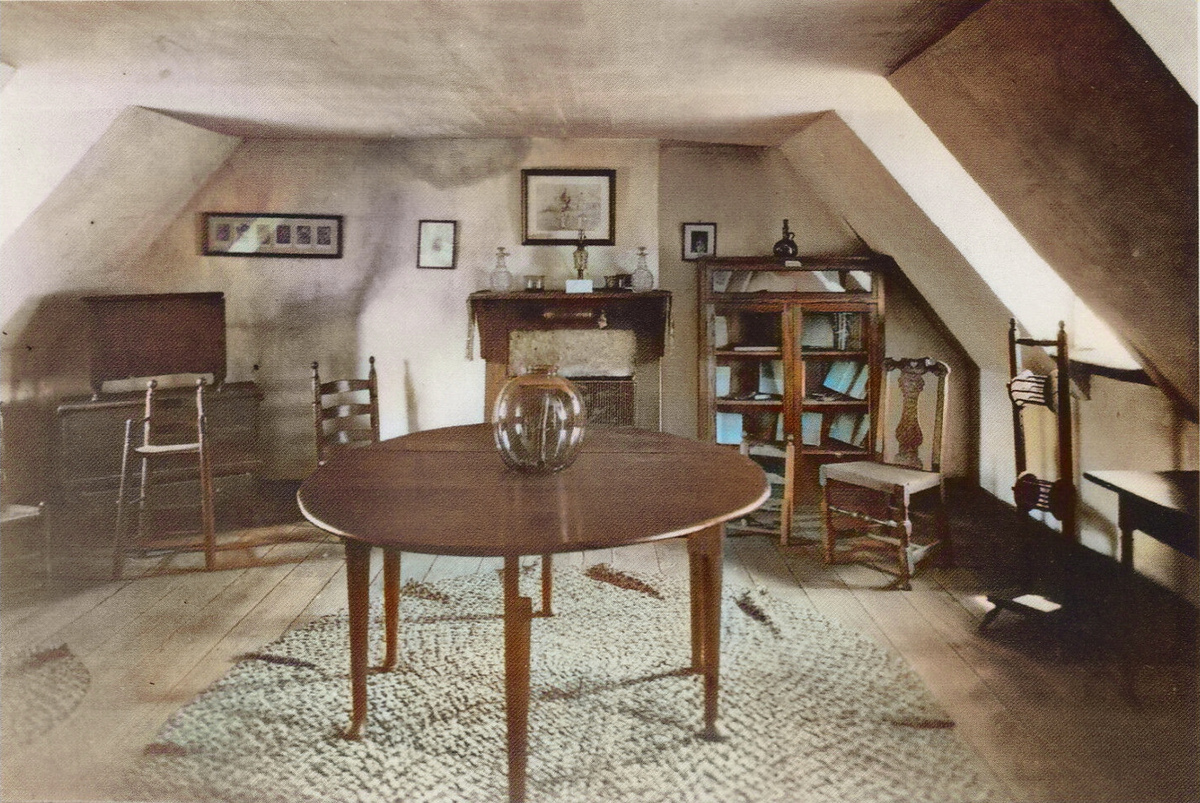
“Poe’s chair, desk, and various personal belongings are there, as well as many architectural details (mantels, a staircase, etc.) from the two Allan houses and the Southern Literary Messenger building [where Poe had been editor], all now demolish’d. One utterly magnificent feature is a gigantick model of the whole town of Richmond as it was during Poe’s boy-hood — about 1820 — in a glass case occupying the entire ground floor space of the colonial house attached to the shrine. This model, made in natural colours and on a scale permitting even the smallest houses to be about an inch square, was constructed a few years ago with the utmost antiquarian accuracy and artistick skill; and is so vivid that one can almost imagine himself in a balloon looking down over the outspread Georgian city. Never have I seen an antient town so miraculously conjured out of the past — I wish someone wou’d do the same for Old Providence!”
Lovecraft returned to Richmond in 1930, on which more later.
3. Poe was taken to live in Britain at a formative time of his life, from 1815-20, aged around 6 to 11. He was schooled in Richmond, then in Surrey and near but not in London.
Lovecraft remarks that the British sites… “are not marked or generally known”. Lovecraft is however known to have made a minute and sustained study of London’s historical topography and thus one wonders if, in part, this was an attempt at a tracing of the young Poe?
4. For a short while on his return to America, a house at Clay and Fifth Streets, Richmond.
Lovecraft states… “This house has vanished, and the site is unmarked.”
5. From 1825 then at the house ‘Moldavia’ at Main and Fifth Streets, Richmond.
Lovecraft notes this is an important site but “demolished without the marking of the site”. See above, for his remarks on the later attempt at recreating this home in Richmond.
6. Rooms at the University of Virginia in Charlottesville. Lovecraft notes this is “fortunately, well commemorated. His room at 13 West Range is fitted up as it was during his tenancy”.

Collected Essays notes that Lovecraft had visited Charlottesville, and presumably an account of the visit is somewhere in the Letters.
7. Various military sites associated with his time as a soldier. Lovecraft notes many of the key military sites “survive, though without Poe tablets” to mark them. Also that “no marker remains to record his sojourn in Room 28, South Barracks” at West Point.
Possibly Lovecraft recalled some of these regions via his boyhood travels with his grandfather.
8. Mechanics Row, Milk Street, Baltimore. This “has vanished without commemoration”.
9. Amity Street, Baltimore, with relatives. Lovecraft calls this “a dormer-windowed brick house at 3 Amity Street, which is still standing though unmarked.”
On visiting Lovecraft found Baltimore “hideously foreignised” but with some colonial survivals in the slums, and there “All the old houses have white marble steps, which are kept spotless by dint of constant labour.” “But to me the culminating thing in Baltimore was a dingy monument in a corner of Westminster Presbyterian Churchyard, which the slums have long overtaken. It is near a high wall, and a willow weeps over it. Melancholy broods around it, and black wings brush it in the night — for it is the grave of Edgar Allan Poe.” He tried to buy some postcards of the “dingy monument” for friends, but quickly had to abandon the quest as he had left himself so little time in the city.
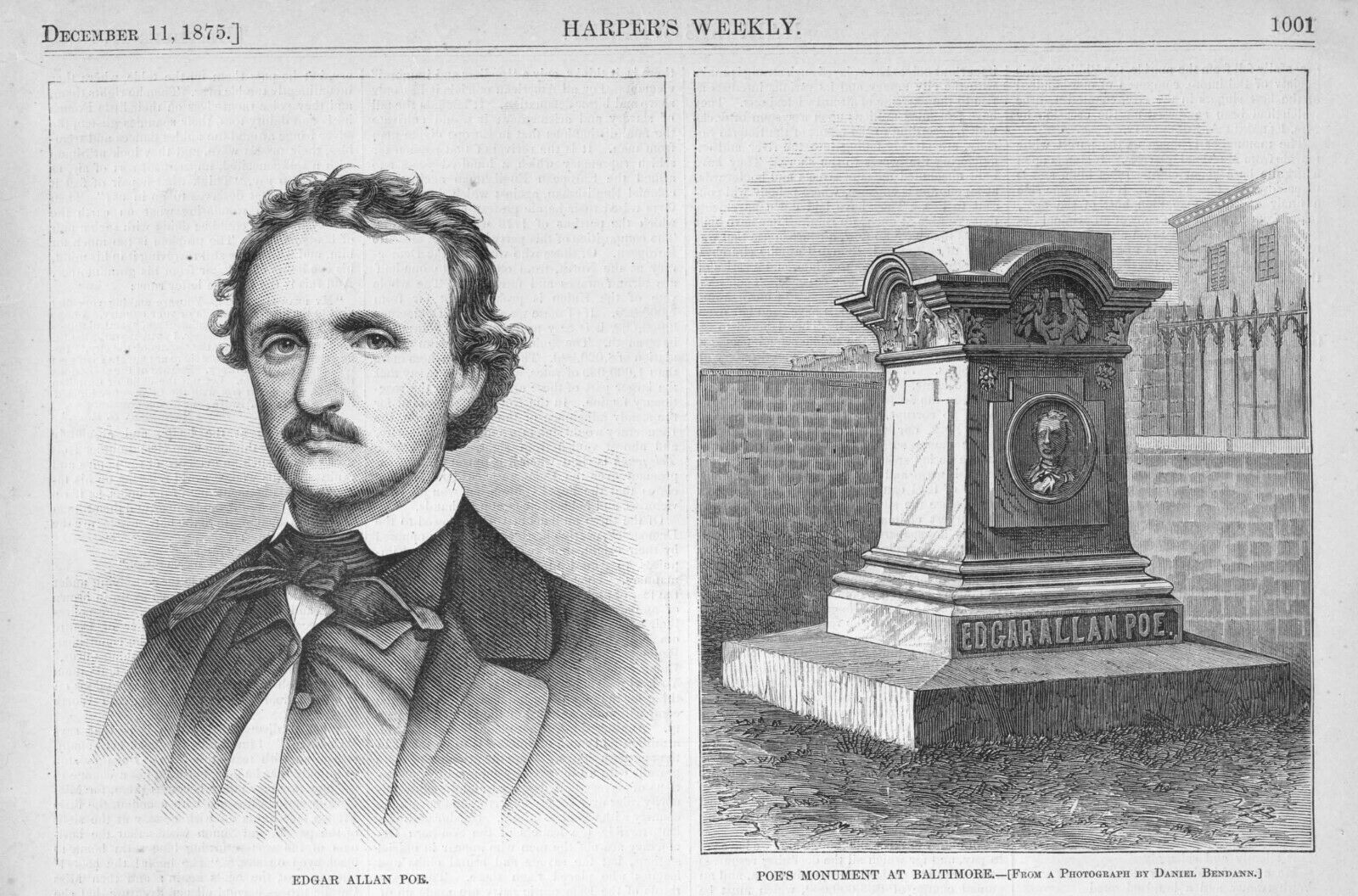
It’s uncertain if he found more than the grave in his very limited time there. He remarks in a February 1930 letter… “I have not looked up the Poe houses or localities in Baltimore, but mean to do so some time”.
10. Bank Street, Capitol Square, Richmond, to marry his thirteen year old bride Virginia. Lovecraft states this… “has disappeared and whose site is unmarked.”
In 1930 Lovecraft returned to Richmond in earnest, spending ten days there and with the benefit of two recent scholarly books on Poe’s life. One assumes that he then located and saw all there was to be seen.
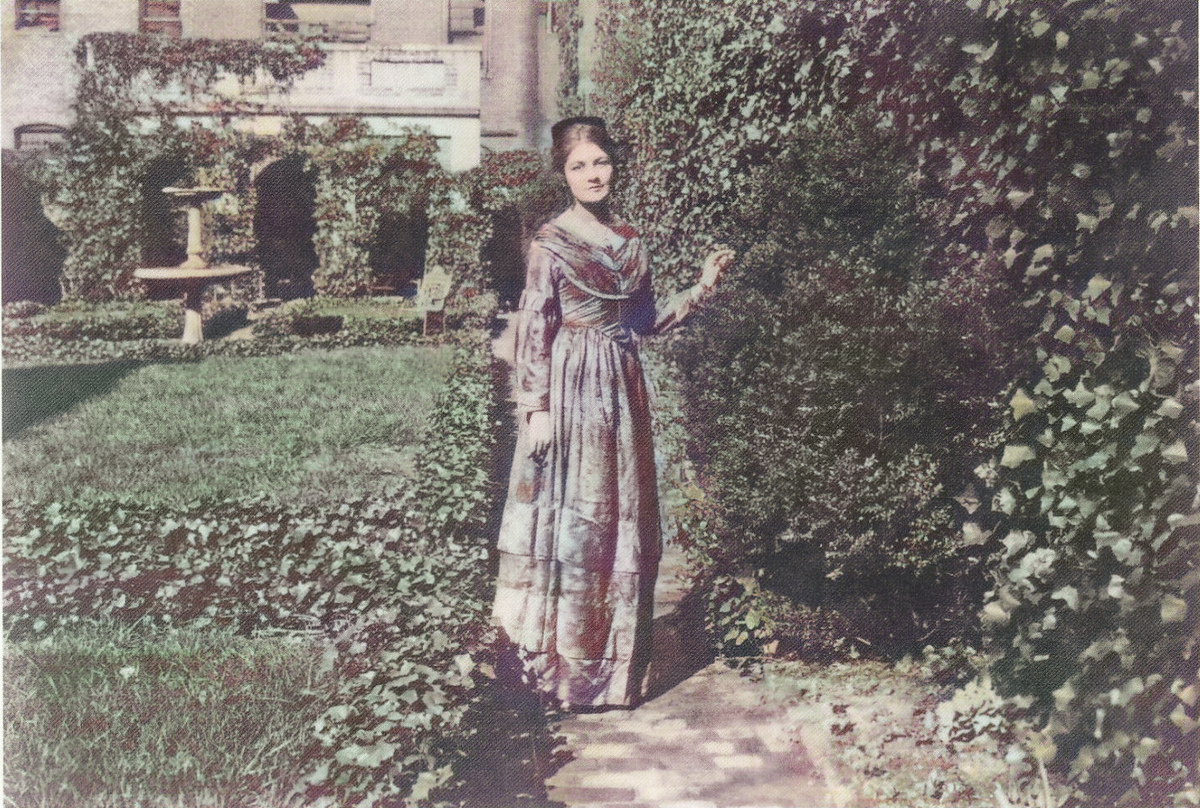
Recreation of Virginia as a teenager, in the garden of the ‘Poe Shrine’ in Richmond.
11. Poe then appears to have made an early try to establish his new family in Greenwich Village. On this Lovecraft refers to… “the corner of Sixth Avenue and Waverly Place in Greenwich Village, where no trace of his tenancy remains. In the spring he moved to 13½ Carmine Street, a site still commonly associated with him, though neither house nor marker exists”.
One imagines this was investigated on night walks during Lovecraft’s New York City years.
12. There were then six years in Philadelphia, where some of Poe’s most famous work was said to have been written. First at two boarding houses, then a small house at… “16th Street near Locust”, soon followed by a larger house “at the junction of Coates Street and Fairmount Drive, overlooking the Schuylkill [river]. Though without a marker, this building is still standing unless very recently destroyed.”
While visiting Philadelphia Lovecraft once… “rose before dawn in order to “observe the gold & rose dawn from the hills beyond the Schuylkill.” (I Am Providence). This sounds like it might have been at or near the Poe site, and his remark “this building is still standing” seems to show personal knowledge.
13. Then the Poe “shrine” cottage in Philadelphia… “the neat brick cottage at North Seventh and Spring Garden Streets, where from 1842 to 1844 lived Edgar Allan Poe”, writing some of his key works.
Lovecraft saw this in 1934 and wrote to Galpin that he had… “inspected the home of Poe (1842–44) at N. 7th & Spring Garden Sts., lately open’d as a publick museum. This small brick cottage is precisely as it was in Poe’s day, & hath been appropriately furnish’d. In a building adjacent is an ample collection of reliques, including copies of most of the magazines containing the first appearance of the various tales & poems. The effect of the place is extreamly lifelike, & it was not difficult to imagine the bard as present in person to welcome & guide the pilgrim.”
This appears to have brought him close to Poe, and perhaps more so than in other places.
14. Poe was then back to Greenwich Village in 1844, and Lovecraft would have thought that for a time he was living in the former Planters Hotel on… “the northwest corner of Greenwich and Albany Streets” which as Lovecraft says “still exists in good condition as a restaurant; though there is no tablet to indicate Poe’s connexion with it.” This may be because its claim to Poe now appears to be questionable. It’s now though likely that Poe never stayed there, and the belief was put about by the restaurant.
Again, one assumes that Lovecraft and his circle did a ‘Poe tour’ of Greenwich Village at night, at least once.
15. A summer house in the “Bloomingdale region” for 1844… “on a knoll near what is now the busy intersection of Broadway and 84th Street” … “The house has of course long vanished, nor does any marker amidst the babel of shops and apartments attest the fact that “The Raven” was completed on that spot”. There seem to be various competing sites for the writing of the famous “The Raven”, but this is obviously where Lovecraft thought it had been written.
Lovecraft was in Bloomingdale after Christmas 1933, for he haled Morton in a letter written from… “West 97th St., corner of the Bloomingdale Road, over-against Stryker’s Bay, Bloomingdale”. His comment that the Poe site there was among “the babel of shops and apartments” suggests he had actually tried to visit the spot.
16. In the direst poverty the Poe family then made a rapid series of complex moves around Greenwich, Broadway, Bloomingdale, and out to Turtle Bay… “15 Amity Street. Neither the house nor any marker exists at present. … 195 Broadway … in extreme poverty, sharing a single back room in a run-down tenement long ago destroyed and forgotten. By midsummer … a return to Amity Street, this time to No. 85, which like so many other Poe abodes has sunk without a trace. … the Bloomingdale farmhouse [and] later to another rural boarding-house at Turtle Bay, where the present 47th Street meets the East River. This was a large farmhouse, of which no vestige or memorial now survives.”
I’m not sure if Lovecraft ever visited the farmhouse/boarding-house site at Turtle Bay.
17. The famous Poe Cottage, at Fordham in the Bronx. Here Poe apparently wrote “Annabel Lee” and “The Bells”. This location was then rural, said to be about fourteen miles outside the current New York City. Lovecraft calls it… “a small but shapely farmhouse … in Poe’s time situated amidst a countryside of the greatest possible beauty. [In 1913 the city] moved it northward about 450 feet to the crossing of the Grand Concourse and Kingsbridge Road, in a small park named for Poe. By 1921 its restoration was complete, and the surrounding landscape was made to resemble its original setting as closely as possible. It is furnished just as it was in Poe’s time; three articles — a rocking-chair, a bedstead, and a mirror — being actually the ones he owned and used. Various relics of Poe are present.”
In 1930 Lovecraft recalled his memories of the first visit there in 1922… “rattle of the elevated [railway] through unknown labyrinths of accursed life … sweep of red-gold sun over a luring balustraded hill-crest — and the Home of Poe!” He later remarked on “the Fordham cottage I know so well”. Another comment was that… “In that shrine of America’s greatest literary artist, a brooding atmosphere lingers, and unseen wings seem to brush the cheek of the worshipper”.
In 1925 Lovecraft saw the eclipse of the sun from High Bridge, and likely knew that for Poe… “a walk to High Bridge was one of his favorite and habitual recreations” while at Fordham.

Frank Belknap Long wrote a prose-poem of the 1922 Lovecraft-Loveman-Morton-Long visit of April 1922, “At the Home of Poe”, published in the United Amateur for May 1922…
“The home of Poe! … The dead years circle slowly and solemnly around its low white walls, and clothe it in a mystic veil of unseen tears. And many marvellous stories could this quaint little old house tell, many weird and cryptic stories of him of the Raven hair, and high, pallid brow, and sad, sweet face, and melancholy mien; and of the beloved Virginia, that sweet child of a thousand magic visions, child of the lonesome, pale-gray latter years, child of the soft and happy South. And how the dreamer of the spheres must have loved this strange little house. Every night the hollow boards of its porch must have echoed to his footfall, and every morn the great rising sun must have sent its rays through the little window, and bathed the lovely tresses of the dream-child in mystical yellow. And perhaps there was laughter within the walls of that house, laughter and merriment and singing. But we know that the Evil One came at last, the grim humourless spectre who loves not beauty, and is not of this world. And we know that the house of youth and of love became a house of death … a thing seen darkly as in a looking-glass; but lovely beyond the dreams of mortals, and ineffably sad.”

On a later 1924 visit with his aunt, Lovecraft was less certain (at least architecturally) of what he had formerly regarded as the “shapely” farmhouse. Finding it now… “very squat and cramped”. But with enough charm in its removed re-creation for visitors, that he could still imagine himself actually living there (Letters to Family). In early 1930 he stated in a letter that preferred Richmond, even though by that time he had spent relatively little time there… “Fordham, (now absorbed in N.Y. City) where so much is made of his cottage. Richmond, however, is really the authentic ‘home town’, where all the formative influences of youth had their sway.” Lovecraft returned to Richmond for ten days in summer 1930, to immerse himself in the places of his idol.
16 Tuesday Mar 2021
Posted in Historical context, New discoveries
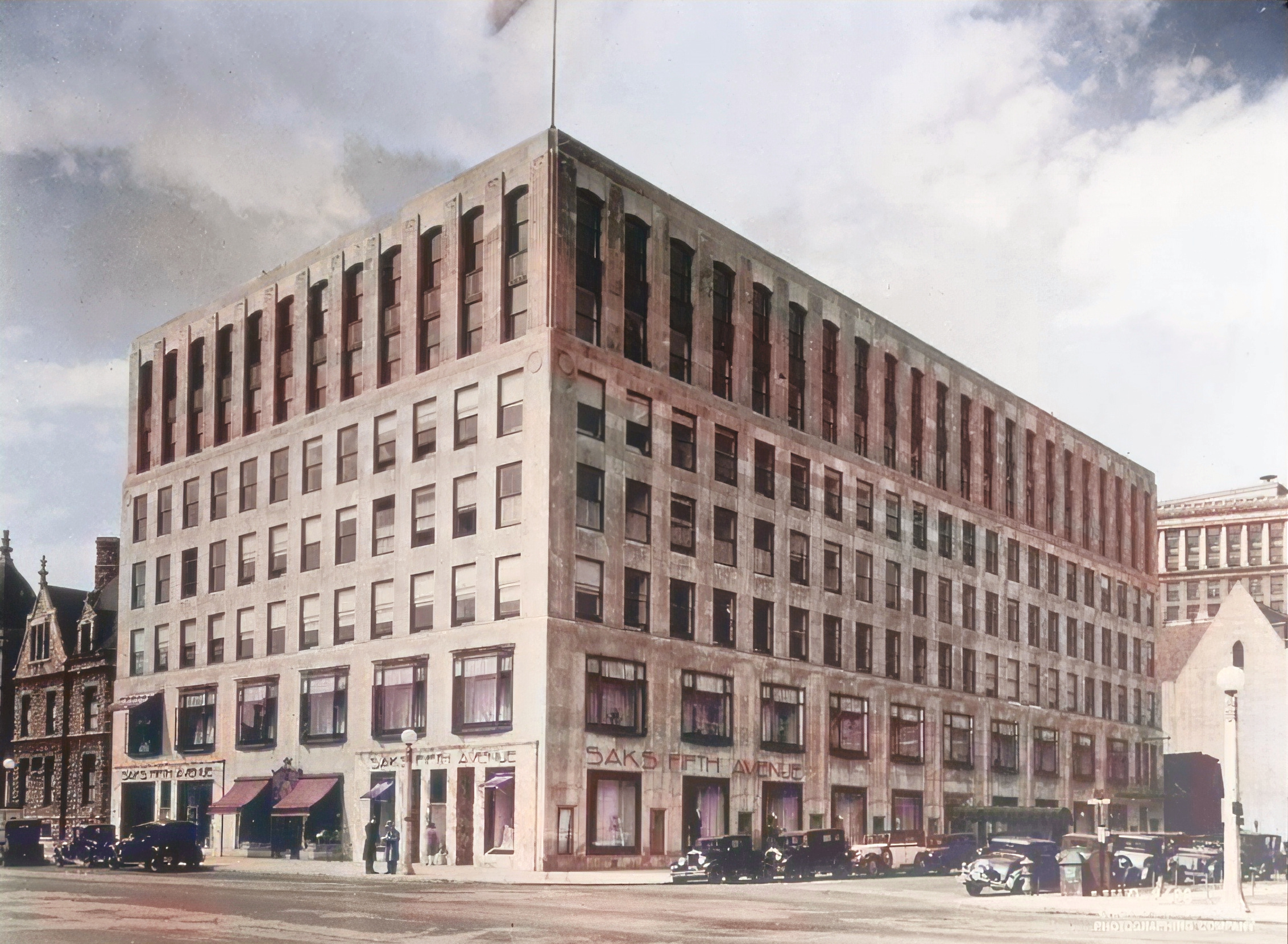
Saks at “The Michigan-Chestnut”, Chicago, circa 1929.
840 North Michigan Avenue, Chicago. One time home of Weird Tales during the Lovecraft years. Designed by the delightfully named Holabird & Root, though their forbidding exterior obviously lacks the same fairy-tail quality. According to the newly released Archive.org microfilm of Editor & Publisher magazine, the first magazine-related tenants moved in just before Christmas 1928, and the place formally opened in 1929. Additional space was opened October 1930, possibly the artists’ studios.
The upmarket retailer Saks Fifth Avenue occupied the walk-in street floor from early March 1929, as can be seen here, when the building was known as “the Michigan-Chestnut”. Perfume and shoes were located on the ground floor, and seemingly also a beauty salon. Womenswear, junior sportswear, hats and probably jewellery were up a flight of stairs, and Saks may even have also occupied most of the first floor. Saks was an oasis for the wealthy lady shopper and thus the building faced the threat of crime from Chicago gangsters. For instance June 1929 saw Saks robbed, in a “terrifying” daylight gunpoint attack, of $20,000 of cash and jewels.
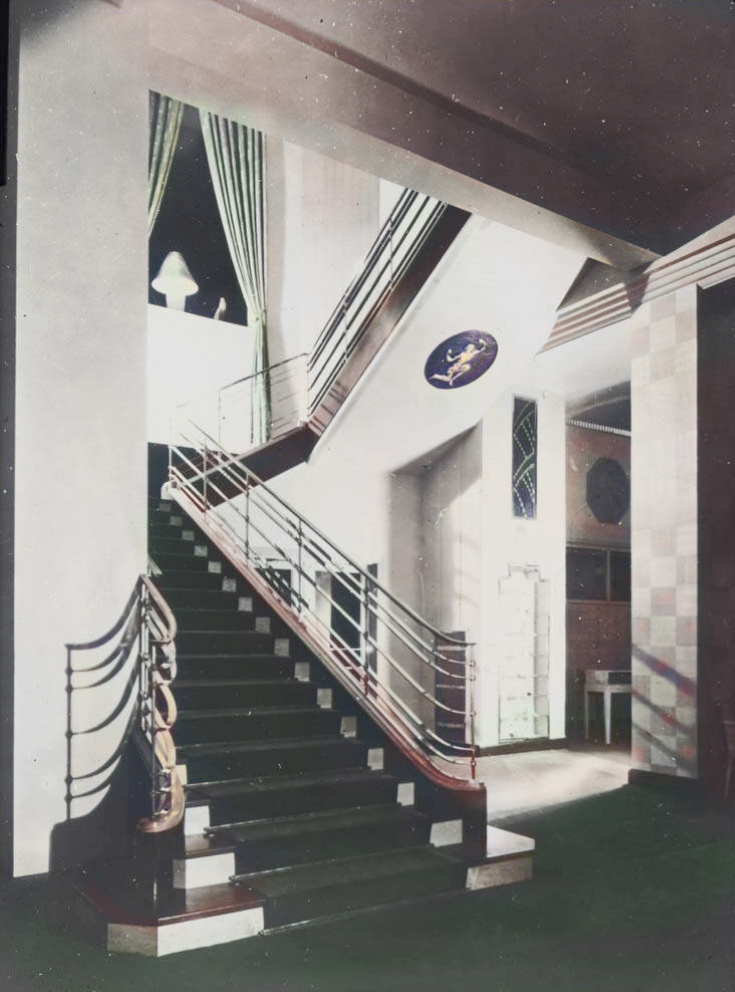
The Saks stairs photograph does at least hint at the likely style of the rest of the interior. Regrettably the upper offices and corridors appear to have eluded the camera, though there is apparently in Marginalia (1944)…
a picture from about 1937 of a part of the Weird Tales office in the “palmy Chicago days” Seated at his desk is Farnsworth Wright.
Possibly it is this one…
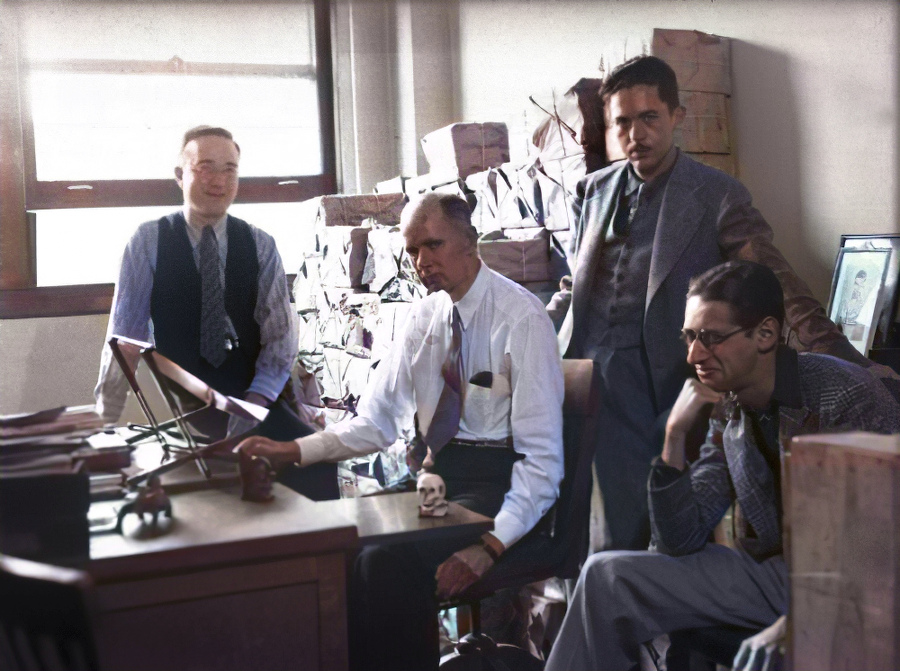
Weird Tales editorial office, Chicago. The business manager Bill Sprenger, then editor Farnsworth Wright seated, Henry Kuttner, and then Robert Bloch on the right.
There is however one vintage architectural view available from the windows, here enlarged and newly colorised. Note that the window casing is the same as that on the group picture above, which shows the Weird Tales office had a view of some sort. Though this particular view only has a one-in four chance of approximating the view had by Farnsworth Wright from the Weird Tales office.
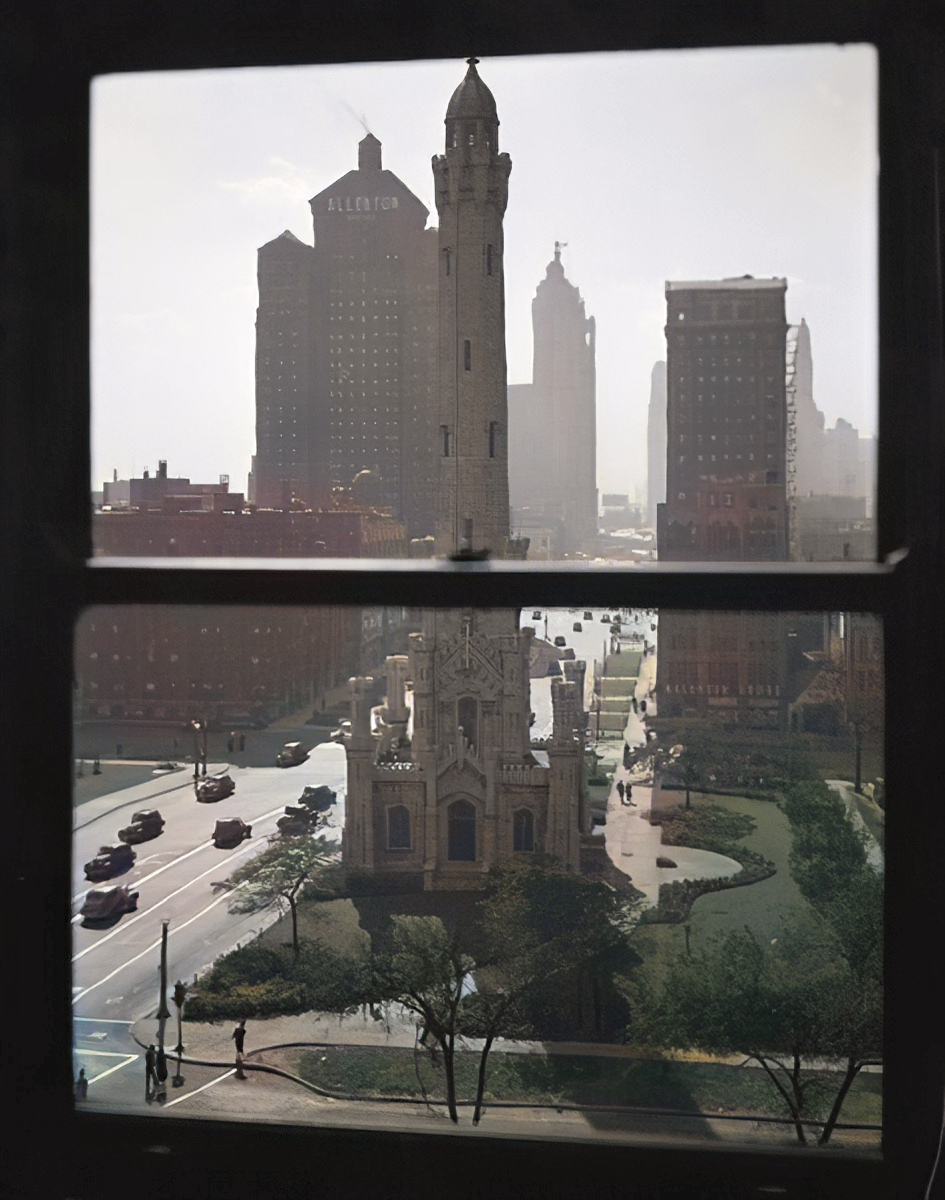
Still if it was indeed more or less his daily view then, as editor of Oriental Stories and with a personal interest in the arts of the East, he might have appreciated the rather incongruous pseudo-oriental minaret. The photograph’s impression of cleanliness and order in the city is perhaps deceptive. One of Lovecraft’s correspondents felt… “unimpressed [by Chicago]… the city is filthy” after visiting the Weird Tales office. The Michigan-Chestnut building and Saks does however seem to have been at the centre of a set of upmarket ladies’ stores, according to the retail histories, so perhaps the area formed an oasis in the gangster-ridden city? Bloch had lived there as a youth and later recalled the smells…
I learned the geography of the city through the windows of streetcars, elevated trains, or double-decker buses. Sometimes my parents would even let me ride on the open-air upper level of a bus, if the wind on Michigan Avenue wasn’t too strong. Everything blew into the Windy City in the twenties — stench from its famous stockyards, smoke and steam from the daily discharge of a thousand trains. The odor of alcohol fermenting in tenement stills mingled with perfume rising from the crowded lobby of the new opera house…” (Introduction to Murder and mystery in Chicago)
Sadly his short memoir reveals nothing about the particulars of the Weird Tales office, other than that he visited it when he returned to the city. The presence of Bloch and the architectural detail of the window confirms that the above group-photo was made in the Michigan Avenue building.
Saks moved out of the building in 1935, most likely due to the stringencies of the Great Depression, and opened a new Chicago store in January 1936. Possibly the presence of Saks had meant that visitors to the Weird Tales and Oriental Stories offices would have been glad to walk in out of the stink of Chicago and through the plush and beautifully scented bazaar to reach the office elevators or back-stairs. But after Christmas 1935 this perfumed pleasure evaporated. Weird Tales followed a few years later, moving out in 1938.
Doubtless there are more small details to be gleaned from various accounts of personal visits to the Weird Tales Chicago office c. 1929-1938, buried deep in the memoirs of writers and fans such as Hoffman Price, but I lack the print resources for such a post.