Now online as a .PDF, Henry Kuttner: A Memorial Symposium (1958).
Henry Kuttner: A Memorial Symposium
20 Saturday Nov 2021
Posted in Historical context, Scholarly works
20 Saturday Nov 2021
Posted in Historical context, Scholarly works
Now online as a .PDF, Henry Kuttner: A Memorial Symposium (1958).
19 Friday Nov 2021
Posted in Historical context, Picture postals
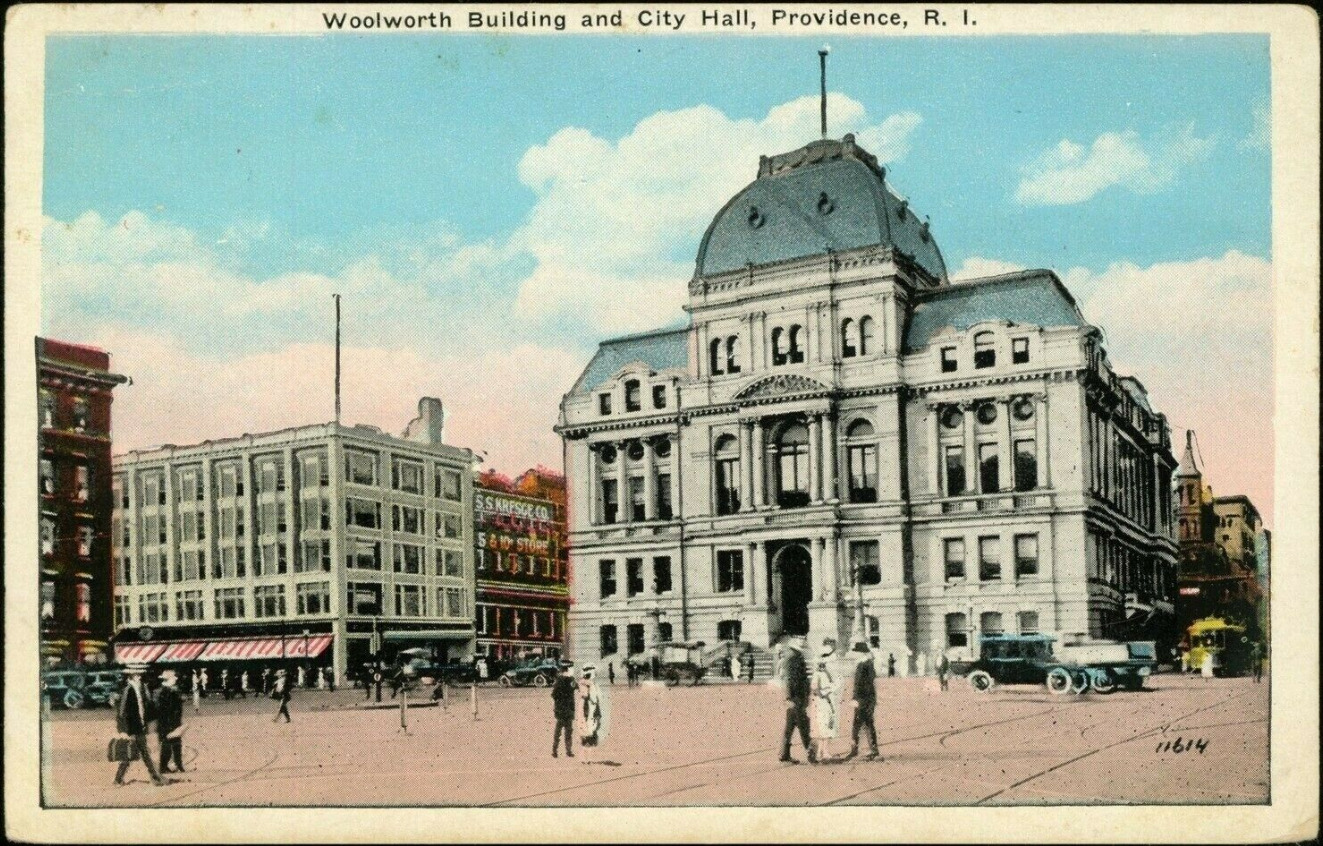
This week, another of my peeps through the door of a store, cafe or soda-bar known to Lovecraft. The Providence Woolworth or Woolworth’s was once a world-famous and much-loved budget department store chain. Here we see the wider urban context for the Providence store. It was just around the corner from the Biltmore Hotel and thus in the centre of the city…
Here we see what the blue-grey ‘tower’ was. The Woolworth building was also next to City Hall, and the store had a similar but presumably less salubrious “Kresge’s 5 & 10c” store opportunistically tagged on behind it.
This store was where, we now know from Letters to Family, Lovecraft acquired his nearly complete set of Our Empire’s Story, told in Pictures. As I wrote earlier…
He found four of this set at 10 cents each, while browsing for bargains before Christmas 1934 in the Providence branch of the Woolworth Store.
We might then assume that in the depths of the Great Depression he found some regular enjoyment in browsing here for small ‘micro bargains’, as people do in a recession, and he likely paid special attention to things like the stationery, budget reprint books, pencils and the sort of bargain candy that Woolworths was once famous for. We definitely know that the 20th century’s all-time champion letter-writer found his envelopes there circa springtime 1934, having finally run out of the supply he had from his friend Kirk. He wrote to Helen Sully in May 1934…
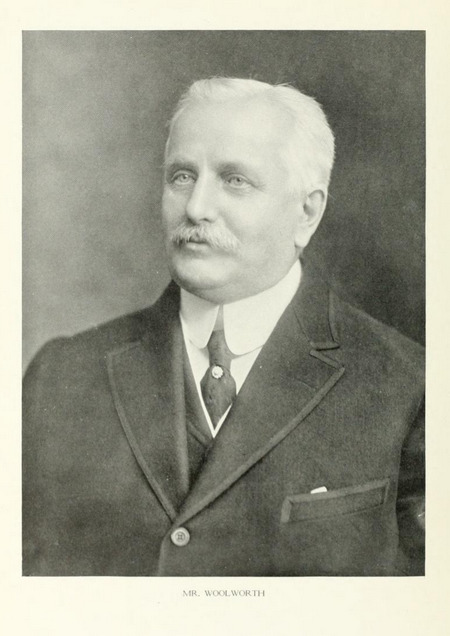
I may reply that the containing envelope (an honest product of my philanthropic stationer-in-chief, Mr. Frank Winfield Woolworth) is infinitely less likely to succumb to disintegration than were the ageing reliquiae of the (to my old correspondents) famous George W. Kirk charity stationery which I have been using for 9 years.
I Am Providence observed the pitiable poverty that lay behind such budget purchases…
In late 1935 we even read of Lovecraft having to conserve on ink: he felt unable to make repeated purchases of his usual Skrip ink, at 25¢ a bottle, and was trying to get by on Woolworth’s 5¢ brand.
In a letter to Rimel at the same time we learn he also uses the Woolworths writing pads and finds they agree tolerably well with his pen and the ink.
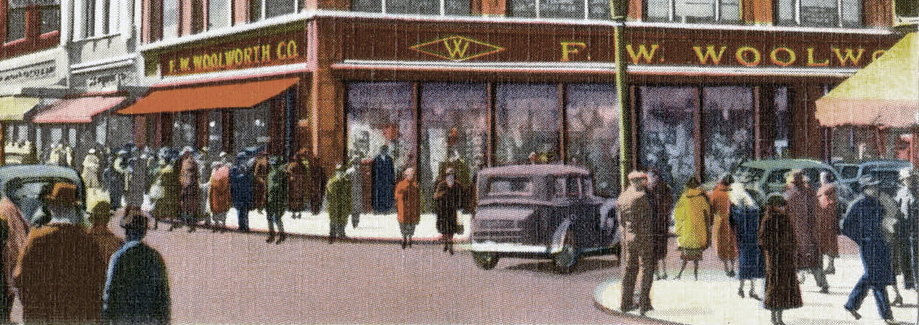
Here is a detail from an over-painted card of circa 1940, its impossibly gaudy colours toned down, which broadly indicates Lovecraft’s view on approaching the Providence Woolworth’s on foot…
And another of the same building, perhaps 20 years earlier and from further back…
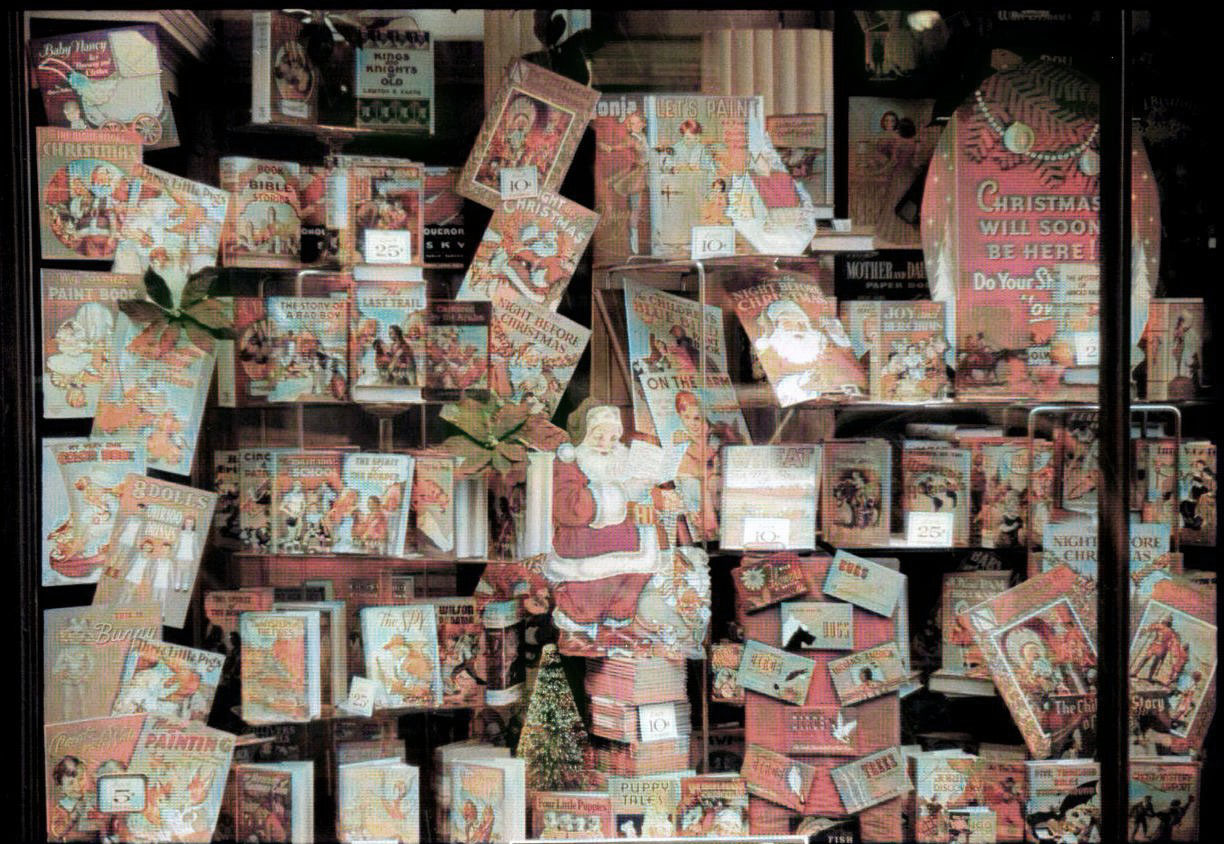
As one approached, the quality of the window dressing in the various show-windows would attract the eye and would probably cause Lovecraft to linger in front of those showing books. Here we see a typical Woolworth’s children’s book selection for Christmas, with books priced at 25 and 10 cents, and one item vaguely akin to Lovecraft’s Our Empire’s Story 10-cent books.
Since Lovecraft was keen to assure his Welsh correspondent (Harris) that the Our Empire’s Story illustrated books were also valuable as visual reference for adults, we might assume they were marketed to children and thus stocked in the children’s books section of the Woolworth store. In those days an old gent could browse a children’s section alone, without security guards being summoned. He elsewhere notes that books of other types might be found there… “Very fair atlases can be obtained at Woolworth’s”.
There were also displays of goods in the recessed main entrance. As seen below, their Providence store promoted the latest hit music records in this way. Lovecraft’s lowbrow musical taste would likely feel right at home here.
The store may have glittered like this but he liked “Frank’s” lack of pomposity, as evidenced his “To a Sophisticated Young Gentleman” poem (1928). In this he remarked that young Long was as… “devoid of Pomp as Woolworth’s”.
Ken Faig has recently identified “Frank’s” as Lovecraft’s sometime name for Woolworth’s. Evidently the master whimsically felt as if Mr. Frank Winfield Woolworth were a sort of capitalist philanthropist-magician, personally conjuring up for impoverished old gents their affordable boxes of envelopes, 5-cent ink-bottles, 10-cent illustrated history books and atlases, and occasional bags of chocolate creams.
18 Thursday Nov 2021
Posted in Historical context, Scholarly works
Spring 2022 Colloquia at Providence College, Rhode Island.
12 Friday Nov 2021
Posted in Historical context, Lovecraftian places, Picture postals
This week’s Friday ‘Picture Postal’ continues the loose Florida theme, begun for me by a recent Voluminous podcast in which Lovecraft preparing for an epic trip to meet Barlow in De Land, Florida.
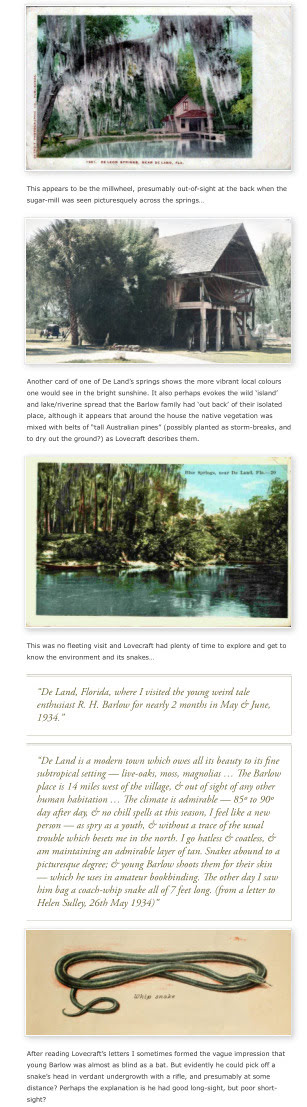
After his arrival at De Land, and settling into the Barlow spread some 14 miles away from the town centre, they began to visit such local tourist spots as there were. One of these places was the nearby De Leon Springs. It was an obvious choice, as there was then a choice bit of antiquity for Lovecraft to enjoy.
Among our diversions have been several trips to ancient places of the sort I dote upon…. including a Spanish sugar-mill at De Leon Springs which antedates 1763 (vide enc. [see enclosed free-leaflet or postcard]). … [many such places having] the tropical background & marks of the jungle’s reconquest, being picturesque & exotic to the highest degree” (letter to Helen V. Sulley)
This is what the spot looked like…
“Tall trees casting a sinister twilight over shallow lagoons…” (Lovecraft on a 1931 visit to Florida).
Another card of one of De Land’s springs shows the more vibrant local colours one would see in the bright sunshine. It also perhaps evokes the wild ‘island’ and lake/riverine spread that the Barlow family had ‘out back’ of their isolated place, although it appears that around the house the native vegetation was mixed with belts of “tall Australian pines” (possibly planted as storm-breaks, and to dry out the ground?) as Lovecraft describes them.
This was no fleeting visit and Lovecraft had plenty of time to explore and get to know the environment and its snakes…
De Land, Florida, where I visited the young weird tale enthusiast R. H. Barlow for nearly 2 months in May & June, 1934.
The following summer he spent a mammoth 10 weeks there. It was, arguably, during these times that he was probably most happy/healthy as an adult.
De Land is a modern town which owes all its beauty to its fine subtropical setting — live-oaks, moss, magnolias … The Barlow place is 14 miles west of the village, & out of sight of any other human habitation … The climate is admirable — 85º to 90º day after day, & no chill spells at this season, I feel like a new person — as spry as a youth, & without a trace of the usual trouble which besets me in the north. I go hatless & coatless, & am maintaining an admirable layer of tan. Snakes abound to a picturesque degree; & young Barlow shoots them for their skin — which he uses in amateur bookbinding. The other day I saw him bag a coach-whip snake all of 7 feet long. (from a letter to Helen Sulley, 26th May 1934)
After reading Lovecraft’s letters I sometimes formed the vague impression that young Barlow was almost as blind as a bat (“he is very unfortunately handicapped by poor eyesight” etc). But evidently he could pick off a snake’s head in verdant undergrowth with a rifle, and presumably at some distance? Perhaps the explanation is he had good long-sight, but poor short-sight?
Screenshot of missing pictures:

11 Thursday Nov 2021
Posted in Historical context
A new post on Deep Cuts goes in search of Lovecraft’s Other Aunts and Great-Aunts.
I took the opportunity to step back a bit from the aunts to their mother — H.P. Lovecraft’s grandmother. This proved somewhat interesting. Lovecraft once wrote to Moe…
“[In my family tree there is] a knight (Sir Lancelot Allgood of Nunwick) [who I have as one of] my great-great-great-grandfathers” (Selected Letters III)
This was via Helen Allgood (1820–1881), Lovecraft’s paternal grandmother (married 1839). She evidently derived from the Allgood family in Northumberland, in the far north of England. Lovecraft later corresponded with her sister from circa 1905, on the family history she had been researching. Lovecraft learned that Helen and her sister were… “of the [Allgood] line of Nunwick, near Hexham, Northumberland”.
Landed Families of Britain and Ireland now has a long 2014 research article on “Allgood of Nunwick Hall and The Hermitage”, with evocative pictures and several pertinent items. Although Lovecraft’s grandmother does not appear to have been in the central line of Allgood descent, there is no reason (that I know of) to doubt that she was not somehow ‘of that family’ and that her line had originated near Hexham. Lovecraft might then have been delighted to learn he was related by very distant and disreputable blood to a leading 18th century writer, albeit a cookery-book writer. Landed Families explains…
Lancelot Allgood (1711-82) … established the Allgoods as one of the leading gentry families in the county. His father, who died in 1725, seems to have lived a life of some dissipation with a wife and son in Northumberland and a mistress and family in London. The only survivor of his illegitimate children was in fact the cookery writer, Hannah Glasse, whose The Art of Cookery was the most successful cookery book of the 18th century.
Sir Lancelot Allgood was indeed a Knight, as Lovecraft stated. Also a Member of Parliament, and the nominal High Sheriff of Northumberland. He could trace his family line back some 400 years to Devonshire. Lovecraft evidently knew something of him and his roles, since in a letter he noted…
the head of the Allgood house in Northumberland seems always to be High-Sheriff of the County, even to this day; a sort of hereditary manorial appurtenance” (Selected Letters II)
He, like Lovecraft, was also enjoyed wide views of a wild landscape made settled and mellowed by hard work. Again, Landed Families explains…
In 1769 it was said that “Sir Lancelot has given a new face, as it were, to the country about Nunwick, within the space of a very few years, by making plantations, enclosures and good roads”, and nearer the house he laid out gardens: “a grove to the west, a grass-lawn to the south, and a terraced gravel-walk to the east, which commands a view to Chipchase at one end, and a variety of prospects on the other.”
What was the connection, exactly? Lovecraft explains it in a letter to Barlow (O Fortunate Floridian). As he understood it in 1934, a William Allgood of Nunwick married Rachel Morris in 1817…
and became the father of Helen (Allgood) Lovecraft, my father’s mother.
And also of her surviving sister Sarah, a great-aunt whom Lovecraft had corresponded circa 1905. Both were, as the “Lovecraft Family in America” page at hplovecraft.com states…
daughter[s] of William Allgood (1787–1848) and Rachel (Morris) Allgood (1796–1843), both natives of Wales.
So, that’s interesting, if their birthplaces rather than residency can be shown to be Wales. I suspect the latter. My guess here is then… ‘of the line of Hexham’ that went back to Sir Lancelot Allgood, but… moved to Wales just before economic hard-times of “the hungry ’20s” set in? According to Ancestry “Wales” is indeed the given 1820* birthplace of their first child Helen Adelia Allgood (1820-1881), presumably identical with Lovecraft’s grandmother. But of her father and mother no birthplace is stated.
What place in Wales was she born, exactly? That appears to be currently unknown, perhaps unrecoverable. The British Census did not start recording names etc until 1841.
Though there were evidently many Allgoods at Pontypool in the far south of the Welsh Marches, where they were well-known makers of exquisite and well-regarded ‘Japanned’ lacquered boxes and the like. They even had a William Allgood who threw up this business and emigrated to America in 1822 to establish himself in the grocery trade. The town nestled in the hills some miles back from the great sea-port of Cardiff — perhaps a cheap port from which to embark for a new life in what was then still a rough-tough gun-slinging America.
Whatever the apparent location in Wales in the early 1820s actually was, Lovecraft is certain that ‘his’ William Allgood and family were established in America by 1829…
The only duel I know of in my own family was fought by my great-grandfather William Allgood (a native of Northumberland, England) in 1829 in the country near Rochester, N.Y., over animosities bequeathed by the War of 1812. Slight bullet-wounds to both participants formed the only results…” (Selected Letters IV).
I could be wrong, and I don’t have all the relevant books and articles, but if the Wales identification is correct then my hypothesis would thus be:
– William came-of-age at 21 circa 1808 in Northumberland;
– in 1817, at age 30, he had been successful enough in life to marry 21 year-old bride Rachel, seemingly also of Northumberland and of good stock;
– the couple were resident in Wales by 1820/21, where their first daughter was born among Allgood relatives;
– as the ‘hungry 1820s’ bit and the local trade failed, they anticipating a move to America from a nearby Welsh port;
– the growing family were in America circa the mid 1820s, and certainly by 1828.
* Some sources say 1821. It was then a common practice to record the birth certificate later than the actual birth, which may explain the discrepancy.

08 Monday Nov 2021
Posted in Historical context, Kipling, Scholarly works
Following my recent post on Kipling’s classic early science-fiction “With the Night Mail: A Story of 2000 A.D.” (1905, written 1904) I was pleased to find the sequel on YouTube: “As Easy as A.B.C: A Tale of 2150 A.D.” (1912 two-part serial, written circa 1907, in book form 1917). Comparing the two titles might make you think the sequel moves ahead by 150 years. It did, at least for the serial magazine publication. But as the authoritative Kipling Society says, Kipling later rolled the date back to 2065.
The year 2000 is an orderly world of high-technology, in which the British Empire appears to have been untroubled by either world war. The Empire has imperceptibly shrunk and morphed into the relatively light-touch global Aerial Board of Control (A.B.C.). A sort of ‘Commonwealth of the Air’, melded with a global Post Office and Merchant Shipping Service and in efficient charge of the world’s commerce and communications.
Heinlein is said to have been strongly influenced by the overall style of the first story, which was a huge ‘hard sci-fi’ breakthrough for its time. This second story is less serious in tone, probably Kipling’s wise choice. The wry humour sweetens the digestion of a clutch of grim themes.
[Spoilers follow]
By 2065 the A.B.C. has become a no-nonsense world government of-a-kind, with a garden-city London as the capital. It is efficient and incorruptible, partly because a kind of libertarian affluence is now ubiquitous and no-one can be bothered by such hard work. Human “executive capacity” has anyway become so hard to find, in a world in which a plague has reduced the global population to some 500 million, that the A.B.C could not rule the world even if they wanted to. The supine 1920s League of Nations or aggressive 1930s Axis it is not, and the A.B.C. ably services a world in which a plague has caused people to become nomadic and extremely averse to crowds and public touching, and to largely live very private and isolated lives. Under the benign oversight of the A.B.C. the world’s people can seemingly go anywhere they like, affluent and seasonally flitting from place to place in their fliers in search of privacy. Robot-like machines work the farm fields. So long as they do not interfere with commerce or the food supply or badger their neighbours, the tall and long-lived people of the time seem free to go live where they want. Think wild camping, gone high-tech glamping with airships, and with healthy ‘social distancing’ enforced by genetically-engineered screens of super-fast growing trees.
There are of course a tiny number of remaining anti-civilisation luddites, short and aged-looking and emotion-fuelled. Their cult-like groups flare up rarely in places such as the re-forested farming backwater of Chicago, where they aggressively agitate for the old ways and annoy the hell out of normal people. They can sometimes be reasoned out of their madness (as Russia tries to do), or can be persuaded to go about their amusingly primitive ways in a quasi-zoo akin to our ‘living museum’ format.
In terms of the technology Kipling’s ideas about a future ‘world-government based on airpower’ would become a commonplace by the 1930s (the later Wells, etc). Kipling’s original airship utopia had already gone beyond such things (“war went out of fashion”), though a small airship fleet armed with crowd pacifier-rays and sonic-stunners is maintained in case of need.
The talk of “plague” in the second tale throws a rather ghoulish back-light on the ‘isolated Greenland sanitariums’ of the first tale, and perhaps tells us why the airship crew solemnly ‘doffed their caps’ as the hospital ship passed in the dawn. In the second tale there are hints that the plague was linked to a tuberculosis that had developed in the abhorred “crowds” of the old world, who had once engaged in endless “talking” and “touching” due to their “settled living” in one place. There are hints that the Aerial Board of Control’s real problems for the post-2065 future will arise from other factors. The dwindling world birthrates in a post-plague world. The ennui and growing lack of curiosity among small-enclave populations, most still living in a plague-defence mindset. The obsessive yearning for privacy in a world of ubiquitous communication and open travel. It all sounds rather familiar.
Though it should be said that there is one strong hint that the birthrate problem will have a technological solution, so this is not a doomed ‘Radium Age’ civilisation, just one with its own interlocking set of problems to solve. Kipling seems there to be setting himself up for a third story. Yet he wrote no other A.B.C. tales, and not a single later author appears to have adopted Kipling’s Aerial Board of Control universe.
Anyway, I was pleased to find “A.B.C.” available on YouTube. Several other YouTubers have it but in a rather poor bathtub Librivox recording.
For those wanting a text to work from for their own audio production, note that The SF Encyclopedia warns that “Night Mail” is presented “incomplete” in the volume Kipling’s Science Fiction (Tor, 1992), though doesn’t state why or what was cut. I can see no problem with the first story. Perhaps the commenter was not aware of the marked differences to be found between the two 1905 versions, and again with the 1909 version. The British 1905 version has a section of about 20 lines entirely missing from later printings, for instance.
For those wanting the original art, Marcus L. Rowland’s free PDF edition of both tales collects the various original illustrations/paintings and also has the original surrounding…
weather advisories, classified advertisements, shipping notices, and a wide range of other snippets, intended to suggest that the tale was in fact appearing in a magazine published in 2000.
Some of these are delightfully humorous and also informative, so don’t skip them in the audiobook.
08 Monday Nov 2021
Posted in Historical context, Scholarly works
Deuce Richardson celebrates “The Fiftieth Anniversary of DAW Books” and the role of Donald A. Wollheim therein.
For about fifteen years—under Wollheim’s firm guidance — there was an SFF golden age at DAW Books that may never be equalled.
I certainly have fond memories of several of them, though I seem to recall that relatively few made it to the UK other than on the used bookstalls. I’m uncertain if they were ever distributed new on the spinner-racks, over here. Other than in the UK’s rare specialist sci-fi shops and the dealer tables at 1980s conventions. Now there’s a topic for a fannish dissertation if someone is looking for such, Perhaps titled: Laser Focus: how British literary sci-fi fans built collections and developed tastes in the 1970s and 80s.
For those who can afford to collect DAW, rather than just pick up a couple of fondly remembered titles again, there’s a Starmont book which comprehensively covers the period, Future and Fantastic Worlds : A Bibliographical Retrospective of DAW Books (1972-1987) by Sheldon Jaffery. Not on Archive.org.
Gawd, look at those dates though. Actually they help me get into the world of Lovecraft a bit, in that (by comparison with the 2020s), those still living in Lovecraft’s 1920s could easily recall how things were in the 1870s and 80s. Much as many can today. Such drifting-away eras and their worldviews must have still been mentally and emotionally close to many oldsters in 1920s and even into the 1930s.
07 Sunday Nov 2021
Posted in Historical context
Sonia’s amateur journalism The Rainbow, Vol. 2 No. II (1922), now on Archive.org as an excellent scan. With fine pictures of Mrs. Miniter, Morton, Loveman, Lilian Middleton (S. Lilian McMullen), and a picture of a young Moe that I had never seen before. Plus “Celephias” by one H.P. Lovecraft.
No. 1 was reprinted as a facsimile, but No. 2 has never been widely available until now.
Deep Cuts has a new long post on The Rainbow.
07 Sunday Nov 2021
Posted in Historical context
Currently being uploaded to Archive.org from microfilm, Munsey’s Magazine 1891-1929. Not fully loaded yet, it seems, but what there is has been made usefully keyword searchable at the text level.
On its connection with and influence on Lovecraft, Joshi’s I Am Providence has…
One specific type of fiction we know he read in great quantities was the early pulp magazines. … As avid a dime novel reader as Lovecraft appears to have been, it is in no way surprising that he would ultimately find the Munsey magazines a compelling if guilty pleasure. What he did not know at the time was that they would radically transform his life and his career — largely, but not uniformly, for the better. There is no evidence of how long Lovecraft had read Munsey’s prior to the October 1903 issue (which, as with most popular magazines, was on the stands well before the cover date), nor how long he continued to read it.
Joshi explores this further in his essay “Lovecraft and the Munsey Magazines” (in Primal Sources and also the latest collection of Joshi’s essays on Lovecraft).
The first editor of Weird Tales had published many tales in Munsey’s. The magazine published Sax Rohmer in 1923, and was evidently publishing strange stories well into the 1920s.
Lovecraft’s local friend and collaborator C. M. Eddy found it a market…
He began his career writing short stories for a broad range of pulp fiction magazines such as … Munsey’s Magazine
Indeed, in 1923 Lovecraft had tried to break into Munsey’s. Most likely the target was their Argosy All-Story, but presumably the Manager Editor could have placed it in Munsey’s itself if he had a mind. Lovecraft had not yet established himself with Weird Tales and the tale was sent to Munsey’s at Eddy’s insistence…
It will interest you to observe the professional rejection of this piece [“The Rats in the Walls”] by R. H. Davis, Esq. of the Munsey Co., to whom I sent it at the insistence of my adopted son Eddy.” (8th November 1923, to Long)
One wonders what the thinking was here. The All-Story had sentimental value for Lovecraft, and also a wider circulation that would have some impact locally. But at the same time, to ‘land’ there would have then put him in a better bargaining position with Weird Tales, once (as Eddy probably anticipated) he quickly became a regular with WT.
05 Friday Nov 2021
Posted in Historical context, Picture postals
This week, a picture that evokes Lovecraft satisfying his craving for sugar.
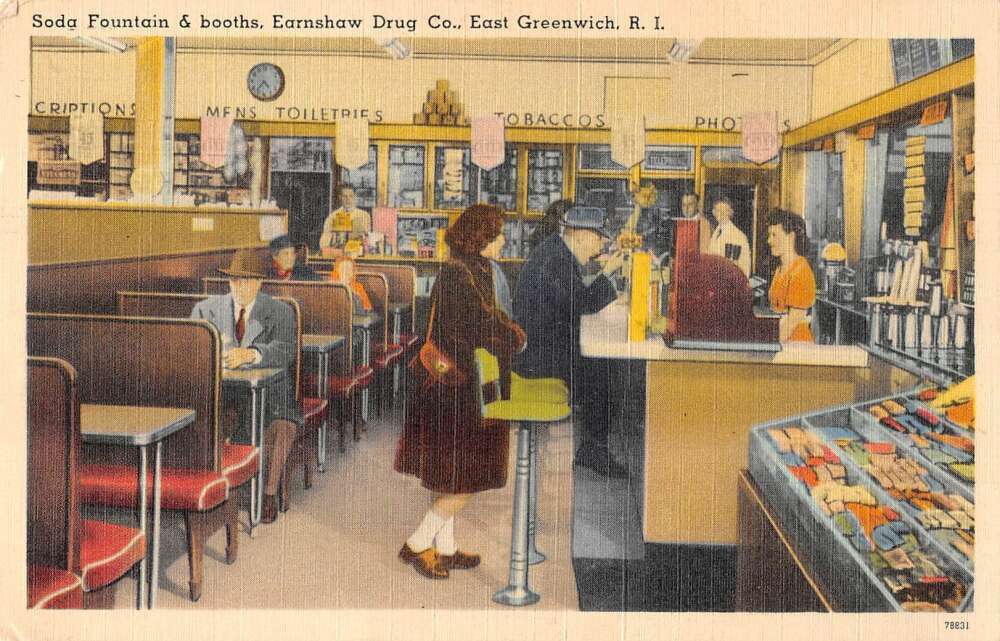
Here we see what appears to be typical soda-fountain inside a Rhode Island drug store. The British have never had quite the same thing in retail, but chemist shop would be about the nearest term. That doesn’t quite catch it, though, as in America the retail mix included tobacco sales and the soda-fountain counter/corner. Large doses of sugar and strong tobacco were considered healthy, back then.
The date is perhaps the late 1940s, a few years after the war? Though some may be able to date it more precisely by knowing at what point the wearing of ‘bobbie-sox’ became a student fashion among the girls of Rhode Island.
But even if as late as the early 1950s, it’s still generally indicative both of the look and the all-ages / all-genders nature of such places back in the 1930s. Note the good selection of candy bars, and the Lovecraft-a-like man at the counter. Possibly about to try the ice-cream and give his verdict.
Lovecraft knew East Greenwich, noting in his ‘homecoming from New York’ letter the train passing through… “East Greenwich with its steep Georgian alleys climbing up from the railway”. He had had close family ancestors there, and in the archives is a card he sent from there to Morton. Thus it’s not impossible he may have once stopped for a summer ice-cream at the East Greenwich soda fountain.
Lovecraft notes in Travels in the Provinces of America (1929) the jobs of “Everybody one speaks to”, talking of the usual pattern for his visits to place. His short list includes “soda-fountain men”, which indicates he frequented such places…
hotel clerks, soda-fountain men, [train] conductors, [tram car] motormen, coach-drivers
Why not coffee shops? I assume they might have been more heavily tobacco-smoky sort of places, their ice-cream could have been more expensive and in smaller portions, the staff could have been less buffed, and there could also be less opportunity to select one of the cheaper candy-bars to sustain him on a long walk. Being also a chemist shop, they were probably reliably ‘open all hours’.
They were also suitable place to take young friends. For instance, I recall reading that when Lovecraft arrived in De Land, to meet Barlow for the first time, they immediately repaired to such a place.
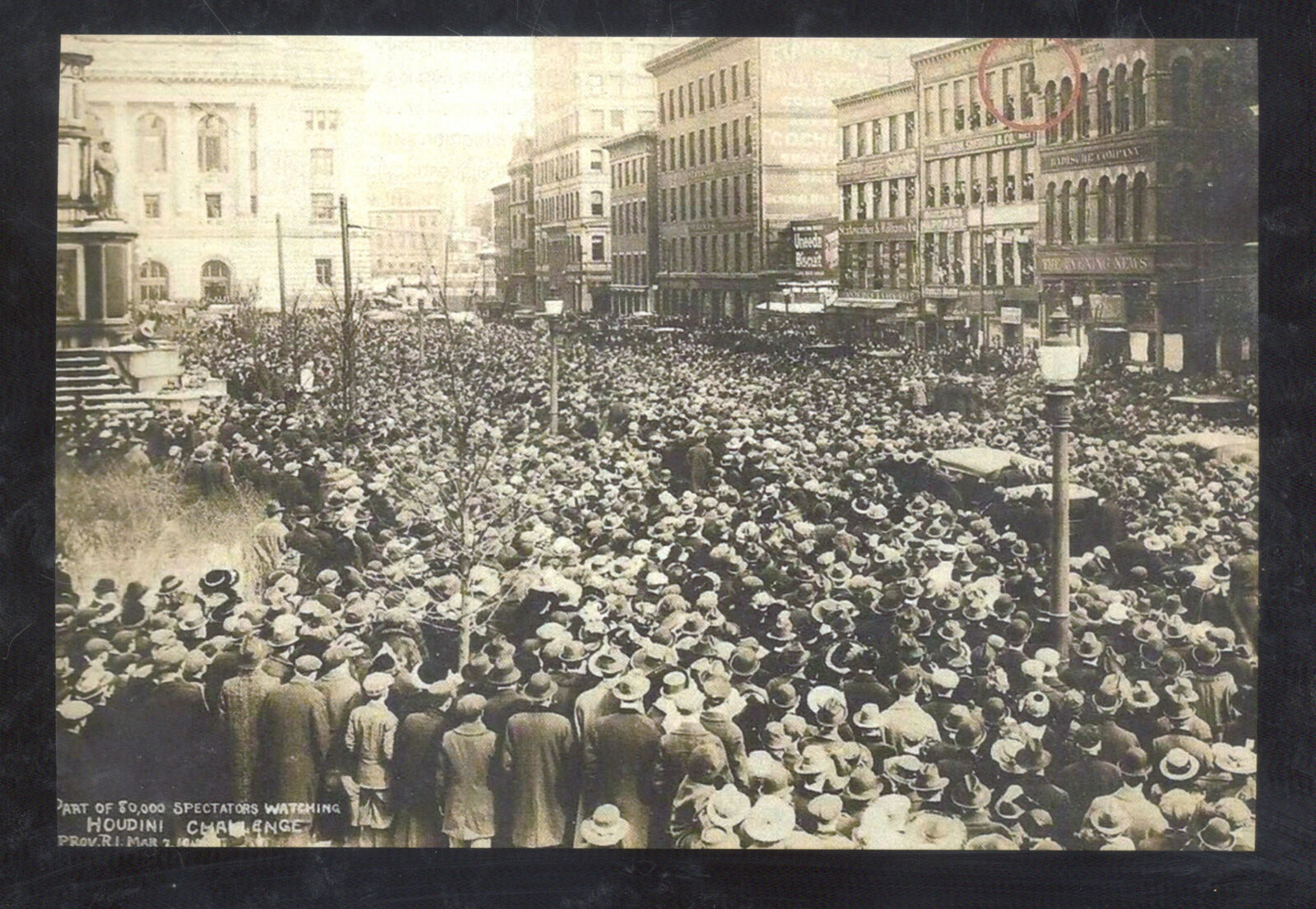
Also, back in January 2020 I found a postcard showing Houdini in Providence, performing in 1917 for a vast crowd outside the building showing “Evening News” on its facade. The picture was relatively small, though. I’ve just this week found a better larger version…
02 Tuesday Nov 2021
Posted in Historical context, Lovecraftian arts, Scholarly works
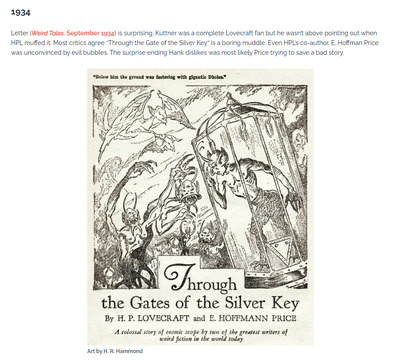
Dark Worlds Quarterly has a fine new illustrated timeline of Henry Kuttner’s Fan Letters to Weird Tales.
Talking of Weird Tales, S.T. Joshi’s Blog has updated. Among other items he brings news of a forthcoming collected stories of Robert Barbour Johnson, an author best known for his Lovecraftian ‘in the subways’ Weird Tales story “Far Below” (1939). I recall there’s already been at least one such collection, though perhaps not complete? The new book will also collect some of Johnson’s essays.
30 Saturday Oct 2021
Posted in Historical context
A Lovecraft letter reveals an item I don’t think I’ve ever noted elsewhere. Lovecraft states that his Weird Tales rival, Seabury Quinn, held a day-job as the Editor of The Casket. This being the twice-monthly trade journal for undertakers. Bacon’s Publicity Manual states of the title in 1933… “Goes to funeral directors and embalmers; circulation 8,900.”