• About
  • Directory
  • Free stuff
  • Lovecraft for beginners
  • My Books
  • Open Lovecraft
  • Reviews
  • Travel Posters
  • SALTES

Tentaclii

~ News & scholarship on H.P. Lovecraft

Tentaclii

Category Archives: Historical context

‘Picture postals’ from Lovecraft: In the White Mountains

10 Friday Dec 2021

Posted by asdjfdlkf in Historical context, Picture postals

≈ Leave a comment

In the spider-haunted Haverhill offices of the amateur journal Tryout, Lovecraft wrote the first of his published summer travelogues. It was a hasty, jotted affair, written to please the venerable old editor and give him some copy. But it was published and thus gives us a clear account of what he was doing and where he was going in the second half of August 1927. It appeared in Tryout for September 1927, titled “The Trip of Theobald”. One small point it reveals is Lovecraft’s first real experience of genuine mountains. As a young boy he may well have glimpsed some in a hazy blue distance from a train, but here he means mountains ‘up close’…

Saturday took a cheap excursion to the White Mountains — saw real mountains for the first time in my life, and had some superb views at Crawford Notch. Ascended Mt. Washington by cog-wheel railway, and had some splendid views on the way up, though it rained just as I reached the summit. (from “The Trip of Theobald”)

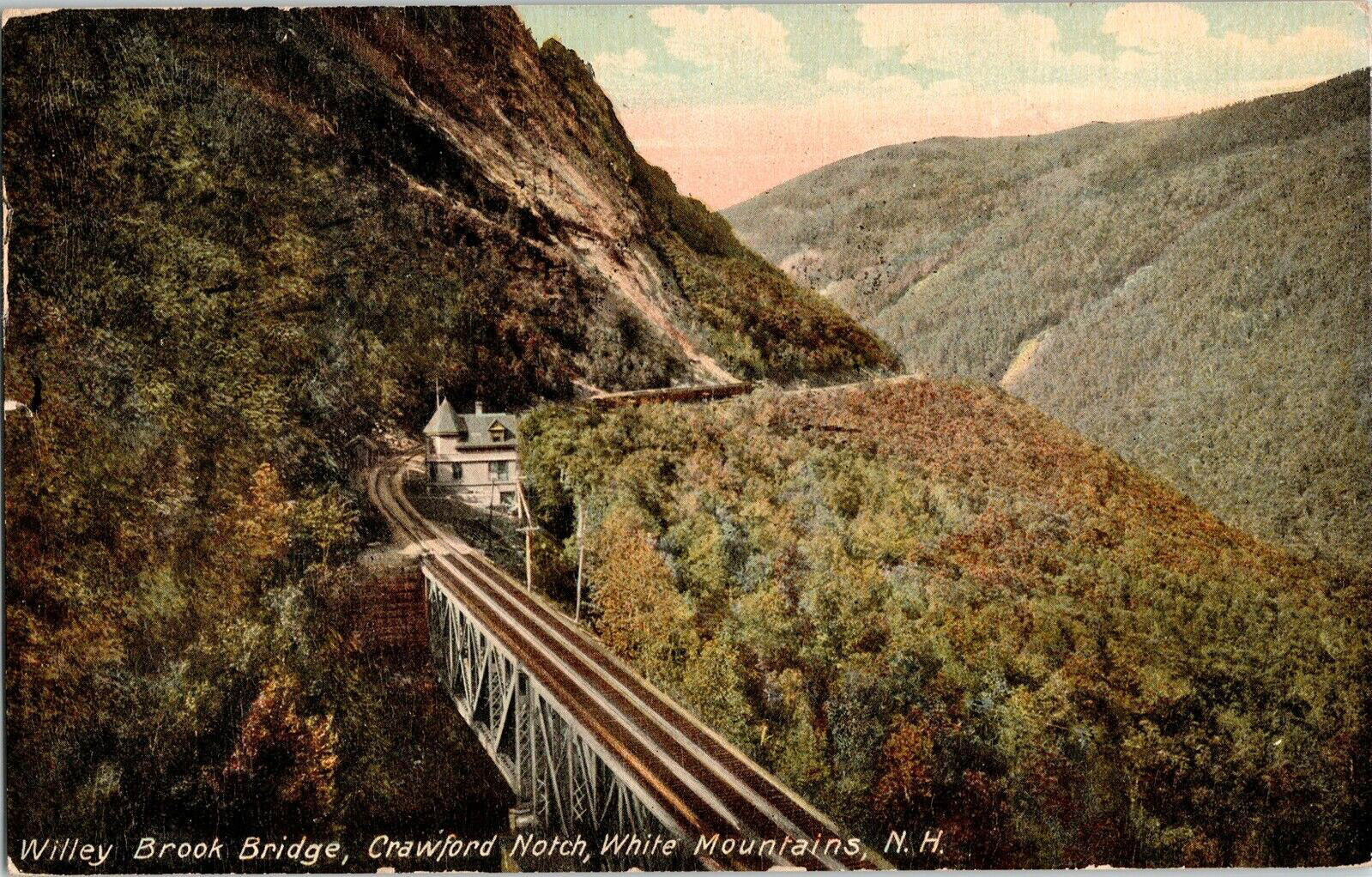
Postcards suggest it would have been quite an excursion by rail, with elevated bridges sweeping across deep gorges and the view climbing every higher….

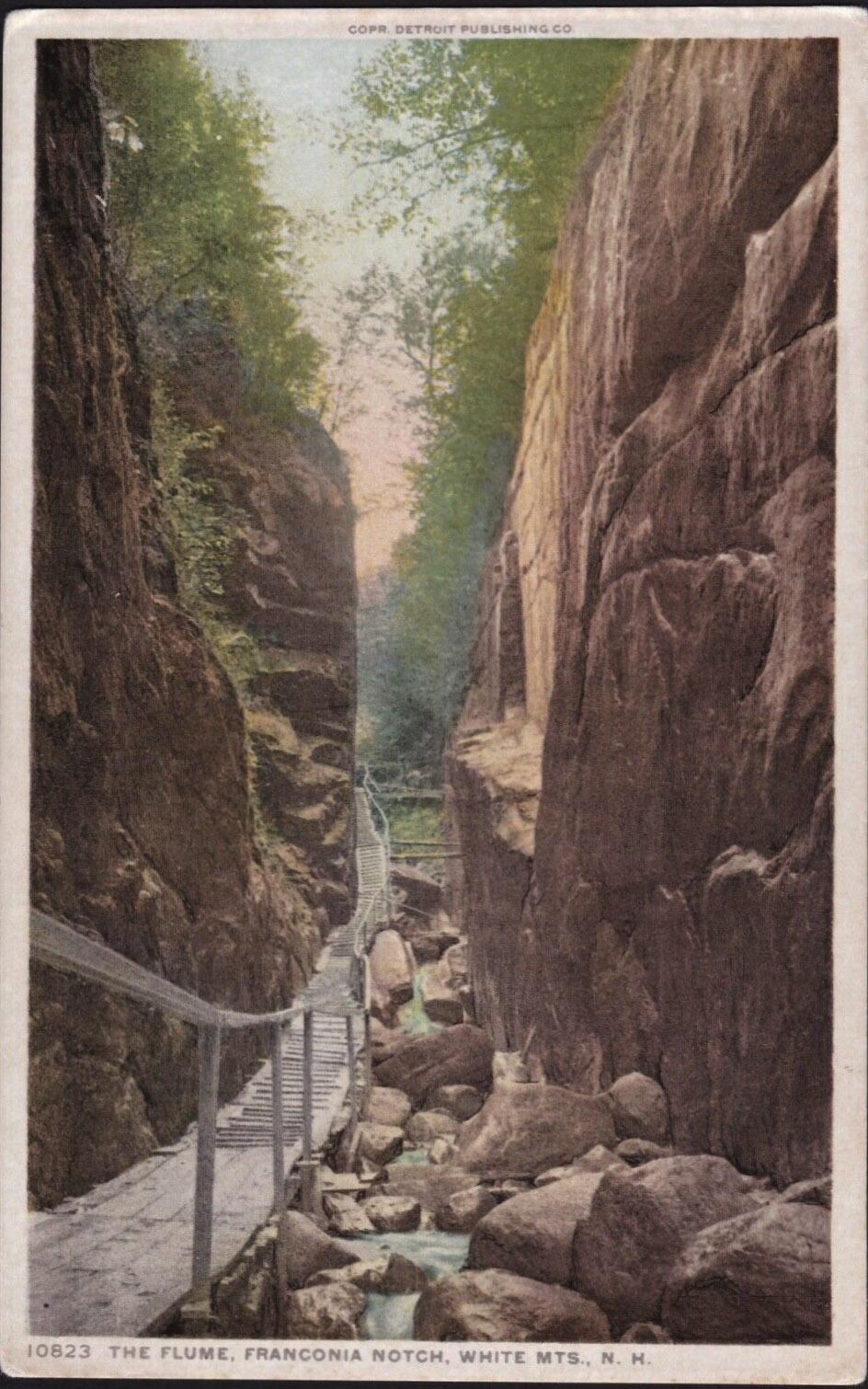
From there he sent Donald Wandrei a postcard of “The Flume, Franconia Notch, White Mountains, NH”.

Note the ‘face’ that greets visitors, with an eel-like fish-head alongside it…

Further along the Franconia Notch…

Franconia Notch appears to be where the “Old Man of the Mountains” was, and presumably still is, located or at least to be viewed. This seems a natural place for an excursion to visit. My feeling is that the day’s itinerary was: Franconia Notch and the Old Man; Crawford Notch; and then the ascent of Mount Washington. The high stone head cannot have influenced Dream-quest, since the draft had been completed by 22nd January 1927 — unless Lovecraft knew of the excursion and was researching his August trip for summer 1927 before Dream-quest.

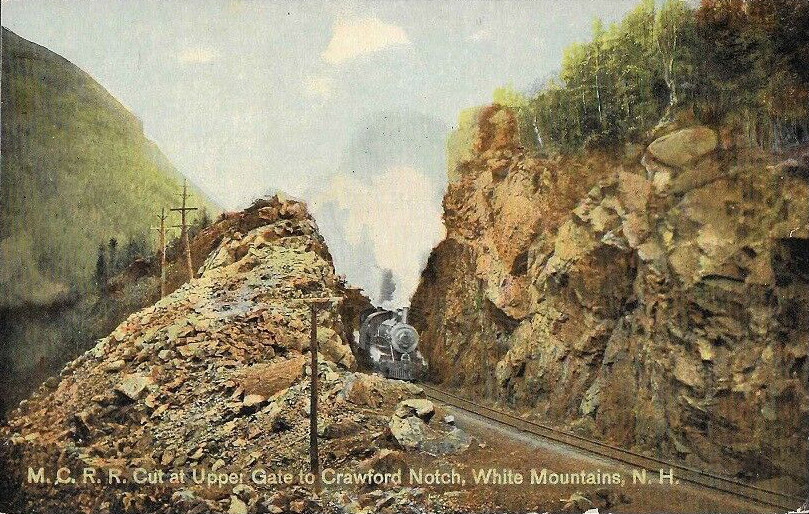
The postcard to Donald Wandrei appears to be the only evidence he was at Franconia Notch. But Lovecraft definitely mentions the Crawford Notch and its view. Here we see the train entering the ‘gate’ of the Crawford Notch…

And one of the views, once arrived there…

S.T. Joshi notes that elevations “less than 6,300 feet above sea level” are not technically mountains, despite this large region being sold to tourists in the 1920s and 30s as ‘The Switzerland of America’. But they were impressive nonetheless and — unlike Tolkien who had by then walked the high passes of the actual Switzerland — Lovecraft had nothing to compare them with. In 1929 he recalled their “grandeur”, in a letter to Derleth…

in northern New England we see the same type of landscape features on an enhanced scale – with a ruggedness which now and then (as in the White Mountains and some parts of Vermont) ascends into positive grandeur.

By 1932 he had still not seen a comparable sight. He recalled for Miss Toldrige in August 1932…

I wouldn’t mind seeing some good-sized mountains sooner or later — my mountainous experience having been confined to a single excursion (1927) to New Hampshire’s White Mountains, On that occasion I took the cog-wheel railway up Mt. Washington, but was deprived by sudden mists of a view from the summit. Still, it was spectral up there — with no sign of the earth below, & cosmic winds sweeping by from out of the unknown depths of space. I felt more isolated from this planet — & more potentially in touch with the unplumbed abysses of outer ether — than on any other occasion. The image lingers, & I may make fictional use of it sooner or later.

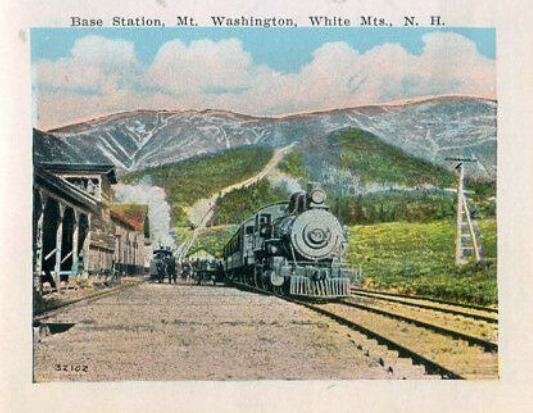
The cog-wheel railway up Mt. Washington began at the base station…

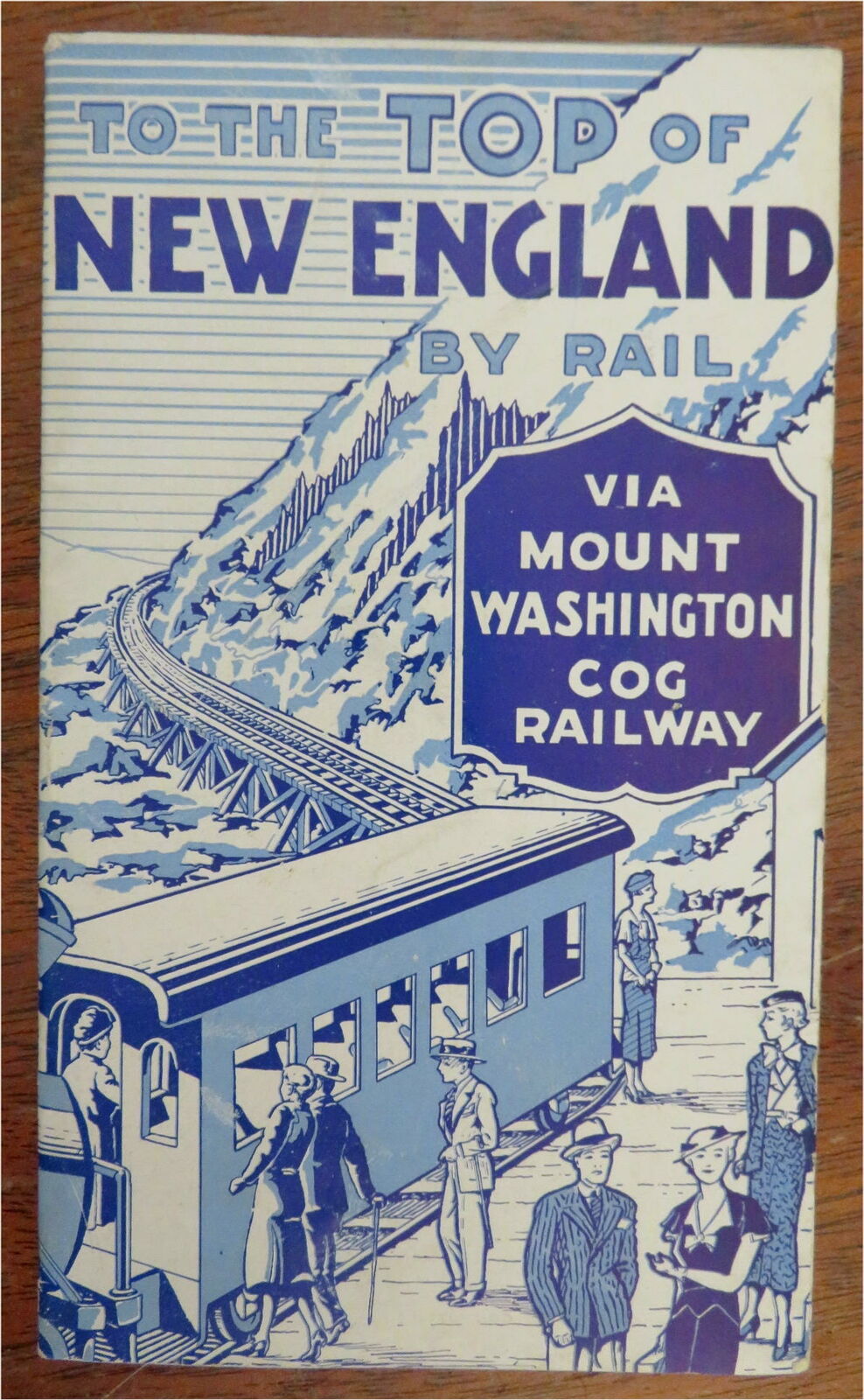
Here day-trip passengers disembarked and boarded a special high-level ‘mountain train’, seen here in a brochure-leaflet of the period…

Coming down must have been a bit of a hair-raiser, too.

The same brochure reveals the summit was ‘arctic’ in nature.

Lovecraft had already written At the Mountains of Madness by this point, and one wonders what his comment on this arctic landscape — “I may make fictional use of it sooner or later” — might have led to had he lived.

Here is a view from the summit, as it was when rain and mist did not obscure…

The Spirit of Revision, second edition

09 Thursday Dec 2021

Posted by asdjfdlkf in Historical context, New books, Podcasts etc., Scholarly works

≈ Leave a comment

There looks set to be a…

hardcover, full-colour second edition of the book The Spirit of Revision: Lovecraft’s Letters to Zealia Reed Bishop

It’s one of the stretch goals for the HPLHS’s Miskatonic Missives crowd-funder. Possibly only available that way, though I guess you might eventually be able to get it via the regular HPLHS Store.

The HPLHS also have a new Voluminous podcast on H.P. Lovecraft, Detective, doggedly solving a dastardly crime at the Haverhill Post Office.

The valuable stolen ‘Dickeybird’ item is a little low-res on their page, so here’s a large one…

Along the way they’ve also found Morton’s article on the virtues of local natural history museums (Oregon Mineralogist, March 1934).

The Lumley revisions

05 Sunday Dec 2021

Posted by asdjfdlkf in Historical context, Lovecraftian arts

≈ Leave a comment

Walking the Strangeways digs up Three poems by William Lumley (1934-1935) of Buffalo N.Y. These are…

* “The Dweller” (1934) by William Lumley. [Definite HPL revision]
* “Shadows” (1934) by William Lumley.
* “The Elder Thing” (1935) by William Lumley. [“Perhaps” a HPL revision]

The first and last are obviously chanter-poems meant for oral recital in the old lugubrious manner, and are rather lively in their way.

Of the three The Ancient Track has only the first, “The Dweller”, in the appendix “Lovecraft’s Revisions of Poetry”.

The Lovecraft Encyclopedia has…

HPL also revised Lumley’s “occasional bits of verse”, perhaps including “The Elder Thing”

… but says nothing of “Shadows”. It does seem poor and different compared to the other two, and it doesn’t feel like one Lovecraft revised.

Elsewhere in poetry this week, The Lone Animator announces he is working on a stop-motion animation for Donald Wandrei’s poetry sequence “Sonnets of the Midnight Hours”.

‘Picture postals’ from Lovecraft: “Rhoby”

03 Friday Dec 2021

Posted by asdjfdlkf in Astronomy, Historical context, Picture postals

≈ Leave a comment

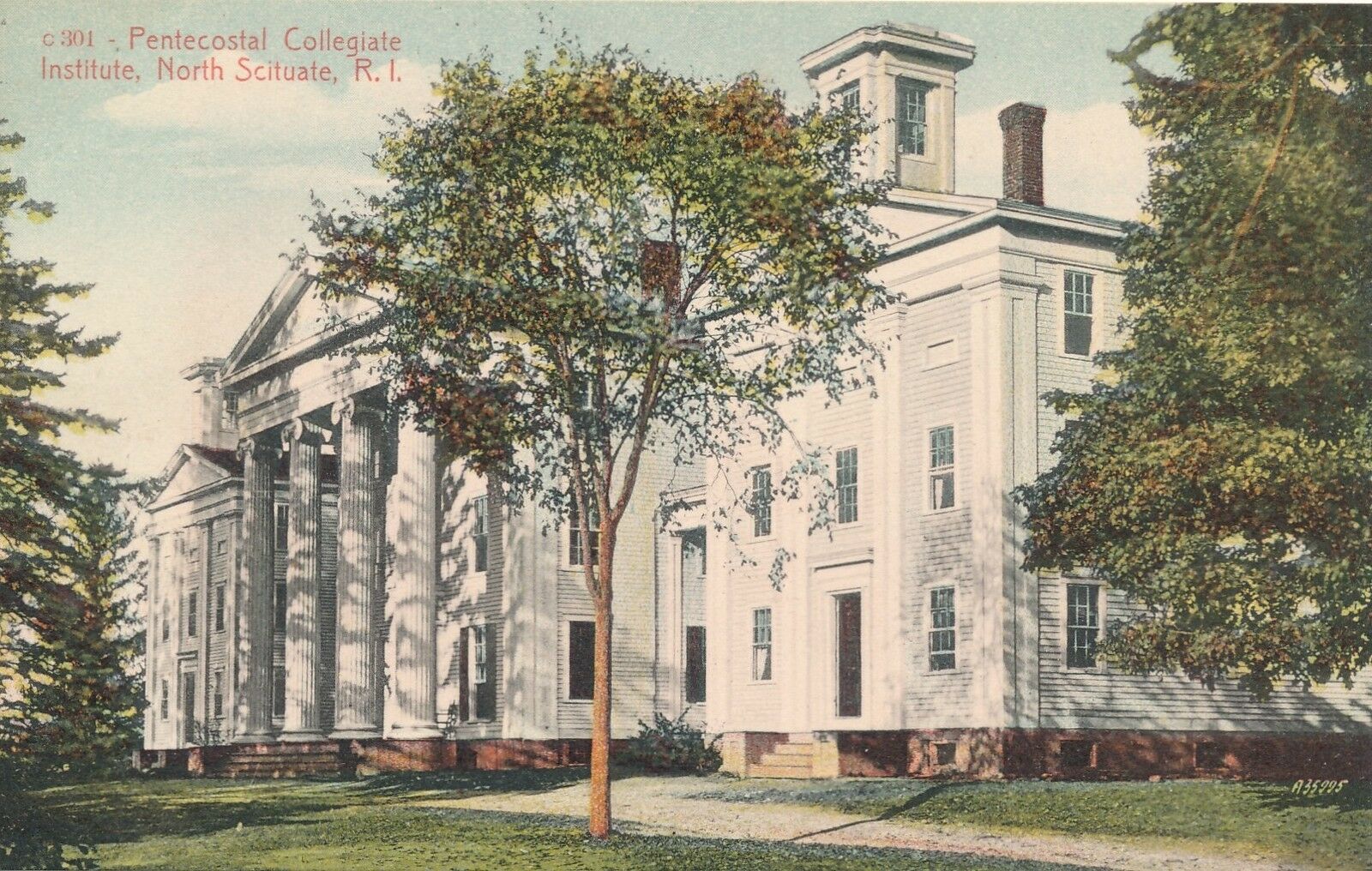
This fine postcard evokes the rural world in which the wife of Lovecraft’s maternal grandfather, and later Lovecraft’s mother, came of age. A small public library, barely bigger than a chicken-coop, with a chicken-yard to one side. Possibly eggs were sold for a nominal amount, as an enticement to children to join the library. The location is North Scituate which is about six miles west of the very centre of Providence. Robie (known to Lovecraft as ‘Rhoby’) — Robie Alzada Place (1827–1896) — is the one who gives the place the connection to Lovecraft. S.T. Joshi, in I Am Providence, notes of her…

Of Whipple Phillips’s wife Robie [married Jan 1856] very little is known. Lovecraft states that she attended the Lapham Institute (cited by Lovecraft as “Lapham Seminary”) in North Scituate, Rhode Island … but does not supply the date of her attendance.

Lovecraft explained the somewhat convoluted family line, to Moe in a letter…

These [ancestors] marry’d, respectively, Stephen Place and Jeremiah Phillips — and in the next generation Sarah’s daughter Rhoby Place (nam’d for her aunt) marry’d Rhoby’s son Whipple Phillips …. these espoused cousins becoming my mother’s parents.

The Lovecraft family ‘Commonplace Book’ contained much information about Robie’s Place family and ancestors at nearby Foster, R.I. de Camp’s biography of Lovecraft, perhaps leaning on oral evidence that has not come down to us, has…

In 1855, he and his younger brother James fell in love with two local girls, Robie Alzada Place and her cousin Jane Place. Said Whipple to James: “You take Jane and the farm, while I take Robie and go to Providence to seek my fortune.

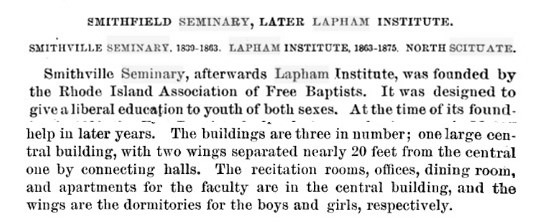
The newly married couple then lived a few miles further west, at Foster, in the homestead built there by her father Stephen Place and in which Robie had been born. (Lovecraft’s mother was also to be born at the Foster house). One might then suspect that the unmarried Robie had regularly travelled the few miles from Foster to North Scituate for her schooling. But a little research reveals a new data point. It was a boarding school with large boarding facilities for girls, and she may thus have been staying there in the week and then going home at weekends…

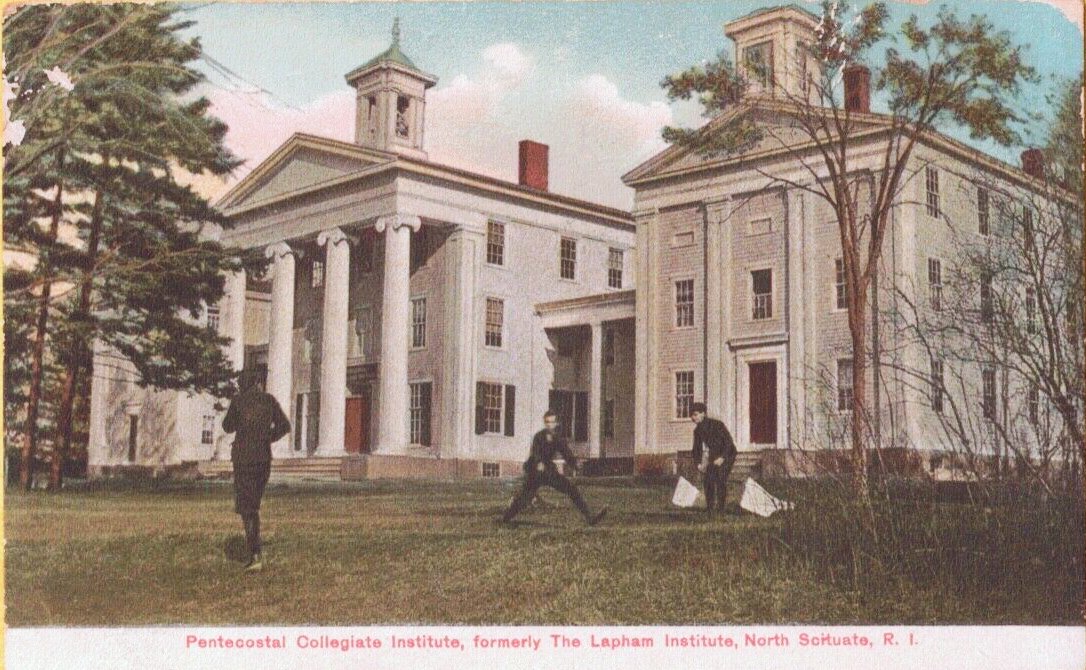
Her most likely attendance dates centre on circa 1845-50, with Lovecraft himself suggesting from “1845” in one letter. The school would have been known as the “Smithville Seminary”, here seen circa 1900 and with the frontage much unchanged. One assumes a school library matching that of the town itself, and perhaps with some connection between the the two libraries.

Did Lovecraft ever visit? He certainly passed through the general district at his leisure on his 21st birthday. Since he had treated himself to an epic all-day tram (‘car’) ride. This first sent him out of Providence and…

riding westward through the picturesque countryside of my maternal ancestors” (letter to F. Lee Baldwin, 1934)

On his return from New York his family history researches may have taken him there in pursuit of memories of Robie and her schooling, and especially her astronomical work. We know that in the mid 1920s, after returning from New York, he made several long and intensive ‘gleaning’ expeditions to Foster and Greene and roundabouts in search of family history.

However, he may not have found much. By 1923 the Institute had passed through several hands and the old Baptist records and yearbooks had undoubtedly been removed to Baptist archives. By 1923 it had become established as the Watchman Institute, though there were bad fires there in 1924 and 1926 and “both wings burned down” according to one history. One has to wonder if there was much there for Lovecraft and his aunt to glean circa 1926-28, other than a brief stroll past the smoke-stained frontage and around the charred grounds.

But Lovecraft might have learned something of the texture of the old life, in Foster and North Scituate, nearer to home. Because his near-lifelong Providence barber came from North Scituate, and one thus imagines that the barber’s memories of the place and its gleaming ‘school on the knoll’ came up from time to time in the barber’s chair…

Had my hair cut yesterday by the same old barber who removed my flowing curls in 1894. He’s a good old R.I. Yankee of the 7th generation of North Scituate settlers.” (May 1926)

There was also a fine new observatory in North Scituate, albeit 75 years later and private. Lovecraft’s “The September Sky” newspaper astronomy column (1st September 1914) concluded by noting the opening of the then-new observatory there…

Of particular interest to Rhode Islanders is the opening of Mr. F. E. Seagrave’s new private observatory in North Scituate, about two miles north of the village. The building stands on an eminence 342 feet above sea-level, free from the smoke and lights of the city, and commanding a magnificent view of the celestial vault.

The observatory had formerly been on 119 Benefit Street, Providence, but there appears to be no evidence of the young Lovecraft being invited to visit the new one on Peeptoad Road. But Robie might have done so, and before the building of the observatory there. Robie had been a Baptist, but that did not then preclude also being an astronomer with a substantial library and presumably a telescope to match. Lovecraft told Moe in a 1915 letter…

My maternal grandmother, who died when I was six, was a devoted lover of astronomy, having made that a speciality at Lapham Seminary, where she was educated; and though she never personally showed me the beauties of the skies, it is to her excellent but somewhat obsolete collection of astronomical books that I owe my affection for celestial science. Her copy of Burritt’s Geography of the Heavens is today the most prized volume in my library.

Robie’s Smithville Seminary was itself on a knoll, perhaps good enough for observing. But back in circa 1845-55 (before the building of the observatory), could Mr. Seagrave’s apparently excellent 342-feet high observing hill have also been one regularly visited by parties of local amateur astronomers — Robie among them?

Lovecraft’s first letter in its magazine context

01 Wednesday Dec 2021

Posted by asdjfdlkf in Astronomy, Historical context

≈ Leave a comment

Currently on eBay, H.P. Lovecraft’s first publication. In Scientific American for 25th of August 1906. In those days Scientific American was about science, not politics.

Interesting to note that this had a cover featuring the New Croton Dam (construction 1892-1906), given the later subject-matter of “The Colour out of Space”. The Dam and its vast lake gathered and sent the first out-of-city supply of water to New York City.

Lovecraft proposed a multi-observatory photographic method of discovering a planet beyond Neptune, at the edge of the solar system. He goes so far as to suggest, basic on his own cosmic observations, that a spot known to him at “50 units” out would be the place to start. The planet Pluto (yes, it is a planet) is sometimes at that distance, a textbook stating it…

averages 40 astronomical units from the Sun, but it ranges from 30 units to 50 units.

It might be interesting for the forthcoming book on Lovecraft’s astronomy to determine: i) when and how he was making the observations that led him to propose “50 units”; and ii) if Pluto was indeed at 50 units out at that time.

Audiobook: Fearsome Creatures of the Lumberwoods (1910)

27 Saturday Nov 2021

Posted by asdjfdlkf in Historical context, Podcasts etc.

≈ Leave a comment

New on LibriVox, a free reading of the short survey Fearsome Creatures of the Lumberwoods: With a Few Desert and Mountain Beasts (1910)…

A limbless reptilian monster that propels itself through the swamps with a propeller-tipped tail? A creature so ashamed of its monstrous appearance that it dissolves into tears when captured? Learn about the Snoligoster, the Squonk and many other ‘fearsome critters’ in this field guide written and illustrated by two North American foresters who know them well. Listeners who suspect that these creatures are the stuff of tall tales, will nevertheless do well to look out for Slide-rock Bolters when vacationing in the Colorado mountains!

So far as I’m aware Lovecraft never mentioned it. But it may have been the sort of item that the Lovecraft correspondent Bernard Austin Dwyer, logging forester and weird tales enthusiast, was aware of.

‘Picture Postals’ from Lovecraft: Pterodactyls

26 Friday Nov 2021

Posted by asdjfdlkf in Historical context, Picture postals, Scholarly works

≈ Leave a comment

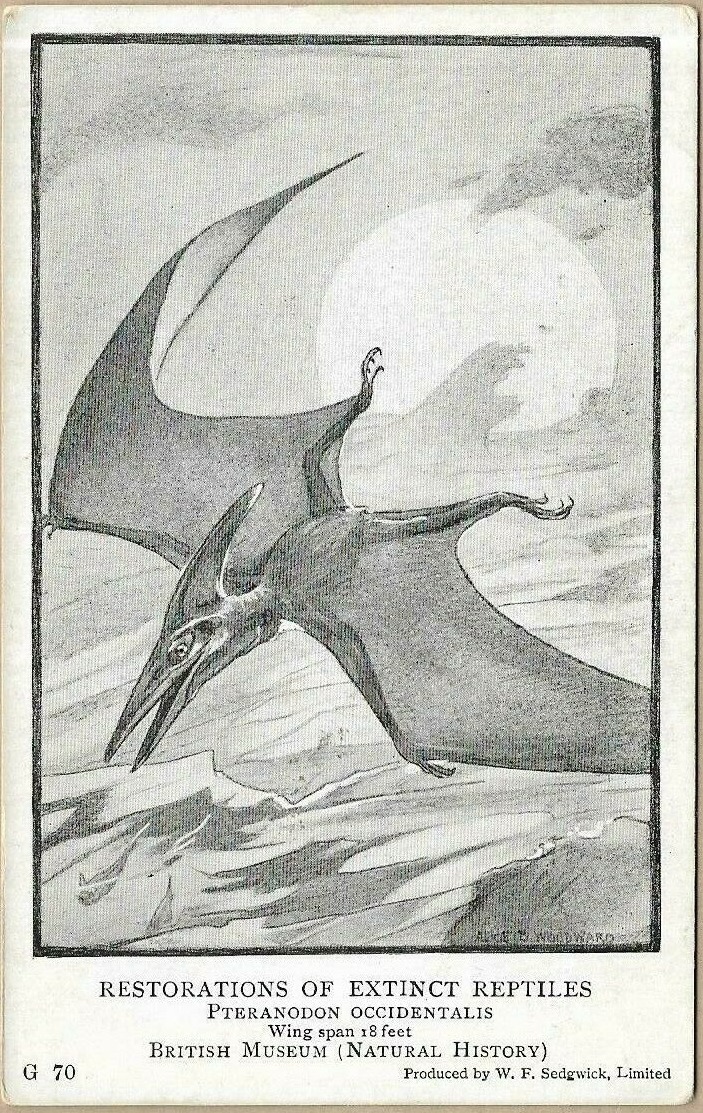
British Museum, possibly 1920s.

In this week’s ‘Picture Postals’ post…

A dark and monstrous lizard-shape that glides
Along the waters of the inland tides

These are the concluding lines from a Weird Tales poem by Frank Belknap Long, later quoted by Lovecraft in corresponding with Long about dinosaurs in 1930. The master had been kindly sent a dinosaur bone from California. (Incidentally, Long’s original poem had “Upon”, not the improving “Along”. So this might count as a little expert Lovecraft micro-revision).

Given the visual appearance of young Lovecraft’s nightmarish ‘Night-gaunts’ one has to wonder what part an early exposure to the imagery of the pterodactyl might have unconsciously had on a very young H.P. Lovecraft. First, what are the dates for this? Well, he began to have nightmares about them at five and a half, so a visual influence from print would have to have been before 1896.

It is of course possible that the black crepe and mourning silks worn by the family on the death of ‘Rhoby’ partly inspired the night-gaunts. Lovecraft was born August 1890, and therefore would have been five and a half in February 1896. ‘Rhoby’ (about whom more next Friday) died 26th January 1896, and the mourning presumably continued until the springtime. Thus the dates fit remarkably well, if one assumes a direct reaction in the boy’s nightmares after a few weeks. However, it must be asked what prior template he might have had. A leathery flying form onto which the family’s sombre rusting black crepe could have been ‘pinned’ at the moment of inception, so-to-speak.

Lovecraft much later, in 1916, speculated that the night-gaunts might have been influenced by the ‘man-devils’ of Dore…

I used to draw them after waking (perhaps the idea of these figures came from an edition de luxe of Paradise Lost with illustrations by Dore [1866], which I discovered one day in the east parlor).

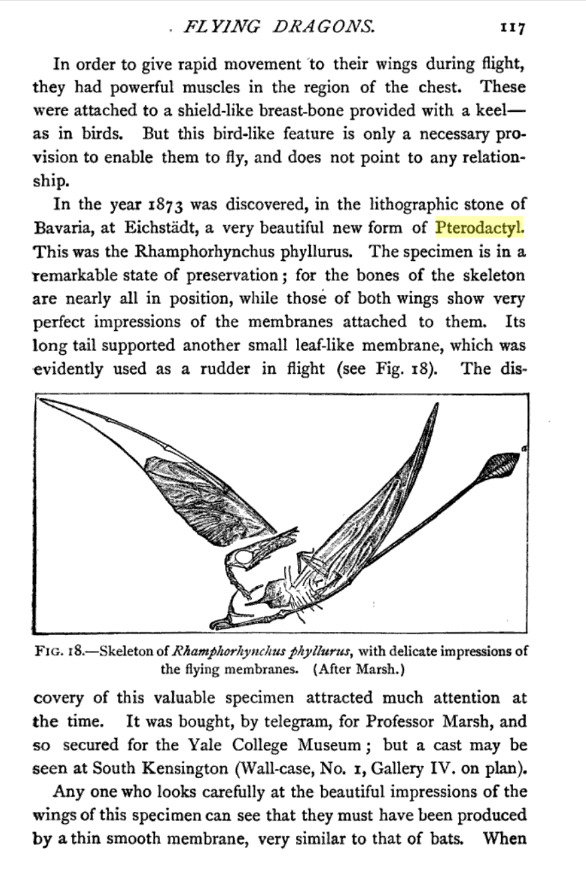
But it is at least worth considering if he might have had a template elsewhere. In popular pterodactyl imagery, and thus had an earlier and forgotten impression of them, for what young boy is not fascinated by such things. Could he have seen them at that time? Yes. Judging by the book Extinct Monsters: A Popular Account (1893) the creatures were quite well known the late Victorians, and a science timeline shows that the first complete scientific description being given in 1891. Presumably this ‘flying dragon’ arousing a certain interest among the public, and among boys in particular. So the timing is perfect there, if they were indeed transmuted into night-gaunts by Lovecraft’s nightmares.
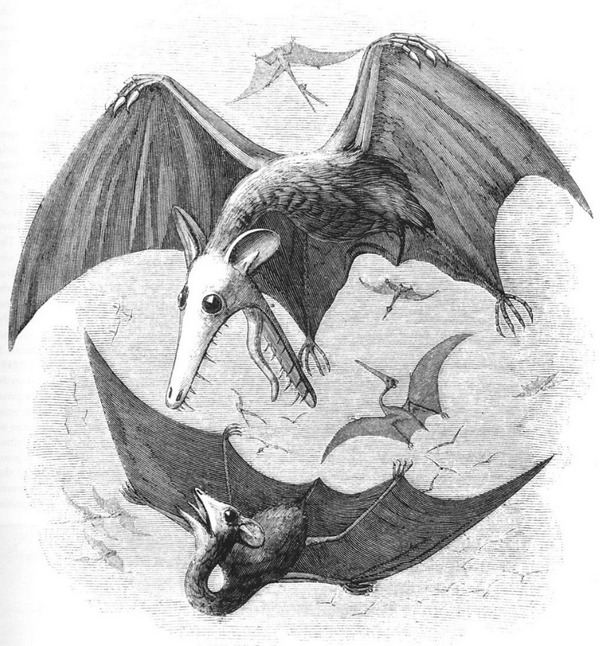
Indeed they had been visualised in living flight (wrongly, but somewhat zoog-like) as early as 1843, as here by Newman…
Thus by the early-mid 1890s they would have been included in most general encyclopedias (as Pterosaur, Pterodactylus, Pteranodon, Pterodactyl, etc), and we know that Lovecraft was poring over at least one of those a little later…

With the insatiable curiosity of early childhood [circa age 8], I used to spend hours poring over the pictures in the back of Webster’s Unabridged Dictionary — absorbing a miscellaneous variety of ideas. After familiarising myself with antiquities, mediaeval dress & armour, birds, animals, reptiles, fishes, flags of all nations, heraldry, &c., &c.,

They also feature briefly in Verne’s novel A Journey to the Centre of the Earth (1871), illustrated and seen during the raft voyage chapter…

the Pterodactyl, with the winged hand, [was seen] gliding or rather sailing through the dense and compressed air like a huge bat.
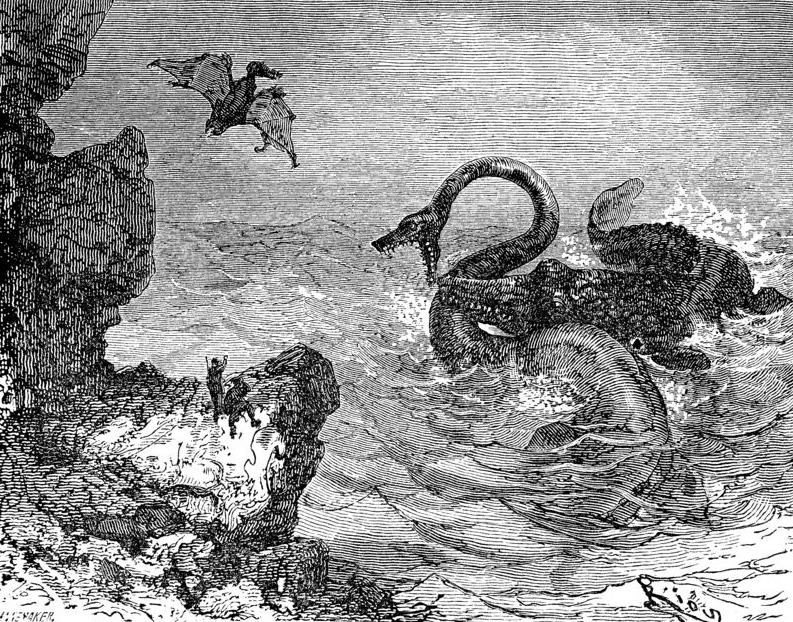
Joshi’s “I Am Providence” notes of the boy storyteller…

Lovecraft admits to being a “Verne enthusiast” and that “many of my [earliest] tales showed the literary influence of the immortal Jules”.

It is thus not impossible that he was at an early age at least browsing ‘the monster-pictures’ in the family edition of Verne, if not actually reading them yet.

The other possibility is that a museum in Boston might have had a life-size reconstruction or vivid diorama circa 1894. But I can find no trace of such in Popular Exhibitions, Science and Showmanship, 1840–1910, and Richard Fallon’s new Reimagining Dinosaurs in Late Victorian and Edwardian Literature (2021) indicates a general 1900 start for major modern museum dinosaur shows in East Coast America, while also lamenting that…

The significance of dinosaurs for general audiences during the late nineteenth century, when dinosaurs were morphing from British lizards to multiform American monsters, however, has hardly been studied. … The lack of detailed attention to dinosaurs in the literary culture of the turn-of-the-century period, and especially the 1890s, is surprising, given that these were the decades in which the word ‘dinosaur’ first became meaningful to general audiences.

So my suggestion is possible on the dates, but cannot now be proven. There is indeed further negative evidence. If this night-gaunt -like creature did make an early and vivid impression in Lovecraft’s very early childhood, then it does not surface later — at least in the original form. Since Lovecraft only makes two fleeting explicit mentions of the creature in fiction…

This was my first word of the discovery, and it told of the identification of early shells, bones of ganoids and placoderms, … dinosaur vertebrae and armour-plates, pterodactyl teeth and wing-bones …” (from “At the Mountains of Madness”)

I fancied I could vaguely recognise lesser, archaic prototypes of many forms — dinosaurs, pterodactyls, ichthyosaurs,” (from “The Shadow Out of Time”)

The pterodactyl does however make a brief and central appearance early in the earlier long essay (“Cats and Dogs”)…

“I have no active dislike for dogs, any more than I have for monkeys, human beings … or pterodactyls.”
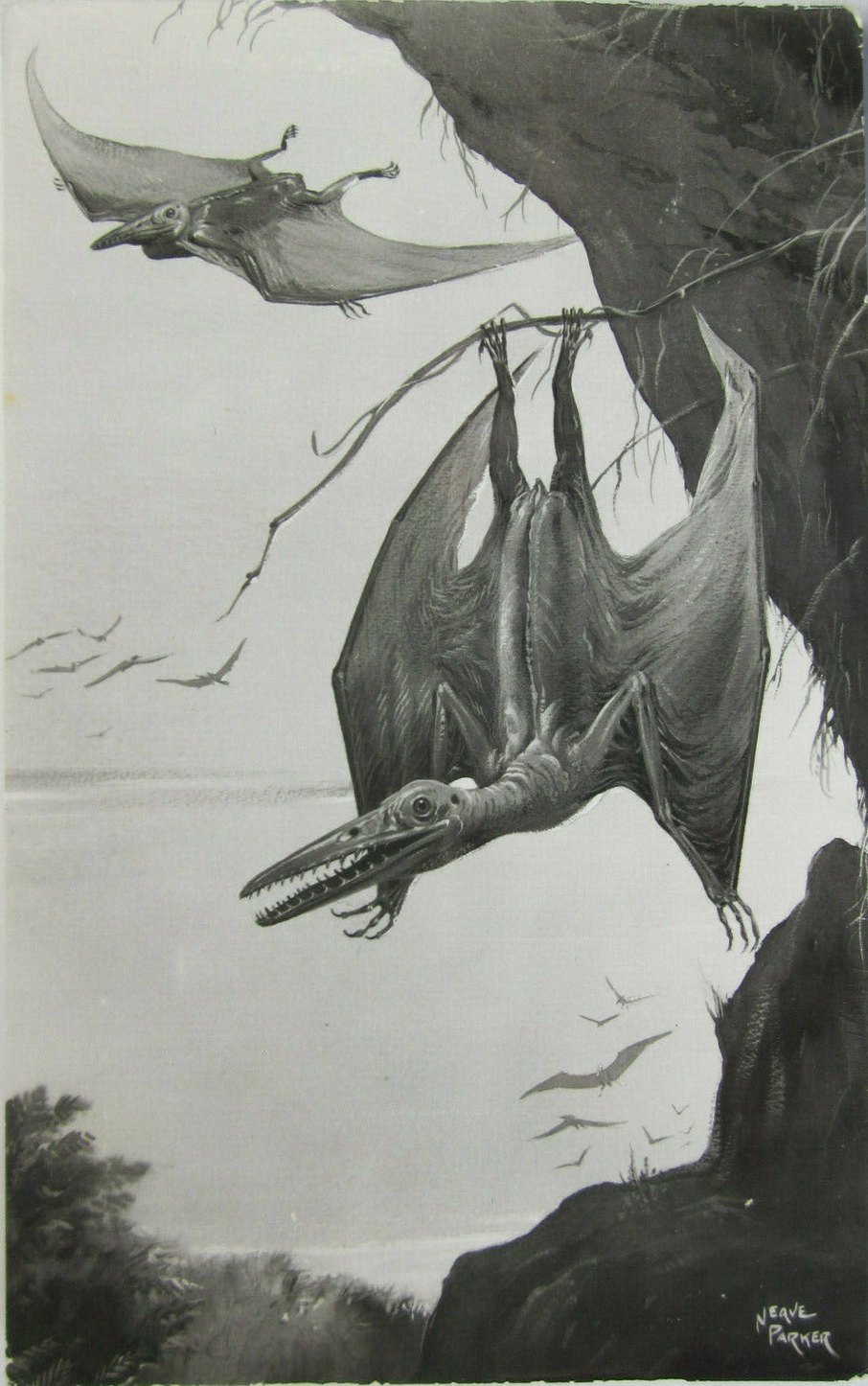

Neave Parker postcard for the British Museum, probably early 1950s.

Happy Thanksgiving

25 Thursday Nov 2021

Posted by asdjfdlkf in Historical context

≈ Leave a comment

Happy Thanksgiving to American readers of Tentaclii.

For some reason S.T. Joshi does not index ‘Thanksgiving’, this lack possibly being an indexer’s convention. But I’ve picked out a few examples in which Lovecraft mentions it. First, here again is Lovecraft’s celebration of a Thanksgiving meal made by Sonia in New York City…

Enchanted soup — apotheosised roast turkey with dressing of chestnuts & all the rare spices & savoury herbs that camel-caravans with tinkling bells bring secretly from forgotten orients of eternal spring across the deserts beyond the Oxus — cauliflower with cryptical creaming — cranberry sauce with the soul of Rhode Island bogs in it — salads that emperors have dreamed into reality — sweet potatoes with visions of pillar’d Virginia plantation-houses — gravy for which Apicius strove & Lucullus sigh’d in vain — plum pudding such as Irving never tasted at Bracebridge Hall — & to crown the feast, a gorgeous mince pie fairly articulate with memories of New-England fireplaces & cold-cellars. All the glory of earth sublimated in one transcendent repast — one divides one’s life into periods of before & after having consumed — or even smelled or dream’d of — such a meal!

Later, as if to celebrate 18 months of safe ensconcement in Providence following his New York nightmare, Lovecraft feasted mightily in November 1927. As he wrote to Donald Wandrei…

To parallel your Morphean [Morpheus, god of sleep] achievement of last Sunday, I can cite my own performance of last night – when, gorged with a Thanksgiving feast of the utmost peril to my 140-lb standard, I was overcome by drowsiness at 5p.m … & continu’d in a somnolent state till ten this morning! My dreams occasionally approach’d the phantastical in character. tho’ falling somewhat short of coherence.

In an April 1928 letter to Talman (presumably begun in 1927 and then added to slowly) he revealed…

our whole family had a Thanksgiving dinner with the Brennans this year

… by which he presumably refers to November 1927, so the blow-out must have been there. They appear, from his following accent in the letter, to have been of Irish descent. At a guess they may have been childhood friends from the Blackstone Band days, or neighbours. They don’t appear in the index of Letters to Family.

In November 1932 he told Robert E. Howard…

My really favourite meal is the regular old New England turkey dinner, with highly seasoned dressing, cranberry sauce, onions, etc., and mince pie for dessert.

And in 1934 he achieved a long-held Thanksgiving hope, though he doesn’t say exactly where or with whom…

[This] Thanksgiving I did something I have been wanting to do all my life — consumed the traditional feast on this historic soil of ancient Plymouth (less than 40 miles from here), where the whole custom started 312 years ago.

So far as I know he knew no writer or relations in Plymouth, but it’s not impossible that he had fallen into conversation with antiquarians while exploring the place, had expressed his wish and been invited.

The Theaters of Providence

24 Wednesday Nov 2021

Posted by asdjfdlkf in Historical context

≈ Leave a comment

Small State, Big History has a long introductory article “The Theaters of Providence, Part 1 – The Early Years”. Not especially focused on the key ‘Lovecraft period’ of 1894-1924, since there is much to say about Providence theatre before that, but at the end there is survey of key sources. Which may interest some new Lovecraftian researchers looking into Lovecraft’s theatre connections and theatre and cinema-going …

The next publication of note was an article that appeared in the Providence Magazine in October 1916. “Popular Amusements – The Drama in Providence” was a fifteen-page account of the theaters of the capitol city [both ancient and modern]. What differentiates this article from both the Blake and Willard books is that it focused less on the performances and the actors and more on the theaters themselves. Numerous pictures of the theaters were displayed. Also much had changed since the printing of Willard’s book in 1891 [History of the Providence Stage, 1762 – 1891] and the appearance of the magazine article in 1916 — drama now shared the stage with vaudeville and some theaters like the Modern on Westminster Street were built more for movies than live performances. [Then] In 1976 Roger Brett wrote Temples of Illusion: The Golden Age of Theaters in an American City. This account brings the story of the theaters of Providence up to the late 1940s and is most useful.

The latter book does not appear to be online, but the 1916 article is online at Hathi and with UK access.

There are a good number of pictures of frontages, but it only gives the modern Opera House a paragraph. The place is especially important because that was where the young Lovecraft had “slung from the stage” great slabs of Shakespeare, and he once recalled…

What a second home the old Opera House used to be to me!” — Lovecraft in Letters to Family.

The details of the Opera House acoustics are then interesting, if only to give a small additional bit of new data about Lovecraft’s performance there.

He would have had perfect acoustics. The remarkable building-time is also notable. Who could build a large opera house with perfect acoustics in 90 days, these days, which could then stand for 60 years and ably serve a city as its best theatre throughout that period? Yet that was what they did in 1871. Today such a project would no doubt take decades to grind through committees, planning offices, obstructionists and red-tape.

Early years of the Providence Opera House.

Researchers should also note that the Keith-Albee Collection is now fully transcribed and publicly searchable. This has the precise manager reports about exactly what was playing at key Providence theatres each week across the early ‘Lovecraft years’ when he was frequenting these theatres, and even how it was received and by which sections of the audience. Entries go along the lines of…

WORMWOOD’S DOGS. 20 mts. Full Stage. Eight monkeys and ten dogs from Great Dane to the tinest poodle, and all well trained. The comedy work of the monkeys got constant laughter. An act for children that could not be surpassed. The finish with the bicycle-riding monkeys and dog race is a scream. KINETOGRAPH [short early cinema film]. A Family of Cats. Rather interesting for the women and children.

These being the openers for a summer vaudeville show at Keith’s in the hot summer of 1908, Lovecraft aged about 17.

The Living Age

23 Tuesday Nov 2021

Posted by asdjfdlkf in Historical context, Scholarly works

≈ Leave a comment

H.P. Lovecraft to Kliener, February 1920…

“McD. has just sent me a card calling my attention to an article on him [H. Rider Haggard] in The Living Age.

The Living Age 1844-1941 is being newly uploaded to Archive.org from microfilm, and has just reached 1921 complete. Thus this perceptive and poetic article can be located in the March 1920 issue. It notes a cosmic touch in Haggard…

He has, indeed, an epic sense which would transcend the limits of our mundane vision and open out perspectives of some super-terrestrial landscape. There is about it a curious, indefinable quality, something of the twilight, more perhaps of the night: a night when summer lightning is abroad, when the stars seem alternately to approach and to recede from the atmosphere of earth. For it conveys, to me at least, a peculiar sense of the Infinite.

The Living Age was presumably a title Lovecraft had access to via the Providence Public Library, but at time of writing he had not yet browsed the very latest issue there.

In the same month Lovecraft’s friend…

Cook has also been kind, outlining a reading course in Haggard. I shall not tackle the gentleman in question till I am through with Algernon Blackwood, whose rather mediocre fantasies I am absorbing one after another. When I do read [Haggard’s] “She”, I will report my critical impressions in detail. (February 1920)

He is not known to have actually got around to reading the famous She until 1926, in order to write his survey Supernatural Literature. It might be interesting to speculate why, with all this prompting, Lovecraft did not read Haggard’s central work at that time. Was Cook’s tour of Haggard so arduous and roundabout, such a tall stack of books, that Lovecraft never got around to She? Or did he, and we simply don’t have a record of the matter until 1926?

New books: R. E. Howard

22 Monday Nov 2021

Posted by asdjfdlkf in Historical context, New books, REH, Scholarly works

≈ Leave a comment

Among the tidal-wave of fiction and comics adapting / related to Robert E. Howard’s works, there are two new non-fiction books which may interest Tentaclii readers.

The first is Robert E. Howard Changed My Life (June 2021). A chunky 338 pages of reminiscences about individual discovery and appreciation of Howard’s work and life, and how he changed lives. Every copy sold supports the Howard Museum at Cross Plains, Texas, and by extension the Howard Days that take place there. There’s also a £7 (about $10) Kindle ebook edition. It might be nice to see something similar done for H. P. Lovecraft, ferreting out a range of ‘Lovecraft changed my life’ historical items from old fanzines and letters pages, and pairing them with similar from living Lovecraftians. I don’t know of any such collection.

The second is a ‘journal-book’ The Robert E. Howard Collector Volume One: Illustrating Robert E. Howard (September 2021). It appears to be only available as wood-pulp from Lulu as a £30 paperback…

This book is a collection of articles about the early history of the art and the illustrators who made the works of Robert E. Howard come to life. Contents include: A heavily illustrated article on some of the best artists who worked for Weird Tales by Frank Coffman. A look at Roy G. Krenkel’s work for Donald M. Grant by Dennis McHaney. A reference guide to Roy G. Krenkel’s work for Amra by Dennis McHaney. A look at Frank Frazetta’s work on The Ultimate Triumph by Robert E. Howard. A Tribute to Jeffrey Catherine Jones by Bill Cavalier. An overview of Stephen E. Fabian’s work for the works of Robert E. Howard by Damon Sasser. The book is 8 1/2 X 11, softcover, color.

The Harry Houdini Collection

21 Sunday Nov 2021

Posted by asdjfdlkf in Historical context, Scholarly works

≈ Leave a comment

The Harry Houdini Collection, with 779 items made public and searchable. Magic, both stage conjuring and occult. Also stagecraft, selected folklore (e.g. Cornwall) and myth, and more.

More recently on Archive.org, the Illustrated London News 1842-2003 is still being loaded, albeit from microfilm so the pictures are not great. But they’re not too bad, and it is thus made easily and quickly searchable. A possible source of portraits of 1920s writers, and various historical snippets about the British Isles. So far as I recall, the run is paywalled in the UK.

← Older posts
Newer posts →


Please become my patron at www.patreon.com/davehaden to help this blog survive and thrive.

Or donate via PayPal — any amount is welcome! Donations total at Easter 2025, since 2015: $390.

Archives

  • March 2026
  • February 2026
  • January 2026
  • December 2025
  • November 2025
  • October 2025
  • September 2025
  • August 2025
  • July 2025
  • June 2025
  • May 2025
  • April 2025
  • March 2025
  • February 2025
  • January 2025
  • December 2024
  • November 2024
  • October 2024
  • September 2024
  • August 2024
  • July 2024
  • June 2024
  • May 2024
  • April 2024
  • March 2024
  • February 2024
  • January 2024
  • December 2023
  • November 2023
  • October 2023
  • September 2023
  • August 2023
  • July 2023
  • June 2023
  • May 2023
  • April 2023
  • March 2023
  • February 2023
  • January 2023
  • December 2022
  • November 2022
  • October 2022
  • September 2022
  • August 2022
  • July 2022
  • June 2022
  • May 2022
  • April 2022
  • March 2022
  • February 2022
  • January 2022
  • December 2021
  • November 2021
  • October 2021
  • September 2021
  • August 2021
  • July 2021
  • June 2021
  • May 2021
  • April 2021
  • March 2021
  • February 2021
  • January 2021
  • December 2020
  • November 2020
  • October 2020
  • September 2020
  • August 2020
  • July 2020
  • June 2020
  • May 2020
  • April 2020
  • March 2020
  • February 2020
  • January 2020
  • December 2019
  • November 2019
  • October 2019
  • September 2019
  • August 2019
  • July 2019
  • June 2019
  • May 2019
  • April 2019
  • March 2019
  • February 2019
  • January 2019
  • December 2018
  • November 2018
  • October 2018
  • September 2018
  • August 2018
  • August 2015
  • July 2015
  • April 2015
  • March 2015
  • February 2015
  • January 2015
  • December 2014
  • November 2014
  • October 2014
  • September 2014
  • August 2014
  • July 2014
  • June 2014
  • May 2014
  • March 2014
  • February 2014
  • January 2014
  • December 2013
  • November 2013
  • October 2013
  • September 2013
  • August 2013
  • July 2013
  • June 2013
  • May 2013
  • April 2013
  • March 2013
  • February 2013
  • January 2013
  • December 2012
  • November 2012
  • October 2012
  • September 2012
  • August 2012
  • July 2012
  • June 2012
  • May 2012
  • April 2012
  • March 2012
  • February 2012
  • January 2012
  • December 2011
  • November 2011
  • October 2011
  • September 2011
  • August 2011
  • July 2011
  • June 2011
  • May 2011
  • April 2011
  • March 2011
  • February 2011
  • January 2011
  • December 2010
  • November 2010
  • October 2010
  • September 2010
  • August 2010
  • July 2010

Categories

  • 3D (14)
  • AI (70)
  • Astronomy (70)
  • Censorship (14)
  • de Camp (7)
  • Doyle (7)
  • Films & trailers (101)
  • Fonts (9)
  • Guest posts (2)
  • Historical context (1,095)
  • Housekeeping (91)
  • HPLinks (76)
  • Kipling (11)
  • Kittee Tuesday (92)
  • Lovecraft as character (58)
  • Lovecraftian arts (1,628)
  • Lovecraftian places (19)
  • Maps (70)
  • NecronomiCon 2013 (40)
  • NecronomiCon 2015 (22)
  • New books (966)
  • New discoveries (165)
  • Night in Providence (17)
  • Odd scratchings (984)
  • Picture postals (276)
  • Podcasts etc. (431)
  • REH (184)
  • Scholarly works (1,469)
  • Summer School (31)
  • Unnamable (87)

Get this blog in your newsreader:
 
RSS Feed — Posts
RSS Feed — Comments

H.P. Lovecraft's Poster Collection - 17 retro travel posters for $18. Print ready, and available to buy — the proceeds help to support the work of Tentaclii.

Proudly powered by WordPress Theme: Chateau by Ignacio Ricci.