• About
  • Directory
  • Free stuff
  • Lovecraft for beginners
  • My Books
  • Open Lovecraft
  • Reviews
  • Travel Posters
  • SALTES

Tentaclii

~ News & scholarship on H.P. Lovecraft

Tentaclii

Category Archives: Astronomy

Review: Lovecraft Annual 2019

20 Wednesday May 2020

Posted by asdjfdlkf in Astronomy, Historical context, New books, Scholarly works

≈ 1 Comment

One can quite imagine S.T. Joshi as a 1920s stage magician. He must surely have at least some magical powers, in order to sustain his vast workload and output. Look, there he is now… appearing from behind a curiously carved panel on the darkened stage. An interlude of dancing cats exits stage-right. Joshi steps forward into the spotlight and deftly tips his bright red fez hat in greeting. Then he whisks back his thick satin cape, and with the merest raise of his eyebrows he invites a member of the audience to step up and inside yet another of his mysterious magical cabinets.

Up the cabinet rises through a stage trap-door. In this case the particular ‘mysterious cabinet’ is the 2019 edition of the annual scholarly journal titled The Lovecraft Annual. This usually appears like magic at the end of each summer. Joshi is here, as usual, the benign editor with the magic wand. Once inside his cabinet it’s a bit of a tight fit, since the page gutters could do with another eighth of an inch. But the audience member doesn’t mind, as he is whirled through 12 essays and several reviews.


The first essay is Fred S. Lubnow’s “The Lovecraftian Solar System”, which briskly alights on each planet in turn and surveys Lovecraft’s footprints on it. The solar tour includes a tantalising single mention of the “white fungi” on Neptune, among which Lovecraft’s indescribable Neptunians must move. Lubnow tracks down most solar items, but in one instance he states that “Lovecraft made no specific reference to Uranus in any of his tales”. I would point out that there is an inference, at least, in one story. “Pickman’s Model” has mention of… “the trans-Saturnian landscapes and lunar fungi that Clark Ashton Smith uses to freeze the blood”. Trans-Saturnian refers to, I believe, Uranus and Neptune. Admittedly, this is a reference not to the planets themselves but to their depiction in art. The planet Pluto (yes, it is a planet in my view) is understandably left until last by Lubnow, and as Yuggoth it sees the most discussion. It also understandable that Lubnow did not want to burden the survey with items from the letters or the poetry. But I hope that in due course we will see a Part Two, in which he does draw on and survey these. Perhaps even a Part Three on things like comets that enter the system, the aurora or ‘northern lights’, meteors, the “star winds”, and similar.


Duncan Norris’s essay “Hungry fer Victuals I Couldn’t Raise nor Buy”: Anthropophagy in Lovecraft” is an excellent survey of cannibalism in Lovecraft’s work, with abundant historical, anthropological and literary contexts. Once one starts looking, it seems, cannibalism is everywhere and Lovecraft was consumed by it. Usefully, Norris also looks for hidden or hinted-at cannibalism. He does not mention Bloch’s “A Visit with H. P. Lovecraft” and its toothsome ending, which would have been an amusing final nibble for the end of the essay.


Andrew Paul Wood’s “The Rings of Cthulhu: Lovecraft, Durer, Saturn, and Melancholy” is a fascinating speculative essay that draws first on Durer’s famous picture “Melancholy”. Then on the mythical Saturn. Saturn’s ‘ravening for delight’ aspect, and one aspect of his visual appearance in his defeat, is linked with the possible genesis of Cthulhu. Lovecraft’s fascination with Saturnalia (the Roman revels of 17th December) is noted along with his early knowledge of Virgil’s ‘golden age of Saturn’, and likely awareness of a lines from Keats’s “The Fall of Hyperion”…

And saw, what first I thought an image huge,
Like to the image pedestal’d so high
In Saturn’s temple. Then Moneta’s voice
Came brief upon mine ear ‘So Saturn sat
When he had lost his realms’ …

One can quite see the potential inspiration, as Wood suggests, for the famous sitting idol showing Cthulhu on his pedestal. Wood offers the reader a brilliant and fascinating essay. There is occasional over-reaching, but the informed reader can make up his own mind on such things. He misses a few elements that might have augmented his argument. He notes Lovecraft’s “Simplicity: A Poem” (1922), further evidence of Lovecraft’s awareness of Virgil’s ‘golden age of Saturn’…

Etherial spirits of celestial grace;
And he, unspoil’d, may childlike bask again
Beneath the beams of Saturn’s golden reign.

But he overlooks another poem which offers… “Hath held too long his Saturnalian feast”. These items again remind me how useful it would be for Lovecraft researchers to have a keyword-searchable ebook edition of The Ancient Track: The Complete Poetical Works of H. P. Lovecraft.

Also unmentioned by Wood is that Lovecraft’s friend Loveman had a literary interest in Saturn, evidenced by his naming his journal The Saturnian. But it’s only an incidental connection, and it’s quite possible that Loveman was using the word Saturnian as it arose from the French decadent milieu, from which it spilled over into use among poets as a code word for ‘homosexual’. A little earlier in time Uranian had a similar vogue among Edwardian poets as a code-word. Still, if Wood is right about a partial Saturn influence on the posture of the Cthulhu idol, then the all-male cultists cavorting around the idol in “The Call of Cthulhu” are also Saturnian orgiasts in the Loveman sense of the word. Because, as Lovecraft himself bemoaned…

You’ll recall that Rankin [the Weird Tales artist] made ample-bosomed wenches of my male orgiasts in the Louisiana swamp scene of “Cthulhu!”


Cecelia Hopkins-Drewer’s short “The Cats”: An Environmental Ditty” is thankfully not saddled with questionable eco-critical theory, and is a straightforward discussion of Lovecraft’s 1925 poem with some historical context. Her essay is a useful study of this powerful New York poem, delving into the sound-patterning and also discussing the relationship to the similar future-visions in the story “He”. Some phrases in the poem are seen to relate to what she claims to have been the state of the sanitation and water supply of New York City in 1925. Fair enough. But there is a rather unfortunate historical tangle on page 71, in which the reader expecting good evidence for the suggestion is expected to jump from 1925 to 1935, and then we get the quote “no system for disposing of sewage and garbage …” which — on my finding its source — actually relates to circa the 1690s. This date is not given by Hopkins-Drewer, and yet she immediately follows the quote with… “Certainly, if the pollution had been left unchecked…” in 1925, Lovecraft’s prediction of a future New York City in “The Cats” would have come true.

Such a damaging tangle on the historical evidence could have been avoided with just a little online research, and the argument strengthened. For instance I can quite easily find that in the 1920s the Brooklyn water-supply actually came from pumped ground-water in Queens, on Long Island, drawn from a catchment area of over 100 square miles. It was chlorinated by the time it reached the taps of Red Hook and does not appear to have done Lovecraft, or probably any of the street-kitties he encountered at their water-bowls, any harm. On sewage Hopkins-Drewer is correct, although the evidence presented for her point is confused and somewhat misleading. It should have quite easy to nail the claim quite precisely to the mid 1920s and Brooklyn, with just a little research — it’s easy enough to find that by the summer of 1926 raw sewage pollution of the harbour became so intolerably bad that all the New York City public beaches were closed, except those that directly faced the open ocean. When we think of Lovecraft living in Red Hook, we forget the likely summer smells — all the raw effluent of New York City, massing up day after day and week after week around the harbour, and the reek of it wafting in over the tenements. Knowing this, one then reads “Red Hook” somewhat differently — regarding the opening words such as “oily waves” and “filth”. In the searing killer heatwave of June 1925 the shores were presumably oily with more than just ship-bilge, and on a windy day the filthy smell of excrement must indeed have been noticeable even some miles from the shore. One wonders if some prevailing summer wind from such a shore partly explains why, until the public works of the mid to late 1930s, there were still shantytowns, open scrubby land and undrained marshland along the waterfront there and why the eastern parts of Red Hook were heavily dotted with “weedy undeveloped terrain” on 1924 aerial photography.

However “The Cats” was actually written in the winter. On 15th February 1925 to be precise, an important point that Hopkins-Drewer does not note. Lovecraft was then about a month into living in his “dismal hovel” at 169 Clinton Street, having luckily moved in just days before the worst snowstorm in living memory (1st-3rd January 1925). The date of the poem might suggest that an early thaw made him suddenly aware of the stench that might well waft up from the shoreline in the high summer. The New York Times for February 1925 does indeed suggest a thaw, with one of its articles titled “Thaw Releases Frozen Cars”. Also, the few letters Lovecraft sent from New York at this time suggest he was out and about and these make no mention of snow or ice. But if a February thaw and sun was quite enough of a thaw to send a new shoreline scent to Lovecraft’s sensitive nose is rather debatable.

Such points do not lessen a claim that “The Cats” is in part an “environmental ditty”, and it is anyway a poetical work that is only partly biographical (i.e. the Red Hook location, the implied black cats which relate to his own lost cat, the allusion to Poe’s Pluto, Lovecraft’s repeated nightmare of how the “thick tide retreats” leaving a shining river a mass of oozing mud). It can certainly be read as an environmental poem — “Streams of live foetor, that rots in the sun. … Jumbles of odour that stifle the brain.” — but such claims need more precise historical evidence on matters of water-supply, sewerage and weather, and close attention to dates.

Hopkins-Drewer does excavate one fascinating historical nugget that was wholly new to me. The Chicago gangster Johnny Torrio was “holed up” in Red Hook after a January 1925 mob shooting in Chicago, and he took over the rackets there. I can add that he appears to have arrived in Red Hook from Chicago in February or March, probably shortly after Lovecraft wrote “The Cats”. He went to Red Hook because he had grown up there and it was his old racketeering ground. It’s not impossible, as Hopkins-Drewer hints, that Red Hook was abuzz with the return of Torrio in summer 1925, when Lovecraft was about to write of the similarly ‘resurrection’-like return to social life of the gangster-consorting Robert Suydam in “The Horror at Red Hook”. We know that Lovecraft frequented cheap cafes where one could overhear hoodlums talking over the current state of things in Red Hook, and there may also have been local cafe-owner gossip and press coverage of the matter. It’s quite a plausible suggestion, and again a little more research would have let Hopkins-Drewer strengthen the suggestion.

What of a curious line in the poem “The Cats”, of their “Yelling the burden of Pluto’s red rune” at the city, almost as a form of curse? This is not addressed in the essay, but it offers another route to a concern with animals and thus the environment. “Pluto” is not a science-fiction reference to the cats arriving from that distant planet in a gigantic cosmic leap — akin to that of the Cats of Ulthar or perhaps the Cats of Saturn in Dream Quest. Since the planet Pluto was not discovered or named until 1930. Rather, it is a reference to the eye-less cat Pluto in Poe’s famous tale “The Black Cat” and thus to Pluto the god of the underworld. Lovecraft thus makes a poetic linkage of this cruel mistreatment of cats with the astrological rune for the planet Pluto, which resembles an eye socket with blood dripping from it. Presumably Poe had also seen this macabre likeness, and drew his tale from the observation. Though I can find no scholar of either Poe or Lovecraft noting a possible connection.

Is there any additional symbolism to the Pluto rune? Unfortunately it is impossible for a search-engine to cut through all the blather produced by neo-pagan parrots and occult mumbo-jumbo munchers. But it’s possible to find some 19th century scholarly sources that suggest a couple of options. To summarise, to one it was spirited living intellect circling above the inevitable river of the underworld (death). To another it simply arose as a confusion with a Nile goddess symbol, when Ptolemy took over Egypt and moved in his new statues. From there it became a sign for Pluto as a god of the underworld. There seems to be no clear route back in time, and the origin is probably lost. All we can really say is that it is a circle in an arc above a short cross. But we can say that Lovecraft’s cryptic literary-historical symbolism in “The Cats” is also a form of concealed environmental commentary for the learned and literary reader, since it evokes the cruelty of certain types of people to animals. One can also note that he cleverly accents the shape of this “rune” with the “oo”s seen in the following line’s “swoop low” — which offers a partial rhyme with “Pluto”. Two “oo”s (eyes) become one “o” (a missing eye), just as in Poe’s gory tale. The imagery of “swoop low” also evokes the gouging motion involved.

Lovecraft’s use of “rune” in the poem may seem incongruous since it offers a Nordic touch to the poem, evoking the one-eyed Odin of the North and Northern runes. If so, then this was not entirely his spurious confabulation. Lovecraft may have noted in the histories that Nordic and Teutonic warrior-cultures had long sent armies across the Danube, and had even occupied Sparta and Alexander the Great’s boyhood/maternal homeland. This would offer Lovecraft a possible cultural origin in the North for the later use of the Pluto symbol in the Egypt of Ptolemy — Ptolemy having raced to claim and hold Egypt as his own, after the death of Alexander. Ptolemy’s Hellenistic Egypt is of course a key place for early astrology and also where one finds the first direct evidence for the origin of alchemy, and it seems from some brief research that such origins were under active discussion in the psychological (Jung) and archaeological literature of the early 1920s.


Matthew Beach’s “Lovecraft’s Consolation” is a follow-up to his earlier “Lovecraft’s Optimism” in Lovecraftian Proceedings #2. He examines the possible consolations of ‘the cosmic’, something Lovecraft offered to some of his friends in letters. These consolations are basically that we need not despair at the ultimate ‘futility of it all’, because: ‘cosmic time’ is full of potential, even if rather impersonal from a human perspective; and the endlessness of ‘cosmic space’ offers infinite possibilities.

Such a sense of time and scale may then give us a certain sense of freedom from the earthly judgements of others. Hence the personal ‘indifferentist’ stance that Lovecraft tried to maintain toward others. This stance was bolstered somewhat by his more down-to-earth understanding of the glandular human body, and the (in his eyes) uncontrollable urges this produced. It follows that if some had “abnormal” urges, they couldn’t help it. Equally, a sense of the vastness of time and space may lead us to consider that beauty and significance may reside, or at least be thought to be found, outside what our age considers “normal”. Perhaps even in the non-human, somewhere else in the vastness of cosmic time and space. Such cosmic possibilities might even arouse in us the “sense of curiosity” (Selected Letters III), and the prospect of the pursuit and gratification of such curiosity would also be a cause for optimism. If not for oneself, then for future generations — to which one contributes useful knowledge today, knowledge on which future generations will build.

In some sense then, I would also suggest we can see Lovecraft as having anticipated the discovery and ‘cosmic unity’ later presented by the more advanced novels of galactic civilisation and alien encounter. In which the presence of a striving and expanding mankind in the galaxy at least supplements the formerly cold cosmic wastes with meaning, even if it doesn’t deeply infuse it with meaning. Of course, if Lovecraft’s work and letters actually influenced the genesis of this sub-genre is more debatable and it would take some hard sleuthing by Lovecraftian scholars to prove such a claim. But when Beach notes Lovecraft tell Sully in a consoling letter that one can “harbour great hopes” for the human future, albeit in a “light, indefinite way”, and extract from them a “bracing power” that should be harnessed to the human imagination — then he might seem to be laying the foundations for a future galactic empire or two.

That said, it’s obvious that if Lovecraft has an “optimism” to share then it’s not the blithe emotionalist’s happy-clappy variety of optimism. He says as much himself, and Beech deftly extracts the relevant quotes. Rather it is an optimism that “integrates rather than ignores the harsh realities within cosmic time and space” (Beech). A sort of Super-rational Optimism. But these “harsh realities” offer another clear form of consolation to the cosmicist — that harsh though the universe is, it has clear and un-breakable rules. There is no capricious hostile god or malign devil toying with human lives or expecting weekly sacrifices of burning babes. Similarly, priests have no power to call down retributions or to channel divine beneficence.

His other consoling advice is more homely and it must draw on the various writers of the classical world that he admired. Practice pragmatism in everyday life. Minimise pain and maximise pleasure, in moderation. Plan for a sensible future, one that will include “inevitable loss” — but with the understanding that ‘time heals all wounds’, and that both personal human memory and long-term recording allow us to cherish and recall the best of what has been. Lovecraft’s antiquarianism was part of this stance, I would suggest, and somewhat fits with his cosmic view. If there is no god, then ancestors can at least serve one as secular substitutes for the saints and angels. The risk comes in knowing too much about them. Spend too much time “correlating the contents” and one’s historical heroes may develop feet of clay, or one’s family tree may develop an unwanted fishy side. A new monograph by Ken Faig Jr. suggests that Lovecraft’s family tree did just that, and I suspect the discovery probably informed “The Shadow over Innsmouth”.


Dylan Henderson’s “The Inability of the Human Mind”: Lovecraft, Zunshine, and Theory of Mind” seeks to sift Lovecraft’s rich life for signs of autism — whatever that is these days, as the definitions are stretched and warped by non-autistics seeking a ‘get out of jail free’ pass for bad behaviour — then he tries to do the same at a few points in Dexter Ward. There may be a case to be made, but I was not convinced by this brief tour of some possibilities.


A brief Notes paragraph notes that no less than three new Lovecraft documentaries are underway.


“H. P. Lovecraft’s ‘Sunset’” is S.T. Joshi’s own musical choral setting for Lovecraft wistful autumn/fall poem of 1917, with pages of musical notation. I don’t read music, so can’t judge this item. Joshi’s blog reports that his choir has performed it several times, but it appears not to be online.


Ann McCarthy’s “The Pathos in the Mythos” is a short essay that points up some elements of emotional ‘colour’ in Lovecraft’s work: the joy he finds in certain places and evocative views; the delight in dogged research and scholarly detection; his sympathy for old and isolated men, both living and those literary ancestors isolated from him in time. One might have added his tenderness and concern for cats, although admittedly this is more in the poems and letters than the stories.


Jan B. W. Pedersen’s ““Now Will You Be Good?”: Lovecraft, Teetotalism, and Philosophy” is a survey of alcohol in the stories, and partly in the letters and in The Conservative. This is introduced with eight pages of general history on temperance and teetotalism, pages which might instead be given over to digging into the context of two fascinating Lovecraft quotes which Pedersen leaves un-examined. The first is the 1915 quote… “to transform himself to a beast, and in the end to degrade himself and his descendants permanently in the scale of evolution”. The second is from 1932, talking with R.E. Howard about “the hard-pressed classes” and their drinking… “The more drink-sodden they get, the worse their biological stock becomes”. Evidently in 1932 Lovecraft was still holding to the “three generations is enough” argument of the 1910s, a slogan which implied the outright danger of allowing the breeding of a “fourth generation”. Circa 1910 the commonly understood sequence of degeneration ran: nervous temperament and moral laxness in the first generation; then their children, who have severe neurotic behaviour leading to addictions and drink; leading in the third generation to insanity and suicide; then at the last a sterile fourth generation with outright cretinism and often malformed bodies and heads. There was also an increasing understanding that recessive genes could be carried by seemingly healthy people, and passed to offspring who would then exhibit the defect. Peterson misses a prime opportunity to explore or at least summarise the anti-liquor movement’s theory of generational degeneration and recessive traits. To ask if Lovecraft understood this correctly, if it was modified by research or was supported by other currents in society and/or developed and added to by Lovecraft himself. Then to tease out what uses might have been made of it in the stories.


I had anticipated that Michael D. Miller “Lovecraft’s Open Boat” might be about the young Lovecraft’s row-boat on the Seekonk river, finding connections to “Dagon” via Lovecraft’s recurring dream of the Seekonk drained to oozing mud, and his landing by row-boat on the muddy washed-over Twin Islands in the Seekonk. But it is not. Miller finds some parallels between Lovecraft’s indifferentist and cosmic stances and Stephen Crane’s “The Boat” (1897), a story inspired by his shipwreck while travelling to pre-communist Cuba.


Horace A. Smith’s “Lovecraft Seeks the Garden of Eratosthenes” details the young Lovecraft’s astronomical observations of the Moon in 1903-06, in particular certain areas of the Moon, and offers some fascinating historical context about the lunar life theories and the observations of William Henry Pickering. Pickering imagined the life he ‘saw’ on the Moon as being a low vegetation. Could the young Lovecraft’s vivid imagination have mused on these Selenites as vegetable animals, a possible precursor to some of his later creatures? Possibly, but Smith sagely calls that idea “a stretch”. Yet Smith also notes something from early in Joshi’s I Am Providence: that the young Lovecraft once had a “now lost tale set on the dark side of a Moon”, although at an unknown date. Smith doesn’t speculate on what the story might have had in it. But I’ve looked into the story’s scientific spur and it seems informative. In 1854 the eminent German astronomer Hansen had proposed that our Moon was not a perfect sphere, but was deformed by a huge elevation of about 35 miles in height. This ‘bump’ was directed toward Earth, presumably due to gravity, and its presence would mean that a shallow atmosphere could just about persist on the dark side, most likely with some icy crater-lakes and thus the potential for primitive life. However, by 1903-06 most scientists assumed that any water and ice would long ago have been lost to space. But not all scientists, as the Germans were still proposing an 1890s ‘water ice’ theory for many cosmic bodies, and this was championed and bolstered by the substantial book Glacial-Kosmogonie in 1912. The theory apparently persisted into 1930s Germany. In the 2010s abundant water ice was indeed found by probes on the surface of the Moon, and presumably it exists in even more abundance on the dark sides of the poles. One assumes Lovecraft’s lost juvenile story would have encountered life of some kind (he recalls it as a “thriller” in a letter to Kleiner) and one wonders if Lovecraft’s 1919… “insect-philosophers that crawl proudly over the fourth moon of Jupiter” (“Beyond the Wall of Sleep”) preserves a hint of the subject matter. Likely written at around age 14, the science of 1904 suggests he would have imagined shallow ice lakes and their sub-surface primitive entities. In this he would have been following the recent German elaborations of Hansen’s initial 1854 proposal. One assumes that the astronomical journals were keeping readers abreast of such developments from Germany, even though the growing consensus elsewhere appears to have been that any Moon water had long since drifted away into space. Such a juvenile tale would thus, eventually, have been proved partly right by science. No ice-lakes, no vegetable-insect life musing on their slow alien philosophies, but… around 6% water-ice per NASA probe-scoop, and possibly much more ice banked up in the crater-shadows. Quite how his tale’s presumed protagonists and their acetylene lamps would have reached the dark side of the Moon from Providence is another question. One imagines that Lovecraft’s beloved black cat, leaping and darting all around his telescope in the garden dusk, might have given him the idea of simply leaping to the Moon as if in a dream. Lovecraft would muse more solidly on such matters a few years later, in his “Can The Moon Be Reached By Man?” (1906).


Scott Meyer’s “Diabolists and Decadents: H. P. Lovecraft as Purveyor, Indulger, and Appraiser of Puritan Horror Fiction Psychohistory” attempts to detect alignments between Lovecraft and the Puritan worldview, and this seems most useful in a short section in which he examines the letters.


Steven J. Mariconda’s “How to Read Lovecraft” column muses on Lovecraft’s playfulness, although the essay sticks within the confines of the 1930s/1970s psychological ideas of the puer aeternus (aka ‘Peter Pan Syndrome’) and Jungian archetypes. We also learn that Lovecraft’s mother was “apparently progressing toward schizophrenia”. She was undoubtedly mad before her botched gall-bladder operation and death, but “toward schizophrenia” seemed to me a rather bold armchair diagnosis. Does one really “progress” toward such a thing? I’d never heard that said, and on investigation it appears not to be the case — on which point see the 2013 paper “The Myth of Schizophrenia as a Progressive Brain Disease” in a leading Oxford University Press journal. Another point of error in the column is the claim that… “Lovecraft was thirty-three and Barlow was sixteen when the former went to Florida”. Actually, when Lovecraft stepped off the bus, he was forty-three and Barlow was fifteen.


Finishing up the 240 page issue is a lengthy book review by veteran Lovecraft scholar Ken Faig Jr., reviewing the new Ave atque Vale, here rather amusing titled Ave atque Value — perhaps in an unconscious pun on its mere $30 price in paperback. This is the fine new book of reminiscences of Lovecraft, effectively replacing the previous Lovecraft Remembered. Faig’s review is entertaining and erudite, and doesn’t forget to give the juicy details of the book — that it has notes and an index, biographies of contributors, and 400 footnotes. One data point has already been superseded — my recent discovery of more Eddy memoirs adds to our knowledge of the bookshops, and Faig’s observation that “Lovecraft knew each of the big three of Providence bookselling” must now be expanded to four — including ‘Uncle’ Eddy.


Well, that’s it for 2019. Onward to the 2020 issue — which I imagine will be going to pre-order relatively soon.

Venus in Westminster Street

21 Friday Feb 2020

Posted by asdjfdlkf in Astronomy, Historical context, Picture postals

≈ Leave a comment

“The marvellous brilliancy of [the planet (that looks like a star)] Venus toward the close of the month will probably cause many persons ignorant of astronomy to mistake it for an artificial light; indeed, one evening about five years ago Westminster Street was lined with curious and excited watchers who pointed out the planet as the searchlight of an aëroplane.” — H.P. Lovecraft, “The September Sky” from his regular astronomy column.

Judging by the female fashions and the electric trams the picture might be the late 1900s, and thus about the time of the “about five years ago” Lovecraft refers to in his 1914 column. In the picture a sign for the Empire Theater can just about be discerned, in the distance on the right. Illiteracy is still a factor in everyday life — as evidenced by the visual shop signs such as a huge key for a locksmith and key-cutter, and an eye for an optician. Lovecraft’s College Hill is glimpsed, rising up as some smudges of green at the end of the street.

Ladd Observatory

15 Friday Nov 2019

Posted by asdjfdlkf in Astronomy, Picture postals

≈ Leave a comment

A fine scan of a card showing the Ladd Observatory, including a building in the background not usually seen in views of the place.

Lovecraft’s observations of the cosmos

05 Tuesday Nov 2019

Posted by asdjfdlkf in Astronomy, Historical context, Scholarly works

≈ 6 Comments

What better time than bonfire/fireworks night, to learn that Falvey Memorial Library at Villanova University have opened up their newly acquired notebook to find Lovecraft drawings of a comet…

The latest manuscript added to Villanova University’s Distinctive Collections is the rare astronomical observation notebook by the noted horror author H.P. Lovecraft from the years 1909-1915. Observing from his Providence, Rhode Island home, Lovecraft noted, and then drew, various celestial phenomena including passing comets.

Slated for digitization in November and full transcription by a notable Lovecraft scholar soon after.

It’s interesting that the young Lovecraft took binoculars, presumably on his bicycle, to good observing spots way out toward Rehoboth. Given that he notes his location (not necessarily his house roof or adjacent ground) with some precision, one could presumably recreate these observational moments in full. This could be done via the free Stellarium software and its ‘time-and-place travel’ function, or similar. Although, the last time I looked, Stellarium doesn’t do comets in graphical form.

For the 100th anniversary of H. P. Lovecraft’s cosmic mythos

31 Thursday Oct 2019

Posted by asdjfdlkf in Astronomy, Scholarly works

≈ Leave a comment

The annotated “The City” (1919), a poem by ‘Ward Phillips’ (H.P. Lovecraft). With an introduction and annotations by myself.

This 10,000-word PDF has been produced and published here to mark the 100th anniversary of H. P. Lovecraft’s cosmic mythos in November 2019.

Download

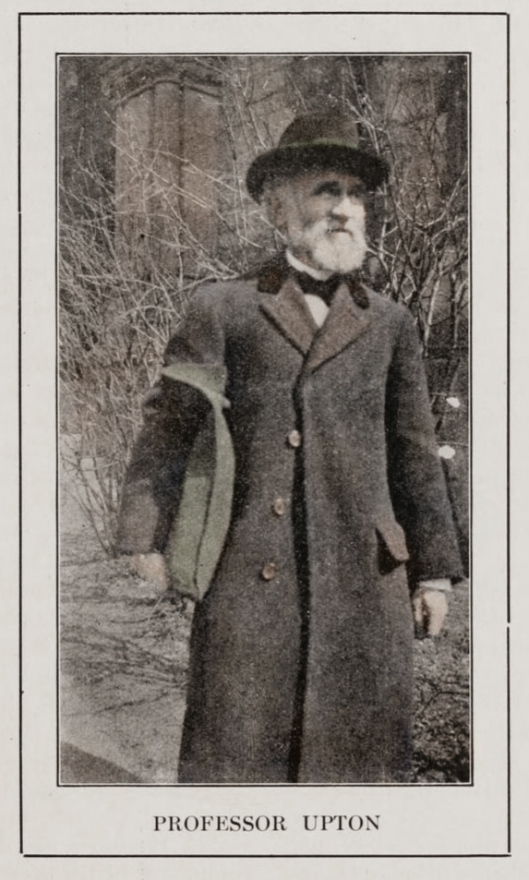
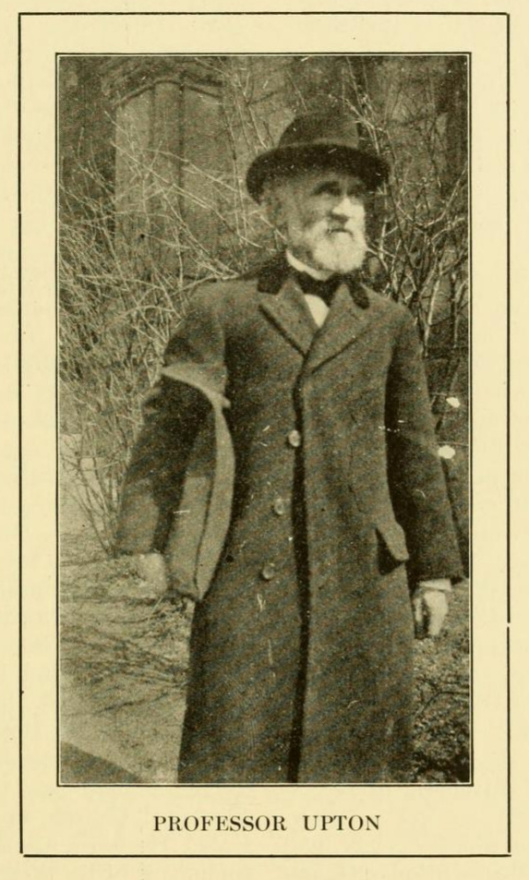
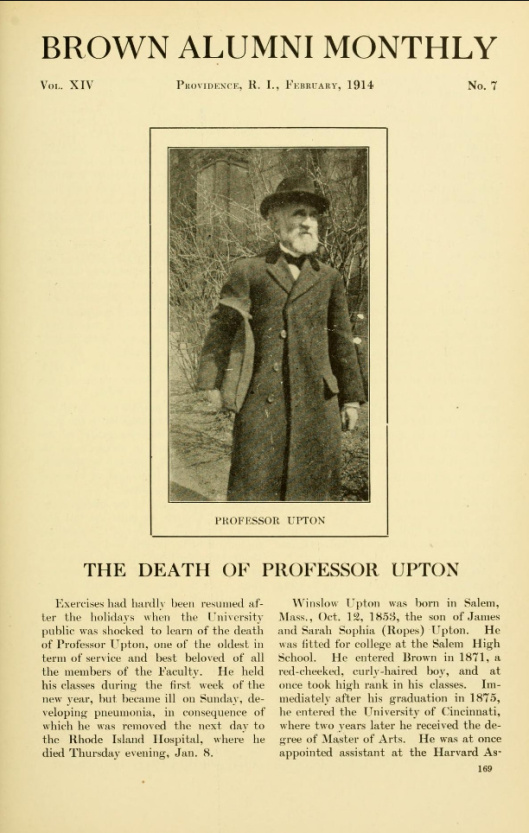
“The late Prof. Upton of Brown”

21 Saturday Sep 2019

Posted by asdjfdlkf in Astronomy, Historical context, New discoveries, Scholarly works

≈ 1 Comment

“The late Prof. Upton of Brown, a friend of the family, gave me the freedom of the college observatory, (Ladd Observatory) & I came & went there at will on my bicycle.” — H.P. Lovecraft.

Possibly this was the man who saved Lovecraft’s life. As a youth Lovecraft was contemplating throwing himself into the river in despair — just before the kind offer came from Prof. Upton.

Friday ‘picture postals’ from Lovecraft: misty lanes at the end of summer

06 Friday Sep 2019

Posted by asdjfdlkf in Astronomy, Historical context, New discoveries, Picture postals

≈ 1 Comment

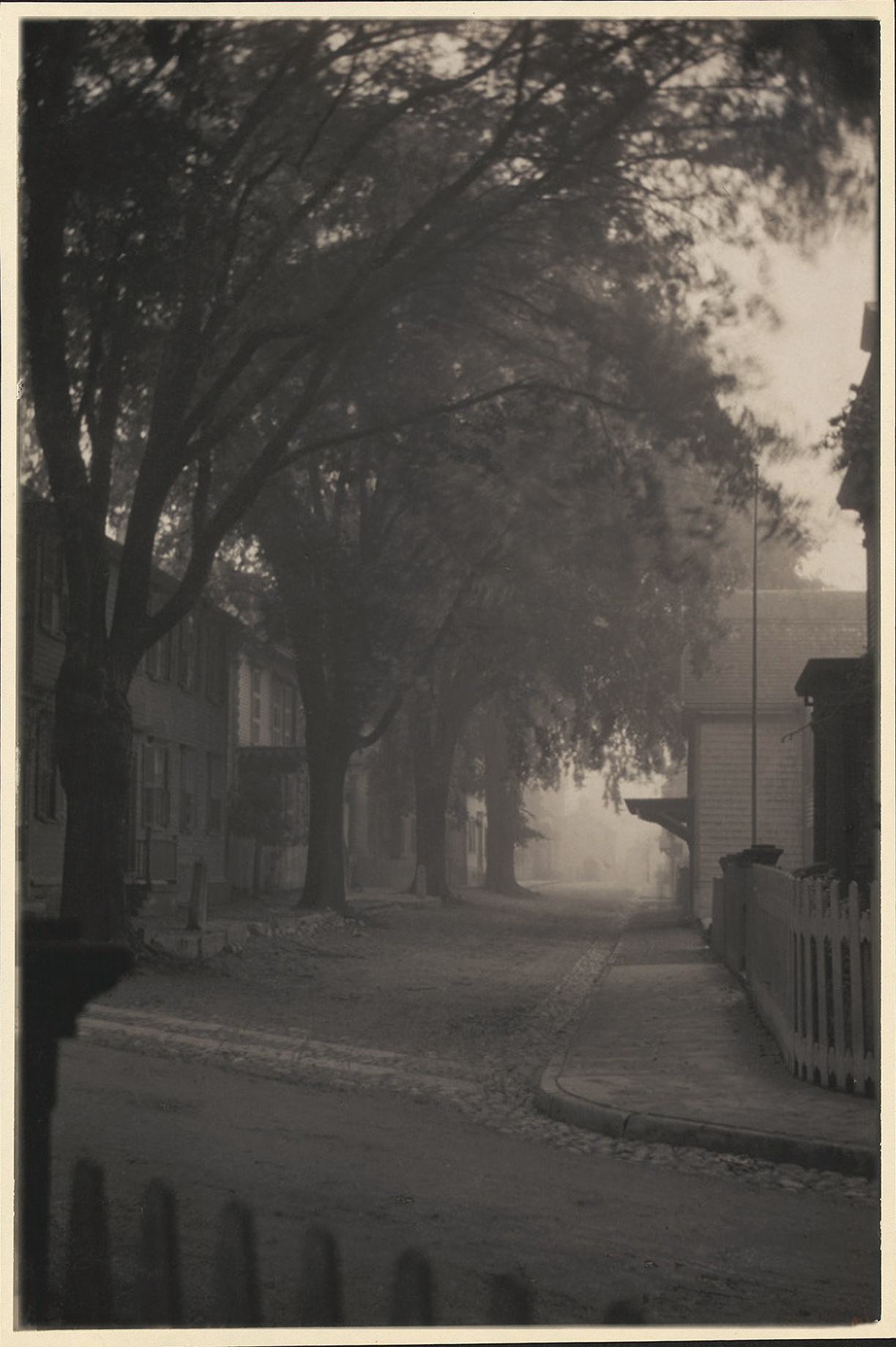
Last week’s ‘picture postal’ had a setting of quiet streets and mistiness. This week’s post continues with the same theme, evoking the ‘end of season’ shawl that many New England places would have worn by September.

I. The mist in New England.

The picture also evokes the distinctly seasonal nature of Lovecraft’s own travels and visits. His annual cycle, of summer walking followed by a winter hermitage, was partly due to his extreme sensitivity to the cold. By the early 1930s he was becoming the old man he had once feigned to be, and appears to have become both more susceptible to cold and more fearful of encountering it. By the mid 1930s his ‘sitting outdoors season’ didn’t usually start until quite late, mid-May. Some historical context is relevant here. The natural state of the eastern USA during the late 1920s and 30s was somewhat different than today, being often significantly hotter in summer and colder and more icy in winter. We can also assume that mistiness was often enhanced by household coal-fires being lit as the mornings and evenings grew chill. Domestic burning of ‘soft coal’ (heavy smoke) was then permitted, for instance, and only in 1946 did Providence begin to adopt clean-air measures. Add to that the likelihood of autumnal garden bonfires being lit.

Toward the end of his annual walking season he would have started to encounter such evocative mists, fogs and mizzling rains. Such mists were almost never captured by picture postcards, which makes scenes like the one seen above all the more valuable. They remind non-residents that New England was actually somewhat akin to England, in terms of the vagaries and mistiness of its very seasonal weather. The region wasn’t all an endless parade of bright summer-scenes.

Yet sometimes it was an endless parade of such scenes, or seemingly so when the bright clement weather would run on in the year. Such was the year 1933, for about six weeks from mid September to the end of October, and Lovecraft continued to enjoy such weather by taking cheap local bus-rides and walks. During most of October 1933 he even contrived to explore parts of the inland back-country far behind Providence. Here he is in October 1933, writing to Morton…

Well, well! The old man’s still out in the open! But though it’s quite oke for brisk walking, it ain’t so good for settin’ down and writin’. Hard work guiding the muscles of my pen hand, for I doubt if the thermometer is over sixty-eight degrees. Glorious autumnal scenery. I’ve spent the last week tramping over archaick rustick landskips, searching out areas still unspoil’d by modernity…

The run of fine weather was over by around Halloween. On 2nd-3rd November 1933 he wrote to R.E. Howard…

Our autumn has been very mild … But of course this is the very end of the season. No more continuous mild weather can be expected [now], though there may be isolated days of more or less pleasantness.

How did he first become sensitised to the Providence mists? He purposefully went walking in such conditions. In a 1933 letter to E. Hoffman Price he also recalled his youthful explorations of Providence, and how he had first become…

sensitive to the mystery-fraught streets and huddled roofs of the town, and often took rambles in unfamiliar sections for the sake of bizarre atmospheric and architectural effects ancient gables and chimneys under varied conditions of light and mist, etc.

He especially favoured such misty atmospherics when blended with a quality of “spectral hush & semi desertion”, ideally accompanied by far half-glimpsed vistas in which the imagination could lightly play. Hush was of course something rather more likely to be encountered at the very end of summer, when the region’s visitors and trippers had departed and the locals were again in a more workaday mood inside their schools and workshops. Lovecraft devised a proto-psychogeographic technique to greatly increase his chances of encountering such hushed moods. In 1933 he would alight from a local cross-country bus in the middle of nowhere, then strike across country in the hope of reaching another distant bus-route where he might flag down a homeward bus. Sometimes he was forced to hitch-hike back, though another part of his practice was to never actually ask for a free ride. Presumably this was partly because he feared that if he asked, a contribution to ‘gas money’ might then be demanded at the end of the journey? By such means he semi-randomly roved down back-roads and up little lanes that he had never seen before…

I have found several alluring regions never before visited by me [that] represent a settled, continuous life of three centuries suggesting the picturesque old world rather than the
strident new.


II. The cosmic mists.

In spring 1931 H.P. Lovecraft had the idea that rain clouds and drizzling mists might be partly influenced by fluxes in incoming cosmic-rays. Although he admitted that the confounding factors on earth would make such things difficult to measure and prove…

Just how far our precipitation is affected by the recent prevalence of ether-waves is a still-open question. The unprecedentedness of any natural phenomena is always subject to dispute — for certain types of phenomena may be naturally cyclic, whilst others may attract notice more than formerly because of increased reporting facilities [and newly populated areas growing up into] dense habitation” — Lovecraft in a letter to Clark Ashton Smith, 15th April 1931.

How prescient. Here his use of “ether-waves” does not mean broadcast radio, though that was by then a secondary shadow-meaning to be found in the radio trade press and a few newspapers. Lovecraft’s new-found ability to hear a speech by the British King may indeed have caused his eyes to mist up with tears of patriotic joy. But his knowledge of science was such that he would not have imagined that mass radio ownership might be the cause of mistier mornings on Rhode Island.

Lovecraft appears rather to have been using “ether-waves” as one finds it in standard 1930s textbooks of meteorological science. There it means radiant energy, such as cosmic-rays, x-rays etc. More specifically, a usage from the June/July 1931 Bulletin of the American Meteorological Society suggests that he had the cosmic-ray end of this spectrum in mind…

First, the cosmic rays enter the earth uniformly from all portions of the sky. Second, they consist – as they enter the earth’s atmosphere – of ether waves, not of electrons. (R.A. Millikan, the Bulletin quoting a talk of his given in September 1930.)

This use of “ether waves” then must indicate that Lovecraft was thinking in April 1931 of ether-waves (cosmic-rays) as inducing “nucleation” in the air, as a mechanism by which the cosmic forces that “filtered down from the stars” could affect the formation of clouds and mists on the earth. Thus, in his mind, a “recent prevalence of ether-waves” would affect “precipitation” in the weather on earth. His only apparent concern was “just how far” this effect carried through.

But all the scientific papers and textbooks say that this idea was first proposed in 1959 by Ney in his Nature paper “Cosmic radiation and weather”. Which implies that Lovecraft’s scientific intuition was thirty years ahead of the curve. Was Lovecraft then the first to propose a direct causal link between ‘space weather’ and ‘earth weather’?

The answer to this puzzle is probably that Lovecraft partly intuited the idea from the Nobel prize-winner Robert A. Millikan. We know this eminent and questing scientist was being tracked by Lovecraft, since he mentions Millikan to Frank Belknap Long in early 1929 when Lovecraft refers to a new theory… “Millikan’s “cosmic ray””… this being mentioned in the context of a discussion of “the radio-active breakdown of matter into energy, and the possible building up of matter from free energy” (Lovecraft).

This latter point indicates that Lovecraft knew that Millikan was proposing cosmic rays that were engaged in atomic construction rather than (as we now understand it) radioactive decay. This point may seem arcane today, but from such things the fate of the universe could be determined: construction meant a constantly-renewing universe, decay an eventual infinitely diffuse heat-death of the universe. The latter theory was given a substantial boost by the publication of the Big Bang theory which occurred in Nature on 9th May 1931 (after Lovecraft’s letter), this being apparently accompanied by much journalistic befuddling of a credulous public — with feverish talk of the coming “heat-death” of the universe.

Of course we cannot be certain that Lovecraft was reading Millikan directly, in the scientific journals available at his Public Library or in the periodicals room at Brown. Because Millikan might also have been encountered in the ‘popular science’ magazines and newspaper columns of the time. He was a popular figure, as scientists go…

Dr. Millikan was the first to prove [1925] the puzzling effect was actually the work of rays bombarding the earth from cosmic depths. The story of his [independent] search is one of the epics of science. Climbing mountain peaks in the Andes, sending aloft sounding balloons on the Texas plains, making tests in a raging blizzard among the Rockies, lowering lead-lined boxes of instruments into the water of snow-fed lakes in the Sierras, he followed one clue after another. (Popular Science, November 1936).

At this time the cutting-edge of science was headline news in regular newspapers, rather than being confined to specialist magazines or to slipshod hysteria in newspapers, as it mostly is today. We also known that Lovecraft was “strongly interested” in such things…

the absorption of radiant energy & re-emission at a lower wave-length has strongly interested me” — letter to Morton on fluorescent rocks, 13th November 1933.

… and that he later attended a public lecture on cosmic rays by W.F.G. Swann in early 1935 (Morton letters).

Perhaps this interest was strong enough in 1931 to cause him to follow the contents pages of the hard science journals, and to actually read papers by Millikan and others. Thus his reading of Millikan and a few others in early 1931 might plausibly be inferred. In which case Lovecraft most likely saw, or at the least read a good summary of, a key paper by Millikan titled “On the question of the constancy of the cosmic radiation and the relation of these rays to meteorology” (Physical Review, December 1930). Since this contains the following…

These rays must therefore exert a preponderating influence upon atmospheric electrical phenomena. [followed by a discussion of] “water vapour … condensing on ions” and the conclusion that… “the cosmic rays enter the atmosphere as ether waves or photons, and hence produce their maximum ionization, not at the surface of the atmosphere, but somewhat farther down.”

The paper does not appear to have been discussed or noted elsewhere. I have looked through and keyword-searched the book-length biography of Millikan (1982), and have searched Google Scholar and Google Books and a few other sources. Note that Millikan doesn’t actually baldly state the rays—>clouds idea in his paper, and he doesn’t actually mention precipitation (i.e.: rain-clouds, rain, drizzling mist). But he gives enough leads and hints in this paper that Lovecraft the meteorologist-and-astronomer would be able to tie the pieces together into a working theory. Given this absence of commentary elsewhere, I then have to suspect this paper is the source for Lovecraft’s April 1931 understanding of levels of precipitation being “affected by the recent prevalence of ether-waves”. The timing of the paper certainly fits neatly with that of Lovecraft’s letter to Smith. We also know that Lovecraft attended a lecture on the latest developments in cosmic rays, in early 1935. In a letter to Barlow he commented on this lecture, implying that he had already had a good working knowledge of such things and that the lecture had usefully updated this.

There is a further small puzzle here. How did Lovecraft know of the recent “prevalence” of ether-waves/cosmic-rays? Because these do not appear to have been measured in time-series until 1933. The answer to the puzzle might be that the aurora borealis was then recently known to be a natural proxy for incoming cosmic-rays. An increase in the aurora would have been noted in the meteorological and polar journals, possibly even in the newspapers. The effect on shortwave radio-reception may also have been understood to be an indicator. We know that Lovecraft enjoyed ‘fishing’ on his older aunt’s radio-set for the most distant exotic radio stations he could find, and this could have sometimes meant rare distant shortwave signals bouncing off the ionosphere. His younger aunt’s radio set was apparently not so powerful. Yet regular ‘fishing’ on either might still have led him to build up a mental time-series of the disturbances in the upper-atmosphere.

“I sometimes ‘fish’ for distant stations when over there — for there is a fascination in the uncanny bridging of space” (Lovecraft in October 1932).

What then was his idea of this rays-to-clouds effect, put in modern scientific terms? At its crudest the idea of “nucleation” holds that: 1) cosmic-rays arrive and cause ionisation inside our atmosphere; 2) which introduces more tiny floating nuclei suitable for water-droplets to form on; 3) and in that way certain types of low-level cloud are more likely to arise when there are more rays. The science of this is still being actively researched, at least by those willing to brave the venomous politics of the field. Personally I remain to be convinced by scientists who suggest more sophisticated and roundabout ideas about how cosmic-ray fluxes and clouds might interact (and thus influence weather). Yet it’s not wholly impossible that Lovecraft’s 1931 hypothesis about ‘cosmic mists’ might one day be agreed to be correct, if science can see through the fog of confounding factors.

The great comet

21 Sunday Jul 2019

Posted by asdjfdlkf in Astronomy, Lovecraftian arts, Odd scratchings

≈ 1 Comment

Another possible public-domain cover for a Lovecraft book on his astronomy. Trouvelot’s “The great comet of 1881”. Taken from the largest .TIF, and tightly cropped from its white frame, and then given a slight edge-fix and clean in Photoshop. Saved to a less unwieldy .JPG with only slight compression while maintaining 300dpi. Again, it’s of a large enough size to be a front/back cover for a 6″ x 9″ Lulu POD book.

The Lovecraft connection is a little lacking, though. 1881 rather than his birth-year of 1890, and an observatory unlike that of the Ladd at Brown. Still, if historical veracity wasn’t a concern then one might paint out the door, and paint in a backlit HPL silhouette standing in the doorway.

In the Vault

01 Saturday Jun 2019

Posted by asdjfdlkf in Astronomy, Historical context

≈ Leave a comment

A new photograph of the interior of the Ladd Observatory, a place which Lovecraft knew very well. The camera looks between rooms and across a corridor, and thus into the tiny Clock Vault room. The need for a sealed room, constant temperature, and thick insulation for this room might remind one of Lovecraft’s story “Cool Air”.

From the same blog, even more Lovecraftian is a 1930s picture of the chemical battery cells that powered the Observatory’s telegraph system…

Guest post: “John Edwards of the Ladd Observatory at Brown – Cockney or Cornishman?”

31 Friday May 2019

Posted by asdjfdlkf in Astronomy, Guest posts, Historical context, Scholarly works

≈ 1 Comment

Horace Smith had kindly posted the following as a comment on this blog. But I think I’d rather present it as a Guest post, which does his work justice. So, here is his investigation…


John Edwards of the Ladd Observatory at Brown — Cockney or Cornishman?

By Horace Smith.

I’ve been researching H.P. Lovecraft’s early astronomical interests. Tentaclii had at one point briefly puzzled over Lovecraft’s calling the Ladd Observatory assistant, John Edwards, a Cockney in one letter and a Cornishman in another. If what I have found is right, he was neither by birth.

Picture: the Ladd Observatory as it appeared in the mid to late 1930s. Newly shadow-lifted and colourised.

Of the three staff members of the Ladd Observatory, whom Lovecraft “pestered half-to-death” in his youth, the observatory assistant John Edwards provided the greatest practical aid to Lovecraft’s astronomical endeavours. Whether it was offering a diagonal eyepiece for his telescope, lantern slides for a lecture, or a lens for a camera, Edwards was there to help. But, aside from being an assistant at the Ladd Observatory, who was John Edwards? In different letters, Lovecraft alternatively referred to him as a cockney, a term traditionally applied to someone from East London, and a Cornishman from Cornwall. Could I pin down which, if either, was correct?

Tracing genealogical connections can be tricky, and not everything you read online can be trusted. I knew when I began only that Edwards had worked at the Ladd Observatory in the late 1890s and early 1900s, but I didn’t know his middle name, nor when he was born, nor where, except that England was a good bet for his birthplace. I turned to Ancestry.com and FamilySearch.org to progress further.

The federal census for 1910 gave me a middle initial, W, and a spouse, Mary A. It also provided a birth date of around 1858 and an immigration date of 1887. In 1915, Edwards accepted his former colleague Frederick Slocum’s offer of a position at Wesleyan University’s new Van Vleck Observatory in Middletown, Connecticut. When Edwards took up that position, the Wesleyan University Bulletin printed his full name: John William Edwards. Alas, his stay at Wesleyan was not long, for he died of heart disease three years later, on 24th April 1918.

Picture: Wesleyan University Bulletin for May 1918.

The Hartford Courant newspaper for 28th April 1918, informed me that, after Edwards’s death, his body was taken to Attleboro, Massachusetts, for burial. Why Attleboro?

‘Find a Grave’ led me to a photograph of the tombstone of John and Mary in Attleboro. It carried their birth and death years (1858-1918 for John and 1856-1917 for Mary) and those of two of their children, Joseph (1882-1901) and May (1891-1891). The 1910 census had already told me that, by 1910, two of their three children had died, and the gravestone and census were thus consistent. The son still living in 1910 was Alban Edwards, born in Lonsdale, Rhode Island, in 1888. His First World War draft card showed that it was he who resided in Attleboro. Massachusetts death records confirmed that Mary Ann Edwards had died in North Attleboro in 1917, the year before her husband’s passing. Now the burial of John and his wife in Attleboro made sense. The gravestone also gave me Robinson as Mary’s maiden name.

With that information, could I trace the family back to England? I checked immigration records, finding one likely match: the arrival from Liverpool of a John Edwards with Mary A. Edwards and Joseph Edwards, all of the right ages, at the port of Boston aboard the Catalonia on the 1st of October 1887. They were lower steerage passengers, and John was labelled a labourer. I next came up with a marriage record for a John Edwards and a Mary Ann Robinson on 12th April 1879, at Christ Church in Preston, Lancashire, with the birth years of 1858 for John and 1857 for Mary. That seemed quite close and, if correct, gave me Peter Edwards as John’s father and an association with Lancashire. Was there additional evidence for a Lancashire connection? A John William Edwards was christened on 4th April 1858, at Saint John Church in Preston, Lancashire. John William Edwards was also listed as having been born in Preston sometime in the first quarter of 1858. If not a certainty, there is at least some likelihood that he was the future assistant at the Ladd Observatory.

Everything was hanging together, so far. But John Edwards is a common name. Could I find any evidence that contradicted the above? I did find one document that didn’t fit. The 1900 U.S. Census showed a John Edwards who was an astronomer’s assistant, who lived on Doyle Avenue, near the Ladd Observatory, who was the right age, and who arrived in the United States 12 years earlier in 1888 — not far off the late 1887 date found above. The census’s March, 1858, birth date is consistent with an early April christening. However, the 1900 census stated that John was single! Where were Mary and Alban? Was that just a mistake? Or did it indicate some sort of otherwise hidden family problem?

I checked the 1900 census for a Mary A. Edwards. Mary Edwards is a common name, but I couldn’t find a Mary Edwards that seemed to fit the bill in terms of age, birthplace, spouse, etc. Nor was there any mention of an Alban Edwards. To try to straighten things out, I turned to the Providence city directories. The 1901 and 1903 directories showed John living at two different Doyle Avenue addresses. They also showed that a Mrs. Mary A Edwards worked as a nurse and lived at 67 Manton Avenue in Providence, but later directories show that she was not the Mary Edwards for whom I was looking. Many women who were not heads of a household or employees do not appear to be listed within the directories, so the absence of Mary is not necessarily telling. For example, John W. Edward’s address in the 1910 city directory is consistent with his 1910 census address, However, the 1910 directory makes no mention of Mary, while the 1910 census indicates she was living with John at that address.

Fortunately, Rhode Island carried out state censuses in between the federal ones. I discovered a 1905 Rhode Island state census for a John W. Edwards, living on Doyle Avenue, of the right age — his birth date is given as 4th March 1858 — and working at the Ladd Observatory, with a mother and father born in England. Those last items are incorrectly indexed on the transcribed version of the census, but are clear in the original. However, in that census, Edwards is listed as married not single, with four in the household. There is also a census entry for Mary A. Edwards at the same address — her birth date is indexed as 18th April, 1856, but the original pencilled entry is hard to read. Mary was then a mother of three, only one of whom was still living, and with a household again containing four people.

My conclusion is that the weight of the evidence indicates that it is the 1900 census entry which is in error. Perhaps the circumstance of their son Joseph having died the following year somehow temporarily disrupted living arrangements? Or perhaps “the census-taker’s knock” awakened John after a night of observing and he just wanted to get back to bed as quickly as possible! If all this is indeed correct, we conclude that John Edwards was English, but neither a cockney nor a Cornishman.


Friday Picture Postals from Lovecraft: The Seekonk and Blackstone Park

17 Friday May 2019

Posted by asdjfdlkf in Astronomy, Maps, Picture postals

≈ 1 Comment

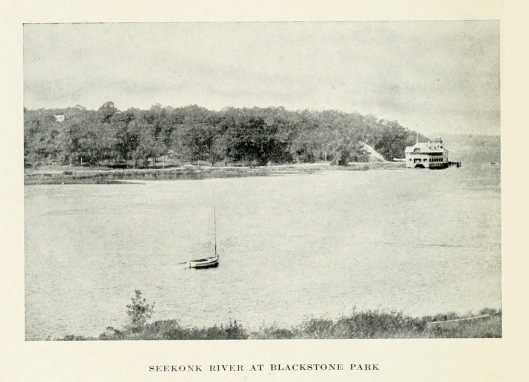
The lower Seekonk shoreline does not seem to have been much photographed for postcards, and there are few postcards of it online and only one of York Pond itself (after the grading and extraction works). This is the largest I have of this particular card.

Here’s H.P. Lovecraft on the Park and shoreline…

“Scarce a stone’s throw from the house lie the nearest parts of that beautiful rustick reservation known as “Blackstone Park” — wherein I have been wont to wander some twenty or more years [i.e. since about age eight]. Here Nature unadorn’d displays a multiplicity of agreeable phases; ravines, groves, brooklets, thickets, & Arcadian stretches of river-bank — for the park borders on the wide & salty Seekonk. The Seekonk is call’d a river, but in truth ’tis but a bay or inlet. The river proper doth not begin till four miles to the north, where (changing its name successively to the Pawtucket & the Blackstone) its fresh streams flow over the mill dam at the Great Bridge of the city of Pawtucket. How beauteous indeed is untainted Nature as beheld in so idyllick a spot as Blackstone Park! […] I think this park would explain why such a born & bred town man shou’d possess such a taste for rural musings & Arcadian themes!

Here’s a Blackstone Park sketch made by Whitman Bailey in 1916. Looking down a sylvan path and ride, toward the glinting of the distant Seekonk.

The young Lovecraft also had a view of the Park and the Seekonk from his home…

“The roof of 598 Engelstrasse is approximately flat, and in the days of my youth I had a set of meteorological instruments there. Hither I would sometimes hoist my telescope, and observe the sky from that point of relative proximity to it. The horizon is fair, but not ideal. One can see the glint of the Seekonk through the foliage of Blackstone Park, and the opposite bank is quite clearly defined.”

One can glimpse a house with a flat roof and just such a view here (from The southern gateway of New England, 1910). The picture-maker looks across at the shore ride, from near Red Bridge…

The shoreline structure seen here is the Boat Club boathouse, thus by looking at maps one can see that the house glimpsed in the trees is likely to be one of those lining Lovecraft’s Angell St.

As one can also see above, the shoreline road was relatively low. No attempt seems to have been made to preserve the shore drive from being covered by the inevitable ten-year winter flood-surge. Indeed, Lovecraft dreamed of such things, but weirdly inverted and horribly revealing rather than covering…

“I was standing on the East Providence shore of the Seekonk River, about three quarters of a mile south of the foot of Angell Street, at some unearthly nocturnal hour. The tide was flowing out horribly — exposing parts of the river-bed never before exposed to human sight. Many persons lined the banks, looking at the receding waters & occasionally glancing at the sky. Suddenly a blinding flare — reddish in hue — appeared high in the southwestern sky; & something descended to earth in a cloud of smoke, striking the Providence shore near the Red Bridge — about an eighth of a mile south on [of?] Angell Street. The watchers on the banks screamed in horror — “It has come — It has come at last!” — & fled away into the deserted streets. [Blind panic ensues] By this time the river-bed was fully exposed — only the deep channel filled with water like a serpentine stream of death flowing through a pestilential plain in Tartarus.” (1920)

There evidently were floods but the natural inundations of winter were brief, expected and subsided. In summer he would often sit all day on the surviving southern bluff above York Pond, reading and writing. In 1927, a letter was headed as from… “High Wooded Bluff Above the Seekonk River – a mile East of 10 Barnes St.” He sometimes even shared his childhood haunt with close friends. Here is an instance from 1927…

“the next day we [he and Cook and Munn] lounged about the Blackstone Park woods beside the Seekonk — agrestick haunt of my earliest infancy, and true genesis of my pastoral soul.”

In a letter of 1934 he remarks…

Almost every warm summer afternoon I take my work or reading in a bag & set out for the wooded river-bank [on the Seekonk] or the fields & woods north of Providence — spending the time till dusk in one or more favourite rustic spots.


A year after Lovecraft passed away, a terrific natural flood struck Providence…

This must surely have also swept up the Seekonk and around his cherished wooded bluff in Blackstone Park, but understandably there seems to be no photo made of the Park shoreline at that time. Evidently the foliage and wildlife of the ponds at that point must be used to such occasional inundations.

Friday Picture Postals from Lovecraft: Pawtucket / Pawtuxet / Pawcatuck

26 Friday Apr 2019

Posted by asdjfdlkf in Astronomy, Historical context, Picture postals

≈ 1 Comment

Sleepy Pawtuxet. The view looks across the Pawtuxet bridge toward Broad St. Note the electric trolley car nestled in its terminus bay, presumably having arrived from Providence, and the Lovecraft-alike man on the right of the picture walking away from it. Lovecraft had a regular 1906 column in the Pawtuxet Valley Gleaner at about the time of this card (probably photographed c. 1906 or 07), with astronomy articles such as “Is Mars an Inhabited World?”. The card photographer was very unlikely to have caught a 16 year old Lovecraft crossing the bridge to make the trolley connection to Phenix, though he is known to have worn his father’s clothes as might be the case with the man seen here. But the card is indicative of a scene he would have known, had he travelled out to the Gleaner newspaper offices or simply taken an early-springtime walk down that way.

I should clarify a possible point of placename confusion for those reading Lovecraft’s letters. Pawtuxet is not Pawtucket. Pawtucket now appears to be effectively a suburb of Providence, and lies to the north of the city beyond Swan Point Cemetery and at the head of what seems to be the navigable part of the River Seekonk…

… while Pawtuxet is in the far south and just beyond Providence, at the head of a river-valley where that valley meets the Providence River as it starts to meet the ocean. Of the two places Pawtuxet was by far the more sleepy and homey place in Lovecraft’s time. This is confirmed by an author in The Survey of 1922, which gives a vivid flavour of the trolley-ride Lovecraft would have had there…

As the [inexpensive electric trolley] car turns south from Providence, out toward the Pawtuxet Valley, it passes through about nine miles of usual city outskirts. Then suddenly, round a curve, rows of little white clapboard houses appear grouped about a mill close to the sides of the river; and on the hill where once also stood the company store, is the spotless white frame company church. The whole picture is flanked by hills and rolling farm lands. The car has entered “the Valley.” It is a different world. Many inhabitants have never visited the city nine miles away.

Although the Pawtuxet Valley Gleaner offices were out in Phenix, so to visit them from Pawtuxet Lovecraft would then have change trolleys and taken another trolley or bus going west some 12 miles along and deep into the Pawtuxet Valley. I imagine he would taken this more scenic route — Providence – Pawtuxet – Pawtuxet Valley – Phenix, which is only about 21 miles in total. This was apparently one is his mother’s home-places when she was growing up, which was why the Gleaner — the valley’s main paper — was still taken in Lovecraft’s home.

The even sleepier Phenix, circa 1908.

An example of Lovecraft’s column in the weekly paper, 1906…


Later, in the late 1920s and early 1930s, Lovecraft would take friends down to Pawtuxet on the trolley and the place was evidently then known for its fine seafood dinners at the local restaurants. These were presumably on the “shore”, and probably rather affordable given the usual state of Lovecraft’s finances…

On the way back I blew Price [‘treated Price’] to a typical R. I. [Rhode Island] clam dinner at antient Pawtuxet and later stopt at a Waldorf [chain restaurant] to tank up my’self.”

Still another trip was to old Pawtuxet — where, as with Price, I watched Morton eat a shore dinner.

Kirk & his wife passed through Providence on the last lap of a long New England motor tour. I took him to the ancient & unchanged fishing village of Pawtuxet, down the bay.

I imagine that Lovecraft might have been tempted to tantalise his friends while showing them around, by mentioning that Pawtuxet had featured as a substantial setting in his unpublished novel Dexter Ward. Written 1927, the book was not to be published until 1941…

He must likewise have begun to practice an extreme care and secrecy in his graveyard expeditions, for he was never again caught at such wanderings; whilst the rumours of uncanny sounds and manoeuvres at his Pawtuxet farm diminished in proportion. His rate of food consumption and cattle replacement remained abnormally high…

“the creaking of Epenetus Olney’s new signboard … was exactly like the first few notes of the new jazz piece all the radios in Pawtuxet were playing”.


Whipple.org has further useful clarification of the placenames, and warns of a third element of potential confusion, in the article “Pawcatuck, Pawtucket, Pawtuxet: Three Places in Rhode Island?”.

Sadly, the feline-loving Lovecraft never made use of ‘Pawcatuck’ in the kitty sense (one imagines a possible witty word-playing poem on the three Paw-places, re: his inevitable encounters with their paw-padding cats). Though it is deemed the site of ‘faery’ in “Dexter Ward”…

… after a few heralding cards the young wanderer quietly slipped into New York on the Homeric and traversed the long miles to Providence by motor-coach, eagerly drinking in the green rolling hills, the fragrant, blossoming orchards, and the white steepled towns of vernal Connecticut; his first taste of ancient New England in nearly four years. When the coach crossed the Pawcatuck and entered Rhode Island amidst the faery goldenness of a late spring afternoon his heart beat with quickened force, and the entry to Providence along Reservoir and Elmwood avenues was a breathless and wonderful thing despite the depths of forbidden lore to which he had delved.

← Older posts
Newer posts →


Please become my patron at www.patreon.com/davehaden to help this blog survive and thrive.

Or donate via PayPal — any amount is welcome! Donations total at Easter 2025, since 2015: $390.

Archives

  • February 2026
  • January 2026
  • December 2025
  • November 2025
  • October 2025
  • September 2025
  • August 2025
  • July 2025
  • June 2025
  • May 2025
  • April 2025
  • March 2025
  • February 2025
  • January 2025
  • December 2024
  • November 2024
  • October 2024
  • September 2024
  • August 2024
  • July 2024
  • June 2024
  • May 2024
  • April 2024
  • March 2024
  • February 2024
  • January 2024
  • December 2023
  • November 2023
  • October 2023
  • September 2023
  • August 2023
  • July 2023
  • June 2023
  • May 2023
  • April 2023
  • March 2023
  • February 2023
  • January 2023
  • December 2022
  • November 2022
  • October 2022
  • September 2022
  • August 2022
  • July 2022
  • June 2022
  • May 2022
  • April 2022
  • March 2022
  • February 2022
  • January 2022
  • December 2021
  • November 2021
  • October 2021
  • September 2021
  • August 2021
  • July 2021
  • June 2021
  • May 2021
  • April 2021
  • March 2021
  • February 2021
  • January 2021
  • December 2020
  • November 2020
  • October 2020
  • September 2020
  • August 2020
  • July 2020
  • June 2020
  • May 2020
  • April 2020
  • March 2020
  • February 2020
  • January 2020
  • December 2019
  • November 2019
  • October 2019
  • September 2019
  • August 2019
  • July 2019
  • June 2019
  • May 2019
  • April 2019
  • March 2019
  • February 2019
  • January 2019
  • December 2018
  • November 2018
  • October 2018
  • September 2018
  • August 2018
  • August 2015
  • July 2015
  • April 2015
  • March 2015
  • February 2015
  • January 2015
  • December 2014
  • November 2014
  • October 2014
  • September 2014
  • August 2014
  • July 2014
  • June 2014
  • May 2014
  • March 2014
  • February 2014
  • January 2014
  • December 2013
  • November 2013
  • October 2013
  • September 2013
  • August 2013
  • July 2013
  • June 2013
  • May 2013
  • April 2013
  • March 2013
  • February 2013
  • January 2013
  • December 2012
  • November 2012
  • October 2012
  • September 2012
  • August 2012
  • July 2012
  • June 2012
  • May 2012
  • April 2012
  • March 2012
  • February 2012
  • January 2012
  • December 2011
  • November 2011
  • October 2011
  • September 2011
  • August 2011
  • July 2011
  • June 2011
  • May 2011
  • April 2011
  • March 2011
  • February 2011
  • January 2011
  • December 2010
  • November 2010
  • October 2010
  • September 2010
  • August 2010
  • July 2010

Categories

  • 3D (14)
  • AI (70)
  • Astronomy (70)
  • Censorship (14)
  • de Camp (7)
  • Doyle (7)
  • Films & trailers (101)
  • Fonts (9)
  • Guest posts (2)
  • Historical context (1,095)
  • Housekeeping (91)
  • HPLinks (74)
  • Kipling (11)
  • Kittee Tuesday (92)
  • Lovecraft as character (58)
  • Lovecraftian arts (1,626)
  • Lovecraftian places (19)
  • Maps (70)
  • NecronomiCon 2013 (40)
  • NecronomiCon 2015 (22)
  • New books (966)
  • New discoveries (165)
  • Night in Providence (17)
  • Odd scratchings (984)
  • Picture postals (276)
  • Podcasts etc. (431)
  • REH (184)
  • Scholarly works (1,469)
  • Summer School (31)
  • Unnamable (87)

Get this blog in your newsreader:
 
RSS Feed — Posts
RSS Feed — Comments

H.P. Lovecraft's Poster Collection - 17 retro travel posters for $18. Print ready, and available to buy — the proceeds help to support the work of Tentaclii.

Proudly powered by WordPress Theme: Chateau by Ignacio Ricci.