• About
  • Directory
  • Free stuff
  • Lovecraft for beginners
  • My Books
  • Open Lovecraft
  • Reviews
  • Travel Posters
  • SALTES

Tentaclii

~ News & scholarship on H.P. Lovecraft

Tentaclii

Category Archives: Astronomy

‘Picture Postals’ from Lovecraft: Inside the Providence Opera House

15 Friday Apr 2022

Posted by asdjfdlkf in Astronomy, Picture postals

≈ Leave a comment

I need to get my DAZ/Poser 3D artistry blog back online, so there’s no time today for a long involved ‘Picture Postals’ post this Friday.

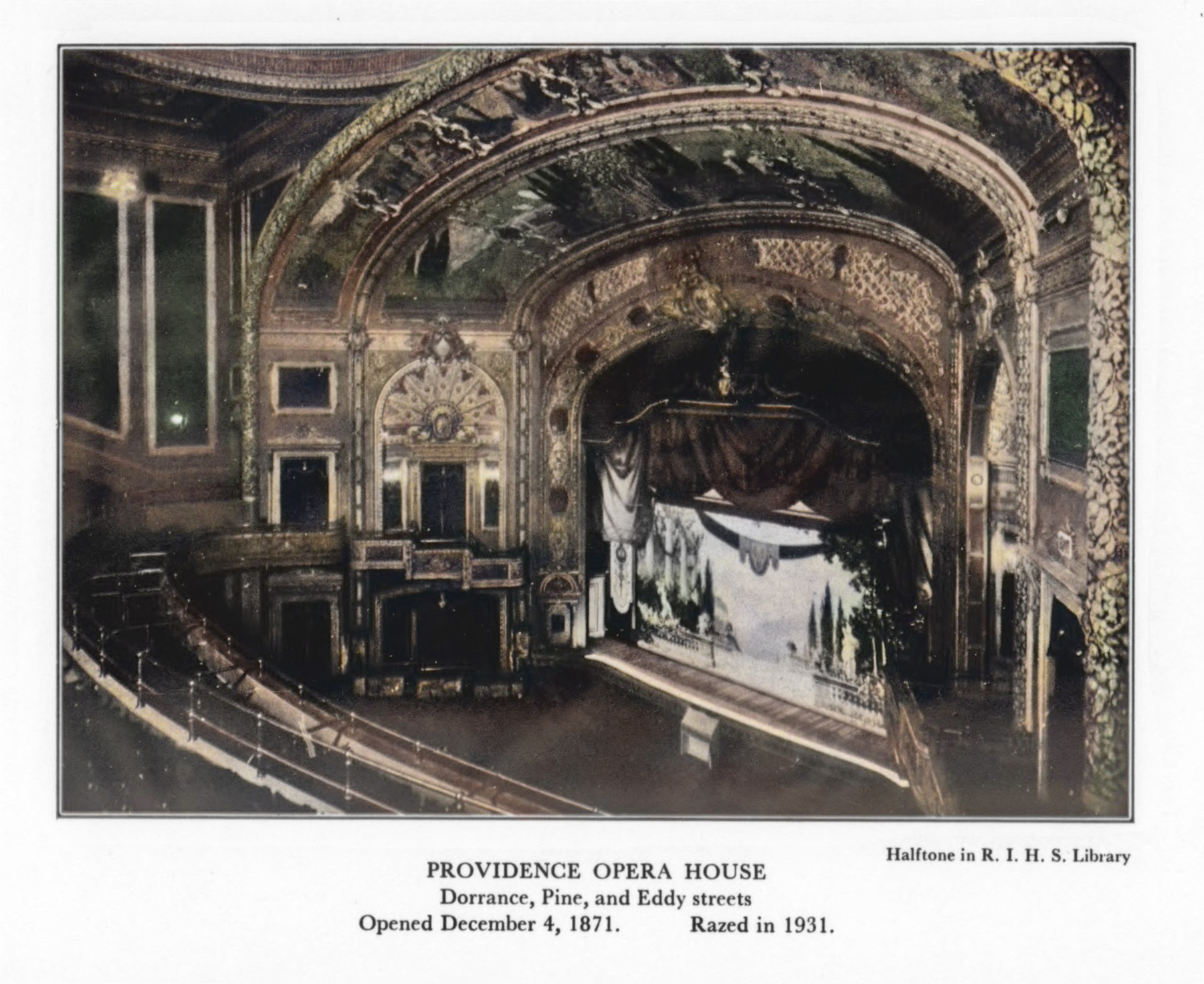
Rhode Island History 1942-2011 is now online at Archive.org from microfilm, with ‘dark but large’ pictures. Here one has been extracted and rectified and given a touch of colour by myself, a rare (perhaps the only) picture of the audience’s view, showing the stage. Presumably made in the late 1920s when the place was under threat of demolition.

This is a rare interior picture (it doesn’t appear to have survived into the current era, to be scanned) of the place which Lovecraft called his second home and the stage from which he “slung” Shakespeare as a youth.

The 1,500 seater was experienced early…

… we were acquainted with Mr. Morrow [Robert Morrow], the lessee & manager of Providence’s chief theatre — The Providence Opera House — (he lived directly across the street) so that it was not thought too shocking to let my aunt take me to see something [on the stage, when a young boy in 1896]” — H. P. Lovecraft, letter to Kleiner dated 16th November 1916.

He later recalled (Letters to Family)…

What a second home the old Opera House used to be to me!

Evidently this was not restricted to boyhood, as he also recalled that he had “slung from the stage” of the Opera House great slabs of a Shakespearean tragedy, given with “vigorous, orotund delivery”. Indeed the full quote, in a letter to Bonner in 1936 (Selected Letters Vol. 5) reveals he had once been out and about at many theatres in the city…

I used to sling from the stage of Forbes’ Theatre, Smarts Hall, Harrington’s Opera House, and the Providence Opera House

That doesn’t sound like a school theatre group ‘show for the parents’. Was he once quietly an actual ‘turn’ on the boards, one wonders?

This is also somewhat strange given his performance at the Boston amateur journalism conference in February 1922 (Selected Letters Vol. 1, pp. 123-24). There he decided to give his banquet speech impromptu rather than from his prepared script, and was thus rapturously recieved as “a born public speaker”. On which he commented…

All of which was rather amusing to me, since I am a hermit who has never before addressed a banquet

He did however note in his letter that he used at least one theatre trick during the speech, with some stock lines delivered and these being…

borrowed from the manner of vaudeville monologue artists

So what are we to make of this? He “slung from the stage” from several theatres, and one has to assume this was to an audience rather than an empty hall. Yet later he appears surprised at his facility with public speaking. I suppose the distinction he may have been making in his mind was between i) large theatre recital of lines from Shakespeare and ii) impromptu after-dinner public speaking with off-the-cuff remarks and tangents. These things, despite having a similar bodily stance, hand-gestures and vocal projections, are probably rightly considered to be different from one another.


Incidentally, I have now started in on a re-reading of the Selected Letters, skipping those I already have in later per-correspondent volumes, and I’ll be posting notes on these volumes as and when. I did think of asking Joshi if I could update his Index to the Selected Letters (second edition), but it would be a huge task and the full mega-index for all volumes of the Letters is anyway said to be forthcoming from someone else in the next few years. I assume this work will also expand the index for the Selected Letters a bit. I was spurred to my passing notion by the very first mention of Venus (the planet, in connection with Develan’s Comet) in Selected Letters Vol. 1 (p. 5), when I found that the planet had no entry in the Index.

Science Fiction Stories with Good Astronomy

07 Thursday Apr 2022

Posted by asdjfdlkf in Astronomy, Scholarly works

≈ Leave a comment

An excellent resource for good science science-fiction, Andrew Fraknoi’s free Science Fiction Stories with Good Astronomy (2019).

‘Picture Postals’ from Lovecraft: High Bridge and the 1925 eclipse

11 Friday Feb 2022

Posted by asdjfdlkf in Astronomy, Historical context, Picture postals

≈ 3 Comments

After last week’s ‘Picture Postals’ visit to sunny climes in New Orleans, this week I look at a frozen New York City.

In one of my earliest blog-essays on Lovecraft, way before I knew as much as know now, I suggested that his 1925 solar eclipse viewing from High Bridge or nearby hill might have provided a dramatic sight of a distant New York City. A city plunged into a sinister darkness, giving an appearance akin to R’lyeh risen from the waves. Whatever the facts of the matter, as set out below, this still seems a poetic image of likely use to future bio-pic makers and graphic novelists. Lovecraft gibbering and stuttering with the severe cold, sinking to his knees like a cultist, as a vision of New York as a R’lyeh-like city emerges from the cold mists under the en-darkening eclipse.

But what of the hard facts? I now revisit my old suggestion, and see if I can glean any more data. My thanks to Horace Smith for reminding me of my old post, and prompting me to look again at the relevant entry in Lovecraft’s 1925 Diary.


We know that an initial intention of the Lovecraft eclipse expedition of 24th January 1925 appears to have been to rise from their beds very early, then travel into the ‘zone of totality’ to reach the High Bridge aqueduct. Kirk invites his girlfriend to join the expedition thus…

… we’ll go up to Yonkers and take [smoked] glasses along and walk up on an aqueduct

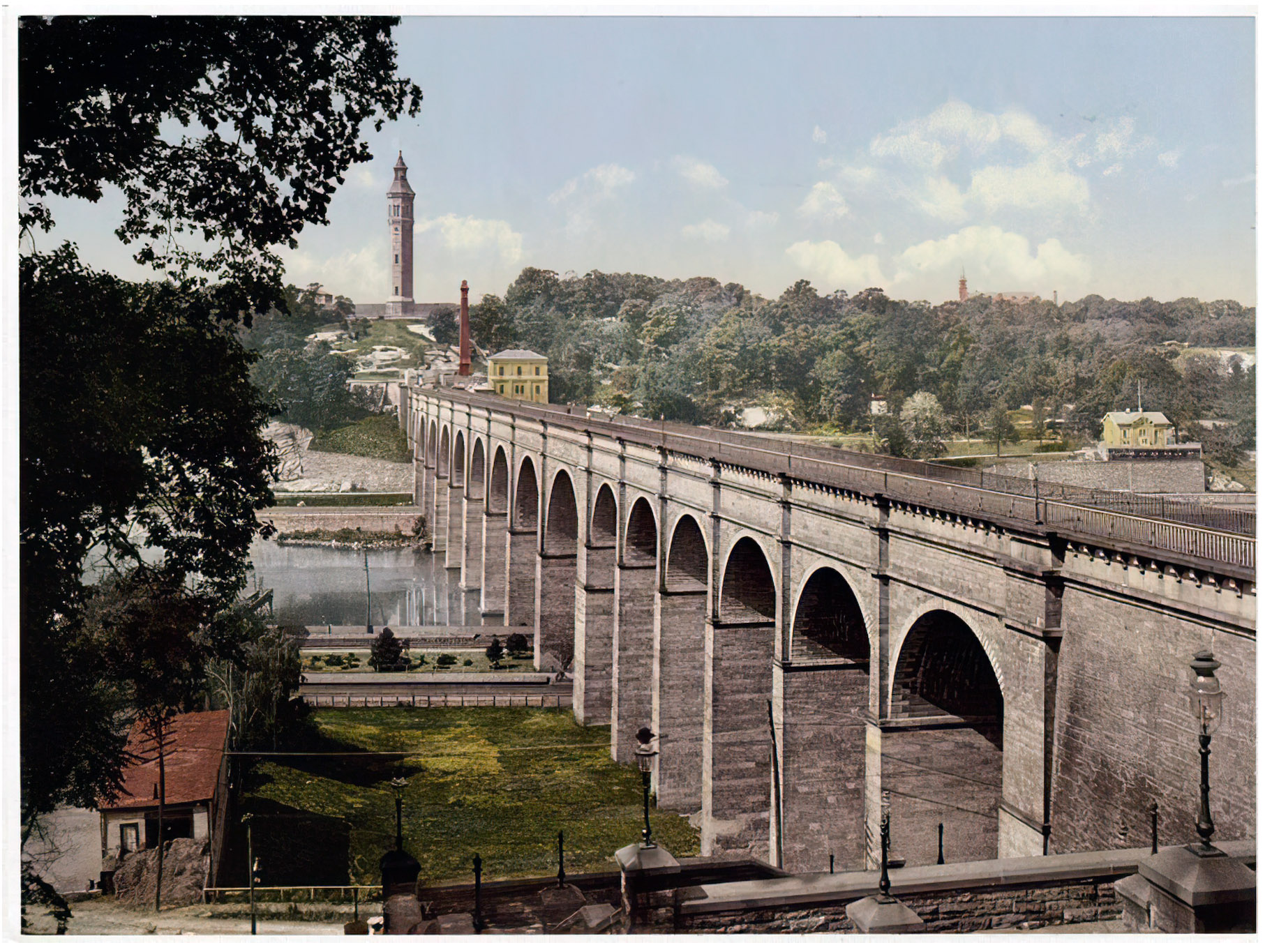
The distant tower and grey wall below it are part of a gigantic elevated reservoir, and the bridge carries its Old Croton Aqueduct.

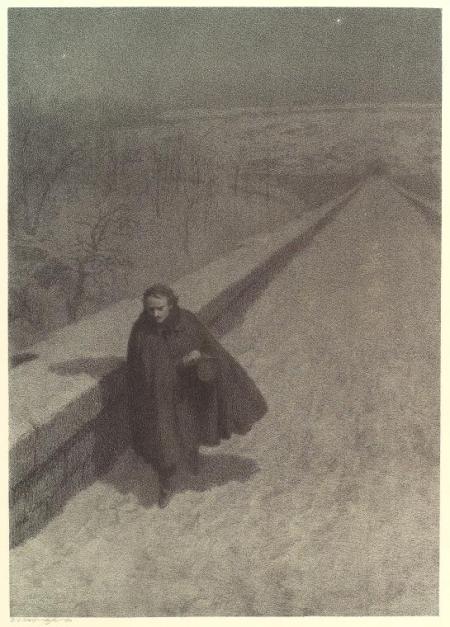
This aqueduct / pedestrian bridge was once a haunt of Poe, it being said that… “a walk to High Bridge was one of his favorite and habitual recreations” while living at Fordham. It would thus have a double-attraction for the Lovecraft expedition — to view the eclipse on the bridge where Poe walked.

Poe on the High Bridge.

At the end of January 1925 New York City was still in the depths of a bitter and snowy winter, which had arrived with the worst snowstorm in living memory at the start of January. About the third week of January Lovecraft peered out of Loveman’s picture-window at the cityscape. He noted in a letter that another ‘ponderous’ snowstorm appeared set for imminent arrival. However, his other New York letters from January suggest it was still relatively easy to get around the city. That said, it is quite possible that High Bridge was closed by the authorities for public safety due to the likelihood of surging crowds and icy conditions.

Anyway, such was the apparent plan and the seasonal weather. But what of the actual day? Lovecraft’s 1925 Diary is cryptic on the matter, the January 1925 entry being…

Up 3:30 [a.m.] — to SL’s [Loveman’s] & Van Ct. [Van Cortlandt St] with GK [Kirk] — meet JFM [Morton], Dench, Leeds. M & D [Morton and Dench] walk, [the] rest ride [public transport to] Getty Sq. [Into] Yonkers. Walk up hills — ECLIPSE

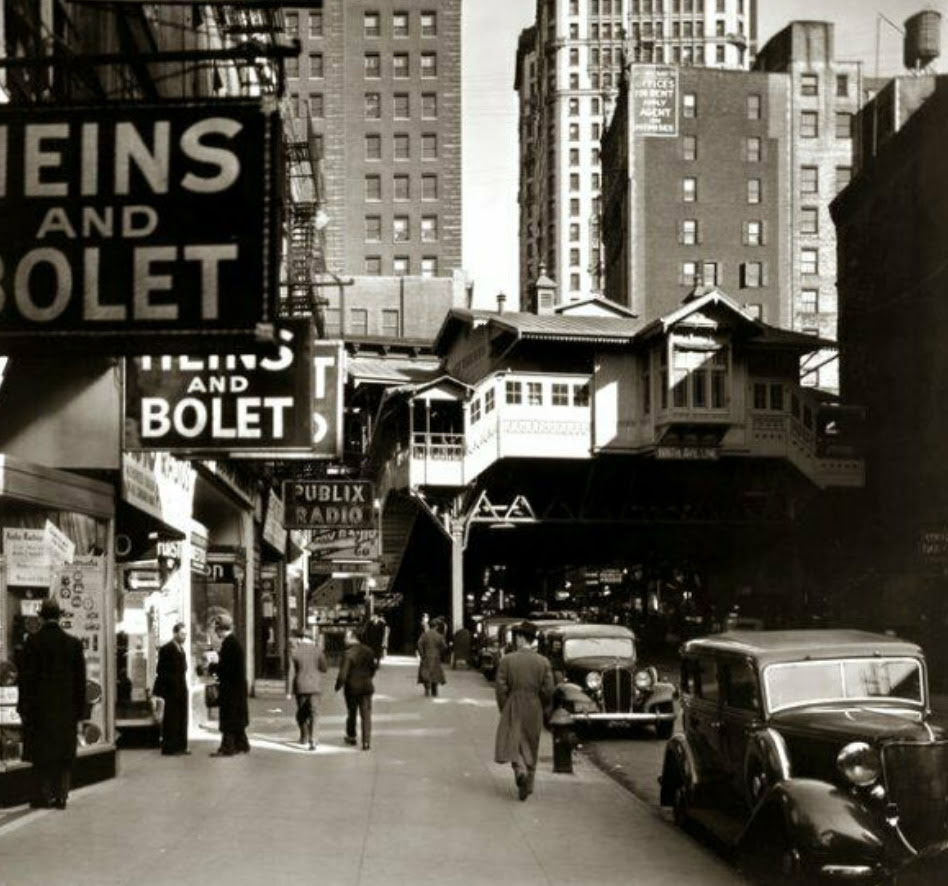
This entry indicates that Kirk was staying over at Loveman’s, at whose apartment Lovecraft perhaps arrived 5am. Loveman presumably had to work that day, a Tuesday. Lovecraft and Kirk then went to Van Cortlandt (Lovecraft the antiquarian is using the archaic ‘Van’ in the street name in his Diary, and abbreviating Cortlandt to Ct.). Here we see Van Cortlandt St. in the 1930s, a quarter mile west of the Brooklyn Bridge and with the street running below the 9th Avenue Elevated station.

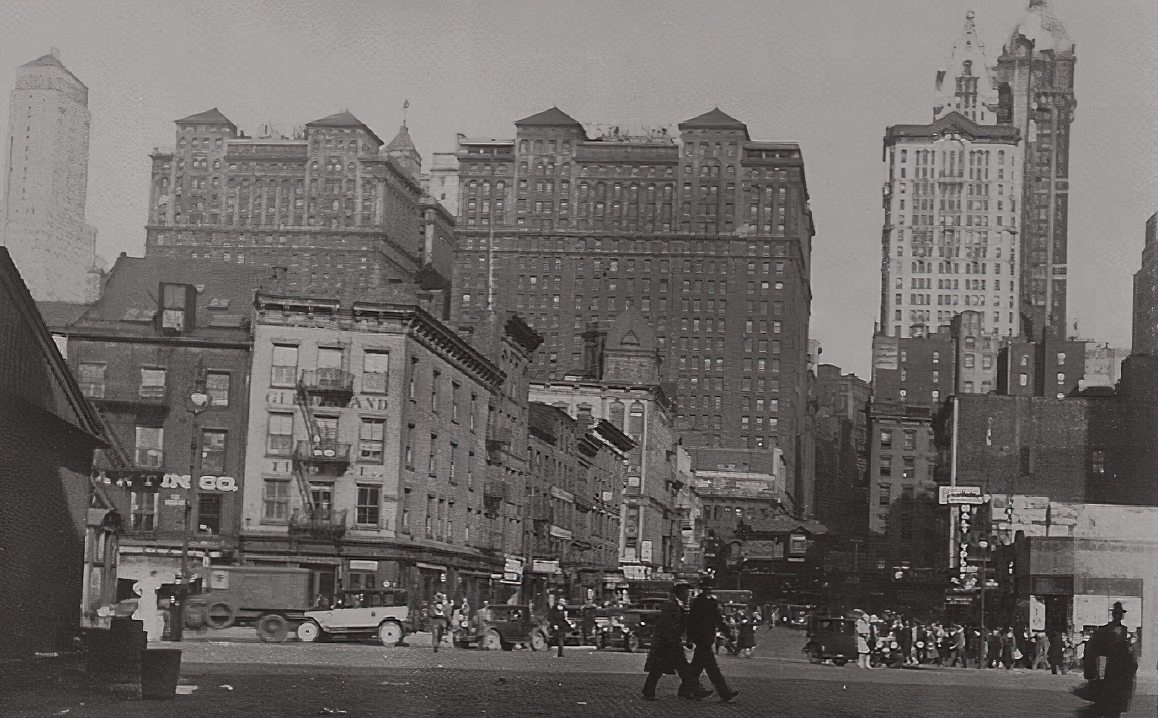
It was a natural place to meet up at 6 a.m., having a key train station on the Elevated. This was presumably serviced by several nearby early-morning cafes. It was on the verge of becoming a famous place in early mass media. In 1925 Oscar Nadel (‘the king of Cortlandt Street’) had opened his famous ‘Oscars Radio Shop’ there. The shop would trigger a cascade of activity which meant that by 1930 the street was a thriving radio broadcasting and radio retail-sales quarter, a place now known to media historians as ‘Radio Row’. In the following 1925 picture we see a wide view from further back, looking into Cortlandt Street and with the Elevated station just about visible in the deep shadows under the new skyscrapers.

Lovecraft’s friend Morton did not yet have his museum job, and would have been travelling in from Harlem. Dench would have been coming in from Sheepshead Bay. After the expedition had all met up and fuelled up on coffee, the Diary shows that Morton and Dench then walked from Van Cortlandt to Getty Square in Yonkers. If these ardent hikers were walking 12 miles directly north, moving at speed along a well-gritted and otherwise deserted shoreline path, then they might have taken 90 minutes. That then implies that Leeds, Kirk and Lovecraft waited for them for an hour or so in a known-to-all breakfast eatery at Getty Square, after having travelled there in comfort.

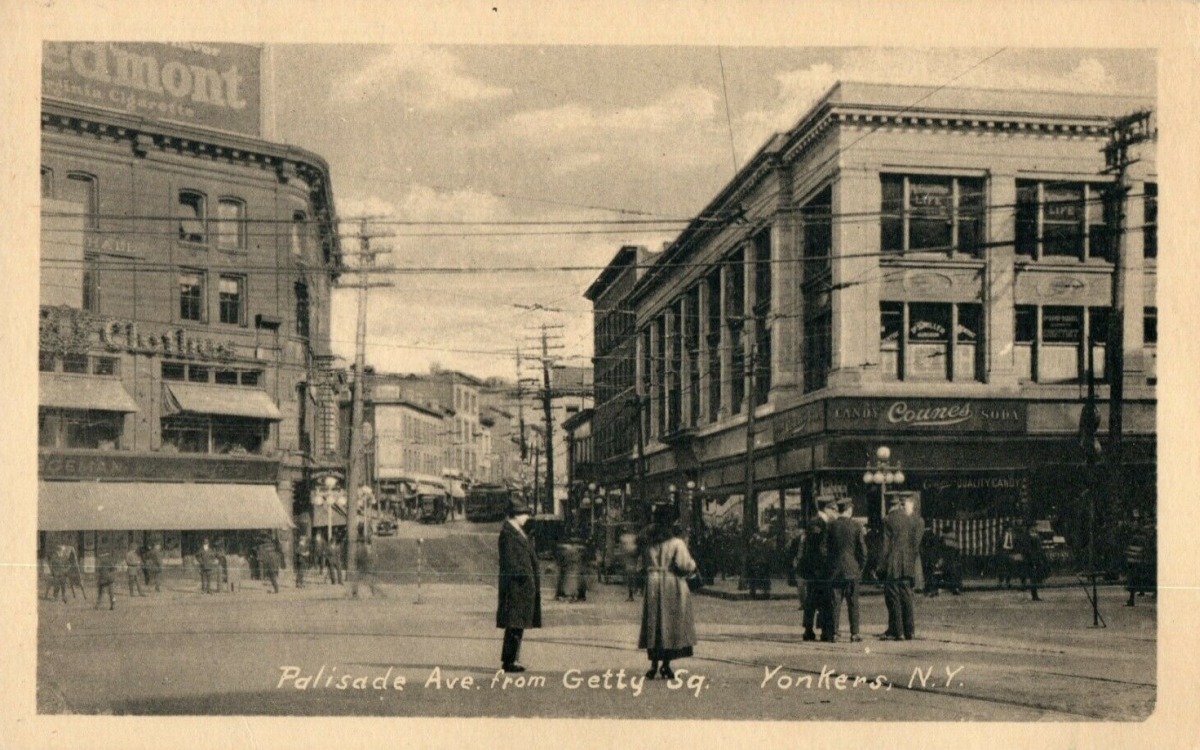
We see here a Yonkers candidate for the cafe, ‘Counes’ on the central corner of Getty Square, an establishment offering soda and ‘quality candy’ and likely indicative of the many sugary delights available at this central transport hub…

By January 1925 Lovecraft had chuffed one too many candies. As he later recalled for Morton, he was a bit plump at that point…

that eclipse morning occurred whilst I was still a problem for Sheraton chair-makers, yet scant comfort did my proteid integuments afford me! [in that chill]

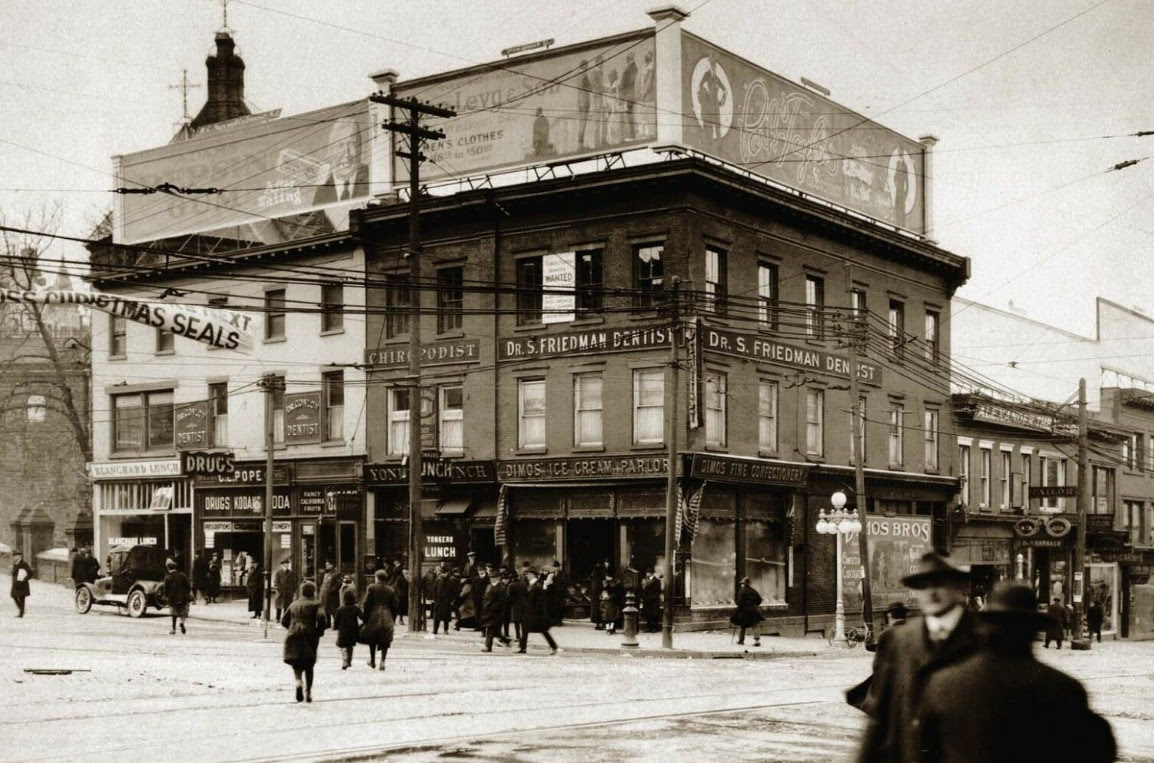
This soda bar is a possibility, and perhaps was likely to be open earlier than usual to serve the eclipse crowds. Though a cheaper coffee / ‘all-day lunch’ shop was probably the more likely choice. Here we see several options on Getty Square, circa 1920…

Lovecraft’s “Walk up hills” diary entry implies multiple hills. But this does not get us much further as to the viewing location, because the terrain of Yonkers rather assumes that any route out from Getty Square would have been up and over some rolling hills. Yonkers was well known, then as now, for its many steep hills. As Joseph J. Conte recalled of his 1940s boyhood in his memoir Flies in My Spaghetti…

Wintertime was a great time of the year and, with all the hills in Yonkers, we had a big choice of where we would take our sleds.

In 1932 Lovecraft was no more precise, recalling…

… some of us tramped up into the cold of northern Yonkers to see the January eclipse.

Another letter I found recently states that a hillside was the observation point, equally vague.

If the expedition had left their Getty Square cafe and were on the road out of the urban nexus by 8.a.m., then they would have had 70 minutes left to find a suitable spot. This photo is indicative of the initial trek up Main Street from Getty Square in the “marrow-congealing” ice and snow. It shows the top of Main St. as seen circa the 1920s, climbing up from Getty Square below…

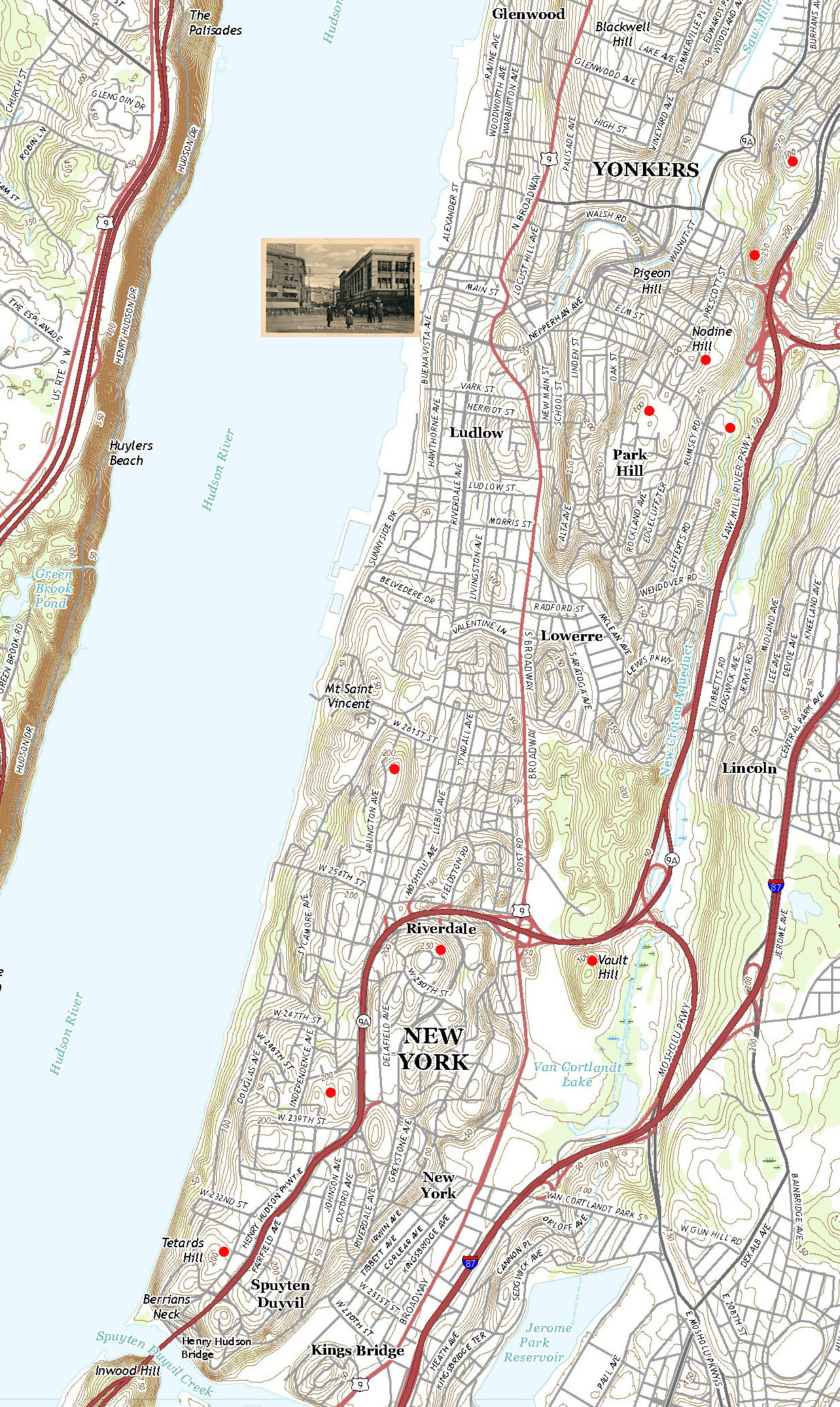
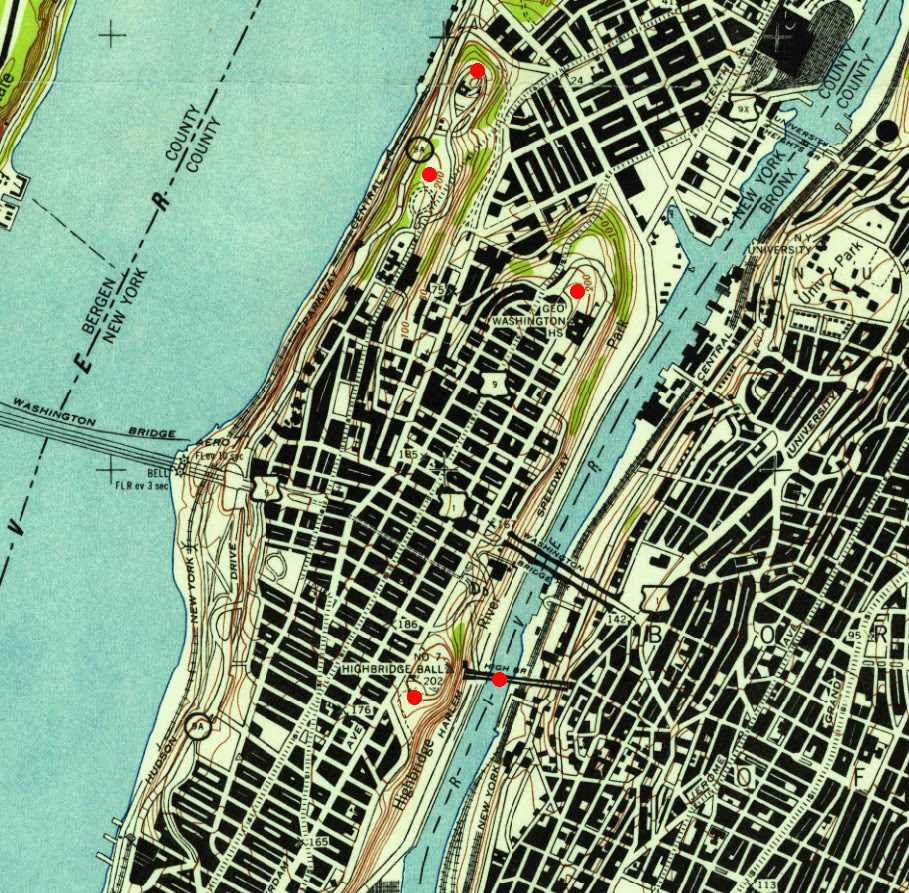
But if High Bridge was still the aim of the expedition, as Kirk’s diary suggests, then one has to assume a walk or tram-ride four miles south from Getty Square through Yonkers to reach the High Bridge. Why do it like this? It would enable them to look out for suitable hillside spots facing east and without encumbering trees or buildings (the sun would be quite low at the ‘totality’), while they walked south. Here then are the likely spots marked by me on a terrain map, spots facing east and not wooded or built-up.

And here we see the above terrain continued down to High Bridge. This map extract is from the 1947 USGS 1:24000 map for the Central Park area. It too has the required elevation contours and heights.

Inwood Hill Park, seen on the top map and here located a little off the north of this map extract, was (at least in 1947) too heavily wooded at the high points to provide good views. If the expedition did hike the four miles through from Getty Square to High Bridge, they would pass two or three 200ft east-facing spots just to the north of the reservoir end of the High Bridge. Again, these are marked on the above map.

Of course, it may well be that the expedition never even reached High Bridge or its nearby hills, as was seemingly initially planned. They could have found a better spot on the way there, or run out of time. Or perhaps they simply chose one of the candidate hills a mile or two back from Getty Square, if they had researched their location or read about likely spots in the newspaper beforehand. This latter idea is supported fairly strongly by the fact that Lovecraft’s 1925 Diary continues after the word “ECLIPSE”, indicating post-Eclipse visits to two local landmarks…

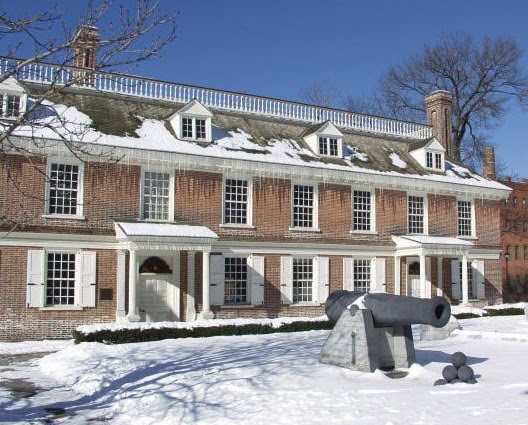
Philipse Manor [a restored Dutch manor house just off Getty Square, with fine interiors], St. John [Episcopal Church, with fine exterior fancy-stonework and fancy roof tiling] home — Tiffany [his regular everyday cafe, near his room on the edge of Red Hook] — rest

Philipse Manor. The plain exterior was probably enhanced a bit by snow and ice.

These items must argue against the High Bridge having been reached or even walked toward, unless they shuttled back up to Getty Square on public transport. That they visited two sites just off Getty Square after the eclipse would seem to indicate that the “hills” would have been those within a few miles of that place. Which at least narrows the choice of the hill in Yonkers down to a few.

But even this data is vague and we shall probably never know the exact viewing spot now, unless a new letter or postcard comes to light. But the red dots above show the likely candidates. Take your pick.

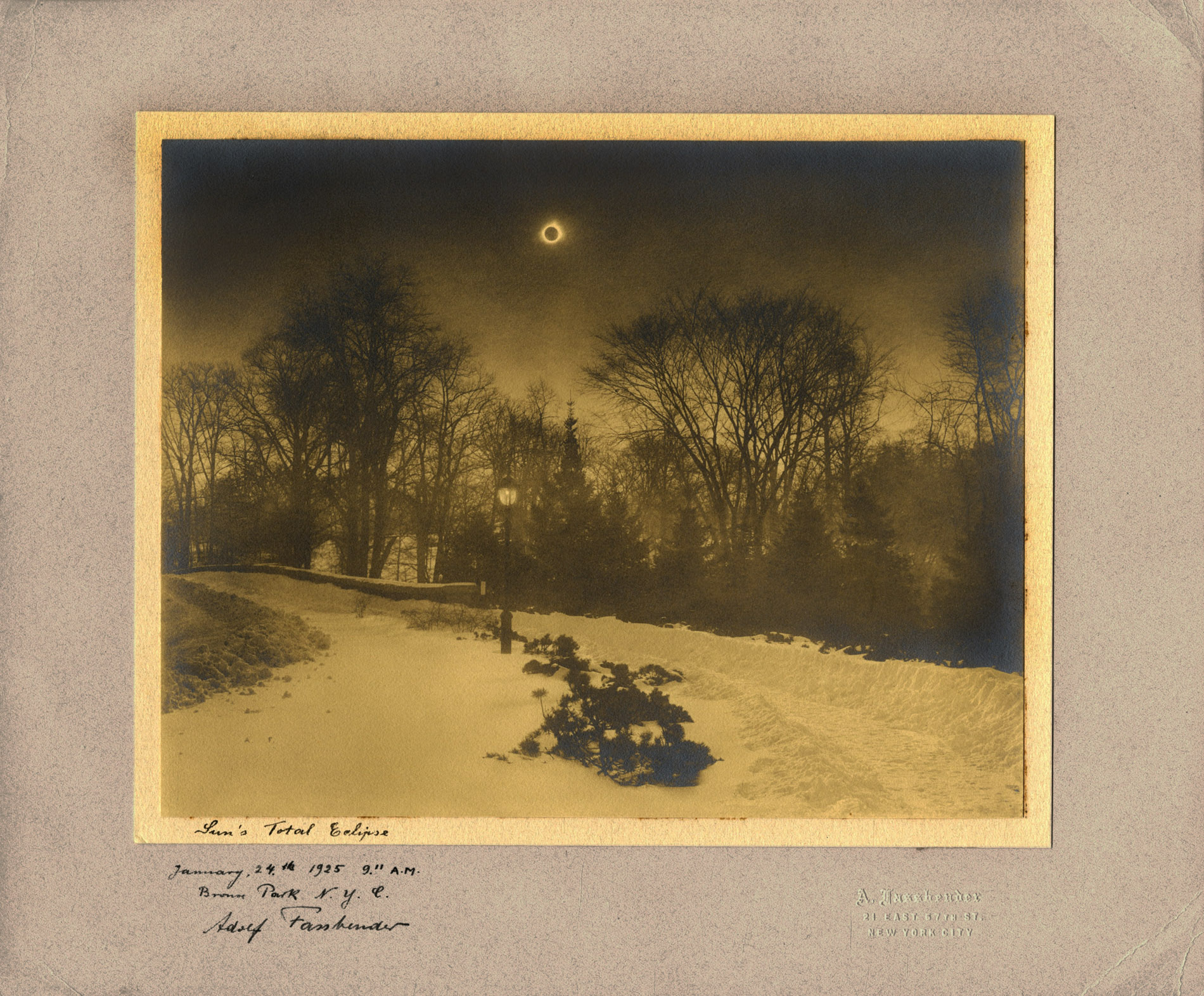
We do however have this evocative picture, seen below. It clearly indicates the elevation of the sun in the east relative to the ground, and the snowy ground conditions in New York City. It also demonstrates that the rather low sun at the totality would present viewers with potential problems re: finding a suitable east-facing observing site that was well free of obscuring trees or buildings.

Adolf Fassbender, “Sun’s Total Eclipse. January 24th, 1925, 9:11 a.m. Bronx Park, N.Y.C.” Original held by the New York Historical Society. Here Photoshopped to repair damage and emulsion silvering due to age.

Years later a letter from Lovecraft to Morton described in some detail his second and rather fine solar-eclipse experience in Newburyport. During this account Lovecraft recalled that the flaring corona around the ‘dark sun’ had been very bright in 1925, and thus the earth below had not become as en-darkened as he had expected. This seems to be borne out by the above photograph. The wide blanket of white snow probably kept light levels high, with a bright corona. Note also that the above picture suggests the air was rather still, as the branches are not blurred by wind-movement even in the low light.

Kirk’s diary suggests a further aspect of the experience, and a key reason for seeking an open hillside — the “rushing shadow”. Apparently this is a well-known aspect of viewing a total eclipse. Kirk tried to entice his girlfriend to come on the expedition by noting that…

… it is said that to be on a hill in open country and to see the rushing shadow thrown to Miss Moon is to marvel.

A little more on the Almanacs

23 Sunday Jan 2022

Posted by asdjfdlkf in Astronomy

≈ Leave a comment

Added to my recent post on Lovecraft’s Almanac collection:

Having sent some introductory astronomy books, Lovecraft also sent young Rimel a copy of the latest Old Farmer’s Almanac for 1935. In a later letter to Rimel of 28th January 1935, Rimel has obviously been a little puzzled by the gift. Lovecraft has to explicitly explain that he recommends it for astronomy. The Almanac being…

capable of assisting the study of astronomy quite a bit.

Fourteen Weeks

22 Saturday Jan 2022

Posted by asdjfdlkf in Astronomy, Historical context, Scholarly works

≈ Leave a comment

In a 1934 letter to Rimel Lovecraft remarks…

I have the entire series of Steele’s old ’14 Weeks’ textbooks […] which were wildly popular half a century ago [circa 1885] and which I still think are almost unsurpassed in giving beginners a good introduction to the science they cover.

These included Joel Dorman Steele’s A Fourteen Weeks Course in Descriptive Astronomy (1873), found in his library after his death. Joshi remarks in I Am Providence that of the old astronomy books found there…

some at least must have come from [his grandmother] Robie’s [astronomy] library. Of course, Lovecraft, ever the ardent used-bookstore hunter, could have picked up some of these titles on various book-hunting expeditions throughout his life.

Archive.org has several of the “Fourteen Weeks” series as scans, including the one on Descriptive Astronomy, though an 1875 edition.

In his reading guide for Anne Tillery Renshaw he calls the one in Physics “antediluvian” and classes it among the “whiskered reliques”, but still rates the ones on Chemistry and Zoology…

For a sound elementary introduction read Steele’s ancient Fourteen Weeks in Chemistry

Steele’s old Fourteen Weeks in Zoology is an easy start, and not at all misleading.

This might sound strange to us, but it’s no different than someone in 2022 recommending books from 1972 or thereabouts. Just as we might now still want to recommend a Carl Sagan or a Richard Feynman book to a beginner.

None of the mentions tell us when he acquired the set, though it must have been before 1934.

Lovecraft was right, part 473

18 Tuesday Jan 2022

Posted by asdjfdlkf in Astronomy, Odd scratchings

≈ Leave a comment

I have seen the dark universe yawning,
Where the black planets roll without aim;
Where they roll in their horror unheeded,
without knowledge or lustre or name.

— from “Nemesis” by H.P. Lovecraft.

Astronomers have used new techniques to detect about 100 ‘dark’ planets moving madly through space rather than orbiting their home star, just as Lovecraft imagined. A rigorous examination of observation data has now given a new catalogue of 70-170 of these. The researchers conclude that there are so many of these in the observed area that… “planets formed around stars and then banished to the blackness must be an important contribution” to their number. It then follows, as they suggest, that billions of unknown sun-less ‘black planets’ must roll through the cold wastes between the stars.

Other research has discovered ‘untethered black holes’, which have no black disk of matter pulled in around them — but can still be detected by the bending of light.

‘Picture Postals’ from Lovecraft: Volcanoes on the Moon

14 Friday Jan 2022

Posted by asdjfdlkf in Astronomy, Historical context, New discoveries, Picture postals

≈ 8 Comments

In an early letter to Galpin, dated 21st August 1918, H.P. Lovecraft recalled…

I began to study astronomy late in 1902 — age 12. My interest came through two sources — discovery of an old book of my grandmother’s in the attic, and a previous interest in physical geography. Within a year I was thinking of virtually nothing but astronomy, yet my keenest interest did not lie outside the solar system. I think I really ignored the abysses of space in my interest in the habitability of the various planets of the solar system. My observations (for I purchased a telescope early in 1903) were confined mostly to the moon and the planet Venus. You will ask, why the latter, since its markings are doubtful even in the largest instruments? I answer — this very MYSTERY was what attracted me. In boyish egotism I fancied I might light upon something with my poor little 2¼-inch telescope which had eluded the users of the 40-inch Yerkes telescope!! And to tell the truth, I think the moon interested me more than anything else — the very nearest object. I used to sit night after night absorbing the minutest details of the lunar surface, till today I can tell you of every peak and crater as though they were the topographical features of my own neighbourhood. I was highly angry at Nature for withholding from my gaze the other side of our satellite!

This tells us a number of things. It implies he was then aware of the Yerkes telescope. He must have been, even at a young age — since it was the Hubble Telescope of its day. It had been grandly exhibited a decade before at the 1893 World’s Fair in Chicago, before being moved with much publicity to its domed home above Lake Geneva, Wisconsin. Doubtless the Providence Public Library could have furnished pictures of such large telescopes for the boy Lovecraft, circa 1902-03, if he had not already seen the Yerkes in newspaper and magazine pictures.

But the quote is rather more interesting because it illustrates his initial and formative stance toward the “habitability … of the solar system”. By which he meant alien life, rather than future habitation by human colonists.

In this respect he obviously had hopes of making a discovery about the apparently cloudy and moist planet of Venus. This was then considered a somewhat likely habitation for alien life and was set to emerge as the Venus of pulp imagination, or the ‘Old Venus’ as some science-fiction historians now usefully call it. Undeniable evidence of its thick atmosphere had been obtained from Earth in 1882, it was warm and roughly Earth-sized and there were also what appeared to be markings on the planet’s surface. The prospect of life there was thus deemed quite possible. One even wonders if Lovecraft’s observations of Venus were partly non-visual, seeking to use his $15 spectrograph to detect something new and telling about the composition of the atmosphere? But, as he says in his letter to Galpin, others had the better equipment either way. Yet for all their immense telescopes and professional equipment, the professionals had still not settled the question of Venus by the time the adult Lovecraft returned to Providence from New York City. For instance here is The New York Times — then a sober paper of record — reporting in April 1927 on new methods of photographing Venus and detecting life…

But, as he recalls for Galpin, the moon was his chief interest. The moon was not, as we might now think, entirely without interest as a prospect for alien life. I have already glanced at the early theories about a pocket of atmosphere on the moon, and the theory’s implications for primitive life and the moon’s dark-side. The basic idea back then was that the moon’s immense natural ‘bump’ meant that a shallow atmosphere could just about persist on the dark-side, and some icy crater-lakes would form there. This theory appears to have been especially favoured by the Germans, and persisted there into the 1930s.

Now a little digging reveals that the young Lovecraft could also have been influenced by a moon book of the time, which had its own ideas about life. This was the illustrated book The moon, considered as a planet, a world, and a satellite, by Nasmyth and a co-writer. It was a key book, and the young Lovecraft had it in the 1903 un-revised fourth edition. The preface to this smaller and popular edition is dated May 1903 and The Bookseller lists it as available for purchase in early September 1903. Thus Lovecraft could not have had the book along with his new telescope (had either “early in 1903”, or in July 1903 according to Lovecraftian researchers). He would have had this worthy and useful book some months later either way, and perhaps it was even given as a Christmas present.
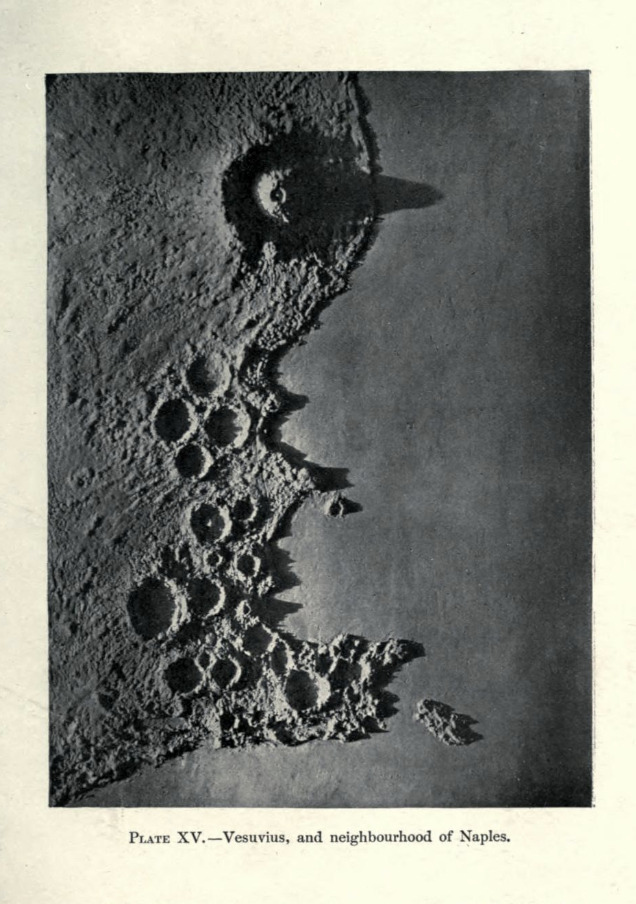
Such are the dates and the edition. What of the book’s ideas and influence? The book strongly supported and elaborately sustained a volcanic theory for the formation of the moon’s pockmarked surface. Volcanism then having obvious implications for things like subsurface heat. Because it implied magma chambers, networks of lava tubes, surface flow channels and so on. And at vast size too, since — as the book states — the moon’s large craters are immense and would dwarf those on earth.

Did Lovecraft subscribe to the theory? Yes. Lovecraft’s c. 1903 short note evaluating the likelihood of a competing theory of water-bearing “Lunar Canals” shows that he early accepted lunar volcanism. Also that he understood the volcanic activity to be relatively feeble by 1903…

“The lunar canals cover much less territory than the martian counterparts, this is doubtless, owing to the smallness of the moon compared with Mars, and therefore its feebler volcanic activity.” (“My Opinion as to The Lunar Canals”, c. 1903, my emphasis)

Was volcanism a crank theory? No. The volcanic theory of active crater formation reigned as a general scientific consensus until c. 1930, by which time some sustained doubts had become readily available in English. Yet its first serious challenge only came in 1949, long after Lovecraft’s death. Even then most scientists held to the consensus, until it was abruptly punctured by examination of actual rocks from the moon in 1965. Thus for most of his life, very likely for all of it, Lovecraft would have understood the moon’s surface to be actively volcanic in origin and nature.

This belief has certain implications. Do we glimpse here the spur for his intense moon observations? Quite possibly. If the boy Lovecraft could spot and observe an actual rare volcanic eruption in progress, and show the world the presence of a crater where before there had been none… he would have made his name as an astronomer.

What of the book’s opinion of life on this apparently volcanic moon? Nasmyth and his co-writer ruled out the possibility of “any high organism” on the moon’s surface due to the obvious lack of an atmosphere. Yet the book did tantalisingly suggest several possibilities for basic life:

i) Some form of ‘protogerm’ lying dormant, having sailed on the winds of space and landed…

Is it not conceivable that the protogerms of life pervade the whole universe, and have been located upon every planetary body therein? Sir William Thomson’s suggestion that life came to the earth upon a seed-bearing meteor was weak, in so far that it shifted the locus of life-generation from one planetary body to another. Is it not more philosophical [and assuming of a Creator] to suppose that the protogerms of life have been sown broadcast over all space, and that they have fallen here upon a planet under conditions favourable to their development, and have sprung into vitality when the fit circumstances have arrived, and there upon a planet that is, and that may be for ever, unfitted for their vivification.

ii) Some hardy form of vegetation able to survive intense cycles of heat and cold…

We may suppose it just within the verge of possibility that some low forms of vegetation might exist upon the moon with a paucity of air and moisture such as would be beyond even our most severe powers of detection.

After briefly considering these possibilities the book soberly concludes the moon is “barren” and that…

The arguments against the possibility of the moon being thus fitted for human creatures, or, indeed, for any high organism, were decisive enough to require little enforcing.

The words “barren” and “fitted” were well-chosen, since they leave open the question of the previously-suggested dormant and/or lower organisms. The book also leaves entirely un-examined the possibility of habitats in the sub-surface, in which the space-borne “protogerms” might have encountered a relatively warm (if apparently wholly dry and somehow non-gaseous) volcanic interior with its stable lava tubes.

Such lacuna would have been tantalising to the imaginative reader. I then suggest that here we may have some possible roots for Lovecraft’s later works, in terms of ideas such as:

i) a form of life that sails the star-winds and survives through space for cosmic time periods, before sifting down onto a clement planet to ‘vivify’;

ii) a hardy form of life, brought from the depths of space and (by implication) perhaps able to lie dormant for aeons in subterranean caverns. Only periodically brought to the surface by massive volcanism. A process akin, then, to the volcanic rising of R’lyeh in “The Call of Cthulhu”.

iii) the book’s volcanic ‘fountain’ diagrams and the idea of ‘protogerms’ arrived from space might both seem to evoke “The Colour out of Space” in its water-well.

I don’t say these were direct inspirations, later dredged from memory and made to serve Lovecraft’s mature fiction. But they would have been formative in shaping the broad contours of Lovecraft’s earliest cosmic imagining.

Incidentally, his yearning to see the dark side of the moon may even hint at a boyish theory about life existing there. In the absence of the lost boyhood story that he set there we can’t know much more about that. Yet knowing that he held to the volcanism theory suggests one obvious path the story could have taken — the discovery of volcanically melted crater-lakes on the dark side (his boy explorers had apparently needed their carbide lamps, implying they had stepped over the dividing-line) under a thin atmosphere.

What of ‘moon life’ claims made by others? Here I give readers a quick flavour of Prof. Pickering’s ‘snow’ ideas, related to his lunar ‘canals’ idea, via a glimpse of a full-page article in The Sphere for Christmas 1901…
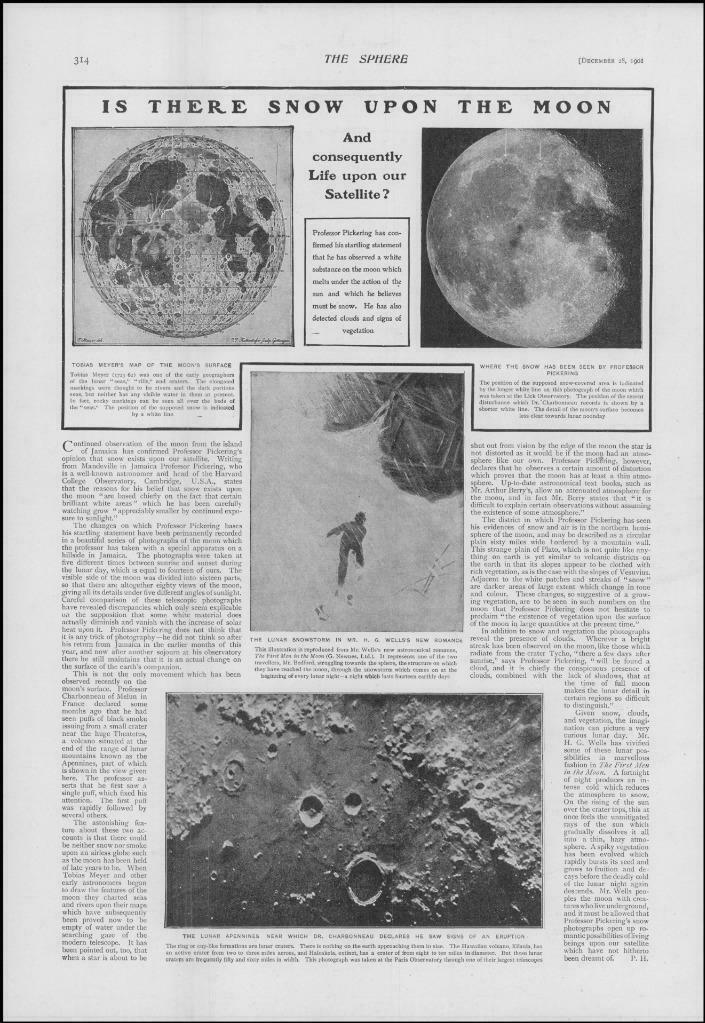
One can see how it would be easy to dismiss such things. Claims of observations of active primitive plant growth along snowy “canals” (or “streaks of vegetation” on the surface as Lovecraft described them) were indeed dismissed early by Lovecraft in his “My Opinion as to The Lunar Canals” (1903?). However much the glittering mountains might look like snow in photographs, water was not detectable from earth. Without water to sustain life, such things as ‘canals’ and ‘vegetation’ could not be. If the “Lunar Canals” text is correctly dated, then I would suggest it was written in late 1903 and under the direct and countering influence of the 1903 reprint of Nasmyth’s moon book.

See the Lovecraft Annual 2019 for a fine essay detailing Lovecraft’s reactions to Professor Pickering’s claims for the ‘lunar canals’ and more.

Yet ‘life on the moon’ was not then an either/or choice. One might sensibly discount questionable ideas such as immense banks of “snow” or “canals” and “vegetation”, while not entirely giving up hope for moon habitats of some sort. For instance, five years after his “My Opinion as to The Lunar Canals” we find Lovecraft even more certain of the apparent evidence for “active volcanism” on the moon, in his essay “Is There Life on the Moon?” (1906). But he has evidently become, after several years of personal observing, far more open to the idea of an active moon. He now aligns himself with some of Pickering’s ideas and the German ‘bulge’ idea, by musing on a “thin” atmosphere and surface frost forming on ridges…

Today [certain moon changes are] generally accepted as the work of active volcanism. Now no volcano can operate without atmosphere, but there could easily be a thin gaseous envelope undetected from the earth. The “lunar rays”, i.e. long, brilliant streaks radiating outward from some of the craters, have always been a puzzle to astronomers. Numerous theories have been promulgated concerning their origin, some saying that they are cracks in the moon’s surface while others maintain them to be streaks of lava, ejected in the remote past from the craters which they surround. But the latest and most startling theory is that they are deep furrows filled with snow. This seems incredible at first sight, considering that there are no clouds on the moon; but when we reflect that little more than hoar frost would be required to produce the glittering appearance, the theory becomes more acceptable. For this theory, the world is indebted to Prof. William H. Pickering of Harvard, the greatest living selenographer [i.e. Moon geographer].

Lovecraft could not believe in Pickering’s vegetative “canals” back in 1903, and he still could not do so. Nor could be believe in a widespread Christmas-y “snow” on the moon. But by 1906 he can at least believe in thin lines of “hoar frost” along the crater rays, while also making a nod to active volcanism operating with a thin atmosphere. These claims then set the reader up, in the same “Is There Life…” essay, for Lovecraft’s far bolder observation that in…

a deep, winding chasm [on the moon] called “Schroeter’s valley” can be seen the only active and ocular proof of seismic conditions. There an assiduous observer can detect peculiar clouds of moving whiteness, which the up-to-date selenographer interprets as nothing more or less than smoke from an active crater! These clouds are often so dense as to obscure neighbouring objects.”

He did not discover this likely spot on the moon, with its apparent implications for a sub-surface habitat for life. Nor was he the observer of the shoggoth-like “clouds”, as his article might vaguely seem to imply. Because it was almost certainly the August 1905 article “Life On the Moon” in Munsey’s Magazine that alerted him to this vast chasm and its “clouds”. I have dug the article out of Hathi (regrettably missing its first page on the scan, presumably torn out for its opening moon illustration). The text reveals that the Schroeter’s valley “clouds” observer was actually Pickering, and the author was generally highly supportive of Pickering’s ideas. This was probably the sort of popular article that had made Lovecraft receptive to some, though not all, of Pickering’s ideas.

Did Lovecraft read the article? It seems highly likely to be the source for his very similar Schroeter’s valley “clouds” observation, and we know he was reading Munsey’s Magazine from at least 1903…

In the only extant issue of [his] Rhode Island Journal of Science & Astronomy (September 27, 1903) makes reference to an article by E. G. Dodge entitled “Can Men Visit the Moon?” in the October issue of Munsey’s Magazine, which if nothing else indicates that Lovecraft was reading the journal at least as early as this. (Joshi, I Am Providence)

So there are now two moon articles known from Munsey’s Magazine, “Can Men Visit the Moon?” (1903) and “Life On the Moon” (1905). It’s quite possible that he read others there that have yet to be discovered.

As it happens it seems that we now know that the Moon was indeed volcanic and had a thin periodic dark-side atmosphere, but that the last such events were some two billion years ago. That ancient process likely created today’s large flat dark ‘mares’ or ‘seas’ as lava flows, and also rather usefully left us billions of tonnes of ice at the poles.


After 25 years away, Lovecraft’s imagination would return to the moon. Though not to encounter fungi-litten volcanic caves, or insect-philosophers crawling over the dark side under a feeble atmosphere, or even cloudy proto-shoggoths oozing from “a deep, winding chasm”. Instead in his Dream-quest tale he deemed the moon’s surface — at least as dreamed of in the Dreamlands — to be the poignantly still and desolate haunt of the cats of Ulthar. With strange and unspecified attractions to be found on the dark side.


Giant Ants

11 Tuesday Jan 2022

Posted by asdjfdlkf in Astronomy, Historical context

≈ Leave a comment

New at Dark Worlds Quarterly, a fun and extensively illustrated survey of the Giant Ants of the Pulps.

Which made me curious about Lovecraft and ants. While alien insects are an occasional thing, the terrestrial ant is hardly made use of by Lovecraft’s imagination. Except in two letters. Here is Lovecraft in a letter of 1916, imagining a “Lovecrafty” ant and the Earth as a giant ant colony in which he resists the rigid conformity of the species…

my point of issue involves the existence of ants which are “Lovecrafty” or crafty in other ways … “Lovecrafty ants” [analogous to himself] do exist on this terrestrial anthill [of the Earth], and suffer keenly from the crude enforcement of orthodoxy.

And later a similar comparison appears when in 1929 he forecasts that man will soon have the instruments to discover “the relation of man and the earth to the solar system and the nearer stars”…

If we can study the relation of a race of ants to a coral atoll or a volcanic islet which has risen and will sink again – and nobody dares deny that we can – then it will be equally possible for us, if we have suitable instruments and methods, to study the relation of man and the earth to the solar system and the nearer stars. The result will, when obtained, be
just as conclusive as that of a study in terrestrial zoology or geology.

One might think that he is suggesting that the ‘new’ cosmic rays and the like will be found to have influenced Earth and thus man’s evolution on Earth. But the context is a long letter to Long seeking to counteract the “popular theological misuse of relativity”. Einstein’s theory of relativity was then a new thing, and was being horribly mangled and twisted in its popular reception. He is here arguing that the physical laws of earth must hold also in space, and thus man’s fleeting and insignificant “relation” to the cosmos will soon be confirmed by scientific measurement. No quasi-spiritualist “trick metaphysics” purveyed by “the Einstein-twisters” will allow us to escape from that conclusion. Thus his imagining of humanity as being akin, in its imperilled existence, to “a race of ants to a coral atoll or a volcanic islet” is an apt one.

More on volcanoes and Lovecraft, on Friday.

Astronomicon

10 Monday Jan 2022

Posted by asdjfdlkf in Astronomy, New books, Scholarly works

≈ Leave a comment

The Spanish newspaper El Espanol has an article celebrating the publication of a new Spanish-language book on Lovecraft and astronomy.

‘Picture postals’ from Lovecraft: the almanacs

07 Friday Jan 2022

Posted by asdjfdlkf in Astronomy, Historical context, New discoveries, Picture postals

≈ 1 Comment

As we move into the New Year, it seems apt to take a look at the annual almanacs which H.P. Lovecraft cherished. Not quite postcards, of course, but still pictorial.

He inherited, and then further developed, a substantial collection of such old country almanacs. He writes in a letter that this family collection, when first passed down to him…

went back solidly only to 1877, with scattering copies back to 1815

Trying to complete this set eventually became a keen occasional hobby, though he had some luck there. He was allowed to root among the home storage attic of his sometime-friend Eddy’s book-selling uncle, and he descended the ladder with many a rare old copy. Which Uncle Eddy then sold him at a very affordable price. This haul appears to have spurred his ambitions, and he wrote…

I am now trying to complete my family file of the Old Farmer’s Almanack

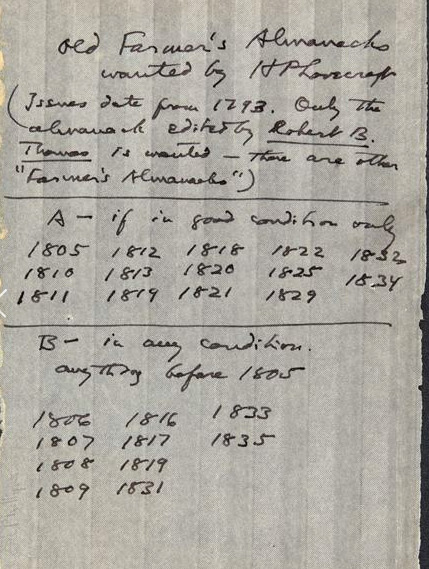
Here we see Lovecraft’s collecting ‘wants list’, as he tried to complete the set…

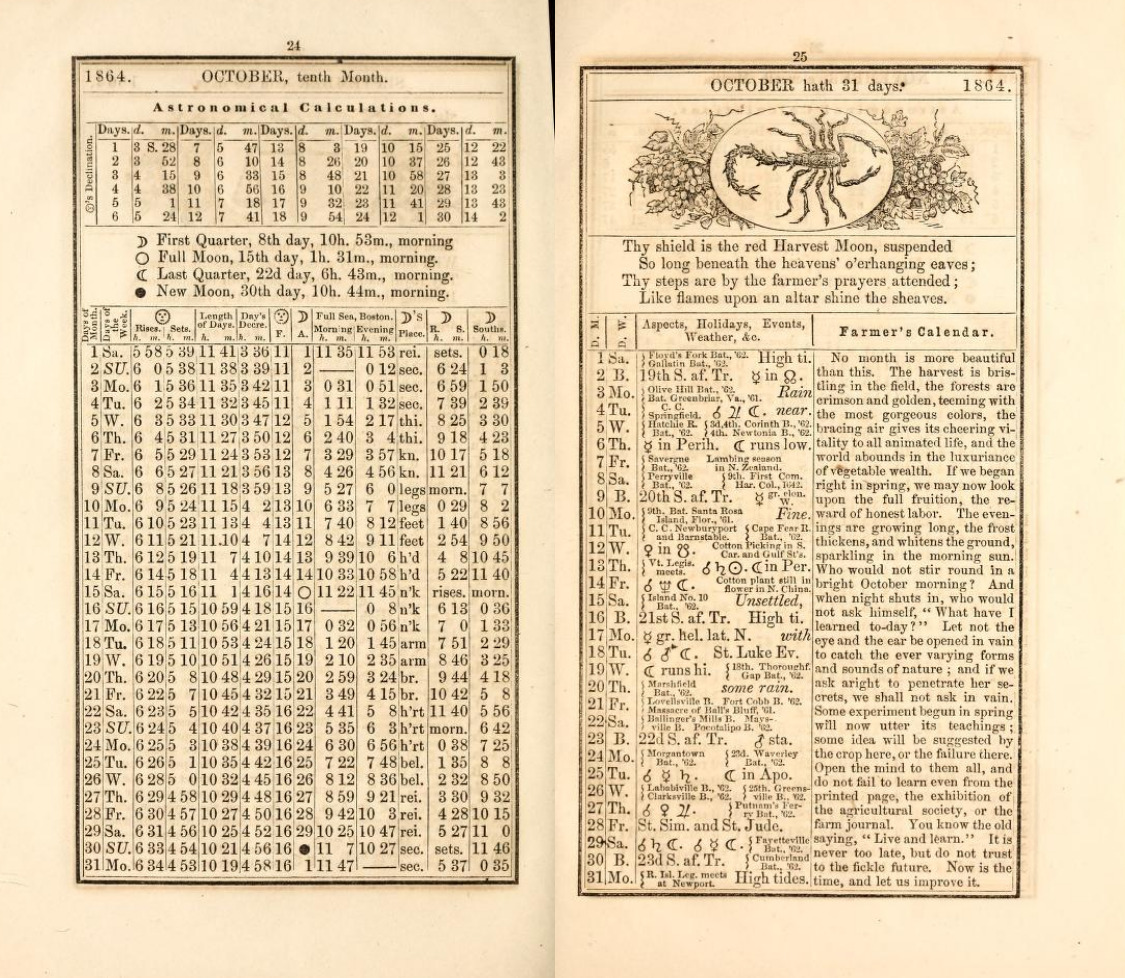
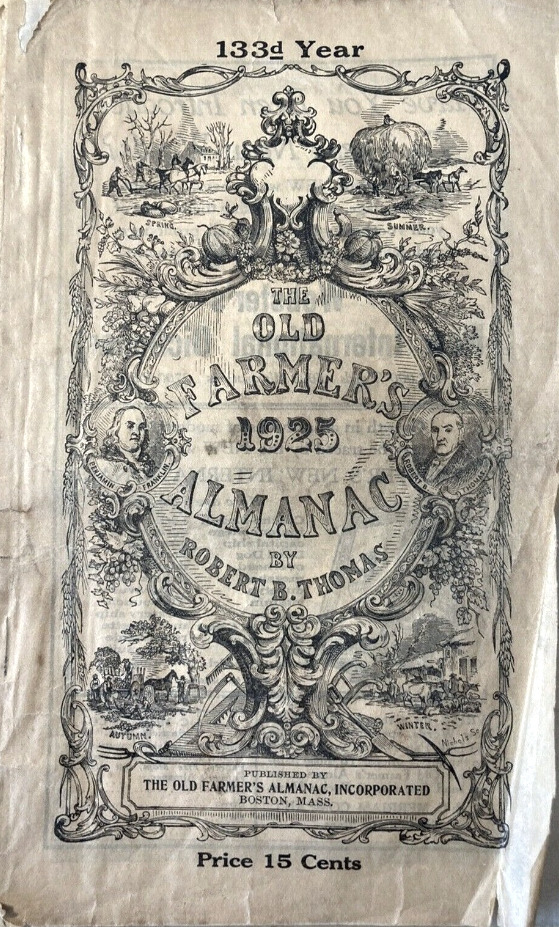
What, exactly, was this publication? Archive.org now has a small selection of scans of this Old Farmer’s Almanack, and thus we can get a better idea of what Lovecraft found between the pages. To be specific, he inherited and collected old copies of the Old Farmer’s Almanack edited by Robert B. Thomas. (It can’t be linked, as the URL is malformed, but if you paste this into the Archive.org search-box you should get it: creator:”Thomas, Robert Bailey, 1766-1846″ )

There were other publications of the same or similar title, but Old Farmer’s Almanack was Lovecraft’s mainstay. Which is not say he wasn’t delighted to discover that other similar almanacs were still publishing, out in the countryside…

It sure did give me a kick to find Dudley Leavitt’s Farmer’s Almanack [Leavitt’s Farmer’s Almanack, improved] still going after all these years. The last previous copy I had seen was of the Civil War period. But of course my main standby is Robt. B. Thomas’s [Almanack]

Thomas’s Old Farmer’s Almanack had begun publication in 1793. As we can see from the above list, Lovecraft was especially keen to get hold of anything before 1805 and in any condition. Many of these used the old long-S in the text…

I can dream a whole cycle of colonial life from merely gazing on a tattered old book or almanack with the long S.

This dream had first occurred very early in his life, and at age five the family Almanack had made a lasting impression…

my earliest memories — a picture, a library table, an 1895 Farmer’s Almanack, a small music-box

Evidently then this annual was taken and consulted in his home at that time. Also cherished and kept, since we know he was able to read the entire set…

[As a boy] I read them all through from 1815 to the present, & came early to think of every turn & season of the year in terms of the crops, the zodiac, the moon, the ploughing & [harvest] reaping, the face of the landscape, & all the other primeval guideposts which have been familiar to mankind since the first accidental discovery of agriculture in the Tigris-Euphrates Valley.

Nor did he overlook the rustic pictures…

I am always fond of seasonal pictures, & dote on the little ovals on the cover of the ancient Farmer’s Almanack — spring , summer, autumn, & winter

On his travels he later found places where the homely traditions and moon and star-lore of the Farmer’s Almanack were still followed, such places as Vermont…

That Arcadian world which we see faintly reflected in the Farmer’s Almanack is here a vital & vivid actuality [in rural Vermont]

The publication was indeed a useful one. For instance it enabled Lovecraft to anticipate with ease the year’s lesser heavenly events…

Sun crosses the equinox next Wednesday at 7:24 p.m. according to the Old Farmer’s Almanack — which we have had in our family, I fancy, ever since its founding in 1793.

Having sent some introductory astronomy books, Lovecraft also sent young Rimel a copy of the latest Old Farmer’s Almanac for the coming year of 1935. In a later letter to Rimel of 28th January 1935, Lovecraft explicitly recommends the publication for astronomy use. The Almanac being…

capable of assisting the study of astronomy quite a bit.

The weather predictions found in its pages were perhaps of less use. Or at least, they had become so by the late 1970s. In 1981 Weatherwise magazine made a tally of sixty forecasts across five years. They found the month-by-month Almanack forecast to be little better than chance by then. How accurate the monthly weather forecasts might have been in the 1895-1935 period and in Providence remains to be determined. It might be quite interesting to tally that, with perhaps a leeway of two days. But to do so one would likely need to go back to the original journal / newspaper summaries of the month’s actual weather, rather than trust any recently ‘rectified’ computer-created data for those decades.

The Almanacks also contained a wealth of rather more reliable factual information. Such as the dates of the year’s key elections, court days, festival and saint’s days, tides, recurring natural events (usual time of lambing, bringing in cows for the winter etc), anniversary dates for sundry historical events, lists of Presidents, the standard weights and measures, distances, nutritional values of various crops and fodder, together with small amusements such as riddles and poetry. Short articles could also be present. Most importantly for Lovecraft’s huge flow of parcels and letters, the little booklets also appear to have given the latest postal regulations in a concise form.

In format they were rather like Lovecraft’s stories, then. A whole lot of sound facts garnished with a few slivers of delicious speculation (meaning the weather forecasts, rather than monsters and cults). Indeed, one might see something of the ‘carnivalesque’ at work in such publications. The use of a small inversion, that by its amusing ridiculousness serves to bolster the belief in the facticity of the rest of the structure.

The latest annual Almanack was also ever-present in Lovecraft’s own study, as he wrote to Galpin in 1933…

You may be assur’d, that my colonial study mantel has swinging from it the undying Farmer’s Almanack of Robert B. Thomas (now in its 141st year) which has swung beside the kindred mantels of all my New-England forbears for near a century & a half: that almanack without which my grandfather wou’d never permit himself to be, & of which a family file extending unbrokenly back to 1836 & scatteringly to 1805 still reposes in the lower drawer of my library table [evidently Lovecraft had by this time added 1876-1836 to the “family file”] … which was likewise my grandfather’s library table. A real civilisation, Sir, can never depart far from the state of a people’s rootedness in the soil, & their adherence to the landskip & phaenomena & methods which from a primitive antiquity shap’d them to their particular set of manners & institutions & perspectives.

This mantel-hanging had been a long-standing practice. For instance it was noted by his earliest visitor, when Lovecraft was emerging from his hermit phase. Rheinhart Kleiner recalled of his curious visit to the darkened room that…

An almanac hung against the wall directly over his desk, and I think he said it was the Farmers’ Almanac.

Lovecraft even kept up the tradition during the hectic New York years, writing in late 1924…

the Old Farmer’s Almanack … of which I am monstrous eager to get the 1925 issue

In that era the Almanacks were very often personalised and annotated quite heavily by their users, and a rural man’s personal collection grew to form a sort of natural diary and personal time-series for useful farm data. In 1900 40% of the American people still worked on the land, so such things were vital.

So far as I’m aware we have none of Lovecraft’s own copies today, so we don’t know if he also marked and noted them in various ways. Or if he had inherited copies that had been so marked by his relatives.

He also hints at being aware of and valuing another such publication. For instance, when he remarked on the discovery of the planet Pluto he wrote…

the discovery of the new trans-Neptunian planet …. I have always wished I could live to see such a thing come to light — & here it is! …. One wonders what it is like, & what dim-litten fungi may sprout coldly on its frozen surface! I think I shall suggest its being named Yuggoth! …. I shall await its ephemerides & elements with interest. Probably it will receive a symbol & be treated of in the Nautical Almanack — I wonder whether it will get into the popular almanacks as well?

In his early newspaper columns on astronomy he also appears to refer to this same publication…

The motions of these satellites, their eclipses, occultations, and transits, form a pleasing picture of celestial activity to the diligent astronomer; and are predicted with great accuracy in the National Almanack. [I assume here a mis-transcription by the newspaper editor of “National” for “Nautical”, or perhaps a correction to its shorthand name in the district].

Indeed, both Almanacks feature in Lovecraft’s “Principal Astronomical Work” list, among the vital accessories needed for a study of the night-sky…

Accessories:

Lunar Map by Wright.
Year Book — Farmer’s Almanack.
Planispheres — Whitaker & Barrett-Serviss.
Atlas by Upton — Library.
Opera glasses — Prism Binoculars.
Am. Exh. & Want Almanac. [meaning the American Ephemeris & Nautical Almanac, as “Exh.” is “Eph.” and “Want” should be “Naut”]

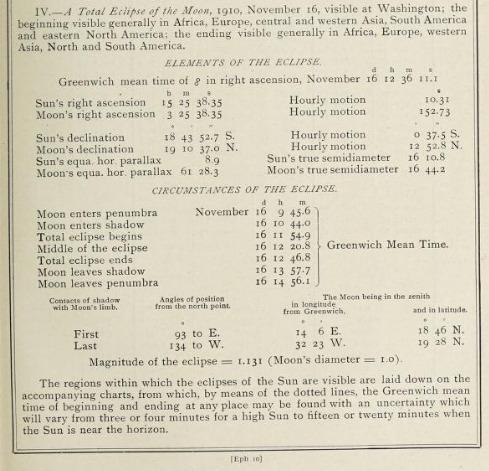
This Nautical Almanac is also on Archive.org, so we can peep inside a copy of that from 1910. Forthcoming eclipses were noted over several pages. Here, for instance we see all the details needed to observe a total eclipse of the Moon in November 1910, the beginning visible from “eastern North America”. I think we have a hint here about what Lovecraft was likely to have been doing in the late evening of 16th November 1910…

Archive.org also has The Old Farmer and his Almanack, a 1920 book which surveyed the topic with erudition. Lovecraft was heartily pleased to discover and read it shortly after publication.

Almanacks occur only once (and very trivially) in Lovecraft’s poetry. The one use in his fiction is more intriguing. In “The Picture in the House” (December 1920) a book is noted…

a Pilgrim’s Progress of like period, illustrated with grotesque woodcuts and printed by the almanack-maker Isaiah Thomas

The sharp-eyed will have spotted that Lovecraft might have meant to imply that this “Thomas” could have been the ancestor of the Robert B. Thomas of Old Farmer’s Almanack fame. That might be how some savvy bookmen took it at the time, but it is not so. For Lovecraft would have known that there was a real “almanack-maker Isaiah Thomas” and that he was no relation. Robert B. Thomas himself tells us this fact, in recalling his early years of trying to get a start in publishing almanacks…

I wanted practical knowledge of the calculations of an Almanack. In September, I journeyed into Vermont to see the then-famous Dr. S. Sternes, who for many years calculated Isaiah Thomas’s Almanack, but failed to see him. … In the fall, I called on Isaiah Thomas of Worcester (no relation) to purchase 100 of his Almanacks in sheets, but he refused to let me have them. I was mortified and came home with a determination to have an Almanack of my own.

Thus my feeling is that Lovecraft knew of these snubs and also, probably while reading his The Old Farmer and his Almanack (1920), had learned that Isaiah Thomas had sustained a sideline in publishing booklets containing the worst sorts of “astrology, palmistry, and physiognomy”. Thus, later that same year Lovecraft gave curmudgeonly old Isaiah Thomas a small poke in his fiction, by implying that Isaiah had marred a classic book with “grotesque” pictures — so “grotesque” that the resulting book ended up resting next to Pigafetta’s account of the Congo and its cannibals.


Update: The Nautical Almanac. Hathi now have the full run of the Nautical Almanac online.

New ‘Astronomy’ tag

01 Saturday Jan 2022

Posted by asdjfdlkf in Astronomy, Housekeeping

≈ 1 Comment

A new post category, with retrospective tagging, ‘Astronomy’ on Tentaclii. I think I’ve got them all.

Friday ‘Picture Postals’ from Lovecraft: Stars and Time in Providence

17 Friday Dec 2021

Posted by asdjfdlkf in Astronomy, Historical context, Picture postals

≈ 2 Comments

An amusing bit of trivia has spurred this week’s ‘Picture Postals’, but has led me to a subtle but potentially quite deep observation about the nature of time in Lovecraft’s Providence.

One of the two precision clocks at the heart of the Ladd Observatory was called “Howard”, which might have tickled Howard Phillips Lovecraft when he was observing and studying there. As many will know, as a youth he lived nearby, had his own key, and was permitted free access at any time. The clock was a “Howard Astronomical Regulator No. 74”, to be precise.

The “Howard” sidereal clock (measuring stellar or cosmic time) was and still is accompanied in the Ladd’s Clock Vault by a “Molyneaux mean time clock” (measuring solar time, or everyday ‘civil time’).

Once the Ladd was opened and running, from September 1893 Professor Upton of the Observatory operated a wired…

system that transmitted telegraph time signals from precision clocks at Ladd Observatory throughout Providence and to other nearby cities.

The source-time for the signal was calculated by Ladd’s observation of the stars, thus giving exact ‘cosmic’ time. Knowing this gives a certain subtle spin to Lovecraft’s famous phrase of “when the stars were right”. In Providence, the stars were always right, since the stars (and presumably “Howard” as the site’s master star-clock) set the exact time for the city and its neighbours.

For the 1895 academic year Brown University invested in their own $100 “Howard”, precisely set by the Ladd Observatory time…

A very valuable Howard clock has recently been placed in the Steward’s office. It is regulated by Ladd Observatory standard time, and is thus kept as near correct as possible. The clock is connected with the bell-ringer’s room, so that now the college bell will be rung at exactly the right time.

The Ladd’s time-wires also went down to City Hall and to all points, via the services of a time-distribution contractor named the Rhode Island Protective Company.

Soon everyone had their exact time by the stars. One wonders if the wires are still there, presumably having gone down the hill under the earth rather than on poles that might be toppled in high winds. A possibility for a Mythos writer to explore, perhaps.

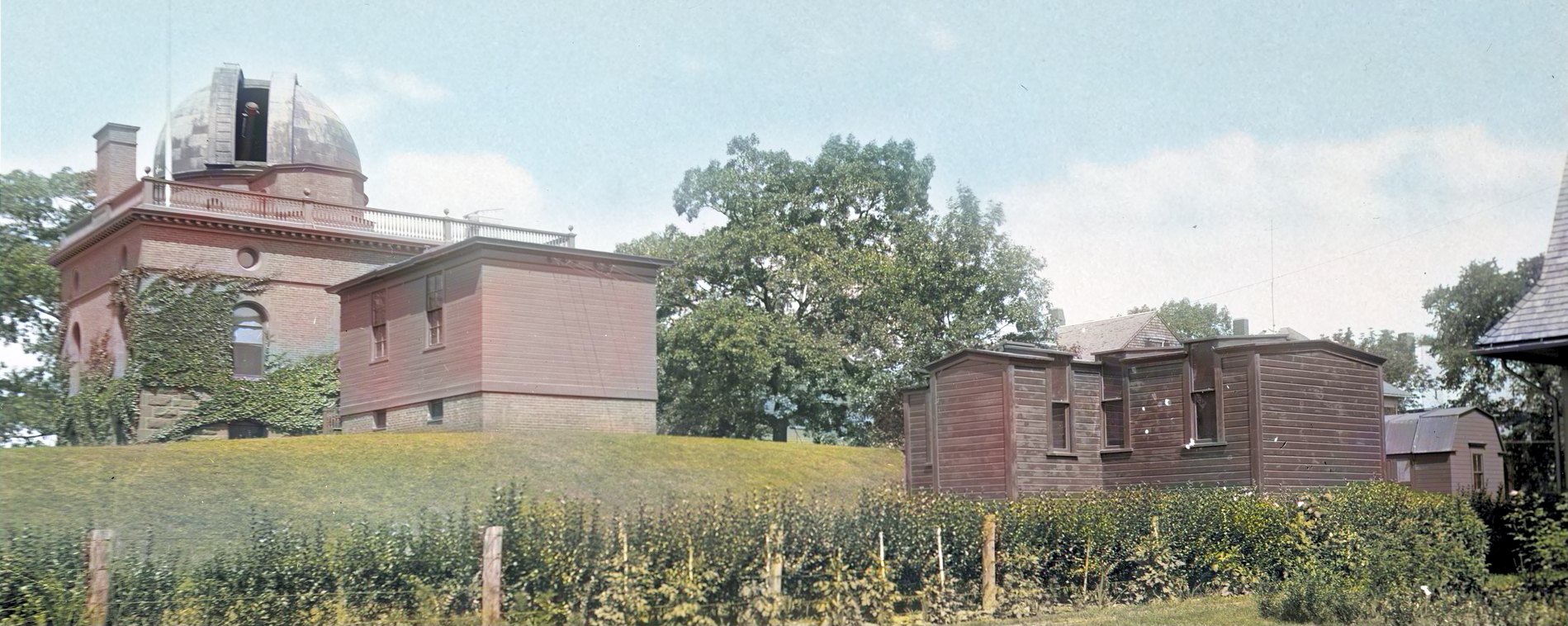
Here we see my colourising of an unusual view of the back of the Ladd, which corresponds with Lovecraft’s own isometric view as drawn in his boyish hand in 1904.

City documents show that the source of the city’s 1893-1916 wired time-transmissions was the square wooden-clad extension block, in which a “Seigmuller transit instrument” and the wired transmission unit was housed. Lovecraft’s drawing shows the observation-hole shutters on the block’s roof.

Note that Lovecraft has also drawn the path out back, which goes through an obvious gate to the small building with the curved roof. This can also be seen on the above photo, behind the later wireless transmissions hut (as war approached, the U.S. Naval Observatory transmitted exact time to the nation by radio from 1916 and thus took over Ladd’s local role).

What the small building with the curving roof was appears to be unknown, and later city plans for Ladd do not encompass it. But obviously Lovecraft thought it important enough to include on his drawing and there it appears to be part of the site. My guess would be it was a teaching room for the first-year Brown University Astronomy students, something that Professor Upton was keen to include from the first. Possibly with its own roof-flaps which could open to allow night observing, items which seem to be present on Lovecraft’s drawing of it. If so, being a hut-like structure with a stove for warmth, it would also be the obvious place to double-up as an impromptu kitchen — for making a hot early breakfast after a long cold night of traversing the astral coldness.

← Older posts
Newer posts →


Please become my patron at www.patreon.com/davehaden to help this blog survive and thrive.

Or donate via PayPal — any amount is welcome! Donations total at Easter 2025, since 2015: $390.

Archives

  • February 2026
  • January 2026
  • December 2025
  • November 2025
  • October 2025
  • September 2025
  • August 2025
  • July 2025
  • June 2025
  • May 2025
  • April 2025
  • March 2025
  • February 2025
  • January 2025
  • December 2024
  • November 2024
  • October 2024
  • September 2024
  • August 2024
  • July 2024
  • June 2024
  • May 2024
  • April 2024
  • March 2024
  • February 2024
  • January 2024
  • December 2023
  • November 2023
  • October 2023
  • September 2023
  • August 2023
  • July 2023
  • June 2023
  • May 2023
  • April 2023
  • March 2023
  • February 2023
  • January 2023
  • December 2022
  • November 2022
  • October 2022
  • September 2022
  • August 2022
  • July 2022
  • June 2022
  • May 2022
  • April 2022
  • March 2022
  • February 2022
  • January 2022
  • December 2021
  • November 2021
  • October 2021
  • September 2021
  • August 2021
  • July 2021
  • June 2021
  • May 2021
  • April 2021
  • March 2021
  • February 2021
  • January 2021
  • December 2020
  • November 2020
  • October 2020
  • September 2020
  • August 2020
  • July 2020
  • June 2020
  • May 2020
  • April 2020
  • March 2020
  • February 2020
  • January 2020
  • December 2019
  • November 2019
  • October 2019
  • September 2019
  • August 2019
  • July 2019
  • June 2019
  • May 2019
  • April 2019
  • March 2019
  • February 2019
  • January 2019
  • December 2018
  • November 2018
  • October 2018
  • September 2018
  • August 2018
  • August 2015
  • July 2015
  • April 2015
  • March 2015
  • February 2015
  • January 2015
  • December 2014
  • November 2014
  • October 2014
  • September 2014
  • August 2014
  • July 2014
  • June 2014
  • May 2014
  • March 2014
  • February 2014
  • January 2014
  • December 2013
  • November 2013
  • October 2013
  • September 2013
  • August 2013
  • July 2013
  • June 2013
  • May 2013
  • April 2013
  • March 2013
  • February 2013
  • January 2013
  • December 2012
  • November 2012
  • October 2012
  • September 2012
  • August 2012
  • July 2012
  • June 2012
  • May 2012
  • April 2012
  • March 2012
  • February 2012
  • January 2012
  • December 2011
  • November 2011
  • October 2011
  • September 2011
  • August 2011
  • July 2011
  • June 2011
  • May 2011
  • April 2011
  • March 2011
  • February 2011
  • January 2011
  • December 2010
  • November 2010
  • October 2010
  • September 2010
  • August 2010
  • July 2010

Categories

  • 3D (14)
  • AI (70)
  • Astronomy (70)
  • Censorship (14)
  • de Camp (7)
  • Doyle (7)
  • Films & trailers (101)
  • Fonts (9)
  • Guest posts (2)
  • Historical context (1,095)
  • Housekeeping (91)
  • HPLinks (74)
  • Kipling (11)
  • Kittee Tuesday (92)
  • Lovecraft as character (58)
  • Lovecraftian arts (1,626)
  • Lovecraftian places (19)
  • Maps (70)
  • NecronomiCon 2013 (40)
  • NecronomiCon 2015 (22)
  • New books (966)
  • New discoveries (165)
  • Night in Providence (17)
  • Odd scratchings (984)
  • Picture postals (276)
  • Podcasts etc. (431)
  • REH (184)
  • Scholarly works (1,469)
  • Summer School (31)
  • Unnamable (87)

Get this blog in your newsreader:
 
RSS Feed — Posts
RSS Feed — Comments

H.P. Lovecraft's Poster Collection - 17 retro travel posters for $18. Print ready, and available to buy — the proceeds help to support the work of Tentaclii.

Proudly powered by WordPress Theme: Chateau by Ignacio Ricci.