This week, the Shepley Library in Providence. This place appears in passing in Lovecraft’s novel Charles Dexter Ward, when Ward is described as having belonged in his city…
as much to the past as the antiquities he loved so keenly. […] His social activities were few; and his hours were spent mainly at home, in rambling walks, [in various learned institutions or at] the newly opened Shepley Library in Benefit Street” Later, in his investigations into Curwen…
Charles Ward examined a set of his accounts and invoices in the Shepley Library
The place also has a passing mention in “The Shunned House”…
I was forced to ransack both the Rhode Island Historical Society and Shepley Library before I could find a local door which the name Etienne Roulet would unlock. In the end I did find something; something of such vague but monstrous import that I set about at once to examine the cellar of the shunned house itself with a new and excited minuteness.
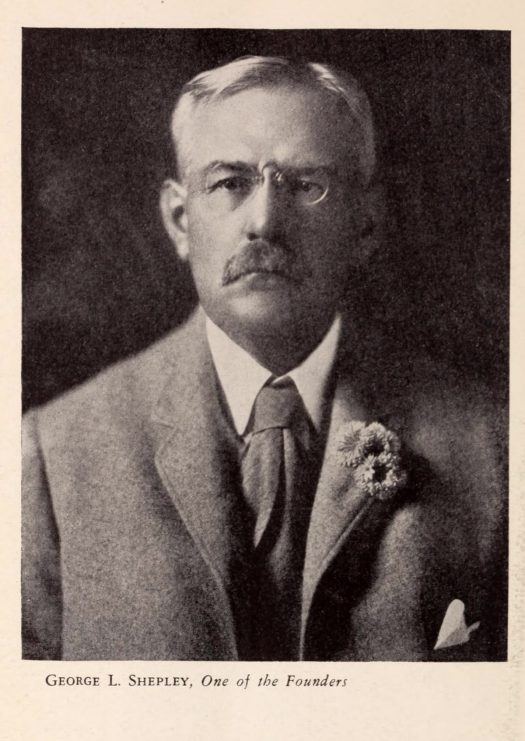
Shepley was Colonel George Leander Shepley (1854-1924). His personally-designed private library / museum opened at 292 Benefit Street in late 1921, as seen here in my newly colourised picture via the Providence Public Library and the Historical Society…
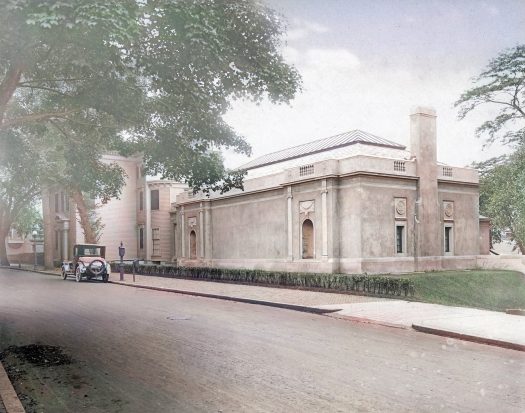
Lovecraft was able to visit in 1923. He appears to have had access because his aunt Annie Gamwell was working there at the time. A magazine of the period shows the Library had been open to the public on afternoons, when first opened in late summer 1921. But I’m uncertain if that opening offer was then continued into 1922 and 1923.
The American Antiquary Society has a short outline biography, revealing the owner to have run and made his fortune in the largest insurance business in the world. One source mentions his ingenuity at developing new insurance services and policy types to serve new markets. Another talks of his absolute integrity. He was a leading Mason who had ascended very high, a member of various clubs and sat on a number of local company boards. In his retirement he built and stocked his large library relating to Rhode Island and Providence history, rivalling that of several other well-endowed local institutions. That Lovecraft’s narrators are able to either frequent or “ransack” the Shepley Library thus implies they knew the old fellow personally, or at least his curator. Lovecraft himself had a friendly reception from the curator, to the extent of apparently being offered the loan of a certain key view of Providence… if only a duplicate could be found to replace it on display. Lovecraft evidently made a long and close inspection of the place and he discovered much, as detailed in the Voluminous podcast letter of 6th March 2022 and also in a letter to Moe (Letters to Maurice W. Moe, page 133-34). It was this visit that revealed to him a previously unknown colonial section at the back of Weybosset, between Weybosset and the waterfront. This quickly led to his foggy expedition into the squalid rookery around ‘Gould’s Court’ (Ghouls Court) at the back of Uncle Eddy’s book shop on Weybosset. Nephew Eddy already knew this area at the back of his uncle’s book shop well, as it happened, and he acted as guide. Ken Faig Jr.’s Some of the Descendants of Asaph Phillips and Esther Whipple also has the museum as being Shepley’s home (“housed in his home on Benefit Street”), and it does appear from the photograph to have been a house with a large museum / library wing seamlessly attached.
Lovecraft was distinctly peeved when the the old fellow died in 1924 without making arrangements for his magnificent collection, other than (seemingly) for it to remain where it was and private. His reaction is revealed by the new Letters to Family (Vol. 1, p. 500), when Lovecraft writes…
the closing of the Shepley museum is utterly barbarous — upon my soul, I don’t think much of the old boy if he didn’t provide for the permanent exhibition of his collection. He aught to have deeded it to the Historical Society, or to Brown University, or to some other institution founded in his name. Egad! But it’s a publick crime to keep a treasure-house like that closed!!
The death of a daughter shortly before her father meant the old man’s planned inheritance was fumbled. The other daughter who did inherit the fortune allowed the museum to languish in a private state for academics only (“opened only to research students on request”), since we hear of no more visits by Lovecraft. If it had been open then he would surely have visited it again and taken friends there, and remarked on this in letters. In 1938, as war loomed, the collection was finally sold (not given) to the Rhode Island Historical Society. The building was for a time used by theatrical players and used to stage puppet-theatre shows for children.
How history might have been different. Imagine… old Colonel Shepley takes a shine to Lovecraft’s aunt, woos and marries her, then adopts Lovecraft as heir-apparent and the ideal antiquarian son he had always wanted. Lovecraft inherits the enormous fortune. He spends the next twenty years championing architectural preservation throughout America and Britain, and on the side issues some modest and slim books of polished philosophy. He barely writes any fiction.
So I guess we should be grateful that such events never happened. But Lovecraft’s extended and generous 1923 visit had done enough. He felt it had been a key turning point in his life, as he told Moe in 1923…
I am now become definitely an antiquarian, rather than a general student of letters
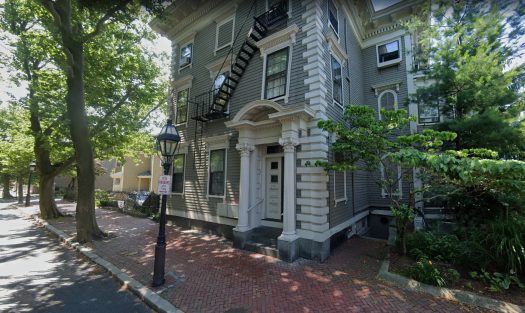
Shepley’s house still exists today as “295”, as can be seen by comparing Street View with the archival view. Today the observant scrutineer will also notice a down-steps side-entrance which goes through through to a shabby apartment and peeling porch on the back of the house. Perhaps this was once the back apartment of the on-site curator? Street View also reveals that the library at the side is now a sunken car-parking area, with crude graffiti and strewn trash… “where once had been only strength and honour, taste and learning” (“The Street”).
The depth and level of this car-park suggest that the 1921 view of the museum from Benefit Street may well be deceptive. I suspect that we see there the back of the building and that the museum actually had two floors, with the lower one being set down into the slope. The 1921 view thus only shows the back of the top floor as it was visible from the street. In fact, we can see it has a top atrium which even might even suggest two floors and perhaps a sky-room. The Federal Writers’ Project (1937) did briefly itemise the building as “one-storey” in a book, something which has since been parroted by others, but those books were often hasty make-work projects for communist cliques — as Lovecraft’s friend Arthur Leeds found to his detriment. I suspect the compilers of the book were not local, and were just working from quick snapshots of street views.
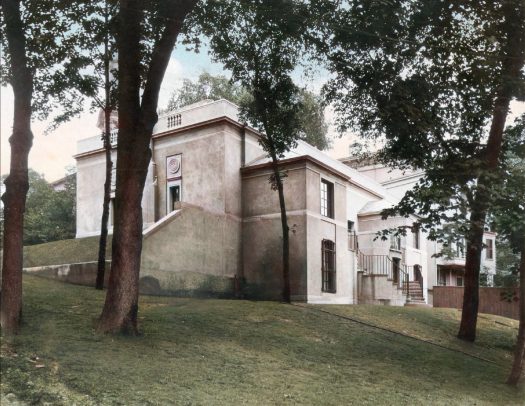
After writing the above I found a back view photograph of the Library, from the Historical Society via the book Providence’s Benefit Street. I’ve here repaired and colorised it. Yes, at the back the building was obviously deeper but also a bit more complex than a straightforward and mundane two-storey building. It may even have had a cellar strongroom (note the bars on the windows) that went down further into the ground. Apparently Shipley’s alarm and burglar-proofing system was state-of-the-art for the time. The modern-day shabby back-porch, as seen on Google Street View, can here be glimpsed in the distance.