Don’t correlate the contents…
15 Monday Apr 2024
Posted in AI
15 Monday Apr 2024
Posted in AI
14 Sunday Apr 2024
Posted in Scholarly works
S.T. Joshi’s blog has updated, and he notes the title of the forthcoming Long letters, A Sense of Proportion: The Letters of H.P. Lovecraft and Frank Belknap Long, in one volume due later in 2024. He and Schultz are also considering a Letters to H.P. Lovecraft volume, which I would assume would be ‘selected’ rather than everything known? Since the Price letters would take up a volume on their own, and the whole lot might have to be two volumes?
Joshi also notes “I continue to work (with David E. Schultz) on Letters to R. H. Barlow“. Which I guess will then replace O Fortunate Floridian? (Update: No it won’t: it’s letters to Barlow from people other than Lovecraft).
Joshi anticipates that the Lovecraft Annual and a number of books of Lovecraft scholarship will appear toward the time of the NecronomiCon / Armitage Symposium in Providence, later in 2024. See his full 12th April 2024 blog post for the details.
13 Saturday Apr 2024
Posted in Odd scratchings
The Lovecraft Letters Vol 1: Mysteries of Time and Spirit from a UK seller at a quite reasonable £27 in hardback. Sadly it can’t be shipped to an Amazon locker, and the seller isn’t also listing it on eBay. So I can’t get it. But some lucky Lovecraftian will. Get it while it’s hot…
13 Saturday Apr 2024
Posted in Odd scratchings, Scholarly works
Useful for writers as well as RPG gamers, and new on Archive.org as a scan in PDF, Monograph #319, Miskatonic University – The Gaslight Equipment Catalogue (2005). ‘Gaslight’ = the game-setting of the British Empire in the 1890s.
12 Friday Apr 2024
Posted in Picture postals
Anticipating the NecronomiCon and Armitage Symposium later in 2024, here’s another ‘Picture Postals’ post on Lovecraft’s Providence.
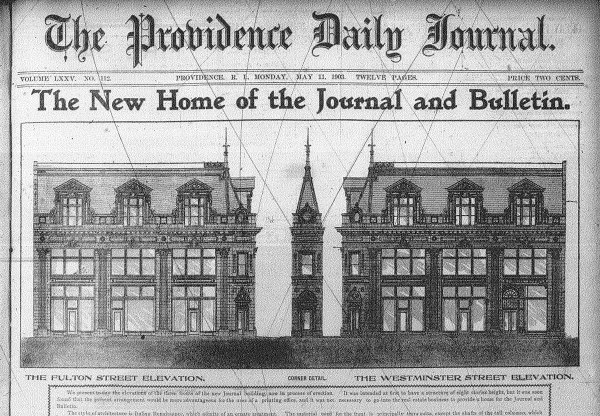
The Providence Journal daily newspaper played a significant part in Lovecraft’s coming of age. In his youth the paper informed him daily — most likely in its Evening Bulletin form — of his surroundings, in a way that adults would not have; it provided him with a slice of local public opinion in the letters pages; and it eventually offered him an outlet in print. A few examples will suffice. In 1906 Lovecraft used the letters pages to attack the ‘hollow earth theory’ of polar entrances to the earth’s interior, then still somewhat plusible. In 1912, the paper gave him his first published poem, the prophetic “Providence in 2000 A.D.”. In the 1920s he advertised in its pages for the return of his lost Houdini manuscript (whatever happened to that, one wonders)…
MANUSCRIPT — Lost, title of story, “Under the Pyramids,” Sunday afternoon, in or about Union station [Providence]. Finder please send to H. P. Lovecraft, 259 Parkside Ave., Brooklyn, N.Y.
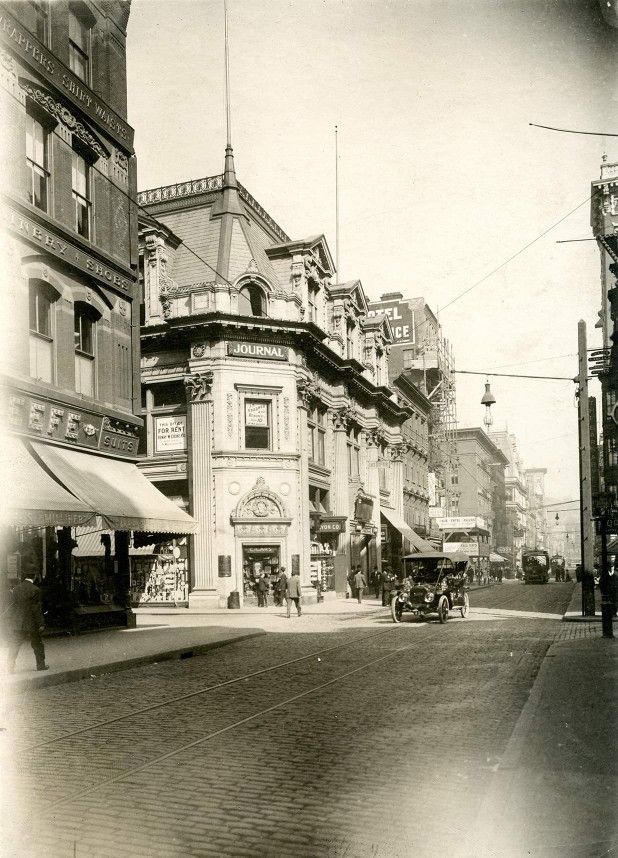
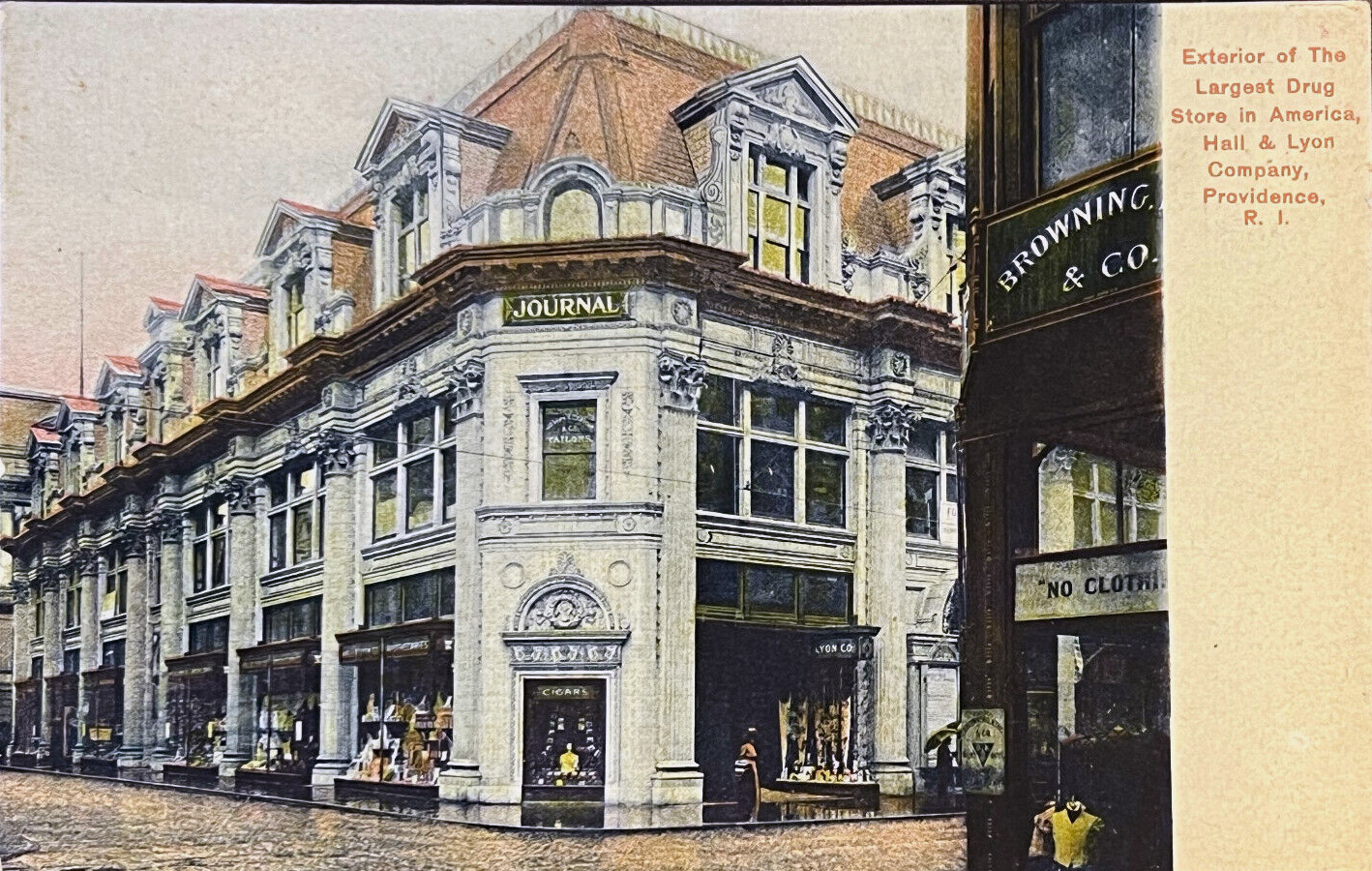
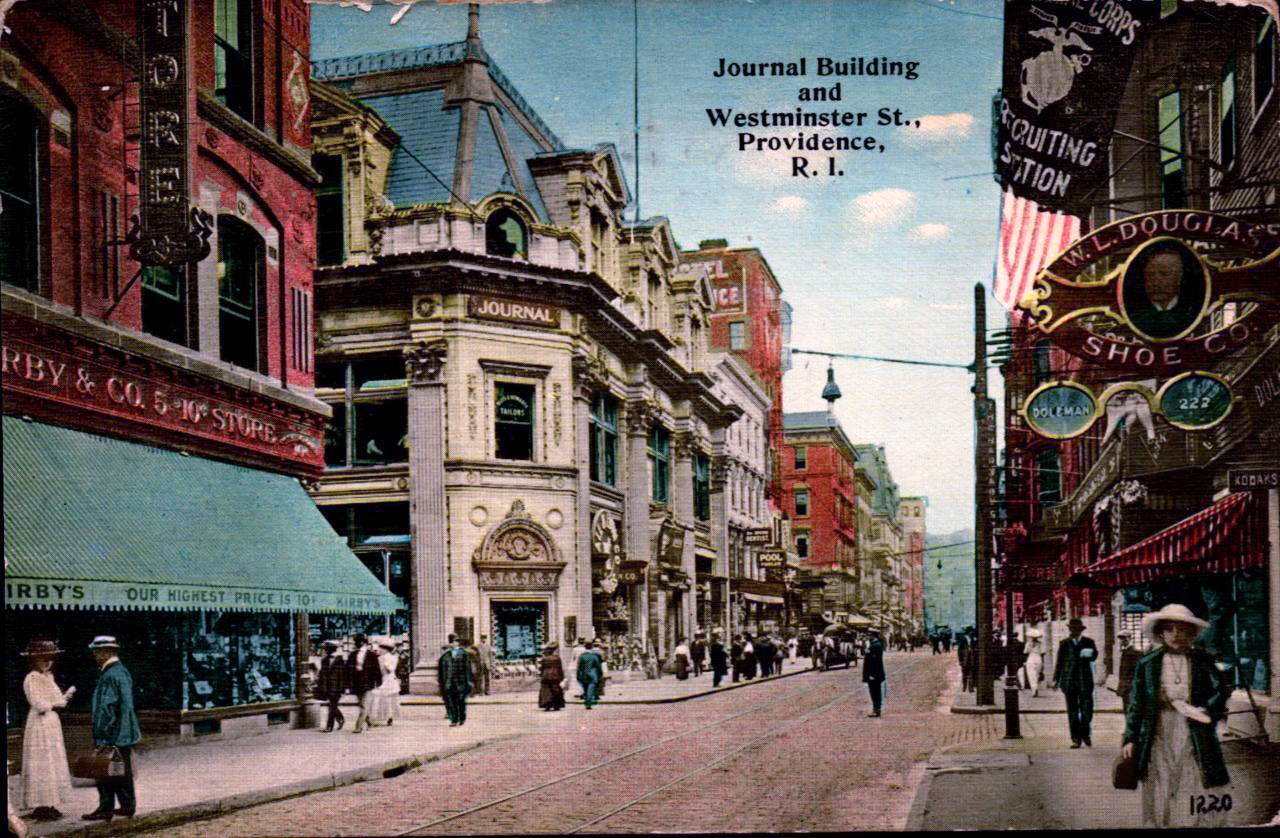
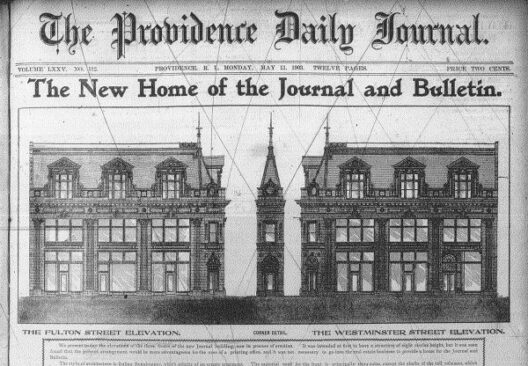
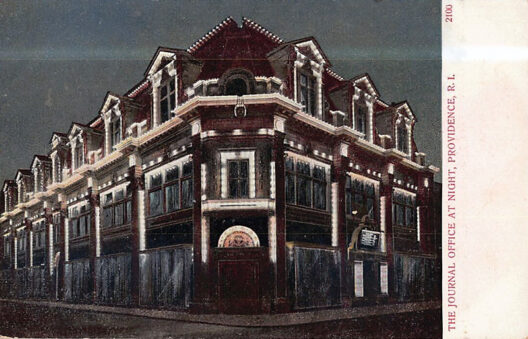
As such, its offices would have been a visual fixture in his early mental map of the city. These offices were new at the time he would have begun to aspire to publication in a newspaper. As we can see here, the offices seen in old postcards date only to 1903, when Lovecraft was around age 13 and would have been becoming increasingly aware of the wider life of his city…
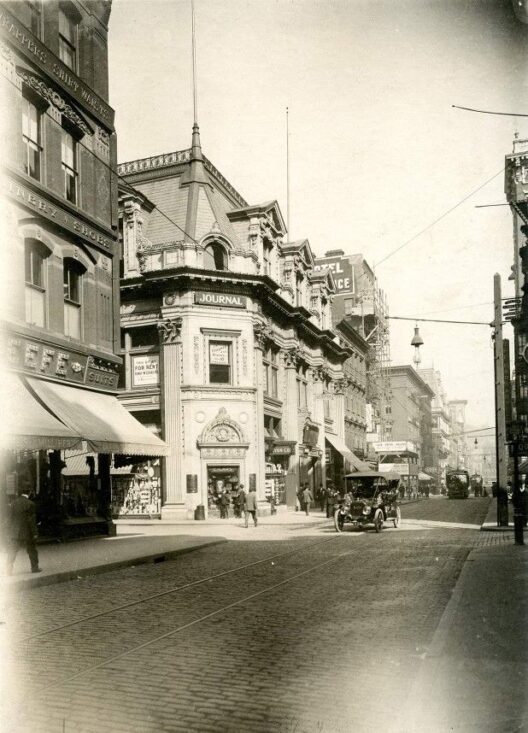
And here we see the offices from the sidewalk…
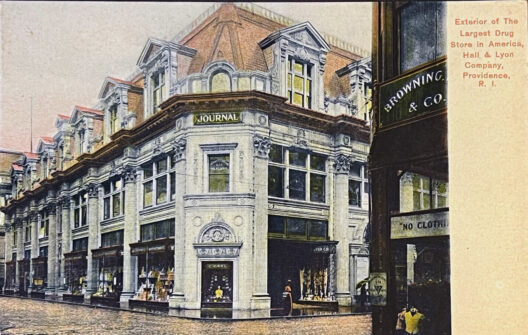
The lower floor was actually retail, and one card reveals their nature: Hall & Lyon, “the largest drug store in America”. It was one of a city chain of four Hall & Lyon drug stores at that time.
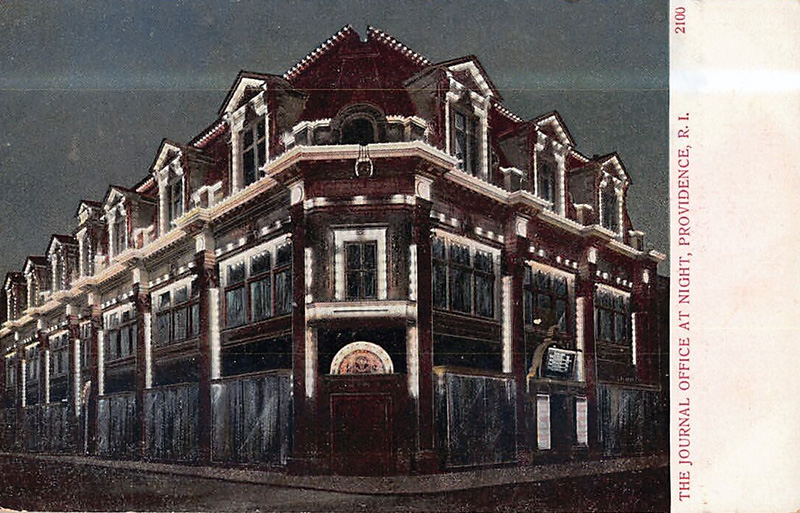
The upper floors were evidently illuminated when the offices were most busy, at night. The offices would not have been empty at this time. Journalism for a morning edition was then a nocturnal affair, and a journalist might work 8pm – 4am. Much of their work would then be reprinted, tweaked and updated, in the evening edition.
In 1918 Lovecraft commented to his friend Galpin re: the unusually large staff and number of pages, compared to a typical U.S. city daily of the period…
dailies hereabouts are inclined to run over that [standard 8-page] size to a considerable extent. The Evening Bulletin has never published less than 18 pages within my recollection, whilst it frequently runs up to 48. 30 is the average number.
He was still reading it 1922, even when away from city. In 1922 he wrote to Kleiner that he would… “read the file of the Evening Bulletin which had accumulated during my absence.” Joshi also states he read it while in New York City…
For the entirety of his New York stay, he subscribed to the Providence Evening Bulletin, [also] reading the Providence Sunday Journal (the Bulletin published no Sunday edition).
At 30 to 48 pages, this would have been a substantial daily read. Though we know he skipped the police reports and court reporting entirely. Given that ‘crime and grime’ can be a substantial proportion of local news focus, this must have reduced the time needed to read the paper.
But he probably read it closely, since he felt the papers were of “the very highest class” for local city papers (they sound like an equivalent of the UK’s Wolverhampton Express & Star in its glory days, perhaps). Indeed, he never discovered one that he thought was a better city paper. However he disliked the “poison of the vilest kind” which they sometimes carried as advertisements (in this particular case those of a “notorious beer-brewing corporation of St. Louis” which promoted an anti-prohibition message via a series of paid-for articles).
The paper must have partially made up for this, in Lovecraft’s mind, by doing something unthinkable for a city newspaper of today. Publishing what a modern newspaper reader would consider the ‘ultimate horror’… poetry. Sometimes he was even a paid contributor and (even more unthinkable today) paid for poetry, as when he had $5 for his lengthy poem “Providence” in the 1920s.
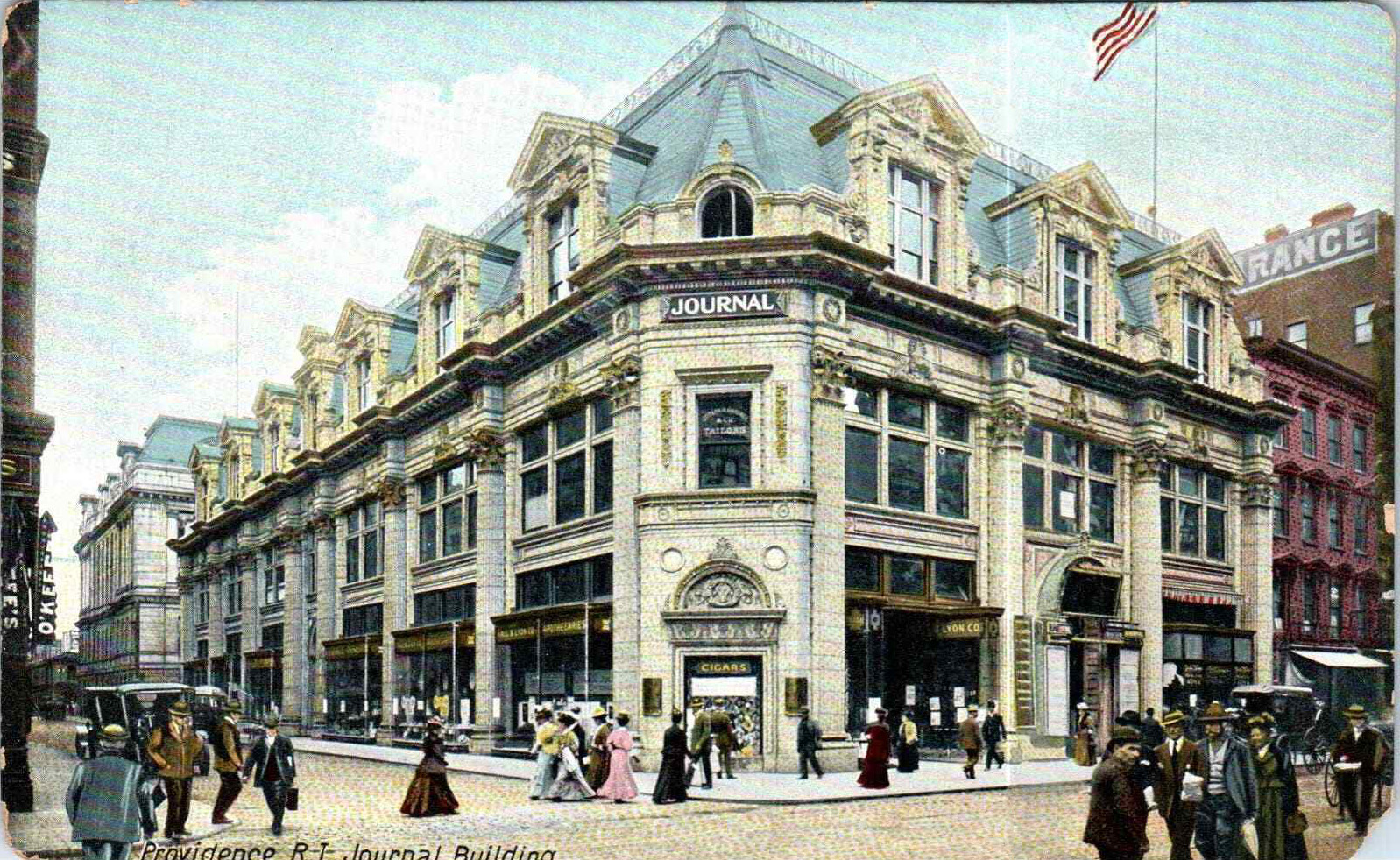
Here we see a good wide view of the 1903 building as the young Lovecraft would have known it…
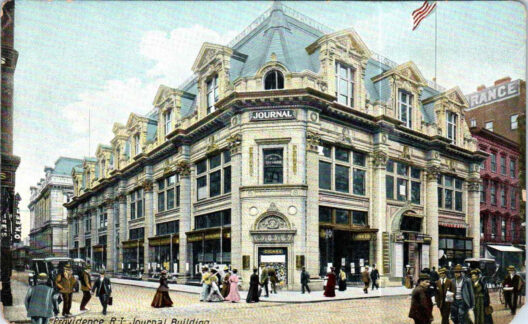
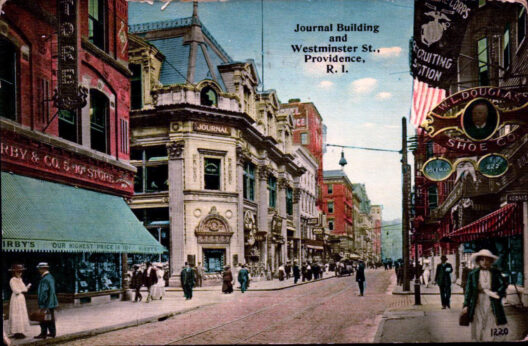
Another card seems to be later, with a ‘5c & 10c’ store established opposite, changing women’s fashions, and a military recruiting station flying the flag. One feels closer to the First World War in this picture. Could this even be the recruiting station at which Lovecraft tried his best to enlist?
I can’t find any mention that the paper carried a comic-strip, spot cartoons, or even a ‘Sunday funnies’ page. So he would not have been enjoying things like Krazy Kat every day. Indeed, he wrote to Kleiner in 1917 that “the New-England dailies [newspapers] of the first rank do not use the conventional ‘comics’.”
The Journal thrived, and moved to larger offices in 1934. In the 1940s one of its journalists would become, essentially, Lovecraft’s first biographer.
The Library of the Rhode Island Historical association states… “The Library has complete runs of both editions on microfilm.” And for Lovecraftians, “A partial card file index (1915-1934) to the Journal is in the Reading Room.”
Note also that there is online access… “Full-text of locally-written articles from 1829-present can be searched, emailed, or downloaded from the Providence Journal on Newsbank”.

11 Thursday Apr 2024
Posted in Lovecraftian arts
Abutova has a new “Colour Out of Space” digital paintings series.
Regrettably the link to the full series is on a platform called Behance, which appears to be for Adobe subscribers only.
Also, a multi-book Randolph Carter as a French-Belgian ‘BD’ graphic novel. Volume One is due 5th June 2024. Presumably in French in the first instance, and perhaps an adaptation rather than just the use of the name? The artist is Jovan Ukropina.
10 Wednesday Apr 2024
Posted in Scholarly works
In the latest edition of the journal Brno Studies in English, “Mad scientists in H.G. Wells’s early fiction”. Freely available in open-access.
09 Tuesday Apr 2024
Posted in AI, Kittee Tuesday, Lovecraftian arts
New on YouTube, “In Lovecraft’s Dreamlands” by The Terrible Old Man and his Band of Cats.
Song lyrics…
In the shadows of ancient time
Where dreams and nightmares intertwine
The cosmic dance in the heart of night
The stars bear witness to the unfathom’ble night
The celestial lands, in eerie blend
Where horror and wonder never seem to end
Nyarlathoptep lurking in the abyss
A haunting presence you cannot dismiss.
Moonlight over Ry’lh, where darkness reigns supreme
In Lovecraft’s dreamlands we are free to dream
Embrace the eld and let your spirit roam
In the depths of madness forevermore…
Moonlight over Ry’lh, where darkness reigns supreme
In Lovecraft’s dreamlands we are free to dream
Embrace the eld and let your spirit roam,
In the depths of madness forevermore…
Others are way ahead of me. Check out Plan 9 From Outer Space – the AI Album.
08 Monday Apr 2024
Posted in Films & trailers, Lovecraftian arts
News from Germany. The German Lovecraftians recently had a joint Hannover / Munich film evening and…
a current trailer for Huan’s current Lovecraft project “The Dreamlands” thrilled the audience. At the end of the evening there was a relaxed Q&A with the director, who was asked numerous questions from the audience.
The project successfully crowdfunded and is now filming.
Also, note that their The Lovecrafter Online “is looking for a new editor immediately”.
07 Sunday Apr 2024
Posted in REH, Scholarly works
The journal Zothique #17 (2024) is a R.E. Howard special issue in a chunky 190 pages and in Italian. Available now.
— Lovecraft and R.E. Howard;
— Howard and Lord Byron;
— Howard and Weird Tales;
— Howard’s western stories set in Bear Creek;
— Howard’s poetic production;
— A thorough and detailed guide to the Italian editions of Conan, Kull and Solomon Kane;
— An autobiographical piece in which Howard talks about his “Celtic origins”;
— All of his letters sent to “The Eyrie” (Weird Tales);
— The mail address book (?) of Weird Tales;
— A memoir by Novalyne Price Ellis about the ‘real’ Bob Howard;
— Five Howard stories in their first Italian translation.
06 Saturday Apr 2024
Posted in Scholarly works
An important update for the excellent Anytxt ‘desktop search’ freeware. Regex is now supported with this new April 2024 version, for sophisticated search across and inside your PC’s local files. Of obvious use to scholars with large local collections in .PDF and .ePub etc.
05 Friday Apr 2024
Posted in Scholarly works
Reading through the back-issues of the Tolkien Society members-journal Amon Hen, in #272 I came across a report of a conference in Italy titled “Tolkien and the literature of the Fourth Age”, which took place just before Christmas 2017. Some big names were there, including Tom Shippey and Thomas Honegger. The latter presented “Tolkien and Lovecraft”, and the report summarised some of the talk’s main points…
– both worked within frameworks of myth and to an extent dream;
– both were interested in changes in language over large time-scales;
– both were interested in “worlds in decay” which nevertheless contain decaying “monuments of fallen grandeur”;
– both loved the mystery of ancient things, ancient landscapes;
– Tolkien’s late “Smith of Wootton Major” tale as comparable to Lovecraft “The Silver Key” and parts of “Dream-Quest”;
– both wrote foundational “theoretical texts” which shaped the work of those who came after them (“On Fairy Stories”, and “Supernatural Literature”).
– both inspired many imitators, continuators, borrowers, and also a wealth of illustrators;
– August Derleth as being in a somewhat similar situation as Christopher Tolkien, as ‘posthumous editor’ and ‘re-shaper’.
To which I would add…
– both gave ‘creative house-room’ to notions of a sort of personal racial memory, and past lives;
– both were interested in time-travel, as the idea then stood;
– both had a very rich store of knowledge about the classical world / the wild North;
– both wrote tales set within the framing of ‘recovered but partial’ scholarly knowledge (often by amateurs);
– both were anti-Freud and his acolytes, and more generally anti-modernist;
– both went ‘over the heads’ of the literary establishment, and appealed direct to the masses;
– both used a literary technique and style deemed ‘outmoded’ for the era;
– the depiction of evil was a key focus for both authors;
– both were aware of the power of ‘un-named creatures’ to evoke fear (though Tolkien uses these with a very light touch);
– both had ‘broadcast telepathy’ by the evil one, e.g. in Tolkien the evil Sauron mentally sends out his Cthulhu-like ‘call’ to all evil things;
– both greatly valued poetry and the oral tradition;
– both were deeply English in outlook and heritage, although Lovecraft was ‘at one remove’ in New England;
– they both deeply valued the physical fabric/landscape and traditions and people of their ‘local place’, for Lovecraft New England and 18th-century England, and for Tolkien mediaeval ‘old England’ and its later survivals.
– both were keen genealogists, though Tolkien’s family-trees were fictional.
– both were keen walkers, in different ways (‘dawdling vs. darting’ might sum it up), though both had a keen eye for traces of the past of a place;
– neither was afraid to offer readers long loving descriptions of a landscape in its season, adding strong doses of ‘travel writing’ to their fiction;
– both valued the imagery of the sea and the coast, in a romantic way;
– both were keen to correctly depict astronomical observations in their fiction;
– both were fatherless and were raised by kindly men who nurtured their talents;
– both were very open to collaborating with and mentoring / working equally with intelligent women;
– both greatly valued the simple Epicurean consolations of life in their personal everyday, though each in their different ways;
– both had a robust and deep-rooted conservative outlook, and could draw (if needed) on robust intellectual support for that outlook;
– neither man expected his tales would make him world-famous for centuries to come, with not only wide public readership but also many attentive scholars and historians.
– many trenchant early critics claimed to have read their writing(s), but quite evidently had not done so (or, at best, as Tom Shippey says… “had not read them with any attention”). At the same time, both were often reviled as arch conservatives.
– the work of both men inspired a wealth of popular music after their deaths, first in various forms of heavy-metal music and now more widely.
‘Were the 2017 proceedings published?’ I wondered. I tracked them down to the first issue of the Italian journal I Quaderni di Arda (2020). Sadly the papers given in English are there translated, and the Lovecraft talk becomes “Re-incantare un mondo dis-incantato: Tolkien e Lovecraft (1890-1937)”.
I see the English PDF used to be on the journal’s iquadernidiarda.it website, but that domain and site have now lapsed. Then I found that the English paper had since been deposited as “Re-enchanting a Dis-enchanted World: Tolkien (1892-1973) and Lovecraft (1890-1937)”. For non Academia.edu members, this can be had by searching for “Re-enchanting a Dis-enchanted World” on Google Scholar. Scholar has an arrangement with Academia.edu for many (but not all) papers re: easy no-membership downloads.
Were there any points in the PDF to add to the list given by the conference report? Just a few…
– both often suggested an “indissoluble connection between language and identity”;
– both “subscribe to the general principle of phonaesthetics”, for example with evil speech sounding ugly and jarring;
– neither was afraid to use dialect on the page.
Honegger published on Lovecraft in English a little later, in the journal Fastitocalon #9, 1 & 2: ‘Fantastic Languages / The Language of the Fantastic (2020). This had his essay “Language, Historical Depth, and the Fantastic in the Work of H.P. Lovecraft”.
Both journal volumes are still available, in paper, for now.
And finally, I would be remiss if I didn’t also note the new book in Italian, Tolkien e Lovecraft (2023). This is now at least on Amazon.co.uk and can be added to a personal List, but cannot be shipped to the UK. I can’t read Italian and haven’t seen it, nor any review for it.