• About
  • Directory
  • Free stuff
  • Lovecraft for beginners
  • My Books
  • Open Lovecraft
  • Reviews
  • Travel Posters
  • SALTES

Tentaclii

~ News & scholarship on H.P. Lovecraft

Tentaclii

Author Archives: asdjfdlkf

The Lovecraft Geek Podcast #4 (new series)

29 Wednesday Apr 2020

Posted by asdjfdlkf in Historical context, Podcasts etc., Scholarly works

≈ 2 Comments

I’m pleased to find The Lovecraft Geek Podcast – New Series #4 (February 2020). I missed this, earlier in the spring, but here’s the link. It’s an excellent set of questions for Robert M. Price, this time around, and he rises to the challenge.

At the end of the The Lovecraft Geek podcast Price reveals he has a new book of short stories available, Horrors and Heresies, in which horror meets various aspects of religion. Price is, of course, an expert on the Bible as well as on Lovecraft and sword-and-sorcery, so a joining of the three should be especially succulent. If you want to know more of the anthology, the podcast The Free Thought Prophet #195 recently brought him onto the show to discuss the new collection.

I can also add a couple of small pointers to the questions and answers in this latest Lovecraft Geek.

i) On the ‘Poe’ question, there’s what appears to be a strong new book The Lovecraftian Poe which would be useful for the enquirer.

ii) On the ‘Nodens’ question, I can add that Nodens was once a god in ancient Britain, and this fact had been known among antiquarians after excavations at Lydney in the 1770s and became briefly known again when an additional find was written up for publication in the 1880s. This material and the name must surely have been known to Machen. Machen’s fictional use greatly impressed Lovecraft, who wrote in a letter…

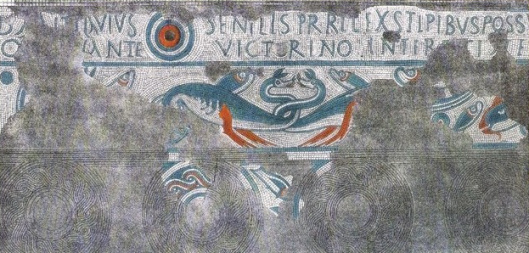
I’ll never forget that pillar raised by Flavius Senilis to Nodens, Lord of the Great Abyss

Machen having the inscription read: “To the great god Nodens (the god of the Great Deep or Abyss) Flavius Senilis has erected this pillar on account of the marriage which he saw beneath the shade.”

Lovecraft had first discovered and read Machen’s work in the summer of 1923, and Nodens then appeared in Lovecraft’s “The Strange High House in the Mist” (1926) and Dream-Quest (1926-27). It seems quite plausible to assume, as Joshi and others have, that Lovecraft had been unfamiliar with Nodens prior to 1923. My quick search of Google Books for the 19th century and for 1900-1924 confirms this strong likelihood. You couldn’t look him up in an encyclopedia, it seems.

Nodens appears to have been only a brief dalliance by Lovecraft, as there seems to be nothing lurking in the poetry. But his lack of any pursuit of the god into Dunsanian realms was perhaps timely. Since there was a flurry of publicity by 1929 around the Nodens name, which would have constrained any continued use of the name in fantastic fiction. The name and site at Lydney became closely associated with the discovery of a lost golden ring, known as ‘The Vyne Ring’, and a curse. The discovers put a call through to one Professor Tolkien, who kindly wrote a learned philological essay on the name Nodens in the light of the new finds. His essay is to be found in good form in the back of the Report on the Excavation of the Prehistoric, Roman, and Post-Roman Site in Lydney Park, Gloucestershire (1932) and reprinted in Tolkien Studies #4 (2007).

Fourth-century inscription dedicated to Nodens, at Lydney, with sea-dragons. Note the Sauron-like staring ‘eye’.

Tolkien’s linguistic pursuit of the name led him to find a cognate across the Irish Sea in Nuada Argat-lam, he of the lost hand. There is thus a possible origin here for Tolkien’s idea of Sauron and the ring of power. Since Sauron lost a severed finger and with it his ring, and thus most of his power was lost. This key idea is not so far, at least in its basics, from a quick imaginative combination of the lost and cursed golden ‘Vyne Ring’ + the lost hand of Nuada.

New book: Fandom in the UK, 1939-1945

29 Wednesday Apr 2020

Posted by asdjfdlkf in New books, Scholarly works

≈ Leave a comment

Rob Hansen’s new and free ebook HOMEFRONT: Fandom in the UK, 1939-1945 may interest those exploring the years immediately after the death of Lovecraft. 163,000 words of primary and memoir material from and about British fandom during the Second World War…

There was a scheme afoot to materialize Lovecraft [among the spiritualist mediums of wartime London]

Well, there’s a cue for a new Mythos and Lovecraft-as-character story. Just add some rival Blackshirt occultists, and a guest appearance by Churchill accompanied by his (apparently) wartime industrial-production consultant S. Fowler Wright.

The Joy of Information

28 Tuesday Apr 2020

Posted by asdjfdlkf in Scholarly works

≈ Leave a comment

This call-for-papers may tickle the fancy of lovers of deep and dusty research, and those who enter a library with a pocket digicam and a piratical grin. The Joy of Information: A Library Trends Special Issue…

This special issue of Library Trends features writings that explore the relationship between information and joy [in an issue that] brings together bright and uplifting views of information to contrast with critical or problem-oriented perspectives that color our literature in grayscale.

They appear not to want to see proposals, but rather full-papers submitted by 1st August 2020.

Kittee Tuesday: I Don’t Want Moths

28 Tuesday Apr 2020

Posted by asdjfdlkf in Kittee Tuesday

≈ Leave a comment

I Don’t Want Moths by Jade Armstrong, a fine little free cat (and moths) comic on Itch.io. I’ve been on Itch.io for a while, only for the 3D software Flowscape, and had no idea they also had a comics section. Looks like it’s large and thriving, and the presence of Atomic Robo on it inspires confidence. Checkout and downloading is very easy, and this particular comic comes as a .PDF file.

Claws out for Lovecraft

27 Monday Apr 2020

Posted by asdjfdlkf in Odd scratchings

≈ Leave a comment

How Christians see him…

More startling is an essay by John Stanifer contrasting [C.S.] Lewis with the horrid themes and stylistics of H.P. Lovecraft. Be assured, when Aslan meets Cthulhu, the Lion wins.

The Christian Librarian, reviewing the proceedings of a 2018 symposium on Narnia author C.S. Lewis.

Grand Comics Database

27 Monday Apr 2020

Posted by asdjfdlkf in Lovecraftian arts, Odd scratchings

≈ Leave a comment

The Grand Comics Database. It’s more or less the ‘IMDb for comic-books’. Back in 2016 Mike Monaco of The University of Akron gave it an assessment for librarians. As of 2020 they have 850,000 cover scans, so it’s also a resource for historic illustrations. The service is probably something that makers of Lovecraftian and related comics want to be sure they’re listed on, and listed correctly with a cover picture.

New book: Beyond the Outposts: Essays on SF and Fantasy, 1955-1996

26 Sunday Apr 2020

Posted by asdjfdlkf in New books

≈ Leave a comment

Algis Budrys, Beyond the Outposts: Essays on SF and Fantasy, 1955-1996, newly published in the UK by Ansible. There’s a lot in the book’s 211,000 words. But of possible special interest to readers of Tentaclii are…

* “Non-Literary Influences on Science Fiction”, “exploring in disquieting depth how magazine stories were routinely cut, padded or rearranged for production reasons beyond the control of author or editor”.

* Science Fiction in the Marketplace.

* Pulp!

* Writing Science Fiction and Fantasy.

Protected: The Cry of Cthulhu

26 Sunday Apr 2020

Posted by asdjfdlkf in Lovecraftian arts

≈ Enter your password to view comments.

This content is password-protected. To view it, please enter the password below.

Close Reading with Computers

25 Saturday Apr 2020

Posted by asdjfdlkf in New books, Scholarly works

≈ Leave a comment

Close Reading with Computers: Textual Scholarship, Computational Formalism, and David Mitchell’s Cloud Atlas (April 2020). This substantial new single-author book applies textual computing to the science-fiction-philosophy novel Cloud Atlas, and is also free and under full Creative Commons.

This book is the first full-length monograph to bring a range of computational methods to bear in a sustained fashion, on a single novel, at the micro-level. While most contemporary digital studies are interested in distant-reading paradigms for large-scale literary history – using their digital methods as a telescope – following calls by Alan Liu and Tanya E. Clement, Close Reading with Computers instead asks what happens when such techniques function as a microscope.

As such it is possibly of interest as an exemplar for a set of computational techniques and approaches that could be used on a Lovecraft work. With the dense and historical (and public domain) Dexter Ward springing to mind.

Picture postals: Brown, the “great clock tower”

24 Friday Apr 2020

Posted by asdjfdlkf in Picture postals

≈ Leave a comment

Here’s a pleasing 1906 sidewalk view of the clock tower at the corner of the Brown campus, much as Lovecraft could have seen it through the trees on various summer night-walks. It was on a corner, and thus accessible for the nocturnal pedestrian to view.

One can imagine what his imagination might have briefly made of it, seen in the dead of a summer’s night, all tree-shadowed in faint moonlight and with a glitter of stars behind it.

The first part of Lovecraft’s tribute “To Klarkash-Ton, Lord of Averoigne” fits such a night-viewing. Lovecraft’s poem was first published in Weird Tales in April 1938…

Lovecraft later lived nearby — ‘just around corner’, in effect — and this tower could also be seen from the upper windows at his last home of 66 College Street…

The main Brown campus with its great clock tower can be seen from our easterly windows

New book: Weird Fiction and Science at the Fin de Siecle

23 Thursday Apr 2020

Posted by asdjfdlkf in New books, Scholarly works

≈ 1 Comment

New from Emily Alder of Edinburgh Napier University, Weird Fiction and Science at the Fin de Siecle. The focus is on British authors and their relations with science as then understood. Alder appears to be challenging the assumption that such works were all in some way ‘supernatural’ or were an elaboration of ‘the gothic’.

In this book, I conceive weird fiction as a literature of borderland science. In its fin-de-siecle forms, the weird tale arises because scientific discourses had murky edges, because the limits of knowledge and the extent of what was or wasn’t possible in the world were unclear, because the boundaries of valid scientific enquiry itself were not stable. Weird fictions flourish in gaps in knowledge or beyond its edges. … Some tales exploit the gaps and possibilities in materialist science opened up by late nineteenth-century biology and evolutionary theories; some extrapolate from theories of physics, from classic thermodynamics and the new physics of unseen, subatomic worlds. All pick up on the strangeness of science, of what is already weird. … Weird fiction and science belong to the same, widespread cultural conversation taking place at this time about new knowledge… [its authors react] to changing ways of understanding generated by scientific exploration, considering how their implications might be experienced by individuals in the present, projected into the future, and reconciled with competing worldviews.

It looks like an interesting approach. Here are the contents…

CONTENTS:

* Weird Tales and Scientific Borderlands at the Fin de Siecle.

* Weird Selves, Weird Worlds: Psychology, Ontology, and States of Mind in Robert Louis Stevenson and Arthur Machen.

* Weird Knowledge: Experiments, Senses, and Epistemology in Stevenson, Machen, and Edith Nesbit.

* Weirdfinders: Reality, Mastery, and the Occult in E. and H. Heron, Algernon Blackwood, and William Hope Hodgson. [On the ‘occult detectives’ sub-genre].

* Borderlands of Time, Place, and Matter.

* Meat and Mould: The Weird Creatures of William Hope Hodgson and H. G. Wells.

* Weird Energies: Physics, Futures, and the Secrets of the Universe in Hodgson and Blackwood.

Kittee Tuesday: Shadow of the Cat

21 Tuesday Apr 2020

Posted by asdjfdlkf in Kittee Tuesday

≈ Leave a comment

Hat-tip to the editors of Modern Monsters #3 (August 1966), which had a “Cats Cats Cats” round-up of cats in horror movies. The above promo card was used as a trailer for the article, at the start of the magazine.

← Older posts
Newer posts →


Please become my patron at www.patreon.com/davehaden to help this blog survive and thrive.

Or donate via PayPal — any amount is welcome! Donations total at Easter 2025, since 2015: $390.

Archives

  • August 2026
  • July 2026
  • June 2026
  • May 2026
  • April 2026
  • March 2026
  • February 2026
  • January 2026
  • December 2025
  • November 2025
  • October 2025
  • September 2025
  • August 2025
  • July 2025
  • June 2025
  • May 2025
  • April 2025
  • March 2025
  • February 2025
  • January 2025
  • December 2024
  • November 2024
  • October 2024
  • September 2024
  • August 2024
  • July 2024
  • June 2024
  • May 2024
  • April 2024
  • March 2024
  • February 2024
  • January 2024
  • December 2023
  • November 2023
  • October 2023
  • September 2023
  • August 2023
  • July 2023
  • June 2023
  • May 2023
  • April 2023
  • March 2023
  • February 2023
  • January 2023
  • December 2022
  • November 2022
  • October 2022
  • September 2022
  • August 2022
  • July 2022
  • June 2022
  • May 2022
  • April 2022
  • March 2022
  • February 2022
  • January 2022
  • December 2021
  • November 2021
  • October 2021
  • September 2021
  • August 2021
  • July 2021
  • June 2021
  • May 2021
  • April 2021
  • March 2021
  • February 2021
  • January 2021
  • December 2020
  • November 2020
  • October 2020
  • September 2020
  • August 2020
  • July 2020
  • June 2020
  • May 2020
  • April 2020
  • March 2020
  • February 2020
  • January 2020
  • December 2019
  • November 2019
  • October 2019
  • September 2019
  • August 2019
  • July 2019
  • June 2019
  • May 2019
  • April 2019
  • March 2019
  • February 2019
  • January 2019
  • December 2018
  • November 2018
  • October 2018
  • September 2018
  • August 2018
  • August 2015
  • July 2015
  • March 2015
  • February 2015
  • January 2015
  • December 2014
  • November 2014
  • October 2014
  • September 2014
  • August 2014
  • July 2014
  • June 2014
  • May 2014
  • March 2014
  • February 2014
  • January 2014
  • December 2013
  • November 2013
  • October 2013
  • September 2013
  • August 2013
  • July 2013
  • June 2013
  • May 2013
  • April 2013
  • March 2013
  • February 2013
  • January 2013
  • December 2012
  • November 2012
  • October 2012
  • September 2012
  • August 2012
  • July 2012
  • June 2012
  • May 2012
  • April 2012
  • March 2012
  • February 2012
  • January 2012
  • December 2011
  • November 2011
  • October 2011
  • September 2011
  • August 2011
  • July 2011
  • June 2011
  • May 2011
  • April 2011
  • March 2011
  • February 2011
  • January 2011
  • December 2010
  • November 2010
  • October 2010
  • September 2010
  • August 2010
  • July 2010

Categories

  • 3D (14)
  • AI (74)
  • Astronomy (70)
  • Censorship (14)
  • de Camp (7)
  • Doyle (7)
  • Films & trailers (101)
  • Fonts (9)
  • Guest posts (2)
  • Historical context (1,096)
  • Housekeeping (91)
  • HPLinks (95)
  • Kipling (11)
  • Kittee Tuesday (92)
  • Lovecraft as character (58)
  • Lovecraftian arts (1,639)
  • Lovecraftian places (19)
  • Maps (72)
  • NecronomiCon 2013 (40)
  • NecronomiCon 2015 (21)
  • New books (974)
  • New discoveries (165)
  • Night in Providence (17)
  • Odd scratchings (984)
  • Picture postals (277)
  • Podcasts etc. (431)
  • REH (189)
  • Scholarly works (1,478)
  • Summer School (31)
  • Unnamable (87)

Get this blog in your newsreader:
 
RSS Feed — Posts
RSS Feed — Comments

H.P. Lovecraft's Poster Collection - 17 retro travel posters for $18. Print ready, and available to buy — the proceeds help to support the work of Tentaclii.

Proudly powered by WordPress Theme: Chateau by Ignacio Ricci.