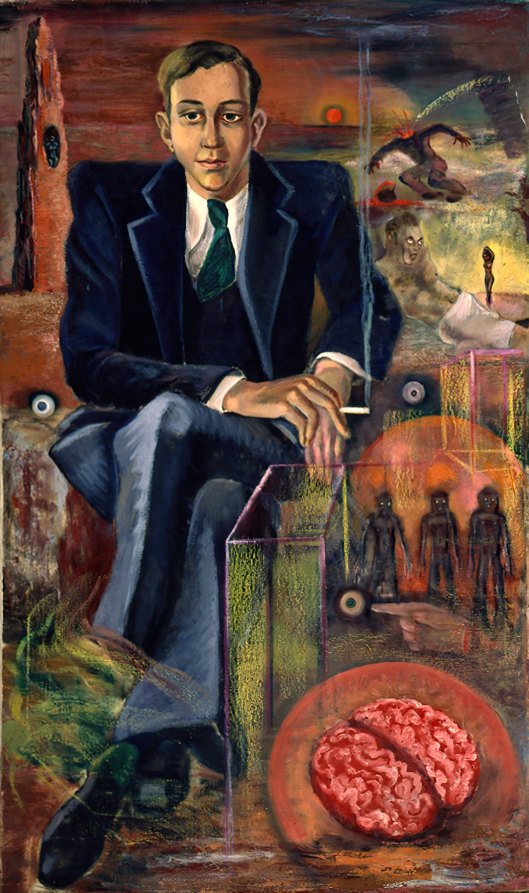
“Author with Dreams”, a circa 1936-46 painting of Donald Wandrei (and his personal dream-world) by Clement B. Haupers.

04 Wednesday Nov 2020
Posted in Historical context, Lovecraftian arts
“Author with Dreams”, a circa 1936-46 painting of Donald Wandrei (and his personal dream-world) by Clement B. Haupers.
03 Tuesday Nov 2020
Posted in New books, REH, Scholarly works
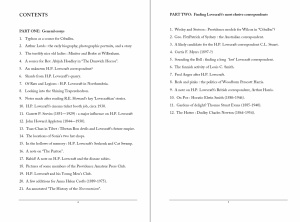
A peep at the contents page of Todd B. Vick’s Renegades and Rogues: The Life and Legacy of Robert E. Howard, due in early January 2021 from the University of Texas Press — but now on Google Books early and with some preview pages.

02 Monday Nov 2020
Posted in Scholarly works
A call for shorter papers on Neo-medievalism Media in the New Millennium, with a deadline of 28th February 2021. The editor sees neo-medievalism as mainstreaming with the Lord of the Rings movies, and flowing into key popular media such as Elder Scrolls: Skyrim, The Witcher, Game of Thrones, etc. He seems to envisage a sort of primer, with short chapters introducing and positioning specific titles for academics. No mention of the resulting book being Open Access.
The list of suggested media made me aware there was a Marco Polo TV series in 2014. I remember I enjoyed the lavish 1982 Marco Polo 10-hour series, one of the best of the 1980s and pre-PC. But according to the Hollywood Reporter the 2014 Netflix series had “dismal reviews” and was a “mess”. Oh well.
02 Monday Nov 2020
Posted in Historical context, Podcasts etc.
Last week the Catholic traditionalist OnePeterFive considered Lovecraft’s worldview for Halloween, and Christian traditionalist blog The Orthosphere offered a long appreciation of Clark Ashton Smith’s “City of the Singing Flame” & Synchronicity. The latter post piqued my interest in an audiobook, as it soon becomes evident that the long essay has far many plot-spoilers and that it should be read after the work itself.
Is there a free audiobook version of quality? Yes. On Archive.org is “The City of the Singing Flame, read by the Late Great Harlan Ellison”, being a 90 minute audiobook via the venerable Cthulhuwho1. Recorded by him from the radio to mid-1980s tape, so you may want to use your audio-player’s graphic equaliser to fix sibilance and hiss and suchlike. I read elsewhere that Harlan Ellison consented to read it on air because it was a formative work for him as a youth. Ellison repeats a short section in the middle, with a better reading the second time around.
S.T. Joshi has called it “intoxicatingly exotic” in I Am Providence. This makes it sound quite interesting, to someone who’s so far found it impossible to get into what is supposed to be the best of Smith (vague memories of interminably dialogue-heavy wizards wandering around in a desert, given up on after XX pages, etc). What did Lovecraft think of it? I can only find a few instances of his mentioning “City of Singing Flame”. He was enthusiastic, but not gushing in his brief remark…
“The City of The Singing Flame” is certainly a memorable thing, & I was glad to learn that Wandrei shares my opinion. (Selected Letters III)
To Barlow he was equally terse in passing… “great story”, “worthy sequel”. To Bloch and Wandrei he mentions it not at all, judging by the indexes in the volumes of letters.
“City of Singing Flame” (the original title) and its sequel “Beyond the Singing Flame” (originally “The Secret of the Flame” on the typescript, now at Brown) ran in the pulp Wonder Stories in 1931. The stories were later reprinted in Famous Science Fiction, Winter 1966/67 and the follow-on Summer 1967 issue. Later both were collected in a single U.S. paperback, with generic ‘butterfly-dragon’ fantasy cover-art which was appears to have been hoping to appeal to the legions of female fans then avidly reading Anne McCaffrey’s best-selling Dragonrider series.
Turns out that Harlan Ellison also reads the sequel in his reading and both, shorn of the repeating middle section, run about 80 minutes in total. But if you want a variant reading there’s also a 2018 one-hour reading of the sequel on YouTube by Nemesis the warlock.
Update: I’ve now heard it. At times it’s very much like an audio-version of one of Moebius’s less convoluted graphic novels.
02 Monday Nov 2020
Posted in Odd scratchings, Scholarly works
New on Archive.org in open access On The Track Of Unknown Animals (1970), in its abridged 1962 edition for the general public. One of the Paladin paperback series in which British publisher Granada published all sorts of weird and wonderful non-fiction books, from British earth-mysteries to the 1970s crazes for ‘talking to plants’ and ESP.
One has to remember that this is from a time when there was barely colour TV, and long before the wildlife documentarians brought the world’s wildlife to our screens.
01 Sunday Nov 2020
Posted in Podcasts etc., Scholarly works
A 50 minute talk from David Goudsward and Buttonwoods Museum on “Lovecraft in the Merrimack Valley”. Apparently a Halloween treat, and thus only online at YouTube until 15th November 2020.
31 Saturday Oct 2020
Posted in Lovecraftian arts
For Halloween, Stanley Chaplin’s “Cornish Litany” series of monster postcards. Apparently there are 12 designs in total, in b&w and colourised variants. The Litany is said to be traceable back to the 15th century, and to be chanted by superstitious Cornishmen and women to ward off the night-spirits.
0.

1.
Missing
2.

3.

4.

5.

6.

7.

8.

9. B&W.

9. Colour

10.
Missing.
11.

12.

31 Saturday Oct 2020
Posted in Odd scratchings
Squish, squish squish. No, that’s not the sound of Lovecraftian monsters arriving ready for Halloween… only to look around in a puzzled manner and wonder where all the people have gone. It’s just that October 2020 was a rather squishy month. Squishy underfoot, with the fallen and yellowing leaves slowly turning into gooey mud. Squishy and futile attempts to squish what is now a not-very-lethal virus. Squishy political operators squirming through America. Students squishing through the rain, back to campus. Tentaclii even became a little squishy, with a temporary paucity of H.P. Lovecraft items in the middle of the month forcing side-topic posts on Machen, Derleth and others.
In new books, the chunky 600-page Eccentric, Impractical Devils: The Letters of Clark Ashton Smith and August Derleth was released for Halloween. I also surveyed where one might find the ‘best of’ Derleth’s imaginative fiction, and was disappointed to find that the two print book needed — In Lovecraft’s Shadow: The Cthulhu Mythos Stories of August Derleth and The Original Text Solar Pons Omnibus — are now ridiculously expensive and lack affordable ebooks. On the other hand, nearly all of Derleth’s science-fiction can now be had free on Archive.org in the original magazines.
In scholarly work, a new Italian book was noted that appears to have a useful summary of ‘Lovecraft and Nietzsche’ in terms of the influence. There was news of a big new book on Lovecraft by leading scholar Ken Faig, but it’s only “forthcoming” at present. The Spanish appear to have reprinted a 1972 book collection of Lovecraft’s essays in translation. In work from the occultist crowd, the new book Dark Magic: H.P. Lovecraft, Starry Wisdom and the Contagion of Fear looks serious and to have an interesting central idea.
There’s not much happening in scholarly journals in this hectic back-to-uni / Christmas-is-coming time, but S.T. Joshi launched his new mega-journal Penumbra #1 to fill the gap, and I noted the non-fiction essays in it which seem of most interest.
In bargains and freebies, I noted that The Lovecraft Arts & Sciences store in Providence appears to have Eckhardt’s illustrated booklet Off the Ancient Track for just $10, and in the revised 2013 edition too. I also noted that one can now get a run of the venerable and informative zine Pulpdom complete in PDF for $30, with an Index. On Archive.org, the H.P. Lovecraft Companion (1977) popped up and is available to borrow.
My regular ‘Picture postals’ blog posts returned to College Street, with a look at the Handicraft Club. Also, I found more night pictures in the form of two evocative views from Providence artist Whitman Bailey (1884-1954). One of these was from Lovecraft’s favourite place, Prospect Terrace, in 1914. I also peered inside Robinson Hall, the first Brown Library, and considered what a fine H.P. Lovecraft Archives & Museum it might have made for the city.
Ahead of an Art Club ‘Picture Postals’ post, which is set for November, I also posted a list of the Providence Art Club Costume Party themes, 1913-26, and the full TOCs for the important new two-volume Letters to Family and Family Friends collection of Lovecraft letters.
My own short research essays in October considered: H.P. Lovecraft’s tentative editorship of the unrealised revival of the Magazine of Fun; Lovecraft and the artist Fuseli; and Lovecraft and Halloween (as a real-life annual event). The latter usefully led me to consider the location of Lovecraft’s un-named New York “occultist” book shop, and to suggest a possible candidate for this. My short post “More on Lovecraft in Harlem” also updated my previous look at the topic, and suggested a walking route he knew and that there was a Kalem meeting in Harlem. And in “Lovecraft in Esquire, 1947″ I was pleased to discover a previously unknown 1940s memoir-fragment about both Lovecraft and Weird Tales, written by the magazine’s publisher Henneberger. I also tested his memory against what we now know.
In academic opportunities, I noted a call for chapters for Religion and Horror Comics, and that Providence’s Brown University has a fully-funded PhD opportunity in Music and Multimedia Composition. A couple more items were added to Open Lovecraft page.
The month was light on podcasts, but I linked to the Voluminous podcast as they began reading a multi-part Robert E. Howard – Lovecraft letter series. I was also pleased to find a new free reading of Lovecraft’s “The City”, a long and seminal poem that I copiously annotated a year ago.
Finally, I’ve just looked at my Patreon and am pleased to find it’s increased slightly to $70 a month, from $69. My thanks to the booster, Daverius, who is giving $1 per month. If you can find a $1 or two to also support Tentaclii and my other ventures, it would be most helpful.
That’s it for October. More next month!
31 Saturday Oct 2020
Posted in Odd scratchings
H.P. Lovecraft’s “The Familiars”, and “The Pigeon-flyers”, from Weird Tales for January 1947.

30 Friday Oct 2020
Posted in New books, Scholarly works
Now listing on both Amazon and Hippocampus for 31st Oct 2020, Eccentric, Impractical Devils: The Letters of Clark Ashton Smith and August Derleth. 602 pages from Hippocampus Press, edited and annotated by David E. Schultz and S. T. Joshi.

Additional information is found in a March 2019 blog post by S.T. Joshi…
Recently a previously unknown batch of Derleth’s letters to Smith came to light, causing us to refashion the book almost in its totality — and forcing me to re-index nearly the whole of the book. Gawd, what a nightmarish task! But the job is done at last, and I hope the book will emerge soon — along with the huge Clark Ashton Smith bibliography that Scott Connors, David E. Schultz, and I have edited.
Ouch, it sounds like he indexes by hand. Someone tell him about the automated PDF Index Generator, which would at least take care of much of the heavy-lifting of index-building.
30 Friday Oct 2020
Posted in Historical context, Picture postals
This week, yet another aspect of College Street as Lovecraft and his aunts would have known it. At the corner of Benefit and College Streets stood the headquarters of the Handicraft Club.

The artistically grown trees were apparently magnolias, and these later grew up substantially and when in leaf they obscure several later photographs of the frontage.

The Club was established there in 1905, and a rigorous approach soon attracted a healthy membership of skilled crafts workers. The place was extensive and there was a showroom and an annual exhibition of new crafts work.
It was here that one of Lovecraft’s aunts lived in 1927…
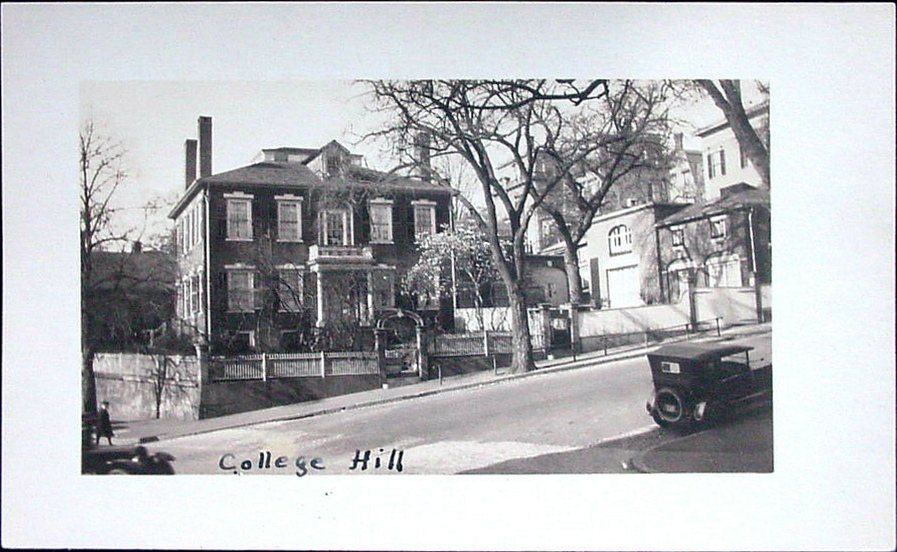
… half-way up [College Street] my aunt boarded in 1927 at the Handicraft Club in the old Truman Beckwith house. You doubtless recall that brick edifice and its old-fashion’d terraced garden.” (letter to Morton, Selected Letters IV)
S.T. Joshi writes of this period in I Am Providence…
We do not know much of what Lovecraft was doing during the first few months of his return to Providence [from New York City]. In April, May, and June [1927] he reported seeing several parts of the city he had never seen before, at least once in the company of Annie Gamwell, who at this time was residing at the Truman Beckwith house at College and Benefit Streets.
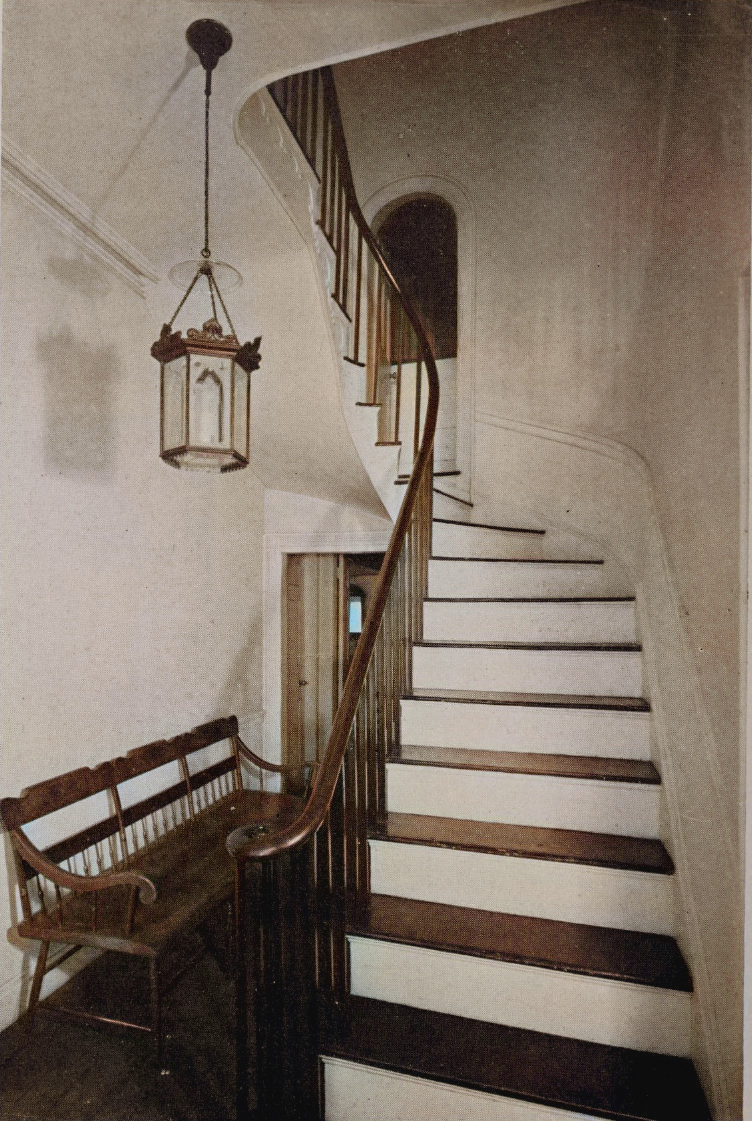
We do however know just a little of why his aunt might have been there. In 1925 the House had been purchased to serve as a “permanent home” (Handicrafts Of New England, page 321) as well as a clubhouse, and we can probably assume this was why Annie Gamwell could live there — if only for perhaps a single summer season of board and lodging. It seems plausible to assume that Lovecraft took the opportunity of his aunt’s residency to thoroughly appreciate the fine architecture. The Library of Congress has a detailed plan-book of the entire house, evoking all the details of the craftsmanship that Lovecraft would have thus admired. Though a photograph perhaps better evokes the interior that his aunt would have enjoyed at that time…
Atheist though he was, a few years later the mellowing Lovecraft was able to amiably enjoy an old traditional custom. Christmas 1933 found him listening to carols sung in the Handicraft Club courtyard…
Fixed up the sitting-room hearth with greens and surprised my aunt — and borrowed a cat for the occasion. Heard carol-singing in the early evening in the quaint cobblestoned courtyard of the Georgian Beckwith mansion (where my aunt was in 1927) halfway down the antient hill.” (letter to Morton, Selected Letters IV)
a turkey dinner at the boarding-house across the back garden & a stroll half-way down the hill to hear the carol-singing at the old Truman Beckwith mansion. I took the midnight coach & arrived in Manhattan the next morning —” (letter to Toldridge, Selected Letters IV)
29 Thursday Oct 2020
Posted in Lovecraftian arts, Scholarly works
Providence’s Brown University has a fully-funded PhD opportunity in Music and Multimedia Composition, which may be of interest to those making Lovecraftian music or sonic environments…
Students have access to the department’s Multimedia and Electronic Music Experiments (MEME) studios, and the university’s Granoff Center for the Creative Arts. These specialized research facilities house recording studios, electronics shops, project studios, exhibition and performance spaces. … faculty specialties in technoculture, sound studies, copyright, improvisation and timbre.