
HPLinks #80.
* An English abstract for a new conference paper from the city in Brno in the Czech Republic, “The Discipline of the Eye: Lovecraft’s Visual Epistemology, Atmospheric Proof, and the Horror of Display” (2026). Through “refusal and display”, Lovecraft…
disciplines the eye to treat atmosphere as evidence […] outline, surface, hue, and scene operate as atmospheric proof—signals of an alien order […] Indeterminacy, shared by narrator and reader, forces imaginative substitution, making the reader complicit in producing what cannot be stably seen.
* The latest (37.1) members-only Journal of the Fantastic in the Arts has a review of David Goudsward’s book Adventurous Liberation: H.P. Lovecraft in Florida. Not online.
* From Russia in Russian and open-access, an essay that translates as ‘The Fantastic Chronotope and the Image of the City in the works of G. Meyrink and H.P. Lovecraft’…
Meyrink’s Prague (The Golem and The Angel of the Western Window) and H.P. Lovecraft’s Innsmouth (“The Shadow over Innsmouth”) each offer a fantastic space with distinctive features [… I also suggest] that certain details of the descriptions of the fictional city of Innsmouth were most likely borrowed by H.P. Lovecraft from The Golem.
However, one can note that Innsmouth was written at the end of 1931 and yet Lovecraft didn’t finally read The Golem until several years later when Barlow was able to send him a copy… “I had seen the cinema version, and thought it was faithful to the original — but when I came to read the book only a year ago [i.e. April 1935]” …. Holy Yuggoth! The film had nothing of the novel save the mere title and the Prague ghetto setting — indeed, in the book the Golem-monster never appeared at all, but merely lurked in the background as a shadowy symbol.” (Lovecraft, in Selected Letters V, p.138). If there was any inspiration, it would have been from the movie. But Lovecraft was personally well acquainted with decrepit seafronts of all sorts.
* Also from Russia and in open-access, a new journal article which translates as “‘Lovecraftian Magic’ as a Form of Fictional Religion” (2026). In Russian, but easily auto-translated.
* A new philosophy article on the Medium platform on “H.P. Lovecraft’s Takedown of Islam” (a short free sample, then $ paywall).
* DMR notes the passing of “Lee Breakiron: A Gentleman and a (Howardian) Scholar”…
While Lee was all-around a gifted scholar of [R.E.] Howardiana, he was the undisputed king — by his own hand — when it came to scholarship regarding the history of Howardian fandom and literary criticism. He’d read and collected all of it during the decades before he strode into the REH scholarship arena.
* A review of Robert E. Howard: The Life and Times of a Texas Author.
* The REH Foundation podcast has a new chat surveying and discussing Robert E. Howard’s Pirate Stories.
* A new review of the Selected Letters of Clark Ashton Smith.
* On Kickstarter… Deep Space Lovecraft: 2 Cthulhu Mythos Horror Adaptations. Being… two “Mythos tales reimagined & visualized as hard science fiction” and done as comics. It’s heavily over-funded already. “The Haunter of the Dark” is imagined as a visit to a giant cathedral-like space station, and “The Hound” seemingly as a visit to another space station / museum? Despite the obviously AI-generated images, which by the looks of them were probably generated some years ago with now-primitive AI and then partly overpainted, the images have been carefully cohered into appealing pages. The pages are offered on the Kickstarter page as free samples. Looks to me like the Inverse Press / Flatline Comics could be a way to publish your AI generated comic in paper, without having to encounter the anti-AI hysteria currently being whipped up elsewhere.
* AI has moved on since then, and if you want a taster of that then have a look at this curious weird experiment. Simply feed the entire text of the seminal science-fiction novel The Time Machine into an AI, and have it make an apparently un-aided script and then generate a 17 minute movie version by itself… “this is the raw unrefined result with a single take, no cherry picking” says the experimenter.
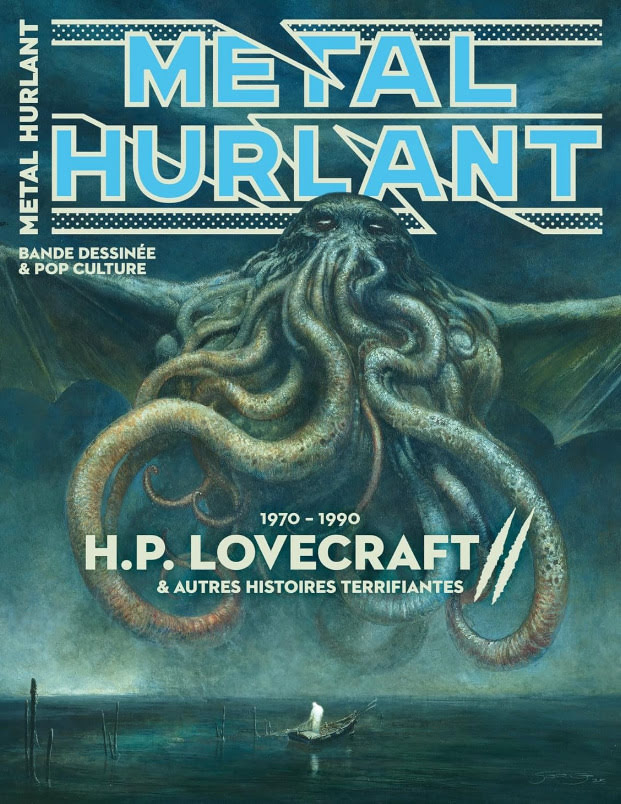
* The new French Metal Hurlant 18 (Lovecraft special, 2026) magazine is now available.
* Amazon UK is listing Donald R. Burleson’s new book Seed of the Gods: Lovecraft-Inspired Tales and Others as published in April 2026… “his first collection of short stories in more than a decade, [in which] Burleson gathers tales written over the past fifteen years”.
* A new free ebook, “Overworked, Undernourished, and Weak in the Eyes”: The Portrayal of Librarians in Comics. An assidious annotated and seemingly completist survey in 365 pages, offered by the author. Freely available to download as a PDF.
* Taskerland has a short essay “On “The Man of Stone” by Hazel Heald and H.P. Lovecraft”. He finds this collaboration is…
not a great story, but it is an instructive one. In its mixture of cosmic suggestion and theatrical excess, it shows how readily Lovecraft’s ideas can be broken apart and made to function elsewhere. What emerges is not simply a change in tone, but a loosening of ownership, the same anxieties set loose from their original form and already beginning to move beyond the control of their author. This process is usually dated to Lovecraft’s afterlife, to obscurity, Derlethian appropriation, copyright murkiness, and the long slide into cultural ubiquity, but its beginnings may be earlier.
* Dark Worlds surveys “The Arkham Sampler Fiction”. Scans of Derleth’s Sampler issues can now be found at the Internet Archive.
* Up for auction at Heritage Auctions, a complete run of Arkham House books.
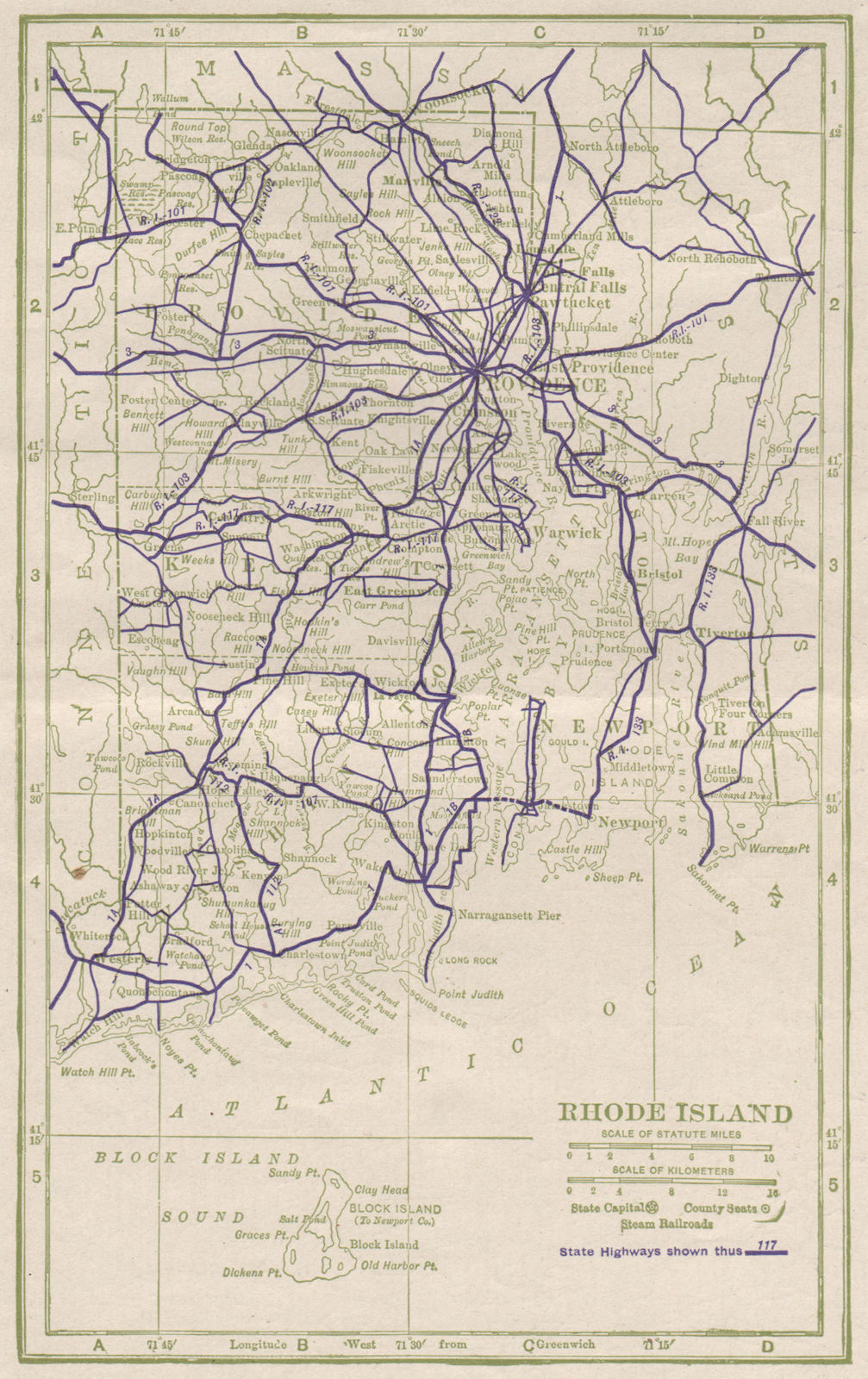
* Browsing eBay for scans, I’d not seen this one before. A pleasing and unwatermarked map of the highway system in Rhode Island, 1925. Could be upscaled to become a good RPG game prop?
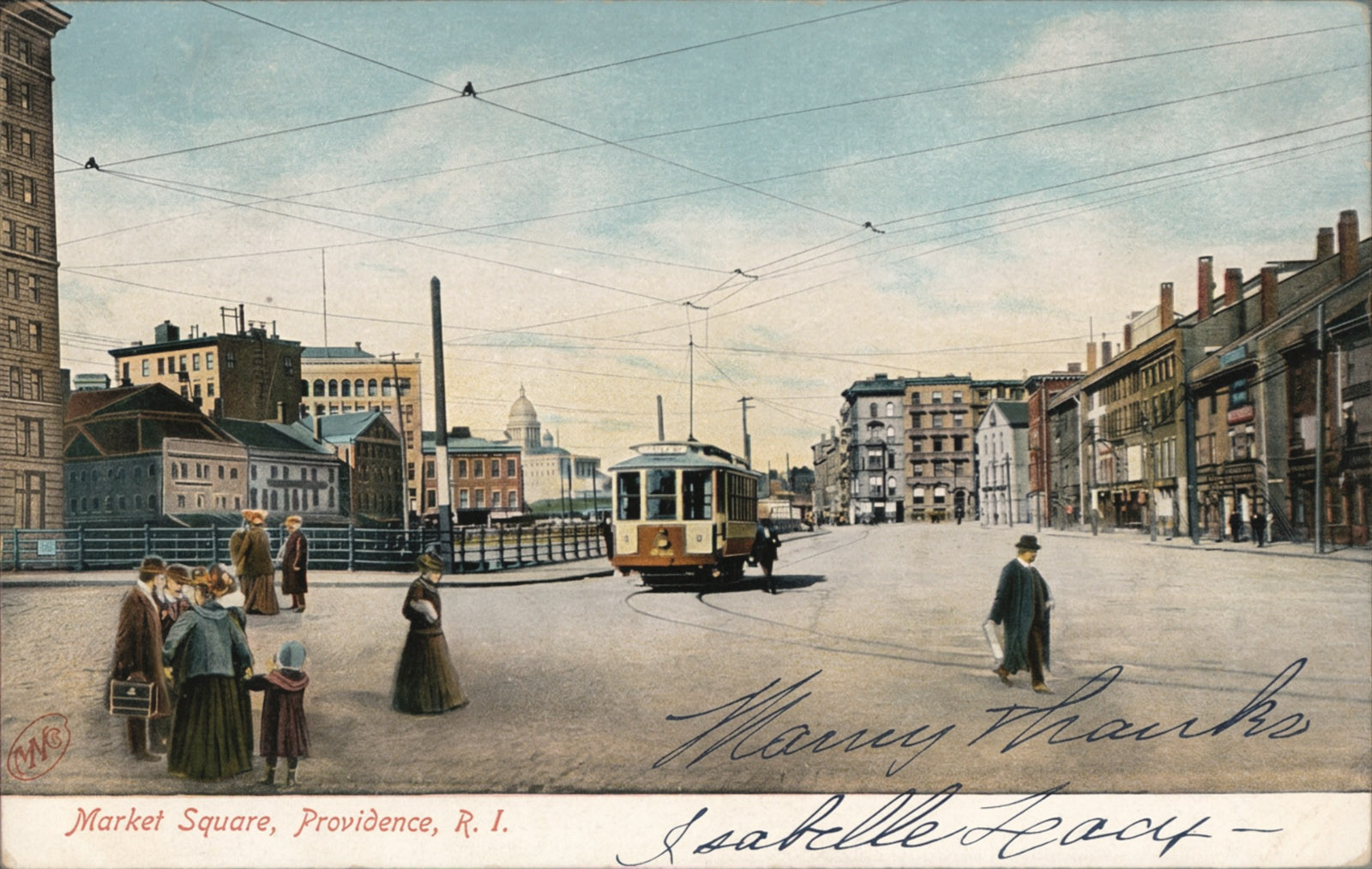
* And finally, a rare street-level view of the Market Square, Providence, as Lovecraft would have encountered it. Many other postcard views are elevated or bridge-views. The view here is north towards the State House dome. The city’s market was held around the railings on the left of the picture. One can almost imagine the fellow alighting from the tram car, holding a black bag, to be the young Lovecraft.
— End-quotes —
“My aunt is well acquainted with Mr. Champlin Burrage, an Oxford man, who is librarian of the John Carter Brown library at Brown. (I hope to meet him very soon.)” — Lovecraft to Kleiner, April 1917. Brown University in Providence.
“Like you I am absolutely devoid of actual friends outside of correspondence. Those whom I knew in youth are all active and successful now, […] one a librarian of the R.I. Historical Society” — Lovecraft to Kleiner, circa 1918.
“My other guest [in Providence], Carl Ferdinand Strauch — poet and Asst. Librarian of Muhlenberg University (a friend of Brobst’s) — was also highly interesting, and very appreciative of the local antiquities and and-wheres.” — Lovecraft to Morton, September 1932.
“Only the other day a correspondent of mine — a librarian who sees all the magazines — was remarking what a fixture of the small & select publications you [i.e. Derleth] are getting to be!” — Lovecraft to Derleth, September 1933.
“… some timid reader has torn out the pages [from the Necronomicon] where the Episode of the Vault under the Mosque comes to a climax — the deletion being curiously uniform in the copies at Harvard & at Miskatonic University. When I wrote to the University of Paris for information about the missing text, a polite sub-librarian, M. Lean de Vercheres, wrote me that be would make me a photostatic copy as soon as he could comply with the formalities attendant upon access to the dreaded volume. Unfortunately it was not long afterward that I learned of M. de Vercheres’ sudden insanity & incarceration, & of his attempt to burn the hideous book which he had just secured & consulted. Thereafter my requests met with scant notice.” — Lovecraft to C.A. Smith, November 1930.