
HPLinks #78.
* The long-awaited limited-edition hardcover of the Lovecraft-Long letters has been released. As the $85 A Sense of Proportion: The Letters of H.P. Lovecraft and Frank Belknap Long. Shipping now.
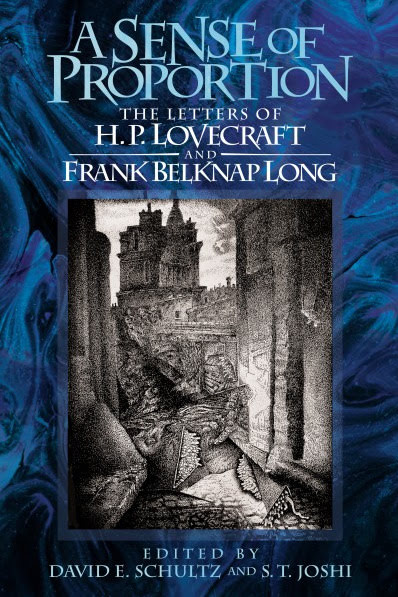
This volume brings to a conclusion the massive effort to publish the totality of Lovecraft’s extant correspondence. In each of these twenty volumes, editors David E. Schultz and S.T. Joshi have consulted original manuscripts and have exhaustively annotated the letters to provide readers with a full understanding of the biographical and literary background of every document.
Congratulations to all involved with this triumph of research, scholarship and endurance. Now all we need is the cumulative index volume. And, to save Tentaclii readers from looking, I should add that there’s no sign yet of a release of the scans of these new letters at the Brown University repository. At least, not when sorting by date. Possibly these are there, but the system dated them a few years back, when they were ingested-but-embargoed? Just a guess, for now.
* S.T. Joshi reports on a newly-found ‘first mention of Lovecraft in print’. Donovan K. Loucks has unearthed a Providence Evening News item from early April 1903, which reported that the boy Lovecraft had his $4 “small express waggon” stolen from in front of the Hope Reservoir Pumping Station. An express waggon was a basic multi-purpose toy cart with a long handle for pulling and no brakes. The one seen below is made of wood, but they were also made of sheet metal by the early 1900s.
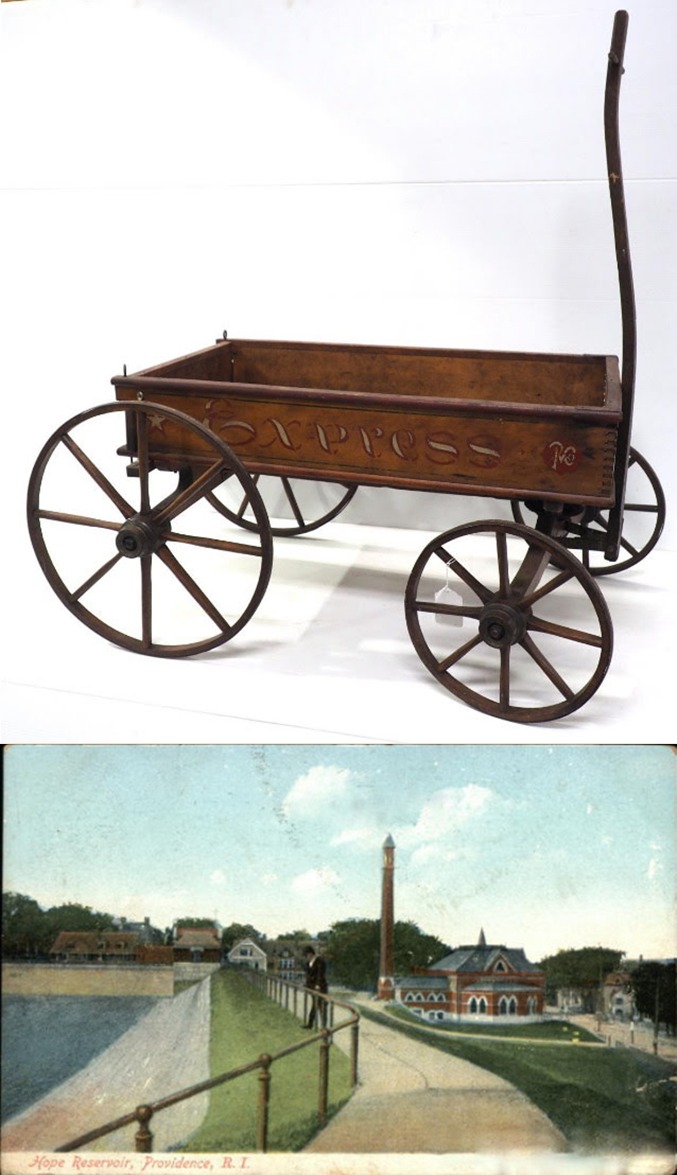
Yes, that sloping path looks perfect for boys and waggon-rides.
* An abstract for a paper presented at the Design Research Society Conference 2026, “User centred dread: a Lovecraftian critique of design”… “The concept of ‘user-centered dread’ emerges as a central provocation, highlighting how users are led into states of incomprehension and even terror through supposedly benign design work”. The authors are from Glasgow in Scotland, a city notorious for its urban design horrors.
* A new open-access article in the journal Modern American History, “Where the Dumps that Used to Be Ponds Used to Be: Urbanization and Waste in Providence, Rhode Island” provides detailed deep historical background on the changing aqueous landscapes of Providence.
from the 1880s until the 1950s, officials encouraged the conversion of inner-city ponds and lakes into landfills, with each filling more quickly than the last. This trend continued until virtually all low, wet places had been filled, along with significant stretches of the urban coastline.
For Lovecraft, such places were Cat Swamp; along the banks of the Seekonk; York Pond and the ravines back of it. From places such as York Pond and the Seekonk arose his earliest literary combinations of landscape and nightmare.
* The Fossil: Official Publication of The Fossils has its January 2026 issue freely available. Including an item from Lovecraft’s wife… “Monica Wasserman writes about a recently discovered early piece by Sonia Green, published in 1921” and the snappily-written piece is also printed. Though it takes some decoding, as its written in the amateur convention-report style of the time.
* Back in July I noted the Argentinian philosophy book H.P. Lovecraft. La Anti-vida y el destino cosmico (2025), and now I see an “English Edition” is newly available as a Kindle ebook on Amazon. Get the 10% free sample to determine if the translation is up to the job.

* At the University of Verona, Italy, there was a campus-wide… “day of studies to explore the role of materials and resources in science-fiction worlds, between theoretical reflections and the analysis of Lovecraft”.
* In open-access, what appears to be a February 2026 special edition of Lingua Italiana magazine (?) on the topic of The New Italian Weird. In Italian. Freely available online.
* DMR considers Lovecraft’s Shout-Outs to Robert E. Howard, rather than the other way around…
Lovecraft told REH that he would name-check some of Howard’s creations in his future tales and he fulfilled that promise. The earliest mentions can be found in “The Whisperer in Darkness”, which was finished in September of 1930.
* Dark Worlds Quarterly surveys “Shoggothian Terror in Sword & Sorcery Comics”.
* The Save the Robert E. Howard Museum campaign is now more than half-way there.

* American Hero Press have a very sumptuous-looking Frazetta TERROR large-format artbook at 15″, with pull-out prints on heavy paper stock.

* Finnish publisher Jalava has long done good work in translating Lovecraft, R.E. Howard and others into Finnish. I see that in 2025 they produced a handsome edited volume of the best stories by Lovecraft in Finnish.
* Now released, the new book Ghost Signals: The Shadowlands Of British Analogue Television 1968-1995. 140 pages of essays on the otherworldly in the British landscape, as seen on British broadcast television in its prime.
* Talking of British spooks, the final ‘farewell’ issue of the scholarly M.R. James journal Ghosts & Scholars has been published.
* From Germany, a YouTube gallery of various Mythos Creatures, visualised as five-second ‘animated pictures’.
* On Kickstarter and already funded, a Dreamlands playing-card pack.

* The Gates of Imagination reads Lovecraft’s “The Haunter of the Dark”, free on YouTube.
* On Librivox and public domain, Short Science Fiction Collection 106. Includes free audio readings of Frank Belknap Long’s “Young Man With a Trumpet” and Hannes Bok’s “Return from Death”.
* And finally, on Reddit one Grandpa Theobaldus (u/GrandpaTheobaldus) is newly fascinated by Lovecraft and film-going, and is regularly digging up Lovecraft quotes in which the master talks about movies he has seen.
— End-quotes —
“My home was not far from what was then the edge of the settled residence district, so that I was just as used to the rolling fields, stone walls, giant elms, squat farmhouses, and deep woods of rural New England as to the ancient urban scene. This brooding, primitive landscape seemed to me to hold some vast but unknown significance, and certain dark wooded hollows near the Seekonk River took on an aura of strangeness not unmixed with vague horror. They figured in my dreams — especially those nightmares containing the black, winged rubbery entities which I called “night-gaunts” — Lovecraft, from “Some Notes on a Nonentity”.
“Remembering that I had no map & knew nothing of the country, [I went] trusting with chance with a very agreeable sense of adventure into the unknown; just as I used to enjoy getting “lost” on walks around Cat Swamp [as a boy]” — Letters to Family, page 421. The northern part of Cat Swamp became the Brown University Baseball Field of the 1920s/30s.
“[the old wild and farmland area of Providence is now] built up with residential streets; although a small strip of it — the high wooded bluff along the Seekonk River & an adjacent series of ravines — has been preserved in its primitive state as a park reservation.”, Selected Letters IV, p.348. The high wooded bluff is the southern one at York Pond, likely relatively pristine throughout Lovecraft’s life (although the northern bluff was ground down and graded for a road). Note however that in Lovecraft’s boyhood this strip along the Seekonk had evidently been a wild and unregulated place, as… “By 1908, Blackstone Park had fallen into almost complete disuse” (Providence Journal) and was being used as a dumping ground. One suspects the city authorities were deliberately neglecting it, in the hope of waterfront development. The city however eventually preserved the tidal Seekonk waterfront for the long term, with…
“the preservation of a splendidly rural series of river-bluffs, wooded ravines, and meadows for a space of at least two miles along the shore, and extending considerably inland. Its ownership and conditions are [legally] fixed, hence it has been the same throughout my life and is always likely to stay so. I can shed the years uncannily by getting into some of my favourite childhood haunts here. In spots where nothing has changed, there is little to remind me that the date is not still 1900 or 1901, and that I am not still a boy of 10 or 11.” — Lovecraft to Derleth, October 1930, written outdoors from “Open fields near the River”.