
HPLinks #73.
* New on Librivox, Ben Tucker unleashes his latest set of audio readings “Unutterable Horrors and Loathsome Entities: Early Frank Belknap Long”. Nineteen good readings of the early tales, all kindly released into the public domain.
* Deep Cuts considers Mara Kirk Hart’s “Walkers in the City: George Willard Kirk and Howard Phillips Lovecraft in New York City, 1924-1926” (1993).
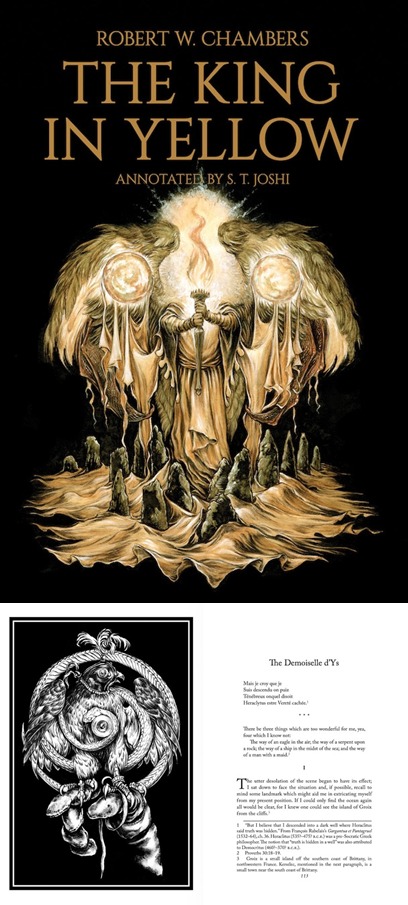
* A hardback edition of The King in Yellow, annotated by S.T. Joshi. Apparently pre-ordering now.
* The acclaimed new French translations of Lovecraft are now also available as Amazon Kindle e-books.

* New to me, an Italian website/journal devoted to Poe and news about Poe scholarship, Edgar Allan Poe: Rivista culturale aperiodica su Poe.
* The latest Mythlore: A Journal of J.R.R. Tolkien, C.S. Lewis, Charles Williams, and Mythopoeic Literature journal is a ‘Mythlore At 50: A Celebration’ (2026) special issue, including a detailed history of this long-running journal of fantasy literature studies and book reviews. The journal mostly carries scholarly articles on Tolkien and his Inklings circle and various near-neighbours, but Lovecraftians will find occasional book reviews of interest — for instance a review of the Historical Dictionary of Horror Literature in 2025.
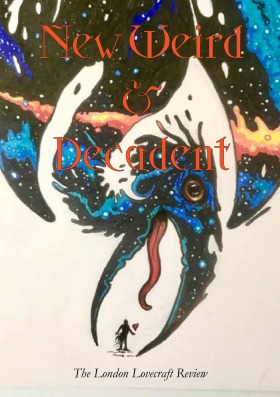
* The complete 2026 Lineup for this year’s London Lovecraft Festival. Also note the cover in a sidebar, which makes me wonder if there’s to be a print book of this year’s festival’s playscripts/transcripts?
* On YouTube, Horror Babble has a new audio reading of one of Lovecraft’s ghost-written tales, “Winged Death” by H.P. Lovecraft and Hazel Heald (1932). In the tale Lovecraft is obviously not taking Heald’s outline too seriously, and he adds an absurb ending, but the tale managed to land in Weird Tales in 1934. Still, if you don’t take it too seriously then it’s entertaining weird hokum, and it allows Lovecraft to imagine an African setting at length. Which shows that he could write about unvisited places if he had to. He had previously placed his “Fishers from Outside” horrors “far, far in the interior” of Africa, somewhere behind the hilltop trading outpost of Great Zimbabwe. In this tale we discover their location is actually 600 miles north of Zimbabwe, in British Uganda…
This jungle is a pestilential place — steaming with miasmal vapours. All the lakes look stagnant. In one spot we came upon a trace of Cyclopean ruins which made even the Gallas run past in a wide circle. They say these megaliths are older than man, and that they used to be a haunt or outpost of ‘The Fishers from Outside’ — whatever that means — and of the evil gods Tsadogwa and Clulu.
* The local Illinois newspaper The Telegraph reports the planned filming of a movie of Lovecraft’s “Herbert West: Reanimator”, the serial-shocker he wrote for Home Brew.
This June, cousins Roger and Jeff Lewis will start filming “Herbert West: Reanimator” […] Jeff Lewis joins the Alton [Alton, Illinois] film scene with 30 years of experience in Hollywood, where his makeup work was nominated for six Primetime Emmy awards, and he spent nine years working on “Star Trek: Voyager” and “Star Trek: Enterprise.”
* In the latest Journal of Roleplaying Studies and STEAM, “From the pages to the gaming table: Designing a homebrew system to adapt a book series into a tabletop RPG”. Offers useful advice, based on playtesting, for those about to tackle the earliest stages of such a venture.
* And finally, the release of FPHam/Regency-Aghast-27b-GGUF, a free local AI LLM trained only on old texts and knowledge. The AI fancies that it is still in Regency era England (1811-1820). Lovecraft fancied himself… “an old British Colonial ever faithful to His Majesty, King George the Third!” (reigned 1760-1820). Sadly it’s a 27B model, and thus too huge in size for me to run on my PC, even as a GGUF.
— End-quotes —
“… the centuried houses [of Providence] with their fanlights and knockers and railed steps and small-paned windows had a strong and significant effect of some sort on me [as a young boy]. This world, I felt, was a different one from the (Victorian) world of French roofs and plate glass and concrete sidewalks and piazzas and open lawns that I was born into. It was a magic, secret world, and it had a realness beyond that of the home neighbourhood. It had, I knew, been there long before the home neighbourhood existed — and I felt it would still be there after the other had passed away. […] It was familiar —I had always known it — I had seen it before — it was part of me in a sense that no other scene ever was. …. and so I dreamed about it by night and visited it by day whenever I could. I used to have (as I still do) favourite vistas — looking up such and such a street and wondering what lay around the curve at the end. Could I walk into the time of Hogarth and the Revolution, if I followed one of those cryptic ways to its unknown end some evening when the twilight was purple and the yellow lamplight flickered up softly behind ancient fanlights and tiny window-panes? On rainy evenings, when the little old gas lamps (now gone) cast strange reflections on the glistening cobblestones and brick sidewalks, I could almost see the figures of yesterday plodding along …. cloaks, three-cornered hats, queues [white wigs] losing their powder in the rain ….. and I began to dream of myself in those scenes, witnessing tantalising fragments of 18th century daily life that faded too soon into wakefulness.” — Lovecraft to Derleth, 1931.
“Even now it is difficult for me to believe that Marblehead exists, save in some phantasticall dream. It is so contrary to everything usually observable in this age, and so exactly conformed to the habitual fabrick of my nocturnal visions, that my whole visit partook of the aethereal character scarce compatible with reality. […] That miracle is simply this: that at the present moment the Georgian Marblehead of 1770 stands intact and unchanged! I do not exaggerate. It is with calm assurance that I insist, that Gen. Washington could tomorrow ride horseback down the long street namd for him without the least sensation of strangeness. Wires are few and inconspicuous. Tramway rails look like deep ruts. Costumes are not marked in the twilight. And on every hand stretch the endless rows of houses built betwixt 1640 and 1780 — some even with overhanging gables — whilst both to north and south loom hills coverd with crazy streets and alleys that Hogarth might have known and portrayd, had he but crossed the ocean to discover them. It is a dream, a grotesque and unbelievable anachronism, an artists or antiquarians fancy stept out of his brain and fixt to earth for publick inspection. It is the 18th century. There are no modern shops or theatres, and no cinema show that I coud discover. The railway is so remote from the town-square, that its existence is forgotten. The shops have small windows, and the men are very old. Time passes softly and slowly there. I came to Marblehead in the twilight, and gazed long upon its hoary magick. I threaded the tortuous, precipitous streets, some of which an horse can scarce climb, and in which two waggons cannot pass. I talked with old men and revelld in old scenes, and climbd pantingly over the crusted cliffs of snow to the windswept height where cold winds blew over desolate roofs and evil birds hovered over a bleak, deserted, frozen tarn. And atop all was the peak; Old Burying Hill, where the dark headstones clawed up thro the virgin snow like the decayd fingernails of some gigantick corpse.” — from Letters to Rheinhart Kleiner.
“[In Philadelphia the] Georgian publick buildings [are] as any antiquary’s soul cou’d ask for. [Congress Hall etc…] To circumnavigate this splendid colonial array, viewing it from all angles and especially from the square to the south, whence many other colonial buildings may be seen, is to live again in that subtle atmosphere of the urban 18th century, of which so few perfect specimens now survive. The effect is marvellous — elsewhere one may find the spirit of the colonial village and small town, but only here may one grasp to the fullest extent the soul of the colonial city — mature and populous when the third George [III] sate upon our throne. [It is a] city of real American background — an integral and continuous outgrowth of a definite and aristocratick past. What a poise — what a mellowness — what a character! [… And elsewere, for those who seek them out, are] Those mazes of colonial brick alleys, that red and black brickwork, those projecting eaves and corniced gables, those slanting cellar-doors and lateral footscrapers, those iron sidewalk posts, those panell’d double doors and semicircular fanlights, those zigzag brick sidewalks, those ancient needle-like steeples, those “F.A.” house plates, those queer window reflectors — all these urban things, with the glamour of quiet squares and venerable churchyards where the ghost of Dr. Franklin wanders.” — Lovecraft to Morton, June 1926.