
HPLinks #58.
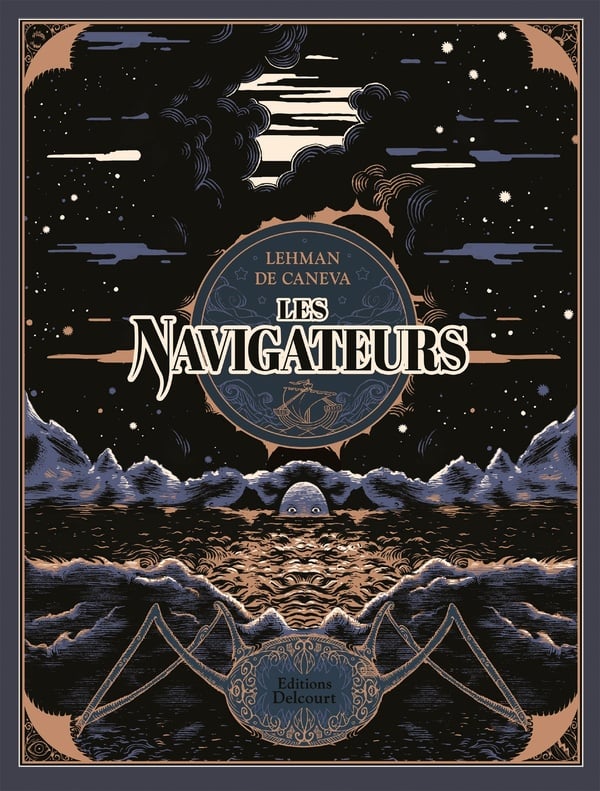
* Les Navigateurs, a new French ‘BD’ graphic novel by Caneva & Lehman, has won the Rene Goscinny Best Writer Award in France. Apparently it’s a graphic novel in which… “Lovecraft meets the waters of the Seine river”.
* Also in France, the Angouleme 2026 comics arts megafest will feature “Francois Baranger meets Gou Tanabe”. Billed as an “exceptional encounter between two masters of H.P. Lovecraft’s masterpieces: Gou Tanabe on one side, and Francois Baranger on the other.” Set for 31st January 2026. Update: the entire festival is now cancelled.
* Gou Tanabe’s 370-page manga adaptation of The Shadow Out of Time has a date for the English edition from Dark Horse, 23rd December 2025.
* The new Routledge Anthology of Global Science Fiction Origins (2025) has “The Machine Man of Ardathia” (1927) by Francis Flagg of Tucson, Arizona, the pseudonym of Henry George Weiss. He was Canadian by birth and moved to America as a boy, but the anthologist pegs him as “Canada”. The introduction to the tale notes his Lovecraft connection…
Flagg engaged in a friendly correspondence with H.P. Lovecraft. Lovecraft’s influence might be apparent in Flagg’s story, “The Blue Dimension” (1928) which tells of a scientist’s invention that allows the user to not only see into other dimensions but, eventually to travel to those other dimensions bodily. An even more direct borrowing from Lovecraft is Flagg’s story, “The Distortion out of Space” (1934), which uses a meteorite impact as its inciting event. The parallels to “The Color Out of Space” are clear and frequent. Flagg placed stories regularly into Weird Tales, Amazing Stories, Science Wonder, and other prominent genre magazines.
Lovecraft started corresponding with Flagg in “early 1929” [Joshi, I Am Providence], so the 1928 influence must have come about simply by reading published Lovecraft tales. Lovecraft would not have contributed any outline or advice on re-writing the tale. “The Distortion out of Space” was published in Weird Tales in August 1934, and — given the above — one wonders what Lovecraft made of the close “parallels”.
* Barbadillo reviews the new book Lovecraft, poeta dell’abisso, in Italian. This reveals the book is actually a reprint of a 1979 book, but here with new…
… essays on, among other things, the relationship between the literature of the ‘recluse of Providence’ and esotericism, the Italian translations of his works, and the illustrators of his tales. [Readers also get the] two chapters which were removed from the first edition at the time, concerning the early myths surrounding Lovecraft and his literary legacy.
The review continues, here in translation…
[Lovecraft has a] “philosophical vision centered on a reevaluation of the tragic. This is clearly evident from some of his letters published at the beginning of the book. In them, among other things, one can read: “Since the entire plan of creation is pure chaos […] there is no need to draw a line between reality and illusion. Everything is a mere effect of perspective”. There are no facts, as Nietzsche knew, but interpretations of them. This conception is a-teleological and, on this subject, he notes: “I cannot imagine the scheme of life and cosmic forces in any other way than as a mass of irregular points gathered in directionless spirals”. Even more significantly: “I believe that the cosmos is a purposeless and meaningless set of endless cycles […] consisting only of blind forces operating according to fixed and eternal patterns”. The matter [he] gazes upon is Lucretian, animated; it is not “matter” in the modern sense. He is aware that transcendence exists only in immanence, in physis, and, in it, establishes the magical possibility of the impossible. Lovecraft’s cosmos is a Leopardian one, horrific and astonishing at the same time. His gaze is of a “detached observer” and his inquisitive curiosity is detached from any anthropocentrism […]. His existential and political conservatism must be understood, then, as a response to chaos, an attempt to order, to give “form,” even if momentary, to that which is not ordered.
* From Russia, “The ‘Gothic Plot’ as Outlined in Lovecraft’s Notes” (2024). A short journal article in Russian with English abstract. Freely available online. Examines Lovecraft’s Commonplace Book and “Notes on Weird Fiction”, to determine exactly what Lovecraft considered ‘the Gothic Plot’…
the unnatural revival of an “antiquity” which was isolated from progressive society, forgotten and mummified, [was considered] to be the mainstay of the Victorian Gothic. The catalyst for the Gothic plot is usually an mechanistic attempt to assimilate alienated relics. Lovecraft identifies several plot ‘formulas’ for a revival of antiquity which threatens modern civilization: (1) activation of spiritless matter (corpse, “lower” realms of nature, bodily parts and organs, inanimate “facilities”), that ultimately inverts the hierarchy of psyche and physiology; (2) recurrent memories that literally resurrect the historical or biological past; (3) psycho-somatic degeneration and impersonation (which is presented as a local substitution of higher forms for lower, rudimentary ones).
* New details of an article for a forthcoming Edinburgh University Press journal article, “World War Weird: Blackwood and the First World War”.
* “Weird Weather Against the Pathetic Fallacy” of Ruskin (2025), an undergraduate final-year dissertation. Freely available online.
Ruskin’s work calls attention to the literary trope of assigning weather in literature emotion, yet Algernon Blackwood and Shirley Jackson intentionally deviate from the pathetic fallacy and make the weather in their stories weird and eerie by both breaking its connection with humanity and intentionally removing human emotion from the weather and natural settings.
* A new paper in the open-access Journal of Tolkien Research, “Cold Words, Heartless and Miserable: Tolkien’s Approach to Supernatural Horror”. Tolkien’s…
“Fog on the Barrow-downs” is basically a tale of supernatural horror [and] demonstrates that Tolkien, as a horror writer, could innovate and improve on his materials.
* In Current Research in Egyptology 2024: Proceedings of the Twenty-Fourth Annual Symposium, “The Call of Nighted Khem: Tracing Ancient Egypt through Weird Fiction”. The book is free online in open-access.
* A forthcoming Society of Illustrators exhibition, “Something Else Entirely: The Illustration Art of Edward Gorey”.
* New on YouTube, Michael K. Vaughan goes “Revisiting The New Annotated H.P. Lovecraft”.
* A stage play titled “Lovecraft Cult”, with a premiere on 29th October 2025 and then running on over Halloween. Apparently to be staged ‘in the round’ in an old surgical Dissection Room at the University of Goettingen, Germany…
A group of students interested in cryptomycology has gathered for a lecture, to learn more about the research of their eccentric Professor Dr. von Tannenberg regarding the mysterious fungus “Tenebris”, whose spores he found in an ancient burial chamber.
* And finally, new on Archive.org is a run of the UK’s The Flying Saucer Review (1955-1969). It looks like there are lots of ideas here for writers considering a crossover ‘UFO-logists unwittingly meet the Lovecraft Mythos’ tale or two. Or even a TV sitcom along the same lines (think ‘Detectorists but with UFO hunters, set in the mid 1970s’).

— End-quotes —
[… on seeking Lovecraft and arriving in] Angell Street [you will] see a tiny piazza [i.e. plaza… You will then] discover upon the corner post of the plazza some figures […] the three modest figures — 598! Your journey is indeed o’er, & your pull of the bell will in all probability bring before you the ungainly form & pasty face of the Demon Critick — the Boeotian Ogre — Ludovicus Theobaldus II” — Lovecraft gives instruction on how to reach his home at 598 Angell St, Providence, June 1918.
“Only last night I had another dream — of going back to 598 Angell Street after infinite years. The neighbourhood was deserted and grass-grown, and the houses were half-falling to pieces. The key on my ring fitted the mouldering door of 598, and I stepped in amidst the dust of centuries. Everything was as it was around 1910 — pictures, furniture, books, etc., all in a state of extreme decay. Even objects which have been with me constantly in all later homes were there in their old positions, sharing in the general dissolution and dust-burial. I felt an extreme terror — and when footsteps sounded draggingly from the direction of my room I turned and fled in panic. I would not admit to myself what it was I feared to confront but my fear also had the effect of making me shut my eyes as I raced past the mouldy, nitre-encrusted mirror in the hall. Out into the street I ran — and I noted that none of the ruins were of buildings newer than about 1910. I had covered about half a block — of continuous ruins, with nothing but ruins ahead — when I awaked shivering.” — Lovecraft recounts a dream of his old home, to C.A. Smith, November 1933.
“When, as a youth of twenty, I laid in these ochraceous pads [pads for writing, purchased in bulk in 1910] did I ever think a grey-headed old has-been of almost forty-five would be scrawling on ’em in the virtually fabulous future of year of 1935? 1935 ….. even today it has an unreal, far-ahead sound! Can I be living in a year whose numeral seems as fantastically remote as 2000 or 2500 or 5000? Where have all the intervening twelvemonths gone to? Even 1910 is fantastic enough to one whose sense of existence is somehow curiously oriented to 1903. And can it be that the world of 1910 will in turn give place to something as different as 1910 is from 1450?” — Lovecraft to Morton, on a sense of ‘living beyond one’s time’, April 1935.