
After last week’s ‘Picture Postals’ visit to sunny climes in New Orleans, this week I look at a frozen New York City.
In one of my earliest blog-essays on Lovecraft, way before I knew as much as know now, I suggested that his 1925 solar eclipse viewing from High Bridge or nearby hill might have provided a dramatic sight of a distant New York City. A city plunged into a sinister darkness, giving an appearance akin to R’lyeh risen from the waves. Whatever the facts of the matter, as set out below, this still seems a poetic image of likely use to future bio-pic makers and graphic novelists. Lovecraft gibbering and stuttering with the severe cold, sinking to his knees like a cultist, as a vision of New York as a R’lyeh-like city emerges from the cold mists under the en-darkening eclipse.
But what of the hard facts? I now revisit my old suggestion, and see if I can glean any more data. My thanks to Horace Smith for reminding me of my old post, and prompting me to look again at the relevant entry in Lovecraft’s 1925 Diary.
We know that an initial intention of the Lovecraft eclipse expedition of 24th January 1925 appears to have been to rise from their beds very early, then travel into the ‘zone of totality’ to reach the High Bridge aqueduct. Kirk invites his girlfriend to join the expedition thus…
… we’ll go up to Yonkers and take [smoked] glasses along and walk up on an aqueduct
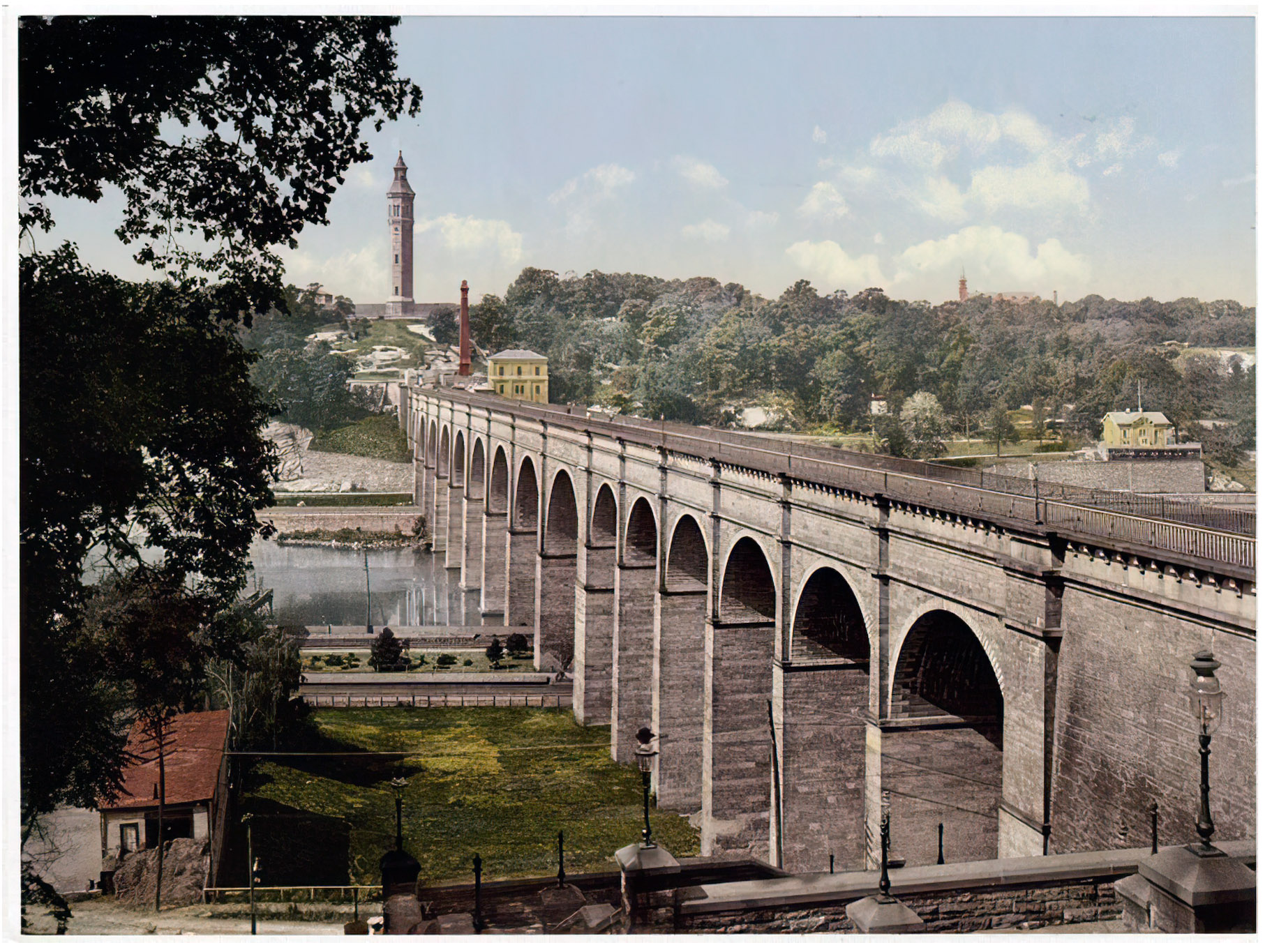
The distant tower and grey wall below it are part of a gigantic elevated reservoir, and the bridge carries its Old Croton Aqueduct.
This aqueduct / pedestrian bridge was once a haunt of Poe, it being said that… “a walk to High Bridge was one of his favorite and habitual recreations” while living at Fordham. It would thus have a double-attraction for the Lovecraft expedition — to view the eclipse on the bridge where Poe walked.
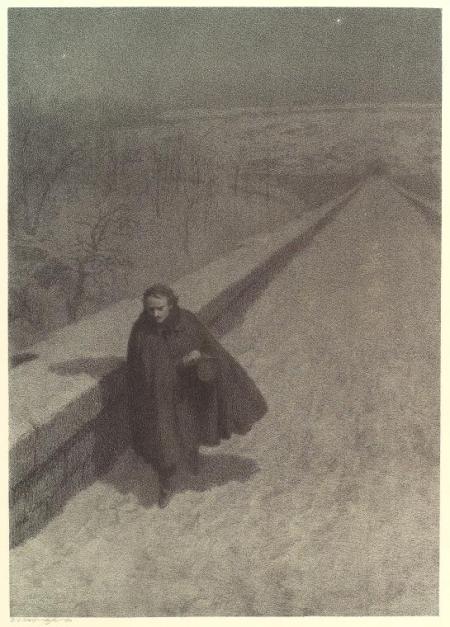
Poe on the High Bridge.
At the end of January 1925 New York City was still in the depths of a bitter and snowy winter, which had arrived with the worst snowstorm in living memory at the start of January. About the third week of January Lovecraft peered out of Loveman’s picture-window at the cityscape. He noted in a letter that another ‘ponderous’ snowstorm appeared set for imminent arrival. However, his other New York letters from January suggest it was still relatively easy to get around the city. That said, it is quite possible that High Bridge was closed by the authorities for public safety due to the likelihood of surging crowds and icy conditions.
Anyway, such was the apparent plan and the seasonal weather. But what of the actual day? Lovecraft’s 1925 Diary is cryptic on the matter, the January 1925 entry being…
Up 3:30 [a.m.] — to SL’s [Loveman’s] & Van Ct. [Van Cortlandt St] with GK [Kirk] — meet JFM [Morton], Dench, Leeds. M & D [Morton and Dench] walk, [the] rest ride [public transport to] Getty Sq. [Into] Yonkers. Walk up hills — ECLIPSE
This entry indicates that Kirk was staying over at Loveman’s, at whose apartment Lovecraft perhaps arrived 5am. Loveman presumably had to work that day, a Tuesday. Lovecraft and Kirk then went to Van Cortlandt (Lovecraft the antiquarian is using the archaic ‘Van’ in the street name in his Diary, and abbreviating Cortlandt to Ct.). Here we see Van Cortlandt St. in the 1930s, a quarter mile west of the Brooklyn Bridge and with the street running below the 9th Avenue Elevated station.
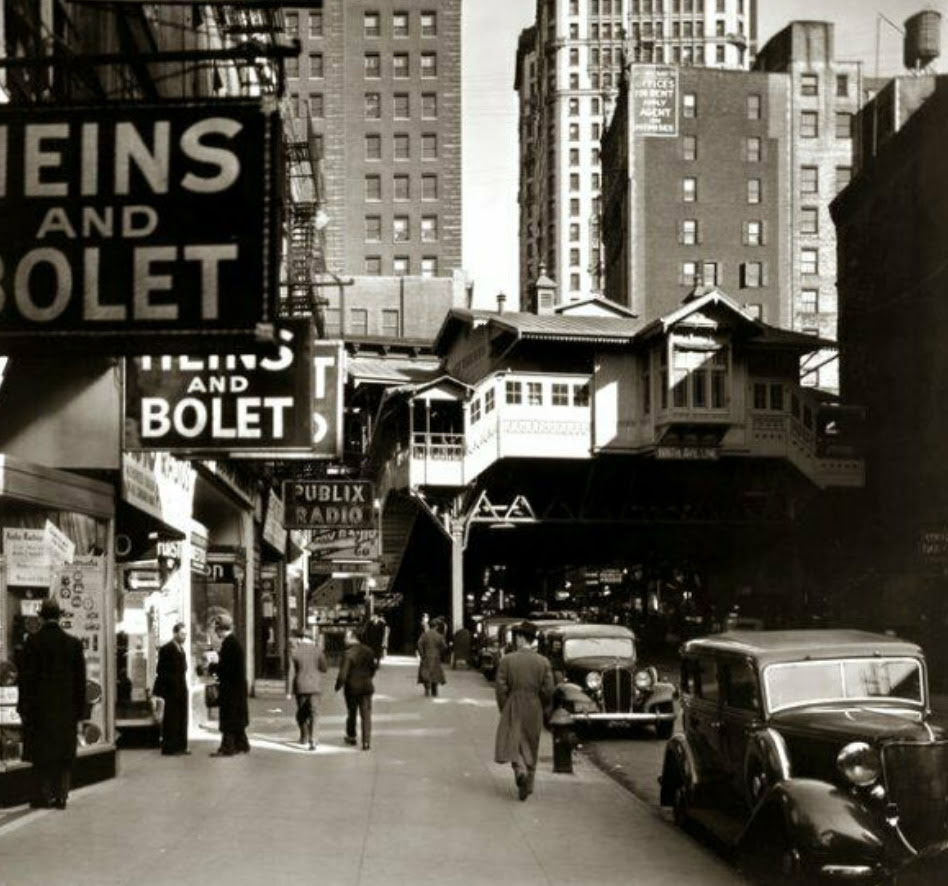
It was a natural place to meet up at 6 a.m., having a key train station on the Elevated. This was presumably serviced by several nearby early-morning cafes. It was on the verge of becoming a famous place in early mass media. In 1925 Oscar Nadel (‘the king of Cortlandt Street’) had opened his famous ‘Oscars Radio Shop’ there. The shop would trigger a cascade of activity which meant that by 1930 the street was a thriving radio broadcasting and radio retail-sales quarter, a place now known to media historians as ‘Radio Row’. In the following 1925 picture we see a wide view from further back, looking into Cortlandt Street and with the Elevated station just about visible in the deep shadows under the new skyscrapers.
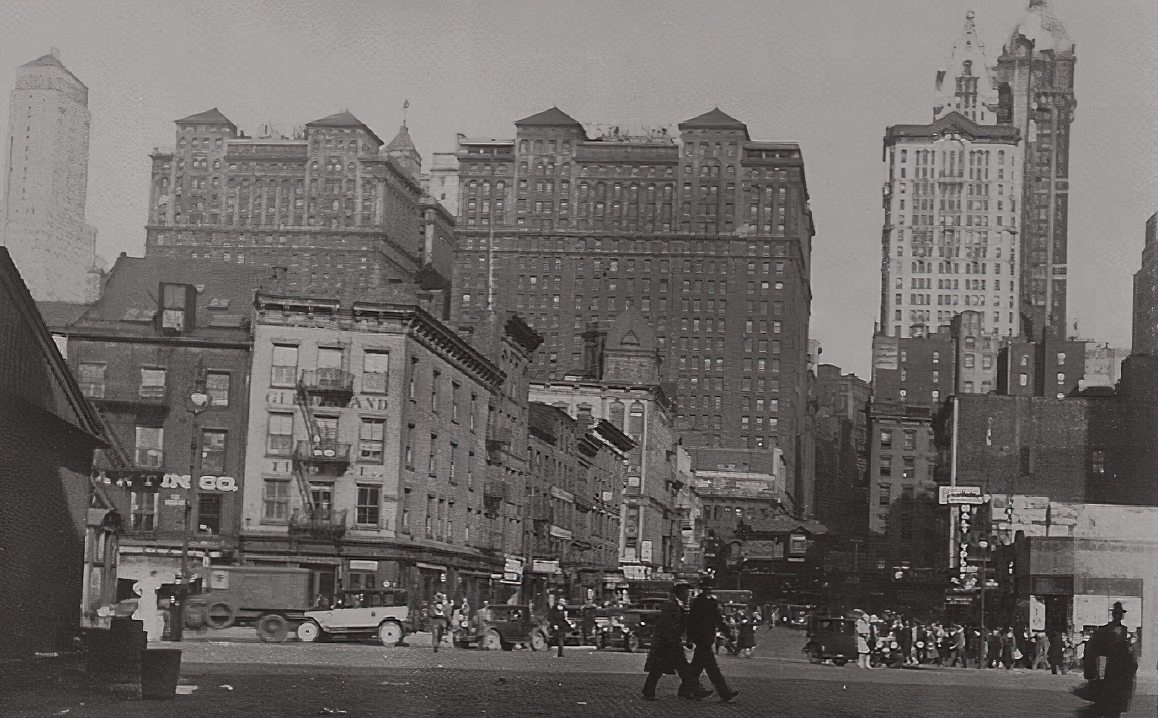
Lovecraft’s friend Morton did not yet have his museum job, and would have been travelling in from Harlem. Dench would have been coming in from Sheepshead Bay. After the expedition had all met up and fuelled up on coffee, the Diary shows that Morton and Dench then walked from Van Cortlandt to Getty Square in Yonkers. If these ardent hikers were walking 12 miles directly north, moving at speed along a well-gritted and otherwise deserted shoreline path, then they might have taken 90 minutes. That then implies that Leeds, Kirk and Lovecraft waited for them for an hour or so in a known-to-all breakfast eatery at Getty Square, after having travelled there in comfort.
We see here a Yonkers candidate for the cafe, ‘Counes’ on the central corner of Getty Square, an establishment offering soda and ‘quality candy’ and likely indicative of the many sugary delights available at this central transport hub…
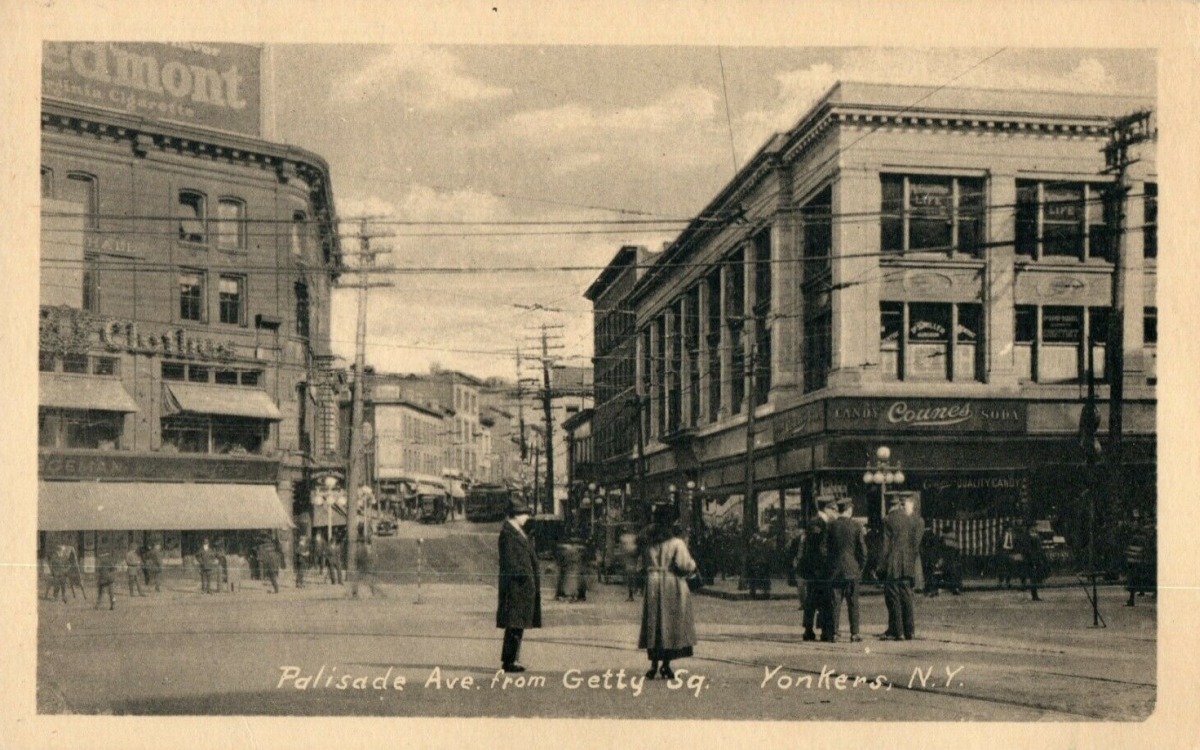
By January 1925 Lovecraft had chuffed one too many candies. As he later recalled for Morton, he was a bit plump at that point…
that eclipse morning occurred whilst I was still a problem for Sheraton chair-makers, yet scant comfort did my proteid integuments afford me! [in that chill]
This soda bar is a possibility, and perhaps was likely to be open earlier than usual to serve the eclipse crowds. Though a cheaper coffee / ‘all-day lunch’ shop was probably the more likely choice. Here we see several options on Getty Square, circa 1920…
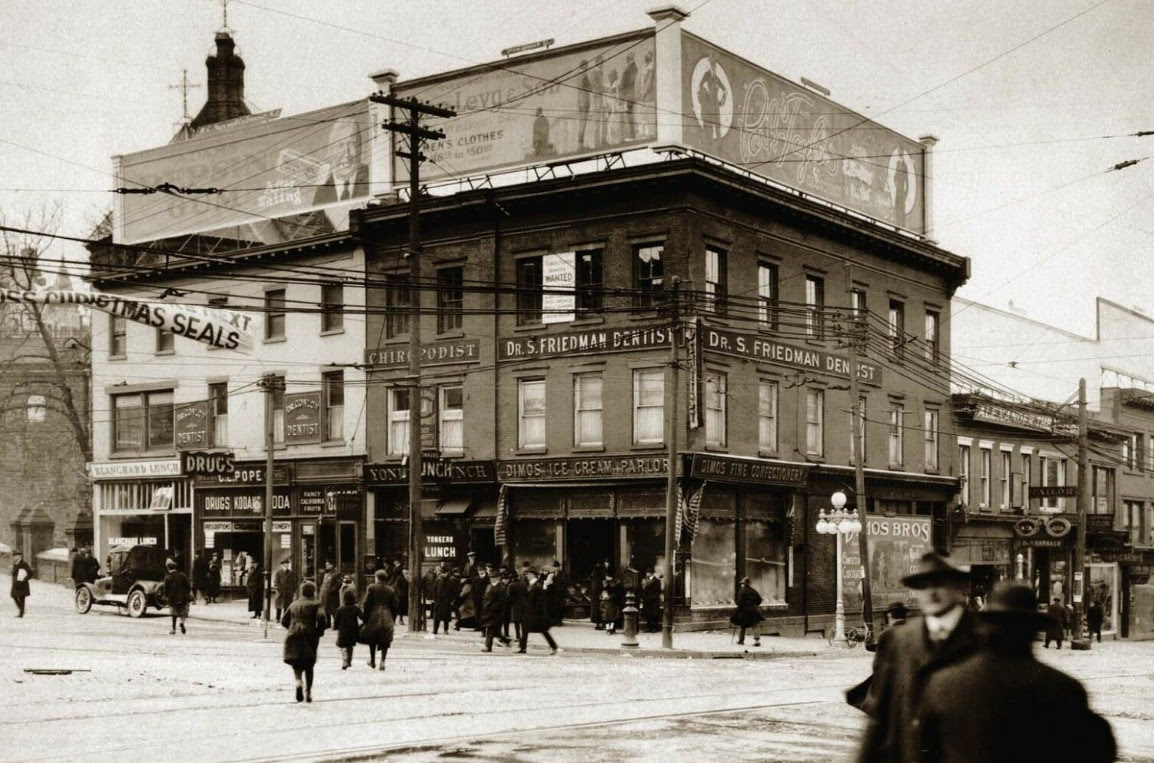
Lovecraft’s “Walk up hills” diary entry implies multiple hills. But this does not get us much further as to the viewing location, because the terrain of Yonkers rather assumes that any route out from Getty Square would have been up and over some rolling hills. Yonkers was well known, then as now, for its many steep hills. As Joseph J. Conte recalled of his 1940s boyhood in his memoir Flies in My Spaghetti…
Wintertime was a great time of the year and, with all the hills in Yonkers, we had a big choice of where we would take our sleds.
In 1932 Lovecraft was no more precise, recalling…
… some of us tramped up into the cold of northern Yonkers to see the January eclipse.
Another letter I found recently states that a hillside was the observation point, equally vague.
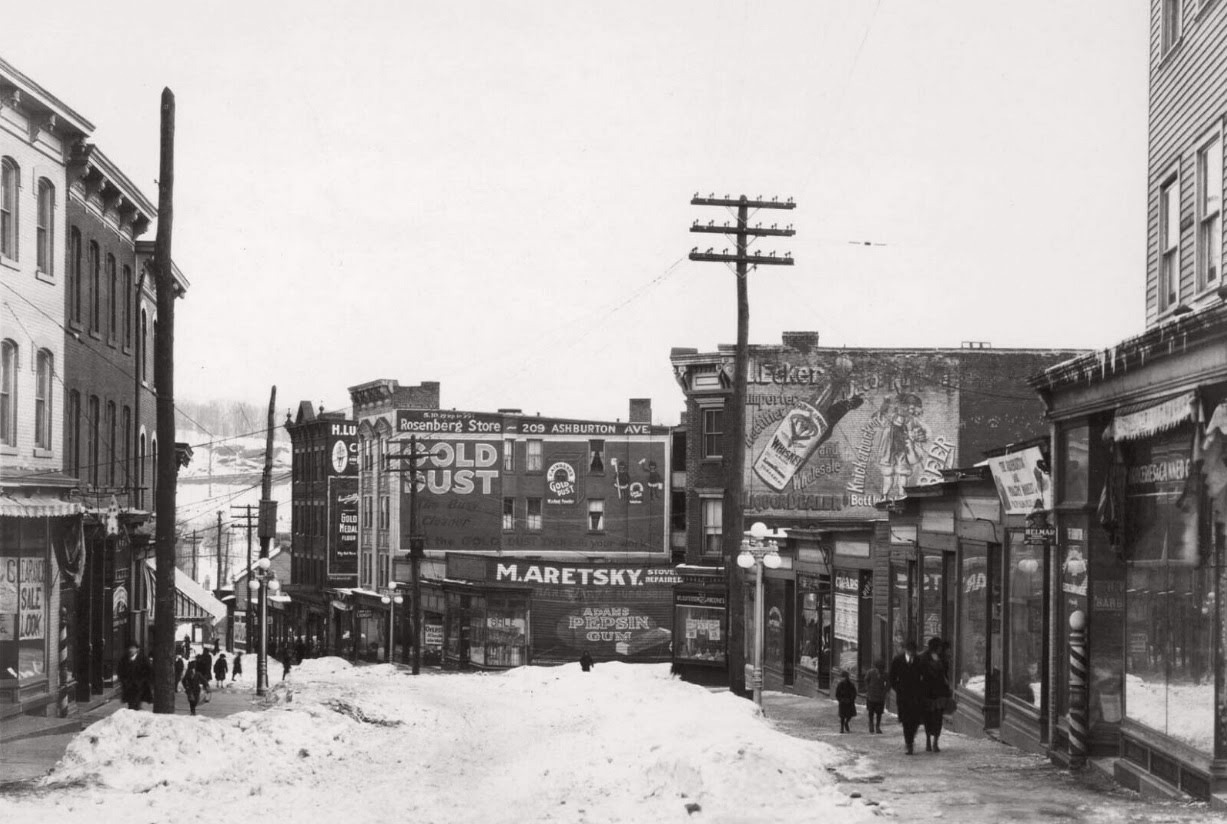
If the expedition had left their Getty Square cafe and were on the road out of the urban nexus by 8.a.m., then they would have had 70 minutes left to find a suitable spot. This photo is indicative of the initial trek up Main Street from Getty Square in the “marrow-congealing” ice and snow. It shows the top of Main St. as seen circa the 1920s, climbing up from Getty Square below…
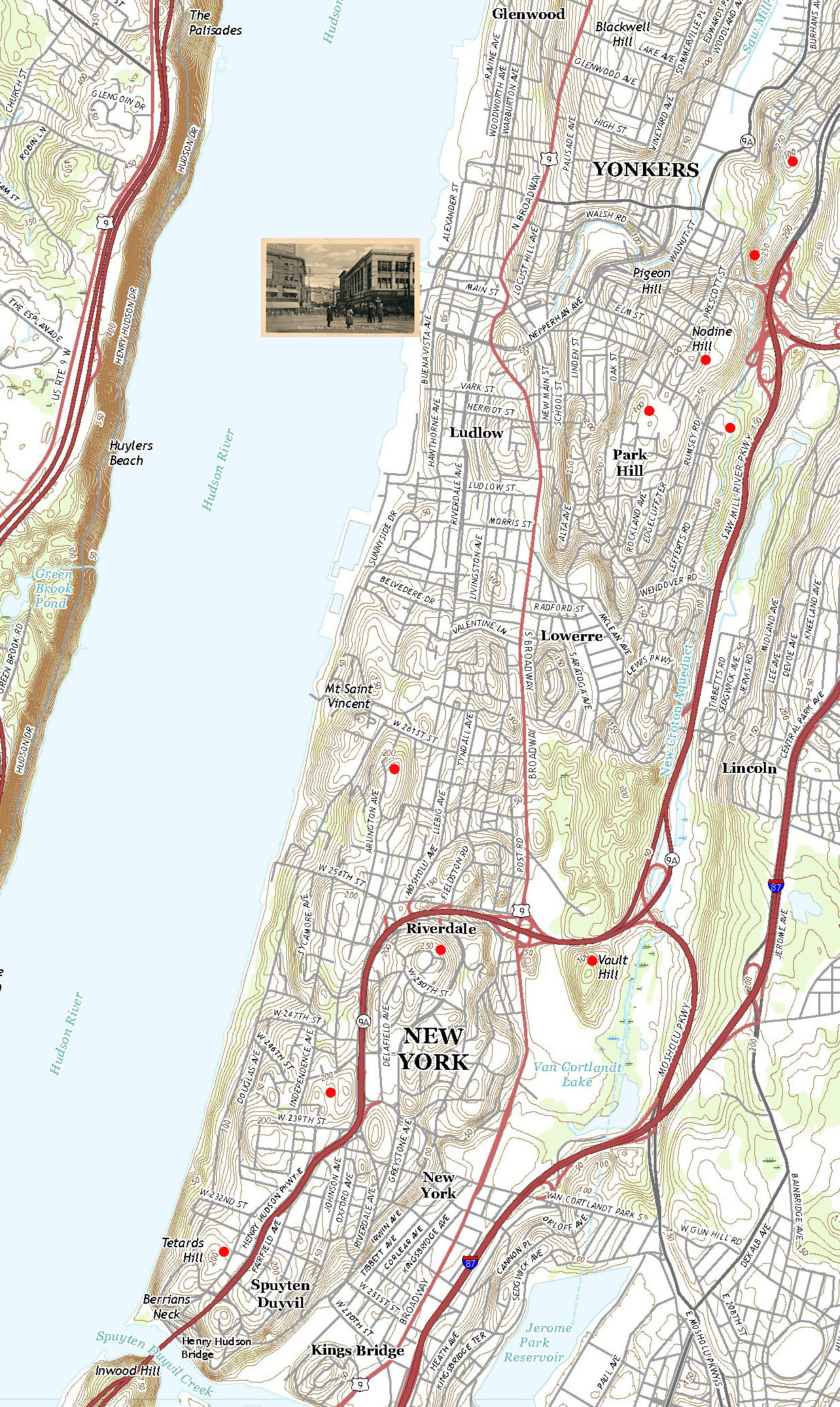
But if High Bridge was still the aim of the expedition, as Kirk’s diary suggests, then one has to assume a walk or tram-ride four miles south from Getty Square through Yonkers to reach the High Bridge. Why do it like this? It would enable them to look out for suitable hillside spots facing east and without encumbering trees or buildings (the sun would be quite low at the ‘totality’), while they walked south. Here then are the likely spots marked by me on a terrain map, spots facing east and not wooded or built-up.
And here we see the above terrain continued down to High Bridge. This map extract is from the 1947 USGS 1:24000 map for the Central Park area. It too has the required elevation contours and heights.
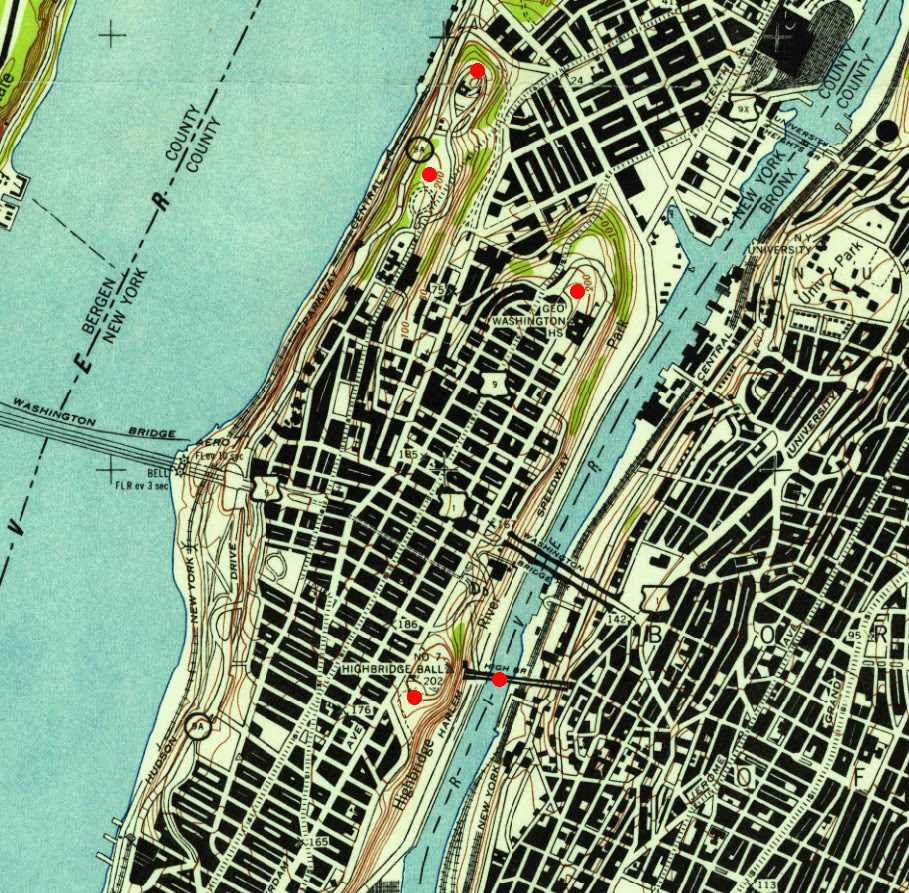
Inwood Hill Park, seen on the top map and here located a little off the north of this map extract, was (at least in 1947) too heavily wooded at the high points to provide good views. If the expedition did hike the four miles through from Getty Square to High Bridge, they would pass two or three 200ft east-facing spots just to the north of the reservoir end of the High Bridge. Again, these are marked on the above map.
Of course, it may well be that the expedition never even reached High Bridge or its nearby hills, as was seemingly initially planned. They could have found a better spot on the way there, or run out of time. Or perhaps they simply chose one of the candidate hills a mile or two back from Getty Square, if they had researched their location or read about likely spots in the newspaper beforehand. This latter idea is supported fairly strongly by the fact that Lovecraft’s 1925 Diary continues after the word “ECLIPSE”, indicating post-Eclipse visits to two local landmarks…
Philipse Manor [a restored Dutch manor house just off Getty Square, with fine interiors], St. John [Episcopal Church, with fine exterior fancy-stonework and fancy roof tiling] home — Tiffany [his regular everyday cafe, near his room on the edge of Red Hook] — rest
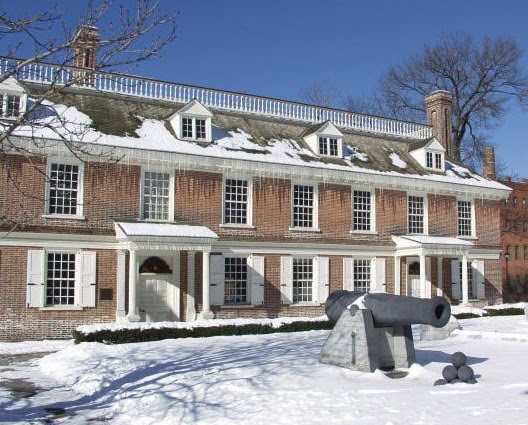
Philipse Manor. The plain exterior was probably enhanced a bit by snow and ice.
These items must argue against the High Bridge having been reached or even walked toward, unless they shuttled back up to Getty Square on public transport. That they visited two sites just off Getty Square after the eclipse would seem to indicate that the “hills” would have been those within a few miles of that place. Which at least narrows the choice of the hill in Yonkers down to a few.
But even this data is vague and we shall probably never know the exact viewing spot now, unless a new letter or postcard comes to light. But the red dots above show the likely candidates. Take your pick.
We do however have this evocative picture, seen below. It clearly indicates the elevation of the sun in the east relative to the ground, and the snowy ground conditions in New York City. It also demonstrates that the rather low sun at the totality would present viewers with potential problems re: finding a suitable east-facing observing site that was well free of obscuring trees or buildings.
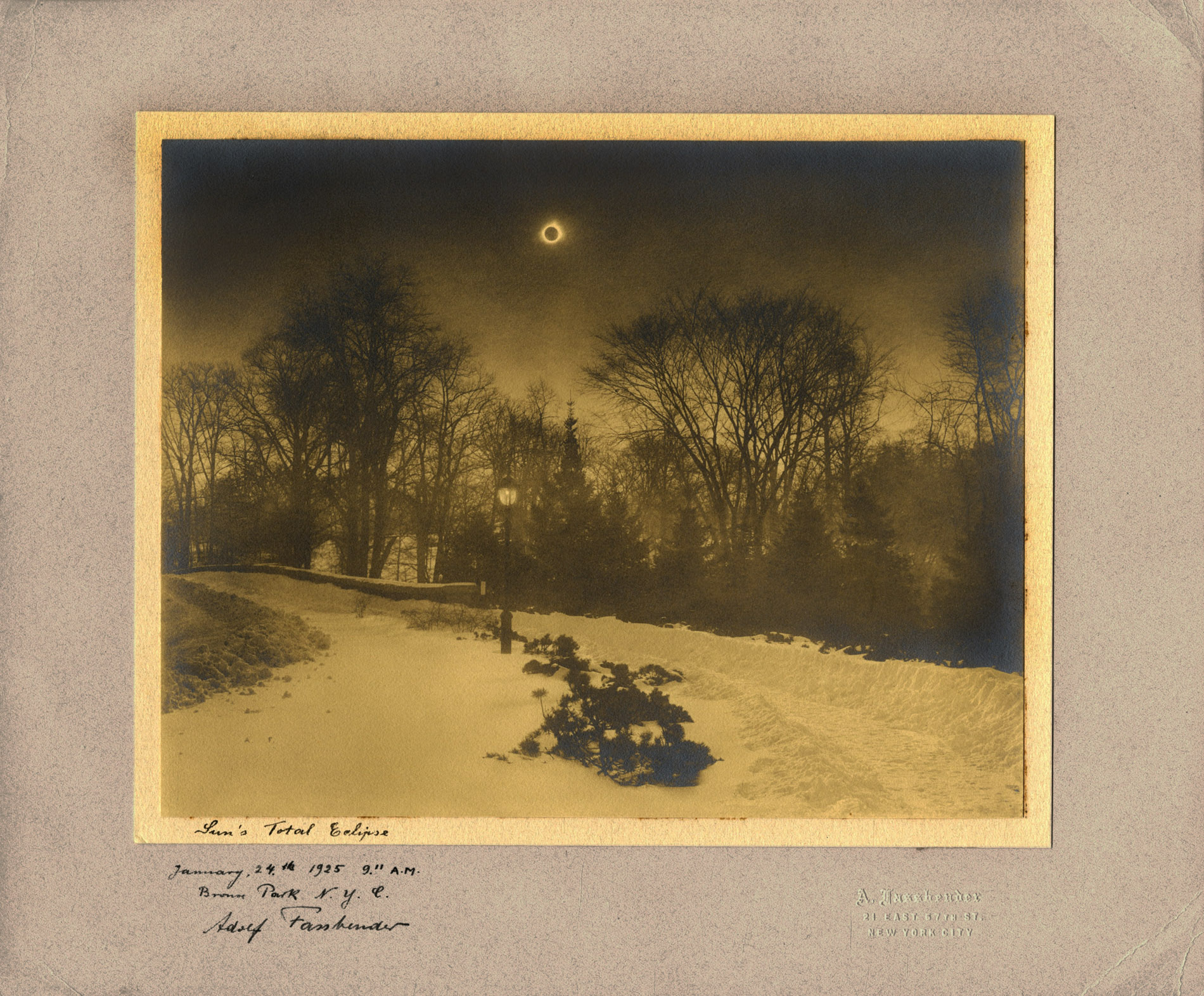
Adolf Fassbender, “Sun’s Total Eclipse. January 24th, 1925, 9:11 a.m. Bronx Park, N.Y.C.” Original held by the New York Historical Society. Here Photoshopped to repair damage and emulsion silvering due to age.
Years later a letter from Lovecraft to Morton described in some detail his second and rather fine solar-eclipse experience in Newburyport. During this account Lovecraft recalled that the flaring corona around the ‘dark sun’ had been very bright in 1925, and thus the earth below had not become as en-darkened as he had expected. This seems to be borne out by the above photograph. The wide blanket of white snow probably kept light levels high, with a bright corona. Note also that the above picture suggests the air was rather still, as the branches are not blurred by wind-movement even in the low light.
Kirk’s diary suggests a further aspect of the experience, and a key reason for seeking an open hillside — the “rushing shadow”. Apparently this is a well-known aspect of viewing a total eclipse. Kirk tried to entice his girlfriend to come on the expedition by noting that…
… it is said that to be on a hill in open country and to see the rushing shadow thrown to Miss Moon is to marvel.
A fine account of a cold but satisfying morning for HPL. I wish that he had been a little more specific in his account of the day, but I suppose he would be astonished that, almost a hundred years after the event, we are interested in the exact spot from which he viewed the eclipse. The frigid weather for the 1925 eclipse surely must have made him appreciate the warm temperatures at his second total solar eclipse in 1932.
One small mistake or typo. 24 January 1925 was a Saturday, not a Tuesday. Somehow I missed that in my earlier reading, and it seems a bit trivial to mention it, but I suppose the day of the week might possibly have some bearing on the eclipse activities. I don’t know why Loveman did not accompany the “Boys” to the eclipse.
Thanks. That might help to explain why Loveman was unavailable. Doubtless a Saturday was a busy day at a New York City bookshop.