• About
  • Directory
  • Free stuff
  • Lovecraft for beginners
  • My Books
  • Open Lovecraft
  • Reviews
  • Travel Posters
  • SALTES

Tentaclii

~ News & scholarship on H.P. Lovecraft

Tentaclii

Monthly Archives: January 2022

German Lovecraft convention in 2022

15 Saturday Jan 2022

Posted by asdjfdlkf in Odd scratchings

≈ Leave a comment

The Deutsche Lovecraft Gesellschaft reports that the German Lovecraft convention in August 2022 will be able to…

offer space for a total of 119 cultists … attendance days will take place from 18th-22nd August 2022. Registration starts in March 2022. You will receive more information in the coming weeks.

The first substantial book for their open royalty-free FHTAGN Lovecraft RPG game has appeared, as “Riders on the Storm”. In 2022 they plan an English translation and a “scenario competition” for FHTAGN.

Also in Germany, an exhibition of Imaginary Creatures in Graphic Art, from the 15th to 17th Century. 1st February 2022 to 6th June 2022. Only a small one, though, rather than a blockbuster. But you may want to pop in if you’re in Berlin.

Give them a hand…

14 Friday Jan 2022

Posted by asdjfdlkf in Odd scratchings

≈ Leave a comment

Only in 1970s Doctor Who. Sarah Jane takes down a nuclear power-station with a Christmas-cracker ring and a severed hand in a plastic Tupperware box.

‘Picture Postals’ from Lovecraft: Volcanoes on the Moon

14 Friday Jan 2022

Posted by asdjfdlkf in Astronomy, Historical context, New discoveries, Picture postals

≈ 8 Comments

In an early letter to Galpin, dated 21st August 1918, H.P. Lovecraft recalled…

I began to study astronomy late in 1902 — age 12. My interest came through two sources — discovery of an old book of my grandmother’s in the attic, and a previous interest in physical geography. Within a year I was thinking of virtually nothing but astronomy, yet my keenest interest did not lie outside the solar system. I think I really ignored the abysses of space in my interest in the habitability of the various planets of the solar system. My observations (for I purchased a telescope early in 1903) were confined mostly to the moon and the planet Venus. You will ask, why the latter, since its markings are doubtful even in the largest instruments? I answer — this very MYSTERY was what attracted me. In boyish egotism I fancied I might light upon something with my poor little 2¼-inch telescope which had eluded the users of the 40-inch Yerkes telescope!! And to tell the truth, I think the moon interested me more than anything else — the very nearest object. I used to sit night after night absorbing the minutest details of the lunar surface, till today I can tell you of every peak and crater as though they were the topographical features of my own neighbourhood. I was highly angry at Nature for withholding from my gaze the other side of our satellite!

This tells us a number of things. It implies he was then aware of the Yerkes telescope. He must have been, even at a young age — since it was the Hubble Telescope of its day. It had been grandly exhibited a decade before at the 1893 World’s Fair in Chicago, before being moved with much publicity to its domed home above Lake Geneva, Wisconsin. Doubtless the Providence Public Library could have furnished pictures of such large telescopes for the boy Lovecraft, circa 1902-03, if he had not already seen the Yerkes in newspaper and magazine pictures.

But the quote is rather more interesting because it illustrates his initial and formative stance toward the “habitability … of the solar system”. By which he meant alien life, rather than future habitation by human colonists.

In this respect he obviously had hopes of making a discovery about the apparently cloudy and moist planet of Venus. This was then considered a somewhat likely habitation for alien life and was set to emerge as the Venus of pulp imagination, or the ‘Old Venus’ as some science-fiction historians now usefully call it. Undeniable evidence of its thick atmosphere had been obtained from Earth in 1882, it was warm and roughly Earth-sized and there were also what appeared to be markings on the planet’s surface. The prospect of life there was thus deemed quite possible. One even wonders if Lovecraft’s observations of Venus were partly non-visual, seeking to use his $15 spectrograph to detect something new and telling about the composition of the atmosphere? But, as he says in his letter to Galpin, others had the better equipment either way. Yet for all their immense telescopes and professional equipment, the professionals had still not settled the question of Venus by the time the adult Lovecraft returned to Providence from New York City. For instance here is The New York Times — then a sober paper of record — reporting in April 1927 on new methods of photographing Venus and detecting life…

But, as he recalls for Galpin, the moon was his chief interest. The moon was not, as we might now think, entirely without interest as a prospect for alien life. I have already glanced at the early theories about a pocket of atmosphere on the moon, and the theory’s implications for primitive life and the moon’s dark-side. The basic idea back then was that the moon’s immense natural ‘bump’ meant that a shallow atmosphere could just about persist on the dark-side, and some icy crater-lakes would form there. This theory appears to have been especially favoured by the Germans, and persisted there into the 1930s.

Now a little digging reveals that the young Lovecraft could also have been influenced by a moon book of the time, which had its own ideas about life. This was the illustrated book The moon, considered as a planet, a world, and a satellite, by Nasmyth and a co-writer. It was a key book, and the young Lovecraft had it in the 1903 un-revised fourth edition. The preface to this smaller and popular edition is dated May 1903 and The Bookseller lists it as available for purchase in early September 1903. Thus Lovecraft could not have had the book along with his new telescope (had either “early in 1903”, or in July 1903 according to Lovecraftian researchers). He would have had this worthy and useful book some months later either way, and perhaps it was even given as a Christmas present.

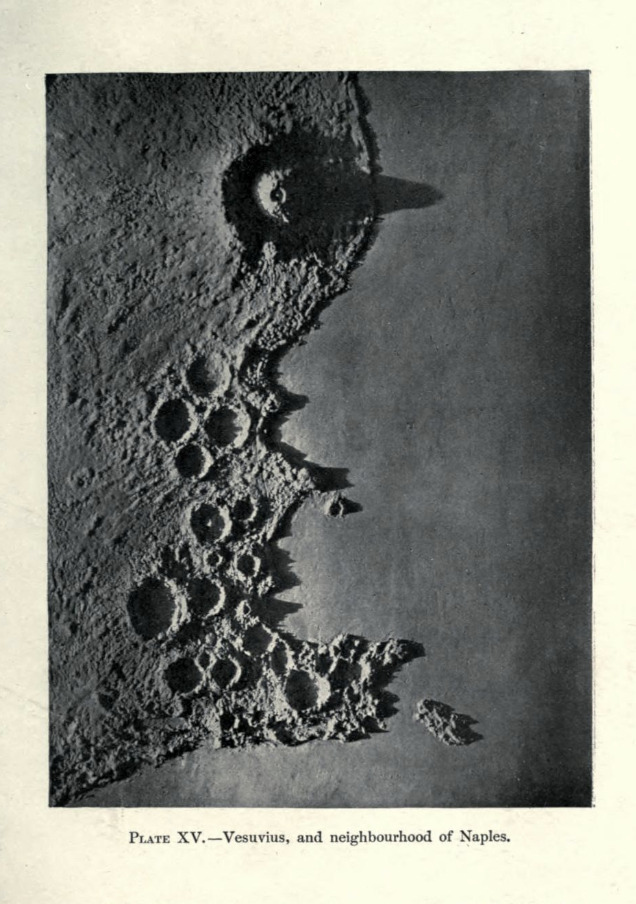
Such are the dates and the edition. What of the book’s ideas and influence? The book strongly supported and elaborately sustained a volcanic theory for the formation of the moon’s pockmarked surface. Volcanism then having obvious implications for things like subsurface heat. Because it implied magma chambers, networks of lava tubes, surface flow channels and so on. And at vast size too, since — as the book states — the moon’s large craters are immense and would dwarf those on earth.

Did Lovecraft subscribe to the theory? Yes. Lovecraft’s c. 1903 short note evaluating the likelihood of a competing theory of water-bearing “Lunar Canals” shows that he early accepted lunar volcanism. Also that he understood the volcanic activity to be relatively feeble by 1903…

“The lunar canals cover much less territory than the martian counterparts, this is doubtless, owing to the smallness of the moon compared with Mars, and therefore its feebler volcanic activity.” (“My Opinion as to The Lunar Canals”, c. 1903, my emphasis)

Was volcanism a crank theory? No. The volcanic theory of active crater formation reigned as a general scientific consensus until c. 1930, by which time some sustained doubts had become readily available in English. Yet its first serious challenge only came in 1949, long after Lovecraft’s death. Even then most scientists held to the consensus, until it was abruptly punctured by examination of actual rocks from the moon in 1965. Thus for most of his life, very likely for all of it, Lovecraft would have understood the moon’s surface to be actively volcanic in origin and nature.

This belief has certain implications. Do we glimpse here the spur for his intense moon observations? Quite possibly. If the boy Lovecraft could spot and observe an actual rare volcanic eruption in progress, and show the world the presence of a crater where before there had been none… he would have made his name as an astronomer.

What of the book’s opinion of life on this apparently volcanic moon? Nasmyth and his co-writer ruled out the possibility of “any high organism” on the moon’s surface due to the obvious lack of an atmosphere. Yet the book did tantalisingly suggest several possibilities for basic life:

i) Some form of ‘protogerm’ lying dormant, having sailed on the winds of space and landed…

Is it not conceivable that the protogerms of life pervade the whole universe, and have been located upon every planetary body therein? Sir William Thomson’s suggestion that life came to the earth upon a seed-bearing meteor was weak, in so far that it shifted the locus of life-generation from one planetary body to another. Is it not more philosophical [and assuming of a Creator] to suppose that the protogerms of life have been sown broadcast over all space, and that they have fallen here upon a planet under conditions favourable to their development, and have sprung into vitality when the fit circumstances have arrived, and there upon a planet that is, and that may be for ever, unfitted for their vivification.

ii) Some hardy form of vegetation able to survive intense cycles of heat and cold…

We may suppose it just within the verge of possibility that some low forms of vegetation might exist upon the moon with a paucity of air and moisture such as would be beyond even our most severe powers of detection.

After briefly considering these possibilities the book soberly concludes the moon is “barren” and that…

The arguments against the possibility of the moon being thus fitted for human creatures, or, indeed, for any high organism, were decisive enough to require little enforcing.

The words “barren” and “fitted” were well-chosen, since they leave open the question of the previously-suggested dormant and/or lower organisms. The book also leaves entirely un-examined the possibility of habitats in the sub-surface, in which the space-borne “protogerms” might have encountered a relatively warm (if apparently wholly dry and somehow non-gaseous) volcanic interior with its stable lava tubes.

Such lacuna would have been tantalising to the imaginative reader. I then suggest that here we may have some possible roots for Lovecraft’s later works, in terms of ideas such as:

i) a form of life that sails the star-winds and survives through space for cosmic time periods, before sifting down onto a clement planet to ‘vivify’;

ii) a hardy form of life, brought from the depths of space and (by implication) perhaps able to lie dormant for aeons in subterranean caverns. Only periodically brought to the surface by massive volcanism. A process akin, then, to the volcanic rising of R’lyeh in “The Call of Cthulhu”.

iii) the book’s volcanic ‘fountain’ diagrams and the idea of ‘protogerms’ arrived from space might both seem to evoke “The Colour out of Space” in its water-well.

I don’t say these were direct inspirations, later dredged from memory and made to serve Lovecraft’s mature fiction. But they would have been formative in shaping the broad contours of Lovecraft’s earliest cosmic imagining.

Incidentally, his yearning to see the dark side of the moon may even hint at a boyish theory about life existing there. In the absence of the lost boyhood story that he set there we can’t know much more about that. Yet knowing that he held to the volcanism theory suggests one obvious path the story could have taken — the discovery of volcanically melted crater-lakes on the dark side (his boy explorers had apparently needed their carbide lamps, implying they had stepped over the dividing-line) under a thin atmosphere.

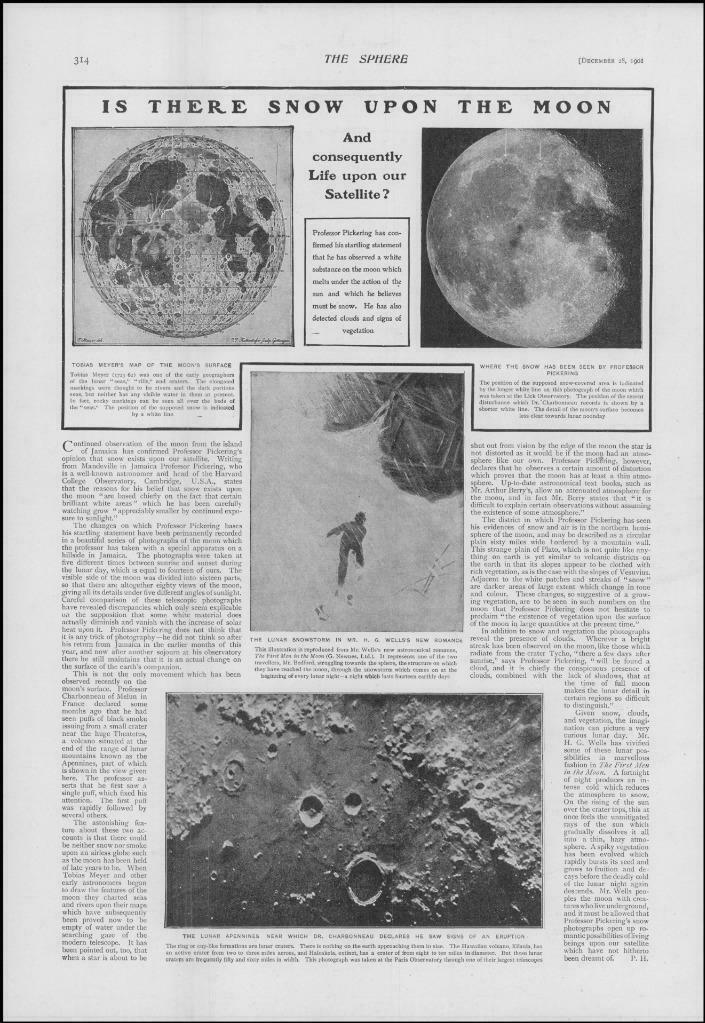
What of ‘moon life’ claims made by others? Here I give readers a quick flavour of Prof. Pickering’s ‘snow’ ideas, related to his lunar ‘canals’ idea, via a glimpse of a full-page article in The Sphere for Christmas 1901…

One can see how it would be easy to dismiss such things. Claims of observations of active primitive plant growth along snowy “canals” (or “streaks of vegetation” on the surface as Lovecraft described them) were indeed dismissed early by Lovecraft in his “My Opinion as to The Lunar Canals” (1903?). However much the glittering mountains might look like snow in photographs, water was not detectable from earth. Without water to sustain life, such things as ‘canals’ and ‘vegetation’ could not be. If the “Lunar Canals” text is correctly dated, then I would suggest it was written in late 1903 and under the direct and countering influence of the 1903 reprint of Nasmyth’s moon book.

See the Lovecraft Annual 2019 for a fine essay detailing Lovecraft’s reactions to Professor Pickering’s claims for the ‘lunar canals’ and more.

Yet ‘life on the moon’ was not then an either/or choice. One might sensibly discount questionable ideas such as immense banks of “snow” or “canals” and “vegetation”, while not entirely giving up hope for moon habitats of some sort. For instance, five years after his “My Opinion as to The Lunar Canals” we find Lovecraft even more certain of the apparent evidence for “active volcanism” on the moon, in his essay “Is There Life on the Moon?” (1906). But he has evidently become, after several years of personal observing, far more open to the idea of an active moon. He now aligns himself with some of Pickering’s ideas and the German ‘bulge’ idea, by musing on a “thin” atmosphere and surface frost forming on ridges…

Today [certain moon changes are] generally accepted as the work of active volcanism. Now no volcano can operate without atmosphere, but there could easily be a thin gaseous envelope undetected from the earth. The “lunar rays”, i.e. long, brilliant streaks radiating outward from some of the craters, have always been a puzzle to astronomers. Numerous theories have been promulgated concerning their origin, some saying that they are cracks in the moon’s surface while others maintain them to be streaks of lava, ejected in the remote past from the craters which they surround. But the latest and most startling theory is that they are deep furrows filled with snow. This seems incredible at first sight, considering that there are no clouds on the moon; but when we reflect that little more than hoar frost would be required to produce the glittering appearance, the theory becomes more acceptable. For this theory, the world is indebted to Prof. William H. Pickering of Harvard, the greatest living selenographer [i.e. Moon geographer].

Lovecraft could not believe in Pickering’s vegetative “canals” back in 1903, and he still could not do so. Nor could be believe in a widespread Christmas-y “snow” on the moon. But by 1906 he can at least believe in thin lines of “hoar frost” along the crater rays, while also making a nod to active volcanism operating with a thin atmosphere. These claims then set the reader up, in the same “Is There Life…” essay, for Lovecraft’s far bolder observation that in…

a deep, winding chasm [on the moon] called “Schroeter’s valley” can be seen the only active and ocular proof of seismic conditions. There an assiduous observer can detect peculiar clouds of moving whiteness, which the up-to-date selenographer interprets as nothing more or less than smoke from an active crater! These clouds are often so dense as to obscure neighbouring objects.”

He did not discover this likely spot on the moon, with its apparent implications for a sub-surface habitat for life. Nor was he the observer of the shoggoth-like “clouds”, as his article might vaguely seem to imply. Because it was almost certainly the August 1905 article “Life On the Moon” in Munsey’s Magazine that alerted him to this vast chasm and its “clouds”. I have dug the article out of Hathi (regrettably missing its first page on the scan, presumably torn out for its opening moon illustration). The text reveals that the Schroeter’s valley “clouds” observer was actually Pickering, and the author was generally highly supportive of Pickering’s ideas. This was probably the sort of popular article that had made Lovecraft receptive to some, though not all, of Pickering’s ideas.

Did Lovecraft read the article? It seems highly likely to be the source for his very similar Schroeter’s valley “clouds” observation, and we know he was reading Munsey’s Magazine from at least 1903…

In the only extant issue of [his] Rhode Island Journal of Science & Astronomy (September 27, 1903) makes reference to an article by E. G. Dodge entitled “Can Men Visit the Moon?” in the October issue of Munsey’s Magazine, which if nothing else indicates that Lovecraft was reading the journal at least as early as this. (Joshi, I Am Providence)

So there are now two moon articles known from Munsey’s Magazine, “Can Men Visit the Moon?” (1903) and “Life On the Moon” (1905). It’s quite possible that he read others there that have yet to be discovered.

As it happens it seems that we now know that the Moon was indeed volcanic and had a thin periodic dark-side atmosphere, but that the last such events were some two billion years ago. That ancient process likely created today’s large flat dark ‘mares’ or ‘seas’ as lava flows, and also rather usefully left us billions of tonnes of ice at the poles.


After 25 years away, Lovecraft’s imagination would return to the moon. Though not to encounter fungi-litten volcanic caves, or insect-philosophers crawling over the dark side under a feeble atmosphere, or even cloudy proto-shoggoths oozing from “a deep, winding chasm”. Instead in his Dream-quest tale he deemed the moon’s surface — at least as dreamed of in the Dreamlands — to be the poignantly still and desolate haunt of the cats of Ulthar. With strange and unspecified attractions to be found on the dark side.

The Metal Monster (1920 version)

13 Thursday Jan 2022

Posted by asdjfdlkf in Historical context, Odd scratchings

≈ 1 Comment

New on Archive.org, the collected and bundled parts of the Argosy version of A. Merritt’s “Metal Monster” as serialised in Argosy All-Story Weekly, 1920.

Lovecraft came to it late, and in the seemingly unchanged(?) book version. He wrote of it in a letter of 1934…

[I read] A. Merrit’s old yarn “The Metal Monster”, which I had never read before because Eddy told me it was dull. The damn’d fool! (nephew — not our late bibliophilick friend). Actually, the book contains the most remarkable presentation of the *utterly alien and non-human* that I have ever seen. I don’t wonder that Merritt calls it his “best and worst” production. The human characters are commonplace and wooden — just pulp hokum — but the *scenes and phaenomena* …. oh, boy! …

In a subsequent letter to Rimel in summer 1934, he suggested the novel “needs extensive revision”. Lovecraft had met and privately dined with Merritt at his New York club in January 1934, which makes this an interesting comment. One then has to wonder what might have happened had Merritt hired Lovecraft as his revisionist in January 1934. Could that have been the purpose of the sumptuous private dinner? Merritt sold at least one novel to Hollywood for a major feature-film at about this time (on the screens as Devil-doll, 1936), and might have had the cash for such. But it was not to be.

Incidentally, the “late bibliophilick friend” in the above quote was ‘Uncle Eddy’, the Providence writer Eddy’s obliging bookseller uncle. The use of the word “late” suggests that either his shop had closed by 1934 and he had retired, or that he had recently passed away. The modern-day RIAMCO Collection of Lovecraft has the following catalogue entry for a press cutting, which might help to pinpoint his retirement date if it could be seen…

Lovecraft, Howard P. [letter to ] to Wandrei, Donald. Undated, with envelope postmarked Jul. 31, 1931. Headed: “Nether Crypts – Lammas-Eve” only. Enclosed is a clipping from The Providence News-Tribune [22 Jul 31] about Arthur A. Eddy, proprietor of Eddy’s Bookstore on Weybosset Street in downtown Providence.

The cutting is not in the Wandrei letters, as published. The name should be Arthur E. Eddy.

“100 miles from my home”

12 Wednesday Jan 2022

Posted by asdjfdlkf in Historical context, Maps

≈ Leave a comment

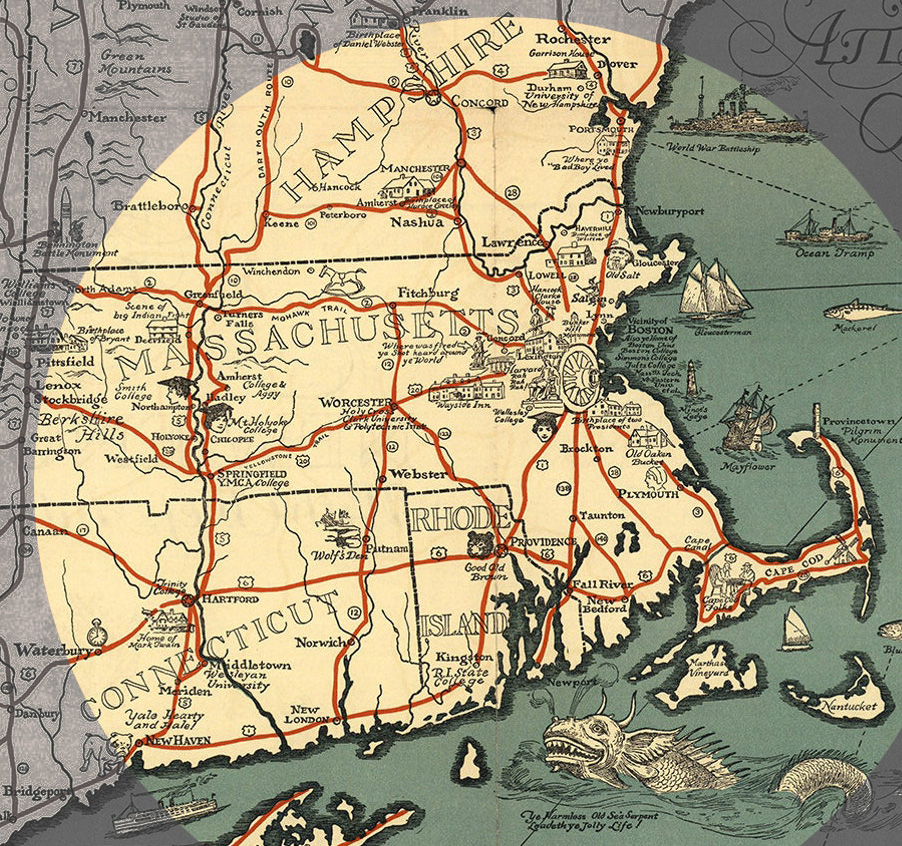
In a 1934 letter to Rimel, Lovecraft remarks… “I didn’t get more than 100 miles from my home until I was 31 years old” (i.e. circa 1922), which provides a useful limit of what he might or might not have seen as a boy, if only from a passing train. No glimpse of the sinister and misty Catskills (“Lurking Fear”) from a Hudson Valley train, then, on a trip with his grandfather.

Drawing a 100 mile circle from his home does however suggest possible youthful visits to…

* the vicinity of Portsmouth and Rochester in the north, via Boston.

* north-west as far as the Berkshire Hills and the river-towns that lie to the east of them.

* south-west along the coast to New Haven.

Sherlock Holmes in 221 Objects

11 Tuesday Jan 2022

Posted by asdjfdlkf in New books

≈ Leave a comment

Glen S. Miranker is a former Apple executive who has collected over 7,000 books, illustrations and letters related to Mr. Sherlock Holmes. He has whittled them down into the New York City exhibition “Sherlock Holmes in 221 Objects”, opening tomorrow at the Grolier Club in Manhattan. The show runs until 16th April 2022. A catalogue is currently available, which may interest some readers of Tentaclii.

Giant Ants

11 Tuesday Jan 2022

Posted by asdjfdlkf in Astronomy, Historical context

≈ Leave a comment

New at Dark Worlds Quarterly, a fun and extensively illustrated survey of the Giant Ants of the Pulps.

Which made me curious about Lovecraft and ants. While alien insects are an occasional thing, the terrestrial ant is hardly made use of by Lovecraft’s imagination. Except in two letters. Here is Lovecraft in a letter of 1916, imagining a “Lovecrafty” ant and the Earth as a giant ant colony in which he resists the rigid conformity of the species…

my point of issue involves the existence of ants which are “Lovecrafty” or crafty in other ways … “Lovecrafty ants” [analogous to himself] do exist on this terrestrial anthill [of the Earth], and suffer keenly from the crude enforcement of orthodoxy.

And later a similar comparison appears when in 1929 he forecasts that man will soon have the instruments to discover “the relation of man and the earth to the solar system and the nearer stars”…

If we can study the relation of a race of ants to a coral atoll or a volcanic islet which has risen and will sink again – and nobody dares deny that we can – then it will be equally possible for us, if we have suitable instruments and methods, to study the relation of man and the earth to the solar system and the nearer stars. The result will, when obtained, be
just as conclusive as that of a study in terrestrial zoology or geology.

One might think that he is suggesting that the ‘new’ cosmic rays and the like will be found to have influenced Earth and thus man’s evolution on Earth. But the context is a long letter to Long seeking to counteract the “popular theological misuse of relativity”. Einstein’s theory of relativity was then a new thing, and was being horribly mangled and twisted in its popular reception. He is here arguing that the physical laws of earth must hold also in space, and thus man’s fleeting and insignificant “relation” to the cosmos will soon be confirmed by scientific measurement. No quasi-spiritualist “trick metaphysics” purveyed by “the Einstein-twisters” will allow us to escape from that conclusion. Thus his imagining of humanity as being akin, in its imperilled existence, to “a race of ants to a coral atoll or a volcanic islet” is an apt one.

More on volcanoes and Lovecraft, on Friday.

Astronomicon

10 Monday Jan 2022

Posted by asdjfdlkf in Astronomy, New books, Scholarly works

≈ Leave a comment

The Spanish newspaper El Espanol has an article celebrating the publication of a new Spanish-language book on Lovecraft and astronomy.

The Diversifier in 1977

10 Monday Jan 2022

Posted by asdjfdlkf in Odd scratchings, REH

≈ Leave a comment

New on Archive.org, The Diversifier #21 (July 1977). Has Emil Petaja’s “The Mist”, an old micro-story written “in the throes of sadness at the death of H.P. Lovecraft, and incorporating parts of the letters from Lovecraft to Petaja. Some memoirs of old times by Carl Jacobi, in which Lovecraft’s letters are barely mentioned while a trivial pipe-fire accident gets several paragraphs. The issue also has poems in memory of August Derleth and R.E. Howard.

Added to Open Lovecraft

09 Sunday Jan 2022

Posted by asdjfdlkf in Scholarly works

≈ Leave a comment

* A. Sokol and J. Pevcikova, “Animal symbolism in the works of H.P. Lovecraft”, Ars Aeterna, December 2021.

* N.S. Scotuzzi, “Keziah Mason: a bruxa cientista de H.P. Lovecraft”, Literates, Vol. 1, No. 15, December 2021. (In Portuguese. Seeks to show how Lovecraft develops the witch figure in “Witch House”, and the extent to which she incorporates earlier Christian ideas of witches).

* B. Kowalczyk, “The Music of the Abyss: Nature in Howard Phillips Lovecraft’s The Music of Erich Zann”, Forum of Poetics, Spring 2021.

My ‘Skip or Watch?’ for the Tom Baker years of Doctor Who

08 Saturday Jan 2022

Posted by asdjfdlkf in Odd scratchings

≈ 6 Comments

Having binged on the ‘David Tennant years’ for Doctor Who in 2019, I felt the need to re-visit some more Doctor Who. The next natural ‘Doctor destination’ after Tennant is then Tom Baker. So, for what it’s worth, here’s my “Skip or Watch?” list for working through the Tom Baker years in the UK’s long-running Doctor Who series. For a bit of fun during a dull January. I’m currently at the end of Season 13 in my viewing.

It’s fine to skip, as Doctor Who is always notoriously choppy within a season. The Baker era is said to be no different, but perhaps different in another way since it drew even more strongly on horror than on science. Indeed, for most of Baker’s run the science takes rather a back seat. But the horror angle may interest some Tentaclii readers who can tolerate the low production values (by today’s standards, and sometimes even by the standards of 1970s British TV). You’d also need to be able to tolerate some of the British wackiness, irony and eccentricity, from the lead Baker but also from showrunner Douglas Adams (Hitchhiker’s Guide). Some of the plots and ideas are said to need a sharp ear and sharp mind to fully grasp, in the more downbeat and ‘science re-introducing’ final season of the Baker run.

The general format for each season was that each story had four episodes, and then the finale story had six. Only occasionally was this varied from. This means that you can expect each of these stories to run two hours, except for the finale for the season which should run for three hours. The audio-story inserts in this list vary on running time, from one to nearly three hours. In total: around 70 hours for the following list.


Doctor Who Season 11 – good old Jon Pertwee is the Doctor.

* “Planet of the Spiders” – not a great finale, but it ends with the famous regeneration scene. Some may want to view this final episode, after reading up on the plot.


Doctor Who season 12 – Tom Baker is now the Doctor.

* “Robot” – weak, and not the best way to start if you’re new to Doctor Who, yet it does ease Baker out of the Pertwee-era UNIT and off Earth.

* “The Ark in Space” – the Tom Baker era properly begins, with a TV sci-fi classic. Start here if you’re new to Who.

* “The Sontaran Experiment” – continuing from “Ark”, an uncharacteristically short two-parter in the middle of the season.

* “Genesis of the Daleks” – good, if a little ‘all around the houses to get back to where we started from’ at times.

“Revenge of the Cybermen” – SKIP, but read up on the plot.


Doctor Who season 13

* “Terror of the Zygons” – not great, but concludes the very loose story-arc begun back in “Ark”. There’s one point where it helps to have seen the ending episode of Season 11, to understand what’s going on. It also helps the viewer new to Doctor Who to have encountered UNIT back in the previous season, in “Robot”.

? Planet of Evil – it could be skipped, but then you would miss an excellent planetary-surface setting in the first half. Some tiresomely histrionic over-acting in the second-half.

* “Pyramids of Mars” – not quite as scintillating as I’d been led to believe, but definitely a ‘watch’.

“The Android Invasion” – SKIP.

* “The Brain of Morbius” – often hilariously ‘over the top’, but a lot of fun.

? “The Seeds of Doom” – this season finale didn’t grab me. Well-made and imaginative, and it starts well and the plot flows along but… it’s a drag. The unusually angry and very shouty Doctor, a surprise-free plot in a long three-hour slog, and a lack of funny jokes (most fall flat) all served to make it fall short of the classic it’s said to be. Feels like someone’s rather distasteful horror-thriller novel re-purposed as a Doctor Who story. Leaves a ‘bad taste’, all round.


Doctor Who season 14

* “The Masque of Mandragora” – excellent, one of the best. Only the VFX are a little dodgy. Surprisingly, most people slate this one but I can’t think why.

* “The Hand of Fear” – well worth a watch, with a good start and ending. Assistant Sarah Jane bows out.

* “The Deadly Assassin” – slumps in the third of the four episodes, but otherwise very entertaining.

* “The Face of Evil” – definitely not great, but you need to watch it because the new assistant Leela is introduced.

* “The Robots of Death” – very entertaining, and with excellent design-values, though apparently some fans don’t rate it. Slightly abrupt ending.

* Talons of Weng-Chiang. Excellent, a ‘must watch’.


> * “The Foe from the Future” (audio, in Fourth Doctor ‘Lost Stories’). This was a series 14 finale that was never made (the writer was sent to save an ailing soap-opera). “Foe” could be enjoyed here, and Tom Baker’s 2012 voice is apparently spot-on for the 1970s.

> * “Requiem for the Rocket Men” (audio, in Fourth Doctor Adventures Series 3) + “Last of the Colophon”/”Death Match” (audio, in Fourth Doctor Adventures Series 4). “Requiem” apparently helps set up the later “Death Match”. All three are stand-out stories and fit here in the timeline.


Doctor Who season 15

* “Horror of Fang Rock”. Excellent, a very good period-horror piece.

* “The Invisible Enemy” – robot-dog K9 1 introduced. Quite watchable, if you can ‘go’ with the silliness.

? “Image of the Fendahl” – COULD BE SKIPPED, but has an ambitious weird-horror atmosphere.

“Sun Makers” – SKIP.

“Underworld” – SKIP, widely said to be the worst episodes ever.

Invasion of Time – SKIP – Assistant Leela and K9 1 depart. Apparently dreadful, but you may want to just see the ‘Leela departure’ bit at the end.


Doctor Who season 16

* “The Ribos Operation” – sets up the ‘Key to Time’ arc. Assistant Romana 1 and K9 2 appear. Very enjoyable, great sense-of-place and interesting characters.

“The Pirate Planet” – SKIP

* “The Stones of Blood”. Excellent, though the later episodes sag a bit.

* “The Androids of Tara” – progresses the ‘Key to Time’ arc. Not great, mostly seen-it-before pulp-era palace intrigues.

“The Power of Kroll” – SKIP

* “Armageddon Factor” – finishes the ‘Key to Time’ arc. Six episodes, definitely drags a bit.


Doctor Who season 17

“Destiny of the Daleks” – SKIP, apparently abysmal. Just assume that Romana 1 regenerates to Romana 2, and takes the shape of a recently departed princess.

* “City of Death” – an all-time classic gem, amid a rough season.

“The Creature from the Pit” – SKIP

“Nightmare of Eden” – SKIP

“The Horns of Nimon” – SKIP

* “Shada” – incomplete TV episodes for the six-episode season finale, cancelled and the ending was never broadcast due to leftist strike action at the BBC. Complete version eventually released in 2017, with recreated missing fill-ins in audio. Then a further enhanced Blu-ray version with animation and better audio. Not the ‘all-time classic’ hailed by the fans during the dead years, but now very watchable and worthy seeing. Also available as an unabridged 12-hour audiobook novel from 2012. Note that there is also a “Big Finish cast audio version of Shada”, but that this “features the Eighth Doctor [Paul McGann] instead of the Fourth”.


> * “The Trouble with Drax” (audio, in Fourth Doctor Adventures: Series 5). A very fine double-cross adventure, voices are good though Romana 2 sounds like Romana 1 for some reason. There are a few touches of modern politically-correct leftist snark, but it’s fairly easy to overlook them.


Doctor Who season 18 – Douglas Adams has now left as showrunner, his quirky 1970s humour is thrown out. The show is more scientific and a bit more thoughtful.

“The Leisure Hive” – SKIP

“Meglos” – SKIP

* “Full Circle” – begins the e-Space trilogy. Boy assistant Adric appears. Has ridiculous rubber-suited monsters, but is otherwise quite entertaining and interesting.

* “State of Decay” – develops the e-Space trilogy. A watchable take of the usual ‘medieval castle’ theme. Not as good as some say.

> * “Chase the Night” (audio, in the Fourth Doctor Adventures: Ninth Series). Fits here, excellent. Adds useful background for enjoying “Warrior’s Gate”.

* “Warrior’s Gate” – concludes the e-Space trilogy. Romana 2 and K9 2 depart. Excellent.

* “The Keeper of Traken” – another ridiculous rubber-suited monster… but definitely watch as it sets up the finale in which several characters continue.

* “Logopolis” – Tom Baker departs as the Doctor. A good finale.


Doctor Who season 19 – Peter Davison is now the new and rather different Doctor. He’s well-liked by fans but only had a short run, 1981-84. His new style was not always well-served by the scriptwriters.

Davison’s ‘watch list’, as suggested by others. I’m now going through these and being somewhat disappointed. I’d say several are ‘skip’:

* WATCH. “Castrovalva”. Directly continues and helps conclude the last episode of the Tom Baker run.

* SKIP? “Four to Doomsday”. Rather tedious ‘filler’, but some fine acting including Michael Gambon as an alien toad-king.

* SKIP? “The Visitation”. A rather weak ‘period costume’ story with very silly monsters, could be skipped. Some very clunky dialogue lines, but also a magnificent Highwayman.

* WATCH. “Black Orchid”. Short at two episodes, a fun ‘period costume’ story. Could make a good refresher after the long and heavy “Keeper of Traken” / “Logopolis” / “Castrovalva” sequence.

* WATCH. “Earthshock”. Starts very well, but soon drops into formula and gets more and more tedious. Yet the ending is un-missable.

* WATCH. “Mawdryn Undead”. Excellent. The companions at last get some new costumes. Introduces a new companion and an old friend.

* WATCH “Terminus”. Second in a trilogy. Average, but ends with the departure of an assistant.

* SKIP? “Enlightenment”. Third in a trilogy. Not great, but it closes the short ‘Black Guardian’ arc. Just watch the ending?

* WATCH. “The Five Doctors”. Excellent, but the ending can be guessed way ahead of time. Self contained. It’s best to leave Davison here, on a high-point.

* SKIP. “Resurrection of the Daleks”. Daleks, but a slow slog and it doesn’t amount to much. Some bad acting.

* SKIP. “Planet of Fire”. Terrible acting. I gave up on it after one episode.

* SKIP. “The Caves of Androzani”. I gave up on it after one episode.


So, overall for Tom Baker: skip perhaps 12 stories and watch 29, saving yourself several days and nights of tedium and cringe. Possibly also add six of the Big Finish stories, at the points indicated above. Be warned that Big Finish’s marketing blurbs ‘spread the spoilers on’ rather thickly. Then just six for the best of Davison.

‘Picture postals’ from Lovecraft: the almanacs

07 Friday Jan 2022

Posted by asdjfdlkf in Astronomy, Historical context, New discoveries, Picture postals

≈ 1 Comment

As we move into the New Year, it seems apt to take a look at the annual almanacs which H.P. Lovecraft cherished. Not quite postcards, of course, but still pictorial.

He inherited, and then further developed, a substantial collection of such old country almanacs. He writes in a letter that this family collection, when first passed down to him…

went back solidly only to 1877, with scattering copies back to 1815

Trying to complete this set eventually became a keen occasional hobby, though he had some luck there. He was allowed to root among the home storage attic of his sometime-friend Eddy’s book-selling uncle, and he descended the ladder with many a rare old copy. Which Uncle Eddy then sold him at a very affordable price. This haul appears to have spurred his ambitions, and he wrote…

I am now trying to complete my family file of the Old Farmer’s Almanack

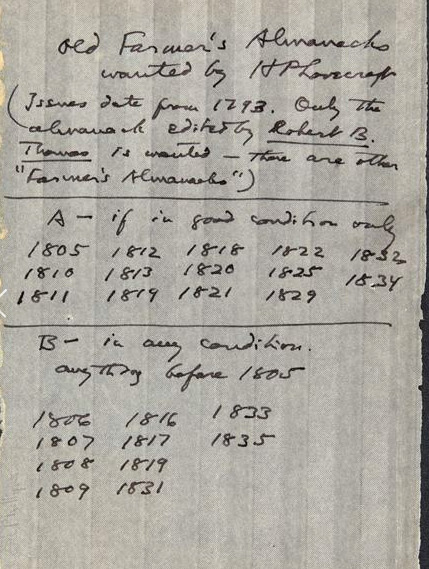
Here we see Lovecraft’s collecting ‘wants list’, as he tried to complete the set…

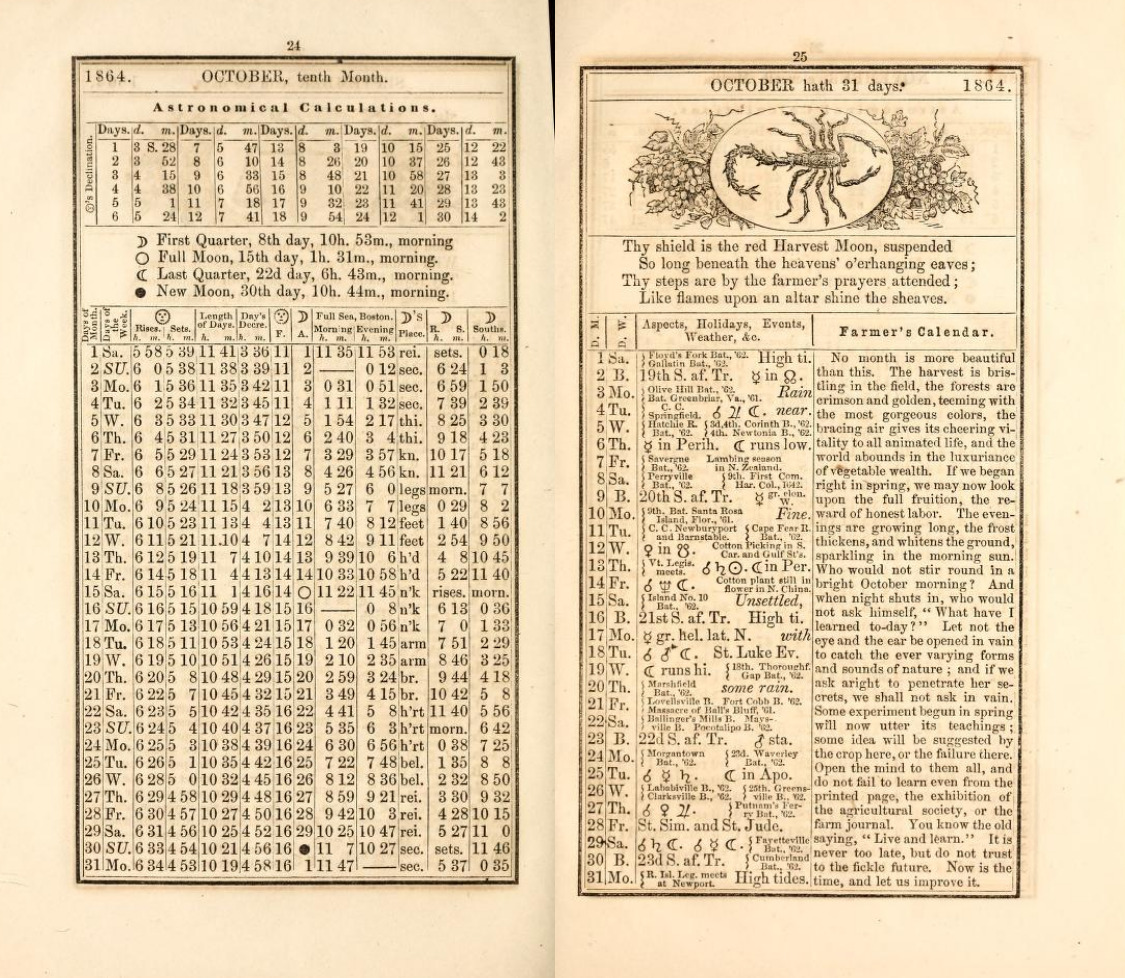
What, exactly, was this publication? Archive.org now has a small selection of scans of this Old Farmer’s Almanack, and thus we can get a better idea of what Lovecraft found between the pages. To be specific, he inherited and collected old copies of the Old Farmer’s Almanack edited by Robert B. Thomas. (It can’t be linked, as the URL is malformed, but if you paste this into the Archive.org search-box you should get it: creator:”Thomas, Robert Bailey, 1766-1846″ )

There were other publications of the same or similar title, but Old Farmer’s Almanack was Lovecraft’s mainstay. Which is not say he wasn’t delighted to discover that other similar almanacs were still publishing, out in the countryside…

It sure did give me a kick to find Dudley Leavitt’s Farmer’s Almanack [Leavitt’s Farmer’s Almanack, improved] still going after all these years. The last previous copy I had seen was of the Civil War period. But of course my main standby is Robt. B. Thomas’s [Almanack]

Thomas’s Old Farmer’s Almanack had begun publication in 1793. As we can see from the above list, Lovecraft was especially keen to get hold of anything before 1805 and in any condition. Many of these used the old long-S in the text…

I can dream a whole cycle of colonial life from merely gazing on a tattered old book or almanack with the long S.

This dream had first occurred very early in his life, and at age five the family Almanack had made a lasting impression…

my earliest memories — a picture, a library table, an 1895 Farmer’s Almanack, a small music-box

Evidently then this annual was taken and consulted in his home at that time. Also cherished and kept, since we know he was able to read the entire set…

[As a boy] I read them all through from 1815 to the present, & came early to think of every turn & season of the year in terms of the crops, the zodiac, the moon, the ploughing & [harvest] reaping, the face of the landscape, & all the other primeval guideposts which have been familiar to mankind since the first accidental discovery of agriculture in the Tigris-Euphrates Valley.

Nor did he overlook the rustic pictures…

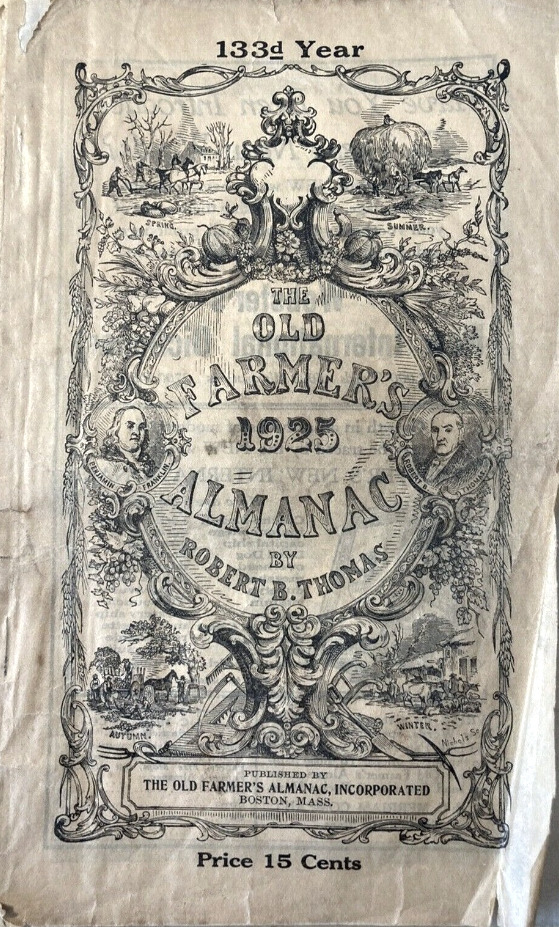
I am always fond of seasonal pictures, & dote on the little ovals on the cover of the ancient Farmer’s Almanack — spring , summer, autumn, & winter

On his travels he later found places where the homely traditions and moon and star-lore of the Farmer’s Almanack were still followed, such places as Vermont…

That Arcadian world which we see faintly reflected in the Farmer’s Almanack is here a vital & vivid actuality [in rural Vermont]

The publication was indeed a useful one. For instance it enabled Lovecraft to anticipate with ease the year’s lesser heavenly events…

Sun crosses the equinox next Wednesday at 7:24 p.m. according to the Old Farmer’s Almanack — which we have had in our family, I fancy, ever since its founding in 1793.

Having sent some introductory astronomy books, Lovecraft also sent young Rimel a copy of the latest Old Farmer’s Almanac for the coming year of 1935. In a later letter to Rimel of 28th January 1935, Lovecraft explicitly recommends the publication for astronomy use. The Almanac being…

capable of assisting the study of astronomy quite a bit.

The weather predictions found in its pages were perhaps of less use. Or at least, they had become so by the late 1970s. In 1981 Weatherwise magazine made a tally of sixty forecasts across five years. They found the month-by-month Almanack forecast to be little better than chance by then. How accurate the monthly weather forecasts might have been in the 1895-1935 period and in Providence remains to be determined. It might be quite interesting to tally that, with perhaps a leeway of two days. But to do so one would likely need to go back to the original journal / newspaper summaries of the month’s actual weather, rather than trust any recently ‘rectified’ computer-created data for those decades.

The Almanacks also contained a wealth of rather more reliable factual information. Such as the dates of the year’s key elections, court days, festival and saint’s days, tides, recurring natural events (usual time of lambing, bringing in cows for the winter etc), anniversary dates for sundry historical events, lists of Presidents, the standard weights and measures, distances, nutritional values of various crops and fodder, together with small amusements such as riddles and poetry. Short articles could also be present. Most importantly for Lovecraft’s huge flow of parcels and letters, the little booklets also appear to have given the latest postal regulations in a concise form.

In format they were rather like Lovecraft’s stories, then. A whole lot of sound facts garnished with a few slivers of delicious speculation (meaning the weather forecasts, rather than monsters and cults). Indeed, one might see something of the ‘carnivalesque’ at work in such publications. The use of a small inversion, that by its amusing ridiculousness serves to bolster the belief in the facticity of the rest of the structure.

The latest annual Almanack was also ever-present in Lovecraft’s own study, as he wrote to Galpin in 1933…

You may be assur’d, that my colonial study mantel has swinging from it the undying Farmer’s Almanack of Robert B. Thomas (now in its 141st year) which has swung beside the kindred mantels of all my New-England forbears for near a century & a half: that almanack without which my grandfather wou’d never permit himself to be, & of which a family file extending unbrokenly back to 1836 & scatteringly to 1805 still reposes in the lower drawer of my library table [evidently Lovecraft had by this time added 1876-1836 to the “family file”] … which was likewise my grandfather’s library table. A real civilisation, Sir, can never depart far from the state of a people’s rootedness in the soil, & their adherence to the landskip & phaenomena & methods which from a primitive antiquity shap’d them to their particular set of manners & institutions & perspectives.

This mantel-hanging had been a long-standing practice. For instance it was noted by his earliest visitor, when Lovecraft was emerging from his hermit phase. Rheinhart Kleiner recalled of his curious visit to the darkened room that…

An almanac hung against the wall directly over his desk, and I think he said it was the Farmers’ Almanac.

Lovecraft even kept up the tradition during the hectic New York years, writing in late 1924…

the Old Farmer’s Almanack … of which I am monstrous eager to get the 1925 issue

In that era the Almanacks were very often personalised and annotated quite heavily by their users, and a rural man’s personal collection grew to form a sort of natural diary and personal time-series for useful farm data. In 1900 40% of the American people still worked on the land, so such things were vital.

So far as I’m aware we have none of Lovecraft’s own copies today, so we don’t know if he also marked and noted them in various ways. Or if he had inherited copies that had been so marked by his relatives.

He also hints at being aware of and valuing another such publication. For instance, when he remarked on the discovery of the planet Pluto he wrote…

the discovery of the new trans-Neptunian planet …. I have always wished I could live to see such a thing come to light — & here it is! …. One wonders what it is like, & what dim-litten fungi may sprout coldly on its frozen surface! I think I shall suggest its being named Yuggoth! …. I shall await its ephemerides & elements with interest. Probably it will receive a symbol & be treated of in the Nautical Almanack — I wonder whether it will get into the popular almanacks as well?

In his early newspaper columns on astronomy he also appears to refer to this same publication…

The motions of these satellites, their eclipses, occultations, and transits, form a pleasing picture of celestial activity to the diligent astronomer; and are predicted with great accuracy in the National Almanack. [I assume here a mis-transcription by the newspaper editor of “National” for “Nautical”, or perhaps a correction to its shorthand name in the district].

Indeed, both Almanacks feature in Lovecraft’s “Principal Astronomical Work” list, among the vital accessories needed for a study of the night-sky…

Accessories:

Lunar Map by Wright.
Year Book — Farmer’s Almanack.
Planispheres — Whitaker & Barrett-Serviss.
Atlas by Upton — Library.
Opera glasses — Prism Binoculars.
Am. Exh. & Want Almanac. [meaning the American Ephemeris & Nautical Almanac, as “Exh.” is “Eph.” and “Want” should be “Naut”]

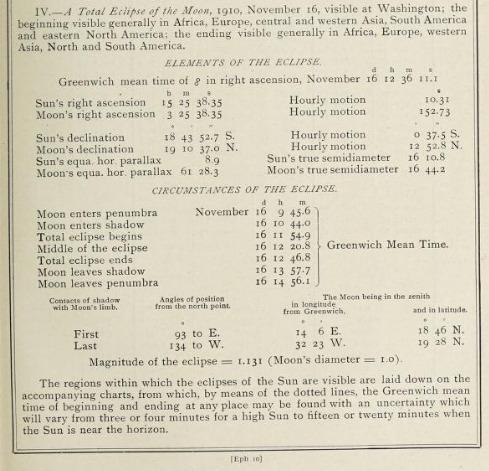
This Nautical Almanac is also on Archive.org, so we can peep inside a copy of that from 1910. Forthcoming eclipses were noted over several pages. Here, for instance we see all the details needed to observe a total eclipse of the Moon in November 1910, the beginning visible from “eastern North America”. I think we have a hint here about what Lovecraft was likely to have been doing in the late evening of 16th November 1910…

Archive.org also has The Old Farmer and his Almanack, a 1920 book which surveyed the topic with erudition. Lovecraft was heartily pleased to discover and read it shortly after publication.

Almanacks occur only once (and very trivially) in Lovecraft’s poetry. The one use in his fiction is more intriguing. In “The Picture in the House” (December 1920) a book is noted…

a Pilgrim’s Progress of like period, illustrated with grotesque woodcuts and printed by the almanack-maker Isaiah Thomas

The sharp-eyed will have spotted that Lovecraft might have meant to imply that this “Thomas” could have been the ancestor of the Robert B. Thomas of Old Farmer’s Almanack fame. That might be how some savvy bookmen took it at the time, but it is not so. For Lovecraft would have known that there was a real “almanack-maker Isaiah Thomas” and that he was no relation. Robert B. Thomas himself tells us this fact, in recalling his early years of trying to get a start in publishing almanacks…

I wanted practical knowledge of the calculations of an Almanack. In September, I journeyed into Vermont to see the then-famous Dr. S. Sternes, who for many years calculated Isaiah Thomas’s Almanack, but failed to see him. … In the fall, I called on Isaiah Thomas of Worcester (no relation) to purchase 100 of his Almanacks in sheets, but he refused to let me have them. I was mortified and came home with a determination to have an Almanack of my own.

Thus my feeling is that Lovecraft knew of these snubs and also, probably while reading his The Old Farmer and his Almanack (1920), had learned that Isaiah Thomas had sustained a sideline in publishing booklets containing the worst sorts of “astrology, palmistry, and physiognomy”. Thus, later that same year Lovecraft gave curmudgeonly old Isaiah Thomas a small poke in his fiction, by implying that Isaiah had marred a classic book with “grotesque” pictures — so “grotesque” that the resulting book ended up resting next to Pigafetta’s account of the Congo and its cannibals.


Update: The Nautical Almanac. Hathi now have the full run of the Nautical Almanac online.

← Older posts
Newer posts →


Please become my patron at www.patreon.com/davehaden to help this blog survive and thrive.

Or donate via PayPal — any amount is welcome! Donations total at Easter 2025, since 2015: $390.

Archives

  • March 2026
  • February 2026
  • January 2026
  • December 2025
  • November 2025
  • October 2025
  • September 2025
  • August 2025
  • July 2025
  • June 2025
  • May 2025
  • April 2025
  • March 2025
  • February 2025
  • January 2025
  • December 2024
  • November 2024
  • October 2024
  • September 2024
  • August 2024
  • July 2024
  • June 2024
  • May 2024
  • April 2024
  • March 2024
  • February 2024
  • January 2024
  • December 2023
  • November 2023
  • October 2023
  • September 2023
  • August 2023
  • July 2023
  • June 2023
  • May 2023
  • April 2023
  • March 2023
  • February 2023
  • January 2023
  • December 2022
  • November 2022
  • October 2022
  • September 2022
  • August 2022
  • July 2022
  • June 2022
  • May 2022
  • April 2022
  • March 2022
  • February 2022
  • January 2022
  • December 2021
  • November 2021
  • October 2021
  • September 2021
  • August 2021
  • July 2021
  • June 2021
  • May 2021
  • April 2021
  • March 2021
  • February 2021
  • January 2021
  • December 2020
  • November 2020
  • October 2020
  • September 2020
  • August 2020
  • July 2020
  • June 2020
  • May 2020
  • April 2020
  • March 2020
  • February 2020
  • January 2020
  • December 2019
  • November 2019
  • October 2019
  • September 2019
  • August 2019
  • July 2019
  • June 2019
  • May 2019
  • April 2019
  • March 2019
  • February 2019
  • January 2019
  • December 2018
  • November 2018
  • October 2018
  • September 2018
  • August 2018
  • August 2015
  • July 2015
  • April 2015
  • March 2015
  • February 2015
  • January 2015
  • December 2014
  • November 2014
  • October 2014
  • September 2014
  • August 2014
  • July 2014
  • June 2014
  • May 2014
  • March 2014
  • February 2014
  • January 2014
  • December 2013
  • November 2013
  • October 2013
  • September 2013
  • August 2013
  • July 2013
  • June 2013
  • May 2013
  • April 2013
  • March 2013
  • February 2013
  • January 2013
  • December 2012
  • November 2012
  • October 2012
  • September 2012
  • August 2012
  • July 2012
  • June 2012
  • May 2012
  • April 2012
  • March 2012
  • February 2012
  • January 2012
  • December 2011
  • November 2011
  • October 2011
  • September 2011
  • August 2011
  • July 2011
  • June 2011
  • May 2011
  • April 2011
  • March 2011
  • February 2011
  • January 2011
  • December 2010
  • November 2010
  • October 2010
  • September 2010
  • August 2010
  • July 2010

Categories

  • 3D (14)
  • AI (70)
  • Astronomy (70)
  • Censorship (14)
  • de Camp (7)
  • Doyle (7)
  • Films & trailers (101)
  • Fonts (9)
  • Guest posts (2)
  • Historical context (1,095)
  • Housekeeping (91)
  • HPLinks (75)
  • Kipling (11)
  • Kittee Tuesday (92)
  • Lovecraft as character (58)
  • Lovecraftian arts (1,627)
  • Lovecraftian places (19)
  • Maps (70)
  • NecronomiCon 2013 (40)
  • NecronomiCon 2015 (22)
  • New books (966)
  • New discoveries (165)
  • Night in Providence (17)
  • Odd scratchings (984)
  • Picture postals (276)
  • Podcasts etc. (431)
  • REH (184)
  • Scholarly works (1,469)
  • Summer School (31)
  • Unnamable (87)

Get this blog in your newsreader:
 
RSS Feed — Posts
RSS Feed — Comments

H.P. Lovecraft's Poster Collection - 17 retro travel posters for $18. Print ready, and available to buy — the proceeds help to support the work of Tentaclii.

Proudly powered by WordPress Theme: Chateau by Ignacio Ricci.