
Downtown Providence, in what looks like the mid 1920s. One can easily imagine that Lovecraft is among the figures, having donned his straw hat and gone in search of muffins and some candy. And that he is, perhaps, about to be jostled by a cultist…


19 Thursday Aug 2021
Posted in Historical context
Downtown Providence, in what looks like the mid 1920s. One can easily imagine that Lovecraft is among the figures, having donned his straw hat and gone in search of muffins and some candy. And that he is, perhaps, about to be jostled by a cultist…
19 Thursday Aug 2021
Posted in Housekeeping
I’ve updated my “Lovecraft for beginners” guide/FAQ page, ready for Lovecraft’s birthday tomorrow. Newly added, among others…
i. “On the searchability/indexing of the letters) “A unified index to the collected volumes of Letters is underway, but may not appear for a while yet.”
ii. (on finding a poetry index). “a full index to the second edition of The Ancient Track is forthcoming and is set to be released for Lovecraft’s Birthday on 20th August 2021.”
iii. (New section for ‘Philosophy’ added). “Introductory studies of Lovecraft’s philosophy and thought, which is considerable, can be found in the books H.P. Lovecraft: The Decline of the West; The Philosophy of H.P. Lovecraft (New Studies in Aesthetics series); and Ideology and Scientific Thought in H.P. Lovecraft.”
iv. (Commenting on the nature of the encyclopedias available). “Note that these encyclopaedias do not cover Lovecraft’s intellectual ideas and his engagement with the ideas/science of his time, and a hypothetical title such as An Intellectual Encyclopaedia for H.P. Lovecraft is a book that remains to be written.”
I see that Bobby Derie also has what appears to be a new-this-week FAQ page answering common questions posed about Lovecraft.
18 Wednesday Aug 2021
Posted in Lovecraftian arts, New books
The English edition of Francois Baranger’s oversized artbook At the Mountains of Madness Vol. 2 is set to ship in the UK on 26th October 2021. Lavish, cinema-scale painted pictures, full of fine detail. Vol. 1 is already available from HPLHS Store among others.


17 Tuesday Aug 2021
Posted in Lovecraftian arts
At the HPLHS Store and new to me, a line of Lovecraftian Netsuke…

Also said to be set for the store (seemingly coming soon, perhaps for the Birthday on the 20th?) a toothsome faux carved whale-tooth from Innsmouth…

Lovecraft on carving…
“That [new] theory of rock carvings 150,000 years old is certainly fascinating in the extreme – even though it presupposes the evolution of man to have begun at a period somewhat earlier than is normally assumed.”
“The prevalence and depth of the mediaeval horror-spirit in Europe, intensified by the dark despair which waves of pestilence brought, may be fairly gauged by the grotesque carvings slyly introduced into much of the finest later Gothic ecclesiastical work of the time”.
“I am truly of an opinion, that [eighteenth century] carvings are just as genuine poesy as anything ever writ in lines and rhymes.”
17 Tuesday Aug 2021
Posted in Lovecraftian arts, New books
S.T. Joshi’s blog has updated. He notes the release of the new paperback edition of…
Ramsey Campbell’s second essay collection, Ramsey Campbell, Certainly [has] a substantial section of essays on Lovecraft, including a fairly recent piece, “Lovecraft Analysed” (2013), that is one of the most perspicacious pieces on Lovecraft written of late.
He also anticipates seeing the new two-hour Lovecraft documentary Exegesis: Lovecraft at the H.P. Lovecraft Film Festival (the one set for Portland at the start of October 2021).
17 Tuesday Aug 2021
Posted in Housekeeping
Fixed my recent “Lovecraft and Michigan” article. I had referred in passing to “The Nameless City”, but it was a slip of the memory. The tale in question was of course “The Transition of Juan Romero”. Fixed now. I’ve been to eBay and the big bottle of mega-memory booster pills arrives on Friday.
17 Tuesday Aug 2021
Posted in Kittee Tuesday, Podcasts etc.
You know you’re in the mid-August silly season for news… when you find a new podcast dedicated to H.P. Lovecraft’s kitten drawings.

If you understand the spoken Italian in this podcast then the rest of the Librinpillole YouTube channel appears to be worth a look, and seems to be a relatively Kitten Free Zone. Lovecraft, Bloch, Poe, Smith and others.
16 Monday Aug 2021
Posted in Historical context, New discoveries
In the second volume of his Letters to Family, H.P. Lovecraft reveals more about the location of his favourite cafe haunt “John’s” in Brooklyn in the mid 1920s. Readers of Tentaclii will recall I took a look for this location in my April 2021 post “Lunch in New York: Spaghetti in Breuckelen”. After that post I had a blog comment from ‘SJM’ pointing out a John’s in the Brooklyn tax-photos at…
185 Willoughby Street, corner Navy Street
… but I left the comment unapproved as I was fairly sure it was not the John’s. 185 Willoughby was a cafe and small corner-store relatively far up Willoughby Street and not especially close to Fulton. There are two photos of 185, one obviously showing changes after a few years.


The latter is from 1940s.nyc and feels like it’s perhaps a few years on after remodelling and gentrification associated with the new high-rise that has gone up in the background.
But a problem arises in this apparent identification… because on page 937 of Letters to Family Lovecraft states…
All three now set out for dinner — at the old Bristol Dining Room in Willoughby Street near Fulton, next door to the now defunct John’s, which was my Brooklyn headquarters for spaghetti in the old days. (July 1931)
Next door.
“Bristol” was the long-established Bristol’s Dining Room, with Mr. J. E. Bristol proprietor. He had a small chain of eight such in New York City by 1920. Can it be found? Well, there is this postcard picture, which appears in a book dedicated to such from the 1905-07 period in Brooklyn…
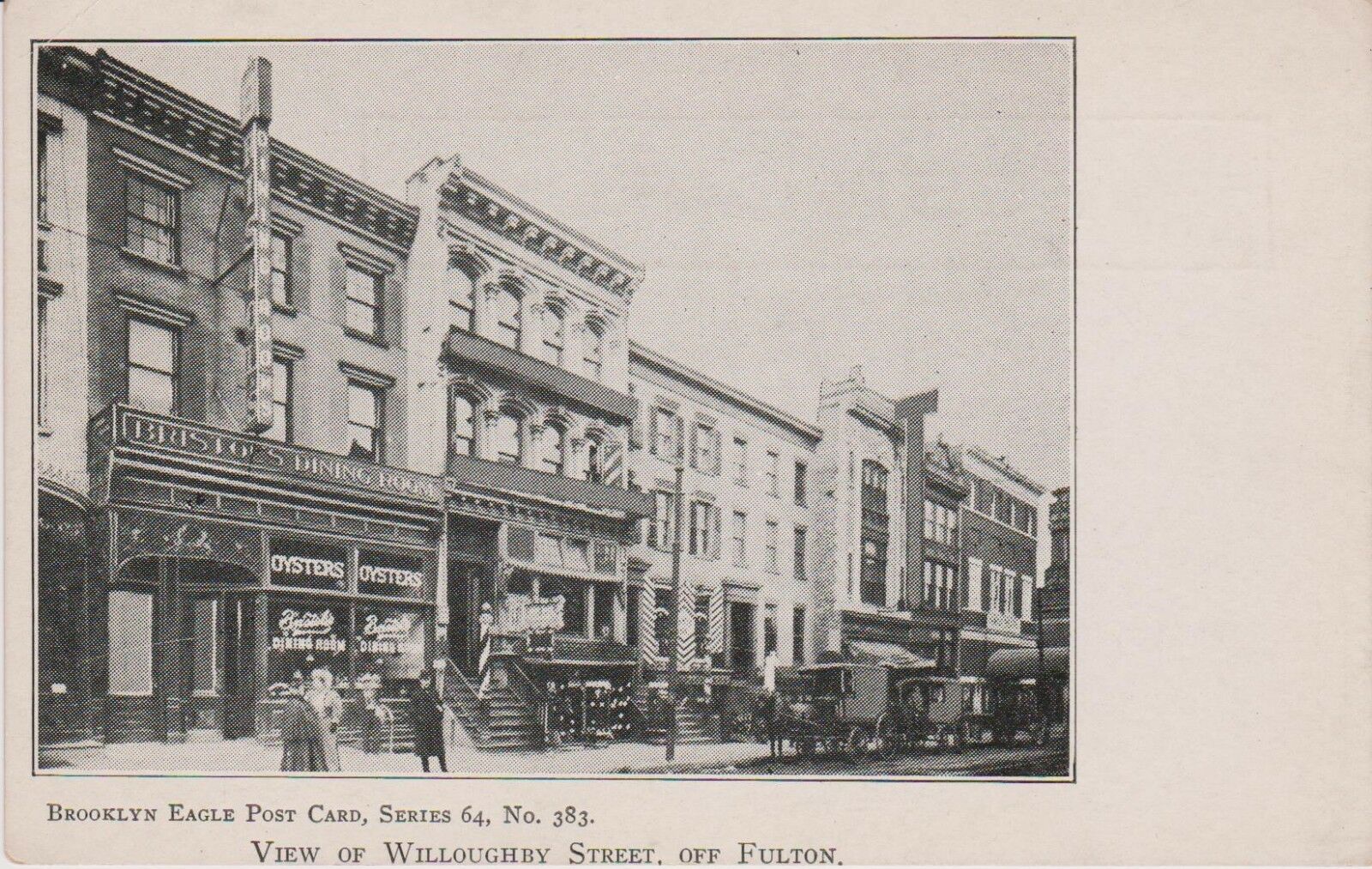
Here is the old Bristol’s Dining Room seen in all its oyster-purveying glory. As one can see, there is no architectural or street-furniture comparison to be found between the suggested site at 185 Willoughby and the postcard of Bristol’s Dining Room. If, as Lovecraft states, his old John’s was next to the Bristol’s Dining Room then it would either have been in the next-door barbers’ shop (barbering pole, outside) seen up steps on the right of the postcard, or is off to the immediate left and out of range of the camera.
Nor is there, on the 185 Willoughby or its adjacent 1940s.nyc pictures, any glimpse of a possible Bristol’s Dining Room next door. The clincher is that in summer 1931 Lovecraft talks of the “defunct John’s”. Therefore it would not be seen on a late 1930s / early 1940s tax picture. Most likely another nearby cafe took the name in the 1930s, perhaps hoping to profit a little on the name-recognition.
What then was the exact address of the Bristol’s Dining Room in Brooklyn in the mid 1920s? Could it have moved since 1900? Was there more than one in Brooklyn by that time? Those are possibilities. But regrettably the address cannot be discovered on the Web in public records or books, though those with access to pay-walled genealogy records might find it. Nor is there any 1920s branch advertising-map or suchlike to be found.
Can the architecture seen on the card be found on a virtual trot down Willoughby Street? Not on 1940s.nyc, so far as I can see.
So, it’s still a mystery.
13 Friday Aug 2021
Posted in Picture postals
Urban Archive has a new pictorial map of “Amusements, Movies, and the Great Outdoors: Summertime Fun with H.P. Lovecraft” in New York City. Including a picture of the Montague Street branch of the Brooklyn Public Library.
I went looking for more of this library branch, and found an evocative picture of the entrance. The exterior book and magazine stand, seen outside, was probably not selling the library’s discards. Since a memoir of a Brooklyn boyhood states that the library rigorously removed all dust-jackets and other attractive elements — placing its books into a severe uniform binding.


From the 1925 telegraphic diary, 2nd February…
[With] CME & GK to Taormina [restaurant] and Montague St. — meet SL in subway — Idol
12 Thursday Aug 2021
Posted in Lovecraftian arts
H.P. Lovecraft Film Festival returns to his home city of Providence, R.I., in physical form, at the…
Columbus Theatre on H.P. Lovecraft’s birthday weekend, 20th-22nd August 2021

My rectification, up-scaling and colorising of a vintage picture of the venue.

The interior today.
11 Wednesday Aug 2021
Posted in Historical context
A new question from a Patreon patron: “Did HPL ever mention the U.S. state of Michigan, or its city of Detroit?”
There is nothing to be found in the fiction or poetry, but small gleanings can be picked up elsewhere.
In his youth Lovecraft would have been aware of the astronomy work at the University of Michigan, and he mentions this in his essays “Are There Undiscovered Planets?” (c. 1906) and “Does ‘Vulcan’ Exist?” (also c. 1906 and about an as-yet undiscovered planet)…
Another remarkable ‘discovery’ was that made by Profs. Watson and Swift at Ann Arbor, Mich., during the eclipse of 1878, when both observers pointed out two objects, one as the hypothetical Vulcan
Lovecraft’s uncle Franklin Chase Clark had published a number of articles in the Detroit Medical Journal. Lovecraft also knew some the very early and tangled history of Detroit and noted its ill-fated Governor of the 1790s and his grisly end…
thirteen of the pirate Blackbeard’s men were subsequently hang’d near by — as well as the royal governor of Detroit, Henry Hamilton
This was as gory as some of the 1920s newspaper reporting it seems, The Unique Legacy of Weird Tales noting that…
Throughout the 1920s, newspapers and journals broke stories about alternative religions (almost always labelled as cults) that made extravagant claims about their ability to secure earthly power and riches for their followers. Additionally, tabloid-style papers like the New York Herald claimed that cultists were responsible for a variety of murders and disappearances (for example … a Detroit murder cult).
… and referencing as the source Phillip Jenkins, Mystics and Messiahs: Cults and New Religions in American History (Oxford University Press, 2000).
Lovecraft was later aware of Detroit as the home of the far more mass-murderous automobile cult. For instance, he writes…
Brattleboro came in the dead of midnight. The rail journey was at an end, and five miles of narrow hill road in a Detroit chaise brought me to the isolated Orton dwelling.
Houdini tried to get Lovecraft to visit Detroit, early in their business relationship. But Lovecraft demurred…
Our slippery friend Houdini, who was here early in the month, and rushed me to hell preparing an anti-astrological article to be finished before his departure — a matter of five days … He says he has a devilish lot more for me to do and has been trying to get me to meet him in Detroit at his own expense to talk things over — but I have maintained that I can do business best within sight of my native town’s Georgian steeples.
The amateur journalist and early Lovecraft collaborator Winifred V. Jackson seems to have had a connection, as she was married there for her first marriage. The amateur whose supernatural desert story provoked Lovecraft’s own “The Transition of Juan Romero” was from Michigan, or at least was educated there…
Philip B. McDonald graduated M.E. (Master of Engineering) from Michigan College of Mines. In Lovecraft’s The Conservative, McDonald was stated to be ‘Assistant Professor of Engineering English, University of Colorado’ in July 1918.
“The Transition of Juan Romero” being a quick ‘demo story’ for Lovecraft’s friends, to demonstrate how a ‘total makeover’ revision could be achieved. Hence the unusual desert setting, which had been in the original tale… and which I later discovered to be ‘Area 52’ of UFO fame.
Lovecraft had a late post-1933 correspondent-protege from Michigan, the telegraphist Richard F. Seawright (see Letters to Richard F. Seawright, 1992).
Major amateur journalist meetings were not unknown in the state, and Lovecraft had verbal and written reports from those who attended. Which may also have given him some impressions of the state…
I had an enjoyable visit from our good old colleague Mocrates the Sage [Moe], now on a visit to various eastern points after a sojourn at the Grand Rapids N.A.P.A. Convention.
Amateurs evidently gleaned some linguistic amusement from listening in on the local lingo during such convention visits, and Lovecraft reported that one…
James F. Morton, Jr., lent a climactic touch [to the end of one meeting of amateurs] with some inimitable stanzas on the pronunciation of English as practiced in various centres of culture, including Kalamazoo.
In chronicling the early interest in Lovecraft, S.T. Joshi observed substantial contributions from Detroit…
In 1958 the University of Detroit’s literary magazine, Fresco, devoted an entire issue to works by and about Lovecraft.
There was also Maurice Levy’s Lovecraft: A Study in the Fantastic (1988) from Detroit and the Wayne State University Press.
11 Wednesday Aug 2021
Posted in Historical context
On eBay, a run of The Netopian, 1921-27. This was the local Hospital Trust pictorial magazine which Lovecraft took and read. There are two runs in the archives in Providence, but neither has yet been scanned from paper. Likely to have at least a half-dozen pictures of interest to Lovecraftians, I’d guess.

