• About
  • Directory
  • Free stuff
  • Lovecraft for beginners
  • My Books
  • Open Lovecraft
  • Reviews
  • Travel Posters
  • SALTES

Tentaclii

~ News & scholarship on H.P. Lovecraft

Tentaclii

Monthly Archives: November 2020

New book: Annotated Guide to Robert E. Howard’s Weird Fantasy

12 Thursday Nov 2020

Posted by asdjfdlkf in New books, REH, Scholarly works

≈ Leave a comment

Fred Blosser has a new book, the Annotated Guide to Robert E. Howard’s Weird Fantasy…

The Annotated Guide to Robert E. Howard’s Weird Fantasy scrutinizes this full range of Howard’s dark fiction by listing, summarizing, and critically analyzing more than 50 tales.

Blosser is also the author of 2018’s Western Weirdness and Voodoo Vengeance: An Informal Guide to Robert E. Howard’s American Horrors, and Ar-I-E’ch and the Spell of Cthulhu: An Informal Guide to Robert E. Howard’s Lovecraftian Fiction. All three would make a pleasing Christmas gift-set in paperback, I’d imagine.

Some anniversaries for 2021

11 Wednesday Nov 2020

Posted by asdjfdlkf in Odd scratchings

≈ Leave a comment

Some anniversaries for 2021:


50 years: 1971

Death of August Derleth.

Derleth’s book HPL, “Biographic Notes on Lovecraft”, a first try at assembling a coherent biography, following Moskowitz’s 1960 bio-article and Shea’s 1966 memoir.

S.T. Joshi dates 1971 as the beginning point of scholarly Lovecraft Studies.

Death of Virgil Finlay, the key early Lovecraft illustrator.

Death of C. M. Eddy, Lovecraft’s Providence friend and collaborator (“The Loved Dead” and others).

1971 Ballantine U.S. paperback edition of The Dream-Quest of Unknown Kadath. Immensely popular, goes through 31 printings.


75 years: 1946

First translation of Lovecraft to Spanish, the substantial book The Lurker at the Threshold, Buenos Aires, Editorial Molino, 1946.

The Acolyte completes its 14 issue run in 1946.


100 years: 1921

“The Outsider”.
“The Music of Erich Zann”.

“In Defence of Dagon” (essay).

New journal issue: Skelos #4

10 Tuesday Nov 2020

Posted by asdjfdlkf in New books, REH, Scholarly works

≈ 1 Comment

Weirdletter has the TOCs for Skelos: The Journal of Weird Fiction and Dark Fantasy #4 (Autumn/Fall 2020). Of likely interest to readers of Tentaclii are…

* “Innsmouth Bus Driver” – by Mark Maddox (frontispiece)

* “Postcards from Lovecraft” – Cliff Biggers (short story)

* Wandrei on Clark Ashton Smith: An Introduction to “Emperor of Dreams” – Scott Connors

* Dracula’s Descendant: An Interview with Dacre Stoker – Anthony Taylor (Dacre being a leading Dracula expert)


On learning that the title has non-fiction, as well as fiction and poetry, I went looking for the TOCs for #1-3. Easier said than done, and only Amazon’s “Look Inside” saved the day. Amazon also shows me that #2 is in Kindle ebook, the others in paperback only. Here are the items likely to interest Tentaclii readers…

#1

* Nameless Tribes: Robert E. Howard’s Anthropological World Building in “Men of the Shadows” — Jeffrey Shanks.

* From the Cosmos to the Test-Tube: Lovecraft, Machen, and the Sublime — Karen Joan Kohoutek.

* A Sword-edged Beauty as Keen as Blades: C.L Moore and Gender Dynamics of Sword and Sorcery — Nicole Emmelhainz.

#2

* Clark Ashton Smith in Carmel — Scott Connors. (Carmel, California)

* “The Shadow Kingdom” and the Origins of Gothic Horror in Robert E. Howard’s Heroic Fantasy — Charles Hoffman.

#3

* Whispers from the Darkness: An Interview with Lynne Jamneck and S.T. Joshi — by Jason V. Brock.

* The Boys from Atlantis – Bobby Derie (article – unknown topic, but may be of interest).

* “It seemed to be a sort of monster”: Misrepresentations of the Cephalopod in the Fiction of Jules Verne and H.P. Lovecraft — Jack Staines.

Bloch’s “The Ghost-Writer” (1940)

09 Monday Nov 2020

Posted by asdjfdlkf in Lovecraft as character, Podcasts etc.

≈ Leave a comment

Horror Babble is starting on the weird stories of Robert Bloch. Four stories have been read so far, and made freely available on YouTube, with the fourth being “The Ghost-Writer” (1940). The tale of…

an ambitious weird fiction writer, whose insatiable desire for success leads to his doom.

Judging by a quick look at it in Weird Tales, though it obviously has traces of the Lovecraft-Bloch relationship, it doesn’t count as a “Lovecraft as a character” story.

Lovecraft postcard for sale

08 Sunday Nov 2020

Posted by asdjfdlkf in Historical context, Picture postals

≈ 1 Comment

For sale, a Lovecraft postcard, a pictorial addendum to a letter, in which he mentions his river journey down the river at Silver Springs. It sounds like it was sent to Clark Ashton Smith.

“Later – June 9 [1934]. Young Ar E’ch-Bei has held this epistle up several days, wishing to [solicit?] one enclosure. Meanwhile the envelope of your drawings has come, and he is in ecstasies over them. He keeps them always within reach and takes them out to gaze at every few minutes — and has made copies of many of them as best he can. I hope you can fix him up regarding the mythological matters. He wants all the available data on Tsathoggua — have you still the bits from ‘The Mound’ that I sent you when casting up that tale in 1930?

I went yesterday to Silver Springs, where the bottom of a lake is riddled with picturesque views seen from a glass-bottomed boat. Also sailed 10 miles down a tropical river which looked very much like the Amazon or Congo. The scenes for the cinema of ‘Tarzan’ were made here. I must send you a folder of the place — one of the most distinctive and fascinating spots I have ever seen. Evr Yrs for the Eternal Infra-red Flame.”


My June 2020 Picture Postals: On Silver River considered the same trip, with pictures.

Wormwood / Bare Bones / Providence Tales

08 Sunday Nov 2020

Posted by asdjfdlkf in New books, Scholarly works

≈ Leave a comment

Wormwood #35 is available, leading with the 200th anniversary of Charles Maturin’s Melmoth the Wanderer.

The Italian journal Providence Tales: La rivista dei racconti horror is available in issue #6. One non-fiction item of interest…

“THE WEREWOLF IN THE BRITISH ISLES” by Elliott O’Donnell.

Also out is Bare Bones #3, leading with surveys of the Planet of the Apes novels and adaptations.

Added to Open Lovecraft

08 Sunday Nov 2020

Posted by asdjfdlkf in Scholarly works

≈ 1 Comment

* P. Bird, “The Occult as a Rejection of Darwinism in Arthur Machen’s The Great God Pan and H. P. Lovecraft’s The Case of Charles Dexter Ward”, Faculty of Economics and Business Administration Journal, KGU, No.8, March 2019. (Kyoto University, Japan)

* D.W. Wise, “The Hesitation Principle in ‘The Rats in the Walls'”, Supernatural Studies: An Interdisciplinary Journal of Art, Media, and Culture, Vol. 6, No. 2, Summer 2020.

* N. Westberg, “Melankoli, isolering, galenskap och dod i verk av Edgar Allan Poe och Howard Phillips Lovecraft” (“Melancholy, isolation, madness and death in works of Edgar Allan Poe and Howard Phillips Lovecraft”, 2020 undergraduate B.A. dissertation for the Linnaeus University, Sweden)

Providence Lost

07 Saturday Nov 2020

Posted by asdjfdlkf in Scholarly works

≈ Leave a comment

News from a departmental Facebook page that M.A. student Dylan Henderson “has successfully defended his thesis project” at University of Arkansas, this being enticingly entitled “Providence Lost: Natural and Urban Landscapes in H. P. Lovecraft’s Fiction” (17 page sample at Proquest)…

“Lovecraft’s early fiction … from 1917 to 1924 … pays little attention to the natural landscape, though Lovecraft does, in story after story, allude to fabulous, semi-mythical cities. … After he returned to Providence … Lovecraft ceased describing Dunsanian cityscapes. Instead, he began to write about nightmarish cities located beneath the sea or on alien planets. Lovecraft’s approach to the natural landscape also began to change, resulting in a series of passionate descriptions that would seem to disrupt the mood he was trying to establish. … his last work of original fiction, “The Haunter of the Dark”, returns to Providence, which it describes in loving terms. … I argue that these passages, far from being gratuitous descriptions, change how we think of Lovecraft as a person, how we interpret his fiction, and how we understand his philosophical beliefs.”

Introduction: Lovecraftian Description
Landscape Description: A Formalist Approach
Gothic and Dunsanian Influences: Lovecraft’s Early Fiction (1917-1924)
Thesis: Urban Dystopia (1925)
Antithesis: Lovecraftian Pastoral (1928-1930)
Synthesis: Urban Pastoral (1935)
Conclusion
Bibliography
Appendix

This sounds stimulating, I’d be interested to see it in the next Lovecraft Annual.

The timeline looks a little too neatly divided though. Significant chunks of his New York City post-Sonia period was spent in pursuit of a vanishing culture out on the old Dutch marshlands, or in suburban explorations in search of rare survivals of semi-rural old-time places, or in seeking out still-pleasant outlying parks where he could write. His night-walks could also be understood as a sort of rejection of the topography of the daytime city. And on his return to Providence, far from “ceasing” he actually plunged into five or six months of intense Dunsanian adventures with the writing of Dream-quest (summer 1926-early 1927). So, while there is undoubtedly a transition period, it is perhaps not as neatly divided as it at first appears.

Friday ‘picture postals’ from Lovecraft: the Newport boat

06 Friday Nov 2020

Posted by asdjfdlkf in Historical context, Picture postals

≈ 2 Comments

This week, another look at an aspect of the Providence dockside. H.P. Lovecraft wrote…

All my spare cash goes into trips to ancient towns like Newport” … In Rhode Island there is only one city really American, and that is Newport”.

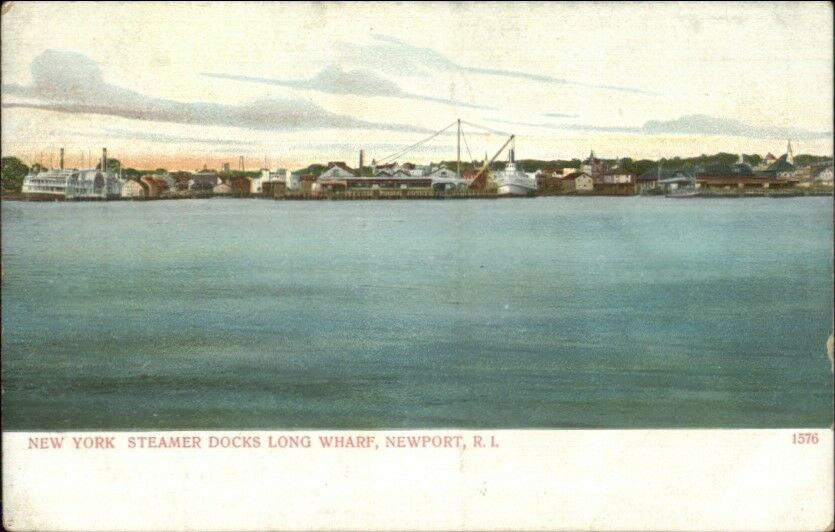
How did he get there? He travelled by sea, and this was his departure point…

The “Newport boat” landing and departure point, Providence.

This picture shows a setting briefly evoked in one of the world’s most famous horror stories…

“Locally, interest was intensified by the obscurity of the cause of death. The professor had been stricken whilst returning from the Newport boat [while he was walking up] a short cut from the waterfront…” (“The Call of Cthulhu”)

Lovecraft himself often “took a boat trip to Newport” from Providence, at the very time he was writing “Cthulhu”. The voyage would have been a day-trip, and thus he would have been at the Providence dockside early. For instance he was writing a letter before dawn in August 1926, and in it he wrote…

Well — it’ll be dawn soon, so that I can tell whether or not I’m going to Newport.

As the Great Depression deepened, he was sometimes able to afford more Newport trips each summer. At one point, what was usually 50 cents in high season became just 15 cents. In August 1932 he remarked on the voyage itself and its duration…

For the past three days I have been taking advantage of the incredibly low steamboat rates (15 cents round trip), and making diurnal [daily] voyages to ancient Newport. It is an admirable relaxation — a two-hour sail past green shores…

Though he regretted that he could not write his letters on the steamship, because…

the vibration will play the devil with my penmanship.

The throbbing steamship that Lovecraft endured was the Sagamore, a “remodelled” Bristol liner that now sometimes served as a local freight and cattle-boat, rather than the more salubrious liner which also plied the same route.

This would be the dawn sight of the Newport dockside, as Lovecraft approached from the sea…

And here is the same dockside seen in the distance, beyond some rather more picturesque fishing jetties…

After bringing in the Providence crowd, the steamship would then cast off for Block Island, returning later to pick up at Newport and return to Providence.

Once ashore in Newport, Lovecraft “wander’d through the living past” of the old town or “hiked into the Bishop Berkeley [British philosopher] country … some four miles beyond Newport beach on the road to Middletown”, through green fields of “sportive lambkins”. Often he sat writing for hours on “the great oceanward cliffs”, and once surveyed “the assembled U.S. Navy” in the bay — the place being also “quite a military town”.

Sometimes he ventured down into the holds of an ancient and venerable sailing ship that had been docked for the benefit of the Navy cadets.

Also, he haunted the oldest graveyards in his… “vain search in Newport for the grave of Michael, the elder James’s father [in his family-tree], who died in 1686”.

A lane in Newport, and Trinity church.

Lovecraft managed to see the town before the circa Fall/Winter 1927 “civic improvements” were made, which in a letter he called “detestable” because they would imperil…

the quaint narrowness of the main street, and the incomparable colour & atmosphere of the ancient wharves

He would also have known the Old Stone Tower, which appears to have had a small park around it where he might have sat and read.

Everyday life in Roman and Anglo-Saxon times – now online

05 Thursday Nov 2020

Posted by asdjfdlkf in Odd scratchings, Scholarly works

≈ Leave a comment

I’m pleased to see that the Quennell’s classic Everyday life in Roman and Anglo-Saxon times has just arrived on Archive.org in downloadable form.

This had been the one book of the set that was not online, when I listed and linked the set in my 2014 post Everyday Life / Everyday Things. The PDF is very over-compressed, but still far better than the usual fare scanned by the Public Library of India (i.e. pictures always so dark that they’re effectively destroyed). The raw .JP2 scans are no better.

H.P. Lovecraft appears to have acquired the “marvellous set” of these books circa 1933.

Lovecraft and Havelock Ellis

05 Thursday Nov 2020

Posted by asdjfdlkf in Historical context, Podcasts etc., Scholarly works

≈ Leave a comment

New on Librivox is a free audiobook reading of the book A Study of British Genius (1904) by the pioneering sexologist Havelock Ellis. This led me to undertake a short survey of what’s known about Lovecraft and Ellis.

First, the book on British genius had originally been published in serial form in 1901 in Popular Science Monthly. It was the sort of serial item that (we might assume) would have caught the attention of the ardently pro-British 11 year-old Lovecraft, perhaps on the newsstands or in the periodicals room of the Providence Public Library. If he actually read it or not at that age is another matter. Though we know that Lovecraft’s uncle had published hypnosis articles in Popular Science Monthly, albeit back in 1876, so Lovecraft could have thought well of the title.

How did A Study of British Genius come to be written? Well, the comprehensive DNB had then recently been issued and thus provided the authoritative data for Ellis’s book…

UNTIL now it has not been possible to obtain any comprehensive view of the men and women who have chiefly built up English civilization. It has not, therefore, been possible to study their personal characteristics as a group. The sixty-three volumes of the ‘Dictionary of National Biography’ of which the last has been lately issued, have for the first time enabled us to construct an authoritative and well balanced scheme of the persons of illustrious genius …

Its appearance was thus a general part of the ‘tightening up’ of general knowledge, and also the affordable public dissemination of such. It forms part of the background of Lovecraft’s early intellectual development circa 1902-1922, in which thinkers sought to “correlate the contents” of the world.

But perhaps he overlooked the book. Such things were, after all, rather taken for granted and uncontroversial before 1914, as the British Empire bestrode the world. More difficult to imagine is that Lovecraft also overlooked Ellis’s substantial book on dreams and dream-worlds, The World of Dreams (1911, reprinted 1926). However, Lovecraft appears not to reference the title in any book I have access too, either pre-war or in the 1926/27 period when it was re-issued and (while writing Dream-quest) he might have been most receptive to it.

Ellis, like most of the early birth-control advocates and sundry leftists and social reformers of the period, was also a strong supporter of eugenic breeding for health. His introduction to the book on British genius positions it as a furtherance of the investigation of the topic undertaken by Sir Francis Galton, for instance. Though this aspect of his work also goes unmentioned by Lovecraft.

Therefore, so far as I know, by the 1920s Lovecraft evidently thought of Ellis only as a pioneering sexologist rather than an ethnographer of British genius and as a fellow explorer of the dreamlands. For instance, in a corrective to Woodburn Harris’s belief in a general female “coldness” on sexual matters, Lovecraft pointed the Harris toward Havelock Ellis and others…

read Havelock Ellis or Bertrand Russell or Lindsey or Fore! or Robie or somebody who knows something about the question! … For Pete’s sake get an intelligible slice of data by seeing what competent specialist physicians, sociologists, anthropologists, historians, psychologists, biologists, etc. have to say from their wide, deep, careful, & accurate observations! That tendency to go only by what you can smell & touch in your own farmyard will be the philosophic ruin of you if you don’t shake it off pretty soon — take off the blinders, boy, & see what the world is thinking & discovering — read, read. (Selected Letters III)

Joshi’s I Am Providence observes that, later in the same mammoth letter, Lovecraft referenced Havelock Ellis’s book “Little Essays in Love and Virtue” (1922, actual title Little Essays of Love and Virtue). Lovecraft could also have imbibed the gist of Ellis’s sexological findings in long conversations with Morton, who had been an ardent public polemicist for such causes — though rather surprisingly the name of Ellis is not to be found in the published Morton letters. Perhaps it was a settled question between them. Lovecraft would of course also have found book reviews and discussion of Ellis’s work in newspapers and magazines.

To Moe in January 1930 he talks of the wider impacts of “Havelock Ellis, Forel, Kraft-Ebing, Freud, etc.” in terms of having helped to brush away cobwebbed Victorian prudery, opening the doors to a less censorious portrayal of ‘modern’ life in literature. (Selected Letters III, also the Moe letters although there “Ellis” is un-indexed).

But that was the 1920s. By the mid 1930s he was rather more interested in debating political-economic matters. Lovecraft continued to mention Ellis as an authority on sex matters, but in May 1935 he told Barlow that he would “be the last to choose” a discussion of Ellis and sexology as a topic of conversation. By then he was more interested in keeping his young proteges away from hard communism, than in nudging them toward the soft cheeks of lovers.

Possibly he also knew from experience that, by the mid 1930s, he would encounter only a mish-mash of formulaic “parrot” talk on the subject. For instance, in 1933 Lovecraft wrote to R.E. Howard…

I always find your arguments full of meat and rich in starting-points for various trains of significant thought — a thing I could never say of the glib, ready-made harangues of those who merely echo Croce or Santayana or Briffault or Marx or Russell or Ellis or some other authority. … These fashion-followers forget that the authorities whom they parrot did not derive their original opinions in this easy [second or third-hand] way. An opinion which is serious with its first-hand creator ceases to be serious when it is mimicked without sufficient basis in experience.

Donald Wandrei by Clement B. Haupers

04 Wednesday Nov 2020

Posted by asdjfdlkf in Historical context, Lovecraftian arts

≈ Leave a comment

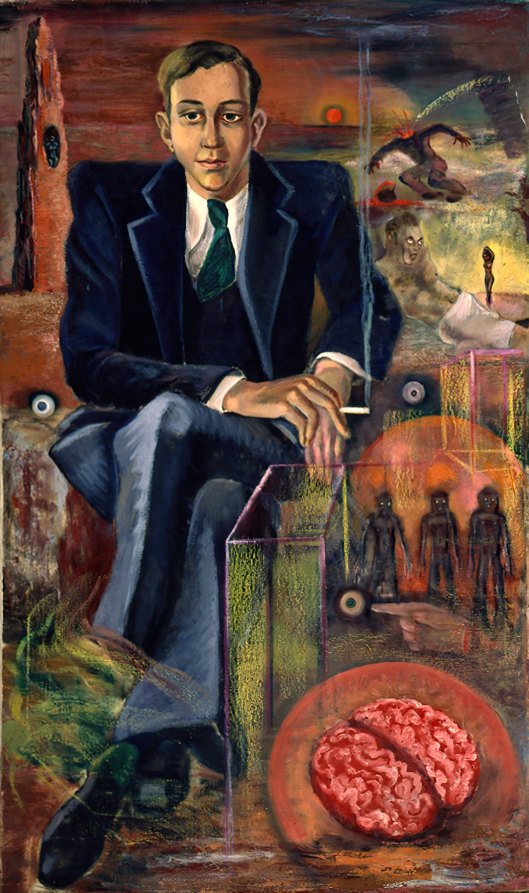
“Author with Dreams”, a circa 1936-46 painting of Donald Wandrei (and his personal dream-world) by Clement B. Haupers.

← Older posts
Newer posts →


Please become my patron at www.patreon.com/davehaden to help this blog survive and thrive.

Or donate via PayPal — any amount is welcome! Donations total at Easter 2025, since 2015: $390.

Archives

  • February 2026
  • January 2026
  • December 2025
  • November 2025
  • October 2025
  • September 2025
  • August 2025
  • July 2025
  • June 2025
  • May 2025
  • April 2025
  • March 2025
  • February 2025
  • January 2025
  • December 2024
  • November 2024
  • October 2024
  • September 2024
  • August 2024
  • July 2024
  • June 2024
  • May 2024
  • April 2024
  • March 2024
  • February 2024
  • January 2024
  • December 2023
  • November 2023
  • October 2023
  • September 2023
  • August 2023
  • July 2023
  • June 2023
  • May 2023
  • April 2023
  • March 2023
  • February 2023
  • January 2023
  • December 2022
  • November 2022
  • October 2022
  • September 2022
  • August 2022
  • July 2022
  • June 2022
  • May 2022
  • April 2022
  • March 2022
  • February 2022
  • January 2022
  • December 2021
  • November 2021
  • October 2021
  • September 2021
  • August 2021
  • July 2021
  • June 2021
  • May 2021
  • April 2021
  • March 2021
  • February 2021
  • January 2021
  • December 2020
  • November 2020
  • October 2020
  • September 2020
  • August 2020
  • July 2020
  • June 2020
  • May 2020
  • April 2020
  • March 2020
  • February 2020
  • January 2020
  • December 2019
  • November 2019
  • October 2019
  • September 2019
  • August 2019
  • July 2019
  • June 2019
  • May 2019
  • April 2019
  • March 2019
  • February 2019
  • January 2019
  • December 2018
  • November 2018
  • October 2018
  • September 2018
  • August 2018
  • August 2015
  • July 2015
  • April 2015
  • March 2015
  • February 2015
  • January 2015
  • December 2014
  • November 2014
  • October 2014
  • September 2014
  • August 2014
  • July 2014
  • June 2014
  • May 2014
  • March 2014
  • February 2014
  • January 2014
  • December 2013
  • November 2013
  • October 2013
  • September 2013
  • August 2013
  • July 2013
  • June 2013
  • May 2013
  • April 2013
  • March 2013
  • February 2013
  • January 2013
  • December 2012
  • November 2012
  • October 2012
  • September 2012
  • August 2012
  • July 2012
  • June 2012
  • May 2012
  • April 2012
  • March 2012
  • February 2012
  • January 2012
  • December 2011
  • November 2011
  • October 2011
  • September 2011
  • August 2011
  • July 2011
  • June 2011
  • May 2011
  • April 2011
  • March 2011
  • February 2011
  • January 2011
  • December 2010
  • November 2010
  • October 2010
  • September 2010
  • August 2010
  • July 2010

Categories

  • 3D (14)
  • AI (70)
  • Astronomy (70)
  • Censorship (14)
  • de Camp (7)
  • Doyle (7)
  • Films & trailers (101)
  • Fonts (9)
  • Guest posts (2)
  • Historical context (1,095)
  • Housekeeping (91)
  • HPLinks (72)
  • Kipling (11)
  • Kittee Tuesday (92)
  • Lovecraft as character (58)
  • Lovecraftian arts (1,624)
  • Lovecraftian places (19)
  • Maps (70)
  • NecronomiCon 2013 (40)
  • NecronomiCon 2015 (22)
  • New books (966)
  • New discoveries (165)
  • Night in Providence (17)
  • Odd scratchings (984)
  • Picture postals (276)
  • Podcasts etc. (430)
  • REH (184)
  • Scholarly works (1,467)
  • Summer School (31)
  • Unnamable (87)

Get this blog in your newsreader:
 
RSS Feed — Posts
RSS Feed — Comments

H.P. Lovecraft's Poster Collection - 17 retro travel posters for $18. Print ready, and available to buy — the proceeds help to support the work of Tentaclii.

Proudly powered by WordPress Theme: Chateau by Ignacio Ricci.