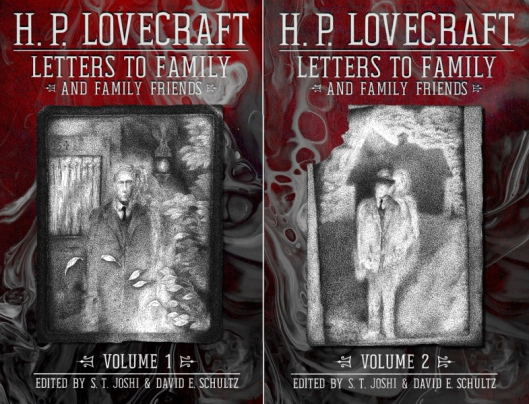
hplovecraft.com now has a page for H.P. Lovecraft: Letters to Family and Family Friends, giving the full table of contents for both volumes.

05 Monday Oct 2020
Posted in New books
hplovecraft.com now has a page for H.P. Lovecraft: Letters to Family and Family Friends, giving the full table of contents for both volumes.
05 Monday Oct 2020
Posted in New books, Scholarly works
Donald Wandrei’s The Complete Ivy Frost is set to ship. 720 pages, in paper hardcover.

Also shipping soon, the Ray Bradbury edition of The Pulpster, Number 29.
04 Sunday Oct 2020
Posted in Historical context, Lovecraft as character
Dipping at random into my newly arrived book of Letters to Donald and Howard Wandrei has yielded up a new addition to my recent Harlem post at Tentaclii. In a 1927 letter Lovecraft talks of the sights the lad must see in New York, and one of these was Harlem…
sinister and fascinating — not a white face for blocks. Lenox Ave. subway to 125th St. — walk north.
This most likely indicates a route Lovecraft was familiar with. Possibly the one he took to visit Morton, who lived in a Harlem brownstone, or one that Morton took to give Lovecraft a taste of Harlem. We know from Lovecraft’s day-by-day 1925 Diary that he made a trip into Harlem at least once.
Update: There was at least one meeting of the Kalem Club in Harlem, at Morton’s place in the heat of August 1924, and this is attested by a Lovecraft letter in Letters to Family and a mention in Kirk’s Diary.
Also found was a new addition to the ‘Lovecraft as character’ list, albeit not extant. In a 1931 letter Lovecraft revealed that Frank Belknap Long was busy writing a novel with Lovecraft and his circle as lightly-veiled characters. This work has evidently not survived. Although Long’s “The Black Druid” (1930) has, in which Lovecraft is the lightly-veiled “Stephen Benefield”. Possibly the novel was an expansion of “The Black Druid”?
04 Sunday Oct 2020
Posted in Scholarly works
Joan Passey’s Corpses, Coasts, and Carriages: Gothic Cornwall, 1840-1913, an open PhD thesis for the University of Exeter, September 2019, online and public in February 2020.

03 Saturday Oct 2020
Posted in Odd scratchings
There’s now a robust fix for automatically reaching the Classic Editor, for users of free WordPress.com blogs.
This means that, for the time being at least, free blog users at WordPress.com don’t have to use the free offline-blogging software Open Live Writer. It was looking like that was going to be the only viable option, to avoid the horrible Block editor at WordPress.
The only element of the UI that you won’t be able to get via the older interface is the “Bell” alerts. Because the “Bell” sidebar (showing alerts from across your blogs) now no longer loads up in the older UI. To see these alerts you need to temporarily click into “My sites”, take a peek at the slide-out Bell sidebar there, then go back again.
03 Saturday Oct 2020
Posted in Historical context
Lovecraft was once recruited by Henneberger as the new editor of The Magazine of Fun, of all things. It appears to be about the closest he came to employment in the period, unless one counts a short stint of envelope-addressing, some small bits of copywriting, and a day as a New York City debt-collector.
“In the fall of 1924 Henneberger provisionally hired HPL to edit a new humor magazine that he was planning (possibly titled the Magazine of Fun) at $40 per week; HPL spent the next several weeks preparing jokes for the magazine, but it never got off the ground. [As pay] Henneberger gave HPL a credit of $60 at the Scribner Book Shop” (Lovecraft Encyclopedia).
“He has — or says he has — hired me for his new magazine at a salary beginning at $40.00 per wk” (letter from Lovecraft)


This was the Magazine of Fun at the end of 1921 / start of 1922, published out of Chicago which was where Henneberger was located. There was much verse in it, probably best described as being “ribald” in a saucy seaside-postcard sort of way, some jokes that are still good, and with occasional touches of dry social satire and pokes at censorship.

One can thus see how Lovecraft ‘the metrical mechanic’ might have used his talents in churning out such light verse, something he could do at the drop of a hat. He also had quite a comic side and a line in ‘snappy-patter’ newly picked up from Sandusky, as one can see in his letters.
In the May 1922 issue Lovecraft’s friend Ernest La Touche Hancock can be found contributing some light verse…

Hancock was a fellow professional light versifier and fellow British Empire loyalist, then getting toward the end of his life. Hancock was working at a time when one could still make a living from such an activity, and had he been younger (he died in 1926) he might have been the one offered the editorship. His verse is also found in other issues of the magazine. His presence suggests that this is the correct Magazine of Fun, and this hunch is confirmed by my finding a 1922 ownership statement that has Henneberger as owner…

The final issue known to collectors appears to have been April 1923, so my guess is that — with Weird Tales successfully launched — the title was given a final big ‘send-off’ issue and then shelved and pencilled in to be re-started under a new editor some 18 months later. There may of course have been plans for a wholly new title in that line, but it seems unlikely — why waste a snappy title that the news-stand buyers recognised?

Its final issue had offered a “French art section with 100 illustrations”. “French art” then being a euphemism for naughty pictures, these presumably helping to justify the cover’s double-price price-tag of 50 cents. One wonders how far its sales helped under-write the bills arising from the first issue of Weird Tales, which was on the news-stands February-March-April 1923. I guess the new book The Thing’s Incredible! The Secret Origins of Weird Tales may well have more details, but its price is staying high and thus I have not yet seen this.
One imagines that, as the new editor, Lovecraft might have tried to take title back toward its 1921/22 approach as seen above. Certainly it’s difficult to imagine Lovecraft helming a magazine of “under-the-counter” girlie drawings, “French art” and explicit limericks. But Lovecraft could probably have managed a ‘snappy verse’ quarterly in the 1921/22 style, perhaps with the likes of ‘wisecrack’ Sandusky and experienced light-versifier Kleiner as contributors. It’s perhaps relevant that he went to see Sandusky in Boston at this time. He could supply the magazine’s anti-liquor comedy-travelogues himself…

It’s delightful to think that a brown folder, somewhere in the world, might yet be found to contain the six weeks of work done by Lovecraft in the Fall/Autumn of 1924, its faded covers opening to reveal an unknown wad of lusty limericks, jaunty jokes, cunning pokes at the censors, and snappy cracks all signed ‘H.P. Lovecraft’.
02 Friday Oct 2020
Posted in Lovecraftian arts, Odd scratchings
If one wanted to start on Derleth ‘as an entertaining fiction writer’, where would one start? Here’s what the landscape looks like to me, after a short survey:
Science-fiction:
August Derleth’s science-fiction collection is all in a book called Harrigan’s File, and below are Archive.org links to the tales, in the order of appearance in the book. The tales are said to be akin to Arthur C. Clarke’s Tales from the White Heart, and all feature newspaperman Tex Harrigan running up against strange inventions and curiously weird-science occurrences. If you want the book it’s a late Arkham House title, and as such it seems to be fairly easy to get hold of in used print at around $35 inc. shipping.
The Other Side of the Wall.
An Eye for History.
The Detective and the Senator.
Protoplasma.
By Rocket to the Moon.
The Man Who Rode the Saucer.
So that’s basically all the science-fiction he wrote, and they sound rather fun in a 1950s way.
The Cthulhu Mythos tales:
What of his Cthulhu Mythos tales? The Nocturnal Revelries blog recently ploughed through all of August Derleth’s Cthulhu Mythos Fiction and gave a flavour of just how repetitive and ‘haunted house’ it all gets. Regrettably he refers vaguely to the repetitions, rather than saying which ones are not repetitive and/or are actually the best of the bunch. But that job appears to have already been done by others. A well-edited ‘best of’ the relevant Derleth is apparently to be found in the book In Lovecraft’s Shadow: The Cthulhu Mythos Stories of August Derleth (1998). (TOC). Or it could be found… if it was affordable, as it’s now become collectable and thus ridiculously expensive. Time for a budget ebook edition of this collection, I’d suggest, if the copyrights and estates permit it. Although at least the book’s long Introduction is online for free in HTML. I can’t do the same Web linkage for this book as I do above for Harrigan’s File, since many of the contents are not on Archive.org.
Solar Pons:
The other big and alluring strand is of course his detective-mystery tales of the Sherlock Holmes-alike Solar Pons, said to be among the better Holmes pastiches and also rather good mystery stories in their own right. Both hefty volumes of the Solar Pons Omnibus are on Archive.org, but only as “Books to Borrow” and these are said to collect all the Derleth Pons stories. Just as well, as they list at forbidding prices in print. The problem here is that apparently this Solar Pons Omnibus managed to badly corrupt the text. These problems were corrected by the revised The Original Text Solar Pons Omnibus, but this is also now ridiculously expensive. Regrettably there appears to be no handy eight-story “The Best of Solar Pons” as an £6 ebook, with the text in good form, to serve as a brisk sampler for those who might be interested in starting in on the full set of tales. The other problem is that others have also done ‘pastiches of pastiches’ for Pons, and these now obscure Derleth’s own Pons in the listings.
02 Friday Oct 2020
Posted in Historical context, New discoveries, Picture postals
The post-war chill of January 1946 was made a little colder for readers of Esquire magazine by an article on the 1938 New England floods, illustrated with with a very gloomy picture specially commissioned for the article.

Not quite a “Friday ‘picture postal'”, but a flooded Providence is as as-good-as. This image unwittingly visually trailed a short profile and supposed memoir of one H.P. Lovecraft, then a figure of quite some mystery. This item was to be found later on in the issue, and was penned by John Wilstach.

S.T. Joshi bluntly calls this memoir “fictitious” in his monumental Lovecraft Bibliography. It’s easy to agree, and for this reason I won’t muddy the waters by republishing it here. The editor of Esquire magazine even appears to implicitly warn his readers of being too credulous, in his trailer-blurb for the article…

In the article itself Wilstach claims to recall that he was drinking with the poet Hart Crane one day in New York in the twenties, and Hart happened to have the crumpled manuscript of Lovecraft’s “He” in his pocket. Crane thought highly of the tale and asked Wilstach to accompany him then and there on a visit to Lovecraft’s decrepit room in Red Hook, as he allegedly felt tender and protective toward the ‘old gent’. Given what we now know of Crane’s antipathy toward Lovecraft, and his apparent ignorance of the tale (only published September 1926, after Lovecraft had left New York), this seems highly unlikely.
But possibly the Esquire article needed jazzing up for acceptance. As such it’s not impossible that Wilstach substituted the famous Crane for a lesser writer he had actually known and who had known Lovecraft. His biographical blurb puts him in about the right place for that…
John Hudnall Wilstach (b. 1891) was a short-story writer and novelist specializing in circus and carnival life, crime, and science fiction.
Given his apparent circus specialism, one wonders if a possible candidate for the ‘real’ Crane might then have been Arthur Leeds. Leeds had a circus background, and might once have asked Wilstach to look over Lovecraft’s new ‘New York’ tales with a view to finding a market in ‘the slicks’ in which Wilstach sometimes published. That would be one hypothesis which could fit, but more would have to be known about Wilstach in 1920s New York to say more.
It can however be more firmly suggested that Wilstach had most of his personal material for the Esquire article from Paul Cook. Comments on the Esquire article, on the front page of the NAPA amateur journal the Literary Newsette for 2nd February 1946, seem to confirm this…
Wilstach obviously “… obtained most of the facts from W. Paul Cook, for whom he seems to have a strong admiration.
Wilstach’s article also claims he once made a post-New York winter visit to Lovecraft’s home in Providence, though he gives no address or date and not a single telling detail. There are however a couple of interesting points in his article, arising from his likely Cook connection. In the second half of the article there is an un-credited quote, which the editor has surprisingly let slip through un-credited. Presumably this quote is from Cook, given Cook’s known concern over people making the Poe comparison…
A friend once suggested that he stimulate dreams by means of drugs. Lovecraft exclaimed that if drugs would give him any worse dreams than he experienced without them, he would go mad. His dreams were his own. It is unfair to call him equal to Poe, greater than Poe, or lacking in certain Poe qualities. Better, consider him as standing alone.
That sounds like Cook, although if the quote was hooked from print I can’t discover. Evidently Wilstach had talked with Cook, since he relates the ‘Lovecraft wouldn’t disturb a sleeping cat in his lap’ anecdote, and states it was “told me by Cook”. A later June 1946 Esquire letter by Wilstach, defending his claims of a mid-1940s “Lovecraft cult” against a questioning March 1946 letter by Weird Tales founder Henneberger, shows that Wilstach had access to Cook’s mid-1940s little magazine Ghost. In this same letter he also talks of “my friend Cook”.
Given this reasonably firm Cook connection, one point in Wilstach’s article does ring true…
The [Lovecraft] family had been prominent in Providence. It was Lovecraft’s ambition to buy back the old home and restore the family’s position. He was almost in tears when he found a number of his grandfather’s books in a bookshop. He bought all he could.
Given that we know Lovecraft went on long book-hunting trips in Providence with Cook, both at the store of ‘Uncle Eddy’ and at other book-sellers, this last seems quite likely to be a fragment of memoir had via Cook. One then wonders if finding “his grandfather’s books in a bookshop” can be confirmed by a mention somewhere in Lovecraft’s letters? It does seem the sort of thing he would have told at least one correspondent about, though I don’t recall encountering it.
The Esquire article succeeded in bringing Weird Tales founder Henneberger to print, on the letters page of the June 1946 issue. This item is not in the Lovecraft Bibliography. He makes a pithy rebuttal without specifics, but more interestingly flashes a light on the very moment of Lovecraft’s initial reception in the Weird Tales office.

This itself is somewhat questionable in light of what we now know. Henneberger recalls that it was he who discovered Lovecraft, via Home Brew and the story “Randolph Carter”. But we know it was Cook’s The Vagrant that had published “Randolph Carter” in May 1920, not Home Brew. While Henneberger was doubtless keeping a close and wary eye on Home Brew (a possible competitor), it’s less certain he had also been tracking The Vagrant since summer 1920. However, its quite likely that in late 1922 he had made enquiries among the amateur journalists about suitable writers for his new Weird Tales, and been sent a bundle of The Vagrant.
He has it that he “contacted Lovecraft through this magazine” via editor Houtain, and personally invited a submission from Lovecraft. He was sent “The Rats in the Walls” and after reading it he showed it to his editor who was incredulous. We know it was published in Weird Tales, but not until March 1924, and we also know that this was not the “first” story to see print. That was “Dagon”, in the Halloween 1923 issue.
We also know that “Rats” could not have been among the initial handwritten manuscripts Lovecraft sent to Weird Tales in May 1923, since the tale was only written in late summer 1923. “Rats” was eventually submitted to Weird Tales, but it only arrived in the office circa 10th November 1923 (Selected Letters I, page 259). “Rats” had been typed by Eddy for Lovecraft, presumably with a couple of carbons, and submitted in good form to Argosy, which was one of the well-paying ‘slicks’. Evidently a carbon had also been mailed to Arthur Leeds, since Lovecraft states Leeds had written back to say he felt the tale was just too horrible for Argosy to accept… and so it proved. The rejected “Rats” was then quickly sent on to Weird Tales, to join the pile of other Lovecraft tales awaiting consideration.
One way of explaining Henneberger’s memories is then to say that he had indeed been tracking Home Brew and that, via Houtain its editor, he had indeed acquired Lovecraft’s address and passed it on to his editor at Weird Tales. This is not incompatible with the known fact that Lovecraft’s friends were drawing the new Weird Tales to his attention and urging him to submit some stories. We know that Lovecraft had eventually after much persuasion sent in stories in passable hand-written manuscript form in May 1923 (“Dagon”, “Carter”, “Ulthar”, “Arthur Jermyn”, The Hound”). But Henneberger’s 1947 letter implies that Lovecraft only really came to his attention when the Weird Tales editor queried how startlingly good the Eddy-typed “The Rats in The Walls” was, when it was read in mid November 1923. Clearly this Lovecraft was a cut above his Home Brew “Herbert West” and “Lurking Fear” serial-shockers, and his sent-in tales “Carter” and “The Hound” obviously gave only a hint of what he could really do. This seminal moment in time would then be what Henneberger was recalling in his 1947 letter. He did indeed ‘discover’ Lovecraft via Home Brew, at least in terms of getting an address out of Houtain. But he perhaps wasn’t quite aware of what a great writer he had got hold of, until his startled editor landed “Rats” on his desk for a second opinion. What he then pulled off his shelves to comfort his editor would not have been the serial-shockers of Home Brew, but was more likely something like some back-issues of Cook’s amateur publication. Containing as it did items such as the 1920 printing of “Randolph Carter”, and more importantly Cook’s 1919 essay “Howard P. Lovecraft’s Fiction” which had introduced “Dagon” to the world. In this respect it’s perhaps notable that “Dagon” was the first Lovecraft story printed in Weird Tales (October 1923). Evidently there was a copy of this in good form, somewhere in the Weird Tales offices. The presence of this last item in print would be ‘a given’, had Lovecraft in May 1923 sent his “Dagon” to Weird Tales not in the handwriting which obscured the other tales in his bundle, but rather in Cook’s 1919 printed form.
Such was the past, as Henneberger recalled it after some 25 years. What of the future? He has certainly been proven correct in his prescient forecast that Lovecraft…
will be read as enthusiastically in 2023 as he was in 1923
A useful reminder that Halloween 2023 will be the 100th anniversary of Lovecraft’s fiction first appearing in Weird Tales.
01 Thursday Oct 2020
Posted in Scholarly works
A detailed proposal for a Fantasy Fiction Dewey Decimal Classification system, as fantasy stood in 1964. An example…
12. Unrationalized permutations, whimsies.
12.5 Animals that talk.
12.6 Unliving things personalized.
I presume things have moved on, both in terms of fine-grained classification and in fantasy’s crossover sub-genres. But it’s still an interesting snapshot of the field at that point in time.