
I’ve found more late 1940s memories of H.P. Lovecraft, from Muriel Eddy. Given that Joshi holds her 1940s memoir as more reliable than those of the 1960s, and that the earlier 1948 memoir I found in a similar magazine (see the post a few weeks ago) turned out to be quite provable from other sources including Lovecraft himself, then it seems worth trusting these too.
There are no great revelations here, as there was with uncle Eddy the bookseller. But I note that the following are not listed in Joshi’s Comprehensive Bibliography nor in de Camp’s biography.
1) Startling Stories, March 1949. “More Lovecraftiania”.
Her first “Lovecraftiania” letter in Startling Stories is banal and of no interest, but this second letter does offer one interesting and genuine-sounding specific memory.


When Lovecraft married… “his two aunts gave our children over 100 empty chocolate boxes to play with! (In fact, a bath-tub full!)”.
The boxes at Angell St. are known from Eddy’s unreliable 1961 memoir. Her main published 1940s memoir (which I now have access to, via A Weird Writer in Our Midst) talks only of two items of furniture being taken over to the Eddys, on Lovecraft’s departure for New York. But this comment on the “chocolate boxes” event may be of interest, because here it’s from 1949 and she even gives the quantity of boxes.
What was he doing with these boxes? The bathtub would, I suppose, be the curious but somewhat logical place to store a collection, if collection they were. Such boxes would otherwise be difficult-to-stack and the stacks inclined to tumble over, being made up of oddly-sized lightweight boxes. So far as I know, the 1920s was not a time of silver-foil collecting-for-charity (which was ‘a thing’ in the mid 1970s following the oil crisis, which caused a knock-on shortage of paper and tin-foil). Thus I doubt the boxes were collected for charity re-cycling. Did Lovecraft have a vague hope of taking up a hobby as a chocolatier at his little gas hot-plate, and re-filling the empty boxes with new weirdly-moulded chocolates to surprise his friends with? It’s a delightful notion, but it seems unlikely. Some vague Joseph Cornell-like ambition to turn them into proto-surrealist art-boxes, perhaps? Again, unlikely at that point in history.
Perhaps they were simply saved for their value as objects, as traditionalist works of ornate construction and printed art which he didn’t care to throw away? Here are quotes from historians on the matter of such boxes…
* “In the 1920s some of the boxes became a work of art in themselves” (The Science of Chocolate)
* “the chocolate boxes of the 1920s and 1930s were largely sentimental holdovers of Victorian romanticism. Modernism was meant to replace this old-fashioned mode with bold new designs [but failed in that respect].” (Chocolate: Food of the Gods).
* “the fancifully beribboned chocolate boxes which were another 1920s addition to the stock of national pleasures.” (Island Stories, of British boxes).
* The critic Banham twitted the great architectural historian Pevsner for bringing… “‘even so slight a thing as a chocolate box’ within his critical system”, while “… apparently not knowing that the design of chocolate boxes was a matter of wide (albeit joking) concern in the 1930s (cartoon of an aesthete pointing the finger of scorn at a sunset and shouting “Chocolate box-y, chocolate box-y!)” (A Critic Writes: Selected Essays by Reyner Banham)
Such lids would contain sunsets and kittens and suchlike, finely printed. Sunsets, kittens, chocolate… well, we know how Lovecraft felt about such things. About Olde worlde scenes from England and the 18th century, too.

Thus, it is not impossible that he kept a collection of the ‘best boxes’ with their traditionalist art, delicate iridescent foils and fancy construction, much in the same way as his friend Morton collected stamps. Of course the fanciest of such boxes would have been expensive, and Lovecraft generally had little money. But other people may have purchased and eaten the chocolates — then given the boxes to him because they knew of his interest in them. Slightly unlikely perhaps, but one imagines his aunts had many chocolate enthusiasts among their friends.
“And yet, who shall say that a bathtub cannot awake the Muse?” (Lovecraft, letter to Kleiner, 1916).
But why not just razor off the artwork and extract the foils, and thus save a lot of the space? He was, after all, quite seriously pressed for living space until 1933. I wonder if perhaps one solution is that the boxes were intended to one day store the sorted and archived collections of his voluminous collection of incoming correspondence? That seems quite a logical solution to his storage problems, since such a picture-coded ‘visual filing cabinet’ would be both practical and fast for consultation. ‘Loveman is in the box with the turtle-doves on it’, etc. Such boxes would make eminently suitable containers for letters, being complete with strong ribbon-ties, provided that the bath tub was thoroughly dried before re-installing the boxes in it.
However, that the aunts gave away 100 or so apparently empty boxes when he went to New York suggests the tub was more likely a curious form of art collection, arising from the fancy-box style of the era. But, on his later return to Providence, he may have found such a practical or long-intended use for a new collection of boxes as a form of letter-storage? Anyway, that would be one theory. Those who have full access to the letters may be able to shed more light on the matter.
The other possibility is that they formed temporary storage for papers when working out in the open, as he did for long stretches in the summer. One would be able to press a peg or long knitting-needle through the card of the box, and so fix them to the turf to prevent the wind taking them. They would also be relatively shower-proof.
Yet another possibility is their use as mailing-boxes for sending manuscripts and collections of amateur journals to his friends and correspondents, suitably wrapped in brown paper. And yet I’ve never heard or read of a correspondent mentioning such boxes.
For the moment it’s a bit of a mystery. We may learn more about such curious domestic arrangements once Lovecraft’s forthcoming ‘aunts letters’ are published. The boxes are of course only a small and seemingly trivial point in Lovecraft’s life, yet clarifying this point may help to forestall a shoddy biographer or hater’s claim that… ‘Lovecraft spent his days in squalor, surrounded by discarded candy-wrappers’ etc.
2) Fantastic Adventures, October 1948. “Shaver and Lovecraft”.

Lovecraft liked to watch husband Eddy writing his music, and he and Lovecraft talked about setting “weird poems” to music. Again this is possibly interesting because of the early date of the memory. I don’t see this point mentioned in the 1940s and 1960s Eddy memoirs I have access to.
3) Fantastic Adventures, December 1948. “Lovecraft’s Wife”.
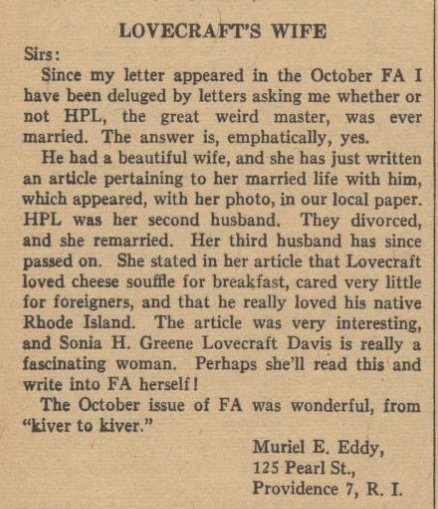
Only of very slight interest. Muriel Eddy notes a newspaper article by Sonia, presumably the memoir of Lovecraft first printed in the Providence Journal. This then must be the article abridged and edited by Winfield Townley Scott, and printed in The Providence Sunday Journal for 22nd August 1948. It later appeared in Books at Brown and then in Lovecraft Remembered.
4) Incidentally I have also found that Ghost Stories magazine for April 1929 has a letter to the editor from Muriel E. Eddy with the address of “317 Plain Street”, Providence. The content is of no interest, but the address may be of use to some researchers. She talks of living on “Second Street, East Providence” in her main 1940s memoir, then moving across the city so that Lovecraft called on the Eddy’s at a different address when he returned from his New York sojourn.
> Her [Muriel Eddy] first “Lovecraftiania” letter in Startling Stories is banal and of no interest
What issue did this “first” Lovecraftiana letter appear in? Thanks.