Journal of Geek Studies. Not peer-reviewed, but with editorial oversight and an approval process. Studies by geeks, not of geeks.


10 Monday Sep 2018
Posted in Scholarly works
Journal of Geek Studies. Not peer-reviewed, but with editorial oversight and an approval process. Studies by geeks, not of geeks.
10 Monday Sep 2018
Posted in Lovecraftian arts, Podcasts etc.
Final Guys Podcast has just posted a new interview (MP3 link) with the well-known Lovecraft audiobook reader Wayne June.
Here’s a sample of his gravelly voicework, on Lovecraft’s “The Rats in the Walls”…
[youtube https://www.youtube.com/watch?v=o0eDis-w-90?rel=0&start=22&w=560&h=315]
10 Monday Sep 2018
Posted in Lovecraftian arts, Podcasts etc.
A few nights ago a new orchestral work by Guillaume Connesson premiered in Germany, “The Cities of Lovecraft” (aka “Les Cités de Lovecraft”, aka “Les Trois Cités de Lovecraft”). The National German Radio service (NDR) now has a complete audio recording of the 25 minute performance online and this is accessible from outside Germany.
Update: Seems to have been taken down. The Lovecraft work opened the recording I linked to, but a few days later NDR broke the link totally and sent the traffic to their homepage. I guess their online “listen again” service only lasts for a week? But there’s an Archive.org community audio backup available here.
Here’s my approximate translation of the key descriptive section in the venue’s German programme notes brochure, with some descriptive additions of my own which reflect my hearing of the work:
Celephais: In the opening movement, Randolph Carter goes to meet his old friend Kuranes in the shining port city of Celephais. Brass fanfares describe the bronze gate through which he enters the dream-city, before a melody of violins evokes the weaving and bustling dream-life of the city’s streets. In the section “The Temple of Turquoise” colourful trumpets express Carter’s encountering of pagan celebrations, followed by a quiet chorale titled the “Rose and Crystal Palace of the Seventy Delicacies” as he enters ascends to more refined parts of the city. The “Seven Processions of the Orchid Crowned Priests” are then encountered, and given a great crescendo to end the first movement.
Kadath: In contrast to the radiant first movement, the scene then shifts to “Kadath”, the gloomy outpost of ancient gods located in an icy region of Antarctica named “The Plateau of Leng”. Lamenting violas emerge from the noise of the wind machine, then twelve-tone passages disseminate culminating chords (so-called “clusters”). Nyarlathotep, the eerie envoy of the ancient gods, approaches a throne room… He is given voice in a solo viola that sings and ripples in half and a quarter tones above kettle-drums and mad titterings.
The Golden Dream-City: Without a pause, a third short movement follows: Mr. Lovecraft begins to drift up from his nightmare slumber and the scene of his dream begins to change into his familiar dream-vision of a distant mighty city in the golden sunset. This is briefly evoked in the form of an intoxicating short dance, but some orgiastic overtones emerge in it at the very end.
09 Sunday Sep 2018
Posted in Lovecraftian arts
Oh no, call the culture-police! The Tearoom of Despair thinks Alan Moore’s Providence series of comics to be a turgid terror, and has an entertainingly argumentative review to back up his sentiments.

09 Sunday Sep 2018
Posted in Odd scratchings
“The reason Pluto lost its status as a planet in 2006 is not valid, according to a recent study led by planetary scientist and UCF alumnus Philip Metzger.”

There’s a Lovecraft connection here, of course. In 2015 science blog Doc Madhattan blogged details of Lovecraft and the discovery of Pluto.
09 Sunday Sep 2018
Posted in Historical context, Scholarly works
W. Wiles, “The Corner of Lovecraft and Ballard”, Places, June 2017.
“H.P. Lovecraft and J.G. Ballard both put architecture at the heart of their fiction, and both made the humble corner into a place of nightmares.”
A good long article, in a landscape and urbanism journal. Though the author doesn’t know about a possible ‘root’ for this in Lovecraft’s life, to be found in his mother’s apparent belief in and fear of… “creatures that rushed out from behind buildings and from corners at dark” as her madness deepened. The quote was from Clara Hess, a neighbour of his mother…
“I remember Mrs. Lovecraft spoke to me about weird and fantastic creatures that rushed out from behind buildings and from corners at dark, and that she shivered and looked about apprehensively…” — Memories of Clara L. Hess, given in De Camp, Lovecraft: A Biography.
This sources to: Clara L. Hess, letter to The Providence Journal newspaper, 19th September 1948, later reprinted by Derleth (with some additions gleaned from an interview with her, including the “corners” item) in the book Something about Cats and other Pieces, Arkham House, 1949, under the title “Addenda to H.P.L.”
If you’re interested in this topic, you may also be interested in two hours of the Lovecraft philosopher Graham Harman, speaking at the Secret Life of Buildings Symposium: 21st October 2016.
09 Sunday Sep 2018
An early appearance of H.P. Lovecraft in fiction is to be found in “The Black Druid” by Frank Belknap Long, published in Weird Tales for July 1930. The Editor, Farnsworth Wright, knowingly bills the story on the contents page as: “A short tale that compresses a world of cosmic horror in its few pages”, trusting the regular reader to make the connection between “cosmic horror” and Lovecraft.
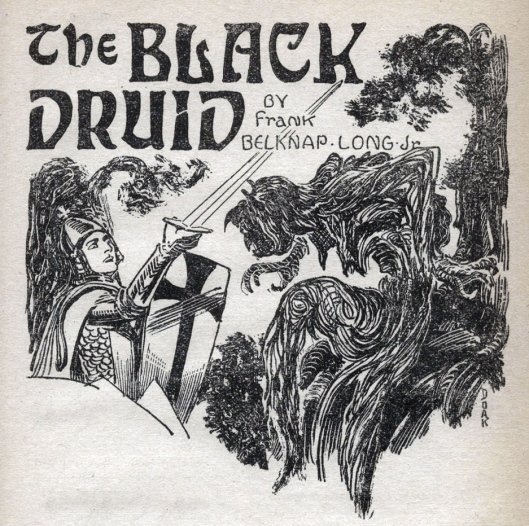 The picture illustrates the Lovecraft character in his ‘dream form’.
The story is interesting to scholars of Lovecraft’s life for being a knowing bit of fun-poking fictional commentary on Lovecraft, by someone who knew him on a near-everyday basis during the New York years. Lovecraft is only lightly veiled as “Stephen Benefield” and the character has similar concerns, physical attributes and locales. The story also fictionalises Lovecraft’s wife Sonia. Possibly the Bene in the name Benefield was even a comment on Lovecraft’s frugal diet, hinting at beans.
Archive.org’s OCR of the text is middling, but I’ve made the story readable as a PDF and have given it some annotations and a little introduction — along the way solving a very minor scholarly mystery about an entry in Lovecraft’s Commonplace Book.
08 Saturday Sep 2018
Posted in Lovecraftian arts, Unnamable
I’m pleased to say I’ve been sent a low-res PDF of the new Lovecraft graphic novel He Who Wrote in the Darkness, for review, and am currently half-way through savouring it.
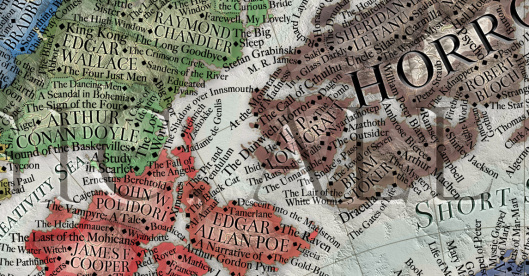
When faced with a low-res PDF many reviewers might have preferred to have been sent a proper Kindle app store review-copy. Because that would have opened with the Amazon app — an app which offers a panel-by-panel ‘guided’ view of comics when reading. For the benefit of other reviewers of graphic novels who want such a ‘guided’ view, here’s what you do when you get an awkward layered PDF (i.e.: where the text is on a separate layer that sits above the art).
1. On your Kindle tablet, add a side-load install of the wholly free Comic Time Reader app as a downloaded .APK file. It does ‘panel detection’ (aka frame-by-frame viewing, aka ‘guided view’), just like Comixology and the Amazon Kindle Viewer do for purchased comics. Given this vital feature, seemingly unique among free apps not tightly tethered to a payments ecosystem, it’s perhaps unsurprising that Comic Time Reader is not present on the Amazon App Store where it would impinge on Amazon’s business model. But it works fine on the 2017 Kindle Fire HD 10″ tablet. The only problem is that the app can’t load PDFs.
2. Then convert your .PDF to .CBR with the Windows desktop freeware Comic Book Archive Creator, at maximum image quality and with .JPG output. Unlike its only free rival Comic Rack, Comic Book Archive Creator can correctly handle a PDF with layered text when converting. Also it appears to save pages at 600dpi, which means that ‘the jaggies’ are minimal on the flattened lettering, balloons and captions. Its only problem is that it works v-e-r-y s-l-o-w-l-y and can be a bit of a system hog while it’s working.
3. If you left Comic Book Archive Creator on its default output type, rename its resulting .ZIP file to .CBR format. .CBR is just a bunch of numbered .JPG page-scans inside a re-named .RAR or .ZIP file, so it’s a very flexible format. Now send it over to your Kindle. You’re then ready to read your graphic novel in a ‘guided’ frame-by-frame manner in the excellent free Comic Time Reader. If Comic Time Reader occasionally has trouble detecting a frame edge in a complex layout, you just press and hold in one corner of the frame, then drag your finger to the opposite corner. That tells the app where the frame is.
If you end up with a ridiculously large 600Mb-to-multiGb comic, because the source input was actually high-quality at around 6800-pixels per page and/or a very long graphic novel, then do the following:
1. Simply unzip the page-images to a folder
2. Open the folder with Irfanview, shift-select all images and press “B” to run a batch reduction on them.
3. In the Batch window. selected Advanced and then set a pixel size, say 2400px on one side. Ensure you are setting your output directory to be different than the input directory.
4. Then re-zip the series of images output from Irfanview and re-name into a .CBR or .CBZ file.
Irfanview’s batch has the advantage over Photoshop here, in that it knows how to re-size the pixel dimensions of an image without needing to know the dimensions on both sides. It’s also much faster than Photoshop.
08 Saturday Sep 2018
Posted in Scholarly works
Mythlore: A Journal of J.R.R. Tolkien, C.S. Lewis, Charles Williams, and Mythopoeic Literature has a two-issue rolling wall, meaning that you can’t download the full-text for the last couple of issues. But, as time goes by, the articles gradually become free and public. You can bypass this by accessing Mythlore at the Free Online Library, where the latest couple of issues are available and public.
This means that while their new article “”Love of Knowledge is a Kind of Madness”: Competing Platonisms in the Universes of C.S. Lewis and H.P. Lovecraft” appears to be locked down until April 2019, it’s actually free here. The same issue also has “”Letting Sleeping Abnormalities Lie”: Lovecraft and the Futility of Divination”, and again it’s free here.
08 Saturday Sep 2018
Posted in Lovecraftian arts, New books, Scholarly works
Robert McParland’s new book on Myth and Magic in Heavy Metal Music, a side-project from his recent book on the history of the uses of science fiction in 1970s rock music.

08 Saturday Sep 2018
Posted in Odd scratchings
Up for auction at Heritage Auctions, A Lovecraft family Bible, (apparently) owned by Lovecraft’s mother early in her marriage. This popped up in the news circa 2014, and there was some scepticism. It’s now up for auction with five days to go. Claimed to have been a wedding gift to Lovecraft’s mother, and with an apparent marriage certificate and a couple of other items in it.

07 Friday Sep 2018
Posted in Picture postals

Benefit St., Providence, with what appears to be a roving ice-cream pedlar and his cart.
Appears to be a view north along Benefit Street, from the point where Angell Street comes down the hill (from the right of the picture) and ends, and then drops down the hill as Thomas Street (the downward opening of which is seen on the left of the picture). See part of the name “Angell St.” written above the lamp-glass…

There’s a glass plate of the scene, at what appears to be an earlier point in time (1890s?)…
