• About
  • Directory
  • Free stuff
  • Lovecraft for beginners
  • My Books
  • Open Lovecraft
  • Reviews
  • Travel Posters
  • SALTES

Tentaclii

~ News & scholarship on H.P. Lovecraft

Tentaclii

Monthly Archives: September 2013

Albert August Sandusky (1896 – c.1934?) of Cambridge, Mass.

11 Wednesday Sep 2013

Posted by asdjfdlkf in Historical context

≈ 7 Comments

I had another look at Albert A. Sandusky, a rather mysterious friend of Lovecraft. We don’t have a birth date, and only have a c.1934? death date for him. He lived in Cambridge, Mass., and this cutting from the Cambridge Chronicle, 7th May 1910, has him performing in a ninth-grade school play…

CambridgeChronicle7 May1910

It seems that, in America, “ninth grade” in May is likely to mean most of the class will have recently hit 15 years of age? If so then that would put his birth date at c.1895. Update: thanks to Miss Allen in the States for pointing out that it’s more like 14. So c.1896.

The same newspaper has him in the city’s school graduation lists in June 1915, where he is named as Albert August Sandusky (which I think is the first time that Lovecraftians have known his middle name?). Sadly this new middle name doesn’t lead anywhere in the online archives, but it might prove useful to those who have access to commercial geneaological databases.

So when the amateur journal The Torpedo (Sept 1913) called him the “youthful editor and publisher” of his Boys’ World magazine, he would have been aged around 17.

There was a Bertha Sandusky who made her way through the Cambridge school system some years ahead of Albert. She is recorded, on her marriage in June 1913, as “of Elm Street” and the daughter of August Sandusky of Cambridge. I’d suspect — given the name, and the fact that Elm Street was also where the school play (see above) was being performed — that August Sandusky may also have been the father of Albert August Sandusky. If so, then the father has left no other trace online.

Kenneth W. Faig Jr., in the Books at Brown Lovecraft special issue, mentions (p.56) that Sandusky became a policeman.

Lovecraft on a rollercoaster

10 Tuesday Sep 2013

Posted by asdjfdlkf in Historical context

≈ 4 Comments

Imagine H.P. Lovecraft trying all the fairground rides at the beach, and then as a finale hurtling down the biggest roller-coaster. It happened, perhaps several times. In November 1921 his fellow amateur Mrs. Miniter wrote up a report of the Boston Convention of amateur journalists of July 1921. This had taken the amateurs to Boston’s Revere Beach amusements park, Boston’s equivalent of Coney Island…

… he [Lovecraft] tried all the soporific stunts at Revere” … “…to Revere Beach, where Mr. Lovecraft dropped eighty-five feet and was all over.” (Lovecraft Remembered, p.83).

wp1

George Houtain expanded on a Revere Beach visit, in a memoir of Lovecraft…

… we all journeyed to Revere Beach. Here Howard Lovecraft and Albert Sandusky did the eighty-five-foot-drop switchback three times in succession and complained bitterly of the tameness of it all. The greatest fun was with [the ride] “Over The Falls” [possibly this was earlier “Neptune’s Frolic”? — see picture below]. After passing through various chambers of trick floors, we were escorted singly and in pairs to a little elevator, where sitting down we expectantly waited either for the elevator to drop or a curtain to go up and the show to commence. Before we could adjust our thoughts, the whole front suddenly gave way, the seat propelled us forward , and in a second we were bounding down the most billowy waves one could imagine. Picture, if you will, the philosophical form of one Henry Padget-Lowe, Edward Softly, Theobald Jr., H.P.L., popping out and coming bouncing toward us. It was a screaming scream.” (Lovecraft Remembered, p.88-89).

His rollercoaster companion Albert Sandusky was the editor of Boys’ World, about six or seven years younger than Lovecraft and so much given to slang that Lovecraft called him “Wisecrack Sandusky” on paper. “Lovecraft met him frequently during trips to the Boston area”, apparently, although little else seems to be known about him other than his early involvement as a boy printer for Lovecraft 1915-1916, and his editing of the Quill magazine for the Hub Journalist Club c. 1923.

Lightning_Revere_Beach_postcard_cropped

rb15

chutes

Here are some of the other attractions Lovecraft could have enjoyed, including a palmist, Hell Gate, Neptune’s Frolic, Dragons Gorge, Japanese Ping-Pong, a “Fatal Wedding” theatre show (a grand guignol?), an animal show with monkeys, the Virginia Reel, The Whirlpool, and more.

rb5-1

$(KGrHqJ,!oIFIFnKuCRJBSGp(V5nNQ~~60_57

$(KGrHqVHJBsFHeFsfLqvBR4KJ!SYnw~~60_57

dragonsg

rb2-1

rb3-1

Wonderlandboston1917

wp20

wp3

It’s also known that Lovecraft visited Coney Island, the world-famous set of amusements, at least twice while living in New York. We also know he enjoyed several attractions there, including the $100,000 Fun House called “The Pit” which had opened in 1923.

Driftwind and Walter J. Coates

09 Monday Sep 2013

Posted by asdjfdlkf in Historical context, Scholarly works

≈ 1 Comment

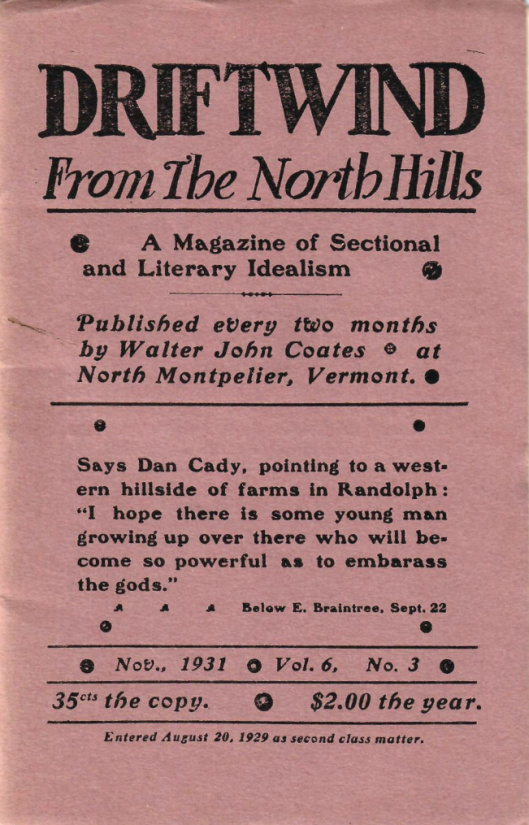
Lovecraft scholars will occasionally come across mention of the amateur journal Driftwind and the Driftwind Press. This is what the issues looked like (from a new eBay listing)…

driftwind

Chris Perridas also has other different covers on show, grabbed from eBay over the years.

The East Montpelier Historical Society has online a detailed historical essay on the magazine and its editor, including several photographs.

Find a Grave has other photographs of Walter J. Coates, from the family…

walter-j-coates

His 250-copy limited edition of his own poetry, Mood Songs (1921), is now scanned and online. The Walter John Coates Papers are now held in the University of Vermont Libraries Special Collections.

Supernatural Horror hyperlinked

08 Sunday Sep 2013

Posted by asdjfdlkf in Scholarly works

≈ Leave a comment

Alphabetic listing by authors of stories referenced by H.P. Lovecraft in his essay “Supernatural Horror in Literature”. With hyperlinks to the texts themselves.

suphorr

Lovecraft Remembered

07 Saturday Sep 2013

Posted by asdjfdlkf in Odd scratchings

≈ Leave a comment

I’m pleased to say that I’ve finally bagged an affordable UK-shipping copy of Lovecraft Remembered, which arrived this morning…

hpl-remembered

More Open Lovecraft

07 Saturday Sep 2013

Posted by asdjfdlkf in Scholarly works

≈ Leave a comment

* Marshall Buchanan (2012), “Horror in Seneca’s Thyestes and Lovecraft’s “The Call of Cthulhu”“. (Student paper written for Latin 5014 class at Department of Classics, Ohio State University).

* Mark McGurl (2012), “The Posthuman Comedy“, Critical Inquiry 38, Spring 2012. (Discussion of Lovecraft in relation to the academic canon and ‘outsider’ writers, on pp.542-547)…

   “an equal part of his interest as a writer is in the troubling shape taken by his limitations. [which] open up, at the level of daily social practice, to a compelling vision of a writerly existence — compelling because so extraordinarily grounded and collegial, so generous in the expense of personal time. … sharing work, sharing imaginative terrain, and freely helping each other toward publication … Working sideways from [amateur] journalistic endeavor into the literary community in which his literary efforts took shape, we are tempted to see the generic institution of the weird, too, as a kind of virtual college, a weird college. … His mistake was to think that the relative weakness and evanescence of the values shared by his community of literary underdogs meant that they were in fact worthless.” [whereas they now seem the forerunner of our own emerging open/remix culture and fan cultures].

Helvete: a journal of black metal theory

06 Friday Sep 2013

Posted by asdjfdlkf in Lovecraftian arts, Scholarly works

≈ Leave a comment

Black metal fans who are looking for a journal in which to place an article on Lovecraft’s influence may be interested in a new academic open access journal Helvete: a journal of black metal theory…

rev1

More Open Lovecraft

04 Wednesday Sep 2013

Posted by asdjfdlkf in Scholarly works

≈ Leave a comment

Added to the Open Lovecraft page…

* Patricia MacCormack (2010), “Lovecraft through Deleuzio-Guattarian Gates”, Postmodern Culture, Vol.20, No.2, January 2010.

* Carlos Corbacho Carrobles (2013), “H.P. Lovecraft’s “The Call Of Cthulhu”: an intermedial analysis of its graphic adaptation“, JACLR: Journal of Artistic Creation and Literary Research, Vol.1, No.1, September 2013.

NecronomiCon Providence 2013 update #18

03 Tuesday Sep 2013

Posted by asdjfdlkf in NecronomiCon 2013

≈ Leave a comment

My unofficial round-up of NecronomiCon Providence 2013 news and links…

* Lovely letter in The Providence Journal about meeting some Lovecraft fans by chance.

* Darkest of the Hillside Thickets (the Saturday WaterFire evening band), has the official stage photos online, and apologies for the technical flummox…

“the power went out on half the stage after just a few songs, leaving us with only 2 of the 4 planned guitars including the bass guitar”

* Ian E. Muller has a convention report.

* Michael Bukowski (Yog-Blogsoth, one of the gallery exhibitors) has a convention report with pictures of artwork.

* Photo set of the Unpacking of the bronze bust of HPL…

unpack

* Big set of photos from Ivan Ronald Schablotski…

ivan

* Inside the Cthulhu Factory Nazo Lab…

cthulhufactory

The location of “Juan Romero”: Area 52

03 Tuesday Sep 2013

Posted by asdjfdlkf in Historical context, Maps

≈ 4 Comments

Lovecraft’s early failure “The Transition of Juan Romero” (Sept 1919) is located in “the Cactus Mountains”…

“In the summer and autumn of 1894 I dwelt in the drear expanses of the Cactus Mountains, employed as a common labourer at the celebrated Norton Mine, whose discovery by an aged prospector some years before had turned the surrounding region from a nearly unpeopled waste to a seething cauldron of sordid life.”

There really were and are “Cactus Mountains”, which lie south-east of Tonopah. Gold was first discovered there 1900, the gold rush there was 1903, and by 1915 the area south of Tonopah was the U.S.A.’s second biggest gold producing locality. The “Cactus Mountains” can be traced in documents from the 1840s, through to the following article in the Mining and Scientific Press magazine (1912). This article gives some of the history and details of a new 1911 gold discovery at the southern tip of the Cactus Mountains, Lovecraft’s exact setting…

mining1912

There had also been new mines sunk at that spot by a British miner (recalling the nationality of the narrator of “Juan Romero”?), ostensibly for other minerals, back in 1908. The British miner’s name was Samuel G. Knott, and he was president of the Cactus Range Gold Mining company of Goldfield. His Mine Supervisor there was Elmer F. King. So far as my researches can tell, Knott was not known to have previously been in British India (as the British narrator of “Juan Romero” had been).

Mention of these mountains also occurs in a U.S. Navy report of 1977… “The 8 to 10 miles of blasting required along each antenna line occurs in the Cactus Mountains on the Tonopah Test Range…” The mountains are now better known as the Cactus Range (Lovecraft also uses this name in the story) and they form part of a vast highly-restricted military testing ground. The location in particular is now “Area 52, Tonopah Test Range“, sited 30 miles SE of Tonopah …

“lies mostly within the Cactus Flat valley, consisting of horst and graben geology. It is flanked by the Cactus Range hills to the west”

Yes, conspiracy fans, Lovecraft got there first as usual — this Area 52 is the neighbour of the fabled Area 51. 🙂 Which, for some, may bring a new frisson to the story’s descriptions — since they appear to somewhat prefigure the tropes of UFO folklore…

“[the mysterious sound from the newly-discovered bottomless cave] was like the pulsing of the engines far down in a great liner, as sensed from the deck, yet it was not so mechanical; not so devoid of the element of life and consciousness.”

“At first I beheld nothing [in the bottomless pit] but a seething blur of luminosity; but then shapes, all infinitely distant, began to detach themselves from the confusion, and I saw — was it Juan Romero? — but God! I dare not tell you what I saw!”

Another curious co-incidence is that the story “Juan Romero” was not published until 1944. I’m no expert on the history of UFOs, but that appears to be the same year as the UFO craze first started.

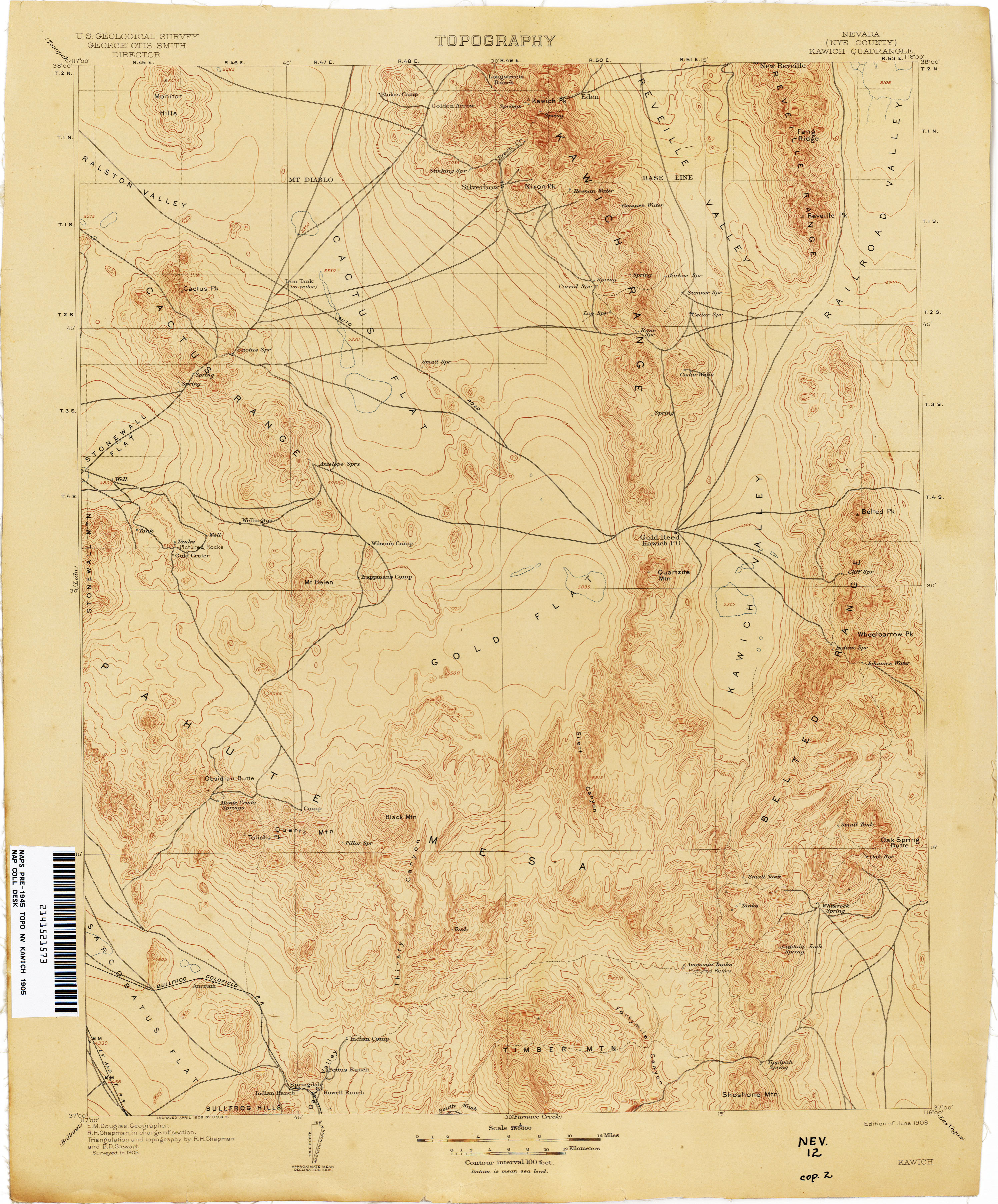
Lovecraft also sites the action in “Juan Romero” directly beneath a “Jewel Lake”. Sadly this name, like the name “Norton Mine”, doesn’t lead anywhere. The area is a volcanic plateau at 6,000 feet, and is very dry on the surface although there are springs and water not far down under the earth. According to the following 1905 topographic map there was no actual named lake at the exact spot, and the history book Preserving the Glory Days: Ghost Towns and Mining Camps of Nye County, Nevada has no mention of a Jewel Lake (or a Norton Mine, for that matter). Although the blue dotted areas on the 1905 topo map perhaps indicate there were temporary flashes of valley-bottom water in winter?

cactus_mountains_1905

There is a huge “Mud Lake” nearby, though. So I wonder if Lovecraft may have flipped the meaning of the name, from Mud to Jewel?

How did Lovecraft come to know of the area? He appears to have been inspired in his choice of a desert setting by reading an amateur journalism author he named in a letter as ‘Phil Mac’ (Prof. Philip B. McDonald), who had apparently used a similar desert / mining setting, but for a “commonplace adventure yarn” (Lord of a Visible World, p.69). It seems Lovecraft had copied out a “dull” and “commonplace adventure yarn” sent to him by McDonald, intending to send the copy to his correspondence circle with a detailed critique of his own. But then he decided to just spend a day writing his own story based on the same or similar setting, and he then sent out both… “Youze gazinks have seen both Mac’s and my yarns.”

Philip B. McDonald graduated M.E. (Master of Engineering) from Michigan College of Mines. In Lovecraft’s The Conservative, McDonald was stated to be “Assistant Professor of Engineering English, University of Colorado” in July 1918, though he later moved to New York to become assistant professor of English, New York University. It appears he was the husband of the noted amateur journalist Edna Hyde McDonald (“Vondy”). McDonald’s desert story was not used in Lovecraft’s The Conservative and seems not to exist today, nor any of his fiction. So we don’t know how closely Lovecraft used, or not, what he called “the richly significant setting” of McDonald’s “dull yarn”.

Dark Swamp trails

02 Monday Sep 2013

Posted by asdjfdlkf in Historical context, Maps

≈ 7 Comments

Stone Wings blog has walked and traced the route of the Lovecraft/Eddy Sunday 4th November 1923 expedition to find the notorious Dark Swamp in western Rhode Island, and reports with fine photographs. Dark Swamp was never actually reached by Lovecraft that day, although he and his “newly adoped son” C.M. Eddy hoped for another trip in summer 1924 that seemingly never happened…

“We now know how to reach the swamp most expeditiously, and will not again lose time in devious inquiries. It will be a pleasing day’s trip, and even tho’ we discover no unsuspected horror, we shall surely behold enough of the darkly picturesque to furnish out a dozen tales apiece.” (Selected Letters I, pp.264-67).

Their not reaching the swamp was probably just as well. Since it reputedly had many snakes, sump pools, and morasses, and was probably filled to brimming by the heavy October rains of that year.

Back in 2001 The Cthulhu Prayer Society (Newsletter, 11th Nov 2001) also followed the route of the walk to Dark Swamp. Jarett Kobek actually made it into part of the Dark Swamp and has online photos of White’s Pond and also part of the swamp.

The swamp had been penetrated by several naturalists early in the 20th century…

“Howard W. Preston, whose Botanical Notebook for the years 1877-1919 awaits and deserves publication, recorded his search for rhododendron in Dark Swamp, Glocester, Rhode Island by the Willie Woodhead Road.” (The Bulletin of the Massachusetts Audubon Society, 1966).

“As early as 1911, Fred Barnes served as a guide into the Dark Swamp in West Glocester for a research group from Brown University” (Glocester, the way up country: a history, guide and directory, 1976).

The swamp was/is not far from Chepachet, the north part of the road from Chepachet to Pascoag being of course the setting for the opening of Lovecraft’s “The Horror at Red Hook”. That was where Malone recoils in horror at reaching the junction and unexpectedly seeing buildings not unlike New York tenements in style. Such buildings can still be seen at that Pascoag junction, using Google StreetView, although they are on the right rather than the left turn. Lovecraft had been for another ramble in this area with Morton, a little earlier in 1923, in search of Durfee Hill (one miles east of the swamp, and Rhode Island’s second highest point), and so it’s possible he may have walked the same stretch of road that appears in “The Horror at Red Hook”.

According to S.T. Joshi’s I Am Providence, the visit to Dark Swamp was also recorded by Lovecraft in a letter to Edwin Baird. But I’m not sure where that’s been published, if it has been.

L. Sprague de Camp wrote in Lovecraft: A Biography that part of the Dark Swamp was submerged by the Ponaganset Reservoir a few years after the Lovecraft/Eddy trip — but judging by the modern satellite photography, trail maps, and the fact that Ponaganset Reservoir was completed in 1865, this cannot be correct.

darkswampri

Similarly shaky on certain points of fact may be Eddy’s recollections of his walks with Lovecraft. They can be found in The Dark Brotherhood and Other Pieces (Arkham House 1966) and reprinted in Lovecraft Remembered. The date of 1966 implies that Eddy was recalling events in the mid 1920s from the viewpoint of the mid 1960s? As I understand it some of these distant recollections of Lovecraft by Eddy, and especially by Eddy’s wife, should not be taken at face value.

Lovecraft and a World in Transition: Collected Essays on H.P. Lovecraft

02 Monday Sep 2013

Posted by asdjfdlkf in New books

≈ Leave a comment

News of S.T. Joshi’s forthcoming book of collected essays. At least the title: it’s to be called Lovecraft and a World in Transition: Collected Essays on H.P. Lovecraft, and is currently weighing in at 620 pages!

← Older posts
Newer posts →


Please become my patron at www.patreon.com/davehaden to help this blog survive and thrive.

Or donate via PayPal — any amount is welcome! Donations total at Easter 2025, since 2015: $390.

Archives

  • February 2026
  • January 2026
  • December 2025
  • November 2025
  • October 2025
  • September 2025
  • August 2025
  • July 2025
  • June 2025
  • May 2025
  • April 2025
  • March 2025
  • February 2025
  • January 2025
  • December 2024
  • November 2024
  • October 2024
  • September 2024
  • August 2024
  • July 2024
  • June 2024
  • May 2024
  • April 2024
  • March 2024
  • February 2024
  • January 2024
  • December 2023
  • November 2023
  • October 2023
  • September 2023
  • August 2023
  • July 2023
  • June 2023
  • May 2023
  • April 2023
  • March 2023
  • February 2023
  • January 2023
  • December 2022
  • November 2022
  • October 2022
  • September 2022
  • August 2022
  • July 2022
  • June 2022
  • May 2022
  • April 2022
  • March 2022
  • February 2022
  • January 2022
  • December 2021
  • November 2021
  • October 2021
  • September 2021
  • August 2021
  • July 2021
  • June 2021
  • May 2021
  • April 2021
  • March 2021
  • February 2021
  • January 2021
  • December 2020
  • November 2020
  • October 2020
  • September 2020
  • August 2020
  • July 2020
  • June 2020
  • May 2020
  • April 2020
  • March 2020
  • February 2020
  • January 2020
  • December 2019
  • November 2019
  • October 2019
  • September 2019
  • August 2019
  • July 2019
  • June 2019
  • May 2019
  • April 2019
  • March 2019
  • February 2019
  • January 2019
  • December 2018
  • November 2018
  • October 2018
  • September 2018
  • August 2018
  • August 2015
  • July 2015
  • April 2015
  • March 2015
  • February 2015
  • January 2015
  • December 2014
  • November 2014
  • October 2014
  • September 2014
  • August 2014
  • July 2014
  • June 2014
  • May 2014
  • March 2014
  • February 2014
  • January 2014
  • December 2013
  • November 2013
  • October 2013
  • September 2013
  • August 2013
  • July 2013
  • June 2013
  • May 2013
  • April 2013
  • March 2013
  • February 2013
  • January 2013
  • December 2012
  • November 2012
  • October 2012
  • September 2012
  • August 2012
  • July 2012
  • June 2012
  • May 2012
  • April 2012
  • March 2012
  • February 2012
  • January 2012
  • December 2011
  • November 2011
  • October 2011
  • September 2011
  • August 2011
  • July 2011
  • June 2011
  • May 2011
  • April 2011
  • March 2011
  • February 2011
  • January 2011
  • December 2010
  • November 2010
  • October 2010
  • September 2010
  • August 2010
  • July 2010

Categories

  • 3D (14)
  • AI (70)
  • Astronomy (70)
  • Censorship (14)
  • de Camp (7)
  • Doyle (7)
  • Films & trailers (101)
  • Fonts (9)
  • Guest posts (2)
  • Historical context (1,095)
  • Housekeeping (91)
  • HPLinks (73)
  • Kipling (11)
  • Kittee Tuesday (92)
  • Lovecraft as character (58)
  • Lovecraftian arts (1,625)
  • Lovecraftian places (19)
  • Maps (70)
  • NecronomiCon 2013 (40)
  • NecronomiCon 2015 (22)
  • New books (966)
  • New discoveries (165)
  • Night in Providence (17)
  • Odd scratchings (984)
  • Picture postals (276)
  • Podcasts etc. (430)
  • REH (184)
  • Scholarly works (1,468)
  • Summer School (31)
  • Unnamable (87)

Get this blog in your newsreader:
 
RSS Feed — Posts
RSS Feed — Comments

H.P. Lovecraft's Poster Collection - 17 retro travel posters for $18. Print ready, and available to buy — the proceeds help to support the work of Tentaclii.

Proudly powered by WordPress Theme: Chateau by Ignacio Ricci.