In Lovecraft had had a Lovecraftmobile….


18 Saturday Aug 2012
In Lovecraft had had a Lovecraftmobile….
18 Saturday Aug 2012
Posted in Odd scratchings
It had to happen. A Lovecraft perfume selection, courtest of the Black Pheonix Alchemy Lab of the eldritch town of… err… North Hollywood. Their A Picnic in Arkham page lists all their Lovecraft scents. The marketing pitch is bit off: no pictures of the bottles, and eye-achingly miniscule type for the descriptions. Possibly that’s because the bottles are, frankly, a little naff looking…

Incidentally, eBay has just banned the sale of magic spells, potions, and curses along with other psychic and prayer mumbo-jumbo. Although perfumes and scented candle schlock can still be sold. Oh, and Etsy has also banned sales of items that include “human remains or body parts”. Eww.
17 Friday Aug 2012
Posted in Historical context, New discoveries, Scholarly works
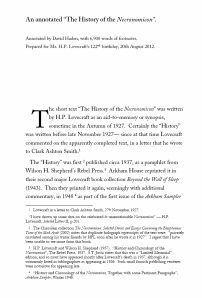
Since Lovecraft’s birthday falls on a Monday this year, I’m releasing my ‘122nd birthday present’ a few days early, so readers can peruse it over the weekend. Enjoy Lovecraft’s 1927 essay “The History of the Necronomicon“, annotated by myself with 6,900 words of scholarly footnotes…
17 Friday Aug 2012
Posted in New books, Scholarly works
The new 2012 edition of the Lovecraft Annual scholarly journal is now available, from Hippocampus Press. $15 with free shipping. Including:
Anna Klein, “Misperceptions of Malignity: Narrative Form and the Threat to America’s Modernity in “The Shadow over Innsmouth””.
Gavin Callaghan, “Elementary, My Dear Lovecraft: H.P. Lovecraft and Sherlock Holmes.”
15 Wednesday Aug 2012
Posted in Lovecraftian arts, Odd scratchings

“The root bridges, some of which are over a hundred feet long, take ten to fifteen years to become fully functional, but they’re extraordinarily strong […] some of the ancient root bridges used daily by the people of the villages around Cherrapunji may be well over 500 years old.”
Health-and-safety commissars in the West would no doubt have a fit over the idea of these in the USA or UK. But one wonders if the same techniques could be used by artists to create giant Cthulhu-esque living structures? It’d certainly go way beyond a timid weaving of willow-wands.

13 Monday Aug 2012
Posted in Scholarly works
Added to the Open Lovecraft page…
Wouter J. Hanegraaff (2007), “Fiction in the Desert of the Real: Lovecraft’s Cthulhu Mythos”, Aries 7, pp.85-109.
Related to this essay’s theme of the French interpretation of Lovecraft are two blog articles by Jason Colavito: “Pauwels, Bergier, and Lovecraft”; and “Lovecraft themes in Bergier’s later work”.
12 Sunday Aug 2012
Posted in Scholarly works
Other Worlds, a Victorian Network Conference, 3rd Dec 2012 in the UK.
“From other lands to other planets to other dimensions, the nineteenth-century imagination thrived on the idea of ‘elsewhere’. Other Worlds seeks to explore the many ways in which Victorians looked beyond to imagined alternatives … other, alternative, transcendent, secret or hidden.”
12 Sunday Aug 2012
Posted in Historical context
The new Uncharted Ruins blog has a long and interesting article on the lost desert city of Iram, relevant to Lovecraft’s “The Nameless City” (1921) and “The Call of Cthulhu” (1926)…
“According to […] some currents of Islamic Sufism, Irem existed in this world as well as on separate levels of existence”

The 1902 Encyclopaedia Britannica entry on “Arabia” also mentions this tradition…
“Very gorgeous are the descriptions given of ‘Irem’, the ‘city of pillars’, as the Koran styles it [which] after the annihilation of its tenants, remains entire, so Arabs say, invisible to ordinary eyes, but occasionally, and at rare intervals, revealed to some heaven-favoured traveler.”
The mention in “Cthulhu” is…
“Of the [Cthulhu] cult, he said that he thought the centre lay amid the pathless deserts of Arabia, where Irem, the City of Pillars, dreams hidden and untouched.” — The Call of Cthulhu.
11 Saturday Aug 2012
Posted in Scholarly works
New addition to the Open Lovecraft library…
Aleksandra Borowskal (2011), “H.P. Lovecraft’s style in translation: a case study of selected stories and their Polish versions“. (In English, with Polish cover page. Appears to be a Masters dissertation?)
10 Friday Aug 2012
Posted in Lovecraftian arts
Instructions for tormenting H.P. Lovecraft’s dreams with night gaunts… 😉

09 Thursday Aug 2012
Posted in Historical context, New books
A possibly interesting new history book on an insanity-causing disease: Rabid: A Cultural History of the World’s Most Diabolical Virus
Was this a disease still a threat in Lovecraft’s time? It seems so. It was a real horror, one literally stalking New England, in the early years of the 20th century. Although possibly it was a minor worry at the time, when weighed alongside things like tuberculosis and syphilis. But raving insanity was the result of the disease, which might make it interesting to Lovecraftian researchers.
“By 1768 rabies had been distributed throughout New England.” — New Jersey municipalities: Volumes 25-26 (1948).
“the increase of rabies of late in New England renders it obligatory on those physicians, who may meet with it, to give an account of their cases as soon as convenient” — Boston medical and surgical journal: Volume 40 (1849).
Rhode Island only had four human death from rabies between 1911 and 1917, one in Providence in 1913 (Mortality Statistics, United States Bureau of the Census 1919, p.44). However by the late 1920s the incidence of death had about doubled (possibly this was because of the swelling of the U.S. population), and there were about 100 human deaths per year from the disease in the USA.
“In the earlier part of this [20th] century, New Jersey had a large problem with canine rabies. In 1939, the worst year for recorded cases of dog rabies, 675 dogs and four humans died of rabies.” — The History of Rabies, New Jersey Department of Health.
However there only appears to be one instance I can remember in which Lovecraft has a dog directly associated with terror, in “The Hound” (1922)…
“The baying was loud that evening, and in the morning I read of a nameless deed in the vilest quarter of the city. The rabble were in terror, for upon an evil tenement had fallen a red death beyond the foulest previous crime of the neighborhood. In a squalid thieves’ den an entire family had been torn to shreds by an unknown thing which left no trace, and those around had heard all night a faint, deep, insistent note as of a gigantic hound.” — “The Hound”.
Rabies was eradicated in Britain in 1902, and then again most famously in 1922 after a four-year outbreak caused by dogs smuggled past the quarantine in 1918. One wonders if the news in 1922 from his beloved British Isles might have set Lovecraft to thinking on threatening dogs? Although personal experience, Poe, and the 1921 movie of The Hound of the Baskervilles might seem more obvious inspirations for “The Hound”.
08 Wednesday Aug 2012
Posted in Lovecraftian arts
‘Pulp art’ special issue, for the latest Imagine FX (Sept 2012), the main magazine for digital painters…
