
HPLinks #93.
* Deep Cuts digs deep and brings up the complete never-reprinted “Something from Beyond” (1941) by Paul Dennis LaVond.
‘Something from Beyond’ is pure Lovecraftian pastiche, albeit in an uncommon space opera setting, which gives it the feel of a very stripped-down prototype of Event Horizon.
* New to me, the Spanish-language book Lovecraft en Argentina (‘Lovecraft in Argentina’) (2015) by Carlos Abraham…
an exhaustive tour of the history of Lovecraftian letters in our country [i.e. the translators, editors and publishers, and also touches on the influence on the nation’s writers]. In an appendix, he also takes the opportunity to review the [Spanish] first editions of Robert Howard’s works. It is an interesting work, essential for the collector who intends to complete his library, but at times the book becomes difficult to read due to small type or the technical nature of the contents.
Contents:
– Introduction.
– Dark beginnings (1939-1956).
– The dissemination of a secret author (1957-1990).
– Lovecraft as a classic (1991-2015).
– Conclusion.
– Appendix: The first Spanish editions of Robert E. Howard.
* Four years after a devastating Russian cyber-attack, the British Library’s EThOS (E-Theses Online Service) is finally restored and back online. The latest relevant “Lovecraft” British PhD thesis is from Manchester in 2022, ‘Live. Laugh. Loathe.’: cosmic humour and contemporary pessimism in literature and on screen (1969-2019). Currently posted online in May 2026 but under a repository embargo with one year to go before release to the public. The same author published a new book with Bloomsbury in June 2026, titled Cosmic Humour and Philosophical Pessimism in Contemporary Culture, which I assume is the PhD text… but revised and polished for publication?
* New in the latest History Today magazine, the short article “Fringe beliefs” (2026, Volume 76, Issue 7, page 6). Possibly this is a regular column(?), and in this instance its indexing-service abstract says the article discusses Lovecraft’s posthumous influence on the 1960s-70s ‘ancient astronauts’ theories.
* The Obelisk reviews Michael Shea’s 1984 novel The Color Out of Time, in “Watchers on the Threshold vs. Vampiric Jelly”…
The Color Out of Time is a mess of a book. It is ‘Lovecraftian pulp’ rather than cosmic horror. Plus, Shea’s attempt to mirror the Master’s purple prose comes across as stiff, and it does little to help the simultaneously simple yet hard-to-follow plot. […] As a homage, it is nice enough. Shea writes like someone who actually enjoys Lovecraft and his works [which is refreshing today …]
* RPG Review reviews the late-Victorian London “Cthulhu by Gaslight” role-playing adventure book from Chaosium.
* The English translation of Gou Tanabe’s “The Dunwich Horror” is still on track for release as a deluxe hardcover at the end of September 2026, and now has cover. Also due around the same time, an 80-page illustrated German translation of “The Colour Out of Space”. A hardback “with four-color, full-page illustrations by Salvador Sanz”, an experienced Argentinian comic-book artist, animator and comics teacher. Looks promising, even in German.

* At the Annecy International animation festival, the U.S. Cartoon Network announced development on a Conan animated series, helmed by Genndy Tartakovsky (Primal). Reported to be an adult Conan animation series, and a project he’s been trying to get off the ground since 2008. Possibly set for 2029, judging by what’s said in animation trade journal reports?
* Lovecraft’s undervalued story “Hypnos” is being filmed, as part of a feature-length indie anthology currently on Kickstarter. No further details.
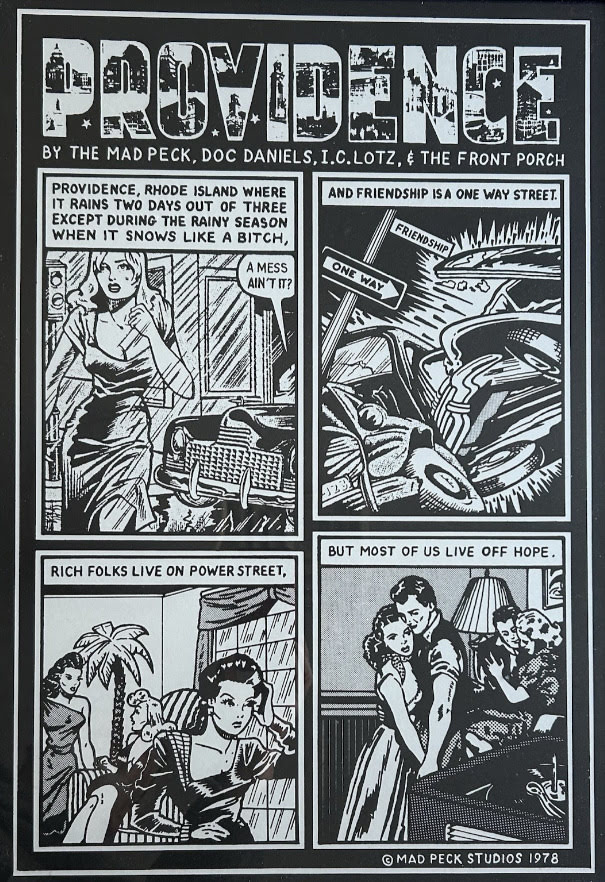
* And finally, plucked from eBay… I found an amusing one-page 1978 underground comix strip which riffs on street names in Lovecraft’s Providence. Was it a one-pager, or were there more pages? The one page is all that’s being sold on eBay.
— End-quotes —
Lovecraft on street-names.
“In 1912 my first bit of published verse appeared in The Evening Bulletin. It is a 62-line satire in the usual heroic couplet, ridiculing a popular movement on the part of the Italians of the Federal Hill slums to change the name of their main street from “Atwells’ Avenue” to “Columbus Avenue”. I pictured Providence in 2000 A.D., with all the English names changed to foreign appellations.” — Lovecraft to Kleiner, November 1916. The poem is “Providence in 2000 A.D.”
“Street names are notably picturesque [in Paris], including such specimens as Rue Git-le-Coeur (Street Where the Heart Lies), Rue Chat-qui-Peche (Street of the Fishing Cat — probably named from a bygone shop sign), Rue de l’Arbre Sec (Street of the Dry Trees), and so on. This quaint nomenclature is typically French, and is paralleled in other towns of France, and in Quebec on our own continent. Many streets are likewise named for the illustrious dead — not only statesmen and warriors, but men distinguished in the arts — a practice also common in Germany, but in America followed only in Boston.” — Lovecraft on Paris street-names, in “European Glimpses”.
“Amongst the [Boston] streets named for illustrious men I was pleas’d to note a Belknap-Street, commemorating the Revd. Jeremy Belknap, minister of a church in Federal-Street, and founder of the Boston Historical Society. The name of this street hath since been chang’d to Joy-Street, and I am sure that no reader of my small Belknap’s phantasies can deny that Belknaps invariably afford joy!” — Lovecraft to Galpin & Long, February 1923. Lovecraft’s story “Pickman’s Model” faithfully used Boston North End street-names in the tale.
“Providence thank heavens has avoided the stultifying custom of numbering [streets, as in New York City] ‐ our only numbered streets being ten obscure ones in the north end of the town.” — Lovecraft to Miss Toldridge, suggesting he knew the names of just about every street and lane in Providence.
As Providence grew into a large city… “still the little ancient lanes led off down the precipice to the west [of College Hill], spectral in their many-gabled archaism and dipping to a riot of iridescent decay where the wicked old waterfront recalls its proud East India days amidst polyglot vice and squalor, rotting wharves, and blear-eyed ship-chandleries, with such surviving alley names as Packet, Bullion, Gold, Silver, Coin, Doubloon, Sovereign, Guilder, Dollar, Dime, and Cent.” — Lovecraft, Dexter Ward.
“Some years ago Long and I attempted to explore the Fulton Fish Market section of New York — which is full of quaint scenes and buildings. I don’t know where I left the lunch I had eaten an hour previously — for I was too dizzy to read the street signs! In the end I managed to stagger out of the stench without actually losing consciousness …” — Lovecraft in a letter of 1933, Selected Letters IV.