New to me, Richard Rosenman’s $50 IK Studio – Inverse kinematics plugin for After Effects (February 2025). Apply IK to the joints of your 2D cutout cartoon characters. He also has a survey of The Best Rigging Tools for After Effects for 2D characters and props. Probably far easier to do such animation in Moho or Cartoon Animator. But if you have to use After Effects, this appears to fill a gap.
Category Archives: The Animation Industry
Release: Pencil Pro, for Blender
I’m all for natural media emulation from 3D scenes. So I was pleased to see the new $15 Pencil Pro add-on for Blender, allowing your 3D scene to emulate a pencil drawing. The result is obviously not great at long distance (e.g. a city scene), where it looks like a point-cloud with the points mapped to tiny graphite strokes. Better for medium and close animation shots, though there’s still a distinct Rhubarb & Custard-style wobble. Which is charmingly old-school in its way, and would be acceptable to young kids watching shorts.
Suitably rough and sketchy and believable, if you overlook the polygonal angles from the 3D. No per-frame autocolour, but something that auto-colours greyscale (e.g. Akvis Coloriage AI) might give colourisation that is not too wobbly, when run frame by frame.
Release: Framepack
Relatively easy ‘video diffusion’ AI is here, and working on relatively low-end PCs. Framepack is fully open source and can be run locally. Feed it a source image and a simple instructional prompt, and generate up to a minute of video at 30FPS. With reasonable speed, and without needing a stupid amount of VRAM. Impressive. It’s from lllyasviel, the guy who made the SD Controlnets, Fooocus and WebUI Forge.
Animated PNG demo, 4Mb.
There is now a one-click Windows installer for Windows 10 (though I guess it might be hacked to use CUDA 11.x + an earlier compatible Pytorch, for Windows 7 users). Note that, once installed, it then fetches 40+Gb of models and controlnets etc. (Models are here for separate download). So you’re likely to need 50Gb+ of space for a local install. There’s no standalone .torrent at present.
It can do widescreen as well as square and phone-screen format. Appears to be limited to about 640px in generation size, so upscaling would be needed. No pristine 4k footage, then. Since it works from any pre-made image, the potential for animating Poser and DAZ renders seems obvious. No whining about ‘piracy’ either, that way.
And the fact that it’s free and can speedily generate somewhat lengthy clips means it has potential for generating lots of possible clips and then stitching a YouTube movie together from the best (though of course there’s no lip-sync).
Due in May, your $10,000 AI virtual movie-studio?
Available in May 2025, the new Digits off-the-shelf AI box direct from NVIDIA, starting at $3,000.
Inside will be a special AI-tuned Linux system, NVIDIA’s special GB10 processor and 128GB of memory, and it should easily run local AI models of “up to 200B” in size. 70B would usually be the maximum for a local PC, so this is effectively a doubling of that capability, plus some overhead left over to run other software. Such as audio voice recognition/synthesis, potentially meaning that models such as an advanced human-ish roleplaying LLM could have real-time fluid voice conversations with a human.
The box can run as a standalone, or be plugged into a normal PC. Two can be placed side-by-side to make an ‘AI super-processor’ capable of running the largest and (arguably) the most powerful AIs. Two boxes should come in at under $10,000, thus superpowered AI becomes affordable for many small businesses. Provided they can afford the electricity — I’ve heard nothing about power consumption as yet.
It would be very interesting to see what creative hackers and tweakers can do with a $10,000 setup and the ability to run multiple AIs and other software, and have the AIs control the software (e.g. Poser, which ‘talks Python’ just as the AIs do) and talk to each other. A complete virtual movie-studio, with voice-actors, in your garage?
Flow (2024)
YouTube playlist for the award-winning made-with-Blender animated movie Flow (2024). Includes three interviews with the maker, and two long “making of” videos.
Wonder Animation
Autodesk Unveils Wonder Animation. Interesting…
* Film your sequence as live-action…
* … then an AI translates what is sees to 3D polygons and rigs (3D scene, figures, mo-cap, cameras, camera movements)
* … then you can render the 3D consistently and quickly as a toon in 3D (Maya, Blender, Unreal game engine).
The drawback appears to be that it’s an online cloud service. Not local desktop software. Still, I like the idea.
Reallusion 2024 ‘Animation At Work’ Competition
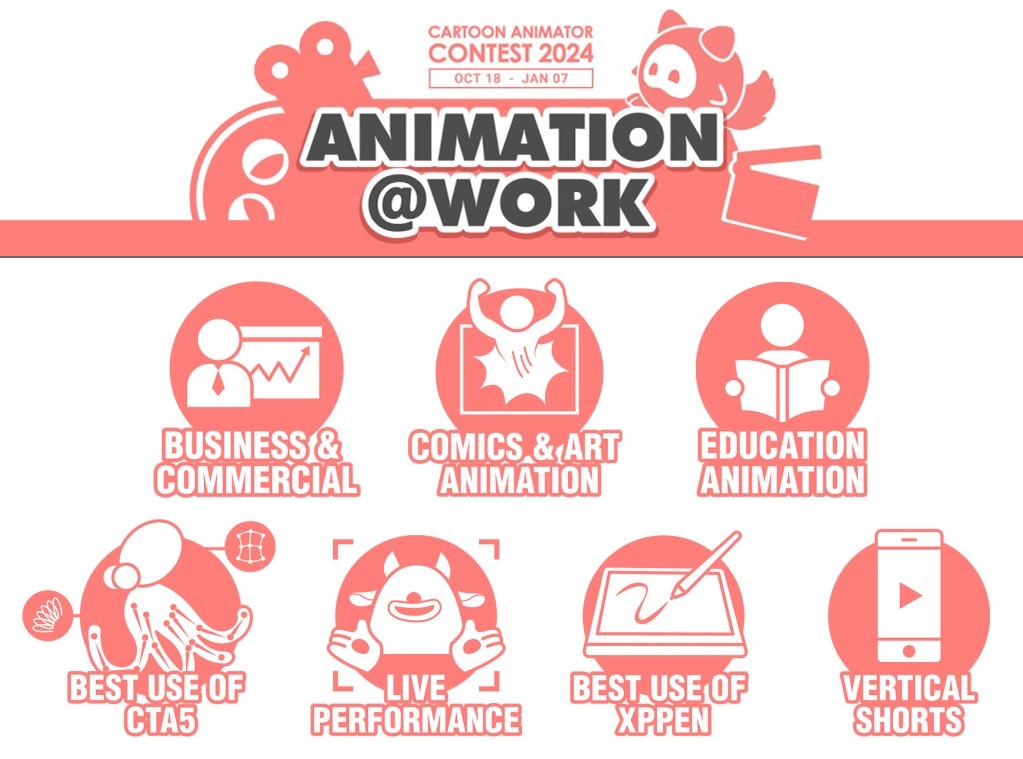
Now on, the Reallusion 2024 ‘Animation At Work’ Competition. Deadline: 7th January 2025. Prizes, including XP-Pen ‘drawn on the screen’ pen-monitors.
Categories include “Best Use of CTA5”. I read that as “Best Use of Cats” at a glance, which would be a fun category if it existed. But no, CTA5 is version 5.x of the worthy and very well-documented desktop software Cartoon Animator (formerly CrazyTalk Animator). All entrants get a two-month free licence for CTA5.
I see the latest CTA 5.3 as a $90 upgrade from CTA3 Pipeline, at the Reallusion software store…
The “first purchase offer” coupon is because I haven’t logged in for a long time, I guess. It takes the price down to $90. The facial mo-cap bundle sounds fun, but knowing Reallusion it’ll only work with new characters which require expensive additional packs to make them work. That’s their long-time business model — low cost for the core software, and then charge like heck for all the additional stuff you need. Though admittedly, as I recall, there’s just the one version (no more ‘Pipeline’) which is something.
Release: Pallaidium
Pallaidium, claimed to be an AI ‘movie generator’ and editor, based around Blender. Requires CUDA 12.4, which in combination with Python means it’s effectively for Windows 10 or 11. Free, open source, and locally run on your PC.
Stable Diffusion in 3DSMax
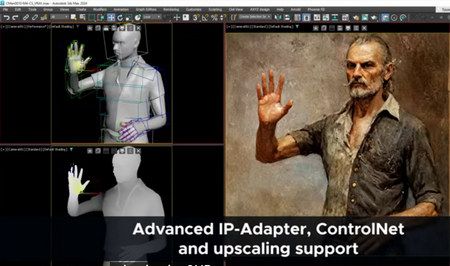
tyFlow 1.111 adds Stable Diffusion in 3DSMax, with its tyDiffusion module “matching simple guide geometry” and “depth” from the 3D scene, to make “detailed” generated images that closely follow the 3D scene. The SD UI being used is ComfyUI. SD 1.5 Models, LORAs and ControlNets are supported.
Interestingly, it appears to be free…
tyDiffusion is available in both the Free and Pro editions of tyFlow, with users of the Free edition getting support for GPU acceleration.
Requires 3ds Max 2018 or higher[tyFlow = “Max 2018”, but tyDiffusion = “Max 2023+”].
Yup, and on an open 435Mb download.
Theoretically then, one could take a Poser scene to Vue, then to Max, then ‘render’ it with AI. Though you can do something similar manually, rendering line-art and a depth map from a Poser scene and using them in ControlNet slots. Unless tyDiffusion is extracting some extra ‘secret sauce’ from the 3D scene, such as PoseNet poses from figures, or light maps for scene lighting.
However, I’m still hoping Renderosity has the sense to save Poser, by making a similar free and robust SD ‘rendering’ plugin for Poser 12 through 14.
ElevenLabs now generates sound FX
Leading audio generator ElevenLabs now offers an AI Text Prompt to Sound Effects Generator. Possibly useful if you can’t find what you need on the FreeSound website or similar. A 20 seconds limit, at present.
Beware of InsightFace
Beware of integrating any AI face-swopping technology from the open-source InsightFace developers. Because they appear to be getting very screwy on the legal side of things, for instance issuing several takedown notices for benign third-party YouTube videos… in which a well-known and respected YouTuber simply shows the technology. InsightFace’s products are thus not something you would want to use in your animations or graphic novels, I’d suggest, in case of legal problems with future licencing and distribution of your work.
‘Animation at Work’ 2023 Contest winners
Winners and videos for the Cartoon Animator software’s annual ‘Animation at Work’ 2023 Contest.
The winner in Nandor Toth, from Hungary…
Release: Cartoon Animator 5.2
Reallusion’s Cartoon Animator (formerly CrazyTalk Animator) has a new Motion Pilot feature. Seems to be a motion-damped mouse-cursor, so you can easily draw an editable motion path. But it has adjustable settings, as you can see here…
For full details see the Motion Pilot demo video.
Release: Moho 14
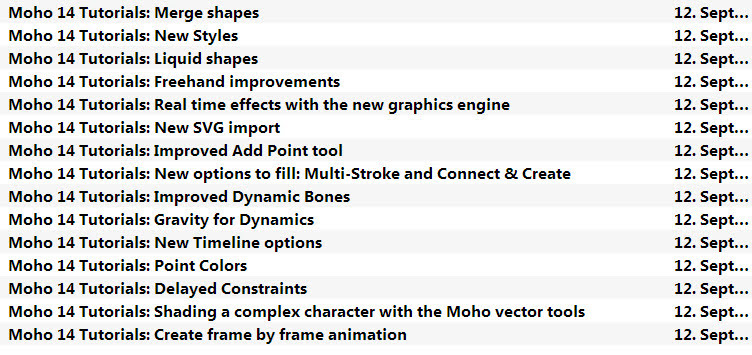
Moho 14 is a big release for the 2D animation software (formerly Anime Studio). New graphics-engine, “near” real-time preview, new intuitive drawing tools for the new engine. Still no restored Poser import, but lots of other new features.
They also have a new 38-video beginner’s course YouTube Playlist.
Auto Effects
AI-powered auto sound-effects for a video. Finds… “the right sound-effects (SFX) to match moments in a video”. A task which can take a day or more of finding, for a long video. Plus the trimming, volume balancing, and slotting in to the video.
Of course it’s not going to do much for Tom & Jerry style animation SFX, compared to the real thing. But I guess for regular normal Powerpoint things (“that’s a dog, it barks, get bark-sound”) it could be useful for those making a ‘holiday-photos slideshow’ presentation.
And it may also save time for creatives. For instance this could interface in interesting ways with the giant Freesound library’s new simple taxonomy. (“That’s a dog, it barks, get links to top-12 bark sounds on Freesound”). That would save some time. Not so much a new ‘recommender’ system (they’re always dim-witted), but more a new creative ‘options bundler’ system. Likely to find a place within the emerging and more complex AI-powered script-flow workflow software.