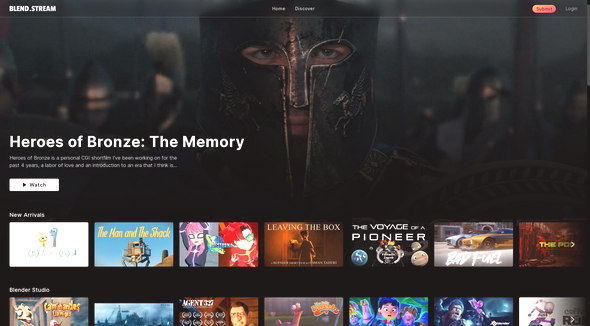
Blend.Stream, a new showcase and aggregator site for all movies made with Blender. This means more than just the official open movies sponsored by the Blender Foundation, and the site is open to all quality films made with the software. Also keep in mind that they’re not all under Creative Commons, though they are all free to view.
Category Archives: Companion software
Release: ZBrush 2023
ZBrush 2023 has been released. I think this is the first release after they were purchased by the Cinema4D owners Maxon. The last ZBrush I looked at here was ZBrush 2021. But I know that some in the Poser and DAZ crowd use ZBrush as a round-trip software, so the new 2023 version seems worth a quick look.
The big news is that the Redshift renderer is now integrated into ZBrush. But only for CPU rendering, not the GPUs that Redshift runs best on (GPU rendering is only unlocked if you pay a subscription). This ‘integrated Redshift’ comes with the required materials and PBR controls. It also supports bucket rendering.
Things I’m not sure about:
i) if it’s just for final renders or is also able to power the Viewport in near real-time (if you have good enough hardware for that) like iRay can in DAZ Studio;
ii) and if Redshift will render the many comic/toon non-photoreal presets (BPR/NPR) that ship with ZBrush. I suspect not, since those will be highly tuned for the existing BPR (“Best Preview Render”) in ZBrush.
There are also some updates to the bundled Sculptris Pro. Sculptris gets what’s said to be a new SubDivide slider control, and the ability to restore areas of higher polygons by painting the back onto the mesh.
There are still perpetual one-time payment ZBrush licences, but these are expensive and you no longer get free upgrades from earlier versions. I imagine that many users are going to be thinking that there are not enough benefits to upgrading to 2023. It doesn’t look like an incredibly feature-rich whizz-bang ‘no-brainer’ upgrade to me, especially given the high price.
Many will be sticking with what they have, and thinking of switching. For that there’s:
* Blender 3.2 or higher, if you can stomach the UI and have a suitable graphic card;
* the hugely-improved and relatively user-friendly 3DCoat 2022 (it’ll be very interesting to see what 3DCoat 2023 looks like), a nicely priced one-time purchase and works back to Windows 7;
* and everyone seems to have forgotten about Autodesk’s Mudbox, but it’s still out there and apparently many students still pass through it briefly at university;
* there are a few others in either OpenGL browser form or mobile app, such as the popular Nomad Sculpt with its real-time lighting.
Release: Vue 2023
E-on has released their landscape software Vue in the 2023 version. This offers “feature parity between Creator and Professional” and unlimited render-size for Creator. Creator is now “personal non-commercial use only”, but that really shouldn’t affect most hobbyists and students.
Vue still has easy automatic Poser integration / import, on which see the recent test in Digital Art Live magazine #71…
Which means this new unified 2023 version now offers an easy Poser export route to…
3D Studio Max 2016 to 2023
Maya 2015 to 2023
Cinema4D R20 to 2023
Creator 2023 users now have access to these export options, since they are no longer locked away in the more costly version of Vue.
The MiDaS touch
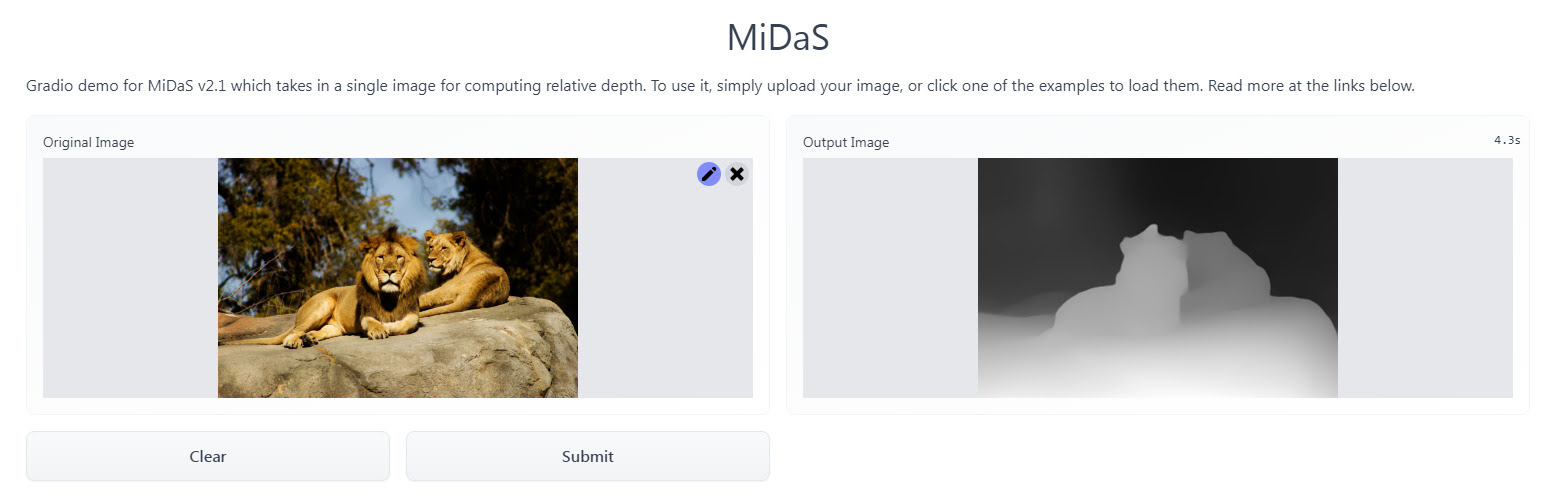
MiDaS uses trained AI to take a normal 2D image and output a 3D depth-map. In Poser-speak it’s like Poser’s ‘auxiliary Z-depth’ pass or render.
Free and public, no sign-up needed. Just drag-and-drop your image. It can probably also be installed locally, though I haven’t looked at the requirements for that.
Once you have it you can use the usual Photoshop layer inversion/blending-mode tricks to create ‘depth-fog’ in the scene, where there was none before.
Release: Marmoset Toolbag 4.05 public beta
Marmoset Toolbag 4.05 is now available in a public beta. Despite being a .05 release for this games-focused desktop software, it’s being touted as a big update which greatly improves texture painting and the available range of materials and lights. There’s also a new stabiliser for your hand-painted brush strokes. Apparently also a “10x” speed boost, on big complex multi-layered object-painting projects.
Interestingly there is also a mention of the NVIDIA “DLSS viewport upscaling”, the first I’ve heard of such a thing in 3D production software. Intended for (retro/older?) videogames, it can up-scale “by 4x”. In Marmoset Toolbag it’s said to enable real-time up-scaling of your viewport. (Adobe also has something called “neural rendering”, which seems to evolve an AI render from a 3D point-cloud, but that’s still at the research-paper stage).
Sadly Marmoset Toolbag is now “Windows 10 only”, but it’s good to see there is still a one-time purchase at $320 for hobbyists. I admit I’m not very familiar with this side of the 3D software world, but I know that Substance Painter (or the free Material Maker) and 3DCoat are some of the ‘adjacent’ software packages for desktop. I’m uncertain how Marmoset and 3DCoat line up these days, feature-wise, and if they can perhaps be classed as broadly having feature-parity. Maybe a reader of this blog could advise on that?
Release: Terragen Sky – Early Access
Terragen’s easy sky generator is now available in Early Access, for Windows desktop PCs. Make “photorealistic CG skies” with “a simplified UI and workflow” using sliders. Also 360-degree HDRIs.
In Early Access it’s apparently not yet a standalone software, but will be. Currently it exports the sky into the main Terragen desktop software, and thus is only available to those who have a Terragen licence or subscription. If Terragen Sky will be free or low-cost and/or public, when it reaches its final release, is as yet unknown.
Dream Textures
Dream Textures is the Stable Diffusion AI, sending AI-gen textures direct to the Blender shader editor. Can be used with DreamStudio as the paid Cloud generator.
Since Poser does Python, I don’t see why something similar couldn’t be done for Poser. Doubtless there will soon be AI’s that can take a text-prompt and pop out a finished .PBR material. For example: “Make me a lava material that looks like glowing snake-skin”.
AI mo-cap from a webcam
Just launched, and said to be free after a sign-up, Rokoko Video. Capture webcam footage, an AI interprets the motions in the clip, and then outputs a motion-capture file.
If you need better then they’ll also be happy to sell you one of their full-body mo-cap wearable suits, specially fitted all over with sensors.
Release: Blender 3.4 – storyboarding and PBR
Blender 3.4 has some interesting new features, including storyboarding and PBR.
* A new storyboarding tool called Storypencil, said to be tested and production-ready. It works in tandem with the Video Sequence Editor, and is intended for making rough animatic sequences or saving out storyboard images. Multiple SVG files can also be imported.
Update: It was in the beta but appears to have been pulled from the final. To get it: i) Get the 3.4 beta and 3.4 final; ii) install both; iii) copy Storypencil folder from Scripts | Addons_contrib to the same folder in Blender 3.4 final.
* Yet more Grease Pencil improvements. It now has some improved maths ‘under the hood’, working to auto-close gaps in line-art when using the Fill tool to colour.
* PBR support. Apparently this wholly new, which if true is kind of amazing? Anyway, the .MTL material files that accompany .OBJs can now call the full range of PBR material sets, including Principled BSDF materials. Poser 11 and 12 now support Cycles BSDF, so there may be potential here for making PBR’d .OBJs in Blender for use in Poser.
Adobe Substance in 2022
Forgotten about Adobe Substance? ArtStation has a handy one-page 2022 Updates Recap. Who knew there was now an official voxel-based “Substance 3D Modeler”, released in October 2022? Also noted is that coming soon is Adobe Substance 3D Sampler, for real-world scanning of objects. All very nice, but still subscription.
RealityScan
Epic has made public its RealityScan beta, which launched in closed form back in April 2022. It’s…
“a free photogrammetry app that turns smartphone photos of real-world objects into textured 3D models”
Only for iPhone and iPad, where it doesn’t appear to have too much free competition. I’m certainly no expert on Mac apps, and I didn’t look very hard, but this is surprising. You might have thought that Apple’s depth-sensing stuff would have cause developers to flock to such things. Or maybe “free” is just a dirty word in iPhone-land? Not being an iPhone or Mac person, I have no clue about such things.
Export is locked to uploading to Epic’s Sketchfab site. Models can’t be directly saved to local files. Also, since the models are said to be geared toward VR, they may well be low-res and perhaps not watertight for 3D printing (just my guess). A free Android version is pencilled in for release sometime in 2023.
Adobe is also gearing up to release its own photogrammetry software.
There’s also something called Polycam 3.0 coming down the pipe in 2023.
Release: Stable Diffusion 2.0
The ‘text prompt to image generating’ AI Stable Diffusion 2.0 has released. 1.4 was the first public release back in summer 2022, and 1.5 was the previous version.
Along other new features, a shape-sensing and shape-preserving model…
It also has a few other nice features such as better in-painting and built in up-scaling. But note that the new 2.0 version is now censored, so some may consider it as effectively no longer open-source. They’ve “removed ability to copy artist styles”. This means 2.0 now ignores popular user prompts such as “in the style of [name]…”. It also refuses to create what is described as “NSFW” images, though how widely that’s defined is unknown.
Release: Clavicula 0.9.9.1
The free Clavicula has released 0.9.9.1, with new features such as “custom shader layers” among other changes. It’s the successor to Neobarok and an innovative way of 3D modelling, completely free for desktops. The YouTube channel is here, and there was a Digital Art Live magazine interview with the maker in Digital Art Live Issue 64 (Christmas 2021).
Tasty Olive
Olive is a new “free, portable, non-linear video editor built to compete with high-end professional video editing software”. Interestingly, it “reminded us a little of Camtasia Studio without the big price tag”, states MajorGeeks, testing the more stable 0.1 alpha. There’s also a nightly build 0.2 alpha as portable or installer, which is likely to be unstable for now.
The MajorGeeks comment about Camtasia was enough to make me test it. I could not get 0.2 working, and I found the 0.1 alpha did not have any Camtasia-like screen capture and annotation features. Still, it looks like a good basic no-nonsense free video editor, and works back to Windows 7.
“Worth having” discounts, starting to appear ahead of Black Friday
Not much sign of “worth having” new discounts ahead of Black Friday (25th November), other than the usual year-round perma-discounts. But I noticed…
* The XPPen Store has discounts on its ‘draw on the screen’ monitors. The XPPen Artist 22 (2nd gen) is probably the target model for most people, and has a nice discount. I have one, and am pleased with it.
* Serif’s Affinity 2.0 bundle continues with its launch discounts. Try before you buy, as the fixed and squinty user interfaces don’t suit everyone.
* E-on has large 45% discounts on the subscriptions for its Vue landscape software. Subscriptions, but… worthy software that can still talk to Poser 11 and 12.
* Reallusion’s Cartoon Animator 5 has a good introductory discount, and all versions are now effectively the Pipeline version. Which makes it bargain if you’re looking for a friendly but powerful 2D animator.
* “Courses from £10.99 until 25th Nov” at Udemy. A nice $10 price on Udemy’s Make Motion Comics video tutorial. Sadly it’s all Adobe software though. Also a $10 price on Poser Pro Game Dev Fundamentals, which may be of interest to those who never moved to Poser 11.
* No discounts on Clip Studio EX (the proper multi-page version of the comics production software), but there is a “get 2.0 free when it appears” flash…
It appears that Clip Studio 2.0 is set for Spring 2023. It’ll be interesting to see if it includes AIs, and if they can make the software less fiddly and annoying to use.