Unreal Studio is now available. No, it’s not the long-awaited virtual movie-studio based on Unreal. Architects and product designers will upload their CAD or 3DS Max files to the Unreal Studio servers, and then Unreal will send them back a real-time Unreal Engine render. There’s a plugin for 3DS Max that examines the textures and suchlike, and auto-converts if needed. Unreal Studio is currently in a free beta until November 2018, but is then set to be $49 a month. May be useful for some, perhaps especially for animated turnarounds, but you have to wonder why someone can’t run 3DS Max to Unreal Engine locally — if all it needs is a plugin and it’s producing a genuine real-time render.
Category Archives: Spotted in the News
For the boot
I was interested to hear about the surprisingly robust approach taken by the French when training their new VFX talent…
“[our] French counterparts [who run university VFX degrees, teach on] courses four or five years long, and cull students from the course who don’t meet the quality expected.” (Tom Box, interviewed in the latest edition of 3D World magazine)
In the UK it’s overwhelmingly a three-year degree. Although there tend to be a lot of first-year drop-outs, the duffers who remain on the course after that tend to be tolerated right through to graduation. They’re too often graduated as well, at management insistence, if only with a 3rd class degree. In France, it seems, the teachers have more control and thus a degree course’s reputation trumps the income from a student’s fees / the university’s student retention-rate statistics.
Stalled at the station
How can there not be a single Stylish makeover theme for Artstation, when there are 37 pages of such themes for changing how DeviantArt looks? Bizarre.
Polybrush 2.2
An interesting new natural/organic 3D modeling software, Polybrush. Now in version 2.2, and it’s “lightweight” — which means you don’t need a beast of a PC just to get it running. There’s a perpetually free Lite edition, with no library of preset brushes, or a full 90-day trial.
Not to be confused with a Unity plugin of the same name.
“Ve hav wayz of twiggling your prims…”
Are your 3D primitive’s nurb flange-sprockets correctly twiggled? val3dity: geometric validation of GML 3D primitives is a free tool to make sure your 3D primitives are the right shape. Exactly the right shape. Apparently there are formal standards for such things.
Release: VLC media player 3.0
The popular free VLC media player is now at version 3.0. I found I was still at 2.2.x. It’s a very major update, and all the new features of 3.0 are listed here. Features I noted…
* VLC now supports 360 video and 3D audio.
* Can stream to Chromecast devices.
* Can play Blu-Ray Java menus.
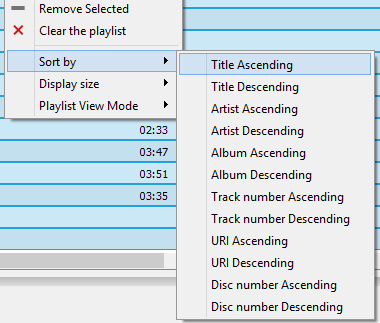
The only problem it has that, while VLC Media Player is excellent, one of its enduring mysteries is what happens when you drag-and-drop a 1, 2, 3, 4 etc list of files to a new playlist. The playlist order always gets garbled into 4, 1, 3, 2 etc. There’s still no way to re-order the list by File Name. Windows Media Player and other players never have any such problem. Even in version 3.0 of VLC there’s still no way to then re-order the list by File Name. You can re-sort the list every other way, but not by file-name order…

Windows Media Player has no such problem. Regrettably you can’t save a properly-ordered Windows Media Player list as .M3U and then load it to VLC.
VLC claims to understand Windows’ own .WPL and .M3U, but in practice it doesn’t. Load a .M3U and it goes haywire in a never-ending loading loop. Load a .WPL and you only get the first track on the list. Load an .ASX in VLC and while the playlist is intact and in the correct order, you’ll see certain files in the album ‘greyed out’. Save that list as a VLC native .XSPF, load that it back into VLC and VLC one again goes haywire in a never-ending loading loop.
Release: Google Earth Pro goes 64-bit
Did you download Google Earth Pro when it became free, a while back now, but haven’t updated it since? The latest Google Earth Pro 7.3.1 update brings “new 64-bit support, performance improvements”. There’s no auto-update in the software, it seems, so you have to go fetch the new installer manually.
Possibly of interest to readers who use Google Earth to find terrains that can then be extracted from datasets for use with 3D landscape software such as Vue and Terragen. Or those who donate 3D building models to Google Earth.
Release: FontLab VI
There was once an excellent desktop software package called FontLab, which was the best professional tool you could get for creating new Windows fonts or tweaking old ones. Now FontLab has finally been updated, indeed completely overhauled, and released as FontLab VI. Regrettably the new cost is a glyph-curling $689, but if you purchased FontLab 5 (way back when Windowsaurii roamed the steaming primeval swamps of the Interwebs) an upgrade is a more feasible $199.
What was hot in 2017?
Interesting 2017 statistics from the booktrade journal Publishers Weekly (19th Jan 2018), giving a snapshot of the print book market for 2017. They’re summarising the industry-leading NPD BookScan data, which tracks 85% of print bookstore retail in the USA. So comparative digital/online trends are missing, but I did note a couple of interesting things:
1. After surging wildly ahead for two years, print sales of graphic novels in bookshops slipped back a little…
“[they had] an 11% increase between 2015 and 2016 — the second biggest gain in adult fiction in that year — [but] saw sales fall 5% last year.”
I’d guess the dip was somewhat due to much-cheaper 10″ digital tablets, such as the new Kindle Fire HD 10″, which is ideal for reading graphic novels. Also, Marvel are having a hard time on sales at the moment, due to their editorial policies in the monthly comic-books.
2. Interest in the fad of adult coloring books has (predictably) collapsed, though it had a good run. Sales of History/Law/Politics and Reference books are now surging, presumably on both sides of the political divide. Book sci-fi for adults seems to have slightly declined, possibly partly due to the depressing / pessimistic nature of most of the ‘serious sci-fi’ novels being released. Fantasy for adults seems to be running at about the same level too, with its apparent strong surge in 2017 nearly all down to Neil Gaiman selling 265,000 print copies of his Norse Mythology. But such broad stability is encouraging for print, in the face of piracy and a continuing slip over to digital and audiobooks rather than print. Much of the ‘serious sci-fi / fantasy’ audience is getting older, and so audiobooks and tablets with scalable ebook fonts will appeal more and more, thus one would expect that trend to cut into print sales.
3. Various cultural trends are evident on looking down the book sales tables. It seems to me that if you want to reach a sweet spot in the 2018 mass market, then you would release the following ‘ideal’ product — which would aim to hit multiple mass-market growth areas at once:
Juvenile: Historical Animals, with their story set in a specific and distinctive Place. (On the flipside of such furry historical fiction, trends in music suggest that ‘boy bands’ and nerd culture may be two hot ‘real world settings’ for 2018).
Adult: Detective Horror set in a very well-researched and detailed historical setting, with a dash of the Fantastical. Light on the Romance.
Non-fiction: The huge success of Gaiman’s Norse Mythology may have opened up a follow-on market for the myths and stories and spirituality of the North?
I also note that steampunk comes through in Hollywood movies set to be released at the end of 2018, and the genre will get a strong marketing/awareness boost due to that. There’s also a major Tolkien biopic movie, though if that will be any good or not remains to be seen. But the middle of the year should see some sustained establishment-media attention for Tolkien. Rocketing sales at Games Workshop also suggests sustained interest in Tolkien-like fantasy at the other end of the age spectrum, as the ‘new baby boom’ kids establish their first out-of-home no-parents interests.
Of course, that’s all “mass market”, which can be heavily skewed by where the marketing money and talent goes. There are plenty of strong genre niches too, made ever more accessible by crowdfunding and new indie distribution platforms.
Tossed in the Blender
Cisco reveals Multiple Unpatched Security Vulnerabilities in Blender.
Blender’s response, after a lot of blather, seems to be boil down to: we’re not going to fix them, even though this huge list of vulnerabilities is now public and exploitable by hackers.
Blender: uninstalled.
Poser 11 Pro for $50
The Poser sale is still on. Upgrade even a very old Poser version to the latest Poser Pro, for $49.95. Looks like Smith Micro can also ship you a physical disc in the mail, which could be rather handy if you’re in a remote place with weak or no broadband.
Dis-Kinect
Vital Kinect accessories are officially discontinued by Microsoft, and the technology downplayed. If you rely on Kinect for your body-tracking / motion-capture workflow, now might be the time to hop on eBay and grab a couple of replacements for some vital components.
Release: Poser 11.1
Poser 11’s 11.1 update is now available, via your Smith Micro Download Manager.
If you run a 64-bit instead of a 32-bit install of Poser 11, then you need to make sure to un-check the 32-bit check-box when the installer runs. Otherwise it may look for both 64-bit and 32-bit installs of Poser, and may then get confused when it can’t find the 32-bit.
If you don’t yet have 11, the Smith Micro site currently has a load of discounts on Poser 11. Including on upgrades from older versions.
Poser 11.1 – due in the next few weeks
After the regular run of Service Release patches for Poser 11, Smith Micro has just announced a free Poser 11.1 update. It’s due later in December.
There are “many improvements” and even a few new features. For free, which is nice. The additional features announced, so far, are:
* 3D Animation Path – “create and manipulate a 3D path on the project scene and have an object travel that path while animating it at the same time”.
* Animation Palette – “group keyframes by categories and/or themes and easily identify the existing keyframes within each group. Additionally, the Animation Palette now shows the number of keyframes that a group contains at any given frame, and also allows for management and assigning of categories to keyframes”.
* Paul v2 and Pauline v2. These are the flagship male and female characters which ship for free with Poser.
I’m not likely to use any of those, but it’s good to see that hard work is being done by the new team on progressing Poser.
“Death by Powerpoint”… in VR
Just announced, Amazon Sumerian. It’s Amazon’s crassly-named new tool for building 3D in virtual and augmented reality. Judging by the cringe-inducing 2002-style picture it looks like they’re anticipating organizations will be using VR for the same-old “Death by Powerpoint” presentations, but done in a way where you can’t look away… because you have huge goggles strapped to your head.
Perhaps you’ll at least be able to close your eyes, and thus have a snooze without anyone in the room knowing, though I guess there will also be all sorts of prompts and audio pings that will try to prevent that. Horrible. Why would anyone want to work for an organisation which inflicted such horrors on staff, at a time of near-full employment (at least here in the UK).
But one hopes that employer fears of lawyered-up claimants — claiming motion sickness / eye-strain / headset-allergies / ‘unfriendly to disabled people’ etc — will put the kibosh on this before it starts.
And it that doesn’t do it… nodes. Nodes with adjustable spaghetti wires. Ugh.