A free webinar: What’s New in KeyShot 9. The forthcoming KeyShot 9 will include, among other things such as Substance Painter conversion, hairiness…
“add randomized, hair-like growth from the surface of any material”

A free webinar: What’s New in KeyShot 9. The forthcoming KeyShot 9 will include, among other things such as Substance Painter conversion, hairiness…
“add randomized, hair-like growth from the surface of any material”
More great news for Poser, there’s a new La Femme CrossDresser License. “Convert clothing from any supported figure to La Femme”. For those who don’t know, La Femme is the new flagship female figure for Poser, and the equivalent to the G8F base in DAZ Studio. She ships for free with Poser 11.2. One of the big drawbacks she had was a lack of clothing, and now… relatively easy access to a vast range!
I have a review and test of CrossDresser 4 here. The software is free, and you only pay to plug in a character licence.
Ever installed new Poser or DAZ content from an .EXE installer file then been unable to find where the content actually installed to? It’s in your runtime somewhere, but where?
FolderChangesView is a free Windows utility that monitors your runtime folder and sub-folders, and shows you what’s changed in there. It needs to be running while you do your installs, as it doesn’t work retrospectively.
The Reality plugin for Poser and DAZ has kindly been made open source by its developer Paolo Ciccone, who has worked on it so long and diligently…
“…I decided to release Reality as an Open Source Software (OSS) covered by the very permissible BSD License. I hope that this will inspire other developers to pick up the project and update it.”
Does this mean the current plugin is now free? No, the existing retail packages and their licencing serials / ping-server stay in place for now. But Paolo continues…
“I hope that over time new versions of Reality will be made and that the first thing that the developers will do is the removal of the DRM [digital rights management, i.e.: serial numbers] code. Once that is done and everybody will have a chance to download the DRM-free version, then I will shut down this website.”
So free versions are coming, if someone with super-skillz is willing to spend a long weekend making, compiling and testing them. Hopefully this will mean a working Reality plugin for Poser 11.2 (it broke with 11.2, though I hear there was a third-party Windows fix) and the forthcoming Poser 12. In fact, Renderosity might consider bringing Reality into Poser 12 as a standard-issue render plugin, now that it’s fully open. It shouldn’t be that much work to fix it for 11.2, even if they don’t want to hook it up to the latest version of the free LUX renderer.
Update: free Poser 11.2.x fix available to run Reality.
Details of KeyShot 9.0 have been revealed. For the first time it will support graphics cards, and in that mode will require a suitable Nvidia RTX graphics card.
No other changes of interest, other than a vaguely trailed new “RealCloth”. I’m guessing that might be a material type that takes advantage of the physics in the Nvidia cards, and which you can drop over or drape around your objects?
A Poser or DAZ Studio user may find they want to un-zip multiple .ZIP files. Such as, for instance, a mix of store-downloads and freebie .ZIPs accumulated over a period of several weeks. The default behaviour of most ZIP utilities is to extract each .ZIP into its own folder. You may thus end up with 50 new folders. This is fine, if you want to carefully cut-paste from each folder to assemble a unified runtime, checking things as you go, and then merge that with your main runtime. That’s the best way to do it if your new content is from a wide range of sources, and you need to visually check each one for packaging problems.
But… let’s say you have all the Poser 11.2 free content .ZIP files downloaded. In this case you know that their folder structures are all going to be viable and all be the same. So you don’t need to manually check and re-sort. In that case you may want the popular WinRAR utility, because it can do what 7-Zip can’t — extract multiple .ZIPs into a single unified folder. Here’s the setting to tell it to do that…
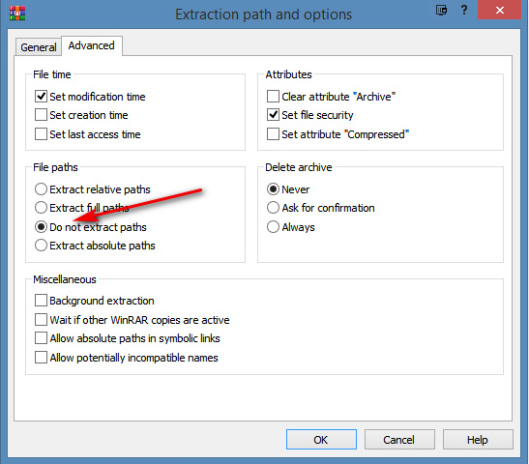
(For multiple 3D Warehouse Collada .ZIPs you also need to tick “Rename” when the ‘overwrite?’ prompt appears, as many use the same model.dae file-name).
Then, once you have the unified mega-runtime containing your new content, you simply copy the ../runtime (or in some cases the ../content folder containing the ..runtime below it) and paste it into your existing main ../runtime or ../content folder as required. My main ../runtime folder is under My Documents, which means that Windows is happy to merge stuff into it.
Sadly it’s impossible to have a single .zip extract just its multiple runtime folders, combine them into one, while also retaining its own sub-folder structure. For instance…
|
fluffybunny/runtime/
|
/textures/
/libraries
/geometries
|
fluffysquirrel/runtime/
|
/textures/
/libraries
/geometries
|
fluffybear/runtime/
/textures/
/libraries
/geometries
|
To a unified single combined /runtime/ folder, thus:
/runtime/
|
/textures/
/libraries
/geometries
I’ve spent hours trawling through Z-zip, WinRAR, Powershell, and others. Nothing on earth will do it.
New Poser and DAZ users should know that it’s possible to tell your software to use multiple runtimes. You’re not restricted to just the default ones for your content (which may be in a place that Windows refuses to cut-paste into, or which causes over-write problems on a Mac). It may be more practical to have two different runtimes for i) your core shipped-with-the-software content and ii) your store-bought/freebies content.
Also, you can have the DAZ Studio runtime show up in Poser, though not all the content you see there can be imported to Poser’s stage via the DSON plugin. Likewise, DAZ Studio users can point the software to the Poser runtime, though they may not always be able to successfully load a bit of content from it (mostly due to Poser-only texture formats, I recall).
The latest FlowScape has added “Desert Biomes“, after the oceanic deluge of the last update.

 Posted in 3D Utilities, Companion software, Poser, Spotted in the News, Tutorials, Vue
1 Comment
Posted in 3D Utilities, Companion software, Poser, Spotted in the News, Tutorials, Vue
1 Comment
I see that the PoserFusion plugins for Poser 11 are still available for me, via the old Smith Micro Download Manager — open the SM Manager with your special PoserFusion plugin serial number (not the regular serial number). There are four plugins which allow import of Poser scenes to Cinema 4D, Maya, 3DS Max, and Lightwave, but you’ll need to step back a few versions on these big-beast programmes. For instance, the PoserFusion plugin for Cinema 4D still works fine with C4D R17 (update: and R18 and 19, or so I’m told). Vue 2016 R4 didn’t need a plugin, with Vue able to natively import a Poser scene. The new subscription version of Vue can still handle easy import of Poser scenes.
I found that all four PoserFusion plugins were lurking on my hard-drive, downloaded some time ago, in my: C:\Users\USER_NAME\SmithMicroDLM\Downloads\release\Poser11\PSFU\win directory.
On cut and pasting these out to save them, and re-starting the Manager, I was still able to access them afresh via download…
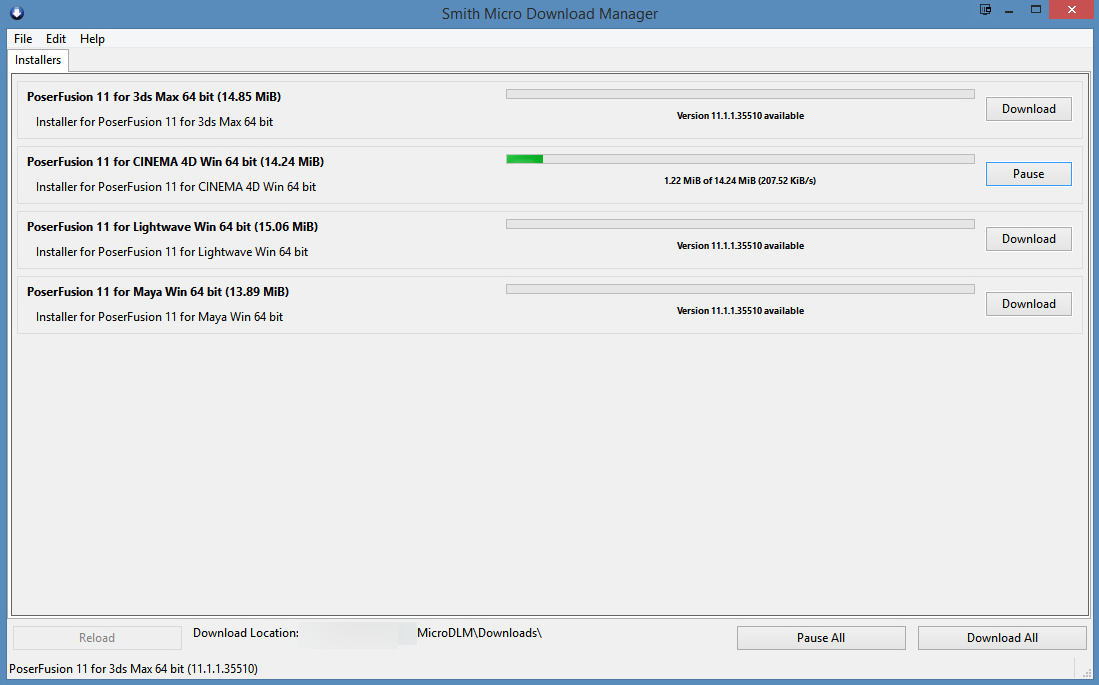
So this could be your last chance to get them, as I imagine that the SM Manager will cease to recognise serial-numbers fairly soon. Apparently Renderosity are not going to maintain these plugins, but that might just be a forum rumour. There’s a certain amount of mis-information flying around at present and I’ve seen nothing official on it.
The PoserFusion plugin for Cinema 4D still works fine with C4D R17 (some Forum voices say R19), with both old saved Poser files and saved file from the new 11.2 version. Basic C4D workflow is…
1. Top menu in C4D. Plugins | Poser. Tell C4D where to find the Poser runtime, if needed.
2. Clicking this adds a ‘Poser Object’ to the panel showing the list of scene content and materials, so that C4D knows how to handle what it’s about to have loaded.
3. In the panel beneath, Find “Object Properties”. Click the “…” button and load your Poser file from there.
4. Then once the Poser scene has loaded in, it will lack materials. Click “Load Materials” to have C4D go get the Poser materials from your runtime and load them onto the scene.
You can’t send cameras across, so you can’t later composite 1:1 with a C4D render and a Poser render.
For those finding this post in the future: this relates to the handover of Poser 11 from Smith Micro to new owners Renderosity, which happened this weekend with the 11.2 update.
The increasingly-beleaguered Adobe has reportedly killed its Fuse CC software. The “3D character generator” will not be updated for the macOS 10.15 next month, and “all downloads will be removed in September 2020”. The online Mixamo.com component will however maintain an offering of a stock library of characters with… “dozens of new ready-to-use 3D characters” coming soon. I’m guessing it’s possible that a few student/indie videogame makers may mourn the loss of Fuse, but it’s no great loss for artists.
I imagine this move by Adobe may something to do with Reallusion’s Character Creator, which is not software I’m taking much notice of… but which I hear has recently had some strong improvements.
A couple of webinars coming up.
1. Reallusion have a free “Importing & Animating DAZ Genesis 8 Characters in iClone” webinar on 11th September 2019. Update: YouTube link.
2. Carrara and Vue webinars from DAL, on 21st and 28th September 2019.
Excellent news from Silvio Grosso, who linked to a job advert in July (now sadly expired)…
the French G’MIC team has hired a developer who will make G’MIC with Photoshop as a .8bf filter. Starting work 1st October 2019 and with the post sponsored for a year.
G’MIC is the excellent filter set in GIMP, and (as a Krita-specific fork) in Krita.
Update, December 2020: Now mature as gmic-8bf.
Posted in Comics, Companion software, SketchUp, Special Offers and Discounts
Leave a comment
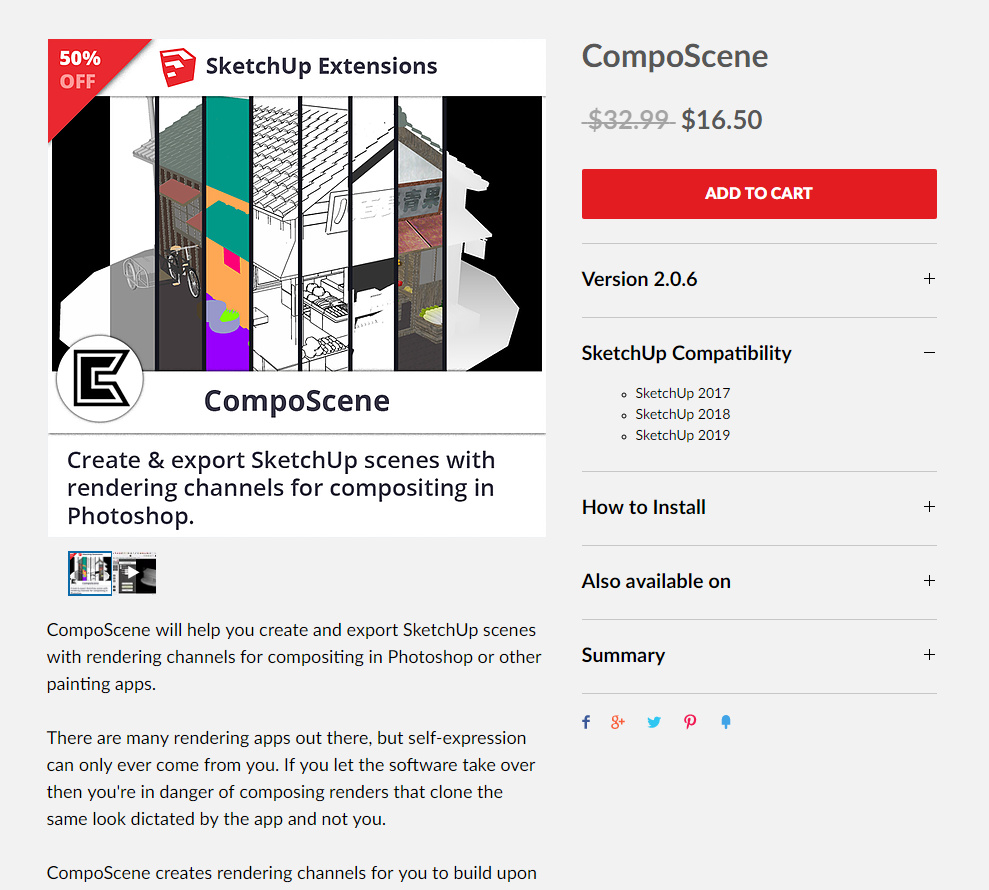
CompoScene is a render plugin, to efficiently export a bundle of multipass renders from SketchUp to Photoshop. Meant for comics makers. Originally $64, now just $16.50. Last updated December 2018.
Shipping now is HitFilm 13.0, the budget $299 video editing, compositing and effects software. It’s basically a cut-down After Effects for VFX-heavy film makers on a tight budget. Lots of camera matching upgrades, plus new colour-grading tools, and an interesting “Remove Stock Background – for compositing stock video footage without manual keying”.
Neobarok. The alpha for 2.0 was previewed a year ago. 2.0 is now being trailed on the site.
Totally free open source software, from one developer. Intuitive modelling and sculpting, with easy boolean and also paint.
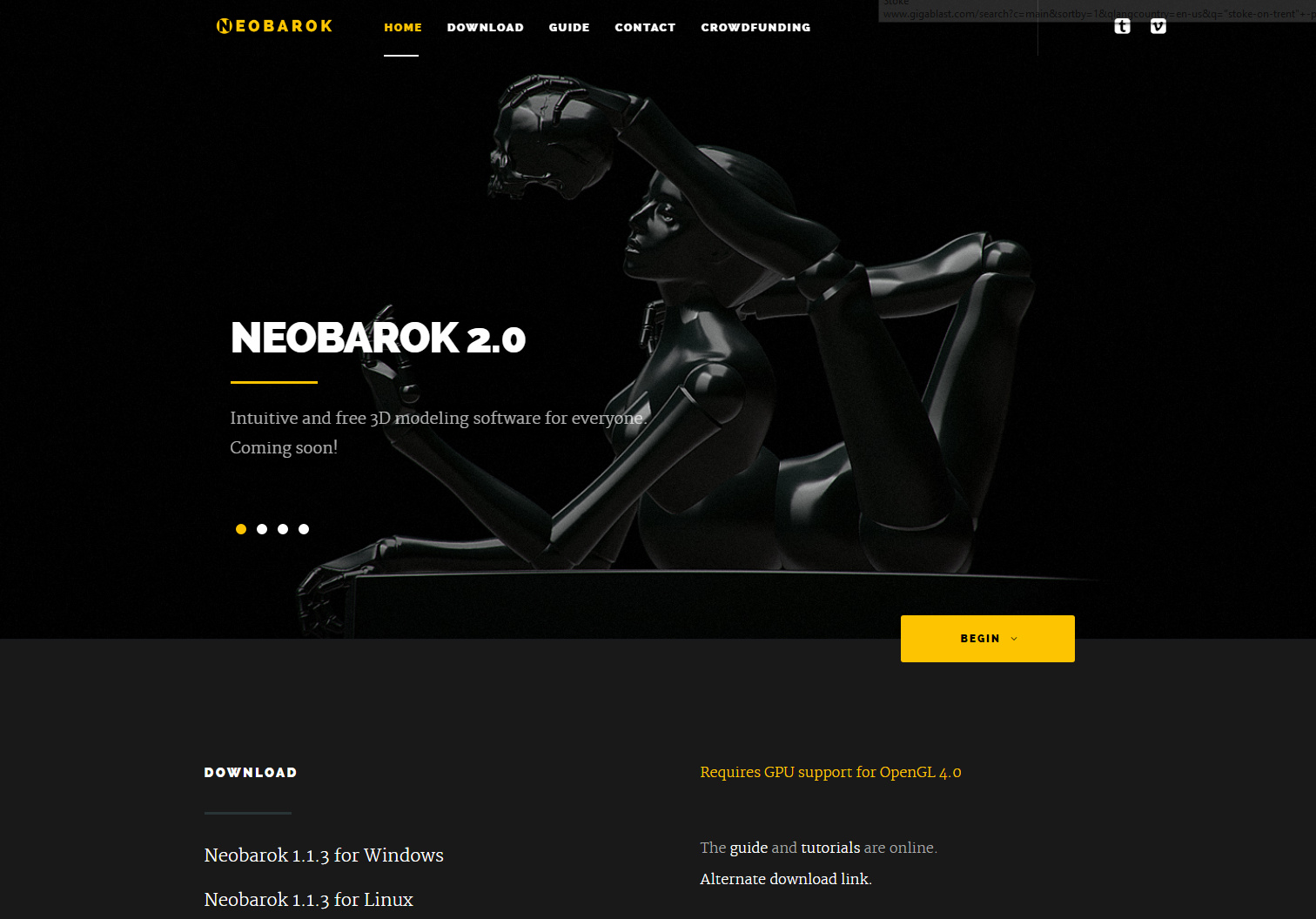
It has good video reviews, and it looks quite promising for 2.0. There’s .OBJ export, but so far as I can tell there’s no in-software rendering of what you see to a big 3000px .PNG file. The best you can get there is switch to hi-res, go fullscreen, and take a PrintScreen screenshot.
There are some introductory tutorials and the maker has a DeviantArt gallery.
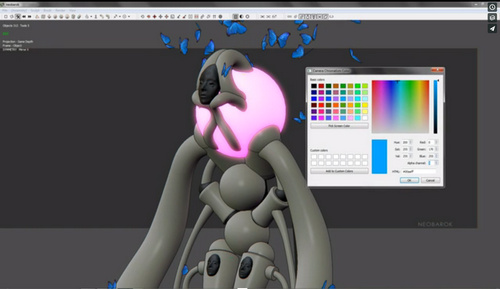
The most vital first-step in using it is quite tricky, until you get the hang of it. To rotate:
1. First press down and HOLD the RIGHT mouse button.
2. Then do the same with LEFT mouse button, so that both buttons are held down.
3. Then move the mouse to rotate the view.
Do not just press both buttons simultaneously, as that won’t work.
It’s not insanely complicated like some software, although the basic camera and move controls are not initially very intuitive or standard. Let’s hope 2.0 has a camera widget like Poser.
Some release notes of interest, re: recent releases in budget/free software and/or comics and non-photoreal rendering.
* The latest version of PD Howler is available, as Howler 2020 (Windows only) at $77 before discounts. The big changes seem to be a revamp of the legacy brush engine, new paper textures, and rationalised de-cluttered media presets.
* The free Krita 4.2.3 (17th July) is only a minor update, but makes the 4.2 (May 2019) brushes even slicker.
* Just released, a new version of Cinema 4D R21, although I can see nothing on the feature list to interest Poser users or users of C4D’s Sketch & Toon module. However, it’s important to note that there’s now no more confusion between Prime / Visualize / Broadcast / Studio / BodyPaint editions of C4D — they’re all gone. Everything is now in the one edition. Apparently Internet access and online log-in is now required with each launch, with this edition. It doesn’t work with the PoserFusion plugin, and for that you want R17 (which also, rather usefully, doesn’t need the Internet).
* The Release Candidate for Blender 2.8 is now available, as Blender continues to grind its interminable way to the final final really-final-we-mean-it-now honest-it’s-here-at-last 2.8 release.