
A group of artists explores the best ways to produce a photorealistic 3D human face. A face that doesn’t freak people out, by looking not-quite human. Their early work is now available as a free Maya file (non-commercial use only).
Category Archives: The Animation Industry
Disney’s Life on Mars
Amazing Disney animation from the 1960s, showing his team’s wonderful visions of the sorts of creatures that might have lived on Mars. Great inspiration here for creature design in 3D…
Tomorrowland: the novelization has additional scenes and details
At the risk of temporarily turning this blog into a Tomorrowland fan blog, I must say that I was fascinated to find that the Tomorrowland novelisation was quite different at certain points. It’s an easy read of a few hours, being 160 or so pages in plain English meant for young adults, and is skip-able in places where the action is the same as in the movie.
The novel has additional information about the back-story that’s unavailable in the prequel novels / ARG / comic-book / deleted scenes etc. Those interested in what deleted scenes might be on the Blu-ray, and also any Tomorrowland fan-fiction writers, may be interested in the changes and differences — along with the Plus Ultra timeline that’s been drawn from the above sources. So I’ve spent 30 minutes typing up my rough notes on the novel’s differences.
Warning! Spoilers, if you’ve not yet seen the movie or read the novelisation:
1. Young Frank’s aggressive farmer father tells Frank that his childish optimism won’t mow the cornfield. Frank invents a device to automatically steer his father’s combine harvester. Frank also sets fire to the corn when he uses his jet-pack, a scene that is known to have been filmed and was the original opening of the movie.
2. At the 1964 World’s Fair, Frank sees an exhibit that claims to use a computer to accurately predict the random fall of balls on a pinball-like table. This foreshadows the functioning of The Monitor. (It’s possible this was filmed, since it has been refered to — by ARG fans who saw early footage — as the “IBM pavilion ‘Probability Machine.'” and they were able to quote the dialogue spoken. They also noted a scene of a close call with a costumed The White Rabbit, and Frank looking admiringly at Father Progress on the Carousel of Progress. They also spotted that Michael Giacchino, the film’s composer, plays the Small World ride’s boat-loader).
3. Young Frank’s conversation with Nix at the World’s Fair reveals that he had learned, from reading of failures at Bell Labs, how not to build a jetpack.
4. In the novel, Casey also lives with her TV-slumped Uncle and dull cousins Mikey and Clarissa. They are unseen, but mentioned.
5. The scenes in Casey’s school classes omits her question of: “So, what are can we do to fix it?” (The movie also filmed a scene with Casey in detention at school, which might follow on from her question — the detention is not in the novel).
6. During the car ride home from the police cells, Casey’s dad tells her he’s been fired. The site demolition foreman had assumed that Casey’s father had asked her to do the sabotage to keep him in work.
7. The Blast From the Past shop staff tell Casey details of the augmented reality system connected to the pins, that Disney was “one of Plus Ultra”, that Disneyland was “just a cover” for Plus Ultra training, and that “they” (Plus Ultra) were planning to go public at the 1964 World’s Fair.
8. While driving to Frank’s house, Athena uses her robot eyes to project the video of a 3-year old Casey that is seen in the movie. Athena says that she found it on YouTube and that it had led her to Casey.
9. While driving to Frank’s house, across the empty spaces of the mid-west, the only radio Casey and Athena can pick up is hellfire evangelical preachers ranting about the end-of-days. Athena turns off the radio, with “strange black eyes” that Casey assumes is the equivalent of robot tears.
10. Athena reveals that she was built in 1957.
11. Frank still lives on the old family farm. He has been a total recluse, but has lately struggled with himself enough to at least go out once a week.
12. Nix hasn’t aged much since 1964, but he claims not to be a robot. He says there are “just enough” people in Tomorrowland to keep the city running, and talks of the need to gather massive power to feed The Monitor (named “The Oracle” in the novel).
13. There is a scene of robots returning through a portal “bridgeway” from Earth, carrying away great art, literature and memorabilia to save it from the coming destruction.
14. Casey doesn’t see a ‘Monitor prediction’ of Earth demonstrations and other moments / types of destruction, simply the devastated Earth as it is three months after the “Inevitability” (doomsday). The Monitor cannot see three months either side of the moment of destruction, “because of the radiation”. This implies nuclear destruction, but those in Tomorrowland are uncertain of the precise cause of what they call the “Inevitability”.
15. When The Monitor was first built, the chances of the “Inevitability” (doomsday) were 1 in 10. Gradually, the odds became slimmer and slimmer. Nix decided (secretly?) to change or boost the Monitor so as to subtly inculcate a feeling of pessimism in humanity, hoping it would shock them into action. Instead, his actions had an unexpected effect — Nix found that humanity took a perverse delight in its new-found pessimism. As he says, pessimism demands nothing of one today, and no thought for tomorrow. Presumably he then tried to increase the effect, vainly hoping that ever-higher levels of pessimism might shock humanity awake.
16. Casey’s realisation of the Monitor’s unintended pessimistic effect is developed a little more slowly in the novel, with a montage of flashbacks.
17. Frank talks of his ability to detect and pirate the Monitor’s signal on Earth being because Nix was turning the Monitor “on and off”. Nix later contradicts this by saying that Monitor cannot be turned off, since it now powers the city. The unspoken implication is that Nix is lying and that he has been secretly turning the Monitor off briefly, perhaps in order to siphon the vast power to some sort of machine that keeps him so young. Such an action might also grimly help explain the under-population of the city.
18. Nix accepts Frank’s handshake at the portal because he had been Frank’s old mentor and teacher. He has been the Governor since at least 1964.
19. Athena remembers and states the exact date of Frank’s exile: 24th April 1984, when he was presumably aged about 29. She says the date is forever burned into her memory.
20. The moment before Frank straps on a Tomorrowland jet-pack and takes off with Athena, he cracks a joke, and so finally makes her laugh. While living in Tomorrowland he had never managed to make her laugh like a human.
21. All the robots/androids stop working when the Monitor is destroyed. (In the film, in contrast, it appears that a few dusty androids emerge cautiously from the ruins to peer at their two liberators). In the novel, Frank and Casey survey the ruins of the city for a longer time.
22. There is a very different pre-credits ending. This is much more low-key and less glitzy / ‘Benetton ad’ than the movie’s ending. You’ll have to buy the book for that one 🙂 Or wait for the Blu-ray, as I’m assuming this is the alternate ending that the director says was filmed.
Also… (warning: more big spoilers)
Raffey Cassidy (Athena) said in a press interview with Marybeth Hamilton (“Exclusive: Raffey Cassidy on the Secret of Athena’s Blue Dress in Tomorrowland!”) that there was a scene where the camera was inside a monorail, the monorail car drew up to a stop, the doors opened and beyond the doors the camera looked straight at Athena and Frank (adult, played by Clooney) waiting on the platform, who were looking into the opened monorail doors at Casey. It’s not in the theatrical release. I wonder if that was one of the alternative endings? An interview with Lindelof seems to confirm something that sounds like this, he said there’s a portrayal of Casey in the deleted scenes for Tomorrowland that shows another Casey (growing into adulthood?) and “shows the evolution of where we ended up” after the movie.
For that monorail doors scene to work as an ending, the current pre-credits scenes would presumably have been cut after about the “glowing trees” scene in the movie. Instead we might have had a voiceover monologue from Casey with a montage of scenes showing: the novelization’s alternative ending on Earth (not in the movie); the “come and help us, Dad” scene from the movie; impressionistic scenes of getting the city back into working order again; Casey wistfully watching the new generation of recruiter robots depart through the portals, and being sorry that none of them look like Athena. Then the big recruitment/wheat-field climax. Fade to black. Then fade slowly up into a coda with Casey riding the monorail, maybe older, re-construction and new life all around, Dad off doing his thing at the spaceport, which he’s called her over to visit because he has a ‘surprise’. Her voiceover says that Frank is so busy these days, on some mysterious project, so that she hardly sees him. The future looks bright, of course, but she often feels the need of old friends and like minds to get her bearings in the whirl of the new world. The monorail doors open… the movie ends with a scene of Frank and Athena on the platform, looking at Casey, spaceport in the background. Frank smiles, Athena also smiles, and cocks her head to the side in a slightly robotic manner. Frank wears a spacesuit and carries a helmet. Athena tells Casey: “We’ve saved a seat, just for you…” and holds out a space helmet. Casey is going to stars, just like her 3-year old self had hoped. Fade to black.
The implication that the audience would be left with is that Frank has had Athena re-made… (the prequel novel talks of how robots are only partly ‘in’ their shell and have a sort of collective remote backup mind – so with that and Frank’s genius, it’s possible).
Beyond Tomorrowland
I must say that I thoroughly enjoyed the new movie Tomorrowland during a rare trip to the local cinema. I even read the excellent prequel novel, Before Tomorrowland, which is rich in back-story about the Plus Ultra organisation, and has some very nice links into the movie. I also found a little more back-story in the deleted Pixar animated scene (on YouTube — it would have been in the movie as part of the “It’s A Small World” sequence at the 1964 World’s Fair).
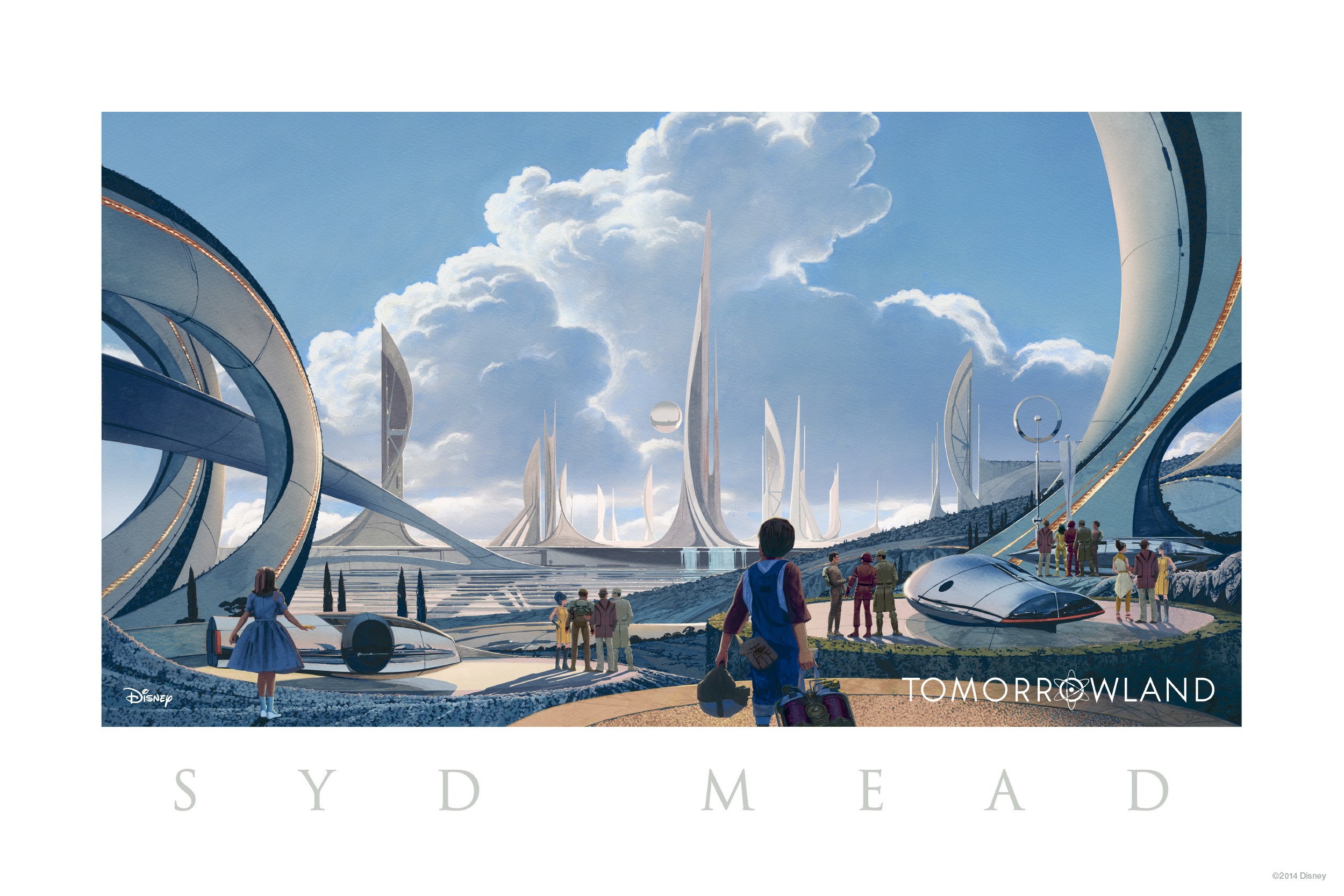 Above: one of Syd Mead’s concept paintings for the movie Tomorrowland.
Tomorrowland is still showing at the cinemas in the UK, for a day or two longer, and has big-screen CGI of the Tomorrowland city that must be some of the most beautiful and fresh ever put on screen. The movie is also interesting, technically, as one of the first serious attempts to improve the quality of cinema digital projection.
But, sad to say, it appears that the movie’s choppy marketing confused the mainstream U.S. audience, who expected another mindless kids’ roller-coaster ride to the future and instead got a thoughtful character-driven movie about the loss of our childhood dreams, and (if you know the back-story) the magical transmissive nature of inspiration. So now the movie’s lacklustre U.S. box-office, followed by a reportedly dismal $14m first-week box-office in China, appears to have effectively killed off any chances of a sequel telling the story of Frank and Athena (and also killed off Tron 3, which I’m less sad about). That’s a great shame for a movie with such big ideas and such a big heart. And also a flawless ensemble cast, I should add.
I did have qualms about the cliched action-movie part of Tomorrowland‘s ending, but according to the director they also shot an alternate ending. Let’s hope that ending is more intelligent and shows up on the coming Blu-ray disc. I suspect a Director’s Cut, though needed, is now sadly out of the question in terms of Disney funding and releasing it.
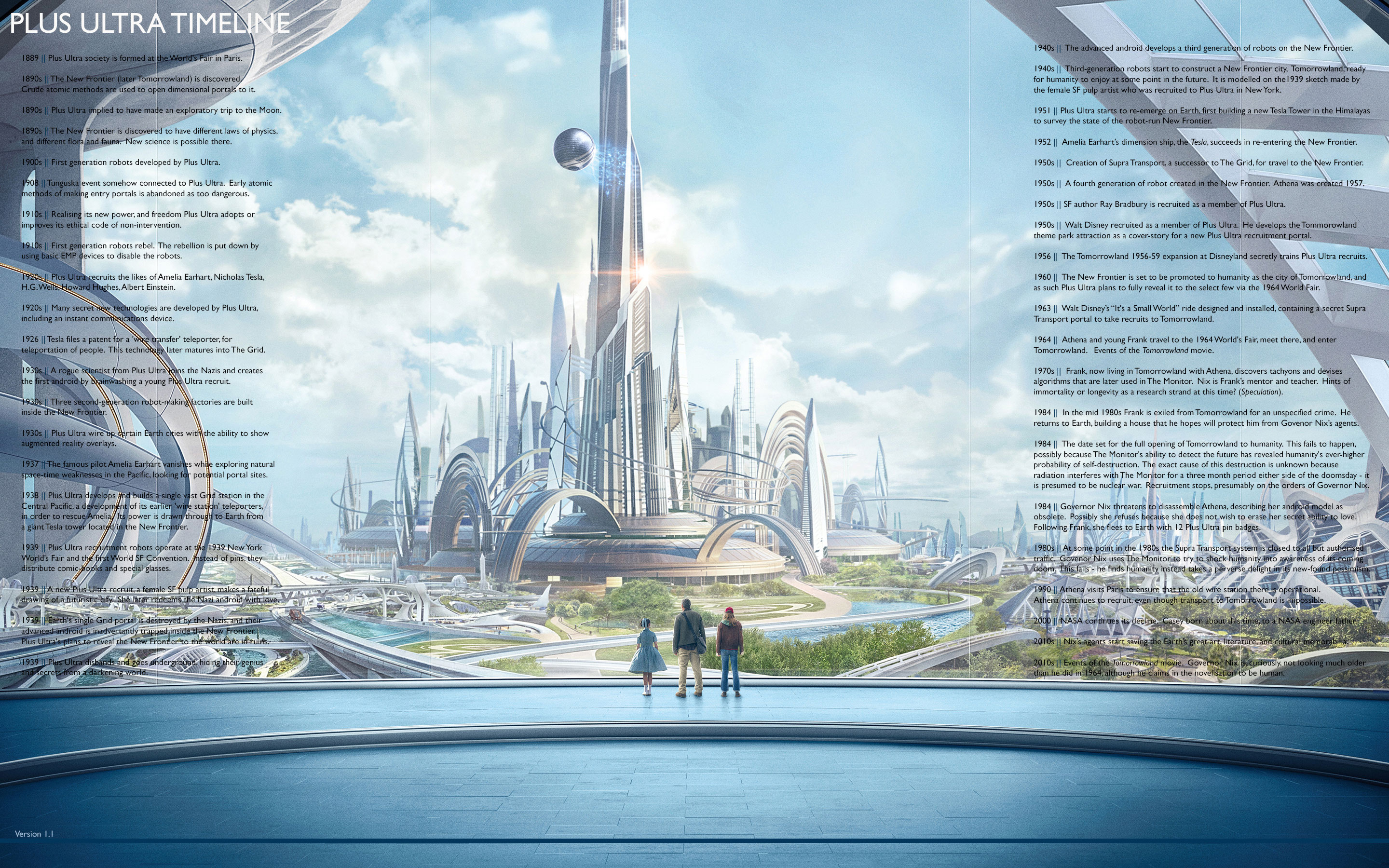 Official wallpaper, with unofficial Plus Ultra / Tomorrowland historical timeline.
For now, for the fans, there’s the Disney’s Tomorrowland Facebook page, and for the longer-term fans there’s A World Beyond – for the recruits of Plus Ultra which is the unofficial fan Group on Facebook.
Pixar’s render engine, for free
Pixar’s Renderman render engine is now free for non-commercial use. Supported by Maya now, Cinema 4D soon.

OctaneRender 3
Posted on
by
 Posted in 3D Utilities, Companion software, DAZ Studio, Spotted in the News, The Animation Industry
Leave a comment
Posted in 3D Utilities, Companion software, DAZ Studio, Spotted in the News, The Animation Industry
Leave a comment
Posted in 3D Utilities, Companion software, DAZ Studio, Spotted in the News, The Animation Industry
Leave a comment
OTOY has announced OctaneRender 3, calling it a massive upgrade.
Flying a kite
Posted on
by
Posted in Films, Real-time animation, Special Offers and Discounts, The Animation Industry
Leave a comment
Posted in Films, Real-time animation, Special Offers and Discounts, The Animation Industry
Leave a comment
A film made in Unreal Engine 4 — all FX, lighting, plants, plus a boy and 100 square miles of landscape, rendered at at 30fps in real-time inside the Unreal Engine 4 videogame engine. An engine which is now free.
Epic freebie
Posted on
by
Posted in Companion software, Real-time animation, Special Offers and Discounts, Spotted in the News, The Animation Industry
Leave a comment
Posted in Companion software, Real-time animation, Special Offers and Discounts, Spotted in the News, The Animation Industry
Leave a comment
The leading videogame engine Unreal Engine 4 is now available… “to everyone for free, and all future updates will be free!”…
“You can download the engine and use it for everything from game development, education, architecture, and visualization to VR, film and animation. When you ship a game or application, you pay a 5% royalty on gross revenue after the first $3,000 per product, per quarter. It’s a simple arrangement in which we succeed only when you succeed.”
Nvidia VCA
Oooh, the end of rendering is here! Again. Yours for a mere $50,000 / £32,000 + tax, the new Visual Computing Appliance (VCA) from Nvidia. 8 of Nvidia’s supercharged graphics cards are at your command, along with 256 GB of fast memory and oodles of other drool-inducing components.
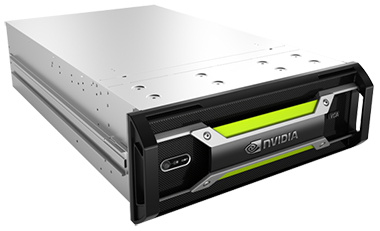
I guess it’s not an impossible option for a 25 business ‘incubator unit’ of creative digital businesses. Everyone would chip in $2,000, via a quarterly $250 levy on their office rental for two years, then time-share the unit over a network. It is amazingly fast, after all, so it’s not as though Sally’s ‘formerly nine hour render’ is going to block Bob’s ‘formerly six hour render’ if they can render in minutes instead.
I also wonder how easy it would be to DIY something similar, and at far less cost, with eight cheap Nvidia GeForce GTX 960 cards and a big empty case, if one was familiar with building PCs. Actually, such a chassis/case may not be that hard to find, as I guess the Bitcoin miners have some similar kit like that lying around, since that sort of thing is what they use to ‘mine’ the coins.
Something Brewing…
Cartoon Brew Seeks An Associate Editor…
“the animation industry’s most visible news source” seeks “a key member in the website’s development, someone who understands both the practice and business of animation inside-out”.
Cinebox
Posted on
by
Posted in Companion software, Films, Real-time animation, The Animation Industry
Leave a comment
Posted in Companion software, Films, Real-time animation, The Animation Industry
Leave a comment
Trailer for the forthcoming Erasmus Brosdau film made with Cinebox, a genuine real-time WYSIWYG renderer that sits on top of the videogame engine CryEngine, and lets you make stills and movies with it in real-time interactive HD (like iClone, not like the slow grainy preview windows that pass for real-time in high-end 3D software). Cinebox has yet to be released, but it already looks pretty good…
More mammoth VFX shots from Game of Thrones
Not to be outdone by Mackelvision’s Game of Thrones VFX show-reel (here), now the rival SFX house Rodeo FX has released a similar show-reel for the VFX they did for the TV series…
Plug-‘n-pose
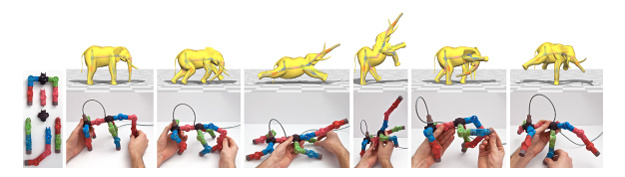
Cool new animation pose controller, shown at SIGGRAPH. Plug the Lego-like modules together to form your animal’s skeleton, then flex and bend it to pose the creature on the screen.
Mammoth Visual FX from Game of Thrones
Here’s the VFX “making of” reel for Game of Thrones, Season 4…
Boom times
The 3D animation market in general is thriving, according to a weighty new market report. That’s despite the ongoing crisis among the custom VFX houses which service big movies and high-end TV series. But in terms of the whole picture (“hardware, software and services”)…
“The 3D animation market is estimated to grow from $21.06 billion in 2014 to $40.78 billion in 2019 at a Compound Annual Growth Rate (CAGR) of 14.1% from 2014 to 2019.”
Of course, one would ideally like to know how much of the consumer end of the 3d videogaming industry they included in those figures. But the relatively small “$40bn” seem to indicate that games and console purchases have been removed, as their previous 2011 report found that…
“The global animation and gaming market is expected to grow from $122.20 billion in 2010 to $242.93 billion by 2016.”