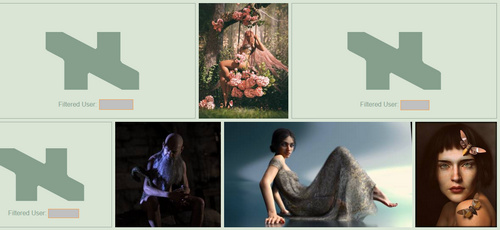
Ah, well… that’s DeviantArt ruined. They’re now forcing the appallingly un-usable new ‘Eclipse’ interface on everyone, from 20th May 2020. The new look is somewhat prettier, but is absolutely vile to try to use. Its poor usability and layout is just so bad, and in so many places, that it’s amazing how it all got past the beta testers. I can only assume they were all using tablets, not widescreen desktops. It’s so bad that I’m considering moving. Are there any real alternatives to DeviantArt, that are not the dour and fun-free ArtStation?
Category Archives: Spotted in the News
Release: Lightwave 2020
Lightwave 2020 has been released. The “what’s new” highlights for artists appear to be:
* Two new hair shaders in FiberFX, with “a simple artist-friendly shading option” which makes controlling and styling the strands easier.
* Tone mapping and better SSS.
* Improved workflow in the Scene Editor.
* “More features” are now supported in the FBX format.
* Updated OpenGL, for a “closer to final render” look in preview.
P3DO Explorer Pro 2.8, for $12.50
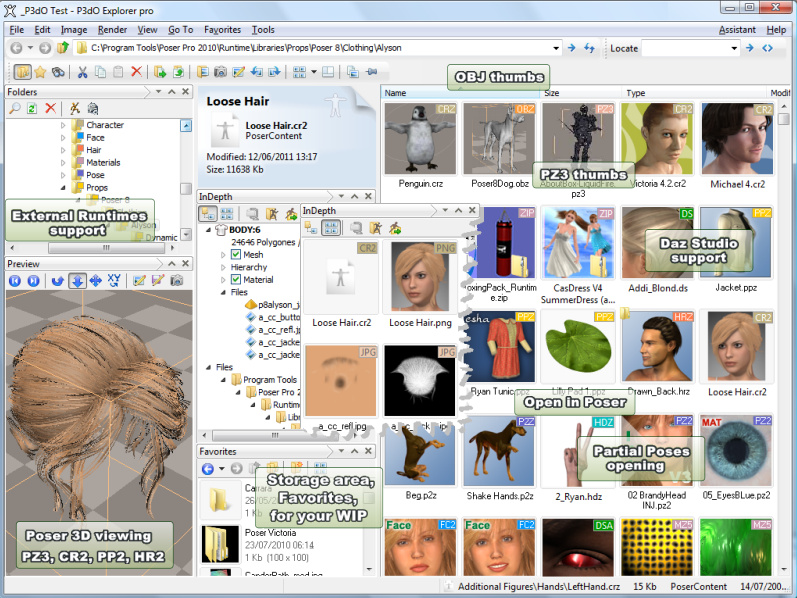
The Poser library manager/finder alternative P3DO Explorer Pro 2.8 is 50% off until 30th April 2020, including the upgrade. That makes it just $12.50 for first-time users.
The last P3DO Pro update was December, with many new features added, and this new 2.8 is March/April 2020. Again, lots of new items added and other tweaks, on which the changelog is linked here. Much as I like PzDB as a Poser library manager, this new P3DO 2.8 has to be worth a mere $12.50 just to have as a backup. I believe it also works offline, whereas PzDB needs to ‘phone home’ occasionally, which may make P3DO useful for offline Poser creatives. P3DO’s main problem is that searches are so incredibly SLOOOOOOWWWWWWWWWW. Really, really SSSSSSSSSSSSSSSSSSLLLLOOOOWWWWWWWWWW. Like eight minutes for one search.
Curiously, the DuckDuckGo search-engine seems to heavily censor searches for the software (six results for “P3DO Explorer”, none relevant). Whereas Google Search is happy to provide 14,000 results. I assume that the word “p3do” is now on the Bing bad-words blacklist (DuckDuckGo is mostly Bing, with a bit of Yandex). Yes, it’s 2020 and advanced search-engines are still using clunky old keyword-based censorship. This is yet another reason why DuckDuckGo isn’t something you should use for serious searching, only for quick navigational searches and image searching (on which it’s actually quite good, mostly because it has less spam and fluff than Google Images).
Also, in other discount news, the main Reallusion Store has a coupon code for 50% off everything, also until 30th April 2020. Theoretically that brings the standalone conversion utility 3DXChange 7 Pro down to $99, which will be of interest even if you don’t want to get into the iClone ecosystem.
Furry fun
The iRay devs reported a few weeks ago that iRay “2020.0 final has just been released”. Strand fibers do “especially well” with the new iRay 2020 + an RTX graphics card, even fibres with dense intersections.
iRay 2020… “introduces native fiber intersection support! This delivers perfectly smooth hair, fur, carpet, and similar curve-based primitives out-of-the-box, without paying for extra memory and/or additional pre-computation time for tessellation to triangle-data!”
Good news for fur render speed and for Look At My Hair users. Though not quite yet, as the latest iRay in DAZ Studio is currently 2019.1.4. But it can’t be long until 2020.1 gets plugged in.
Several other major bits of software are also doing short hair, KeyShot 9 has its new “fuzz”, and Lightwave 2020 also adds new shaders and easier controls to its existing FiberFX.
Release: Poser Pro 11.3 update
The Poser Pro 11.3 update has just been released. Congratulations on the team for getting it on time in the current difficult circumstances. 11.3 adds…
* support for RTX graphics cards on Windows, and apparently this has to be “20 series”. The added support is said to “significantly reduce render times”;
* improved content library search, with new Boolean “AND” and “OR” search-operators for the Library search-box;
* a new stand-alone male figure, L’Homme, who was previously only a morph of La Femme. But “they can still share morphs, textures and poses”;
* the La Femme figure has been updated to remove the L’Homme morph dial;
* users can now log in to “Renderosity accounts through the Poser Software interface” and download/install store purchases that way. Note that “Users will not have to “Install from Zip” unless they want to.”;
* Poser’s Python scripting is updated to Python 2.7.17;
* 11.3 adds the latest .FBX handling, and there’s a forum post that suggests this means FBX 2019;
* new “faster loading of default scene load time by using PMD”. (Never heard of it, but sounds good. Does it also speed up Poser scenes that are not the ‘default’?);
* and “hundreds of bug fixes”.
On the ‘store content installs’, I presume one can tell Poser which Runtime you want it installed in. Since Poser 11 has several, and users often have more and in strange places.
11.3 looks good, but I won’t be installing it just yet, and I might even prefer to wait until the summer and Poser 12. Poser 11.2 runs fine for me, and I’ll wait and see what scripts the Python update breaks before installing. I’ll probably update this blog’s ‘Poser 11 Python scripts page’ in due course for 11.3, in a few weeks, as and when stable fixes are noted and linked on the forums.
It’s all gone Bendie!
If you haven’t been following Reallusion closely, you can catch up with a handy new 3-minute Reallusion 2019 video roundup. It briskly showcases all the new ‘big’ content made available for sale in 2019, in both 3D and 2D. Note that there will also have been content from smaller makers, and last time I looked they had a separate store for such items.
The show-reel usefully reminded me of Garry Pye Creations and through it I discovered new work from him that I hadn’t seen before: his The Bendies series.
The Bendies were first made for CrazyTalk Animator 3, then upgraded for Cartoon Animator 4 and its ‘360 head’ feature and new face puppeting. They also lack edge inking, which means webcomics artists could over-ink a bit to add their own look. They look excellent, and can be purchased individually at around $10-$12 each.
Sweet Apple
The Apple macOS version of CrazyTalk Animator 3 Pro (now Cartoon Animator 4) is free until the 1st of April 2020. Note that Pro is a limited version, compared to the full top-of-the-line Pipeline version. Pro lacks .PSD import/export, and vector .SWF loading.
I don’t imagine that there are many poor people with Macs. But for those who are short of cash, such as school students, then it’s a nice bit of creative software and is not tied to a subscription. Those who know schools that run on Macs might also point them in the direction of this offer, with a warning that Reallusion’s content-packs can be expensive.
Voice controlled comics software
Worried about your fingers getting creaky? By the time they do, software will likely be stuffed with AI-enhanced voice assistants and the old mouse and keyboard may be gathering dust in a drawer. This is suggested by a new article from Maxon, maker of Cinema 4D, which profiles Kye Young and her use of the software. She Makes Comics in C4D Using Voice Controls…
“after developing degenerative arthritis in her fingers … she figured out how to use voice commands to control C4D, dramatically reducing the need for her mouse and keyboard.”
Poser lineart webinar
“Create a Signature Line Art Style with Poser”. A live webinar with Mike Mitchell in which he steps through his techniques, and shows how the renders are then worked up in the comics production software Clip Studio (formerly Manga Studio). Sunday 16th February 2020.
RTX for Poser 11.3
News today from the Poser developer team. The Poser 11.3 free update is officially dated as due at the end of March 2020, and it will also support RTX-capable graphics cards.
In the UK you’d currently be looking at around £400 for a good new RTX card, although it may also require a new power-supply unit too.
It’ll be interesting to see if this new feature can ‘drive’ the main scene-view window in real-time, thus optionally replacing OpenGL and making Poser 11.3 into a “what you see is what you get” software.
Dynamic Outline Inking with Blender
A new video from Lightning Boy Studio, Dynamic Outline Inking with Blender. Definitely not as simple to set up or control as Poser 11’s real-time inking, but the video’s result on the test ‘dinosaur mask’ looks production-ready to me.
Double it and double it again…
Using the latest DAZ Studio gives you a substantial iRay speed boost, thanks to the integration of the latest iRay version. 2x faster on CPUs, for instance. Though, as NVIDIA want to sell $500 graphics cards, you’ll only read about that in a quiet blog post from the iRay dev team.
But now I read on the forums about another way to add a further 2x boost to DAZ Studio. So long as you don’t have transparency in the scene, choosing the “Interactive” rather than “Photoreal” version of iRay in DAZ Studio should apparently give you another 2x speed-boost with minimal loss of quality. Some shadows are skipped and transparency is handled differently. But otherwise it’s a good WYSIWYG representation of what your render will look like. The advice is from someone on a fast dual-Xeon PC, but it’s something to consider re: working toward a real-time iRay viewport rather than just a Preview window. It’s easily tested on your system.
P3DO Explorer Pro 2.7 R3 – now supporting Poser light and camera presets
P3DO Explorer Pro has updated to a 17th January 2020 release, and…
“As promised this version contains Poser additions: lights and cameras have been added to the Poser formats supported.”
This again brings P3DO into parity with its competitor PzDB, following the recent addition of DAZ .DUF content indexing. Lights appear to have been done in quite a robust way, and search hits…
“shows the lights list with the light type (infinite, spot, point, diffuse IBL, area light) and image references for IBL.”
And for an unspecified future release in 2020 the maker plans to…
“add the ability to load only one light/spot from a given set into Poser.”
There will be a P3DO 2.8 ’20th anniversary edition’ in April 2020, so the Easter store-wide sales may be the time you’ll want to bag a copy on Renderosity.
Poser 11 Webinar Series: Meeting 1
Poser 11 Webinar Series: Meeting 1 January 2020 is a welcome new webinar from Poser expert Nerd3D. Here’s the handy contents-list from the front of the video recording which is archived on YouTube…
I’ve added three red dots on those items likely to interest those who are not store content-developers.
Perhaps, in future, the show might get an even bigger audience if the producers were to front-end it with such general items, and then follow those with the more content-developer-ish items?
Enlightening the dense
A promising new 2020 paper, “Generating Digital Painting Lighting Effects via RGB-space Geometry”. Along with the paper are Python scripts that inspect your digital painting, detect where “the density of strokes” are, and then intelligently re-light the painting accordingly.
It’s ‘early days’ for this and similar experimental re-lighting techniques. But one wonders if it could be used on 3D renders, perhaps if they were output along with a quickly-calculated data-file that served as a proxy for “density of strokes”. That would perhaps be the equivalent of Poser’s Sketch rendering, but without the rendering — only the stroke density data would be saved, as a text file. Poser can already save its stroke data for export to Corel Painter.