OnlyFreeTurboSquid. A handy UserScript for your Web browser, that…
“makes it so you only see free things on TurboSquid.”
OnlyFreeTurboSquid. A handy UserScript for your Web browser, that…
“makes it so you only see free things on TurboSquid.”
Coming soon and booking now, Mastering Animation for Poser 12 webinars with Charles Taylor. Also relevant for Poser 11, of course, it’s just that 11 users won’t have such swift SuperFly rendering or some of the new Cycles nodes. But that won’t matter much if you’re using Firefly, Sketch, Comic Book, or Preview PNG sequence + Photoshop filters/actions.
Poser 12 Early Access has updated again. Now at 12.0.421 (2nd March 2021). The main thing is the Manual.
* “Major updates to Poser Manual to cover Cycles updates and other new features”. Related to this is “Several Help menu commands are correctly linked” in the software.
Beyond that, more tweaks to SuperFly, which is Poser’s implementation of Blender’s main Cycles renderer…
* “SuperFly using Infinite lights [now] consistently renders specularity on sequenced images”. Which appears to be a useful fix for animators.
* “Fixed HDRI background images corruption, no longer previews or renders red or black.” Also, SuperFly render size was being constrained in size by a 4095 pixel limit on background images. This limit has been removed.
And some Python scripting things fixed, presumably ahead of a big update for the bundled scripts and more (said to be due in mid-March), such as…
* “Bundled Python command-line tools and apps now have the correct library load path attributes.”
The subscription VUE R6 is out, and it’s a big update. I hadn’t realised that the new subscription Vue now includes major compatibility with…
* 3D Studio Max 2016 to 2021
* Maya 2015 to 2020
* Cinema4D R20 to R23
* Lightwave 11.6 to 2020
Or, if it didn’t before, then it does now with the new R6. Therefore, since Vue still has excellent Poser scene import… this could be a way to get your Poser scene over to those big beasts, if either: i) you can no longer get the PoserFusion plugins; or ii) your PoserFusion variety can’t support the very latest edition of Cinema 4D, Maya etc and your boss needs you to.
Poser to the forthcoming Omniverse modules too, via Vue…
* “We’ve also included a direct export preset for Nvidia’s Omniverse.”
Other changes:
* Export via Pixar’s Universal Scene Description (.usda, .usdz, .usdc).
* Control clouds based on their altitude in the scene.
* Support for “non-photorealistic rendering” in the Path Tracer, and supports for the Substance GPU engine in the viewport. It’ll be interesting to see demos of those.
* Python 3 since R5. Therefore those relying on Python 2 scripts either need to get them updated or stick to R4.
* Terragen .TER import is back, from R5. Had been broken.
* I see that “SkinVue fixed and added to VUE” since R2, which is important for Poser scene imports with figures.
* Vue’s developer are obviously spending a lot of time aligning the software with NVIDIA’s doomed Omniverse project.
All in all, I still don’t see a big need for a hobbyist to move from the old Vue 2016.
Blender 2.92 is around the corner. What’s new and key?
* Geometry nodes, scatter and instancing.
“Nodes can be used to change an object’s geometry in a more complex way than regular modifiers.” There’s a new node-based system for this, which “lays the groundwork” for the future but for now it has “object scattering and instancing” already enabled. Could be useful for DAZ and Poser… scatter in Blender, save and use in Poser or DAZ.
* Primitives in a click.
“Create primitives with two clicks.” Nice. It’s now probably a bit easier to set up a Synthwave picture by loading simple primitives to an Eevee scene, and then (see below) to get mattes for later compositing.
* Eevee Cryptomatte
Create mattes from the scene, for compositing. This was already in Cycles, is now also in Eevee. A “new compositor node was also added to adjust the exposure of images”.
* Grease pencil
Edit grease pencil strokes using Bezier curves. Also a rather vital Grease Pencil menu, that was accidentally totally bjorked by 2.91, is back again. Nice for the NPR crowd, but grease pencil is obviously one of Blender’s many ‘moving targets’ with features and menus popping into and out of existence.
* Cycles
Faster rendering on complex scenes. “Multithreaded export of geometry, to improves performance in scene synchronization when there are many mesh, hair and volume objects.” Also faster hybrid rendering. “GPU devices can now take over rendering of tiles that are currently being rendered by CPU threads, to improve hybrid rendering performance”. This looks like the main thing.
Cycles getting power-ups is important, because these may well feed into Poser 12 at some point. In Poser, Cycles is ‘SuperFly’.
* Fluids
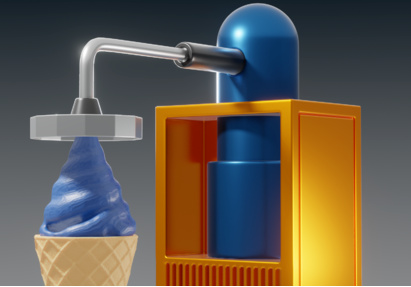
Viscosity, so you can now do things like ice-cream cone twirls. Or er… doggie doings. Yum.
Old 3D World magazine PDF scans have been taken down from Archive.org. They can still show up in search results there and at Google Search, from circa the 2008-2012 era, when it was taking notice of Poser in a real way (some tutorials from Brian Haberlin, some letters-page advice, freebies and an occasional review). But they are gone once you click through. So far as I can tell from search, the only way to get issues from that era now is to buy them in print from eBay when they come up. A pity, as it was quite fun to browse them occasionally and chuckle at what the oldware looked like. Or what a (now puny) PC £2,300 would buy you, back in the day. And sometimes they could yield up a useful nugget of obscure information.
I’d like to think that 3D World are preparing a $25 DVD with all their 2000-2015 back-issues as good digital scans on it, but such things do not tend to happen from big publishers. Being beholden to advertisers they view their complete set of back-issues as a liability that would distract attention from the current issue and its ads, rather than as an asset.
Though a couple of issues from even earlier in time are still online there, to give you a taste of what we once enjoyed each month circa 2006. Also most of the free cover-CDs as ISOs. I produced a survey of the 3D models on the latter, a few years ago. You may want to grab them now, just in case they go too.
Tafi has taken on the task of making game-ready DAZ conversions for the Unity Game Engine, and to a level that will satisfy real game-makers. Around 300 of them are on the Unity Store now. The prices are right, especially as it seems they can be put into commercial games royalty-free. Though I’m not 100% certain of that. The licence info is rather basic on the page. Perhaps there’s a big legal agreement in the download?
The Poser 12 Early Access installer yesterday moved forward a month, and is now public in the latest version 12.0.386 (28th January 2021) for both Windows and Mac.
The very latest version has two key fixes… “Alpha channel from Cycles image-node renders correctly in SuperFly” and “SuperFly motion blur fixed for background rendering and the queue”.
Before that there were slightly earlier iterations, unreleased until now, which fixed shadow-blur and unsightly ‘seams’ on figures… “Shadow Blur Radius fixed and now working in SuperFly” and “Body part seams [which used to show] in SSS no longer appear, when traditional skinning is used”, and the “Diffuse Value on Poser Surface now correctly functions in Superfly renders.”
Actually the seams do still appear on some figures. The simple fix is to switch the figure to use Unimesh…
It looks like these should fix most of the forum gripes, re: photoreal rendering in Poser 12 Early Access. To aid newer users there are also newly tweaked render presets… “Updated SuperFly presets with improved consistency between threshold value on medium and high adaptive settings, and GPU and non-GPU settings.”
Other notable items are several fixes for CUDA/Optix and other hardware-related glitches, and “Render in Background, with GPU or on CPU, no longer crashes.”
Elsewhere it’s stated that SuperFly now does background transparency and shadow catching, making compositing renders together in a graphics editor easier.
The full technical Changelogs are here along with the installers.
Google has an online 3D object library, Google Poly. Who knew? Not many it seems… it closes down on 30th June 2021. It seems to be all VR paintings made with Google Tilt Brush, their now-abandoned VR tool which has just gone open source. These take so long to load that I gave up on the site. I couldn’t even get one of them to load… they must be huge.
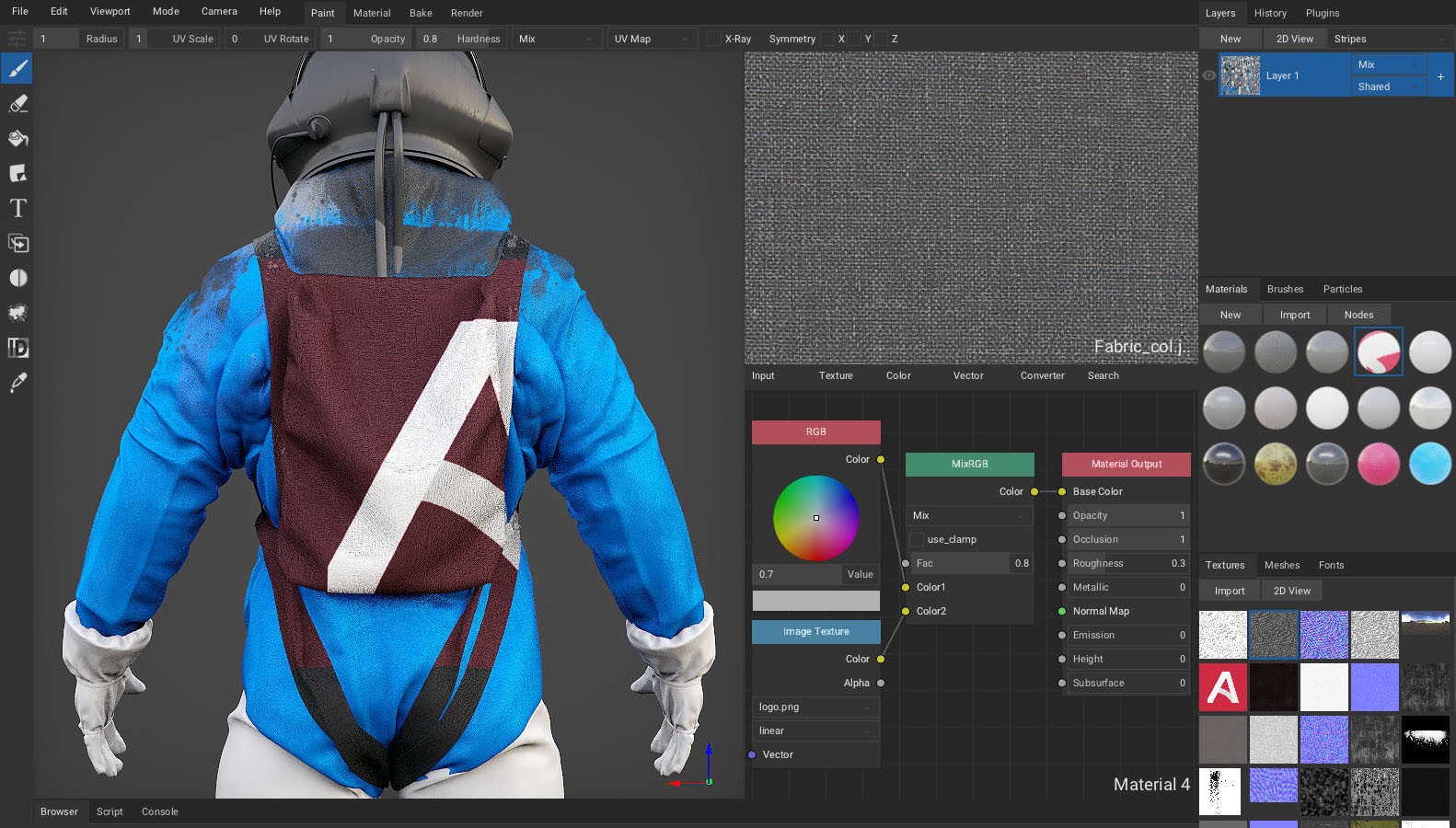
ArmorPaint (aka Armor Paint or Armour Paint) is an open-source standalone for painting on 3D models, including with PBR. Very like Substance Painter, but free and with no subscription shackle. Or… sort-of-free. It’s 16 Euros on GumRoad, where your $20 also gets you the latest builds dropped into your GumRoad Library. Or you can compile an .EXE yourself for free from the source-code — if you have a few hours to spare, a copy of Microsoft Visual Studio (free, when last heard of) and a YouTube tutorial handy.
ArmorPaint has had a couple of big updates, and the latest is now 0.8 (19th January 2021). There was another big update you may have missed hearing about, this time last year. There’s a YouTube video for ArmorPaint: Four key new features, January 2021…
“Added Viewport cel-shader plugin”.
Nice. It’s ‘two-clicks’ instant too, and it appears there’s no need to fiddle about with setting up special toon materials. No lineart on the edges, though you might paint along the seams. For the huge list of fixes and changes, including new .SVG import, see the Changelog.
There’s a Blender bridge, but as yet not ones for Poser or DAZ.
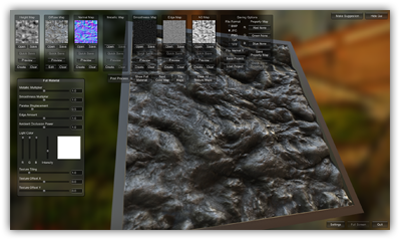
Apparently the freeware Materialize, from Bounding Box Software, is said to work well with ArmorPaint as a flanking ‘assistant’ software. Materialize can “create an entire material from a single image”…
The DAZ Store builds a handy Library of your purchases, and very usefully allows re-downloads of .ZIP files, for manual installs. Sometimes for stuff you purchased years ago. It’s a good system. But in the last few days or weeks all the old Poser .ZIPs have been re-labelled as “DAZ Studio”, and here’s an example…
Good luck getting ‘Send in the Clones for Poser’ running in DAZ Studio 🙂 Thankfully the actual sales page still says only “Compatible Software: Poser”, so the Helpdesk team shouldn’t be seeing too many confused customers.
Other tests suggest the Poser installers are still in there, but they’re now mis-labelled. You thus have to squint at the filename and hope it has “Poser” in it, or see if the sales page states ‘Poser only’. Otherwise you have to download all the ZIPs and then open them locally to determine which would need to go in the Poser runtime and which in the DAZ content folder. It’s pretty easy to tell the difference… if it has a “data” folder, then it’s for DAZ.
Update: “Send in the Clones” is said to need Poser Pro 2012 with its service release SR3 patch. But I could not get it working even then, in a 64-bit Poser.
A translated report from the German forums…
The import of scenes from Poser 12 Early Access does not seem to work so well with the current Vue version. According to Walther Beck, from Vue Support, there are apparently inconsistencies.
Vue import of Poser scenes has always been excellent, something that was honed and crafted and aligned over many years. There was a minor glitch with the Vue 2016 R4 patch (Poser 11.2 scene saves may not open correctly in Vue 2016 R4), but this bug was fixed in Vue 2016 R5. But after that, the compatibility has so far continued under the new ownerships.
Let’s hope the problems are not too difficult to fix, and that Vue keeps the ability to nicely import Poser scenes. Vue R6 should be out relatively soon, and that should hopefully fix it.
DAZ Studio 4.15 has been released, as 4.15.0.2 (7th January 2021). My last detailed consideration of DAZ Studio changes was back in November 2020, when I looked at…
What do I get if I move from DAZ Studio 4.12.1.117 (approx. midsummer 2020), to the very latest version 4.14.0.8.. (just released yesterday)?
… and I decided not to make the leap.
Ok, so what’s new in the latest 4.15 (Jan 2021)?
* It newly integrates the latest iRay 2020.1.3. Back in November 2020, iRay 2020.1.2 was a mystery. But it now has a DAZ-specific changelog along with one for the newly integrated iRay 1.3. Notable 1.2 additions were: bugfixes; “performance optimizations for some material paths”; “general improvements to volumes and materials featuring sub-surface scattering (SSS), both in performance/convergence and quality”. 1.3 has bugfixes and “fixes 3D textures being wrong with motion blur.”
So, sounds like 4.15 is mainly a useful upgrade for those using complex materials and motion-blur animation.
* Additions to the scripting API. The sub-link for this at docs.daz3d.com is current non-responsive, even when using an alt. DNS and/or a USA VPN. But the main changelog states… “Made additions in various areas”. I assume “additions” means new additions, not changes to existing scripting items that might then break old scripts. Perhaps these additions are part of the fixes needed to get DAZ working on the latest Mac OS, at a guess?
* Various in-scene opacity and tinting changes. Also “added support for visualizing an iRay Section Plane node in the viewport”. The latter appears to be about spaces that allow light through walls, such as glass windows?
All in all, then, there’s no outstanding reason for me to jump six months forward to the latest 4.15, and some drawbacks re: some of the small UI and labelling changes of render-engine and Viewport draw types. I’ll wait for the next version.
Looking at the official iRay Dev Blog, it has a new question about NPR and an interesting answer. This makes a future DAZ Studio look more interesting for me…
Q. Will iRay Toon be coming to DAZ Studio?
A. Unfortunately we cannot speak for DAZ. I’d hope that this will make it into a future release though.
This is, apparently, not the same “iRay toon” which some third-party DAZ Store products claimed to do circa 2015-18. It sounds like something official and currently known to the iRay devs and insiders. Of course, if it’s iRay then it will not be rendering in real-time (as with Poser 11 and the Comic Book Mode). Unless, presumably, the user has a $700 NVIDIA 30-series card and a PC able to keep up with it. It would make sense for NVIDIA to be developing such a thing for their forthcoming Omniverse releases, so I guess that could be it.
Also revealed by the developers on the blog is that…
In the next major release of iRay, we will also improve the filtering of normal maps and bump maps dramatically.
… which at a guess might even mean a boost for rendering speeds? A further guess would be that these changes could have to do with making a ‘iRay Toon’ render mode run sufficiently fast?
The enforced removal of the Flash Player by Adobe means that Flash .SWF files can no longer play, at least when opened with a tool that relied on the PC’s main Flash Player engine.
However this has not caused problems with Reallusion Cartoon Animator, which can still import .SWF files for conversion to props. For instance I can still drag-and-drop a Flash .SWF asset to the CrazyTalk Animator (now Cartoon Animator) stage, and have it instantly become a prop…
Possibly this is because Animator appears to have its own internal standalone Flash player, presumably for import of props and not under the control of Adobe, at least in the version I’m using (Animator 3 Pipeline)…
Tests also show that vector-capable graphics software such as PhotoLine, able to write .SWF files, are still able to do so.
Poser 11 Pro is now newly discounted down to $99.99 at Renderosity, until 31st January 2021. I assume it must be the latest Poser 11.3, which now makes the old ‘Pro only’ features available to everyone.
But the offer’s a bit moot, when parent company Bondware are still selling Poser 11 Pro over at NeoWin for $20 less. That $80 offer has just rolled over again, and now has 5 days left.
But the new Renderosity price and date is useful information, of a kind. It seems to imply we’re not going to see the release of the long-awaited Poser 12 Final before the end of January 2021. It had been slated for December 2020. Update: the Mac version of Poser 12 is now due at the end of January.