A free Vue Solutions community webinar, 28th November 2021. Booking now.
Category Archives: Companion software
Monkeying with Moho
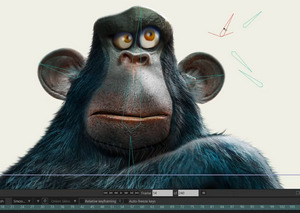
The venerable indie animation software Moho, now back with its original developers, has released a YouTube preview of a new CrazyTalk-like ‘Live Mesh’ feature. Apparently this is…
coming with the free Moho 13.5.2 update for Moho 13.5 owners
Looks like you can relatively easily add face-rigging to a 2D image, for a 2.5D animatable look, something other software can also do. Though here it looks nicely professional, is integrated into the all-in $400 software (i.e. no $1,000+ of extra plugins to buy), and it obviously gives good results.
Sadly it’s probably not an alternative way to rig a Poser face, and thus perhaps have an older Poser figure fake the look of having ‘real stretchy muscles’ under the skin. Other than as a 2D rendered from Poser. That’s because Moho (formerly Anime Studio) had licencing problems with the Smith Micro / Renderosity switchover, and that caused the drop of the Poser import feature with Moho 13. My guess would be that there was a big script doing the work and that was by Smith Micro and had not been labelled as public domain (as DAZ tends to do with key scripts, presumably to prevent such future problems). So far as I know 12.5.x was the last Moho to officially support Poser import, and there have as yet been no experiments to see if the following is possible:
Poser 11 -> Moho 12.5 -> save file -> open in Moho 13.5.
Poly Haven
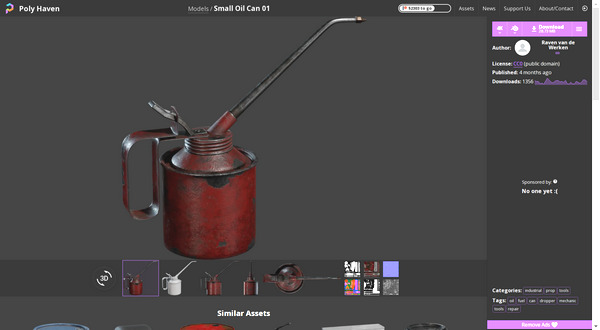
From South Africa, the new Poly Haven. A library website of free CC-Zero Blender assets with, at present, what appears to be some quality-control. A test of a small oil-can gave me an open public download (no sign-up needed). The polished and roomy new site seems to be from a small group of young Blender enthusiasts, who plan to run on a mix of crowdfunding and ads. It’s crowdfunding now.
Opening my test file failed in Blender 2.76, but succeeded in 2.83. Automatic Blender to Poser conversion then succeeded nicely, and the can was inside Poser in seconds and looking good.
Technical Search expands again
My Technical Search is now covering 95 sites or pages. It’s now exponentially more useful than when first launched.
Also, added to the sidebar on this blog, PD Howler and Vue Galleries (Facebook). I recently got around to trying the free Howler 2020 (given away in the summer) and it’s excellent for landscape painting. Also for creating simple 3D from greyscale heightmaps, which then auto-magically extrude into lit landscapes — and which you can use as a base for paintovers. The UI takes an hour of getting used to, but it soon makes sense. It’s now one of the four I’d recommend trying on a Windows 7 PC (Photoshop 2018, SAI2, PaintStorm Studio, PD Howler 2021 build 86). For Windows 10 users there’s a 2022 version. If you last tried it decades ago, take another look.
Black Friday 2021: first moves
The software side of Black Friday is starting to move slightly forward. Here’s a round-up of the current discounts I could find:
* The innovative and now greatly refined PD Howler 2021 and 2022 (aka Project Dogwaffle), both strongly improved and speeded up since any version you may have tried years or even decades ago. It’s a digital painting tool that’s especially good for landscape artists, but can also do Bryce-like 3D landscape creation/rendering, some superb particles (inc. particle brushes), animation, spline-based fast inking for comics (‘Penny Paint’ module), and much more. Bear in mind you may already have a copy of 2020 stashed away but not yet installed, as it was temporarily given away free in August 2021. However, that was build 37, a relatively early build, and later builds of 2020 have many further improvements including brushes working faster on larger canvases (build 50).
Windows 7 users should target the most recent version of 2020 (discounted to $29) or buy 2021 (at $30) and then ask for PD Howler 2021.3 (build 85) — which the changelog suggests was the ‘last good’ version before it went all ‘Windows 10’. Other purchasers should just go for the latest 2022 version, and they will also get a free Howler 2021 licence along with 2022 “and you are allowed and encouraged to give 2021 as a gift”. Nice, though bear in mind the recipient ideally needs to have lots of RAM and CPU threads available. If all they have is a dusty old laptop then they probably need the lightweight SAI2.
Actually it gets better. This sales page currently has 2022 for just $20, and presumably you also get the 2021 freebie with that(?).
* Humble Bundle: the Campaign Cartographer software, plus a lot of fantasy and some sci-fi map making packs that work with it. Two weeks left. Bear in mind there’s now a wide range of fantasy map-making software available, and the venerable Campaign Cartographer is by no means the only choice.
* 15% off Silo & Milo. Basically, you get a discount that covers your local sales tax.
* 10% off U-Render, which is kind of ‘Blender’s real-time Eevee, but for Cinema 4D’. Again, doing little more than covering some of your local sales tax, but any discount is welcome in these difficult times. Depending on how you can juggle the versions to align with each other, there may be a ‘Poser 11 – Poserfusion – Cinema 4D – U-render’ route in there somewhere.
* DxO ViewPoint for $50, down from $80. Automatically straightens the ‘fish eye’ camera-curvature lines in your architectural photos or renders, and does a fine job of it. Highly recommended if you want ‘architect magazine perfect’ verticals on pictures, and want it done in seconds.
iClone 8 – new features reveal
Just in today, iClone 8 New Features Introduction. Some of the highlights…
* extended animated .FBX support (“Drag and drop! Any FBX motion data format is compatible, which largely removes platform barriers for motion data and makes it all compatible”);
* many improvements to animation editing and figure controls;
* a new look for the figure Control Rig;
* Hotkey Manager and Collection Manager (“freely categorize objects in the Scene Manager”);
* simulated volumetric lighting in real-time (by adding “visible volume to directional, spot and point lights”);
* mirrors (“simulate realistic mirror reflection, with various control settings like opacity and blur”);
* NVIDIA Omniverse connection (requires RTX graphics card);
* performance optimization (such as “hidden objects will not be processed in the background” for large scenes).
iClone 8 is not out yet. The official take from the Forum is… ”
“iClone 8 … not scheduled for release until at least Spring 2022”
Since the downloads of purchased versions are limited to the last three versions, now might be a good time to go get and archive the installers for iClone 5 — just in case you ever need it for backwards compatability.
VRoid Studio 1.0
Japanese avatar creation software VRoid Studio is out of beta (launched August 2018), and has released its stable 1.0 version. They write… “we rebuilt it from scratch”. Commercial use of the results, summed up as “Your models are yours to use freely”.
Easy to use, and while limited to a generic manga/anime look it does have pointy-ears and suchlike.
Designed characters are low-poly (designed for VR, chat) and export to .VRM format. There are ways to get .VRM to .FBX files and into other 3D software. There is also software such as VSeeFace for facial motion-capture for .VRM figures.
For DAZ and Poser users it would probably be better to get the right shapes/eyes/morphs and build the character natively. You would then have a high-poly model that could also take accessories, motions, face mo-cap and lip-sync etc. Though admittedly the toon texturing and getting the lines looking right would present problems for many. But Poser users have the Comic Book mode and now my discovery of blur + overlay.
Going Live…
Well, my eBay bargain Asus Xtion Pro depth-sensing 3D camera has turned out to be better than expected. After trudging through an Autumn/Fall storm to pick it up, on opening the box it turns out to be… an Asus Xtion Pro Live. And thus, a later improved model and even more of an absolute bargain. Super.
The first Asus Xtion Pro was out for about a year before it was replaced by the later Live. This added a RGB camera and two microphones either side. It’s the model widely named by 2012-2018 software makers as their supported camera, alongside various early incarnations of the Kinect. It appears to support OpenNI 2.0 without needing to be flashed with new firmware.
Sadly though, this happy discovery means I shall never be able to tell readers if the first generation Xtion works with software X, Y or Z. As I now have no way of testing that.
Pitterbill, re-mapping blendshapes to morphs, in Faceshift…
Export .FBX from Poser, Binary, 2012 spec. Place in the \faceshift\targets working folder, along with any texture .fbm folder.
Open Faceshift. Tracking | Display | Target | Import. Import the .FBX. Pair jointNeck with Neck, and then the other morphs will appear. Align the head (better than seen here). Then match the targets, with the Pitterbill targets on sliders similar to Poser dials. Turn to 1.0 to activate the Pitterbill target.
Above we see the left blink being matched.
Clavicula 0.9
Lucian Stanculescu, maker of Neobarok, has released v.0.9 for his equally free 3D modeller Clavicula. “Clavicula supersedes Neobarok, with more functionality and PCVR support”. As innovative and open source and stylish as Neobarok.
Xtion and iClone
Well, well. I find my new bargain depth-camera once worked with, of all things… iClone. To be specific, with iClone Pro 5 at 5.1 or above. Also required the Reallusion Mocap Device Plug-in v.1.1 (for the first Kinect for Xbox version, running the OpenNI 32-bit drivers). This plugin is not in the 5.x Resource Pack and is now utterly unavailable.
I discovered the iClone 5 compatibility because, many years ago, the official forum moderator stated of the Asus Xtion and iClone 5.x…
“The Asus Xtion will work with the Primesense/Open NI version of the plugin, but it lacks the advanced features of the Kinect For Windows version, including Near Mode and Head Rotation.”
This is confirmed by this screenshot, which shows the three mocap plugin packages then available with 5.1…
Great, though of course the Xtion camera owner must then have an archive somewhere of 5.x AND the first MoCap plugin (which had in it all the SDKs and other requirements). The latter was always a $150 purchase, never free or a bonus so far as I know, and I never bought it.
In practice, though… it may not have been terribly useful. It’s not as though you could do simultaneous face + body, driving the character in real-time WYSIWYG, and you’d be missing hand and head animations.
ArmorPaint 0.8
Out now, a new version of ArmorPaint, the PBR materials maker and 3D paint-on-the-mesh painter. Think of it as ‘Substance Painter for $20, without the subscription shackle’.
0.8 is described as “a major update” and it apparently also now runs on Android and the iPad, and has a new Cloud-based assets library. It’s sort-of-free. Free to compile from source code, or buy it ready-to-install for $20.
Movmi
On the sidebar ‘directory’ of this blog, there’s now a new “motion capture” set of eight links. All in some way Poser/DAZ friendly. Some of this software has been around a while, in fact so long that it’s vanished from sale (mocap software tends to do that).
But the latest software is Movmi V1.2.4 (October 2021), which is freeware. From one-man developer Ahmed Askar, making a free AI-powered 2D video-based motion detector software for Windows 7. Movmi has had mocap extraction capabilities added in the last few weeks. Export appears to be to .FBX for now?
It’s AI, so the download is hefty at 1.1Gb. He probably needs to get it on a torrent, in time for when the masses arrive, but for now it downloads fast. The lad’s got the right idea: Windows 7 support, free, no sign-up required and ‘just download it’.
Collapsing code in Visual Studio Code
The free desktop PC software Microsoft Visual Studio Code (‘VSC’) is a sort of super Notepad++. It’s what you now want in order to copy-paste coloured code into the Renderosity Python forum, since a recent back-end forum update. Notepad++ on its own can’t do that particular job.
Here’s a handy tip for editing a non-Python Poser file with VSC…
Crtl + K.
Then hands off keyboard.
Then Ctrl + 3.
This collapses the zillion lines of nested code, as you can see here. Much more comprehensible now…
Then Mouseover the blank bit, to reveal the arrows that expand the hidden code block…
Not sure if this also works in Microsoft’s newly launched online version of Visual Studio Code, but it probably does.
Also, in the sidebar of this blog I’ve added links to a couple of free community-made editors for Poser file types (.CR2, .PZ2, etc).
Black Friday, too late…
Black Friday 2021 falls on Friday, 26th November 2021 this year. Way too late. Less than a month to Christmas. Haul it forward by a complete month, would be my suggestion. That’s what sensible consumers will be doing with their Christmas buying, for fear of truck-driver shortages, packaging shortages, gadget and computer shortages, fuel shortages, power-cuts, Internet outages, port snarl-ups and lockdowns.
Cyber Monday on the 29th November looks a bit more viable, though if Black Friday effectively comes forward then you have to wonder if anyone will have any Paypal left by the end of November.
Not a great deal left for my wants-list this year:
Two remaining Raffy Raffy Vue landscapes, Path Forest in Vue and Dangerous Canyon in Vue.
Two remaining Xurge M4 armours, ATES for Mike 4 and HYPER SUIT for M4.
Some CrossDresser Licenses. Not vital, but nice to have for a couple of Nursoda characters and I think I’m still missing Mavka.
A few 90%-off sub-$4 picks from the “nice to have, but don’t really need” items in the WishLists at DAZ and Renderosity and ArtStation Marketplace, with Renderosity edging ahead in terms of quirk-appeal. But that assumes a 90% off sale.
Blambot fonts, and Retro Supply’s $20 TOOM Horror Comic Font.
AKVIS Decorator 8.1 for Photoshop. But it never goes low enough, when you factor in the 20% UK sales tax that’s added at the Checkout. 50% off and bundle it with a 50%-off Charcoal, might do it.
Booksorber, for quickly digitizing books and journals with a digital SLR camera.
Poser 12 still doesn’t appeal — due to the need for Python 3 scripts and lack of changes at the Comic Book / Sketch end of rendering.
A few G’MIC tips
Note that the free G’MIC will not launch in Photoshop if the layer being filtered has multiple areas of transparency, as you might get from a .PNG render of a 3D scene. In which case, right-click on the layer and ‘Convert to Smart Objects’ first. Then G’MIC will launch for that layer. Apparently the mighty Photoshop still cannot handle more than one area of transparency in a layer, without such a conversion being done. Other similar software has no such problem.
Also, when filtering real-time Poser Comic Book renders for detail, such filtering is usually aided by having good quality (rather than muddy / low-res) textures loaded. Here’s how you do that with a Preview render…
Obviously if you’re instead rendering for a Colour Flats layer in your Photoshop layer-stack, then the low-res textures don’t matter so much. Because you’re going to scour off all that unwanted grunge and noise with Topaz Clean 3.1 or G’MIC’s Comic Book filter. Ready to lay the Lineart layer on top.