
Want to learn how to rig a 3d character in Poser, learn it quickly and do it right? Digital Art Live has a new webinar coming up, Poser Rigging – Master the rigging process with Teyon Alexander.
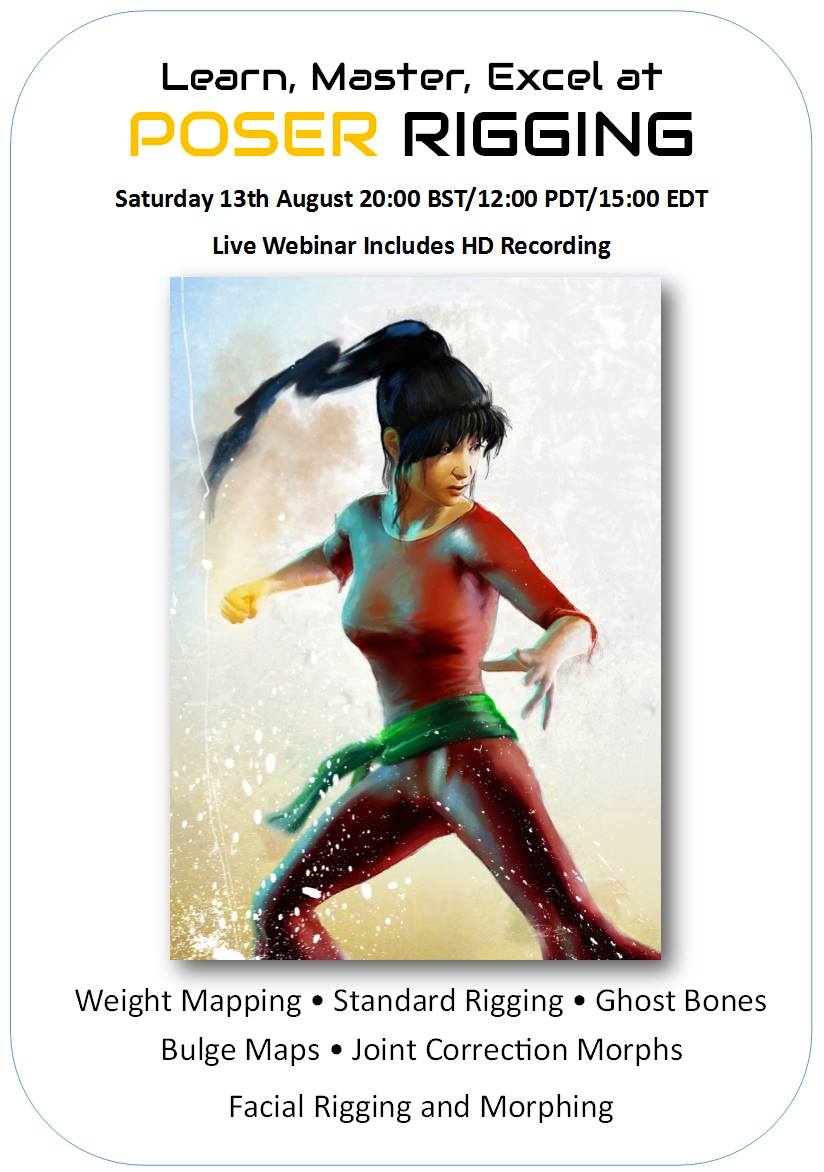

Want to learn how to rig a 3d character in Poser, learn it quickly and do it right? Digital Art Live has a new webinar coming up, Poser Rigging – Master the rigging process with Teyon Alexander.
Still using trusty old Photoshop CS6? Not been wow-ed by the new features in the various Photoshop CC versions? I haven’t been, I’ll admit. Even though a realtime healing brush preview and a font bookmarking system might have been somewhat nice to have.
But the latest Photoshop CC 2015.5 brings a couple of very nice new features, which may tempt users to make the move. One of the new features is very major and seems especially useful for DAZ/Poser artists.
* Face-Aware Liquify. If you’re rendering faces and characters in big renders, this may well help you to nudge the face out of the ‘uncanny valley’ and make it more appealingly human. You don’t have to laboriously place dots and virtual push-pins on the face, as everything is automatically pinpointed for you by Photoshop. Here’s the very impressive video demo…
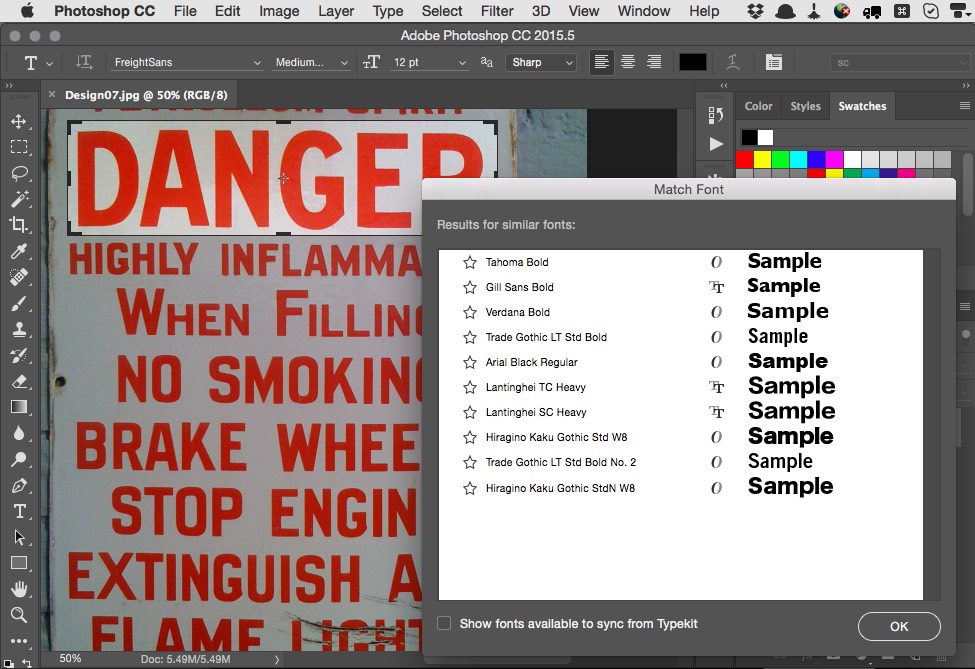
* Match Font. Need to replace some lettering in a bit-mapped image? Draw a box around it, and similar fonts from your system are shown. Nice, but not vital. Third-party services such as WhatTheFont! do the same thing, while searching across a far wider set of fonts than the few hundred installed on your PC. I guess maybe some of these services are even available as Photoshop plugins?
For Poser 11 users who haven’t loaded up the Smith Micro Download Manager for a while, the SR4 patch for Poser 11 is ready for download…
A few of the new things I noted in SR4…
* Lots of general, performance and stability updates and improvements.
* Content Library List View now up “up to 3x” faster at displaying huge runtime folders. (Yup!)
* Content Library’s “Autocomplete” can now be toggled off. (Wonderful!)
* SuperFly rendering now based on Cycles 1.7. (Good to see Poser keeping pace with new Cycles versions)
* OBJ export: Added options for using full texture paths in MTL file and copying textures to output folder. (Useful)
* The PoserFusion plugins now interface Poser 11 with the “most recent LightWave versions”.
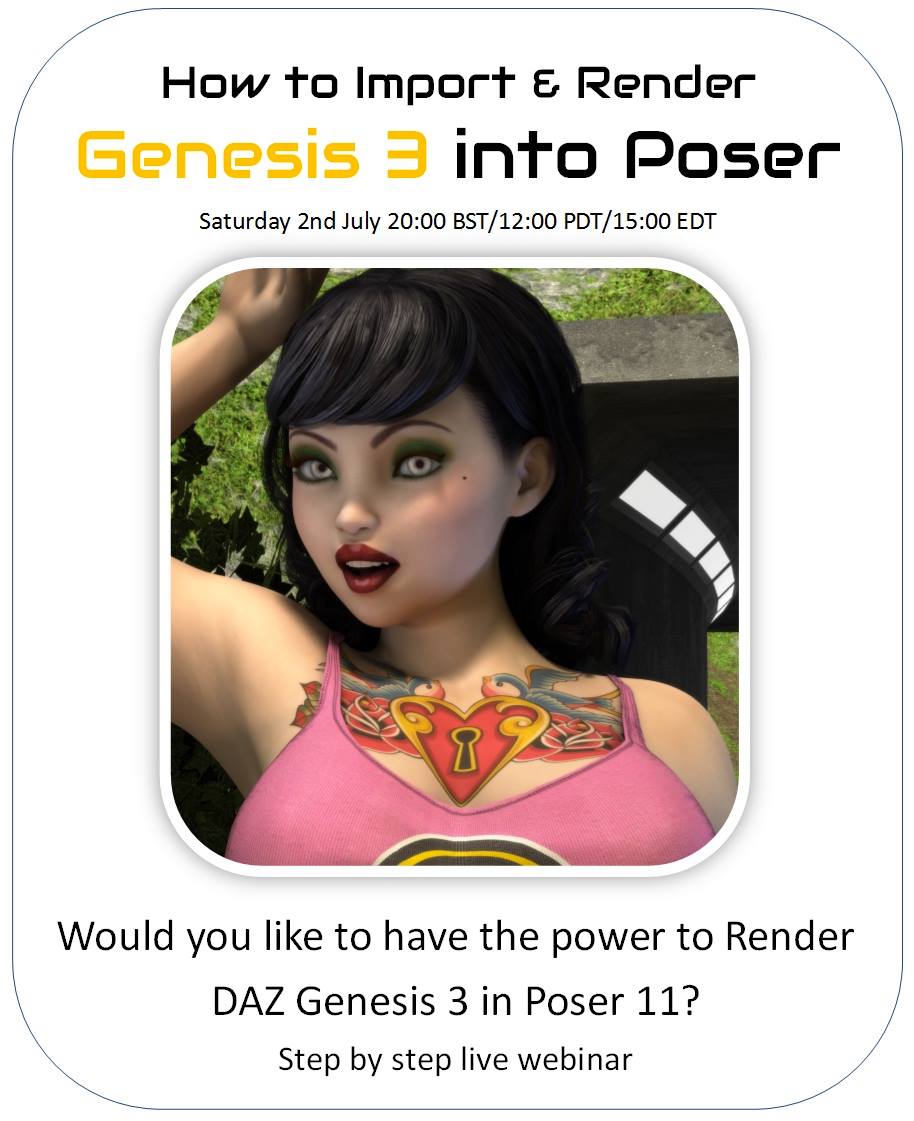
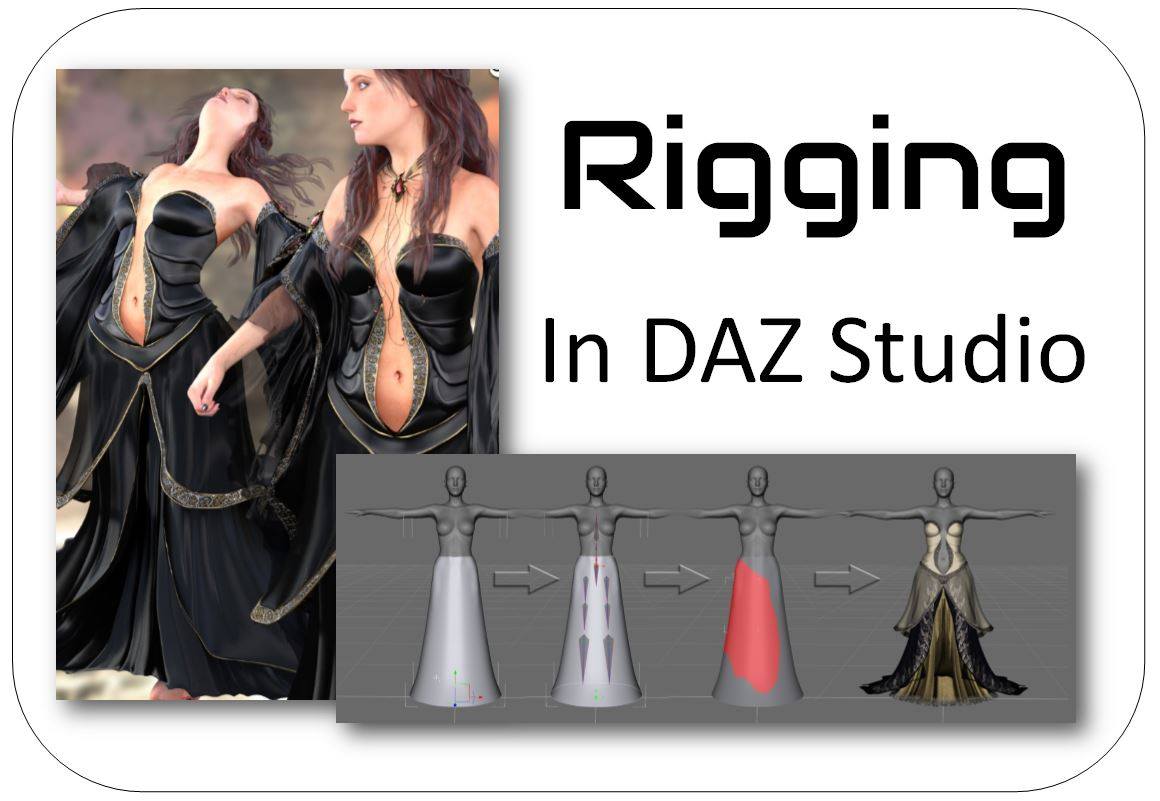
Two new Digital Art Live online webinars, DAZ Studio Rigging and How to Import and Render Genesis 3 into Poser 11.
Many Poser users will remember Anomaly, Brian Haberlin’s best-selling sci-fi masterwork book, which was made with Poser. Now there’s a sequel set for February 2017, Anomaly 2: The Rubicon
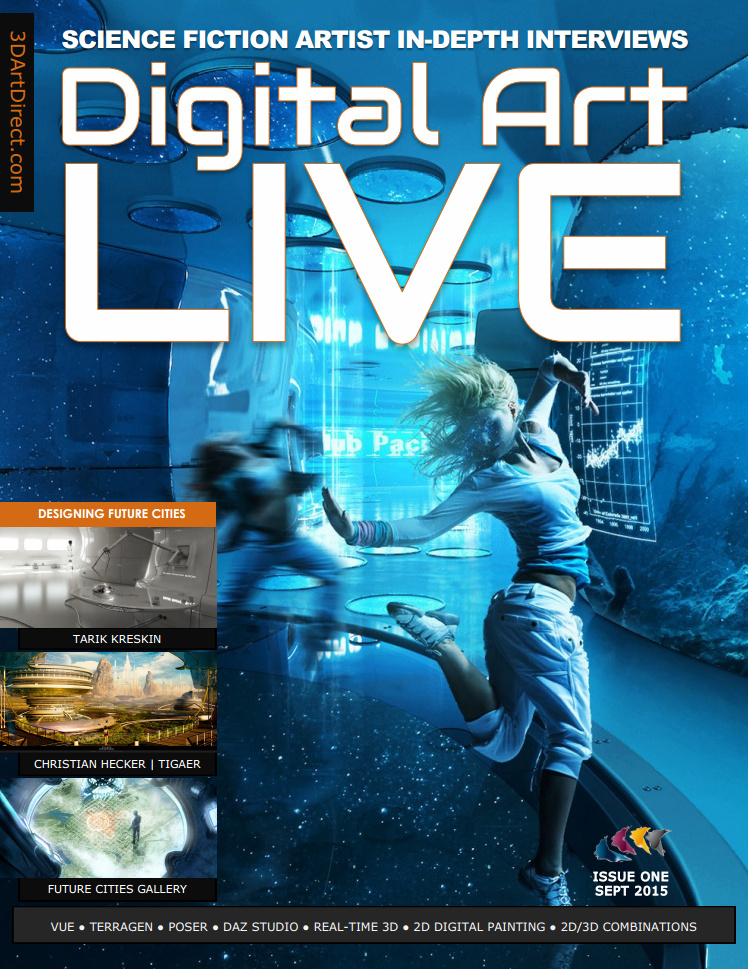
Issue 8 of the free monthly Digital Art Live magazine is now available, with a theme of “Our Future Frontier”. Mars colonisation, and more, in an 84-page issue.

April’s issue 7 also had a theme, being a whopping 116 pages of strong “Female Future Heroes”…
I see that there are two new open-source Windows video editors, since I last went looking for a possible replacement for the lumbering heap of annoyances that is Adobe Premiere Elements 12.
Each is relatively simple, compared to the various behemoths that are meant for editing Hollywood movies. They may thus may be useful to you, if the old Windows Movie Maker is too limited or if Adobe Premiere Elements is just too awful an experience to keep on using. I installed both, and as a test I tried slapping together an 28Mb audio .MP3 and a 1Mb still .JPG, and outputing to a video small enough to upload to YouTube (less than 100mb).
* OpenShot 2.0 (beta) has a Windows version and a simple modern interface. Though it’s not 64-bit, which may be why it crashed for me again and again on final rendering, tried with three different export settings. Uninstalled.
* Shotcut. Windows 64-bit, but I never got it to the rendering stage. Because the simple task of fitting a static .JPG onto an .MP3 audio file is made into vastly more work than it should be, and in an interface that only a software developer could really love. Uninstalled.
So, no luck for me with these two. Why are free video-editors so flaky? But you may have a different experience. OpenShot 2.0 in particular is worth a try, to see if you get crash-free exports.
Poser 11’s SR3 patch has been released. There’s a big list of small fixes, though nothing very major that I could spot, other than…
“Queue Manager (Poser Pro only) – Enabled SuperFly support.”
That’s great news.
Also a new “SuperFly Tileable” Materials library category, which may be handy if it’s pre-filled with goodies. My updates are downloading now.
A free playable pinball table game, as a skin-able template for Blender. Creative Commons Attribution.
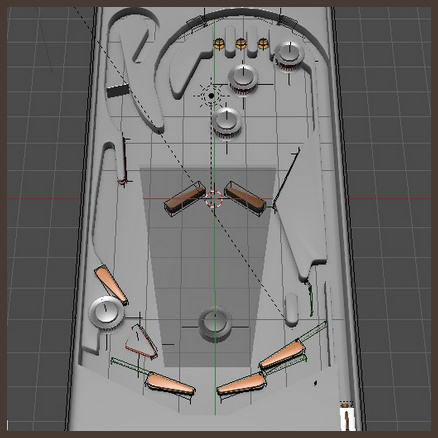
Update: the author of the .blend has been blocked, so the template can no longer be downloaded.
There’s a new e-on software competition, Jungle Book, for Vue users.

Google Nik Collection for Photoshop is now free. Personally I still prefer the older-but-similar plugin suite of tools called 55mm Digital Film Tools, but Nik can do all that 55mm does and a bit more.
“Starting March 24, 2016, the latest Nik Collection will be freely available to download: Analog Efex Pro, Color Efex Pro, Silver Efex Pro, Viveza, HDR Efex Pro, Sharpener Pro and Dfine. If you purchased the Nik Collection in 2016, you will receive a full refund, which we’ll automatically issue back to you in the coming days.”
The affordable and user-friendly CrazyTalk Animator is now in version 2.1…
* 64-bit version.
* Now has a Mac version.
* Masked PNG output, for use in Powerpoint.
* Support for semi-transparency on import (from Flash only?).
* Variable outline-width (but no Photoshop-style artistic-line Styles, yet).

Studio Ghibli’s former animation software Toonz is being made open source (100% free) from 26th March 2016. It has “the ability to combine the hand-drawn animation with the digitally painted ones seamlessly”. It was also used to make Futurama.
The current owners want to make it “a world standard for 2D animation”, hence it’s becoming a freebie. The new open version will be developed under the name of OpenToonz.
Check out especially the Plastic Tool, and think how one might use that with a Poser comic-book mode render to speed up comic book production. And “apply brushes along the line” on both raster and vector. Yum, this will be very interesting to explore.
More official training and features videos here.
A new Cartoon Brew article “How Long Should It Take To Draw A [animated TV series] Storyboard Panel?”. The math is here.
“A 25-year veteran of the TV animation industry recently sat down to figure out the average amount of time it takes to draw a board panel. […] an average of 20 minutes, based on a script with equal parts action and acting, and importantly, no revisions.”
It seems that, traditionally, 11 minutes of TV animation took six weeks to fully storyboard for production. Arguably, some children’s animation has generally become much more complex in each shot since the 1990s. Compare Wacky Races with Gravity Falls, for instance. But it appears that, rather than the time worked increasing due to the complexity, it’s actually decreased in the industry.
I’ve noticed that there seems to be no dedicated blog for readers seeking quality in sci-fi / fantasy / macabre / adventure comic-book series and graphic novels. I mean comics that are non-superhero, and not aimed wholly or largely at adolescents. So… there’s an opportunity there for a blogger and curator, though it won’t be me.
Since I last blogged on the topic, as a recent returnee to a certain type of comics, I’ve learned a couple of things.
Firstly, to be wary about starting comics series that haven’t concluded yet. Great intelligent sci-fi comics like Letter 44 and Descender being good examples. The reader hears about a new and intelligent series, gets six or 10 or 20 issues into it and then… is left hanging. A regular weekly series of 20-page episodes, done in that fashion, I could handle. But when each subsequent issue can take four to eight weeks or more for the makers to grind out, then this particular reader finds it: i) difficult to pick up the often quite complex plot threads again with each issue; and ii) difficult to find the same level of enjoyment as when reading along in a complete story-with-an-ending.
Secondly, I’ve also learned that the current comics industry has an annoying habit of touting a forthcoming comic as being the “conclusion” when it’s actually no such thing (Descender #11, hem hem) and it’s just a cliff-hanger ‘conclusion’ of an arbitrary run of issues that the publisher will collect as a ‘volume 1’ or ‘volume 2’ omnibus edition.
Thirdly, even when some mega-series do eventually come to a close, they can get a bit wobbly for various reasons. Such as, apparently, the otherwise excellent The Manhattan Projects. The makers can run out of ideas, lose control of complex plots, need to pay bills and so pad out the ending by a few extra un-needed issues, and/or find that the whole project’s become a drag that they’re not really interested in any more.
So for those reasons I’m wary of launching into ongoing biggies like Saga or Black Science or Moore’s Providence, excellent though they’re said to be. That sentiment shouldn’t stop readers from trying some of the best episodic sci-fi out there, certainly the aforementioned Letter 44 and Descender. You just need to be aware that you’re getting into titles that are currently all very far from being finished stories.
Anyway, a few readers may like to know that I’ve added more sci-fi comics titles to the must-read queue on the tablet, since my last post:—
* Brass Sun. Steampunk / sci-fi, originally in 2000 A.D. Seems to be complete.

* Miyazaki’s Nausicaä of the Valley of the Wind, the classic graphic novel on which the famous sci-fi eco movie was based. Complete.

* Arctica. Seven issues, so far? Might not be complete yet?

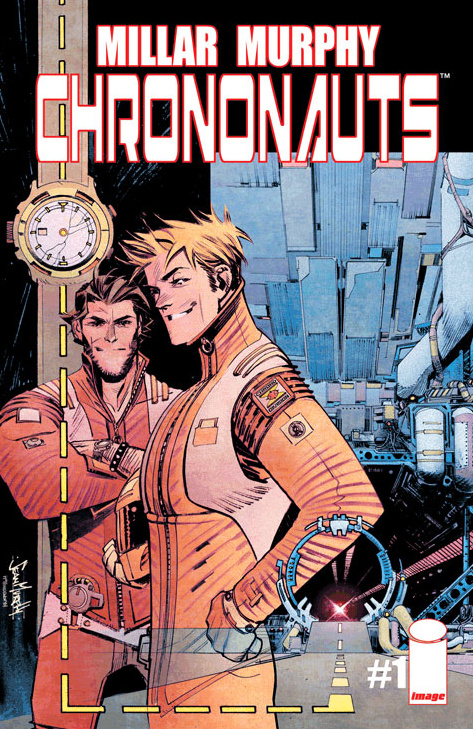
* Chrononauts. Seems to be a complete mini-series, issues 1 through 4. Possibly a bit adolescent and played-for-laughs, but it must be good — as it’s been picked up by Universal to be made into a movie.
* Golden City is set on a futuristic hi-tech ocean colony and also looks interesting, though is apparently only unofficially available in English translation.
Also cued up are the Lovecraft Anthology #1 and #2, and the graphic novels of Lovecraft’s The Temple and The Case of Charles Dexter Ward. Nearly all fiction / film / fan-schlock claiming to be ‘inspired by Lovecraft’ is either dire or has only the most tenuous connection to Lovecraft. But I have some hope for these direct comic-book adaptations of the stories.